ECU Seat Exeo 2011 Service Manual
[x] Cancel search | Manufacturer: SEAT, Model Year: 2011, Model line: Exeo, Model: Seat Exeo 2011Pages: 313, PDF Size: 5.02 MB
Page 244 of 313
242Wheels and tyres
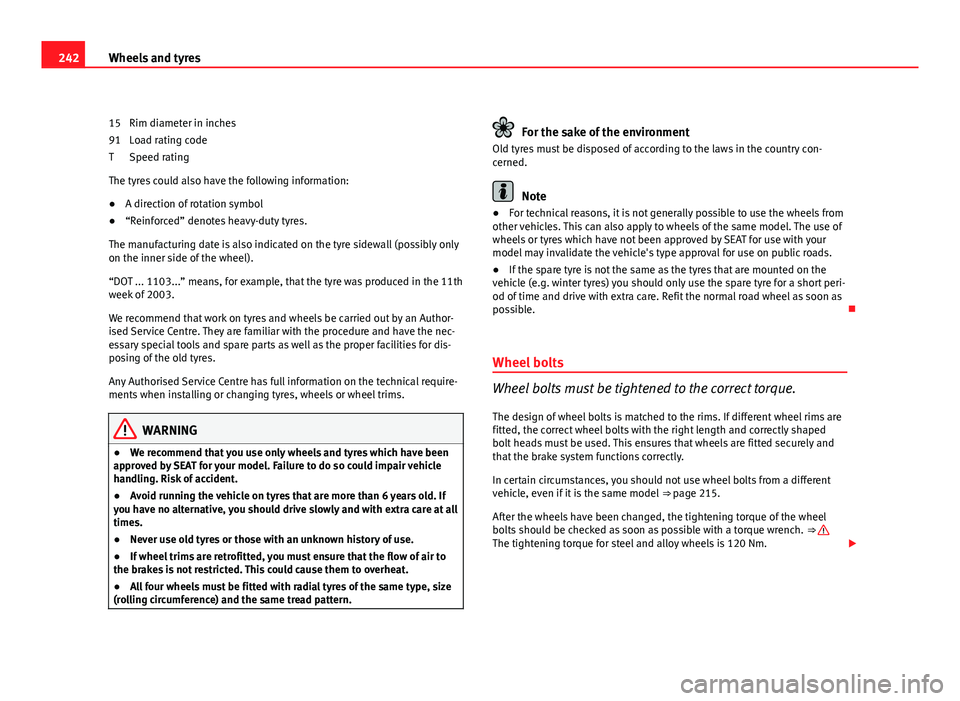
Rim diameter in inches
Load rating code
Speed rating
The tyres could also have the following information:
● A direction of rotation symbol
● “Reinforced” denotes heavy-duty tyres.
The manufacturing date is also indicated on the tyre sidewall (possibly only
on the inner side of the wheel).
“DOT ... 1103...” means, for example, that the tyre was produced in the 11th
week of 2003.
We recommend that work on tyres and wheels be carried out by an Author-
ised Service Centre. They are familiar with the procedure and have the nec-
essary special tools and spare parts as well as the proper facilities for dis-
posing of the old tyres.
Any Authorised Service Centre has full information on the technical require-
ments when installing or changing tyres, wheels or wheel trims.
WARNING
● We recommend that you use only wheels and tyres which have been
approved by SEAT for your model. Failure to do so could impair vehicle
handling. Risk of accident.
● Avoid running the vehicle on tyres that are more than 6 years old. If
you have no alternative, you should drive slowly and with extra care at all
times.
● Never use old tyres or those with an unknown history of use.
● If wheel trims are retrofitted, you must ensure that the flow of air to
the brakes is not restricted. This could cause them to overheat.
● All four wheels must be fitted with radial tyres of the same type, size
(rolling circumference) and the same tread pattern.
15
91
TFor the sake of the environment
Old tyres must be disposed of according to the laws in the country con-
cerned.
Note
● For technical reasons, it is not generally possible to use the wheels from
other vehicles. This can also apply to wheels of the same model. The use of
wheels or tyres which have not been approved by SEAT for use with your
model may invalidate the vehicle's type approval for use on public roads.
● If the spare tyre is not the same as the tyres that are mounted on the
vehicle (e.g. winter tyres) you should only use the spare tyre for a short peri-
od of time and drive with extra care. Refit the normal road wheel as soon as
possible.
Wheel bolts
Wheel bolts must be tightened to the correct torque.
The design of wheel bolts is matched to the rims. If different wheel rims are
fitted, the correct wheel bolts with the right length and correctly shaped
bolt heads must be used. This ensures that wheels are fitted securely and
that the brake system functions correctly.
In certain circumstances, you should not use wheel bolts from a different
vehicle, even if it is the same model ⇒ page 215.
After the wheels have been changed, the tightening torque of the wheel
bolts should be checked as soon as possible with a torque wrench. ⇒
The tightening torque for steel and alloy wheels is 120 Nm.
Page 248 of 313
246If and when
Tyre mobility system
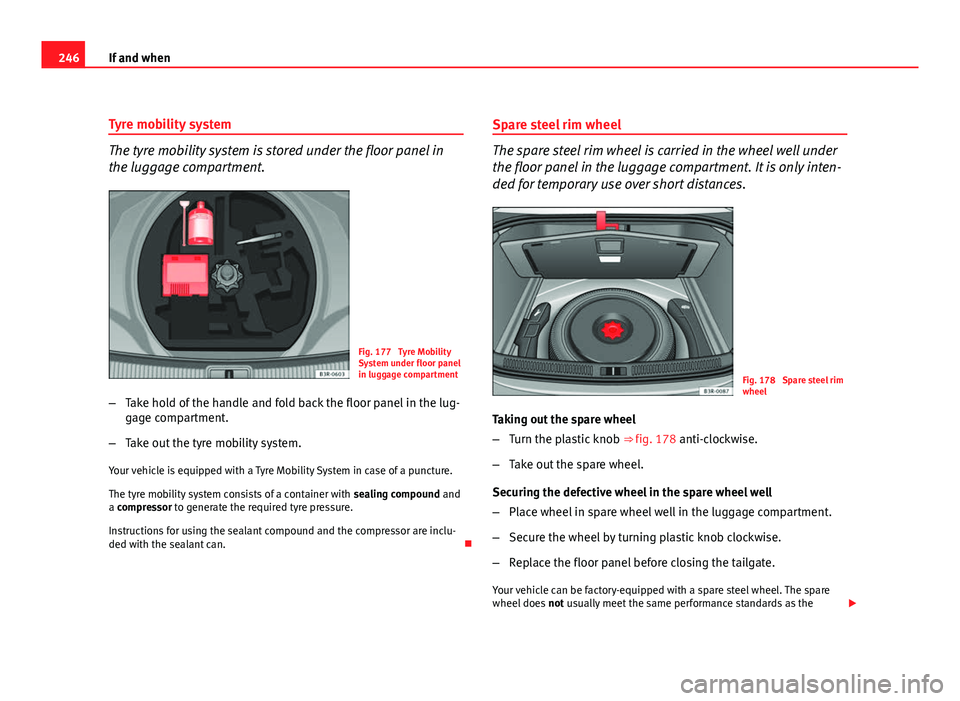
The tyre mobility system is stored under the floor panel in
the luggage compartment.
Fig. 177 Tyre Mobility
System under floor panel
in luggage compartment
– Take hold of the handle and fold back the floor panel in the lug-
gage compartment.
– Take out the tyre mobility system.
Your vehicle is equipped with a Tyre Mobility System in case of a puncture.
The tyre mobility system consists of a container with sealing compound and
a compressor to generate the required tyre pressure.
Instructions for using the sealant compound and the compressor are inclu-
ded with the sealant can. Spare steel rim wheel
The spare steel rim wheel is carried in the wheel well under
the floor panel in the luggage compartment. It is only inten-
ded for temporary use over short distances.
Fig. 178 Spare steel rim
wheel
Taking out the spare wheel
– Turn the plastic knob ⇒ fig. 178 anti-clockwise.
– Take out the spare wheel.
Securing the defective wheel in the spare wheel well
– Place wheel in spare wheel well in the luggage compartment.
– Secure the wheel by turning plastic knob clockwise.
– Replace the floor panel before closing the tailgate.
Your vehicle can be factory-equipped with a spare steel wheel. The spare
wheel does not usually meet the same performance standards as the
Page 250 of 313
248If and when
Note
Please observe legal requirements when doing so.
Changing a wheel
Change the wheel as described below.
– Remove the wheel cover .
– Loosen the wheel bolts ⇒ page 249.
– Raise the vehicle with the jack ⇒ page 250.
– Take off the wheel with the flat tyre and then put on the spare
wheel ⇒ page 251.
– Lower the vehicle.
– Tighten the wheel bolts firmly in diagonal sequence with the
box spanner ⇒ page 249.
– Replace the cover.
After changing a wheel
After changing the wheel, there are still tasks to complete. – Place the wheel with the defective tyre in the spare wheel well
and secure it.
– Put the tools and jack back in the luggage compartment. –
The inflation pressure of the newly fitted spare tyre must be
checked as soon as possible.
– Have the tightening torque of the wheel bolts checked as soon
as possible with a torque wrench. It must be 120 Nm (always
when cold)
– Have the flat tyre replaced as quickly as possible.
Note
● If you notice that the wheel bolts are rusty and difficult to turn when
changing a wheel, they must be replaced before having the tightening tor-
que checked.
● For safety reasons, drive at moderate speeds until the wheel bolt tight-
ening torque has been checked.
Page 272 of 313
270If and when
Removing the tail light
To change the bulbs you must remove the tail light assem-
bly. Removing the light requires a certain degree of practical
skill.
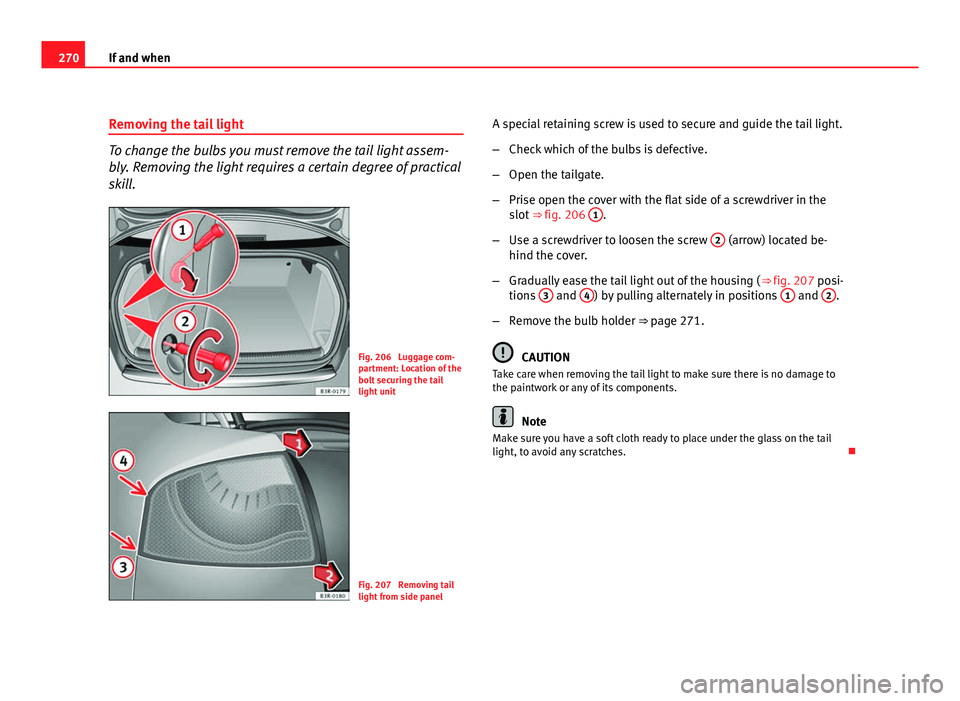
Fig. 206 Luggage com-
partment: Location of the
bolt securing the tail
light unit
Fig. 207 Removing tail
light from side panel A special retaining screw is used to secure and guide the tail light.
–
Check which of the bulbs is defective.
– Open the tailgate.
– Prise open the cover with the flat side of a screwdriver in the
slot ⇒ fig. 206 1
.
– Use a screwdriver to loosen the screw 2
(arrow) located be-
hind the cover.
– Gradually ease the tail light out of the housing ( ⇒ fig. 207 posi-
tions 3
and 4) by pulling alternately in positions 1 and 2.
– Remove the bulb holder ⇒ page 271.
CAUTION
Take care when removing the tail light to make sure there is no damage to
the paintwork or any of its components.
Note
Make sure you have a soft cloth ready to place under the glass on the tail
light, to avoid any scratches.
Page 273 of 313

271
If and when
Remove the bulb holder
When changing a bulb, you must first remove the bulb hold-
er.
Fig. 208 Retaining tabs
on reverse side of tail
light
There are three securing tabs on the inside of the tail light.
– Release the retaining tabs ⇒ fig. 208 A
.
– Take out the bulb holder.
– Change the defective bulb ⇒ page 271 ⇒ page 272.
WARNING
If a bulb is replaced in a tail light assembly with LED, do not pull too hard
on the bulb holder. This may damage the wiring of the LED module.
Changing bulbs
All bulbs can be changed easily in the bulb holder.
Fig. 209 Position of the
bulbs in the bulb holder.
Example: Left tail light in
side panel
The bulbs are secured with a bayonet fastener. The table below
gives an overview of the bulb positions.
– Lightly press the defective bulb into the bulb holder, then turn it
to the left and remove it.
– Fit the new bulb, pressing it into the bulb holder and turn it to
the right as far as it will go.
– Use a cloth to remove any fingerprints from the glass part of the
bulb.
– Check whether the new bulb is working.
– Re-install the bulb holder ⇒ page 272.
Safety FirstOperating InstructionsPractical TipsTechnical Specifications
Page 274 of 313
272If and when
Position of the bulbs
Pos.
⇒ fig. 209Bulb function
ABrake light and side lightP21W LLBSide lightsP21W LLCTurn signalPY21W
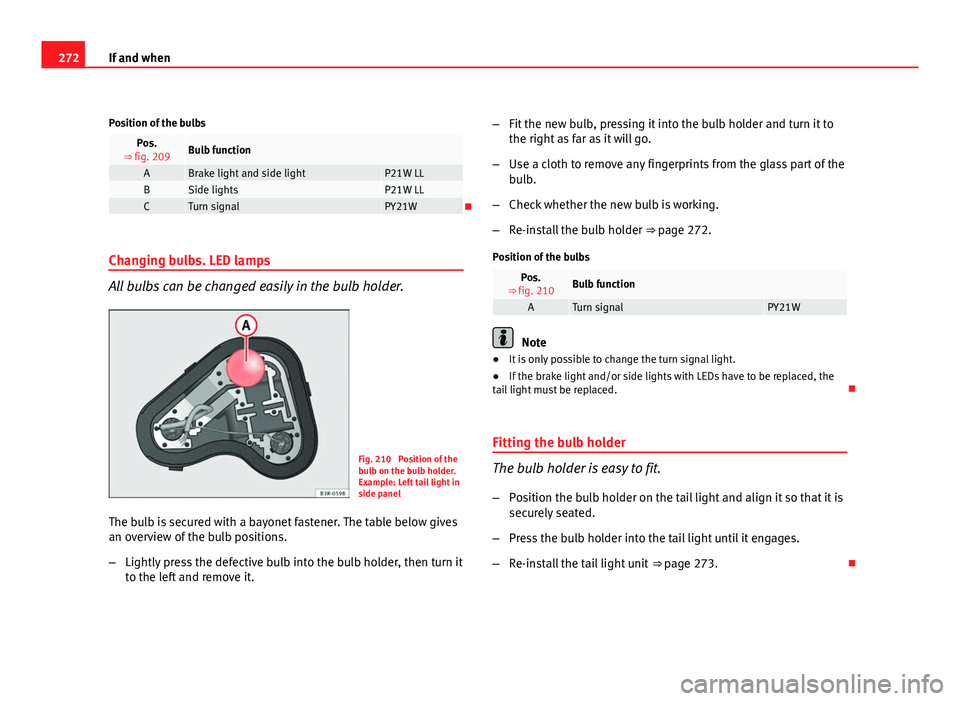
Changing bulbs. LED lamps
All bulbs can be changed easily in the bulb holder.
Fig. 210 Position of the
bulb on the bulb holder.
Example: Left tail light in
side panel
The bulb is secured with a bayonet fastener. The table below gives
an overview of the bulb positions.
– Lightly press the defective bulb into the bulb holder, then turn it
to the left and remove it. –
Fit the new bulb, pressing it into the bulb holder and turn it to
the right as far as it will go.
– Use a cloth to remove any fingerprints from the glass part of the
bulb.
– Check whether the new bulb is working.
– Re-install the bulb holder ⇒ page 272.
Position of the bulbs
Pos.
⇒ fig. 210Bulb function
ATurn signalPY21W
Note
● It is only possible to change the turn signal light.
● If the brake light and/or side lights with LEDs have to be replaced, the
tail light must be replaced.
Fitting the bulb holder
The bulb holder is easy to fit. – Position the bulb holder on the tail light and align it so that it is
securely seated.
– Press the bulb holder into the tail light until it engages.
– Re-install the tail light unit ⇒ page 273.
Page 275 of 313

273
If and when
Fitting the tail light unit
The tail light unit is easy to fit.
Fig. 211 Fitting the tail
light unit
Fig. 212 Luggage com-
partment: Location of the
bolt securing the tail
light unit –
First place the tail light unit in ⇒ fig. 211 arrow 1
in the hous-
ing.
– Gently press the tail light unit against the housing, first in posi-
tion 2
and then in position 3, until that the clips engage firm-
ly in the rubber mountings.
– Apply gentle pressure to the upper part of the tail light unit and
secure using the screwdriver, from the luggage compartment
⇒ fig. 212 1
.
– Try to move the tail light sideways to ensure it is correctly fitted.
– Replace the cover 2
in the interior trim.
– Make sure that all bulbs for the tail lights are working.
CAUTION
Take care when fitting the tail light unit to make sure there is no damage to
the paintwork or any of its components.
Safety FirstOperating InstructionsPractical TipsTechnical Specifications
Page 278 of 313
276If and when
The bulbs are secured with a bayonet fastener. The table below
gives an overview of the bulb positions.
–Lightly press the defective bulb into the bulb holder, then turn it
to the left and remove it.
– Fit the new bulb, pressing it into the bulb holder and turn it to
the right as far as it will go.
– Use a cloth to remove any fingerprints from the glass part of the
bulb.
– Check whether the new bulb is working.
– Re-install the bulb holder ⇒ page 277.
Position of the bulbs
Pos.
⇒ fig. 217Bulb function
AReverse lightP21W LL
BSide light and
rear fog lightP21W LL Changing bulbs. LED lamps
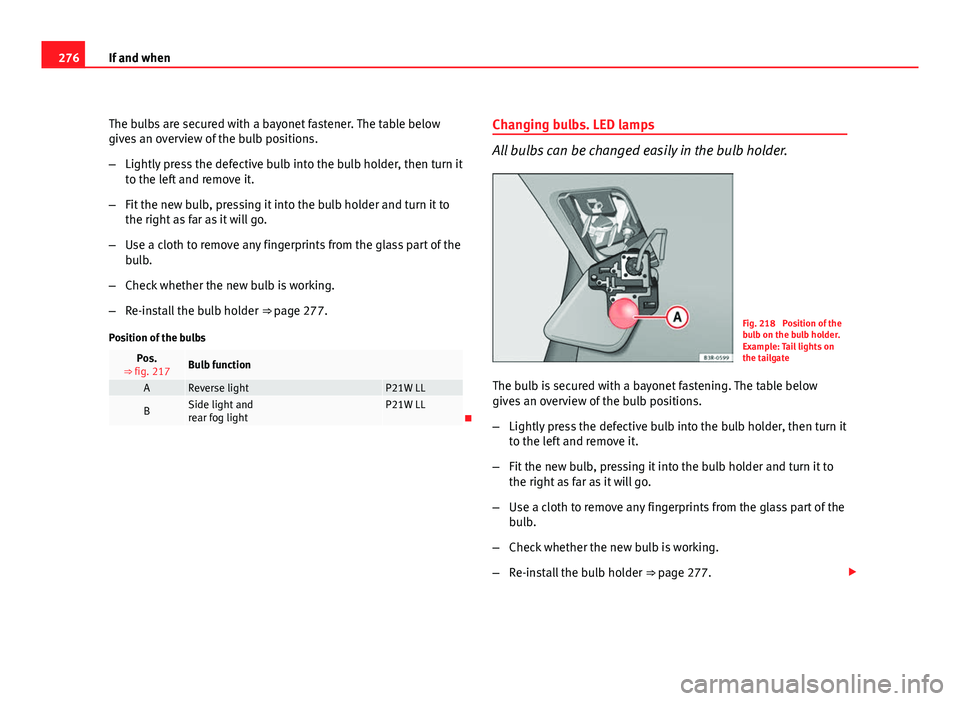
All bulbs can be changed easily in the bulb holder.
Fig. 218 Position of the
bulb on the bulb holder.
Example: Tail lights on
the tailgate
The bulb is secured with a bayonet fastening. The table below
gives an overview of the bulb positions.
– Lightly press the defective bulb into the bulb holder, then turn it
to the left and remove it.
– Fit the new bulb, pressing it into the bulb holder and turn it to
the right as far as it will go.
– Use a cloth to remove any fingerprints from the glass part of the
bulb.
– Check whether the new bulb is working.
– Re-install the bulb holder ⇒ page 277.
Page 279 of 313

277
If and when
Position of the bulbs
Pos.
⇒ fig. 218Bulb function
AReverse lightP21W LL
Fitting the bulb holder
The bulb holder is easy to fit. – Check that the seal is seated correctly on the bulb holder.
– Position the bulb holder on the tail light and align it so that it is
securely seated.
– Press the bulb holder into the tail light until it engages.
– Fit the cover back in the interior trim so that it engages.
– Make sure that all bulbs for the tail lights are working. Side turn signals
Fig. 219 Side turn signal
– Press the turn signal to the left or to the right to remove the
bulb.
– Remove the bulb holder from the turn signal.
– Remove the failed glass bulb and replace with a new bulb.
– Insert the bulb holder in the turn signal guide until it clicks into
place.
– First place the turn signal in the opening in the bodywork, fixing
the tabs ⇒ fig. 219, arrow 1
.
– Insert the bulb as shown by the arrow 2
⇒ fig. 219.
Safety FirstOperating InstructionsPractical TipsTechnical Specifications
Page 304 of 313

Bonnet . . . . . . . . . . . . . . . . . . . . . . . . . . . . . . . 220Closing . . . . . . . . . . . . . . . . . . . . . . . . . . . . 222
Opening . . . . . . . . . . . . . . . . . . . . . . . . . . . 221
Releasing . . . . . . . . . . . . . . . . . . . . . . . . . . 220
Brake light Failure control . . . . . . . . . . . . . . . . . . . . . . . . 80
Brake pads . . . . . . . . . . . . . . . . . . . . . . . . . . . . 191
Brakes . . . . . . . . . . . . . . . . . . . . . . . . . . . . . . . . 191 Brake assist system . . . . . . . . . . . . . . . . . . 186
Brake fluid . . . . . . . . . . . . . . . . . . . . . . . . . 230
Worn brake pads . . . . . . . . . . . . . . . . . . . . . 81
Brake servo . . . . . . . . . . . . . . . . . . . . . . . . . . . . 191
Brake system Brakes . . . . . . . . . . . . . . . . . . . . . . . . . . . . . 188
Brake servo . . . . . . . . . . . . . . . . . . . . . . . . . 188
Malfunction . . . . . . . . . . . . . . . . . . . . . . . . . 77
Braking distance . . . . . . . . . . . . . . . . . . . . . . . 191
Bulb change general notes . . . . . . . . . . . . . . . . . . . . . . . 258
C
Car care Exterior . . . . . . . . . . . . . . . . . . . . . . . . . . . . 207
Catalytic converter . . . . . . . . . . . . . . . . . . . . . . 192
CCS . . . . . . . . . . . . . . . . . . . . . . . . . . . . . . . . . . 173
Central locking . . . . . . . . . . . . . . . . . . . . . . . . . . 99 Manual locking . . . . . . . . . . . . . . . . . . . . . . 102
Sunroof: opening and closing . . . . . . . . . . 112
Central locking system Anti-theft security system . . . . . . . . . . . . . 100
Locking . . . . . . . . . . . . . . . . . . . . . . . . . . . . 100 Locking and unlocking the vehicle from in-
side . . . . . . . . . . . . . . . . . . . . . . . . . . . . . 101
Opening and closing the windows . . . . . . 110
Security central locking . . . . . . . . . . . . . . . 101
Switch on the driver door . . . . . . . . . . . . . . 101
Tailgate . . . . . . . . . . . . . . . . . . . . . . . . . . . . 103
Unlocking . . . . . . . . . . . . . . . . . . . . . . . . . . . 99
Cetane number . . . . . . . . . . . . . . . . . . . . . . . . . 219
Changing tail light bulbs . . . . . . . . . . . . . . . . . 269
Changing the main headlight bulb Main headlight . . . . . . . . . . . . . . . . . . . . . . 262
Changing the main headlight bulbs Dipped beam headlight . . . . . . . . . . . . . . . 263
Changing the tail lights Luggage compartment lights . . . . . . . . . . 278
Changing windscreen wiper blades . . . . . . . . 229
Chassis number . . . . . . . . . . . . . . . . . . . . . . . . 287
Childproof lock Rear doors . . . . . . . . . . . . . . . . . . . . . . . . . . 104
Child safety . . . . . . . . . . . . . . . . . . . . . . . . . . . . . 46
Child safety seat ISOFIX system . . . . . . . . . . . . . . . . . . . . . . . . 52
Child seat . . . . . . . . . . . . . . . . . . . . . . . . . . . . . . 48 Categorisation in groups . . . . . . . . . . . . . . . 48
Group 1 . . . . . . . . . . . . . . . . . . . . . . . . . . . . . 49
Group 2 . . . . . . . . . . . . . . . . . . . . . . . . . . . . . 49
Group 3 . . . . . . . . . . . . . . . . . . . . . . . . . . . . . 49
Groups 0 and 0+ . . . . . . . . . . . . . . . . . . . . . . 48
Safety notes . . . . . . . . . . . . . . . . . . . . . . . . . 46
Securing . . . . . . . . . . . . . . . . . . . . . . . . . . . . 51
Child seats on the front passenger seat . . . . . . . . . . . . . 29 Cigarette lighter . . . . . . . . . . . . . . . . . . . . . . . . 148
Cleaning alloy wheel rims . . . . . . . . . . . . . . . . 211
Cleaning chrome . . . . . . . . . . . . . . . . . . . . . . . 210
Cleaning engine compartment . . . . . . . . . . . . 212
Cleaning steel wheel rims . . . . . . . . . . . . . . . . 210
Cleaning windows . . . . . . . . . . . . . . . . . . . . . . 209
Clock, setting . . . . . . . . . . . . . . . . . . . . . . . . . . . 61
Cloth seat covers cleaning . . . . . . . . . . . . . . . . 213
Coat hooks . . . . . . . . . . . . . . . . . . . . . . . . . . . . 153
Cockpit . . . . . . . . . . . . . . . . . . . . . . . . . . . . . . . . 57
Overview . . . . . . . . . . . . . . . . . . . . . . . . . . . . 57
Compartments . . . . . . . . . . . . . . . . . . . . . . . . . 152 In the door trim . . . . . . . . . . . . . . . . . . . . . . 153
In the front seats . . . . . . . . . . . . . . . . . . . . 154
Coolant Checking the level . . . . . . . . . . . . . . . . . . . 226
Coolant fluid Antifreeze . . . . . . . . . . . . . . . . . . . . . . . . . . 225
Coolant fluid additive . . . . . . . . . . . . . . . . . 225
Topping up . . . . . . . . . . . . . . . . . . . . . . . . . 227
Cooling system Coolant temperature gauge . . . . . . . . . . . . . 60
Malfunction . . . . . . . . . . . . . . . . . . . . . . . . . 78
Correct adjustment of front seat head re- straints . . . . . . . . . . . . . . . . . . . . . . . . . . . . . . . 13
Correct adjustment of rear seat head restraints In-use and non-use positions . . . . . . . . . . . 14
Correct sitting position Front passenger . . . . . . . . . . . . . . . . . . . . . . 12
Incorrect sitting position . . . . . . . . . . . . . . . 14
302 Index