light Seat Exeo ST 2009 Owner's manual
[x] Cancel search | Manufacturer: SEAT, Model Year: 2009, Model line: Exeo ST, Model: Seat Exeo ST 2009Pages: 316, PDF Size: 8.83 MB
Page 283 of 316
If and when281
Safety First
Controls and equipment
Practical tips
Technical Data
Caution
Take care when fitting the rear light unit to make sure there is no damage to
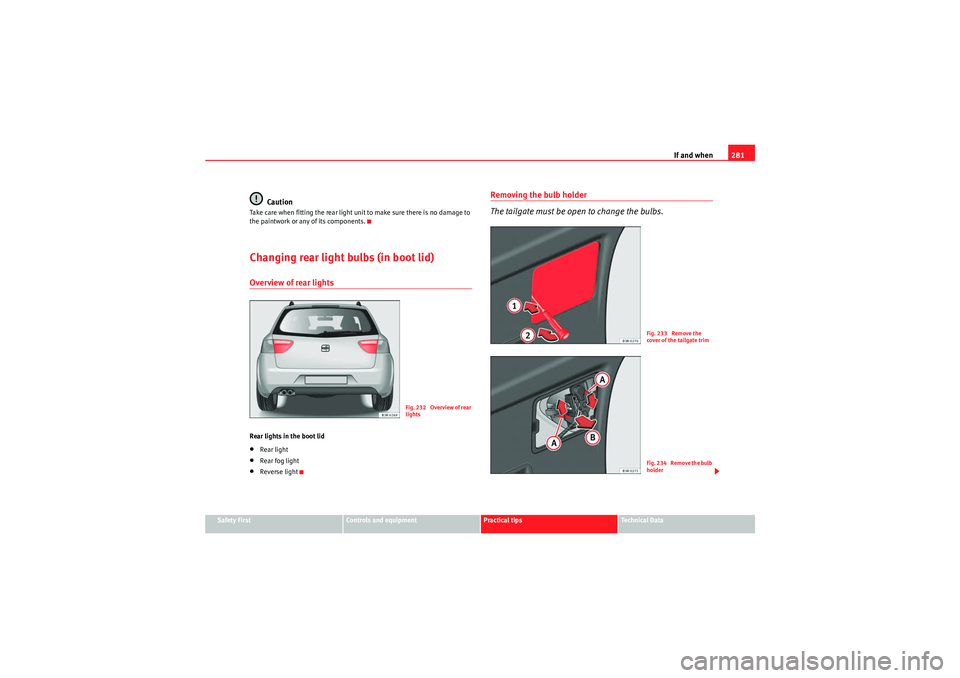
the paintwork or any of its components.Changing rear light bulbs (in boot lid)Overview of rear lightsRear lights in the boot lid•Rear light•Rear fog light•Reverse light
Removing the bulb holder
The tailgate must be open to change the bulbs.
F ig. 232 O ver vie w of rear
lights
Fig. 233 Remove the
cover of the tailgate trimFig. 234 Remove the bulb
holder
ExeoST_EN.book Seite 281 Donnerstag, 3. September 2009 12:24 12
Page 284 of 316
If and when
282
You can access the bulb holder for the inner rear lights via the inside
of the tailgate.
– Check which of the bulbs is defective.
– Take the screwdriver out of the vehicle's tool kit ⇒ page 251.
– Insert the screwdriver into the opening in the cover ⇒page 281,
fig. 233 and detach the cover .
–Press on the tabs ⇒page 281, fig. 234 in the direction of the
arrows and remove the bulb holder by pulling in the direction of
the arrow .
– Change the bulbs ⇒page 282.Changing bulbs
All bulbs can be changed easily in the bulb holder.
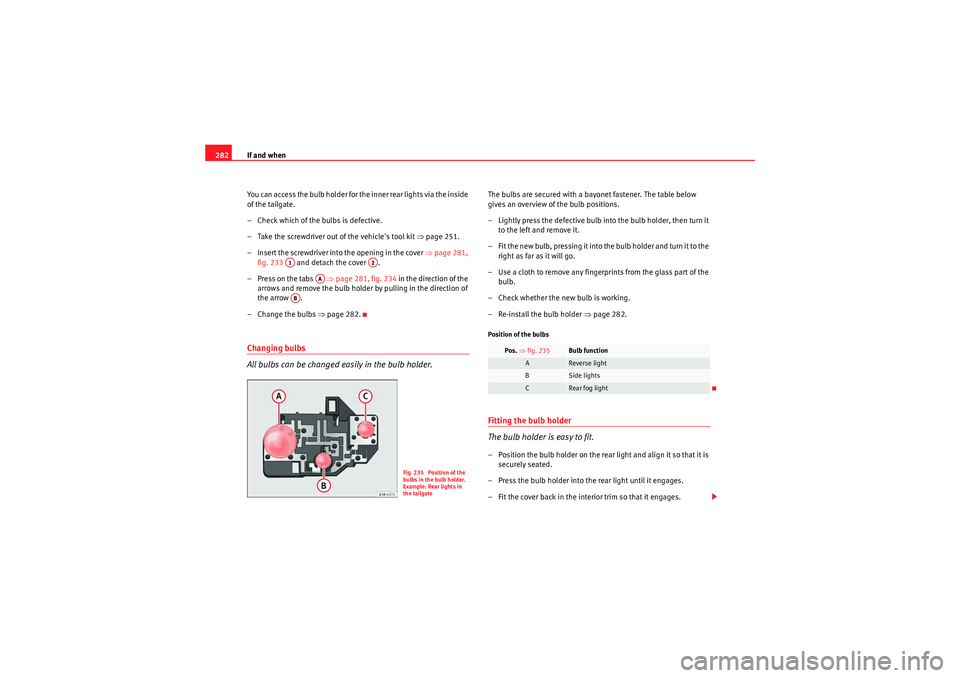
The bulbs are secured with a bayonet fastener. The table below
gives an overview of the bulb positions.
– Lightly press the defective bulb into the bulb holder, then turn it
to the left and remove it.
– Fit the new bulb, pressing it into the bulb holder and turn it to the right as far as it will go.
– Use a cloth to remove any fingerp rints from the glass part of the
bulb.
– Check whether the new bulb is working.
– Re-install the bulb holder ⇒page 282.Position of the bulbsFitting the bulb holder
The bulb holder is easy to fit.– Position the bulb holder on the rear light and align it so that it is
securely seated.
– Press the bulb holder into the rear light until it engages.
– Fit the cover back in the interior trim so that it engages.
A1
A2
AA
AB
Fig. 235 Position of the
bulbs in the bulb holder.
Example: Rear lights in
the tailgate
Pos. ⇒ fig. 235
Bulb function
A
Reverse light
B
Side lights
C
Rear fog light
ExeoST_EN.book Seite 282 Donnerstag, 3. September 2009 12:24 12
Page 285 of 316
If and when283
Safety First
Controls and equipment
Practical tips
Technical Data
– Put the screwdriver back into the tool kit.
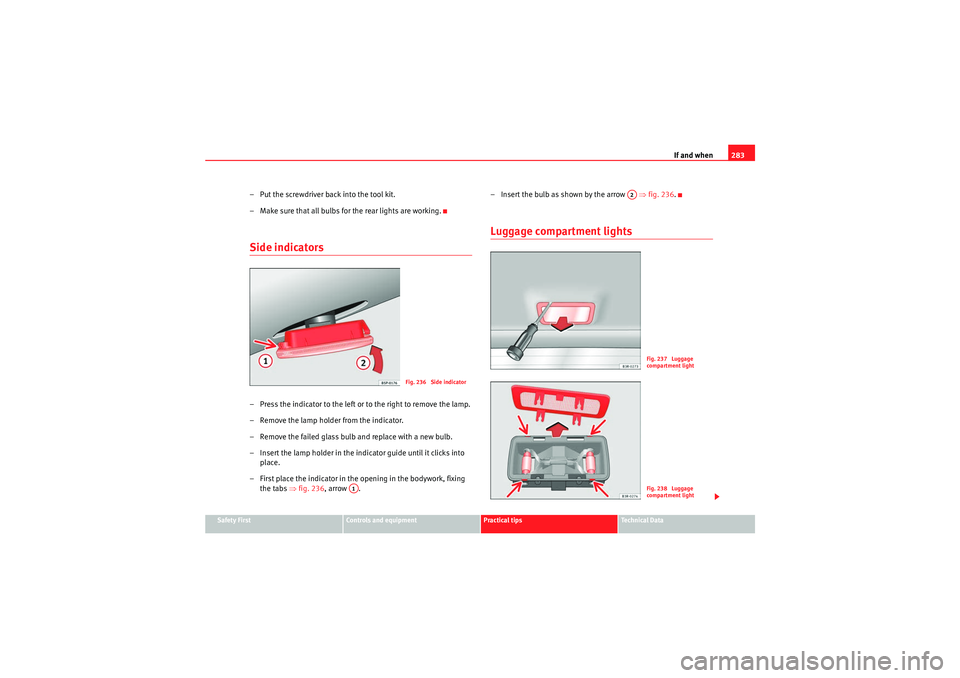
– Make sure that all bulbs for the rear lights are working.Side indicators– Press the indicator to the left or to the right to remove the lamp.
– Remove the lamp holder from the indicator.
– Remove the failed glass bulb and replace with a new bulb.
– Insert the lamp holder in the indicator guide until it clicks into
place.
– First place the indicator in th e opening in the bodywork, fixing
the tabs ⇒ fig. 236, arrow . – Insert the bulb as shown by the arrow
⇒fig. 236 .
Luggage compartment lights
Fig. 236 Side indicator
A1
A2
Fig. 237 Luggage
compartment lightFig. 238 Luggage
compartment light
ExeoST_EN.book Seite 283 Donnerstag, 3. September 2009 12:24 12
Page 286 of 316
If and when
284
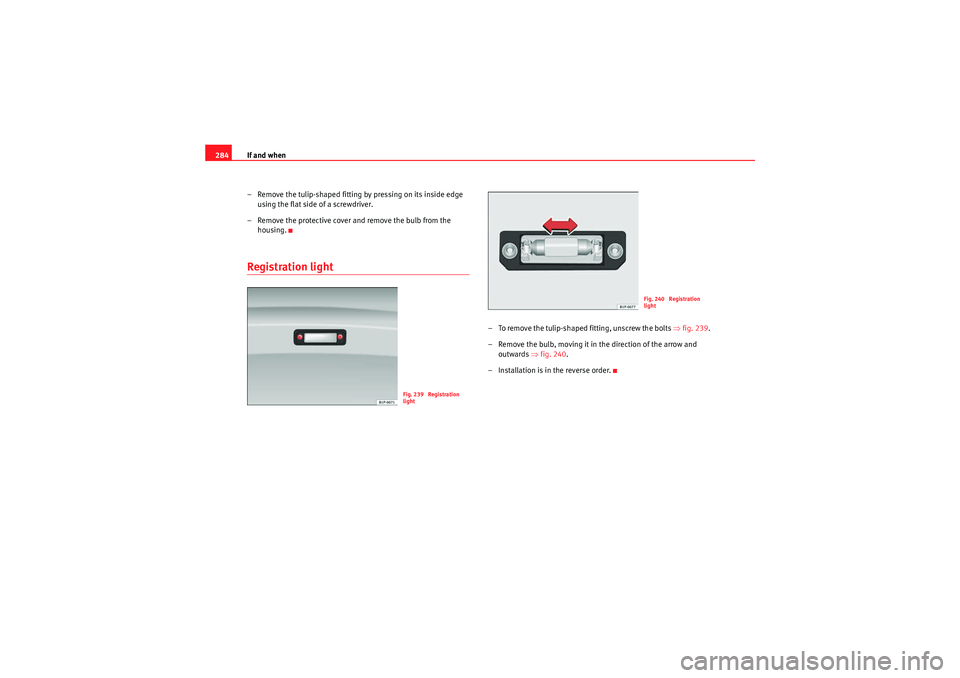
– Remove the tulip-shaped fitting by pressing on its inside edge using the flat side of a screwdriver.
– Remove the protective cover and remove the bulb from the housing.Registration light
– To remove the tulip-shaped fitting, unscrew the bolts ⇒fig. 239 .
– Remove the bulb, moving it in the direction of the arrow and outwards ⇒fig. 240 .
– Installation is in the reverse order.
Fig. 239 Registration
light
Fig. 240 Registration
light
ExeoST_EN.book Seite 284 Donnerstag, 3. September 2009 12:24 12
Page 287 of 316
If and when285
Safety First
Controls and equipment
Practical tips
Technical Data
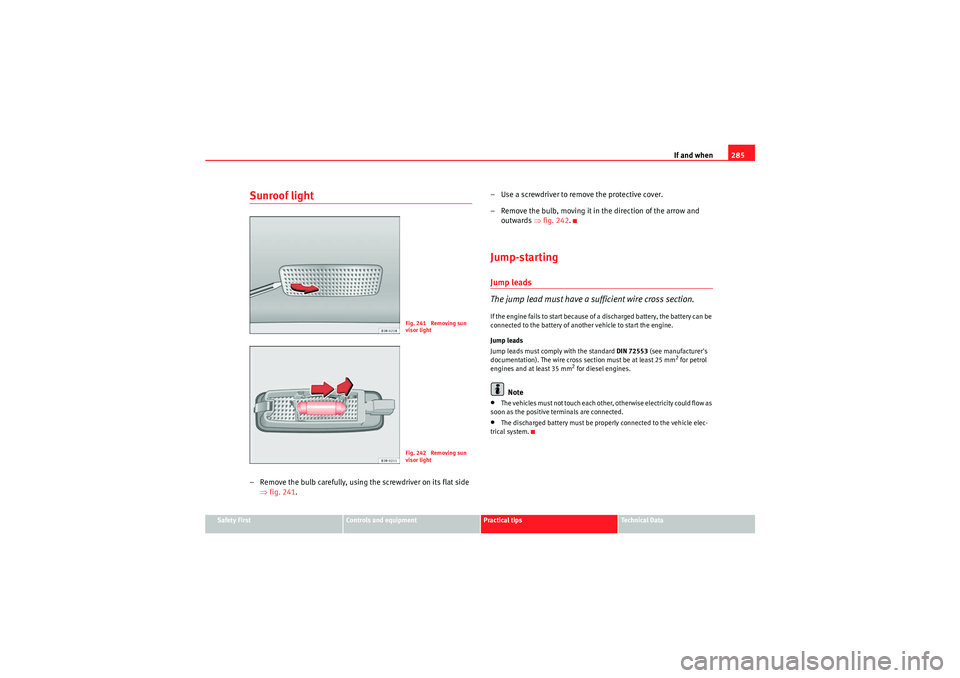
Sunroof light– Remove the bulb carefully, using the screwdriver on its flat side
⇒fig. 241 . – Use a screwdriver to remove the protective cover.
– Remove the bulb, moving it in the direction of the arrow and
outwards ⇒fig. 242 .
Jump-startingJump leads
The jump lead must have a su fficient wire cross section.If the engine fails to start because of a discharged battery, the battery can be
connected to the battery of another vehicle to start the engine.
Jump leads
Jump leads must comply with the standard DIN 72553 (see manufacturer's
documentation). The wire cross section must be at least 25 mm
2 for petrol
engines and at least 35 mm
2 for diesel engines.
Note
•The vehicles must not touch each other, otherwise electricity could flow as
soon as the positive terminals are connected.•The discharged battery must be properly connected to the vehicle elec-
trical system.
Fig. 241 Removing sun
visor lightFig. 242 Removing sun
visor light
ExeoST_EN.book Seite 285 Donnerstag, 3. September 2009 12:24 12
Page 288 of 316
If and when
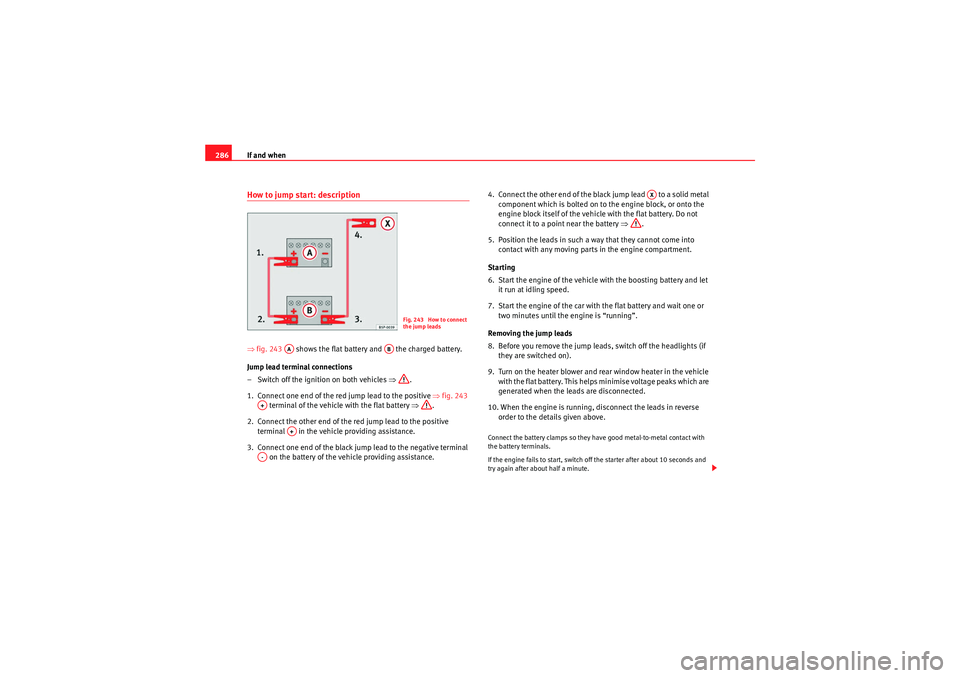
286How to jump start: description⇒ fig. 243 shows the flat battery and the charged battery.
Jump lead terminal connections
– Switch off the ignition on both vehicles ⇒.
1. Connect one end of the red jump lead to the positive ⇒fig. 243
terminal of the vehicle with the flat battery ⇒.
2. Connect the other end of the red jump lead to the positive terminal in the vehicle providing assistance.
3. Connect one end of the black jump lead to the negative terminal on the battery of the vehicle providing assistance. 4. Connect the other end of the black jump lead to a solid metal
component which is bolted on to the engine block, or onto the
engine block itself of the vehicle with the flat battery. Do not
connect it to a point near the battery ⇒.
5. Position the leads in such a way that they cannot come into contact with any moving parts in the engine compartment.
Starting
6. Start the engine of the vehicle with the boosting battery and let it run at idling speed.
7. Start the engine of the car with the flat battery and wait one or two minutes until the engine is “running”.
Removing the jump leads
8. Before you remove the jump lead s, switch off the headlights (if
they are switched on).
9. Turn on the heater blower and rear window heater in the vehicle with the flat battery. This helps minimise voltage peaks which are
generated when the leads are disconnected.
10. When the engine is running, disconnect the leads in reverse order to the details given above.
Connect the battery clamps so they have good metal-to-metal contact with
the battery terminals.
If the engine fails to start, switch off the starter after about 10 seconds and
try again after about half a minute.
Fig. 243 How to connect
the jump leads
AA
AB
A+
A+
A-
AX
ExeoST_EN.book Seite 286 Donnerstag, 3. September 2009 12:24 12
Page 289 of 316
If and when287
Safety First
Controls and equipment
Practical tips
Technical Data
WARNING
•Please note the safety warnings referring to working in the engine
compartment ⇒page 227.•The battery providing assistance must have the same voltage as the flat
battery (12V) and approximately the same capacity (see imprint on
battery). Failure to comply could result in an explosion.•Never use jump leads when one of the batteries is frozen. Danger of
explosion! Even after the battery has thawed, battery acid could leak and
cause chemical burns. If a battery freezes, it should be replaced.•Keep sparks, flames and lighted cigarettes away from batteries, danger
of explosion. Failure to comply could result in an explosion.•Observe the instructions provided by the manufacturer of the jump
leads.•Do not connect the negative cable from the other vehicle directly to the
negative terminal of the flat battery. The gas emitted from the battery could
be ignited by sparks. Danger of explosion.•Do not attach the negative cable from the other vehicle to parts of the
fuel system or to the brake line.•The non-insulated parts of the battery clamps must not be allowed to
touch. The jump lead attached to the positive battery terminal must not
touch metal parts of the vehicle, this can cause a short circuit.•Position the leads in such a way that they cannot come into contact
with any moving parts in the engine compartment.•Do not bend over the batteries. This could result in chemical burns.Note
The vehicles must not touch each other, otherwise electricity could flow as
soon as the positive terminals are connected.
ExeoST_EN.book Seite 287 Donnerstag, 3. September 2009 12:24 12
Page 290 of 316
If and when
288Towing and tow-startingTo w - s t a r t i n g
The use of jump leads is preferable to tow-starting.We recommend that you do not tow-start your vehicle. Jump-starting
is preferable ⇒ page 285.
However, if your vehicle has to be tow-started:
– Engage the 2
nd or the 3
rd gear.
– Keep the clutch pressed down.
– Switch the ignition on.
– Once both vehicles are moving, release the clutch.
– As soon as the engine starts, press the clutch and move the gear lever into neutral. This helps to prevent driving into the towing
vehicle.
WARNING
The risk of accidents is high when tow-starting. The vehicle being towed
can easily collide with the towing vehicle.
Caution
When tow-starting, fuel could enter the catalytic converter and damage it.
CommentsPlease observe the following points if you use a tow-rope:
Notes for the driver of the towing vehicle
– Drive slowly at first until the tow-rope is taut. Then accelerate gradually.
– Begin and change gears cautiously. If you are driving an auto- matic vehicle, accelerate gently.
– Remember that the brake servo and power steering are not working in the vehicle you are towing. Brake earlier than you
would normally, but with a more gentle pressure on the brake.
Notes for the driver of the towed vehicle
– Ensure that the tow-rope remains taut at all times when towing.Tow-rope or tow-bar
It is easier and safer to tow a vehicle with a tow-bar. You should only use a
tow-rope if you do not have a tow-bar.
A tow-rope should be slightly elastic to reduce the loading on both vehicles.
It is advisable to use a tow-rope made of synthetic fibre or similarly elastic
material.
Attach the tow-rope or the tow-bar only to the towing eyes provided or a
towing bracket.
Driving style
Towing requires some experience, especially when using a tow-rope. Both
drivers should be familiar with the technique required for towing. Inexperi-
enced drivers should not attempt to tow-start or tow away another vehicle.
ExeoST_EN.book Seite 288 Donnerstag, 3. September 2009 12:24 12
Page 291 of 316
If and when289
Safety First
Controls and equipment
Practical tips
Technical Data
Do not pull too hard with the towing vehicle and take care to avoid jerking the
tow-rope. When towing on an unpaved road, there is always a risk of over-
loading and damaging the anchorage points.
The ignition of the vehicle being towed must be switched on to prevent the
steering wheel from locking and also to allow the use of the indicators, horn,
windscreen wipers and washers.
As the brake servo does not work if the engine is not running, you must apply
considerably more pressure to the brake pedal than you normally would.
As the power assisted steering does not work if the engine is not running, you
will need more strength to steer than you normally would.
Towing vehicles with an automatic gearbox
•Put the selector lever into position “N”.•Do not drive faster than 50 km/h when towing a vehicle.•Do not tow further than 50 km.•If a breakdown vehicle is used, the vehicle must be towed with the front
wheels raised.Note
•Observe legal requirements when towing or tow-starting.•Switch on the hazard warning lights of both vehicles. However, observe
any regulations to the contrary.•For technical reasons, vehicles with an automatic gearbox must not be
tow-started.•If damage to your vehicle means that there is no lubricant in the gearbox,
you must raise the drive wheels while the vehicle is being towed.•If the vehicle has to be towed more than 50 km, the front wheels must be
raised during towing, and towing should be carried out by a qualified person.•The steering wheel is locked when the vehicle has no electrical power. The
vehicle must then be towed with the front wheels raised. Towing should be
carried out by a qualified person.
•The towing eye should always be kept in the vehicle. Please refer to the
notes ⇒page 288, “Tow-starting”.Front towing eyeFitting the towing eye
– Take the towing ring from the onboard tool set.
– Remove the front cover by pressing down on the right hand side.
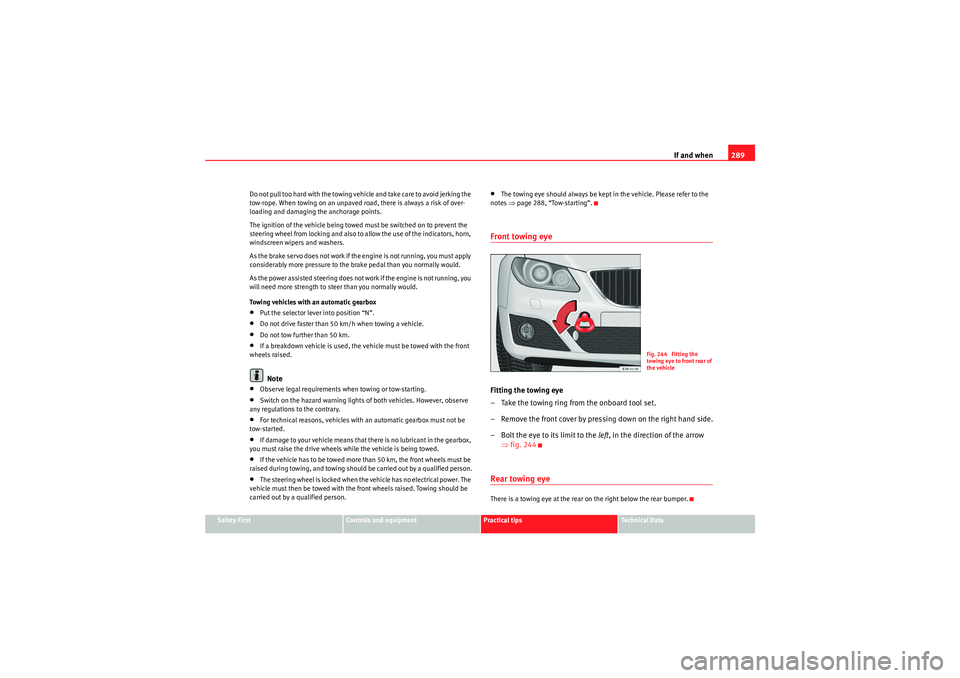
– Bolt the eye to its limit to the left, in the direction of the arrow
⇒ fig. 244Rear towing eyeThere is a towing eye at the rear on the right below the rear bumper.
Fig. 244 Fitting the
towing eye to front rear of
the vehicle
ExeoST_EN.book Seite 289 Donnerstag, 3. September 2009 12:24 12
Page 296 of 316
General notes on the technical data
294Towing a trailerTrailer weightsTrailer weights
The trailer weights and drawbar loads approved are selected in intensive
trials according to precisely defined criteria. The approved trailer weights are
valid for vehicles in the EU for maximum speeds of 80 km/h (in certain
circumstances up to 100 km/h). The figures may be different in other coun-
tries. All data in the official vehicle documents take precedence over these
data ⇒ .
Drawbar load
The maximum permitted weight exerted by the trailer drawbar on the ball joint
of the towing bracket must not exceed 75 kg.
In the interest of road safety, we recommend that you always tow
approaching the maximum drawbar load. The response of the trailer on the
road will be poor if the drawbar load is too small.
If the maximum permissible drawbar load cannot be met (e.g. with small,
empty and light-weight single axle trailers o r ta n d e m a x l e t r a i l e r s wi t h a n a x le
base of less than 1 metre), at least 4% of the actual trailer weight is a legal
stipulation for a drawbar load.
WARNING
•For safet y reas ons , d o not excee d the 8 0 k m/h limit . Th is is als o valid in
countries where higher speeds are permitted.•Never exceed the maximum trailer weights or the draw bar loading. If
the permissible axle load or the permissible total weight is exceeded, the
driving characteristics of the vehicle may change, leading to accidents,
injuries and damage to the vehicle.
WheelsTyre pressure, snow chains, wheel boltsTyre pressures
The sticker with the tyre pressure values can be found on the inside of the
tank flap. The tyre pressure values given there are for cold tyres. The slightly
raised pressures of warm tyres must not be reduced. ⇒
Snow chains
Snow chains may be fitted only to the front wheels.
Consult the chapter “wheels” of this manual.
Wheel bolts
After the wheels have been changed, the tightening torque of the wheel bolts
s ho uld b e che cke d as s o on as p ossible wit h a to rqu e w re nch ⇒ . The tight-
ening torque for steel and alloy wheels is 120 Nm.
WARNING
•Check the tyre pressure at least once per month. Checking tyre pressure
value is very important. If the tyre pressure is too high or too low, there is
an increased danger of accidents, particularly at high speeds.•If the torque of the wheel bolts is too low, they could loosen while the
vehicle is in motion. Risk of accident! If the tightening torque is too high,
the wheel bolts and threads can be damaged.Note
We recommend that you ask your Authorised Service Centre for information
about appropriate wheel, tyre and snow chain size.
ExeoST_EN.book Seite 294 Donnerstag, 3. September 2009 12:24 12