light Seat Exeo ST 2009 Owner's manual
[x] Cancel search | Manufacturer: SEAT, Model Year: 2009, Model line: Exeo ST, Model: Seat Exeo ST 2009Pages: 316, PDF Size: 8.83 MB
Page 228 of 316
Checking and refilling levels
226The bonnetReleasing the bonnet
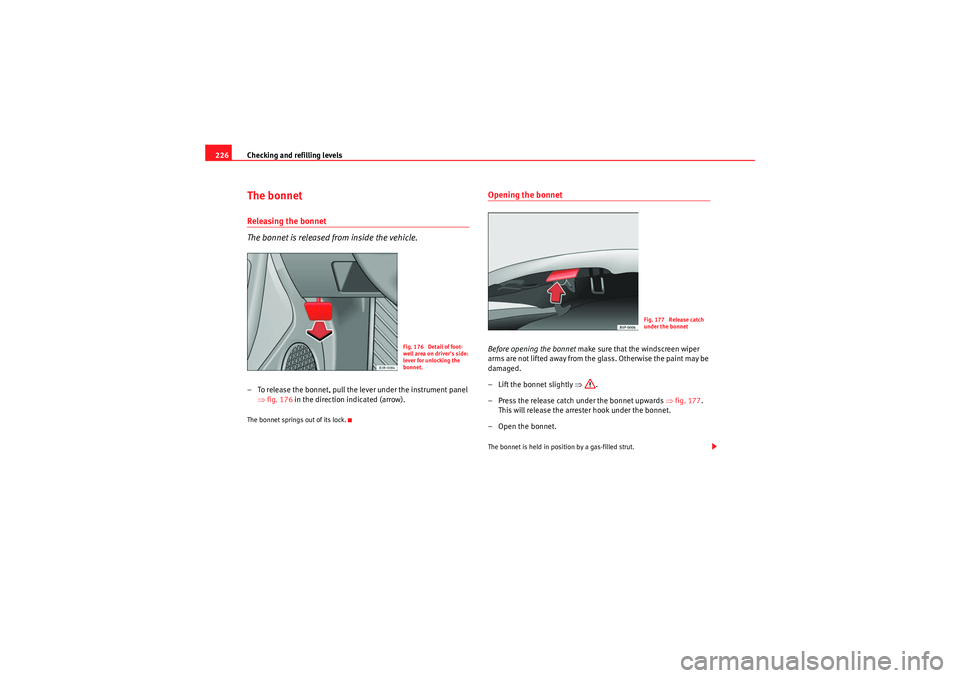
The bonnet is released from inside the vehicle.– To release the bonnet, pull the lever under the instrument panel
⇒fig. 176 in the direction indicated (arrow).The bonnet springs out of its lock.
Opening the bonnetBefore opening the bonnet make sure that the windscreen wiper
arms are not lifted away from the glass. Otherwise the paint may be
damaged.
– Lift the bonnet slightly ⇒.
– Press the release catch under the bonnet upwards ⇒fig. 177 .
This will release the arrester hook under the bonnet.
– Open the bonnet.The bonnet is held in position by a gas-filled strut.
Fig. 176 Detail of foot-
well area on driver's side:
lever for unlocking the
bonnet.
Fig. 177 Release catch
under the bonnet
ExeoST_EN.book Seite 226 Donnerstag, 3. September 2009 12:24 12
Page 234 of 316
Checking and refilling levels
232freeze protection of temperatures down to approx. -40°C. However,the
concentration of anti-freeze must not exceed 60%, as the anti-freeze protec-
tion would then drop and the performance of the coolant system would suffer.
Vehicles for countries with cold climates (e.g. Sweden, Norway and Finland)
have factory-filled anti-freeze protection for temperatures down to -35°C. In
these countries, the concentration of anti-freeze should always be at least
50%.
Caution
•It is advisable to have the cooling system checked before the winter
season to make sure that the antifreeze concentration is adequate for the
conditions to be expected. This applies particularly if you intend to take the
car into a colder climate zone. If necessary, have the antifreeze concentration
increased to 50 - 60% as required.•Use only anti-freeze G12++ , an additive meeting the “TL-VW 774G” spec-
ification. Other anti-freezes may give considerably inferior corrosion protec-
tion. The damage caused by the use of these anti-freezes may lead to a loss
of liquid coolant, causing serious damage to the engine.•The anti-freeze G12++ can be mixed only with anti-freeze additives G11,
G12 and G12+.
Checking the liquid coolant level
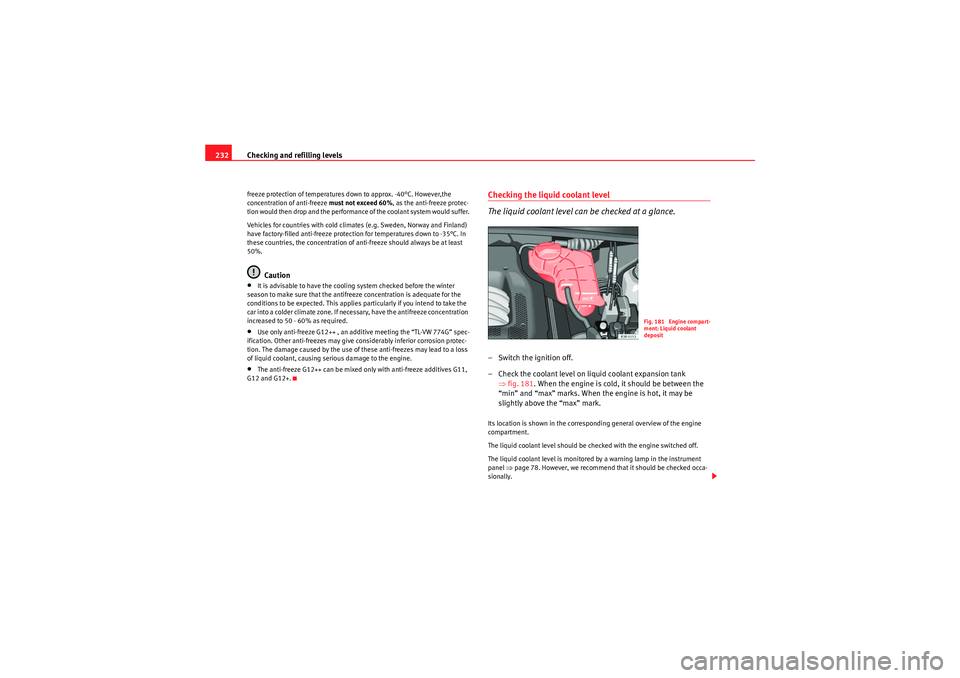
The liquid coolant level can be checked at a glance.– Switch the ignition off.
– Check the coolant level on liquid coolant expansion tank ⇒fig. 181 . When the engine is cold, it should be between the
“min” and “max” marks. When the engine is hot, it may be
slightly above the “max” mark.Its location is shown in the corresponding general overview of the engine
compartment.
The liquid coolant level should be checked with the engine switched off.
The liquid coolant level is monitored by a warning lamp in the instrument
panel ⇒ page 78. However, we recommend that it should be checked occa-
sionally.
Fig. 181 Engine compart-
ment: Liquid coolant
deposit
ExeoST_EN.book Seite 232 Donnerstag, 3. September 2009 12:24 12
Page 236 of 316
Checking and refilling levels
234
WARNING
when working in the engine compartment be aware that the radiator fan
may start running suddenly, leading to the risk of injury.Washer fluid and windscreen wiper bladesWindscreen washer system
Plain water on its own is not sufficient for the windscreen
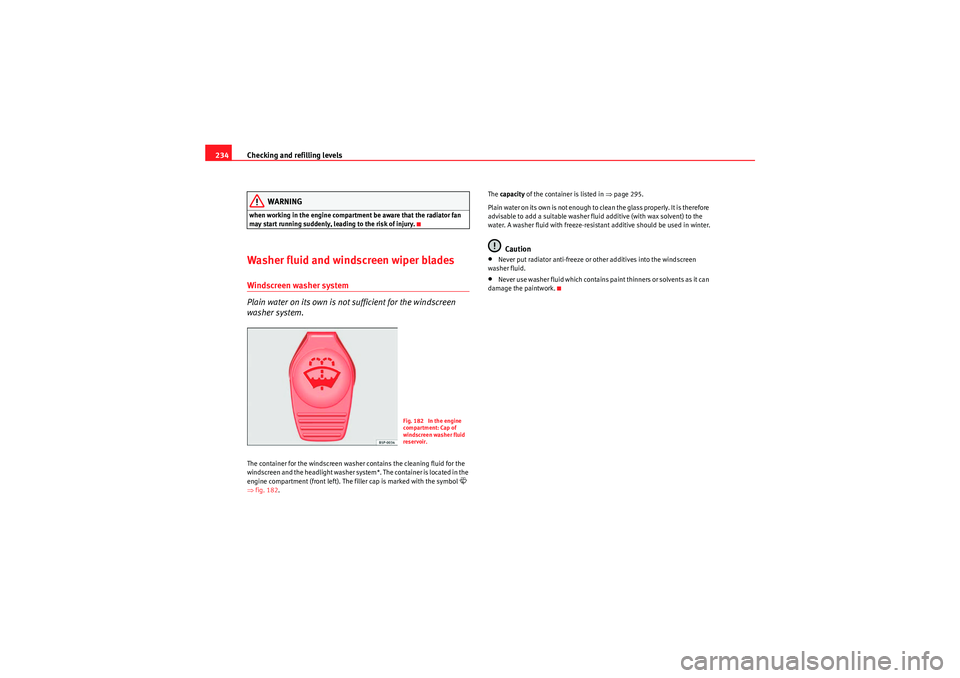
washer system.The container for the windscreen washer contains the cleaning fluid for the
windscreen and the headlight washer system*. The container is located in the
engine compartment (front left). The fi ller cap is marked with the symbol
⇒ fig. 182 . The
capacity of the container is listed in ⇒page 295.
Plain water on its own is not enough to clean the glass properly. It is therefore
advisable to add a suitable washer fluid additive (with wax solvent) to the
water. A washer fluid with freeze-resistant additive should be used in winter.
Caution
•Never put radiator anti-freeze or other additives into the windscreen
washer fluid.•Never use washer fluid which contains paint thinners or solvents as it can
damage the paintwork.
Fig. 182 In the engine
compartment: Cap of
windscreen washer fluid
reservoir.
ExeoST_EN.book Seite 234 Donnerstag, 3. September 2009 12:24 12
Page 239 of 316
Checking and refilling levels237
Safety First
Controls and equipment
Practical tips
Technical Data
Removing the wiper blade
– Lift the wiper arm away from the glass ⇒ page 236, fig. 185.
– Slide the blade adapter in the di rection of the arrow and remove
the blade ⇒ page 236, fig. 185 .
Fitting the wiper blade
– With one hand, hold the top end of the wiper arm.
– Place the blade as shown in the ⇒ page 236, fig. 186 and slide
the adapter along until it engages.Check the condition of the wiper blad e regularly. Change as required.
If the windscreen wiper scrapes, i t s h o u l d b e r e p la ce d i f d a m a ge d , o r c l ea n e d
if soiled.
If this is not sufficient, refer to a qualified workshop.
WARNING
Do not drive unless you have good visibility through all windows!•Clean the windscreen wiper blades and all windows regularly.•The wiper blades should be changed once or twice a year.Caution
•A damaged or dirty window wiper could scratch the rear window.•Never use fuel, nail varnish remover, paint thinner or similar products to
clean the window.•Never move the windscreen wiper by hand. This could cause damage.
Brake fluidChecking the brake fluid level
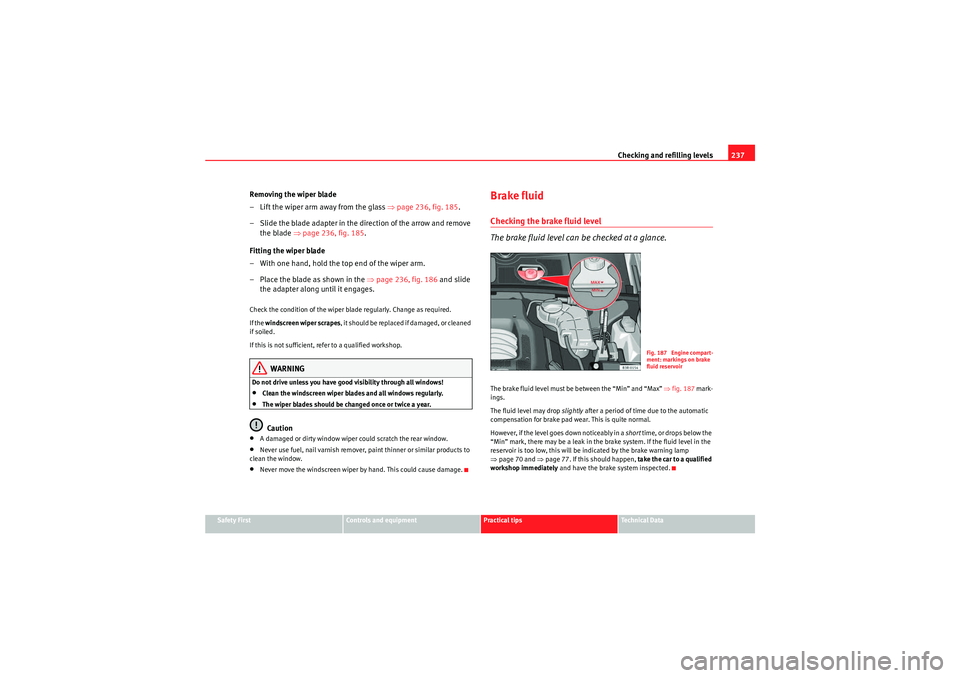
The brake fluid level can be checked at a glance.The brake fluid level must be between the “Min” and “Max” ⇒fig. 187 mark-
ings.
The fluid level may drop slightly after a period of time due to the automatic
compensation for brake pad wear. This is quite normal.
H owe ve r, if th e le ve l goes d own not icea bly i n a short time, or drops below the
“Min” mark, there may be a leak in the brake system. If the fluid level in the
reservoir is too low, this will be indicated by the brake warning lamp
⇒ page 70 and ⇒page 77. If this should happen, take the car to a qualified
workshop immediately and have the brake system inspected.
Fig. 187 Engine compart-
ment: markings on brake
fluid reservoir
ExeoST_EN.book Seite 237 Donnerstag, 3. September 2009 12:24 12
Page 241 of 316
Checking and refilling levels239
Safety First
Controls and equipment
Practical tips
Technical Data
Winter operations
The battery is drained more in cold weather, which means that the starting
power is reduced. For this reason, have the battery checked and charged if
necessary before the start of winter.
Replacing the battery
A replacement battery
must have the same capacity, voltage and current
rating. It must also have the same dimensions as the original, factory-fitted
battery and have sealed caps. The SEAT batteries which have been specially
developed fulfil the maintenance, performance and safety specifications for
your vehicle.
We recommend you use maintenance-free batteries.
WARNING
•All work on batteries requires specialist knowledge. If work is required
on the battery, this should be performed by a Technical Service or
specialist garage. Danger of caustic burns and explosion!•The battery must not be opened. Never try to change the battery's
liquid level. Explosive gas is released from the battery that could lead to an
explosion.Caution
•The battery holder and clamps must always be correctly secured.•Before starting any work on the battery, always observe the warnings
listed under ⇒.For the sake of the environment
Batteries contain toxic substances including sulphuric acid and lead.
Therefore, they must be disposed in line with environmental regulations and
must not be disposed of with ordinary household waste. Make sure discon-
nected batteries cannot tip over. Sulphuric acid could be spilt!
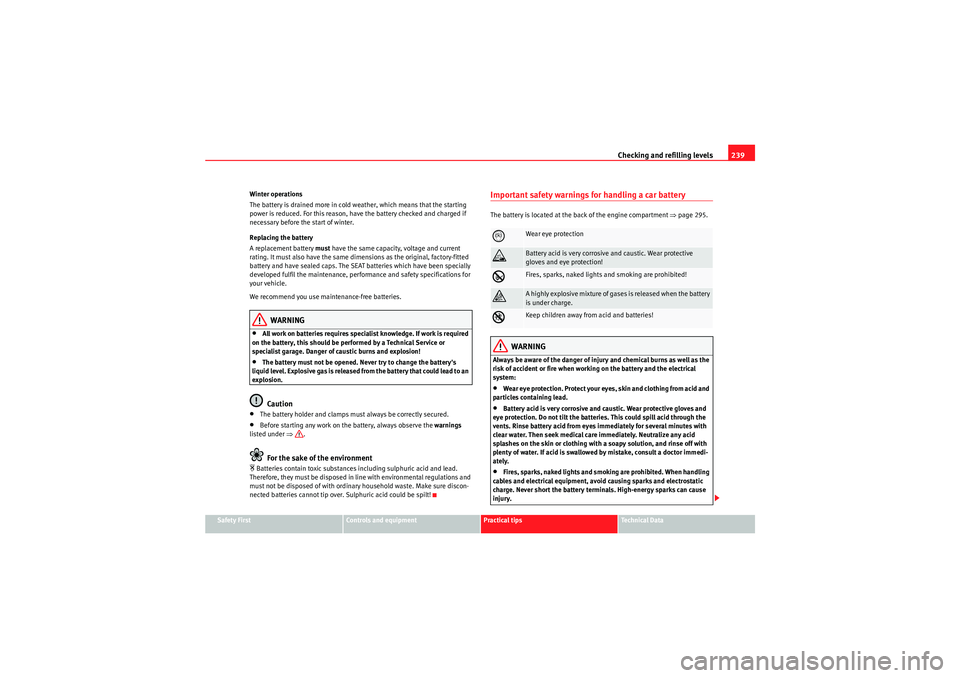
Important safety warnings for handling a car batteryThe battery is located at the back of the engine compartment ⇒ page 295.
WARNING
Always be aware of the danger of injury and chemical burns as well as the
risk of accident or fire when working on the battery and the electrical
system:•Wear eye protection. Protect your eyes, skin and clothing from acid and
particles containing lead.•Battery acid is very corrosive and caustic. Wear protective gloves and
eye protection. Do not tilt the batteries. This could spill acid through the
vents. Rinse battery acid from eyes immediately for several minutes with
clear water. Then seek medical care immediately. Neutralize any acid
splashes on the skin or clothing with a soapy solution, and rinse off with
plenty of water. If acid is swallowed by mistake, consult a doctor immedi-
ately.•Fires, sparks, naked lights and smoking are prohibited. When handling
cables and electrical equipment, avoid causing sparks and electrostatic
charge. Never short the battery terminals. High-energy sparks can cause
injury.
Wear eye protection
Battery acid is very corrosive and caustic. Wear protective
gloves and eye protection!
Fires, sparks, naked lights and smoking are prohibited!
A highly explosive mixture of gases is released when the batter y
is under charge.
Keep children away from acid and batteries!
ExeoST_EN.book Seite 239 Donnerstag, 3. September 2009 12:24 12
Page 242 of 316
Checking and refilling levels
240•A highly explosive mixture of gases is released when the battery is
under charge. The batteries should be charged in a well-ventilated room
only.•Keep children away from acid and batteries.•Before working on the electrical system, you must switch off the
engine, the ignition and all consumers. The negative cable on the battery
must be disconnected. When a light bulb is changed, you need only switch
off the light.•Deactivate the anti-theft alarm by unlocking the vehicle before you
disconnect the battery! The alarm will otherwise be triggered.•When disconnecting the battery from the vehicle electrical system,
disconnect first the negative cable and then the positive cable.•Switch off all electrical consumers before reconnecting the battery.
Reconnect first the positive cable and then the negative cable. Never
reverse the polarity of the connections. This could cause an electrical fire.•Never charge a frozen battery, or one which has thawed. This could
result in explosions and chemical burns. Always replace a battery which
has frozen. A flat battery can freeze at temperatures around 0°C.•Ensure that the vent hose is always connected to the battery.•Never use a defective battery. This may be fatally explosive. Replace a
damaged battery immediately.Caution
•Never disconnect the battery if the ignition is switched on or if the engine
is running. This could damage the electrical system or electronic compo-
nents.•Do not expose the battery to direct sunlight over a long period of time, as
the intense ultraviolet radiation can damage the battery housing.•If the vehicle is left standing in cold conditions for a long period, protect
the battery from frost. If it “freezes” it will be damaged.
Charging the battery
A fully-charged battery is important for reliable starting.– Note the warnings ⇒ in “Important safety warnings for
handling a car battery” on page 239 and ⇒.
– Switch off the ignition and all electrical equipment.
– Only if “fast-charging”: both battery cables must be discon- nected (first the “negative” cable, then the “positive” cable).
– Connect the charger cables to the battery terminals, noting the colour code (red is used for “positive”, black or brown for “nega-
tive”).
– Now connect the battery charger to the power point and switch on.
– After charging the battery: switch off the battery charger and disconnect the power point cable.
– Finally disconnect the charger cables from the battery.
– If necessary, reconnect both battery cables to the battery (first the “positive” cable, then the “negative” cable).When charging with a low current (for instance with a small battery charger)
the battery does not normally have to be disconnected. However, both
battery cables must be disconnected before “ fast-charging” the battery with
a high current. However, always follow the instructions given by the manufac-
turer of the battery charger.
The fast-charging procedure for a battery is dangerous ⇒ in “Important
safety warnings for handling a car battery” on page 239, as it requires a
WARNING (continued)
ExeoST_EN.book Seite 240 Donnerstag, 3. September 2009 12:24 12
Page 245 of 316

Wheels and tyres243
Safety First
Controls and equipment
Practical tips
Technical Data
2. The tyre pressures should only be checked when the tyres are
cold. The slightly raised pressures of warm tyres must not be
reduced.
3. Adjust the tyre pressure to the load you are carrying.Tyre pressure
The correct tyre pressure is especially important at high speeds. The pressure
should therefore be checked at least once a month and before starting a
journey.
The sticker with the tyre pressure values can be found on the inside of the
tank flap. The tyre pressure values given are for cold tyres. Do not reduce the
slightly raised pressures of warm tyres ⇒.
WARNING
•Check the tyre pressure at least once per month. Checking tyre pressure
value is very important. If the tyre pressure is too high or too low, there is
an increased danger of accidents - particularly at high speeds.•A tyre can easily burst if the pressure is too low, causing an accident!•At continuously high speeds, a tyre with insufficient pressure flexes
more. In this way it becomes too hot, and this can cause tread separation
and tyre blow-out. Always observe the recommended tyre pressures.•If the tyre pressure is too low or too high, the tyres will wear prema-
turely and the vehicle will not handle well. Risk of accident!For the sake of the environment
Under-inflated tyres will increase fuel consumption.
Tyre pressure monitoring*
The tyre pressure monitoring system constantly checks the
pressure of the tyres.The system warns the driver in the event of a loss of pressure by means of
symbols and messages in the instrument cluster display.
Note that tyre pressure also depends on tyre temperature. Tyre pressure
increases about 0.1 bar for each 10°C in tyre temperature increase. The tyre
heats up while the vehicle is being driven and the tyre pressure will rise
accordingly. For this reason, you should only adjust the tyre pressures when
they are cold (i.e. approximately at ambient temperature).
To ensure that the tyre pressure monitoring system works reliably, you should
check and, if necessary, adjust the tyre pressures at regular intervals and
store the correct pressures (reference values) in the system.
A tyre pr essure i nfor ma ti on lab e l is a tta che d to t he insi de o f the fu el ta nk f lap.
WARNING
•Never adjust tyre pressure when the tyres are hot. This may damage or
even burst the tyres. Risk of accident!•An insufficiently inflated tyre flexes a lot more at high speeds and
causes significant heating of the tyre. Under these conditions, the tyre
bead may be released or the tyre may burst. Risk of accident!For the sake of the environment
Under-inflated tyres lead to increased fuel consumption and tyre wear.
ExeoST_EN.book Seite 243 Donnerstag, 3. September 2009 12:24 12
Page 246 of 316

Wheels and tyres
244Significant tyre pressure lossThe tyre symbol
is displayed and indicates that the tyre pressure for a least
one tyre is insufficient.
- Stop the vehicle.
- Switch the engine off.
- Check the tyre(s).
- Change the wheel if necessary.
Tyre pressure monitoring (RKA+)*
The type pressure monitor display on the instrument panel
indicates that the pressure is too low.The tyre pressure monitoring system makes use of the ABS sensors to
compare the rolling circumference and the frequency characteristics of the wheels. If the rolling circumference or frequency characteristic changes on
one or more wheels, the tyre pressure warning lamp
will light up. The fault
will also be indicated by a warning buzzer. The position of the affected tyre
will also be shown (if only one tyre is affected) on the centre display of the
instrument panel.
The rolling circumference and frequency characteristics can change if:
•the tyre pressure is too low.•the tyre has suffered structural damage.•the wheels or the inflation pressures have been changed without initial-
ising the system (see Adjusting the tyre pressure settings).•there is a greater load on the wheels of one axle (e.g. if you are carrying
more passengers or luggage).•the road surface under the left wheels is different to the road surface
under the right wheels for a long period.•when driving with snow chains.
Adjusting the tyre pressure settings (initialising the tyre pressure
monitoring system)
After any incident regarding the wheels of your vehicle, e.g. after modify the
tyre pressure ⇒page 245 or after changing of swapping around wheels ⇒
page 180 - with the vehicle at a standstill and the engine running - press
⇒ fig. 188. The yellow warning lamp
will light up. Hold the button down
for 2 seconds until the warning lamp goes out and an acoustic warning is
given. You can now release the button.
If the wheels are subjected to extremely stress (e.g. heavy load), the tyre pres-
sure must be increased to the recommended value for the maximum load
(see the adhesive label on the inside of the fuel tank flap) and then initialise
the system.
Tyre pressure warning lamp on
When you switch on the ignition, the tyre pressure warning lamp
will light
up for about 2 seconds. There is a fault in the system if the indicator stays on
permanently after switching on the ignition. The instrument panel also
Fig. 188 Detailed view of
the centre console: Button
for the tyre pressure
monitoring system
ExeoST_EN.book Seite 244 Donnerstag, 3. September 2009 12:24 12
Page 247 of 316

Wheels and tyres245
Safety First
Controls and equipment
Practical tips
Technical Data
display TMPS (Tyre Pressure Monitoring System). Please contact the nearest
specialist garage as soon as possible.
The tyre pressure warning lamp
lights up if the tyre pressure on one or
more wheels is significantly lower than the tyre pressure setting which was
confirmed by the driver ⇒.
WARNING
•If the tyre pressure warning lamp lights up
you must slow down
immediately and avoid any severe braking or steering manoeuvres. Stop
the vehicle as soon as possible and check the tyres and their pressure.
•The driver is responsible for maintaining correct tyre pressures. There-
fore, the tyre pressure must be regularly checked.•Under certain conditions (e.g. driving at high speeds, on ice and snow
or on poor road surfaces) the tyre pressure warning lamp
may not light
up immediately or not at all.
•Please ask your Dealer or specialist garage whether run-flat tyres can
be used on your vehicle. Fitting this type of tyre in an undue manner could
lead to your driving licence being taken away from you. Furthermore, it may
led to damage to the vehicle or, under certain circumstances, may cause
accidents.•If you change normal tyres for run-flat tyres or vice versa, the control
unit must be reprogrammed by the Dealer or a specialist garage.Note
If you did not press the button for the tyre pressure monitoring system to
confirm a new tyre pressure setting after making changes to the tyre pres-
sures or changing one or more wheels, the warning lamp
may light up
although the tyre pressures are correct. In this case, stop the vehicle as soon
as possible and, after examining the tyres, press the button for the tyre pres-
sure monitoring system.
Tyre ser vice life
The service life of tyres is dependent on tyre pressure, driving
style and fitting.
Fig. 189 Tyre tread wear
indicatorsFig. 190 Diagram for
changing wheels
ExeoST_EN.book Seite 245 Donnerstag, 3. September 2009 12:24 12
Page 256 of 316
If and when
254Changing a wheelPreparation work
What you must do before changing a wheel.– If you have a flat tyre or puncture, park the car as far away from
the flow of traffic as possible. Choose a location that is as level
as possible.
– All passengers should leave the vehicle. They should wait in a
safe place (e.g. behind the roadside crash barrier).
–Apply the handbrake firmly.
–Engage 1st gear.
– When towing a trailer: Unhitch the trailer from your vehicle.
–Take the tools and the spare wheel ⇒ page 251 out of the
luggage compartment.
WARNING
If you have a puncture in heavy traffic, switch on the hazard warning lights
and place the warning triangle in a visible location. This is for your own
safety and also warns other road users.
Caution
If you have to change the tyre on a gradient, block the wheel opposite the
wheel being changed by placing a stone or similar object under it to prevent
the vehicle from rolling away.
Note
Please observe legal requirements when doing so.Changing a wheel
Change the wheel as described below.– Remove the wheel cover.
–Loosen the wheel bolts ⇒ page 255.
– Raise the car with the jack ⇒page 256.
– Ta k e o f f the wheel with the flat tyre and then put on the spare
wheel ⇒page 257.
– Lower the vehicle.
– Tighten the wheel bolts firmly in diagonal sequence with the box
spanner ⇒page 255.
–Replace the cover .After changing a wheel
After changing the wheel, there are still tasks to complete.– Place the wheel with the defective tyre in the spare wheel well
and secure it.
– Put the tools and jack back in the luggage compartment.
ExeoST_EN.book Seite 254 Donnerstag, 3. September 2009 12:24 12