tow Seat Exeo ST 2009 User Guide
[x] Cancel search | Manufacturer: SEAT, Model Year: 2009, Model line: Exeo ST, Model: Seat Exeo ST 2009Pages: 316, PDF Size: 8.83 MB
Page 110 of 316

Unlocking and locking
108If the indicators do not flash, check the doors, the bonnet and the tailgate to
ma ke su re t he y ar e pr op e rly close d . T h e in di cato rs will a lso flash br i ef ly i f o ne
of the doors or the tailgate or engine bonnet are closed after the alarm system
has been enabled.
LED
When the vehicle is locked, the LED on the top of the driver's door trim will
flash rapidly for about 30 seconds and then continue flashing slowly. This is
to indicate that the anti-theft alarm system (including the interior monitor
and tow-away protection ) is operative. If the LED lights up continuously for
about 30 seconds when the vehicle is locked instead of flashing, this means
the alarm system is not working properly.
Note
•To make sure that the alarm is fully operative when leaving the vehicle,
briefly check that all the doors and windows and the sun roof* are closed.•The alarm is triggered immediately if one of the battery cables is discon-
nected while the alarm system is enabled.
Interior monitoring*
The interior monitor triggers an alarm if it detects movement
inside the vehicle.You should disable the interior monitor if there is a possibility that
the alarm could be triggered, e.g. by a pet or by an object moving
about inside the car ⇒ . The tow-away protection feature, which
is integrated into the alarm system, should be disabled if the car is
being towed or transported (e.g. by rail or ship).
Disabling the interior monitor
– Open the door and pull out the switch (with the symbol
) to
one side of the storage compartment, in the driver's door
⇒ fig. 79 .
– Then lock the vehicle.
Fig. 79 Interior monitor
switch
AA
ExeoST_EN.book Seite 108 Donnerstag, 3. September 2009 12:24 12
Page 111 of 316
Unlocking and locking109
Safety First
Controls and equipment
Practical tips
Technical Data
Disabling the tow-away protection
– Open the door and pull out switch (with the symbol
) to one
side of the storage compartment, in the driver's door
⇒ page 108, fig. 79 .
–Then lock the vehicle.
The LED on switch will light up when the interior monitor is disabled. The
LED on the top of the driver's door trim will also light up for about 3 seconds.
When the vehicle is locked, the LED on the top of the driver's door trim will
flash rapidly for about 3 seconds. The interior monitor is automatically
enabled again the next time the vehicle is locked.
The LED on switch will light up when the tow-away protection function is
disabled. The LED on the top of the driver's door trim will also light up for
about 3 seconds. When the vehicle is locked, the LED on the top of the
driver's door trim will flash rapidly for about 3 seconds. The tow-away protec-
tion is automatically enabled again the next time the vehicle is locked.
WARNING
Do not leave anyone (especially children) in the car if it is locked from the
outside and the anti-theft security system is enabled, as the doors and
windows cannot then be opened from the inside. Locked doors could delay
assistance in an emergency, potentially putting lives at risk.
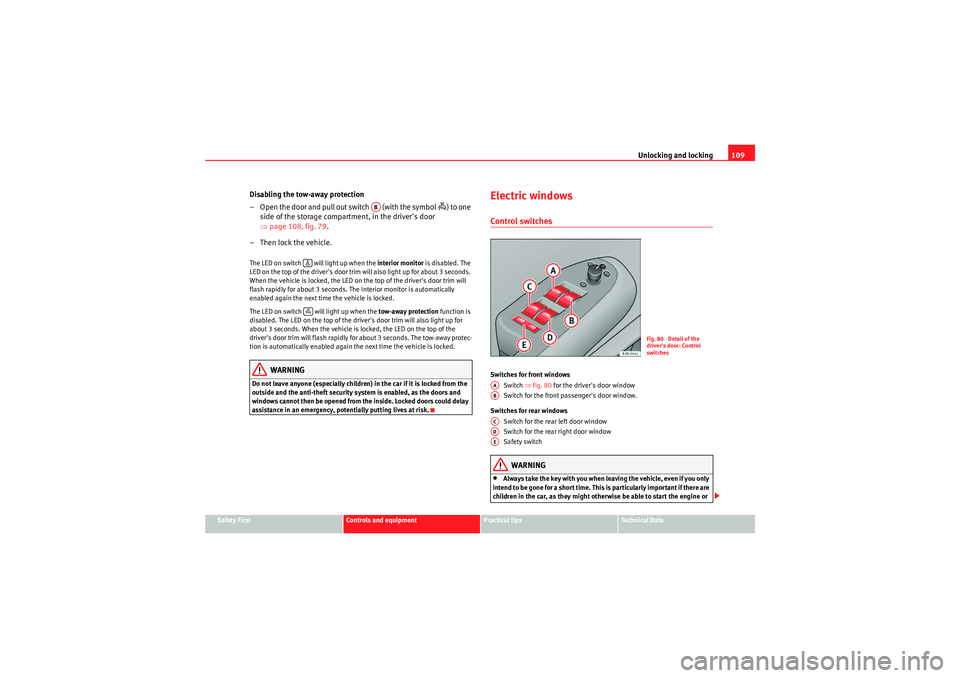
Electric windowsControl switchesSwitches for front windows
Switch ⇒fig. 80 for the driver's door window
Switch for the front passenger's door window.
Switches for rear windows Switch for the rear left door window
Switch for the rear right door window
Safety switch
WARNING
•Always take the key with you when leaving the vehicle, even if you only
intend to be gone for a short time. This is particularly important if there are
children in the car, as they might otherwise be able to start the engine or
AB
Fig. 80 Detail of the
driver's door: Control
switches
AAABACADAE
ExeoST_EN.book Seite 109 Donnerstag, 3. September 2009 12:24 12
Page 120 of 316
Lights and visibility
118headlight or anti-dazzle function from working correctly or even from working
at all.•The warning symbol
will appear on the instrument panel if a malfunc-
tion occurs ⇒ page 80.
•Observe all relevant legal requirements when using the signalling and
lighting systems described here.Front fog lights
The light switch can also be used to turn on the front fog
lights.Switching on the front fog lights
–Do
⇒ page 116, fig. 85 not turn the light switch to the symbol
.
– First turn the light switch to the position
or .
– Then pull the light switch out to the first stop .
The front fog light symbol
next to the switch will light up when the front fog
lights are on.
Rear fog light
The light switch can also be used to turn on the rear fog light.–Do
⇒ page 116, fig. 85 not turn the light switch to the symbol
. – First turn the light switch
⇒ page 116, fig. 85 to the position
or .
– Then pull out the light switch to the second stop to switch on the rear fog light.
The symbols
and
next to the switch will light up when the rear fog light
is switched on.
If you are towing a trailer or caravan equipped with a rear fog light on a vehicle
with a factory-fitted towing bracket*, only the rear fog light on the trailer or
caravan will light up.
Caution
To avoid dazzling the traffic behind you, the rear fog light should only be used
in accordance with legal regulations.
A1
A2
ExeoST_EN.book Seite 118 Donnerstag, 3. September 2009 12:24 12
Page 125 of 316
Lights and visibility123
Safety First
Controls and equipment
Practical tips
Technical Data
–Press the switch
⇒ page 122, fig. 92 to switch the hazard
warning lights on or off.
All four indicators flash simultaneously when the hazard warning lights are
switched on. The hazard warning light indication lamps
and the turn
signal indication lamp itself
flash at the same time. The hazard warning
lights also work when the ignition is switched off.
In an accident in which the airbags are triggered, the hazard warning lights
are switched on automatically.
Note
You should switch on the hazard warning lights to warn other road users, e.g.•When reaching the tail end of a traffic jam•If your vehicle breaks down or there is an emergency•If your vehicle is being towed away or if you are towing another vehicle
Indicator
and main beam headlight lever
The turn signal and main beam headlight lever also operates
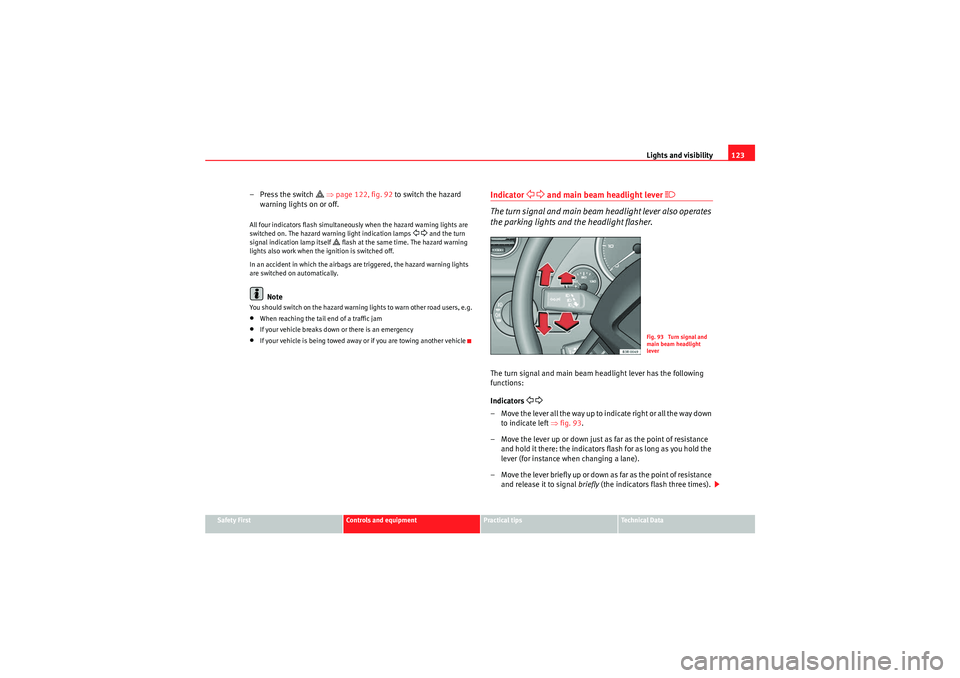
the parking lights and the headlight flasher.The turn signal and main beam headlight lever has the following
functions:
Indicators
– Move the lever all the way up to indicate right or all the way down to indicate left ⇒fig. 93 .
– Move the lever up or down just as far as the point of resistance and hold it there: the indicators flash for as long as you hold the
lever (for instance when changing a lane).
– Move the lever briefly up or down as far as the point of resistance and release it to signal briefly (the indicators flash three times).
Fig. 93 Turn signal and
main beam headlight
lever
ExeoST_EN.book Seite 123 Donnerstag, 3. September 2009 12:24 12
Page 126 of 316
Lights and visibility
124
Main beam headlights
– Press the lever forward to switch on the main beams.
– Pull the lever back towards you to switch the main beam head-lights off again.
Headlight flasher
– Pull the lever towards the steering wheel to operate the flasher.
Parking light
– Switch the ignition off.
– Move the lever up or down to turn on the right or left-hand
parking lights respectively.Notes on these functions•The indicators only work when the ignition is switched on. The indicator
lamp or flashes in the instrument panel when the turns signals
⇒ page 65 are working.
•The indicators are cancelled automatically when the steering wheel is
returned to the straight-ahead position.•The main beam headlights can only be switched on if the dipped beam
headlights are already on. The main beam headlight indicator lamp
then
comes on in the instrument panel.
•The headlight flasher co m es on fo r as long as you pull th e le ve r, ev en if n o
other lights are switched on. The main beam headlight indicator lamp
then comes on in the instrument panel.
•When the parking lights are switched on, the headlight and the rear light
on one side of the car light up with reduced intensity. The parking lights will
only work with the ignition off.
Caution
Never use the main beam headlights or the headlight flasher if this would
dazzle oncoming traffic.Interior lightsFront interior lights and glove compartment light
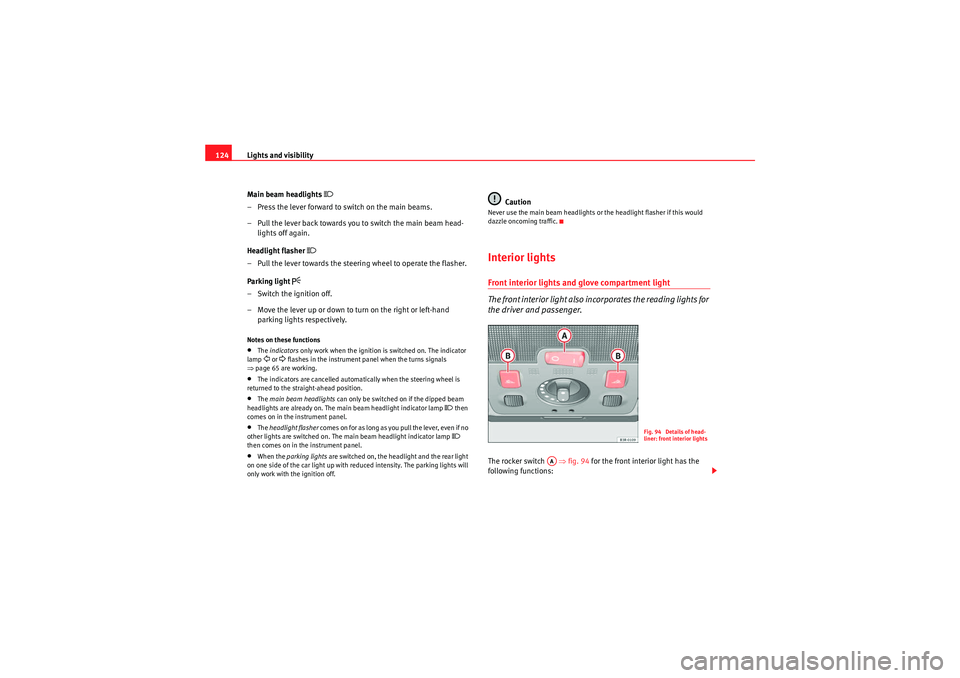
The front interior light also incorporates the reading lights for
the driver and passenger.The rocker switch ⇒ fig. 94 for the front interior light has the
following functions:
Fig. 94 Details of head-
liner: front interior lights
AA
ExeoST_EN.book Seite 124 Donnerstag, 3. September 2009 12:24 12
Page 129 of 316
Lights and visibility127
Safety First
Controls and equipment
Practical tips
Technical Data
VisibilityHeated rear window
The rear window heating clears the rear window of condensa-
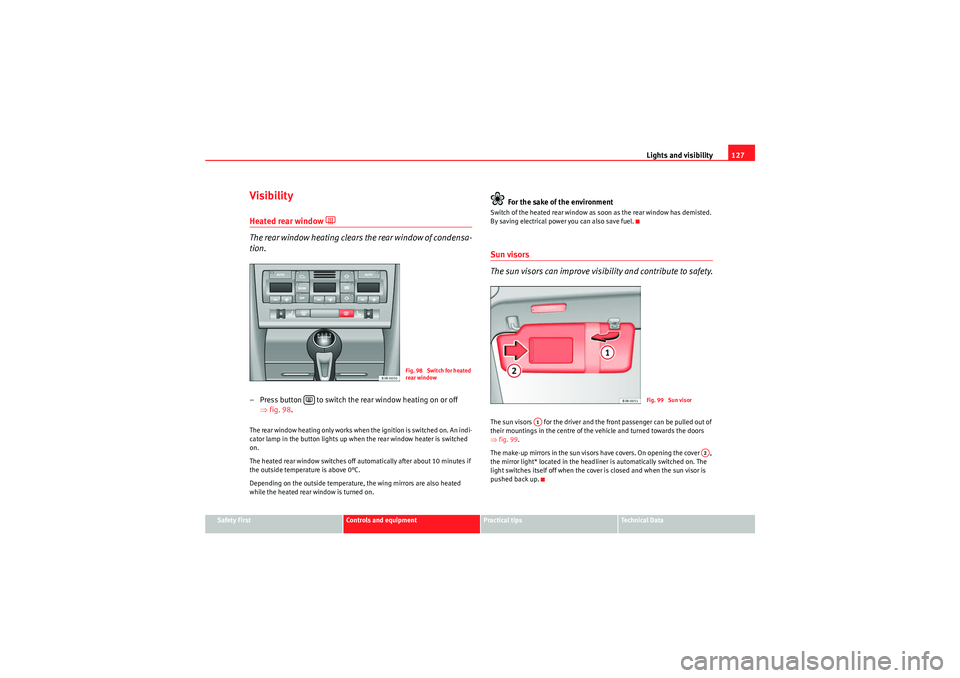
tion.– Press button to switch the rear window heating on or off
⇒fig. 98.The rear window heating only works when the ignition is switched on. An indi-
cator lamp in the button lights up when the rear window heater is switched
on.
The heated rear window switches off automatically after about 10 minutes if
the outside temperature is above 0°C.
Depending on the outside temperature, the wing mirrors are also heated
while the heated rear window is turned on.
For the sake of the environment
Switch of the heated rear window as soon as the rear window has demisted.
By saving electrical power you can also save fuel.Sun visors
The sun visors can improve visibility and contribute to safety.The sun visors for the driver and the front passenger can be pulled out of
their mountings in the centre of the vehicle and turned towards the doors
⇒fig. 99 .
The make-up mirrors in the sun visors have covers. On opening the cover ,
the mirror light* located in the headli ner is automatically switched on. The
light switches itself off when the cover is closed and when the sun visor is
pushed back up.
Fig. 98 Switch for heated
rear window
Fig. 99 Sun visor
A1
A2
ExeoST_EN.book Seite 127 Donnerstag, 3. September 2009 12:24 12
Page 131 of 316
Lights and visibility129
Safety First
Controls and equipment
Practical tips
Technical Data
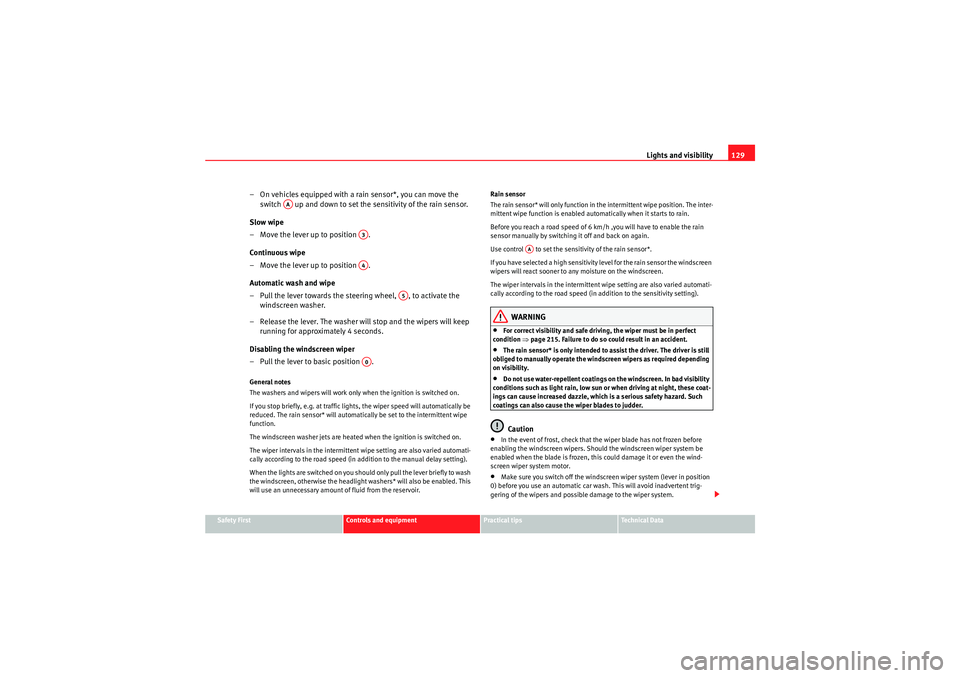
– On vehicles equipped with a rain sensor*, you can move the
switch up and down to set the sensitivity of the rain sensor.
Slow wipe
– Move the lever up to position .
Continuous wipe
– Move the lever up to position .
Automatic wash and wipe
– Pull the lever towards the steering wheel, , to activate the windscreen washer.
– Release the lever. The washer will stop and the wipers will keep running for approximately 4 seconds.
Disabling the windscreen wiper
– Pull the lever to basic position .General notes
The washers and wipers will work only when the ignition is switched on.
If you stop briefly, e.g. at traffic lights, the wiper speed will automatically be
reduced. The rain sensor* will automatically be set to the intermittent wipe
function.
The windscreen washer jets are heated when the ignition is switched on.
The wiper intervals in the intermittent wipe setting are also varied automati-
cally according to the road speed (in addition to the manual delay setting).
When the lights are switched on you should only pull the lever briefly to wash
the windscreen, otherwise the headlight washers* will also be enabled. This
will use an unnecessary amount of fluid from the reservoir. Rain sensor
The rain sensor* will only function in the intermittent wipe position. The inter-
mittent wipe function is enabled automatically when it starts to rain.
Before you reach a road speed of 6 km/h ,you will have to enable the rain
sensor manually by switching it off and back on again.
Use control to set the sensitivity of the rain sensor*.
If you have selected a high sensitivity level for the rain sensor the windscreen
wipers will react sooner to any moisture on the windscreen.
The wiper intervals in the intermittent wipe setting are also varied automati-
cally according to the road speed (in addition to the sensitivity setting).
WARNING
•For correct visibility and safe driving, the wiper must be in perfect
condition ⇒page 215. Failure to do so could result in an accident.•The rain sensor* is only intended to assist the driver. The driver is still
obliged to manually operate the windscreen wipers as required depending
on visibility.•Do not use water-repellent coatings on the windscreen. In bad visibility
conditions such as light rain, low sun or when driving at night, these coat-
ings can cause increased dazzle, which is a serious safety hazard. Such
coatings can also cause the wiper blades to judder.Caution
•In the event of frost, check that the wiper blade has not frozen before
enabling the windscreen wipers. Should the windscreen wiper system be
enabled when the blade is frozen, this could damage it or even the wind-
screen wiper system motor.•Make sure you switch off the windscreen wiper system (lever in position
0) before you use an automatic car wash. This will avoid inadvertent trig-
gering of the wipers and possible damage to the wiper system.
AA
A3A4
A5
A0
AA
ExeoST_EN.book Seite 129 Donnerstag, 3. September 2009 12:24 12
Page 133 of 316
Lights and visibility131
Safety First
Controls and equipment
Practical tips
Technical Data
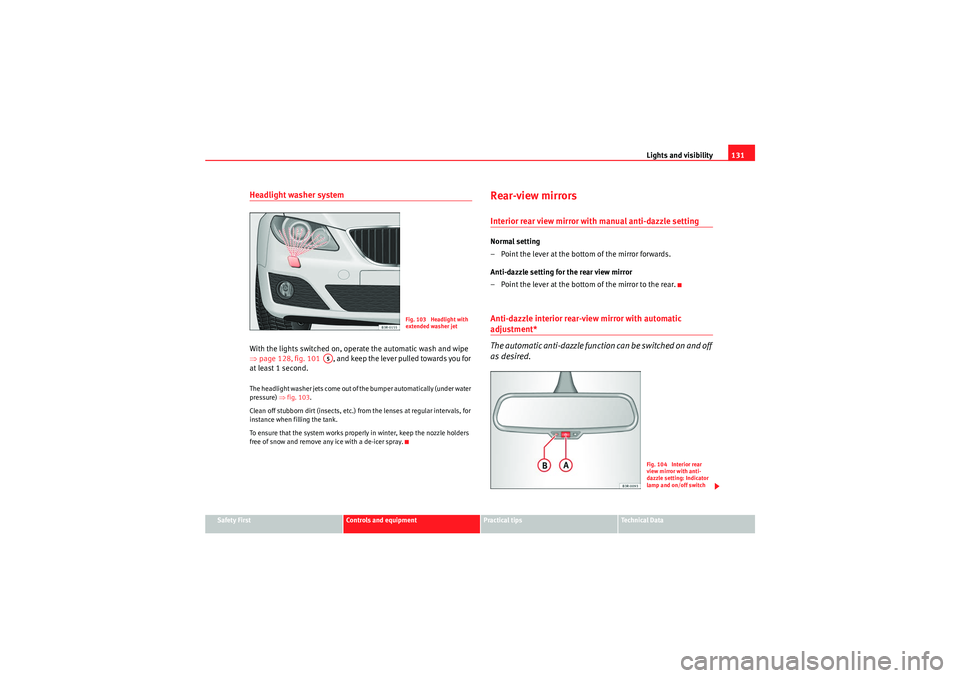
Headlight washer systemWith the lights switched on, operate the automatic wash and wipe
⇒page 128, fig. 101 , and keep the lever pulled towards you for
at least 1 second.The headlight washer jets come out of the bumper automatically (under water
pressure) ⇒fig. 103 .
Clean off stubborn dirt (insects, etc.) from the lenses at regular intervals, for
instance when filling the tank.
To ensure that the system works properly in winter, keep the nozzle holders
free of snow and remove any ice with a de-icer spray.
Rear-view mirrorsInterior rear view mirror wi th manual anti-dazzle settingNormal setting
– Point the lever at the bottom of the mirror forwards.
Anti-dazzle setting for the rear view mirror
– Point the lever at the bottom of the mirror to the rear.Anti-dazzle interior rear-view mirror with automatic adjustment*
The automatic anti-dazzle function can be switched on and off
as desired.
Fig. 103 Headlight with
extended washer jet
A5
Fig. 104 Interior rear
view mirror with anti-
dazzle setting: Indicator
lamp and on/off switch
ExeoST_EN.book Seite 131 Donnerstag, 3. September 2009 12:24 12
Page 136 of 316
Seats and stowage
134Seats and stowageManual adjustment of the front seatsSeat adjuster controls
There are several seat adjustment functions for your conven-
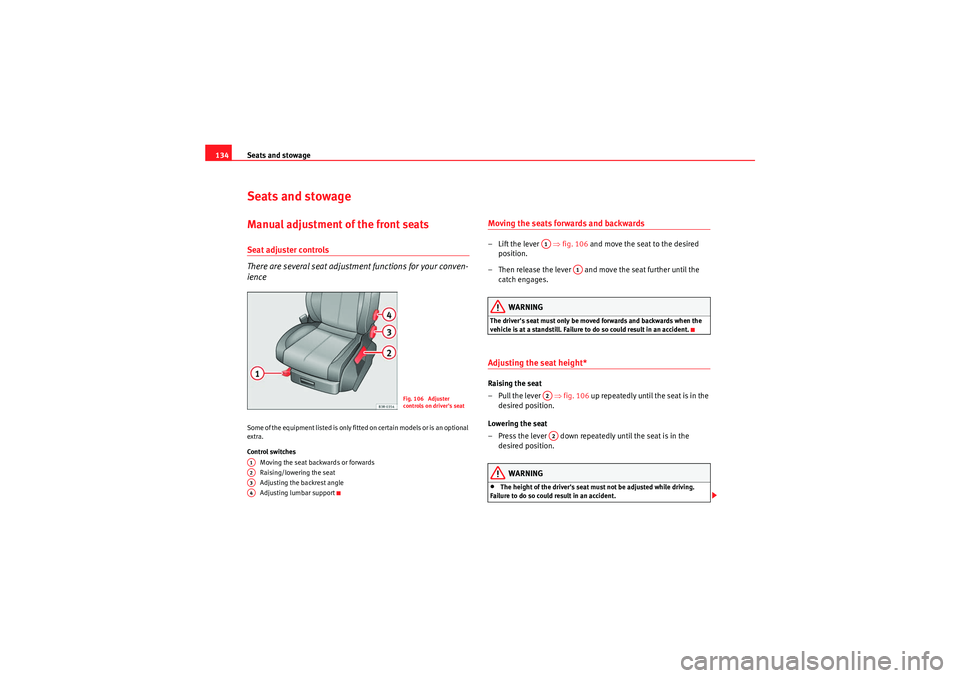
ienceS o m e o f t h e e q u i p m e n t l is t e d is o n l y f i t t e d o n ce r ta i n m o d e l s o r is a n o p t i o na l
extra.
Control switches
Moving the seat backwards or forwards
Raising/lowering the seat
Adjusting the backrest angle
Adjusting lumbar support
Moving the seats forwards and backwards– Lift the lever ⇒fig. 106 and move the seat to the desired
position.
– Then release the lever and move the seat further until the catch engages.
WARNING
The driver's seat must only be moved forwards and backwards when the
vehicle is at a standstill. Failure to do so could result in an accident.Adjusting the seat height*Raising the seat
– Pull the lever ⇒ fig. 106 up repeatedly until the seat is in the
desired position.
Lowering the seat
– Press the lever down repeatedly until the seat is in the desired position.
WARNING
•The height of the driver's seat must not be adjusted while driving.
Failure to do so could result in an accident.
Fig. 106 Adjuster
controls on driver's seat
A1A2A3A4
A1
A1
A2A2
ExeoST_EN.book Seite 134 Donnerstag, 3. September 2009 12:24 12
Page 137 of 316
Seats and stowage135
Safety First
Controls and equipment
Practical tips
Technical Data
•Be careful when adjusting the seat height. Injuries can be caused if the
height is adjusted without due care and attention.
Adjusting the backrest angle– Lean forwards to take your weight off the backrest.
– Turn the adjuster wheel ⇒ page 134, fig. 106 to set the angle
of the backrest as required.
WARNING
The front backrests must not be reclined for driving. Otherwise, safety
belts and the airbag system might not protect as they should, with the
subsequent danger of injury.Adjusting lumbar support*– Do not exert any pressure on the backrest and turn adjuster wheel ⇒page 134, fig. 106 to adjust lumbar support.As you make the adjustments, the curvature of the cushioned area of the
lumbar region becomes more or less acute. In this way, it adapts to the
natural curvature of the spine.
WARNING (continued)
A3
A4
ExeoST_EN.book Seite 135 Donnerstag, 3. September 2009 12:24 12