tow Seat Exeo ST 2009 Workshop Manual
[x] Cancel search | Manufacturer: SEAT, Model Year: 2009, Model line: Exeo ST, Model: Seat Exeo ST 2009Pages: 316, PDF Size: 8.83 MB
Page 194 of 316

Intelligent technology
192Traction control system (TCS)
The traction control system prevents the drive wheels from
spinning when the car is accelerating.General notes
The traction control system (TCS) is one of the functions incorporated in the
electronic stabilisation programme (ESP).
The traction control system (TCS) helps the car to start moving, accelerate or
climb a gradient in slippery conditions where this may otherwise be difficult
or even impossible.
How it works
The TCS acts automatically, i.e. without the driver's intervention. With the aid
of the ABS sensors ⇒page 190, the TCS monitors the speed of the driven
wheels. If the wheels start to spin, the engine power is reduced automatically
to match the amount of grip available. The system is active across the entire
speed range.
The TCS works in conjunction with the ABS. If a malfunction occurs in the ABS,
the TCS will also be inoperative.
Note
To ensure that the TCS works properly, all four wheels must be fitted with
identical tyres. The difference in size of the wheels may lead to an undesired
reduction in engine power. Also see ⇒page 248.
BrakesGeneral notesNew brake pads
New brake pads do not provide optimal performance during the first 200 km
they must be “run in”. However, the reduced braking capacity may be
compensated by pressing on the brake pedal a little harder. Avoid over-
loading the brakes during run-in.
Wear
T h e r a t e o f we a r o n t h e brake pads depends a great deal on how you drive and
the conditions in which the vehicle is operated. Negative factors are, for
instance, city traffic, frequent short trips or hard driving with abrupt starts
and stops.
Wet roads; road salt
In certain conditions, such as in heavy rain, or after washing the car or driving
through water, the full braking effect can be delayed by moisture (or in winter
by ice) on the discs and brake pads. The brakes should be “dried” by pressing
the pedal to restore full braking effect.
When the velocity is over 80 km/h windscreen wipers are on, the brake
system moves the pads towards the brake discs for a few seconds. This
occurs - without warning to the driver - at regular intervals and requires a
more rapid response from the brakes when driving on wet roads.
The effectiveness of the brakes can also be temporarily reduced if the car is
driven for some distance without using the brakes when there is a lot of salt
on the road in winter. In this case, the layer of salt on the brake discs and pads
has to wear off before braking.
ExeoST_EN.book Seite 192 Donnerstag, 3. September 2009 12:24 12
Page 195 of 316
Intelligent technology193
Safety First
Controls and equipment
Practical tips
Technical Data
Corrosion
There may be a tendency for dirt to build up on the brake pads and corrosion
to form on the discs if the car is used infrequently, or if you only drive low
mileages without using the brakes very much.
If the brakes are not used frequently, or if rust has formed on the disks, it is
advisable to clean off the pads and disks by braking firmly a few times from a
moderately high speed
⇒.
Faults in the brake system
If the brake pedal travel should ever increase suddenly, this may mean that
one of the two brake circuits has failed. Drive immediately to the nearest qual-
ified workshop and have the fault rectified. On the way to the dealer, be
prepared to use more pressure on the brake pedal, and allow for longer stop-
ping distances.
Low brake fluid level
Malfunctions can occur in the brake system if the brake fluid level is too low.
The brake fluid level is monitored electronically.
WARNING
When applying the brakes to clean off deposits on the pads and discs,
select a clear, dry road. Be sure not to inconvenience or endanger other
road users. Risk of accident.
Caution
•Never let the brakes “drag” by leaving your foot on the pedal when you do
not really intend to brake. This overheats the brakes, resulting in longer stop-
ping distances and greater wear.•Before driving down a long, steep gradient, it is advisable to reduce speed
and change to a lower gear (or move the selector lever to a lower gear position
if your car has automatic transmission). This makes use of engine braking and prolongs the service life of the brakes. If you still have to use the brakes,
it is better to brake firmly at intervals than to apply the brakes continuously.
Note
If you wish to equip the car with accessories such as a front spoiler or wheel
covers, it is important that the flow of air to the front wheels is not obstructed,
otherwise the brakes can overheat.Brake servo
The brake servo assists the driver when brakingThe brake servo amplifies the pressure you apply to the brake pedal. The
brake servo works only when the engine is running.
WARNING
Ensure the vehicle does not move while in neutral, when the motor is
stopped. Failure to do so could result in an accident.
Note
If the brake servo is not working, e.g. because the vehicle has to be towed or
because it is broken, you will have to press the brake pedal considerably
harder to make up for the lack of servo assistance.
ExeoST_EN.book Seite 193 Donnerstag, 3. September 2009 12:24 12
Page 196 of 316
Intelligent technology
194Power steeringThe power steering assists the driver when turning the
steering wheel (with the engine running).The power steering assists the driver by reducing the force needed to turn the
steering wheel.
The power steering does not work if the engine is off. In this case the steering
wheel is very hard to turn.
If the steering is held at its turning limit when the car is stationary, this will
place an excessive load on the power steering system. Turning the steering
wheel to its limit places a load on the system, which causes noise. It will also
reduce the idling speed of the engine.
Caution
When the engine is running, do not turn the steering wheel to its limit for
more than 15 seconds. Otherwise, there is a risk of damaging the power
steering.
Note
•If the power steering should fail at any time or the engine is switched off
(for instance when being towed), the car can still be steered. However, more
effort will be required to turn the steering wheel.•If the system is leaking or malfunctioning, please take the car to a quali-
fied workshop as soon as possible.•The power steering requires a special hydraulic fluid. The fluid reservoir is
located at the front of the engine compartment on the left ⇒ page 295. The
correct fluid level in the reservoir is important for the power steering to func-
tion properly. The hydraulic fluid level is checked at the Inspection Service.
ServotronicThe servotronic system electronically adjusts the degree of
power assistanceIn cars equipped with servotronic power steering the degree of power assist-
ance ⇒page 194 is adjusted electronically according to road speed.
If a fault should occur in the servotronic system, the power steering will still
operate. The degree of power assistance will, however, no longer adapt to
different speeds. If the electronic regulating system is not working properly,
this is most noticeable when turning the steering wheel at low speeds (for
instance when parking) – more effort will be required than usual. The fault
should be corrected by a qualified workshop as soon as possible.
ExeoST_EN.book Seite 194 Donnerstag, 3. September 2009 12:24 12
Page 197 of 316
Driving and the environment195
Safety First
Controls and equipment
Practical tips
Technical Data
Driving and the environmentRunning-inRunning in a new engine
The engine needs to be run-in over the first 1,500 km.Up to 1,000 kilometres
– Do not drive at speeds of more than 2/3 the maximum speed.
– Do not accelerate hard.
– Avoid high engine revolutions.
– Do not tow a trailer.
From 1000 to 1500 km
– Speeds can be gradually increased to the maximum road speed
or maximum permissible engine speed (rpm).During its first few hours of running, the internal friction in the engine is
greater than later on, when all the moving parts have bedded in.
For the sake of the environment
If the engine is run in gently, its life will be increased and its oil consumption,
reduced.
Braking effect and braking distance
The braking effect and braking distance are influenced by
driving situations and road conditions.The efficiency of the brakes depends directly on the brake pad wear. The rate
of wear of the brake pads depends to a great extent on the conditions under
which the vehicle is operated and the way the vehicle is driven. If you often
drive in town traffic, drive short distances or have a sporty driving style, we
recommend that you have the thickness of your brake pads checked by an
Authorised Service Centre more frequently than recommended in the Ser vice
Schedule.
If you drive with wet brakes, for example, after crossing areas of water, in
heavy rainfall or even after washing the car, the effect of the brakes is less-
ened as the brake discs are wet or even frozen (in winter): The brakes should
be “dried” by pressing the pedal to restore full braking effect.
WARNING
Longer braking distances and faults in the brake system increase the risk
of accidents.•New brake pads must be run in and do not have the correct friction
during the first 200 km. However, the reduced braking capacity may be
compensated by pressing on the brake pedal a little harder. This also
applies when new brake pads are fitted.•If brakes are wet or frozen, or if you are driving on roads which have
been gritted with salt, braking power may set in later than normal.•On steep slopes, if brakes are excessively used, they will overheat.
Before driving down a long steep slope, it is advisable to reduce speed and
change down into a lower gear (or move the selector lever to a lower gear if
ExeoST_EN.book Seite 195 Donnerstag, 3. September 2009 12:24 12
Page 198 of 316
Driving and the environment
196your vehicle has automatic transmission). This makes use of engine
braking and relieves the brakes.•Never let the brakes “slip” by applying light pressure. Continuous
braking will cause the brakes to overheat and the braking distance will
increase. Apply and then release the brakes alternately.•Never let the vehicle run with the engine switched off. The braking
distance is increased considerably when the brake servo is not active.•Very heavy use of the brakes may cause a vapour lock if the brake fluid
is left in the system for too long. This impairs the braking effect.•Non-standard or damaged front spoilers could restrict the airflow to the
brakes and cause them to overheat. Observe the relevant instructions
before purchasing accessories ⇒ page 220, “Technical modifications”.•If a brake circuit fails, the braking distance will be increased consider-
ably. Contact a qualified workshop immediately and avoid unnecessary
journeys.
Exhaust gas purification systemCatalytic converter*To conserve the useful life of the catalytic converter
– Always use unleaded petrol.
– Do not let the fuel get too low in the tank.
– For engine oil changes, do not replenish with too much engine oil ⇒page 230. – Never tow the vehicle to start it, use jump leads if necessary
⇒page 285.
If you notice misfiring, uneven running or loss of power when the vehicle is
moving, reduce speed immediately and have the vehicle inspected at the
nearest qualified workshop. In general, the exhaust warning lamp will light
up when any of the described symptoms occur ⇒page 66. If this happens,
unburnt fuel can enter the exhaust system and escape into the environment.
The catalytic converter can also be damaged by overheating.
WARNING
The catalytic converter reaches very high temperatures! Fire hazard!•Never park where the catalytic converter could come into contact with
dry grass or inflammable materials under the vehicle.•Do not apply additional underseal or anti-corrosion coatings to the
exhaust pipes, catalytic converter or the heat shields on the exhaust
system. These materials could catch fire when the vehicle is being driven.Caution
Never fully drain the fuel tank because the irregularity of the fuel supply may
cause ignition problems. This allows unburnt fuel to enter the exhaust
system, which could cause overheating and damage the catalytic converter.
For the sake of the environment
Even when the emission control system is working perfectly, there may be a
smell of sulphur from the exhaust under some conditions. This depends on
the sulphur content of the fuel used. Quite often the problem can be solved
by changing to another brand of fuel.
WARNING (continued)
ExeoST_EN.book Seite 196 Donnerstag, 3. September 2009 12:24 12
Page 202 of 316
Trailer towing
200Trailer towingTrailer towingTechnical requirements
The towing bracket must meet certain technical requirements.Your car is intended mainly for transporting passengers and luggage.
However, if suitably equipped, it can also be used to tow a trailer or caravan.
If your vehicle has been factory -supplied with a towing bracket, all of the
necessary technical and legal aspects for trailing towing have been taking
into account during manufacturing.
Your vehicle is fitted with a 13-pole socket for the electrical connection
between the trailer and the vehicle. If the trailer has a 7-pole connector you
can use an adapter cable. This can be purchased from any SEAT Dealer.
If a towing bracket is to be fitted after the car is purchased, this must be done
according to the instructions of the towing bracket manufacturer
⇒ page 209.
WARNING
If a towing bracket is retrofitted, the installation should be carried out by a
specialist garage.•Particularly in high outdoor temperatures, it is not possible to drive up
long steep gradients without a suitable cooling system. The engine would
heat up.•Incorrect installation can result in a safety risk!
Notes on towing
There are a number of points which need to be checked before
towing a trailer or caravan.– Observe the maximum permitted trailer weights ⇒page 295.Trailer weights
Never exceed the maximum permitted trailer weights.
If you do not load the trailer up to the maximum permitted trailer weight, you
can then climb correspondingly steeper gradients.
The maximum trailer weights listed are only applicable for altitudes up to
1,000 m above sea level. With increa sing altitude the engine power and
therefore the vehicle's climbing ability are impaired because of the reduced
air density. The maximum trailer weight has to be reduced accordingly. The
weight of the car and trailer must be reduced by about 10% for every subse-
quent 1000 m (or part thereof). This figure refers to the combined weight of
the (loaded) vehicle and (loaded) trailer.
The figures for the draw bar weight that appear on the identification plate of
the towing bracket are for certification purposes only. The correct figures for
your specific model, which may be lower than these figures for the towing
bracket, are given in the registration documents and on ⇒page 288. Also
refer to ⇒page 295.
Distributing the load
Distribute loads in the trailer so that heavy objects are as near to the axle as
possible. Loads carried in the trailer must be secured to prevent them
moving.
ExeoST_EN.book Seite 200 Donnerstag, 3. September 2009 12:24 12
Page 203 of 316
Trailer towing201
Safety First
Controls and equipment
Practical tips
Technical Data
Where possible, operate the trailer with the maximum permitted
draw bar
weight on the ball joint of the towing bracket, but do not exceed the specified
limit.
Tyre pressure
Check the tyre pressures on your car, and adjust for “full load” conditions
(refer to the sticker listing the tyre pressures on the door pillar). It may also be
necessary to adjust the tyre pressures on the trailer according to the recom-
mendations of the trailer manufacturer.
Exterior mirrors
Check whether you can see enough of the road behind the trailer with the
standard mirrors. If this is not the case you should have additional mirrors
fitted. The two exterior mirrors should be fitted on folding arms. Adjust the
mirrors to give sufficient rear vision.
Headlights
Before starting a journey, check the headlight beam settings with the trailer
hitched up. If necessary, alter the height of the headlight beams by means of
the headlight range control. See ⇒page 120.
Power supply
When you remove the ignition key, the power supply to the trailer is inter-
rupted.
Removable ball joint coupling
Vehicles with a factory-fitted towing bracket are equipped with a removable
ball joint coupling. This is stored in the spare wheel well in the luggage
compartment together with the necessary fitting instructions.
Note
If you frequently tow, we recommend you also have vehicle ser viced between
services.
Notes on towing
Towing a trailer involves additional attention by the driver.Weight distribution
The weight distribution of a loaded trailer with an unladen vehicle is very
unfavourable. However, if this cannot be avoided, drive extra slowly to allow
for the unbalanced weight distribution.
Speed
The stability of the car and trailer is reduced with increasing speed. Therefore,
it is advisable not to drive at the maximum permissible speed in an unfavour-
able road, weather or wind conditions. This especially applies when driving
downhill.
You should always reduce speed immediately if the trailer shows the slightest
sign of swaying . Never try to stop the “snaking” by increasing speed.
Anticipate hazards and brake in good time. If towing a trailer with an inertia
brake , first brake gently and then more severely. This will prevent brake
tapping by the trailer wheels when they lock. Select a low gear in due course
before going down a steep downhill. This enables you to use the engine
braking to slow down the vehicle.
Swaying and pitching can be reduced by stabiliser aids. We recommend
having stabiliser aids installed when towing trailers with a high trailer load.
They can be purchased and installed at a Dealer.
Reheating
When climbing long hills in hot weather with the engine running fast in low
gear, you should keep an eye on the coolant temperature gauge ⇒page 60.
Reduce speed immediately if the needle moves to the right end of the scale.
If the temperature warning light
in the instrument cluster should start
flashing, stop the car and let the engine cool down by running it at idling
speed for a few minutes.
ExeoST_EN.book Seite 201 Donnerstag, 3. September 2009 12:24 12
Page 204 of 316
Trailer towing
202Equipment and accessories
Before mounting equipment and accessories (e.g. bicycle
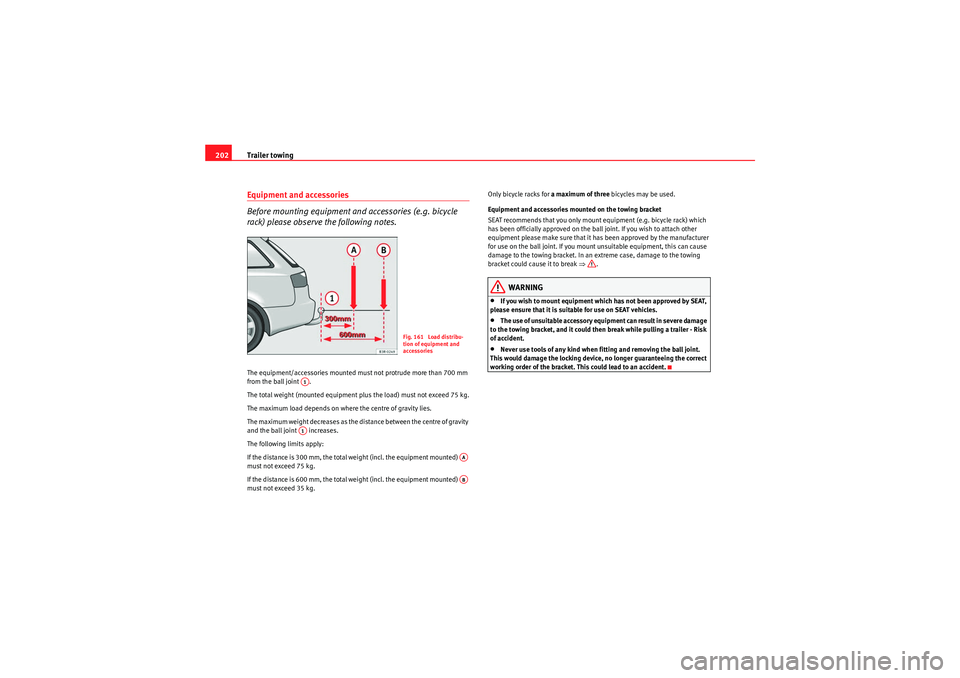
rack) please observe the following notes.The equipment/accessories mounted mu st not protrude more than 700 mm
from the ball joint .
The total weight (mounted equipment plus the load) must not exceed 75 kg.
The maximum load depends on where the centre of gravity lies.
The maximum weight decreases as the distance between the centre of gravity
and the ball joint increases.
The following limits apply:
If the distance is 300 mm, the total weight (incl. the equipment mounted)
must not exceed 75 kg.
If the distance is 600 mm, the total weight (incl. the equipment mounted)
must not exceed 35 kg. Only bicycle racks for
a maximum of three bicycles may be used.
Equipment and accessories mounted on the towing bracket
SEAT recommends that you only mount equipment (e.g. bicycle rack) which
has been officially approved on the ball joint. If you wish to attach other
equipment please make sure that it has been approved by the manufacturer
for use on the ball joint. If you mount unsuitable equipment, this can cause
damage to the towing bracket. In an extreme case, damage to the towing
bracket could cause it to break ⇒ .
WARNING
•If you wish to mount equipment which has not been approved by SEAT,
please ensure that it is suitable for use on SEAT vehicles.•The use of unsuitable accessory equipment can result in severe damage
to the towing bracket, and it could then break while pulling a trailer - Risk
of accident.•Never use tools of any kind when fitting and removing the ball joint.
This would damage the locking device, no longer guaranteeing the correct
working order of the bracket. This could lead to an accident.
Fig. 161 Load distribu-
tion of equipment and
accessories
A1A1
AAAB
ExeoST_EN.book Seite 202 Donnerstag, 3. September 2009 12:24 12
Page 205 of 316
Trailer towing203
Safety First
Controls and equipment
Practical tips
Technical Data
Removable towing bracketIntroduction
Special care is required when fitting and removing the towing
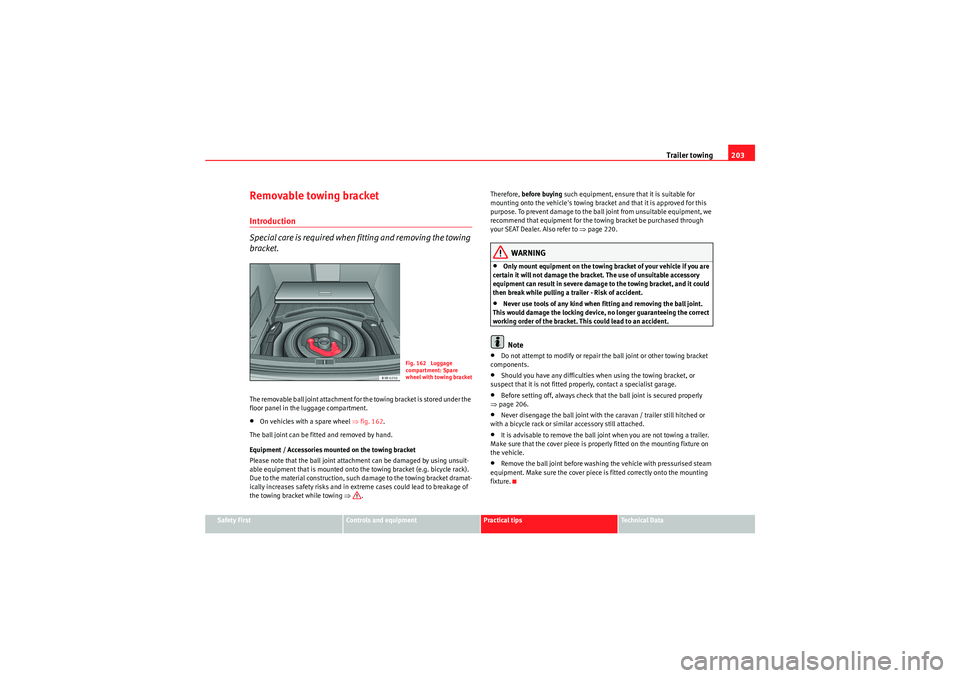
bracket.The removable ball joint attachment for the towing bracket is stored under the
floor panel in the luggage compartment.•On vehicles with a spare wheel ⇒fig. 162 .
The ball joint can be fitted and removed by hand.
Equipment / Accessories mounted on the towing bracket
Please note that the ball joint attachment can be damaged by using unsuit-
able equipment that is mounted onto the towing bracket (e.g. bicycle rack).
Due to the material construction, such damage to the towing bracket dramat-
ically increases safety risks and in extreme cases could lead to breakage of
the towing bracket while towing ⇒. Therefore,
before buying such equipment, ensure that it is suitable for
mounting onto the vehicle's towing bracket and that it is approved for this
purpose. To prevent damage to the ball joint from unsuitable equipment, we
recommend that equipment for the towing bracket be purchased through
your SEAT Dealer. Also refer to ⇒page 220.
WARNING
•Only mount equipment on the towing bracket of your vehicle if you are
certain it will not damage the bracket. The use of unsuitable accessory
equipment can result in severe damage to the towing bracket, and it could
then break while pulling a trailer - Risk of accident.•Never use tools of any kind when fitting and removing the ball joint.
This would damage the locking device, no longer guaranteeing the correct
working order of the bracket. This could lead to an accident.Note
•Do not attempt to modify or repair the ball joint or other towing bracket
components.•Should you have any difficulties when using the towing bracket, or
suspect that it is not fitted properly, contact a specialist garage.•Before setting off, always check that the ball joint is secured properly
⇒ page 206.•Never disengage the ball joint with the caravan / trailer still hitched or
with a bicycle rack or similar accessory still attached.•It is advisable to remove the ball joint when you are not towing a trailer.
Make sure that the cover piece is properly fitted on the mounting fixture on
the vehicle.•Remove the ball joint before washing the vehicle with pressurised steam
equipment. Make sure the cover piece is fitted correctly onto the mounting
fixture.
Fig. 162 Luggage
compartment: Spare
wheel with towing bracket
ExeoST_EN.book Seite 203 Donnerstag, 3. September 2009 12:24 12
Page 206 of 316
Trailer towing
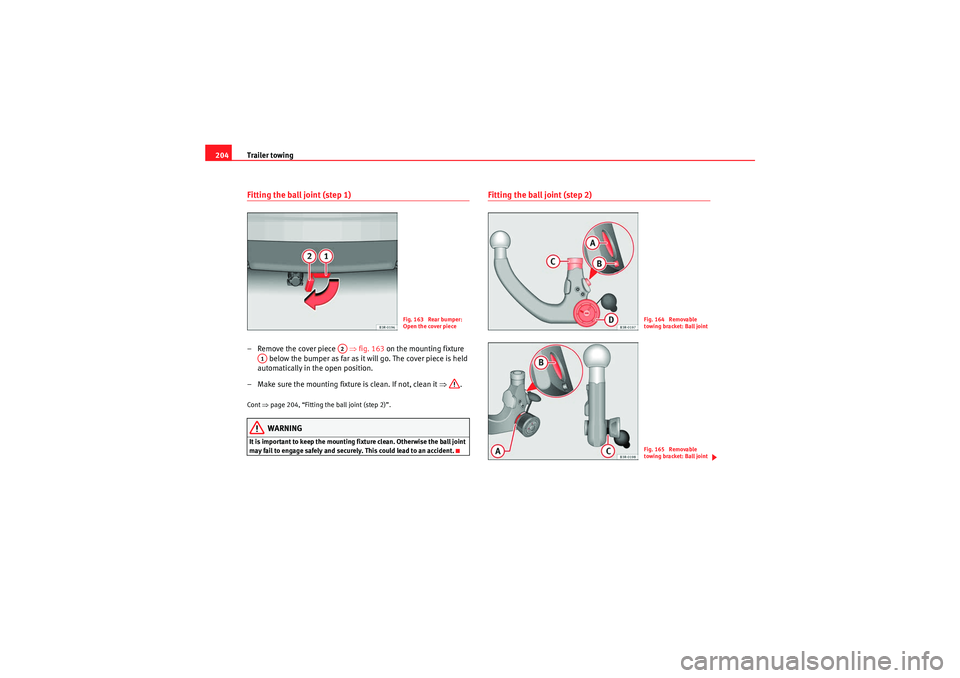
204Fitting the ball joint (step 1)– Remove the cover piece ⇒fig. 163 on the mounting fixture
below the bumper as far as it will go. The cover piece is held
automatically in the open position.
– Make sure the mounting fixture is clean. If not, clean it ⇒.Cont ⇒page 204, “Fitting the ball joint (step 2)”.
WARNING
It is important to keep the mounting fixture clean. Otherwise the ball joint
may fail to engage safely and securely. This could lead to an accident.
Fitting the ball joint (step 2)
Fig. 163 Rear bumper:
Open the cover piece
A2
A1
Fig. 164 Removable
towing bracket: Ball jointFig. 165 Removable
towing bracket: Ball joint
ExeoST_EN.book Seite 204 Donnerstag, 3. September 2009 12:24 12