tow bar Seat Exeo ST 2009 User Guide
[x] Cancel search | Manufacturer: SEAT, Model Year: 2009, Model line: Exeo ST, Model: Seat Exeo ST 2009Pages: 316, PDF Size: 8.83 MB
Page 179 of 316

Driving177
Safety First
Controls and equipment
Practical tips
Technical Data
Enabling/DisablingEnabling
– Engage reverse gear or
– Press the button
on the central console ⇒fig. 150 or on the
gear selector gate. You will hear a brief acknowledgement tone
and the LED on the switch will light up.
Disabling
– Drive forwards faster than 10 km/h, or
– Press the button or
– disconnect the on button or
– go out of reverse gear.
WARNING
•The parking aid is not a replacement for driver awareness. The driver is
personally responsible for safe parking and other manoeuvres.•The sensors have blind spots in which obstacles are not registered.
Always look out for small children and animals because the system will not
always detect them. Always pay attention when reversing to avoid acci-
dents.•Always keep a close eye on the area around the vehicle and make full
use of the rear-view mirrors.Caution
Please note that low obstacles detected by the system may no longer be
registered by the sensors as the car moves closer, so the system will not give
any further warning. Certain kinds of obstacles (such as wire fences, chains,
thin painted posts or trailer draw bars, etc) may not always be detected by the
system, so take care not to damage the vehicle in such cases.
Note
•Please refer to the notes on towing ⇒page 177.•There is a slight delay in the picture display.To w i n g b r a c k e t *In towing mode, the rear parking sensors are not enabled when you select
reverse gear or press the switch
. This function may not be guaranteed on
towing brackets that are not factory fitted. This results in the following restric-
tions:
Fig. 150 Centre console:
switch for parking aid
ExeoST_EN.book Seite 177 Donnerstag, 3. September 2009 12:24 12
Page 202 of 316
Trailer towing
200Trailer towingTrailer towingTechnical requirements
The towing bracket must meet certain technical requirements.Your car is intended mainly for transporting passengers and luggage.
However, if suitably equipped, it can also be used to tow a trailer or caravan.
If your vehicle has been factory -supplied with a towing bracket, all of the
necessary technical and legal aspects for trailing towing have been taking
into account during manufacturing.
Your vehicle is fitted with a 13-pole socket for the electrical connection
between the trailer and the vehicle. If the trailer has a 7-pole connector you
can use an adapter cable. This can be purchased from any SEAT Dealer.
If a towing bracket is to be fitted after the car is purchased, this must be done
according to the instructions of the towing bracket manufacturer
⇒ page 209.
WARNING
If a towing bracket is retrofitted, the installation should be carried out by a
specialist garage.•Particularly in high outdoor temperatures, it is not possible to drive up
long steep gradients without a suitable cooling system. The engine would
heat up.•Incorrect installation can result in a safety risk!
Notes on towing
There are a number of points which need to be checked before
towing a trailer or caravan.– Observe the maximum permitted trailer weights ⇒page 295.Trailer weights
Never exceed the maximum permitted trailer weights.
If you do not load the trailer up to the maximum permitted trailer weight, you
can then climb correspondingly steeper gradients.
The maximum trailer weights listed are only applicable for altitudes up to
1,000 m above sea level. With increa sing altitude the engine power and
therefore the vehicle's climbing ability are impaired because of the reduced
air density. The maximum trailer weight has to be reduced accordingly. The
weight of the car and trailer must be reduced by about 10% for every subse-
quent 1000 m (or part thereof). This figure refers to the combined weight of
the (loaded) vehicle and (loaded) trailer.
The figures for the draw bar weight that appear on the identification plate of
the towing bracket are for certification purposes only. The correct figures for
your specific model, which may be lower than these figures for the towing
bracket, are given in the registration documents and on ⇒page 288. Also
refer to ⇒page 295.
Distributing the load
Distribute loads in the trailer so that heavy objects are as near to the axle as
possible. Loads carried in the trailer must be secured to prevent them
moving.
ExeoST_EN.book Seite 200 Donnerstag, 3. September 2009 12:24 12
Page 203 of 316
Trailer towing201
Safety First
Controls and equipment
Practical tips
Technical Data
Where possible, operate the trailer with the maximum permitted
draw bar
weight on the ball joint of the towing bracket, but do not exceed the specified
limit.
Tyre pressure
Check the tyre pressures on your car, and adjust for “full load” conditions
(refer to the sticker listing the tyre pressures on the door pillar). It may also be
necessary to adjust the tyre pressures on the trailer according to the recom-
mendations of the trailer manufacturer.
Exterior mirrors
Check whether you can see enough of the road behind the trailer with the
standard mirrors. If this is not the case you should have additional mirrors
fitted. The two exterior mirrors should be fitted on folding arms. Adjust the
mirrors to give sufficient rear vision.
Headlights
Before starting a journey, check the headlight beam settings with the trailer
hitched up. If necessary, alter the height of the headlight beams by means of
the headlight range control. See ⇒page 120.
Power supply
When you remove the ignition key, the power supply to the trailer is inter-
rupted.
Removable ball joint coupling
Vehicles with a factory-fitted towing bracket are equipped with a removable
ball joint coupling. This is stored in the spare wheel well in the luggage
compartment together with the necessary fitting instructions.
Note
If you frequently tow, we recommend you also have vehicle ser viced between
services.
Notes on towing
Towing a trailer involves additional attention by the driver.Weight distribution
The weight distribution of a loaded trailer with an unladen vehicle is very
unfavourable. However, if this cannot be avoided, drive extra slowly to allow
for the unbalanced weight distribution.
Speed
The stability of the car and trailer is reduced with increasing speed. Therefore,
it is advisable not to drive at the maximum permissible speed in an unfavour-
able road, weather or wind conditions. This especially applies when driving
downhill.
You should always reduce speed immediately if the trailer shows the slightest
sign of swaying . Never try to stop the “snaking” by increasing speed.
Anticipate hazards and brake in good time. If towing a trailer with an inertia
brake , first brake gently and then more severely. This will prevent brake
tapping by the trailer wheels when they lock. Select a low gear in due course
before going down a steep downhill. This enables you to use the engine
braking to slow down the vehicle.
Swaying and pitching can be reduced by stabiliser aids. We recommend
having stabiliser aids installed when towing trailers with a high trailer load.
They can be purchased and installed at a Dealer.
Reheating
When climbing long hills in hot weather with the engine running fast in low
gear, you should keep an eye on the coolant temperature gauge ⇒page 60.
Reduce speed immediately if the needle moves to the right end of the scale.
If the temperature warning light
in the instrument cluster should start
flashing, stop the car and let the engine cool down by running it at idling
speed for a few minutes.
ExeoST_EN.book Seite 201 Donnerstag, 3. September 2009 12:24 12
Page 256 of 316
If and when
254Changing a wheelPreparation work
What you must do before changing a wheel.– If you have a flat tyre or puncture, park the car as far away from
the flow of traffic as possible. Choose a location that is as level
as possible.
– All passengers should leave the vehicle. They should wait in a
safe place (e.g. behind the roadside crash barrier).
–Apply the handbrake firmly.
–Engage 1st gear.
– When towing a trailer: Unhitch the trailer from your vehicle.
–Take the tools and the spare wheel ⇒ page 251 out of the
luggage compartment.
WARNING
If you have a puncture in heavy traffic, switch on the hazard warning lights
and place the warning triangle in a visible location. This is for your own
safety and also warns other road users.
Caution
If you have to change the tyre on a gradient, block the wheel opposite the
wheel being changed by placing a stone or similar object under it to prevent
the vehicle from rolling away.
Note
Please observe legal requirements when doing so.Changing a wheel
Change the wheel as described below.– Remove the wheel cover.
–Loosen the wheel bolts ⇒ page 255.
– Raise the car with the jack ⇒page 256.
– Ta k e o f f the wheel with the flat tyre and then put on the spare
wheel ⇒page 257.
– Lower the vehicle.
– Tighten the wheel bolts firmly in diagonal sequence with the box
spanner ⇒page 255.
–Replace the cover .After changing a wheel
After changing the wheel, there are still tasks to complete.– Place the wheel with the defective tyre in the spare wheel well
and secure it.
– Put the tools and jack back in the luggage compartment.
ExeoST_EN.book Seite 254 Donnerstag, 3. September 2009 12:24 12
Page 267 of 316
If and when265
Safety First
Controls and equipment
Practical tips
Technical Data
WARNING
•Take particular care when working on components in the engine
compartment if the engine is warm - risk of burns!•Bulbs are highly sensitive to pressure. The glass can break when you
touch the bulb, causing injury.•The high voltage element of gas discharge lamps* (xenon light) must
be handled correctly. Otherwise, there is a risk of death.•When changing bulbs, please take care not to injure yourself on sharp
parts in the headlight housing.Caution
•Remove the ignition key before working on the electric system. If not, a
short circuit could occur.•Switch off the lights or parking lights before you change a bulb.For the sake of the environment
Please ask your specialist retailer how to dispose of used bulbs in the proper
manner.
Note
•Depending on weather conditions (cold or wet), the front lights, the fog
lights, the rear lights and the indicators may be temporarily misted. This does not affect the useful life of the lighting system. By switching on the lights, the
area through which the beam of light is projected will quickly be demisted.
However, the edges may continue to be misted.
•Please check at regular intervals that all lighting (especially the exterior
lighting) on your vehicle is functioning pr operly. This is not only in the interest
of your own safety, but also in that of all other road users.•Before changing a bulb, make sure you have the correct new bulb.•Do not touch the glass part of the bulb with your bare hands, use a cloth
or paper towel instead. Otherwise, the fingerprints left on the glass will
vaporise as a result of the heat generated by the bulb, be deposited on the
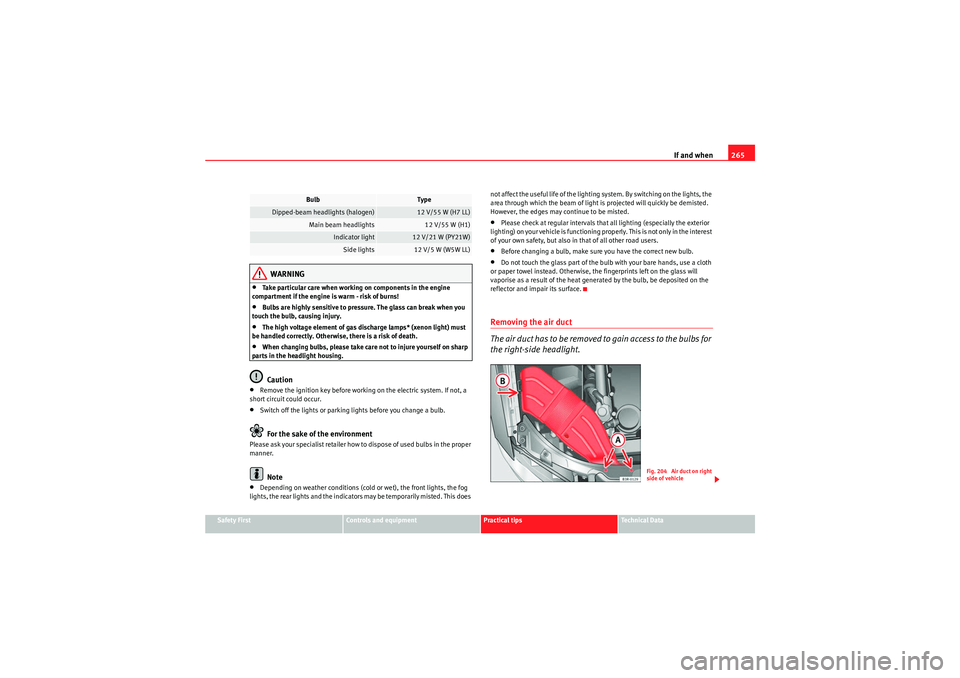
reflector and impair its surface.Removing the air duct
The air duct has to be removed to gain access to the bulbs for
the right-side headlight.
Bulb
Type
Dipped-beam headlights (halogen)
12 V/55 W (H7 LL)
Main beam headlights
12 V/55 W (H1)
Indicator light
12 V/21 W (PY21W)
Side lights
12 V/5 W (W5W LL)
Fig. 204 Air duct on right
side of vehicle
ExeoST_EN.book Seite 265 Donnerstag, 3. September 2009 12:24 12
Page 274 of 316
If and when
272
WARNING
•Take particular care when working on components in the engine
compartment if the engine is warm - risk of burns!•Bulbs are highly sensitive to pressure. The glass can break when you
touch the bulb, causing injury.•The high voltage element of gas discharge lamps* (xenon light) must
be handled correctly. Otherwise, there is a risk of death.•When changing bulbs, please take care not to injure yourself on sharp
parts in the headlight housing.Caution
•Remove the ignition key before working on the electric system. If not, a
short circuit could occur.•Switch off the lights or parking lights before you change a bulb.For the sake of the environment
Please ask your specialist retailer how to dispose of used bulbs in the proper
manner.
Note
•Depending on weather conditions (cold or wet), the front lights, the fog
lights, the rear lights and the indicators may be temporarily misted. This does not affect the useful life of the lighting system. By switching on the lights, the
area through which the beam of light is projected will quickly be demisted.
However, the edges may continue to be misted.
•Please check at regular intervals that all lighting (especially the exterior
lighting) on your vehicle is functioning properly. This is not only in the interest
of your own safety, but also in that of all other road users.•Before changing a bulb, make sure you have the correct new bulb.•Do not touch the glass part of the bulb with your bare hands, use a cloth
or paper towel instead. Otherwise, the fingerprints left on the glass will
vaporise as a result of the heat generated by the bulb, be deposited on the
reflector and impair its surface.Removing the air duct
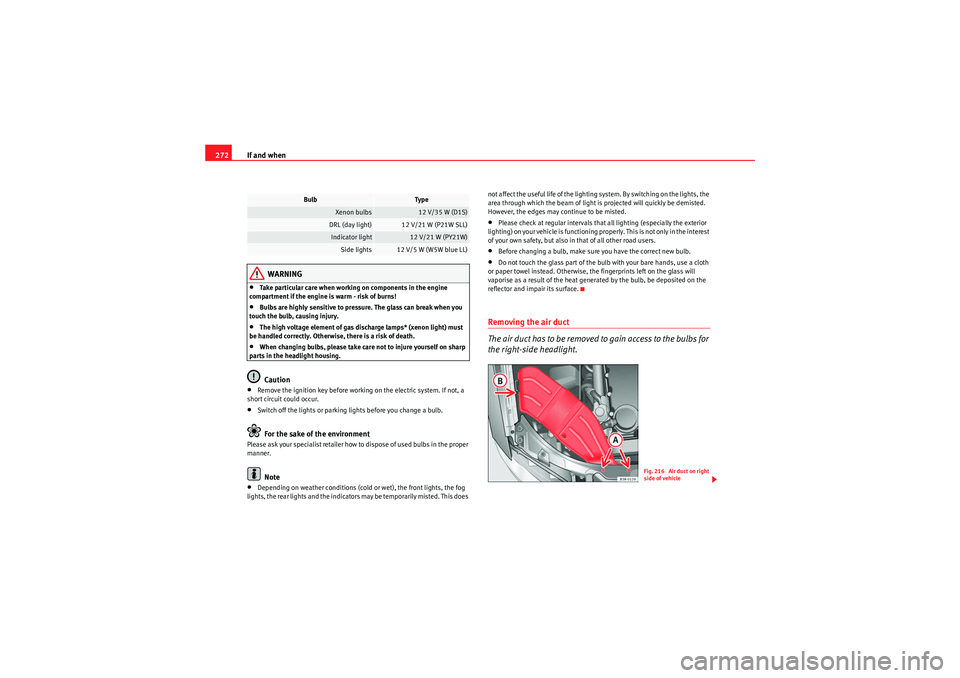
The air duct has to be removed to gain access to the bulbs for
the right-side headlight.
Bulb
Type
Xenon bulbs
12 V/35 W (D1S)
DRL (day light)
12 V/21 W (P21W SLL)
Indicator light
12 V/21 W (PY21W)
Side lights
12 V/5 W (W5W blue LL)
Fig. 216 Air duct on right
side of vehicle
ExeoST_EN.book Seite 272 Donnerstag, 3. September 2009 12:24 12
Page 290 of 316
If and when
288Towing and tow-startingTo w - s t a r t i n g
The use of jump leads is preferable to tow-starting.We recommend that you do not tow-start your vehicle. Jump-starting
is preferable ⇒ page 285.
However, if your vehicle has to be tow-started:
– Engage the 2
nd or the 3
rd gear.
– Keep the clutch pressed down.
– Switch the ignition on.
– Once both vehicles are moving, release the clutch.
– As soon as the engine starts, press the clutch and move the gear lever into neutral. This helps to prevent driving into the towing
vehicle.
WARNING
The risk of accidents is high when tow-starting. The vehicle being towed
can easily collide with the towing vehicle.
Caution
When tow-starting, fuel could enter the catalytic converter and damage it.
CommentsPlease observe the following points if you use a tow-rope:
Notes for the driver of the towing vehicle
– Drive slowly at first until the tow-rope is taut. Then accelerate gradually.
– Begin and change gears cautiously. If you are driving an auto- matic vehicle, accelerate gently.
– Remember that the brake servo and power steering are not working in the vehicle you are towing. Brake earlier than you
would normally, but with a more gentle pressure on the brake.
Notes for the driver of the towed vehicle
– Ensure that the tow-rope remains taut at all times when towing.Tow-rope or tow-bar
It is easier and safer to tow a vehicle with a tow-bar. You should only use a
tow-rope if you do not have a tow-bar.
A tow-rope should be slightly elastic to reduce the loading on both vehicles.
It is advisable to use a tow-rope made of synthetic fibre or similarly elastic
material.
Attach the tow-rope or the tow-bar only to the towing eyes provided or a
towing bracket.
Driving style
Towing requires some experience, especially when using a tow-rope. Both
drivers should be familiar with the technique required for towing. Inexperi-
enced drivers should not attempt to tow-start or tow away another vehicle.
ExeoST_EN.book Seite 288 Donnerstag, 3. September 2009 12:24 12
Page 296 of 316
General notes on the technical data
294Towing a trailerTrailer weightsTrailer weights
The trailer weights and drawbar loads approved are selected in intensive
trials according to precisely defined criteria. The approved trailer weights are
valid for vehicles in the EU for maximum speeds of 80 km/h (in certain
circumstances up to 100 km/h). The figures may be different in other coun-
tries. All data in the official vehicle documents take precedence over these
data ⇒ .
Drawbar load
The maximum permitted weight exerted by the trailer drawbar on the ball joint
of the towing bracket must not exceed 75 kg.
In the interest of road safety, we recommend that you always tow
approaching the maximum drawbar load. The response of the trailer on the
road will be poor if the drawbar load is too small.
If the maximum permissible drawbar load cannot be met (e.g. with small,
empty and light-weight single axle trailers o r ta n d e m a x l e t r a i l e r s wi t h a n a x le
base of less than 1 metre), at least 4% of the actual trailer weight is a legal
stipulation for a drawbar load.
WARNING
•For safet y reas ons , d o not excee d the 8 0 k m/h limit . Th is is als o valid in
countries where higher speeds are permitted.•Never exceed the maximum trailer weights or the draw bar loading. If
the permissible axle load or the permissible total weight is exceeded, the
driving characteristics of the vehicle may change, leading to accidents,
injuries and damage to the vehicle.
WheelsTyre pressure, snow chains, wheel boltsTyre pressures
The sticker with the tyre pressure values can be found on the inside of the
tank flap. The tyre pressure values given there are for cold tyres. The slightly
raised pressures of warm tyres must not be reduced. ⇒
Snow chains
Snow chains may be fitted only to the front wheels.
Consult the chapter “wheels” of this manual.
Wheel bolts
After the wheels have been changed, the tightening torque of the wheel bolts
s ho uld b e che cke d as s o on as p ossible wit h a to rqu e w re nch ⇒ . The tight-
ening torque for steel and alloy wheels is 120 Nm.
WARNING
•Check the tyre pressure at least once per month. Checking tyre pressure
value is very important. If the tyre pressure is too high or too low, there is
an increased danger of accidents, particularly at high speeds.•If the torque of the wheel bolts is too low, they could loosen while the
vehicle is in motion. Risk of accident! If the tightening torque is too high,
the wheel bolts and threads can be damaged.Note
We recommend that you ask your Authorised Service Centre for information
about appropriate wheel, tyre and snow chain size.
ExeoST_EN.book Seite 294 Donnerstag, 3. September 2009 12:24 12