door lock Seat Exeo ST 2009 Owner's Guide
[x] Cancel search | Manufacturer: SEAT, Model Year: 2009, Model line: Exeo ST, Model: Seat Exeo ST 2009Pages: 316, PDF Size: 8.83 MB
Page 121 of 316
Lights and visibility119
Safety First
Controls and equipment
Practical tips
Technical Data
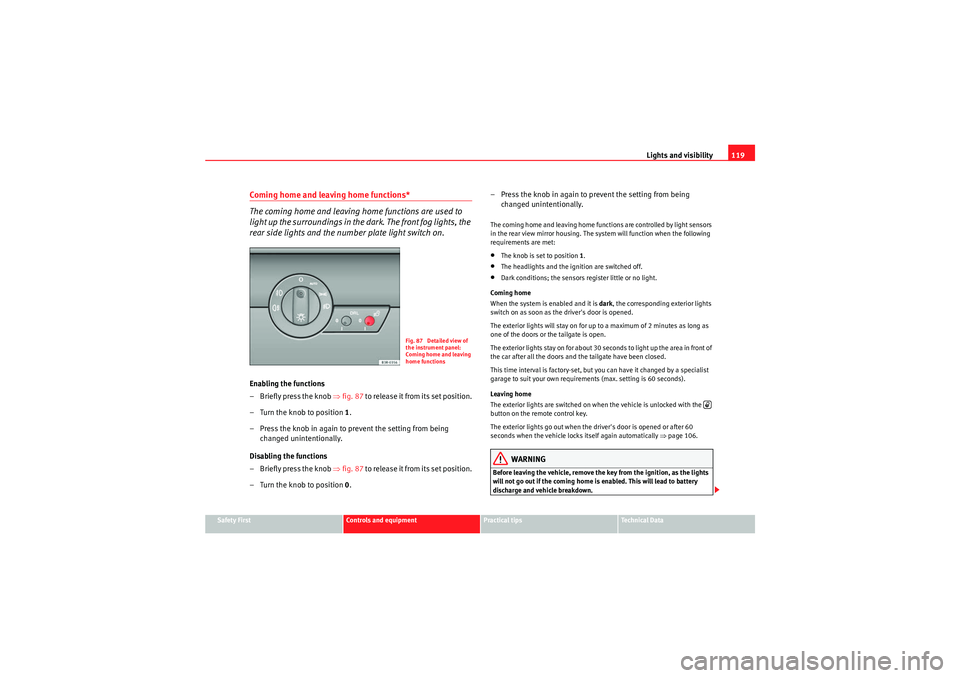
Coming home and leaving home functions*
The coming home and leaving home functions are used to
light up the surroundings in the dark. The front fog lights, the
rear side lights and the number plate light switch on.Enabling the functions
– Briefly press the knob ⇒ fig. 87 to release it from its set position.
– Turn the knob to position 1.
– Press the knob in again to prevent the setting from being changed unintentionally.
Disabling the functions
– Briefly press the knob ⇒ fig. 87 to release it from its set position.
– Turn the knob to position 0. – Press the knob in again to prevent the setting from being
changed unintentionally.
The coming home and leaving home functions are controlled by light sensors
in the rear view mirror housing. The system will function when the following
requirements are met:•The knob is set to position 1.•The headlights and the ignition are switched off.•Dark conditions; the sensors register little or no light.
Coming home
When the system is enabled and it is dark, the corresponding exterior lights
switch on as soon as the driver's door is opened.
The exterior lights will stay on for up to a maximum of 2 minutes as long as
one of the doors or the tailgate is open.
The exterior lights stay on for about 30 seconds to light up the area in front of
the car after all the doors and the tailgate have been closed.
This time interval is factory-set, but you can have it changed by a specialist
garage to suit your own requirements (max. setting is 60 seconds).
Leaving home
The exterior lights are switched on when the vehicle is unlocked with the
button on the remote control key.
The exterior lights go out when the driver's door is opened or after 60
seconds when the vehicle locks itself again automatically ⇒page 106.WARNING
Before leaving the vehicle, remove the key from the ignition, as the lights
will not go out if the coming home is enabled. This will lead to battery
discharge and vehicle breakdown.
Fig. 87 Detailed view of
the instrument panel:
Coming home and leaving
home functions
ExeoST_EN.book Seite 119 Donnerstag, 3. September 2009 12:24 12
Page 127 of 316
Lights and visibility125
Safety First
Controls and equipment
Practical tips
Technical Data
Door light position
– Move switch to the centre position.
Interior light switched on
– Move switch to position I.
Interior light switched off
– Move switch to position O.
Front reading lights
– Press one of the switches to turn the left and right reading
lights on and off.
Glove compartment light
– Open the glove compartment on the front passenger's side. The glove compartment light will come on automatically if the side
lights or headlights are switched on, and will go out again when
the glove compartment is closed.
Footwell* and door lighting
– This is switched on when the doors are opened and off when they are closed.If the switch is in the courtesy light position, the interior light comes on auto-
matically when the vehicle is unlocked or the doors are opened. The light also
comes on when the key is pulled out of the ignition. The light turns off about
30 seconds after closing the doors. The interior light is switched off immedi-
ately when the vehicle is locked or when the ignition is switched on.
If a door is left open, the light is switched off after about 10 minutes to
prevent the battery from running flat. The brightness of the lights is automatically adjusted by a dimmer when they
are switched on.
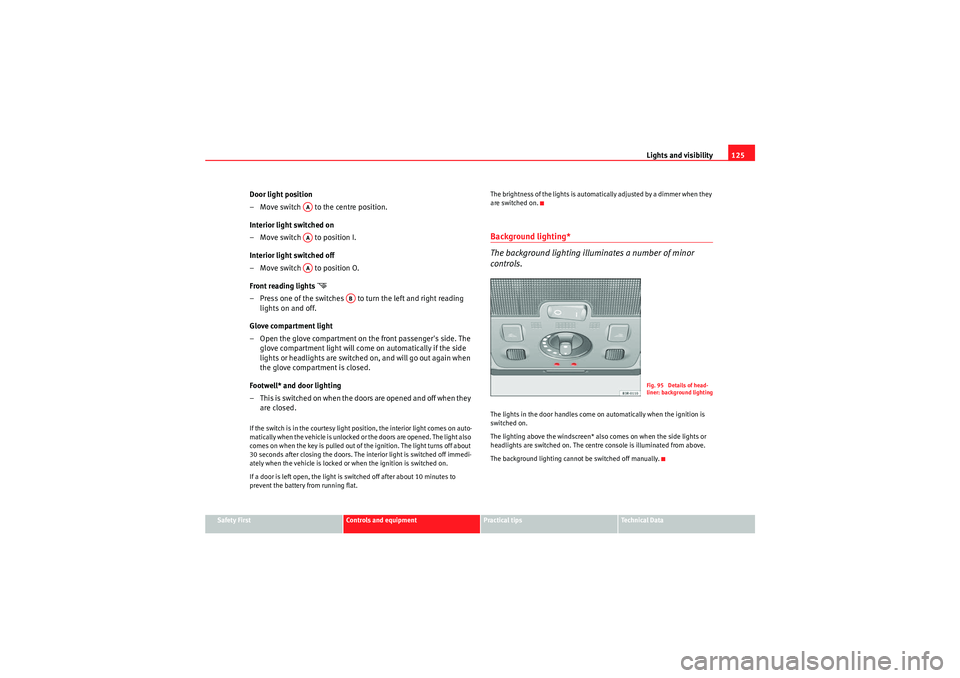
Background lighting*
The background lighting illuminates a number of minor
controls.The lights in the door handles come on automatically when the ignition is
switched on.
The lighting above the windscreen* also comes on when the side lights or
headlights are switched on. The centre console is illuminated from above.
The background lighting cannot be switched off manually.
AAAAAA
AB
Fig. 95 Details of head-
liner: background lighting
ExeoST_EN.book Seite 125 Donnerstag, 3. September 2009 12:24 12
Page 141 of 316
Seats and stowage139
Safety First
Controls and equipment
Practical tips
Technical Data
adjustment. Use of the button is recommended to disable the memory
system when the vehicle is being driven
temporarily by a different driver
whose settings do not need to be stored in the memory.
Note
You can also use the remote control to call up the stored settings
⇒ page 140.Storing settingsThe button must be in its down position (pressed in) before
you can store the desired settings.
– Adjust the driver's seat as required ⇒page 136.
– Adjust both exterior mirrors ⇒page 132.
– Press and hold the button. At the same time, press one of the memory buttons for at least a second.
– Release both buttons. The settin g is now stored on the selected
memory button.Any new setting selected automatically cancels the existing setting stored on
the memory button. It is best to begin with memory button No. 1 for the first
driver and then assign the other memory buttons to each subsequent driver.
The seat and mirror positions are stored when the car is locked with the
remote control and are assigned to the remote control key. The exterior
mirrors adjust automatically to the previous position when you unlock the
car; the driver's seat adjusts automatically when you open the driver's door. However, this does not delete the settings stored in memory buttons 1 to 4.
These settings can be enabled at any time.
Enabling settings
Stored settings can be recalled using either the memory
buttons or the remote control (remote control key).Using the memory buttons
– If the driver's door is open, press the desired memory button
briefly.
– If the driver's door is closed, press and hold down the appro- priate memory button until the seat and exterior mirrors reach
their programmed positions.
Using the remote control
– Unlock the vehicle using the remote control and open the driver's door within the next ten minutes.The seat adjustment will have to be call ed up using the memory buttons if the
driver's door is not opened within 10 minutes after unlocking the vehicle with
the remote control.
WARNING
•For safety reasons, the seat must only be adjusted when the vehicle is
at a standstill. Failure to do so could result in an accident.•In an emergency, the memory function can be stopped at any time by
pressing the STOP button or by briefly pressing any of the memory
buttons.
STOP
STOP
MEMO
ExeoST_EN.book Seite 139 Donnerstag, 3. September 2009 12:24 12
Page 177 of 316

Driving175
Safety First
Controls and equipment
Practical tips
Technical Data
If you drive by mistake with the handbrake still applied, you will hear a
warning buzzer and the display will show the message:
Handbrake applied
The handbrake warning is enabled after driving for 3 seconds at a speed
above 5 km/h.
The handbrake warning lamp
lights up when the handbrake is applied
with the ignition on.
WARNING
Please note that the handbrake should be released all the way. If it is only
partially released, this will cause rear brakes overheating, which can
impair the function of the brake system and could lead to an accident.
Caution
Once the vehicle has come to a standstill, always apply the handbrake firmly
and then, on a manual gearbox, engage a gear, or select P on an automatic.Parking
The following points will ensure there is no risk of the car
rolling away accidentally after it is parked.– Use the foot brake to stop the vehicle.
– Apply handbrake firmly.
– Switch the engine off.
– On a manual gearbox engage 1st gear or on an automatic move the selector lever to P ⇒ .
When parking on slopes:
Turn the steering wheel so that the, if the vehicle moves, it will do so towards
the curb.
WARNING
•Do not leave anyone (especially children) in the vehicle when it is
locked. Locked doors could delay assistance in an emergency, potentially
putting lives at risk.•Never leave children unsupervised in the vehicle. They could release
e.g. the handbrake or gear lever, moving the vehicle and causing an
accident.
Parking aid acoustic systemGeneral notesVarious systems are available to help you when parking or manoeuvring in
tight spaces, depending on the equipment fitted on your vehicle.
The SEAT parking system gives an acoustic warning if there are any obstacles
behind your car ⇒ page 176.
When you are parking, SEAT parking system plus warns you acoustically and
optically about obstacles in front of and behind the vehicle ⇒page 176.
Note
To ensure the acoustic parking aid works properly, the sensors must be kept
clean and free of snow and ice.
ExeoST_EN.book Seite 175 Donnerstag, 3. September 2009 12:24 12
Page 203 of 316
Trailer towing201
Safety First
Controls and equipment
Practical tips
Technical Data
Where possible, operate the trailer with the maximum permitted
draw bar
weight on the ball joint of the towing bracket, but do not exceed the specified
limit.
Tyre pressure
Check the tyre pressures on your car, and adjust for “full load” conditions
(refer to the sticker listing the tyre pressures on the door pillar). It may also be
necessary to adjust the tyre pressures on the trailer according to the recom-
mendations of the trailer manufacturer.
Exterior mirrors
Check whether you can see enough of the road behind the trailer with the
standard mirrors. If this is not the case you should have additional mirrors
fitted. The two exterior mirrors should be fitted on folding arms. Adjust the
mirrors to give sufficient rear vision.
Headlights
Before starting a journey, check the headlight beam settings with the trailer
hitched up. If necessary, alter the height of the headlight beams by means of
the headlight range control. See ⇒page 120.
Power supply
When you remove the ignition key, the power supply to the trailer is inter-
rupted.
Removable ball joint coupling
Vehicles with a factory-fitted towing bracket are equipped with a removable
ball joint coupling. This is stored in the spare wheel well in the luggage
compartment together with the necessary fitting instructions.
Note
If you frequently tow, we recommend you also have vehicle ser viced between
services.
Notes on towing
Towing a trailer involves additional attention by the driver.Weight distribution
The weight distribution of a loaded trailer with an unladen vehicle is very
unfavourable. However, if this cannot be avoided, drive extra slowly to allow
for the unbalanced weight distribution.
Speed
The stability of the car and trailer is reduced with increasing speed. Therefore,
it is advisable not to drive at the maximum permissible speed in an unfavour-
able road, weather or wind conditions. This especially applies when driving
downhill.
You should always reduce speed immediately if the trailer shows the slightest
sign of swaying . Never try to stop the “snaking” by increasing speed.
Anticipate hazards and brake in good time. If towing a trailer with an inertia
brake , first brake gently and then more severely. This will prevent brake
tapping by the trailer wheels when they lock. Select a low gear in due course
before going down a steep downhill. This enables you to use the engine
braking to slow down the vehicle.
Swaying and pitching can be reduced by stabiliser aids. We recommend
having stabiliser aids installed when towing trailers with a high trailer load.
They can be purchased and installed at a Dealer.
Reheating
When climbing long hills in hot weather with the engine running fast in low
gear, you should keep an eye on the coolant temperature gauge ⇒page 60.
Reduce speed immediately if the needle moves to the right end of the scale.
If the temperature warning light
in the instrument cluster should start
flashing, stop the car and let the engine cool down by running it at idling
speed for a few minutes.
ExeoST_EN.book Seite 201 Donnerstag, 3. September 2009 12:24 12
Page 215 of 316
Your vehicle maintenance and cleaning213
Safety First
Controls and equipment
Practical tips
Technical Data
Caution
•Never remove dirt, mud or dust if the vehicle surface is dry. Never use a
dry cloth or sponge for cleaning purposes. This could scratch the paintwork
or glass on your vehicle.•Washing the vehicle in low temperatures: when washing the vehicle with
a hose, do not direct water into the lock cylinders or the gaps around the
doors, tailgate, or sunroof. Risk of freezing.For the sake of the environment
To protect environment, the car should be washed only in specially provided
wash bays. This prevents toxic, oil-laden waste water entering the sewerage
system. In some districts, washing vehicles outside wash bays is prohibited.
Note
Do not wash the vehicle in direct sunlight.Washing the car with a high pressure cleaner
Be particularly careful when using a high pressure cleaner!– Always observe the instructions for the high-pressure cleaner, particularly those concerning the pressure and the spraying
distance.
– Increase the spraying distance for soft materials and painted
bumpers.
– Do not use a high pressure cleaner to remove ice or snow from windows ⇒page 214. – Never use concentrated jet nozzles (“rotating jets”)
⇒.
– Directly after washing, avoid sudden and sharp braking. “Dry” ⇒page 195 the brakes by braking several times.
WARNING
•Never wash tyres with a concentrated jet (“rotating nozzle”). Even at
large spraying distances and short cleaning times, visible and invisible
damage can occur to the tyres. This may cause an accident.•Water, ice and salt on the brakes can reduce braking efficiency. Risk of
accident.Caution
•Do not use water hotter than 60°C. This could damage the vehicle.•To avoid damage to the vehicle, keep a sufficient distance from sensitive
materials such as flexible hoses, plastic, soundproofing material, etc. This is
also important for bumpers painted as the paintwork. The closer the nozzle is
to the surface, the greater the wear on the material.Vehicle paint maintenance requirements
Regular waxing protects the paintwork.You need to apply wax to your car if water does not form small drops and run
off the paintwork when it is clean.
A good quality hard wax product is available from your Authorised Service
Centre.
ExeoST_EN.book Seite 213 Donnerstag, 3. September 2009 12:24 12
Page 217 of 316
Your vehicle maintenance and cleaning215
Safety First
Controls and equipment
Practical tips
Technical Data
to the windscreen washer fluid prevents wiper blades from juddering. Wax
deposits are not removed.
Caution
•Never use warm or hot water to remove snow and ice from windows and
mirrors. This could cause the glass to crack!•The heating element for the rear window is located on the inner side of the
window. To prevent damage, do not put stickers on the heating elements
inside the window.Cleaning windscreen wiper bladesClean wiper blades are essent ial to provide clear vision.
1. Use a soft cloth to remove dust and dirt from the windscreen wiper blades.
2. Use window cleanser to clean the windscreen wiper blades. Use
a sponge or a cloth to remove stubborn stains.Rubber seals maintenance
If rubber seals are well looked after, they will not freeze so
quickly.1. Use a soft cloth to remove dust and dirt from the rubber seals.
2. Apply a specialist care product to the rubber seals.
The strips on the doors, windows, bonnet and rear lid will remain pliable and
last longer if they are treated with a suitable care product (for example sili-
cone spray).
Caring for rubber seals will also prevent premature ageing and leaks. The
doors will be easier to open. If rubber seals are well looked after, they will not
freeze so quickly in winter.Door lock cylinders
The door lock cylinders can freeze up in winter.To de-ice the lock cylinders you should only use spray with lubricating and
anti-corrosive properties.Cleaning chrome parts1. Clean chrome parts with a damp cloth.
2. Polish chrome parts with a soft, dry cloth.If this does not provide satisfying results, use a specialist chrome cleaning
product . Chrome cleaning products will remove stains and coatings from the
surface.
Caution
To prevent scratching chrome surfaces:•Never use an abrasive care product on chrome.•Do not clean or polish chrome parts in a sandy or dusty environment.
ExeoST_EN.book Seite 215 Donnerstag, 3. September 2009 12:24 12
Page 308 of 316
Index
306Brakes . . . . . . . . . . . . . . . . . . . . . . . . . . . . . . . . 195
Brake assist system . . . . . . . . . . . . . . . . . . 190
Brake fluid . . . . . . . . . . . . . . . . . . . . . . . . . . 237
Worn brake pads . . . . . . . . . . . . . . . . . . . . . . 80
Braking distance . . . . . . . . . . . . . . . . . . . . . . . . 195
Bulb change general notes . . . . . . . . . . . . . . . . . . . . . . . 264CCar keys . . . . . . . . . . . . . . . . . . . . . . . . . . . . . . . . 96
Catalytic converter . . . . . . . . . . . . . . . . . . . . . . 196
CD-ROM player . . . . . . . . . . . . . . . . . . . . . . . . . 149
Central locking . . . . . . . . . . . . . . . . . . . . . . . . . . 98Manual locking . . . . . . . . . . . . . . . . . . . . . . 102
Sunroof: opening and closing . . . . . . . . . . 113
Central locking system Anti-theft security system . . . . . . . . . . . . . . 100
Locking . . . . . . . . . . . . . . . . . . . . . . . . . . . . . 99
Locking and unlocking the vehicle from inside100
Opening and closing the windows . . . . . . 111
Security central locking . . . . . . . . . . . . . . . 101
Switch on the driver's door . . . . . . . . . . . . . 100
Tailgate . . . . . . . . . . . . . . . . . . . . . . . . . . . . 103
Unlocking . . . . . . . . . . . . . . . . . . . . . . . . . . . . 99
Cetane number . . . . . . . . . . . . . . . . . . . . . . . . . 224
Changing the main headlight bulb Main headlight . . . . . . . . . . . . . . . . . . . . . . 268
Changing the main headlight bulbs Dipped beam headlight . . . . . . . . . . . . . . . 269 Changing the rear lights
luggage compartment lights . . . . . . . . . . . 283
Changing windscreen wiper blades . . . . . . . . . 235
Chassis number . . . . . . . . . . . . . . . . . . . . . . . . 292
Child safety . . . . . . . . . . . . . . . . . . . . . . . . . . . . . 46
Child safety seat ISOFIX system . . . . . . . . . . . . . . . . . . . . . . . . 52
Child seat . . . . . . . . . . . . . . . . . . . . . . . . . . . . . . . 48 Categorisation in groups . . . . . . . . . . . . . . . 48
Group 1 . . . . . . . . . . . . . . . . . . . . . . . . . . . . . 49
Group 2 . . . . . . . . . . . . . . . . . . . . . . . . . . . . . 49
Group 3 . . . . . . . . . . . . . . . . . . . . . . . . . . . . . 49
Groups 0 and 0+ . . . . . . . . . . . . . . . . . . . . . . 48
Safety notes . . . . . . . . . . . . . . . . . . . . . . . . . . 46
Securing . . . . . . . . . . . . . . . . . . . . . . . . . . . . . 51
Child seats on the front passenger seat . . . . . . . . . . . . . 29
Childproof lock Rear doors . . . . . . . . . . . . . . . . . . . . . . . . . . 104
Cigarette lighter . . . . . . . . . . . . . . . . . . . . . . . . 155
Cleaning alloy wheel rims . . . . . . . . . . . . . . . . 216
Cleaning chrome . . . . . . . . . . . . . . . . . . . . . . . . 215
Cleaning engine compartment . . . . . . . . . . . . . 217
Cleaning steel wheel rims . . . . . . . . . . . . . . . . 216
Cleaning windows . . . . . . . . . . . . . . . . . . . . . . . 214
Climate control Air distribution . . . . . . . . . . . . . . . . . . . . . . 167
Air outlets . . . . . . . . . . . . . . . . . . . . . . . . . . 167
Air purity sensor . . . . . . . . . . . . . . . . . . . . . 165
Air recirculation . . . . . . . . . . . . . . . . . . . . . . 164
Air recirculation (automatic) . . . . . . . . . . . . 165 Automatic mode . . . . . . . . . . . . . . . . . . . . . 163
Blower . . . . . . . . . . . . . . . . . . . . . . . . . . . . . 166
Controls . . . . . . . . . . . . . . . . . . . . . . . . . . . . 162
ECON Mode (economy) . . . . . . . . . . . . . . . . 164
Economical use . . . . . . . . . . . . . . . . . . . . . . 168
Key settings . . . . . . . . . . . . . . . . . . . . . . . . . 168
Temperature selection . . . . . . . . . . . . . . . . 163
Clock, setting . . . . . . . . . . . . . . . . . . . . . . . . . . . 61
Cloth seat covers cleaning . . . . . . . . . . . . . . . . 218
Coat hooks . . . . . . . . . . . . . . . . . . . . . . . . . . . . 158
Cockpit . . . . . . . . . . . . . . . . . . . . . . . . . . . . . . . . . 57 Overview . . . . . . . . . . . . . . . . . . . . . . . . . . . . 57
Compartments . . . . . . . . . . . . . . . . . . . . . . . . . . 156 In the door trim . . . . . . . . . . . . . . . . . . . . . . 158
In the front seats . . . . . . . . . . . . . . . . . . . . . 159
Cool box in glove compartment . . . . . . . . . . . . 157
Cooling system Coolant temperature gauge . . . . . . . . . . . . . 60
Malfunction . . . . . . . . . . . . . . . . . . . . . . . . . . 78
Cruise control . . . . . . . . . . . . . . . . . . . . . . . . . . 178
Cruise control system Adjust stored speed . . . . . . . . . . . . . . . . . . 179
Disabling . . . . . . . . . . . . . . . . . . . . . . . . . . . 180
Disabling temporarily . . . . . . . . . . . . . . . . . 180
Setting speed . . . . . . . . . . . . . . . . . . . . . . . 179
Curtain airbags . . . . . . . . . . . . . . . . . . . . . . . . . . 41 Description . . . . . . . . . . . . . . . . . . . . . . . . . . 41
Function . . . . . . . . . . . . . . . . . . . . . . . . . . . . . 42
Safety notes . . . . . . . . . . . . . . . . . . . . . . . . . . 42
ExeoST_EN.book Seite 306 Donnerstag, 3. September 2009 12:24 12
Page 309 of 316

Index307
DDanger of fitting a child seat on the front passenger
seat . . . . . . . . . . . . . . . . . . . . . . . . . . . . . . . 29
Dash panel cleaning . . . . . . . . . . . . . . . . . . . . . 217
Data entry control . . . . . . . . . . . . . . . . . . . . . . . . 88
Date display . . . . . . . . . . . . . . . . . . . . . . . . . . . . . 61
Daytime running lights . . . . . . . . . . . . . . . . . . . 121
Diesel . . . . . . . . . . . . . . . . . . . . . . . . . . . . . . . . . 224
Diesel engine Winter driving . . . . . . . . . . . . . . . . . . . . . . . . 225
Diesel engine particulate filter . . . . . . . . . . . . . 197
Diesel particulate filter . . . . . . . . . . . . . . . . . . . . 80 Engine oil . . . . . . . . . . . . . . . . . . . . . . . . . . . 228
Digital clock . . . . . . . . . . . . . . . . . . . . . . . . . . . . . 61
Dipped headlights . . . . . . . . . . . . . . . . . . . . . . . 116
DIS Average fuel consumption . . . . . . . . . . . . . . 85
Average speed . . . . . . . . . . . . . . . . . . . . . . . . 85
Driving time . . . . . . . . . . . . . . . . . . . . . . . . . . 85
Instantaneous fuel consumption . . . . . . . . . 85
Disabling front passenger airbag Safety notes . . . . . . . . . . . . . . . . . . . . . . . . . . 45
Disabling the airbag Disabling front passenger airbag . . . . . . . . . 44
Disposal Airbags . . . . . . . . . . . . . . . . . . . . . . . . . . . . . . 30
Distance covered . . . . . . . . . . . . . . . . . . . . . . . . . 86
Distance display . . . . . . . . . . . . . . . . . . . . . . . . . 63
Door catch/ tailgate warning . . . . . . . . . . . . . . . 74 Door lock cylinders . . . . . . . . . . . . . . . . . . . . . . 215
Doors
Childproof lock . . . . . . . . . . . . . . . . . . . . . . 104
Locking the doors manually if the central lock-ing fails to work . . . . . . . . . . . . . . . . . . . . 102
Driver information system . . . . . . . . . . . . . . . . . . 71 Ambient temperature display . . . . . . . . . . . . 72
Auto-check system . . . . . . . . . . . . . . . . . . . . 75
CD and radio display . . . . . . . . . . . . . . . . . . . 72
Door catch/ tailgate warning . . . . . . . . . . . . 74
Driver messages . . . . . . . . . . . . . . . . . . . . . . 76
Handbrake warning . . . . . . . . . . . . . . . . . . . . 76
Menu display . . . . . . . . . . . . . . . . . . . . . . . . . 87
On-board computer . . . . . . . . . . . . . . . . . . . . 85
Red symbols . . . . . . . . . . . . . . . . . . . . . . . . . . 77
Speed warning . . . . . . . . . . . . . . . . . . . . . . . . 82
Warning messages . . . . . . . . . . . . . . . . . . . . 76
Yellow symbols . . . . . . . . . . . . . . . . . . . . . . . 79
Driver messages . . . . . . . . . . . . . . . . . . . . . . . . . 76
Driver's seat Assigning the key to the seat . . . . . . . . . . . 140
Enabling stored settings . . . . . . . . . . . . . . . 139
With memory . . . . . . . . . . . . . . . . . . . . . . . . 138
Driving Driving abroad . . . . . . . . . . . . . . . . . . . . . . . 199
Economically / With Respect for the Environment . . . . . . . . . . . . . . . . . . . . . . . 197
Driving abroad . . . . . . . . . . . . . . . . . . . . . . . . . . 199 Headlights . . . . . . . . . . . . . . . . . . . . . . . . . . 199
Driving safety . . . . . . . . . . . . . . . . . . . . . . . . . . . . . 9
Dynamic gear control program . . . . . . . . . . . . . 186
EEconomical driving . . . . . . . . . . . . . . . . . . . . . . 197
Electric windows . . . . . . . . . . . . . . . . . . . . . . . . 109 Central locking system . . . . . . . . . . . . . . . . 111
Possible malfunctions . . . . . . . . . . . . . . . . . 111
Switch on font passenger's door . . . . . . . . 110
Switch on rear doors . . . . . . . . . . . . . . . . . . 110
Switches in the driver's door . . . . . . . . . . . 110
Electrical power point . . . . . . . . . . . . . . . . . . . . 155
Electronic differential lock How it works . . . . . . . . . . . . . . . . . . . . . . . . 191
Electronic immobiliser . . . . . . . . . . . . . . . . . . . . 98
Electronic stabilisation programme Description . . . . . . . . . . . . . . . . . . . . . . . . . . 170
How the system works . . . . . . . . . . . . . . . . 189
Warning light . . . . . . . . . . . . . . . . . . . . . . . . 171
Emergencies Changing a wheel . . . . . . . . . . . . . . . . . . . . 254
Disconnecting the battery . . . . . . . . . . . . . . 238
Jack . . . . . . . . . . . . . . . . . . . . . . . . . . . 251, 256
Tools . . . . . . . . . . . . . . . . . . . . . . . . . . . . . . . 251
tyre mobility system . . . . . . . . . . . . . . . . . . 252
Engine Running in . . . . . . . . . . . . . . . . . . . . . . . . . . 195
Starting . . . . . . . . . . . . . . . . . . . . . . . . . . . . 172
Stop . . . . . . . . . . . . . . . . . . . . . . . . . . . . . . . 173
Engine compartment Safety instructions . . . . . . . . . . . . . . . . . . . 227
ExeoST_EN.book Seite 307 Donnerstag, 3. September 2009 12:24 12
Page 311 of 316
Index309
Ignition key
Safety interlock . . . . . . . . . . . . . . . . . . . . . . 171
Ignition lock . . . . . . . . . . . . . . . . . . . . . . . . . . . . 171
Indicator lamps Cruise control system . . . . . . . . . . . . . . . . . . 67
Glow plug system . . . . . . . . . . . . . . . . . . . . . 70
Hazard warning lights . . . . . . . . . . . . . . . . . . 68
Indicators . . . . . . . . . . . . . . . . . . . . . . . . . . . . 68
Main beam headlights . . . . . . . . . . . . . . . . . 69
Trailer indicators . . . . . . . . . . . . . . . . . . . . . . 67
Indicator lamps - overview . . . . . . . . . . . . . . . . . 65
Indicators . . . . . . . . . . . . . . . . . . . . . . . . . . . . . . 123
Instruments Lighting . . . . . . . . . . . . . . . . . . . . . . . . 62, 120
Interior lights Background lighting . . . . . . . . . . . . . . . . . . 125
Front . . . . . . . . . . . . . . . . . . . . . . . . . . . . . . . 124
Luggage compartment . . . . . . . . . . . . . . . . 126
Rear . . . . . . . . . . . . . . . . . . . . . . . . . . . . . . . . 126
Interior monitoring . . . . . . . . . . . . . . . . . . . . . . . 108
Intermittent wipe . . . . . . . . . . . . . . . . . . . . . . . . 128
ISOFIX . . . . . . . . . . . . . . . . . . . . . . . . . . . . . . . . . . 52JJack . . . . . . . . . . . . . . . . . . . . . . . . . . . . . . 251, 256
Jump leads . . . . . . . . . . . . . . . . . . . . . . . . . . . . . 285
Jump-starting . . . . . . . . . . . . . . . . . . . . . . . . . . . 285
KKeys . . . . . . . . . . . . . . . . . . . . . . . . . . . . . . . . . . . 96 Battery . . . . . . . . . . . . . . . . . . . . . . . . . . . . . . 97
Climate control settings . . . . . . . . . . . . . . . 168
Remote control key . . . . . . . . . . . . . . . . . . . 105
Settings for the driver's seat . . . . . . . . . . . . 140
Kick-down feature . . . . . . . . . . . . . . . . . . . . . . . 185LLeather cleaning . . . . . . . . . . . . . . . . . . . . . . . . 218
Light sensor faulty . . . . . . . . . . . . . . . . . . . . . . . . 80
Lighting Instruments . . . . . . . . . . . . . . . . . . . . . . 62, 120
Lights . . . . . . . . . . . . . . . . . . . . . . . . . . . . . . . . . 116 Adaptive headlights . . . . . . . . . . . . . . . . . . 122
Automatic headlight control . . . . . . . . . . . . 116
Cornering light . . . . . . . . . . . . . . . . . . . . . . . 122
Dipped headlights faulty . . . . . . . . . . . . . . . 81
Dynamic headlight range control . . . . . . . . 121
Headlight flasher . . . . . . . . . . . . . . . . . . . . . 124
Parking light . . . . . . . . . . . . . . . . . . . . . . . . . 124
Rear lights faulty . . . . . . . . . . . . . . . . . . . . . . 81
Switching on and off . . . . . . . . . . . . . . . . . . 116
Xenon lights . . . . . . . . . . . . . . . . . . . . . . . . . 121
Liquid coolant Anti-freeze . . . . . . . . . . . . . . . . . . . . . . . . . . 231
Checking the level . . . . . . . . . . . . . . . . . . . . 232
Liquid coolant additive . . . . . . . . . . . . . . . . 231
Topping up . . . . . . . . . . . . . . . . . . . . . . . . . . 233 Load compartment in the boot
See Luggage compartment . . . . . . . . . . . . . . 16
Locking the doors manually if the central locking fails to work
Locking the doors manually if the central lock- ing fails to work . . . . . . . . . . . . . . . . . . . . 102
Locks . . . . . . . . . . . . . . . . . . . . . . . . . . . . . . . . . 215
Long periods of non-use Battery . . . . . . . . . . . . . . . . . . . . . . . . . . . . . 238
Luggage compartment . . . . . . . . . . . . . . . . 16, 143 Cover . . . . . . . . . . . . . . . . . . . . . . . . . . . . . . 145
Extending . . . . . . . . . . . . . . . . . . . . . . . . . . . 149
Fastening rings . . . . . . . . . . . . . . . . . . . . . . 144
Light . . . . . . . . . . . . . . . . . . . . . . . . . . . . . . . 126
Loading . . . . . . . . . . . . . . . . . . . . . . . . . . . . 143
Luggage compartment liner . . . . . . . . . . . . 148
Luggage net . . . . . . . . . . . . . . . . . . . . . . . . . 144
Partition grille . . . . . . . . . . . . . . . . . . . . . . . 146
Retaining strap . . . . . . . . . . . . . . . . . . . . . . 145
Side storage compartment . . . . . . . . . . . . . 149
Ski bag . . . . . . . . . . . . . . . . . . . . . . . . . . . . . 150
See also Luggage compartment . . . . . . . . . . 16
Luggage compartment cover Removing . . . . . . . . . . . . . . . . . . . . . . . . . . . 147
MMain beam headlights . . . . . . . . . . . . . . . . . . . 123
Maintenanceairbags . . . . . . . . . . . . . . . . . . . . . . . . . . . . . . 30
Maintenance and cleaning . . . . . . . . . . . . . . . . 211
Manual gearbox . . . . . . . . . . . . . . . . . . . . . . . . . 181
ExeoST_EN.book Seite 309 Donnerstag, 3. September 2009 12:24 12