roof Seat Exeo ST 2010 Owner's Guide
[x] Cancel search | Manufacturer: SEAT, Model Year: 2010, Model line: Exeo ST, Model: Seat Exeo ST 2010Pages: 325, PDF Size: 9.34 MB
Page 202 of 325

Driving and the environment
200Avoid driving at high speed
We advise you not to drive at the top speed permitted by the vehicle. Fuel
consumption, exhaust emissions and noise levels all increase very rapidly at
higher speeds. Driving at moderate speeds will help to save fuel.
Avoid idling
It is worthwhile switching off the engine when waiting in a traffic jam, at level
crossings or at traffic lights with a long red phase. The fuel saved after only
30 - 40 seconds is greater than the amount of fuel needed to restart the
engine.
The engine takes a very long time to warm up when it is running at idling
speed. Mechanical wear and pollutant emissions are also especially high
during this initial warm-up phase. It is therefore best to drive off immediately
after starting the engine. Avoid running the engine at high speed.
Periodic maintenance
Periodic maintenance work guarantees that, before beginning a journey, you
will not consume more than the required amount of fuel. A well-serviced
engine gives you the benefit of improved fuel efficiency as well as maximum
reliability and an enhanced resale value.
A badly serviced engine can consume up to 10% more fuel than necessary.
Avoid short journeys
To reduce the consumption and emission of polluting gases, the engine and
the exhaust filtration systems should reach the optimum service tempera-
ture .
With the engine cold, fuel consumption is proportionally higher. The engine
does not warm up and fuel consumption does not normalise until having
driven approximately four kilometres. This is why we recommend avoiding
short trips whenever possible.
Maintain the correct tyre pressures
Bear in mind that keeping the tyres at an adequate pressure saves fuel. If the
tyre pressure is just 1 bar too low, fuel consumption can increase by as much as 5%. Due to the greater rolling resistance, under-inflation also increases
tyre wear
and impairs handling.
The tyre pressures should always be checked when the tyres are cold.
Do not use winter tyres all year round as they increase fuel consumption by
up to 10%.
Avoid unnecessary weight
Every kilo of extra weight will put up the fuel consumption, so it is worth
checking the luggage compartment occasionally to make sure that no unnec-
essary loads are being transported.
A roof rack is often left in place for the sake of convenience, even when it is
no longer needed. At a speed of 100-120 km/h your vehicle will use about
12% more fuel as a result of the extra wind resistance caused by the roof rack
even when it is not in use.
Save electricity
The engine activates the alternator, which produces electricity. With the need
for electricity, fuel consumption is also increased. Because of this, always
turn off electrical components when you do not need them. Examples of
components that use a lot of electricity are: the fan at high speeds, the rear
window heating or the seat heaters*.
Note
•If you vehicle has Start-Stop, it is not recommended to disconnect this
function.•It is recommended to close the windows when driving at more than 60
km/h•Do not drive with your foot resting on the clutch pedal, as the pressure can
make the plate spin, more fuel will be used and it can burn the clutch plate
lining, causing a serious fault.
ExeoST_EN.book Seite 200 Freitag, 3. September 2010 11:41 11
Page 217 of 325

Vehicle maintenance and cleaning215
Safety First
Operating Instructions
Practical Tips
Technical Specifications
Vehicle exterior maintenanceAutomatic car wash tunnel
The vehicle can normally be washed without problem in an
automatic car wash.The vehicle paintwork is so durable that the vehicle can normally be washed
without problems in an automatic car wash tunnel. However, the paintwork
wear depends to a large extent on the kind of the car wash tunnel, the
brushes used, its water filtering and the type of cleaning and preservative
products.
Before going through a vehicle wash, be sure to take the usual precautions
such as closing the windows and sunroof.
If the vehicle has special accessories such as spoilers or a roof rack or two-
way radio aerial, etc., it is advisable to consult the car wash tunnel operator.
After washing, the brakes could take some time to respond as the brake discs
and pads could be wet, or even frozen in winter. Dry the brakes by braking
several times.
WARNING
Water, ice and salt on the brakes can reduce braking efficiency. Risk of
accident.Washing by handVehicle washing
– First soften the dirt with plenty of water and rinse it off. – Clean your vehicle from top to bottom with a soft sponge, a glove
or a brush. Use very light pressure.
– Rinse the sponge or glove often with clean water.
– Special car shampoo should only be used for very stubborn dirt.
– Leave the wheels, sill panels etc. until last, using a different sponge or glove.
– Rinse the vehicle thoroughly with water.
– Dry the vehicle surface gently with a chamois leather.
–In cold temperature , dry the rubber seals and their surfaces to
prevent them from freezing. Apply silicone spray to the rubber
seals.
After washing
– After washing, avoid sudden and sharp braking. Dry the brakes by braking several times ⇒page 197, “Braking capacity and
braking distance”.
WARNING
•Wash your vehicle with the ignition switched off.•Protect your hands and arms from cuts on sharp metal edges when
cleaning the underbody, the inside of the wheel housings etc. Risk of
injury.•Water, ice and salt on the brakes can reduce braking efficiency. Risk of
accident.
ExeoST_EN.book Seite 215 Freitag, 3. September 2010 11:41 11
Page 218 of 325
Vehicle maintenance and cleaning
216
Caution•Never remove dirt, mud or dust if the vehicle surface is dry. Never use a
dry cloth or sponge for cleaning purposes. This could scratch the paintwork
or glass on your vehicle.•Washing the vehicle in low temperatures: when washing the vehicle with
a hose, do not direct water into the lock cylinders or the gaps around the
doors, tailgate, or sunroof. Risk of freezing.For the sake of the environment
To protect environment, the vehicle should be washed only in specially
provided wash bays. This prevents toxic, oil-laden waste water entering the
sewerage system. In some places, washing vehicles outside wash bays is
prohibited.
Note
Do not wash the vehicle in direct sunlight.Washing the vehicle with a high pressure cleaner
Be particularly careful when using a high pressure cleaner!– Always observe the instructions for the high-pressure cleaner,
particularly those concerning the pressure and the spraying
distance.
– Increase the spraying distance for soft materials and painted bumpers.
– Do not use a high pressure cleaner to remove ice or snow from windows ⇒page 217. – Never use concentrated jet nozzles (“rotating jets”)
⇒.
– After washing, avoid sudden and sharp braking. Dry the brakes by braking several times ⇒page 197.
WARNING
•Never wash tyres with a concentrated jet (“rotating nozzle”). Even at
large spraying distances and short cleaning times, visible and invisible
damage can occur to the tyres. This may cause an accident.•Water, ice and salt on the brakes can reduce braking efficiency. Risk of
accident.Caution
•Do not use water hotter than 60 °C. This could damage the vehicle.•To avoid damage to the vehicle, keep a sufficient distance from sensitive
materials such as flexible hoses, plastic, soundproofing material, etc. This is
also important for bumpers painted in the colour of the bodywork. The closer
the nozzle is to the surface, the greater the wear on the material.Vehicle paint maintenance
Regular waxing protects the paintwork.You need to apply wax to your vehicle if water does not form small drops and
run off the paintwork when it is clean .
Good quality hard wax products are available at your Authorised Service
Centre.
ExeoST_EN.book Seite 216 Freitag, 3. September 2010 11:41 11
Page 267 of 325

If and when265
Safety First
Operating Instructions
Practical Tips
Technical Specifications
Note
•Do not use the compressor for longer than 6 minutes. Otherwise, it might
overheat. When the compressor has cooled down, you can use it again.•If tyre sealant should leak out, leave it to dry and then pull it off like foil.•After carrying out a tyre repair remember to buy a new tyre sealant can at
a qualified workshop. This will ensure that the Tyre Mobility System is opera-
tive again.•Please observe legal requirements when doing so.FusesChanging fuses
If a fuse has blown, it must be replaced.
– Switch off the ignition and its failed electrical component.
– Remove the fuse cover using a screwdriver ⇒fig. 200 .
– Identify the fuse corresponding to the damaged electric consumer ⇒page 266, “Fuse assignment”.
– Take the plastic clip from inside the fuse cover, fit it onto the blown fuse, and pull the fuse out.
– Replace the blown fuse (which will have a melted metal strip) with a new fuse of the same amp rating.
–Fit the fuse cover back on.The individual electrical circuits are protected by fuses. The fuses are located
behind a cover at the left-hand end of the dash panel.
Two spare fuses and a sticker identifying the fuses are provided on the inside
of the fuse cover. There is also a crank handle for operating the sunroof* by
hand (if the electrical system fails).
Fig. 200 Left side of dash
panel: Fuse box cover
Fig. 201 Schematic
drawing of fuse box at the
left-hand end of dash
panel: Fuses (without fuse
cover)
ExeoST_EN.book Seite 265 Freitag, 3. September 2010 11:41 11
Page 268 of 325

If and when
266
CautionNever “repair” damaged fuses and never replace them with fuses with a
higher rating. Failure to comply could result in fire. It could also cause
damage to other parts of the electrical system.
Note
If a newly replaced fuse blows again after a short time, the electrical system
must be checked by a qualified workshop as soon as possible.Fuse assignment
This list shows the fuses which can be replaced relatively
easily by the owner.No.
Consumer
Amps
1
Air conditioner
10
2
Footwell lamps
5
3
Heated washer jets
5
4
Radiator fan
5
5
Parking aid, automatic gearbox
10
6
Air conditioner (air purity sensor), pressure sensor
5
7
Electronic Stability Programme (ESP), brake light
switch, clutch pedal switch, steering angle sensor
10
8
Tele ph one
5
9
Va can t
10
Adaptive headlights right
5
11
Airbag and disconnection of the front passenger air-
bag
5
12
Diagnostic socket
10
13
Steering column unit
10
14
Brake lights
10
15
Instrument panel
10
16
Va can t
17
Tyre pressure control, rain/light sensor
10
18
Adaptive headlights left
5
19
Va can t
20
Va can t
21
Va can t
22
Driver door / front passenger door
15
23
Rear doors
15
24
Central electrics unit for convenience equipment
20
25
Heater blower
30
26
Rear window heater
30
27
Power socket for trailer (control unit)
30
28
Fuel pump, auxiliary pump for diesel
20
29
Va can t
30
Sliding/tilting sunroof
20
31
Diagnosis connection, automatic anti-dazzle interior
mirror, reverse light, automatic gearbox
15
32
Towing socket
15
No.
Consumer
Amps
ExeoST_EN.book Seite 266 Freitag, 3. September 2010 11:41 11
Page 304 of 325

Technical Specifications
302Petrol engine 1.8 88 kW (120 PS)Engine specifications
Performance
Weights
Trailer weight Power output in kW (PS)
rpm 88 (120) / 3650-6200
Maximum torque in Nm at rpm 230 / 1500-3650
No. of cylinders/ capacity in cm
3
4 / 1798
Fuel Super 95 RON
a)/Normal 91 RON
b)
a)Research- Octane- Number = Anti-detonation rating of the petrol.b)Slight power loss.Maximum speed in km/h 196
Acceleration from 0-80 km/h in sec. 7.3
Acceleration from 0-100 km/h in sec. 11.1
Gross vehicle weight in kg 2040
Weight in running order (with driver) in kg 1555
Gross front axle weight in kg 1075
Gross rear axle weight in kg 1090
Permitted roof load in kg 75
Trailer without brakes 750
Trailer with brakes, gradients up to 8% 1500
Trailer with brakes, gradients up to 12% 1300
ExeoST_EN.book Seite 302 Freitag, 3. September 2010 11:41 11
Page 305 of 325

Technical Specifications303
Safety First
Operating Instructions
Practical Tips
Technical Specifications
Engine oil capacity
Petrol engine 1.8 118 kW (160 PS)Engine specifications
Performance
Weights
Approximate engine oil capacity with oil filter change
4.6 litres
Power output in kW (PS) rpm 118 (160) / 4500-6200
Maximum torque in Nm at rpm 250 / 1500-4500
No. of cylinders/ capacity in cm
3
4 / 1798
Fuel Super 95 RON
a)/Super 91 RON
b)
a)Research- Octane- Number = Anti-detonation rating of the petrol.b)Slight power loss.Maximum speed in km/h 218
Acceleration from 0-80 km/h in sec. 6.1
Acceleration from 0-100 km/h in sec. 8.9
Gross vehicle weight in kg 2040
Weight in running order (with driver) in kg 1555
Gross front axle weight in kg 1075
Gross rear axle weight in kg 1090
Permitted roof load in kg 75
ExeoST_EN.book Seite 303 Freitag, 3. September 2010 11:41 11
Page 307 of 325

Technical Specifications305
Safety First
Operating Instructions
Practical Tips
Technical Specifications
Weights
Trailer weight
Engine oil capacity
Petrol engine 2.0 155 kW (210 PS)Engine specifications
Manual
Automatic
Gross vehicle weight in kg 20502075
Weight in running order (with driver) in kg 15651590
Gross front axle weight in kg 10901115
Gross rear axle weight in kg 10901090
Permitted roof load in kg 7575
Manual Automatic
Trailer without brakes 750750
Trailer with brakes, gradients up to 8% 16001700
Trailer with brakes, gradients up to 12% 14001500
Approximate engine oil capacity with oil filter change 4.5 litres
Power output in kW (PS) rpm 155 (210) / 4600-6000
Maximum torque in Nm at rpm 320 / 1500-4600
No. of cylinders/ capacity in cm
3
4 / 1984
Fuel Super 95 RON
a)/Super 91 RON
b)
a)Research- Octane- Number = Anti-detonation rating of the petrol.b)Slight power loss.
ExeoST_EN.book Seite 305 Freitag, 3. September 2010 11:41 11
Page 308 of 325

Technical Specifications
306Performance
Weights
Trailer weight
Engine oil capacity Maximum speed
in km/h 239
Acceleration from 0-80 km/h in sec. 5.4
Acceleration from 0-100 km/h in sec. 7.3
Gross vehicle weight in kg 2050
Weight in running order (with driver) in kg 1565
Gross front axle weight in kg 1090
Gross rear axle weight in kg 1135
Permitted roof load in kg 75
Trailer without brakes 750
Trailer with brakes, gradients up to 8% 1700
Trailer with brakes, gradients up to 12% 1500
Approximate engine oil capacity with oil filter change 4.6 litres
ExeoST_EN.book Seite 306 Freitag, 3. September 2010 11:41 11
Page 309 of 325
Technical Specifications307
Safety First
Operating Instructions
Practical Tips
Technical Specifications
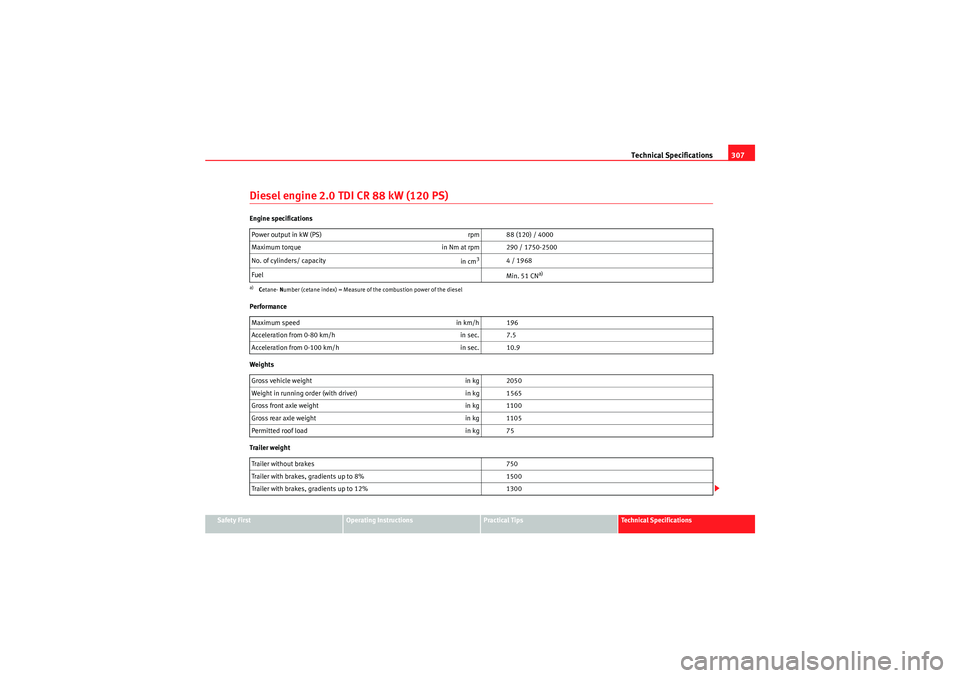
Diesel engine 2.0 TDI CR 88 kW (120 PS)Engine specifications
Performance
Weights
Trailer weightPower output in kW (PS)
rpm 88 (120) / 4000
Maximum torque in Nm at rpm 290 / 1750-2500
No. of cylinders/ capacity in cm
3
4 / 1968
Fuel Min. 51 CN
a)
a)Cetane- Number (cetane index) = Measure of the combustion power of the dieselMaximum speed in km/h 196
Acceleration from 0-80 km/h in sec. 7.5
Acceleration from 0-100 km/h in sec. 10.9
Gross vehicle weight in kg 2050
Weight in running order (with driver) in kg 1565
Gross front axle weight in kg 1100
Gross rear axle weight in kg 1105
Permitted roof load in kg 75
Trailer without brakes 750
Trailer with brakes, gradients up to 8% 1500
Trailer with brakes, gradients up to 12% 1300
ExeoST_EN.book Seite 307 Freitag, 3. September 2010 11:41 11