ECU Seat Exeo ST 2011 Owner's Guide
[x] Cancel search | Manufacturer: SEAT, Model Year: 2011, Model line: Exeo ST, Model: Seat Exeo ST 2011Pages: 319, PDF Size: 5.12 MB
Page 150 of 319
148Seats and storage compartments
Note
It is advisable to secure the items by means of a strap secured to the fasten-
ing rings on the left and the right hand side.
Side storage compartment
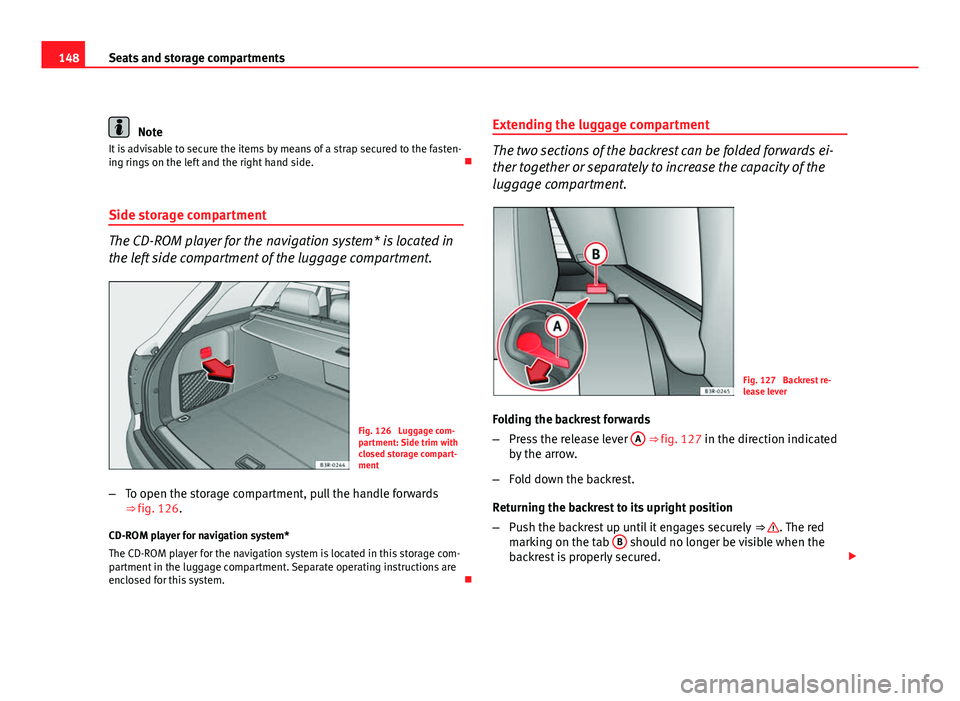
The CD-ROM player for the navigation system* is located in
the left side compartment of the luggage compartment.
Fig. 126 Luggage com-
partment: Side trim with
closed storage compart-
ment
– To open the storage compartment, pull the handle forwards
⇒ fig. 126.
CD-ROM player for navigation system*
The CD-ROM player for the navigation system is located in this storage com-
partment in the luggage compartment. Separate operating instructions are
enclosed for this system. Extending the luggage compartment
The two sections of the backrest can be folded forwards ei-
ther together or separately to increase the capacity of the
luggage compartment.
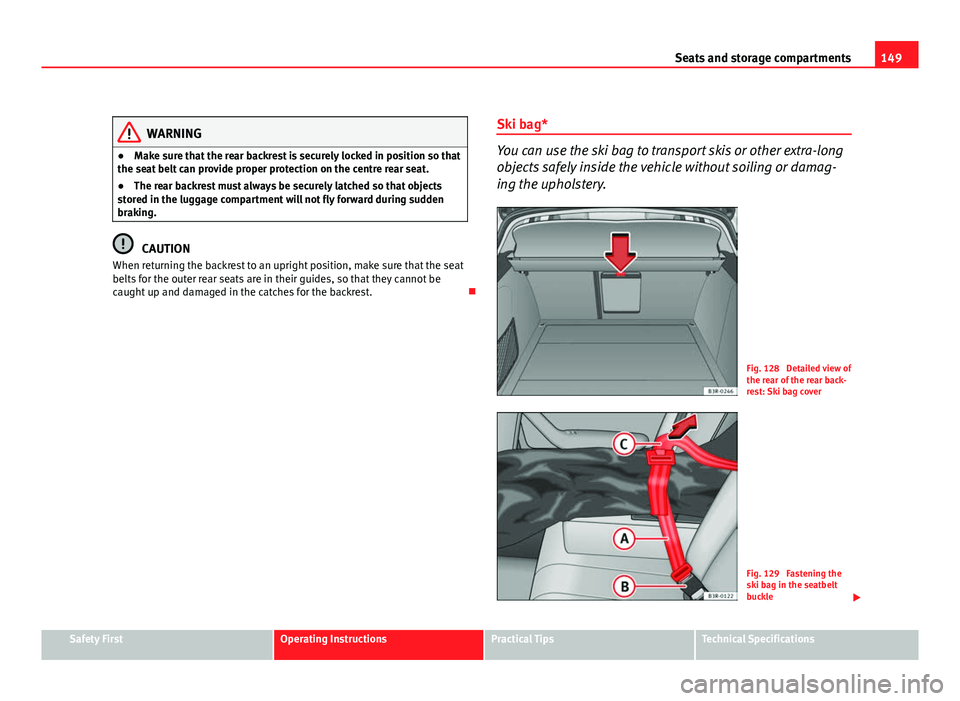
Fig. 127 Backrest re-
lease lever
Folding the backrest forwards
– Press the release lever A
⇒ fig. 127 in the direction indicated
by the arrow.
– Fold down the backrest.
Returning the backrest to its upright position
– Push the backrest up until it engages securely ⇒
. The red
marking on the tab B should no longer be visible when the
backrest is properly secured.
Page 151 of 319
149
Seats and storage compartments
WARNING
● Make sure that the rear backrest is securely locked in position so that
the seat belt can provide proper protection on the centre rear seat.
● The rear backrest must always be securely latched so that objects
stored in the luggage compartment will not fly forward during sudden
braking.
CAUTION
When returning the backrest to an upright position, make sure that the seat
belts for the outer rear seats are in their guides, so that they cannot be
caught up and damaged in the catches for the backrest. Ski bag*
You can use the ski bag to transport skis or other extra-long
objects safely inside the vehicle without soiling or damag-
ing the upholstery.
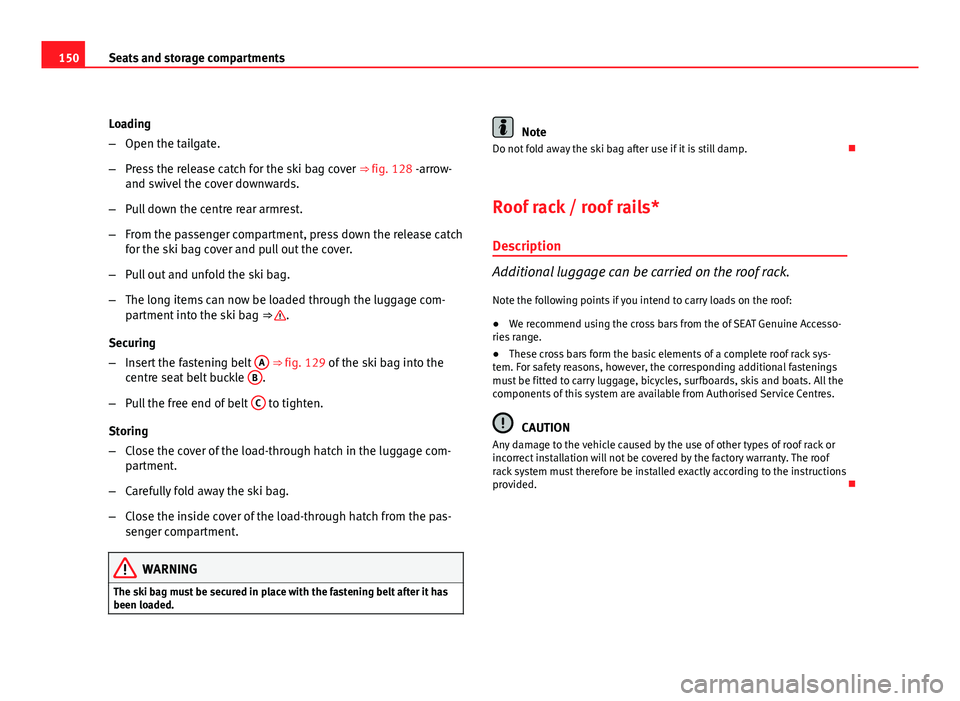
Fig. 128 Detailed view of
the rear of the rear back-
rest: Ski bag cover
Fig. 129 Fastening the
ski bag in the seatbelt
buckle
Safety FirstOperating InstructionsPractical TipsTechnical Specifications
Page 152 of 319
150Seats and storage compartments
Loading
–Open the tailgate.
– Press the release catch for the ski bag cover ⇒ fig. 128 -arrow-
and swivel the cover downwards.
– Pull down the centre rear armrest.
– From the passenger compartment, press down the release catch
for the ski bag cover and pull out the cover.
– Pull out and unfold the ski bag.
– The long items can now be loaded through the luggage com-
partment into the ski bag ⇒
.
Securing
– Insert the fastening belt A
⇒ fig. 129 of the ski bag into the
centre seat belt buckle B.
– Pull the free end of belt C
to tighten.
Storing
– Close the cover of the load-through hatch in the luggage com-
partment.
– Carefully fold away the ski bag.
– Close the inside cover of the load-through hatch from the pas-
senger compartment.
WARNING
The ski bag must be secured in place with the fastening belt after it has
been loaded.
Note
Do not fold away the ski bag after use if it is still damp.
Roof rack / roof rails* Description
Additional luggage can be carried on the roof rack.
Note the following points if you intend to carry loads on the roof:
● We recommend using the cross bars from the of SEAT Genuine Accesso-
ries range.
● These cross bars form the basic elements of a complete roof rack sys-
tem. For safety reasons, however, the corresponding additional fastenings
must be fitted to carry luggage, bicycles, surfboards, skis and boats. All the
components of this system are available from Authorised Service Centres.
CAUTION
Any damage to the vehicle caused by the use of other types of roof rack or
incorrect installation will not be covered by the factory warranty. The roof
rack system must therefore be installed exactly according to the instructions
provided.
Page 153 of 319
151
Seats and storage compartments
Attachment points
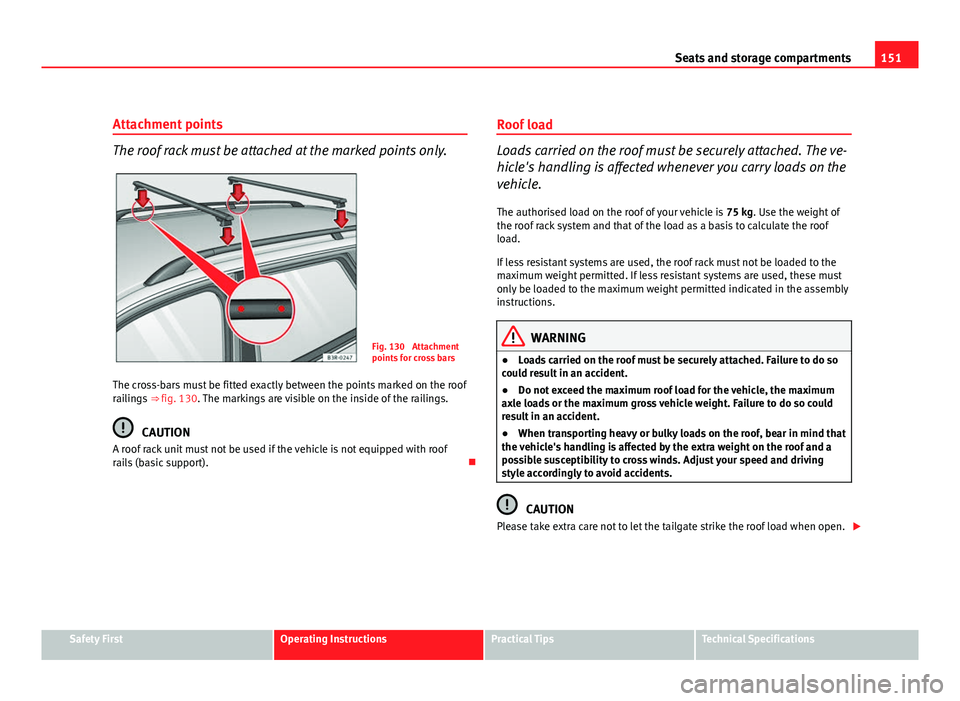
The roof rack must be attached at the marked points only.
Fig. 130 Attachment
points for cross bars
The cross-bars must be fitted exactly between the points marked on the roof
railings ⇒ fig. 130. The markings are visible on the inside of the railings.
CAUTION
A roof rack unit must not be used if the vehicle is not equipped with roof
rails (basic support). Roof load
Loads carried on the roof must be securely attached. The ve-
hicle's handling is affected whenever you carry loads on the
vehicle.
The authorised load on the roof of your vehicle is 75 kg. Use the weight of
the roof rack system and that of the load as a basis to calculate the roof
load.
If less resistant systems are used, the roof rack must not be loaded to the
maximum weight permitted. If less resistant systems are used, these must
only be loaded to the maximum weight permitted indicated in the assembly
instructions.
WARNING
● Loads carried on the roof must be securely attached. Failure to do so
could result in an accident.
● Do not exceed the maximum roof load for the vehicle, the maximum
axle loads or the maximum gross vehicle weight. Failure to do so could
result in an accident.
● When transporting heavy or bulky loads on the roof, bear in mind that
the vehicle's handling is affected by the extra weight on the roof and a
possible susceptibility to cross winds. Adjust your speed and driving
style accordingly to avoid accidents.
CAUTION
Please take extra care not to let the tailgate strike the roof load when open.
Safety FirstOperating InstructionsPractical TipsTechnical Specifications
Page 155 of 319
153
Seats and storage compartments
The retainer arm should be positioned against the drink holder so that it is
held securely.
One or two drink holders can be held in the centre console.
WARNING
● Do not put any hot drinks in the drink holder while the vehicle is mov-
ing. You can be scalded if the hot liquid is spilt.
● Do not use hard china cups or glasses. These could cause injury in the
event of an accident.
Ashtray*, cigarette lighter* and electric
sockets* Front ashtray*
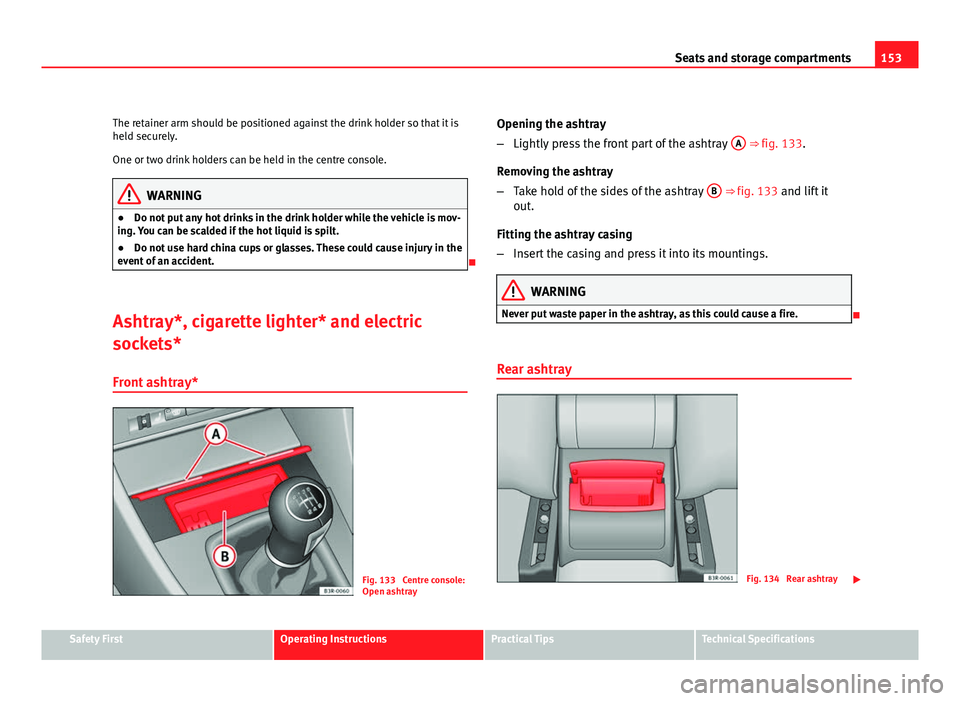
Fig. 133 Centre console:
Open ashtray Opening the ashtray
–
Lightly press the front part of the ashtray A
⇒ fig. 133.
Removing the ashtray
– Take hold of the sides of the ashtray B
⇒ fig. 133 and lift it
out.
Fitting the ashtray casing
– Insert the casing and press it into its mountings.
WARNING
Never put waste paper in the ashtray, as this could cause a fire.
Rear ashtray
Fig. 134 Rear ashtray
Safety FirstOperating InstructionsPractical TipsTechnical Specifications
Page 159 of 319
157
Seats and storage compartments
WARNING
● Heavy appliances or connectors (for example, adapters) which hang
down directly from the Europlug socket may damage the socket with the
resultant risk of injury.
● Ensure that appliances connected to the socket are secure to prevent
them from being thrown around the vehicle in the event of sharp braking
or an accident. This could result in severe injury or loss of life ⇒ page 16,
Storing objects.
● Never spill liquid over the socket – there is a risk of death. If any
moisture enters the socket, ensure that it is thoroughly dry before using.
● Improper use of the sockets or electrical accessories can lead to seri-
ous injuries or cause a fire, with the resultant risk of injury.
● Children must never be left alone in the vehicle with the engine run-
ning. They could cause an accident.
● Appliances connected to the socket do not behave in the same way as
when they are connected to the mains power supply. They may overheat
during use and cause injury.
● When using adapters and extension leads, the childproof safety de-
vice on the 230 volt socket is disconnected and the socket is live. Risk of
injury!.
● Never insert objects which conduct electricity, such as a needle, in
the pins of the 230 volt socket. There is a risk of death.
● Always switch off electrical appliances connected to the socket if the
inverter goes off as a result of overheating. Failure to comply could result
in injuries.
CAUTION
● The instructions for handling appliances connected to the socket must
be observed.
● If the power consumption of the appliances connected exceeds 150
watts, the socket inverter will overheat. If the temperature exceeds a certain
value, the inverter will switch off. It may also switch off if the outside tem- perature is very high, even if the power consumption is normal. The inverter
will switch on again automatically after it has cooled down. Appliances con-
nected to the socket, and which have been left switched on, will automati-
cally come back on
⇒
.
● Do not connect neon lamps to the socket. For technical reasons, these
could break down.
● Do not connect 115 volt appliances to the 230 volt power socket, as
they could be damaged. If you have any queries, please check the manufac-
turer's label for details of the power supply accepted by the appliance.
● With some adapters, for example for laptops, their built-in overload dis-
connection system prevents the equipment from switching on in the event
of an excessive start-up current. In this case, disconnect the adapter from
the power supply and try to reconnect after ten seconds.
Note
● Non-insulated equipment may cause interference to the radio or vehicle
electronics.
● The Europlug socket has a built-in childproof device and only carries live
current when the Europlug is correctly plugged in.
● Some appliances may not operate correctly in the absence of adequate
power (watts).
● In some countries this socket is 115 volts. Therefore the socket should
have a different inverter installed at the factory. You can obtain retrofit kits
from your Authorised Technical Service. Do not connect 115 Volt appliances
to the 230 Volt socket.
● The use of electrical equipment in the vicinity of the aerial in the rear
window may cause interference to the reception of stations broadcasting in
AM.
Safety FirstOperating InstructionsPractical TipsTechnical Specifications
Page 173 of 319
171
Driving
Driving SteeringAdjusting the steering wheel position
The height and reach of the steering wheel can be freely ad-
justed to suit the driver
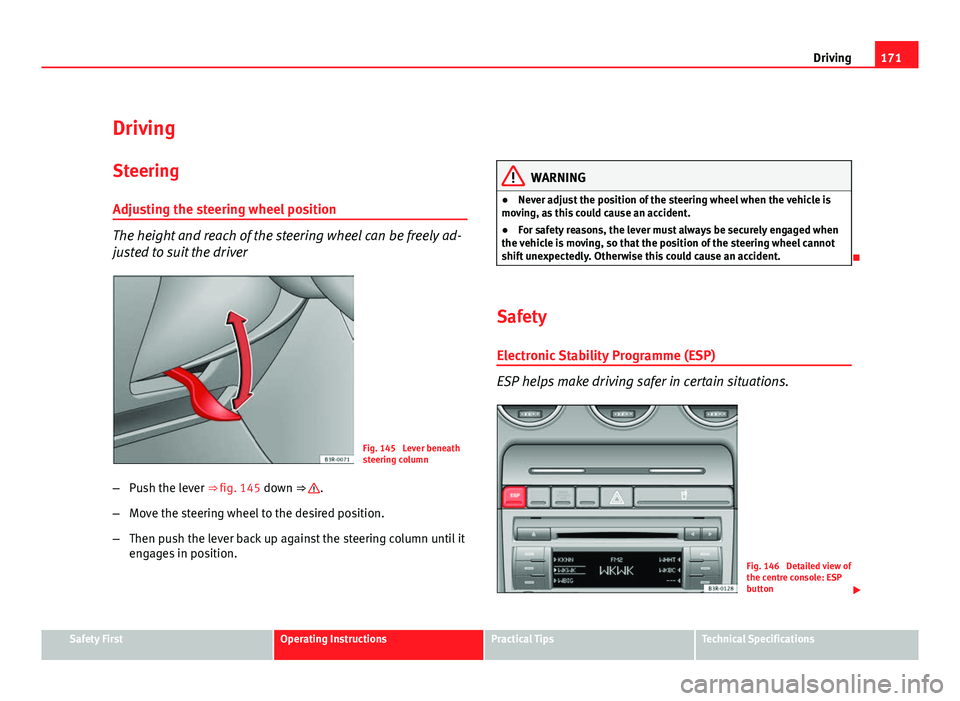
Fig. 145 Lever beneath
steering column
– Push the lever ⇒ fig. 145 down ⇒
.
– Move the steering wheel to the desired position.
– Then push the lever back up against the steering column until it
engages in position.
WARNING
● Never adjust the position of the steering wheel when the vehicle is
moving, as this could cause an accident.
● For safety reasons, the lever must always be securely engaged when
the vehicle is moving, so that the position of the steering wheel cannot
shift unexpectedly. Otherwise this could cause an accident.
Safety Electronic Stability Programme (ESP)
ESP helps make driving safer in certain situations.
Fig. 146 Detailed view of
the centre console: ESP
button
Safety FirstOperating InstructionsPractical TipsTechnical Specifications
Page 203 of 319
201
Trailer towing
Trailer towing Trailer towing
Technical requirements
The towing bracket must meet certain technical require-
ments.
Your vehicle is intended mainly for transporting passengers and luggage.
However, if suitably equipped, it can also be used to tow a trailer or cara-
van.
If your vehicle has been factory-supplied with a towing bracket, all of the
necessary technical and legal aspects for trailing towing have been taking
into account during manufacturing.
Your vehicle is fitted with a 13-pole socket for the electrical connection be-
tween the trailer and the vehicle. If the trailer has a 7-pole connector you
can use an adapter cable. This can be purchased at an Authorised Service.
If a towing bracket is to be fitted after the vehicle is purchased, this must be
done according to the instructions of the towing bracket manufacturer
⇒ page 209.
WARNING
If a towing bracket is retrofitted, the installation should be carried out by
a qualified workshop.
● Particularly in high outdoor temperatures, it is not possible to drive
up long steep gradients without a suitable cooling system. The engine
would heat up.
● Incorrect installation can result in a safety risk!
Notes on towing
There are a number of points which need to be checked be-
fore towing a trailer or caravan.
– Observe the maximum permitted trailer weights ⇒ page 296.
Trailer weight
Never exceed the maximum permitted trailer weight.
If you do not load the trailer up to the maximum permitted trailer weight,
you can then climb correspondingly steeper gradients.
The maximum trailer weights listed are only applicable for altitudes up to
1000 m above sea level. With increasing altitude the engine power and
therefore the vehicle's climbing ability are impaired because of the reduced
air density. The maximum trailer weight has to be reduced accordingly. The
weight of the vehicle and trailer must be reduced by about 10% for every
subsequent 1000 m (or part thereof). This figure refers to the combined
weight of the (loaded) vehicle and (loaded) trailer.
The figures for the drawbar load that appear on the identification plate of
the towing bracket are for certification purposes only. The correct figures for
your specific model, which may be lower than these figures for the towing
bracket, are given in the registration documents and on ⇒ page 289. Also
refer to ⇒ page 296.
Distributing the load
Distribute loads in the trailer so that heavy objects are as near to the axle as
possible. Loads carried in the trailer must be secured to prevent them mov-
ing.
Safety FirstOperating InstructionsPractical TipsTechnical Specifications
Page 206 of 319
204Trailer towing
Removable towing bracket
Introduction
Special care is required when fitting and removing the tow-
ing bracket.
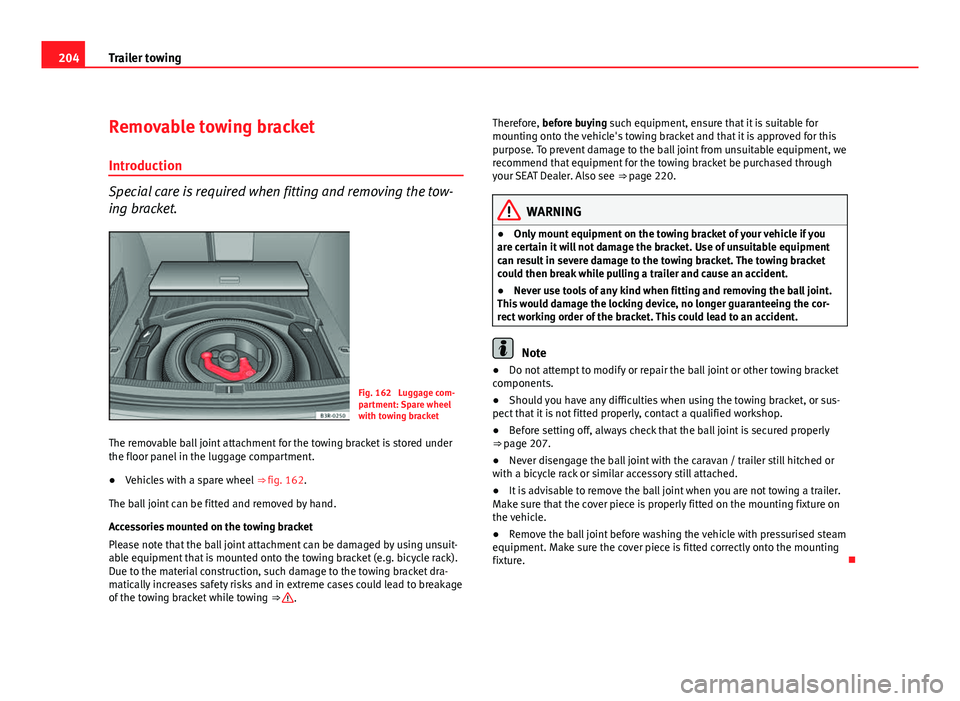
Fig. 162 Luggage com-
partment: Spare wheel
with towing bracket
The removable ball joint attachment for the towing bracket is stored under
the floor panel in the luggage compartment.
● Vehicles with a spare wheel ⇒ fig. 162.
The ball joint can be fitted and removed by hand.
Accessories mounted on the towing bracket
Please note that the ball joint attachment can be damaged by using unsuit-
able equipment that is mounted onto the towing bracket (e.g. bicycle rack).
Due to the material construction, such damage to the towing bracket dra-
matically increases safety risks and in extreme cases could lead to breakage
of the towing bracket while towing ⇒
. Therefore, before buying such equipment, ensure that it is suitable for
mounting onto the vehicle's towing bracket and that it is approved for this
purpose. To prevent damage to the ball joint from unsuitable equipment, we
recommend that equipment for the towing bracket be purchased through
your SEAT Dealer. Also see
⇒ page 220.
WARNING
● Only mount equipment on the towing bracket of your vehicle if you
are certain it will not damage the bracket. Use of unsuitable equipment
can result in severe damage to the towing bracket. The towing bracket
could then break while pulling a trailer and cause an accident.
● Never use tools of any kind when fitting and removing the ball joint.
This would damage the locking device, no longer guaranteeing the cor-
rect working order of the bracket. This could lead to an accident.
Note
● Do not attempt to modify or repair the ball joint or other towing bracket
components.
● Should you have any difficulties when using the towing bracket, or sus-
pect that it is not fitted properly, contact a qualified workshop.
● Before setting off, always check that the ball joint is secured properly
⇒ page 207.
● Never disengage the ball joint with the caravan / trailer still hitched or
with a bicycle rack or similar accessory still attached.
● It is advisable to remove the ball joint when you are not towing a trailer.
Make sure that the cover piece is properly fitted on the mounting fixture on
the vehicle.
● Remove the ball joint before washing the vehicle with pressurised steam
equipment. Make sure the cover piece is fitted correctly onto the mounting
fixture.
Page 207 of 319
205
Trailer towing
Fitting the ball joint (step 1)
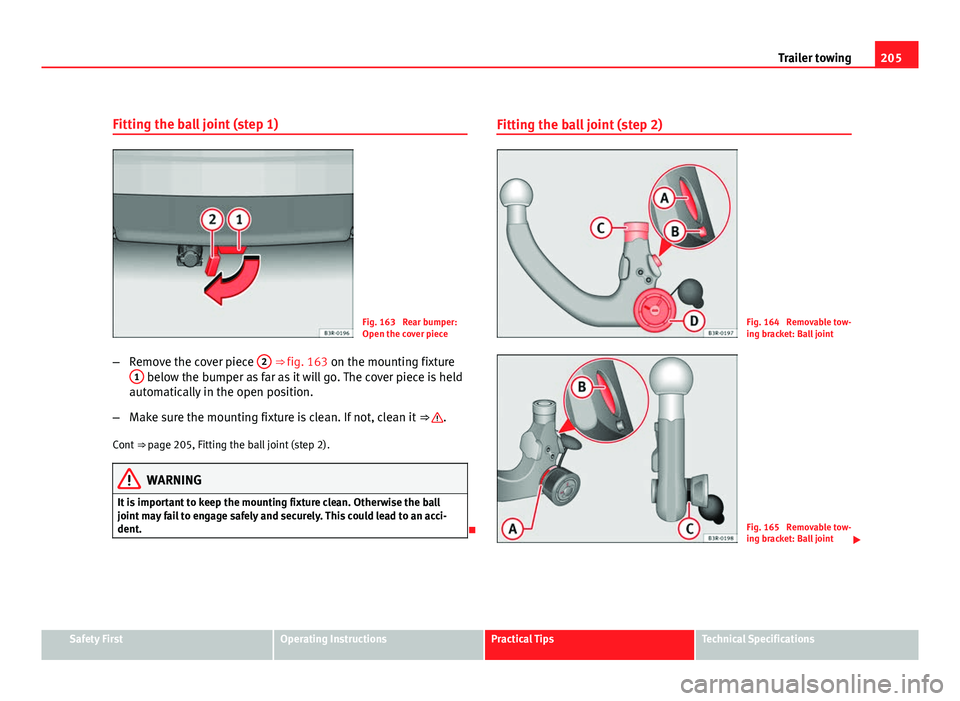
Fig. 163 Rear bumper:
Open the cover piece
– Remove the cover piece 2
⇒ fig. 163 on the mounting fixture
1 below the bumper as far as it will go. The cover piece is held
automatically in the open position.
– Make sure the mounting fixture is clean. If not, clean it ⇒
.
Cont ⇒ page 205, Fitting the ball joint (step 2).
WARNING
It is important to keep the mounting fixture clean. Otherwise the ball
joint may fail to engage safely and securely. This could lead to an acci-
dent.
Fitting the ball joint (step 2)
Fig. 164 Removable tow-
ing bracket: Ball joint
Fig. 165 Removable tow-
ing bracket: Ball joint
Safety FirstOperating InstructionsPractical TipsTechnical Specifications