fuel pressure Seat Exeo ST 2012 User Guide
[x] Cancel search | Manufacturer: SEAT, Model Year: 2012, Model line: Exeo ST, Model: Seat Exeo ST 2012Pages: 325, PDF Size: 5.56 MB
Page 253 of 325
251
Wheels and tyres
Significant tyre pressure loss
The tyre symbol is displayed and indicates that the tyre pressure
of at least one tyre is insufficient.
– Stop the vehicle.
– Switch the engine off.
– Check the tyre(s).
– Change the wheel if necessary.
Tyre pressure monitoring (RKA+)*
The tyre pressure monitor display on the instrument panel
indicates if the pressure is too low.
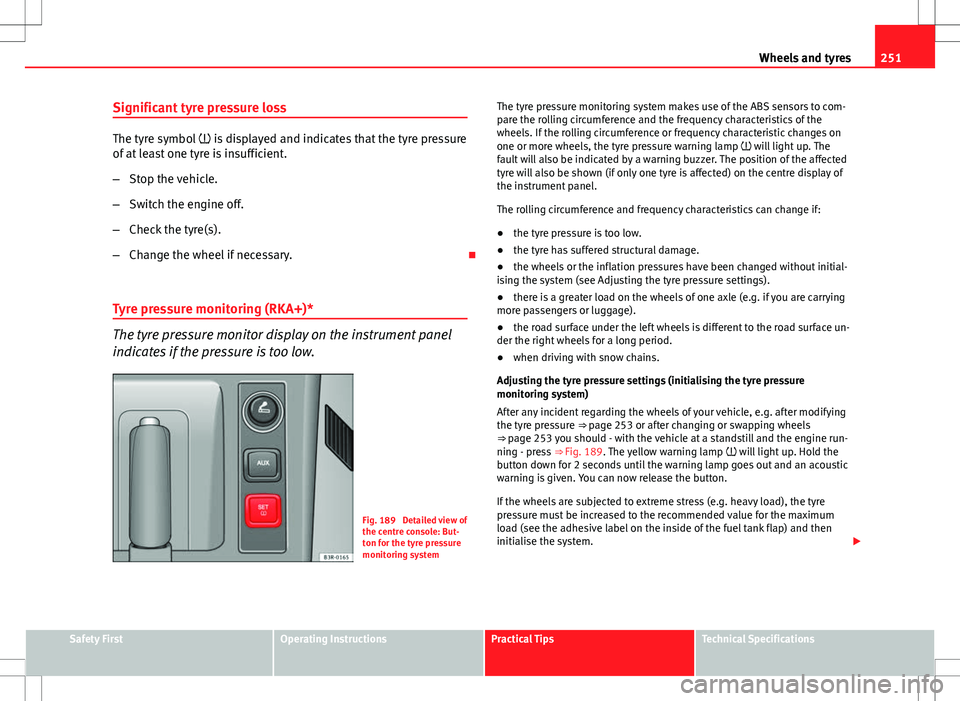
Fig. 189 Detailed view of
the centre console: But-
ton for the tyre pressure
monitoring system The tyre pressure monitoring system makes use of the ABS sensors to com-
pare the rolling circumference and the frequency characteristics of the
wheels. If the rolling circumference or frequency characteristic changes on
one or more wheels, the tyre pressure warning lamp will light up. The
fault will also be indicated by a warning buzzer. The position of the affected
tyre will also be shown (if only one tyre is affected) on the centre display of
the instrument panel.
The rolling circumference and frequency characteristics can change if:
●
the tyre pressure is too low.
● the tyre has suffered structural damage.
● the wheels or the inflation pressures have been changed without initial-
ising the system (see Adjusting the tyre pressure settings).
● there is a greater load on the wheels of one axle (e.g. if you are carrying
more passengers or luggage).
● the road surface under the left wheels is different to the road surface un-
der the right wheels for a long period.
● when driving with snow chains.
Adjusting the tyre pressure settings (initialising the tyre pressure
monitoring system)
After any incident regarding the wheels of your vehicle, e.g. after modifying
the tyre pressure ⇒ page 253 or after changing or swapping wheels
⇒ page 253 you should - with the vehicle at a standstill and the engine run- ning - press ⇒ Fig. 189. The yellow warning lamp will light up. Hold the
button down for 2 seconds until the warning lamp goes out and an acoustic
warning is given. You can now release the button.
If the wheels are subjected to extreme stress (e.g. heavy load), the tyre
pressure must be increased to the recommended value for the maximum
load (see the adhesive label on the inside of the fuel tank flap) and then
initialise the system.
Safety FirstOperating InstructionsPractical TipsTechnical Specifications
Page 255 of 325
253
Wheels and tyres
Tyre service life
The service life of tyres is dependent on tyre pressure, driv-
ing style and fitting.
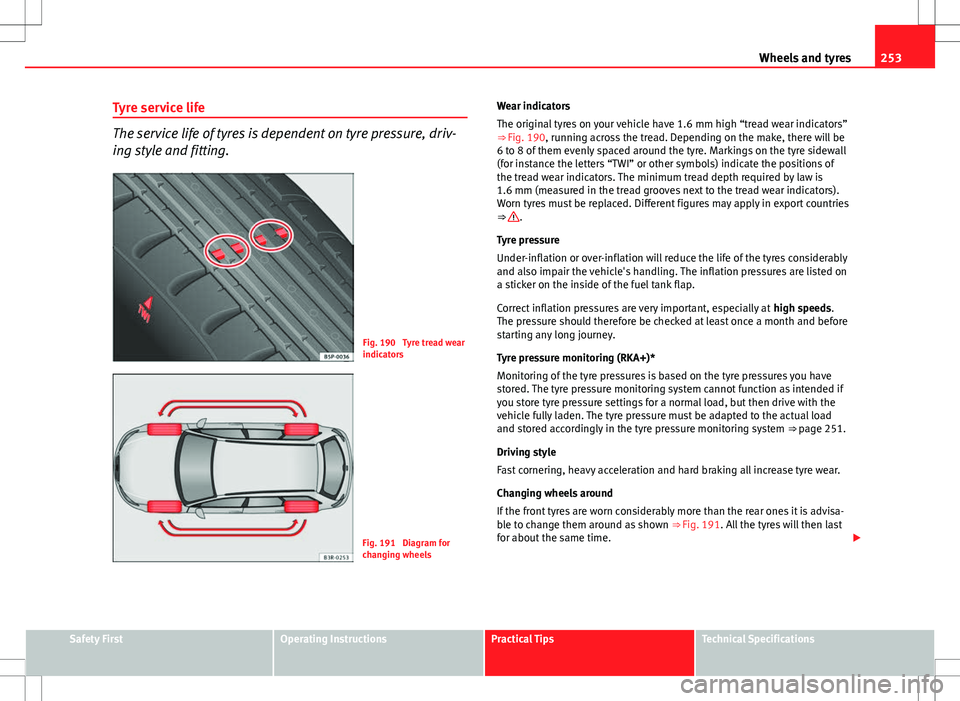
Fig. 190 Tyre tread wear
indicators
Fig. 191 Diagram for
changing wheels Wear indicators
The original tyres on your vehicle have 1.6 mm high “tread wear indicators”
⇒ Fig. 190, running across the tread. Depending on the make, there will be
6 to 8 of them evenly spaced around the tyre. Markings on the tyre sidewall
(for instance the letters “TWI” or other symbols) indicate the positions of
the tread wear indicators. The minimum tread depth required by law is
1.6 mm (measured in the tread grooves next to the tread wear indicators).
Worn tyres must be replaced. Different figures may apply in export countries
⇒
.
Tyre pressure
Under-inflation or over-inflation will reduce the life of the tyres considerably
and also impair the vehicle's handling. The inflation pressures are listed on
a sticker on the inside of the fuel tank flap.
Correct inflation pressures are very important, especially at high speeds.
The pressure should therefore be checked at least once a month and before
starting any long journey.
Tyre pressure monitoring (RKA+)*
Monitoring of the tyre pressures is based on the tyre pressures you have
stored. The tyre pressure monitoring system cannot function as intended if
you store tyre pressure settings for a normal load, but then drive with the
vehicle fully laden. The tyre pressure must be adapted to the actual load
and stored accordingly in the tyre pressure monitoring system ⇒ page 251.
Driving style
Fast cornering, heavy acceleration and hard braking all increase tyre wear.
Changing wheels around
If the front tyres are worn considerably more than the rear ones it is advisa-
ble to change them around as shown ⇒ Fig. 191. All the tyres will then last
for about the same time.
Safety FirstOperating InstructionsPractical TipsTechnical Specifications
Page 256 of 325
254Wheels and tyres
Wheel balance
The wheels on new vehicles are balanced. However, various factors encoun-
tered in normal driving can cause them to become unbalanced, which re-
sults in steering vibration.
Unbalanced wheels should be rebalanced, as they otherwise cause exces-
sive wear on steering, suspension and tyres. A wheel must also be reba-
lanced when a new tyre is fitted.
Incorrect wheel alignment
Incorrect wheel alignment causes excessive tyre wear, impairing the safety
of the vehicle. If tyres show excessive wear, you should have the wheel
alignment checked by a Technical Service.
WARNING
There is a serious danger of accidents if a tyre bursts during driving!
● The tyres must be replaced at the latest when the tread wear indica-
tors are worn ⇒ page 253. Failure to do so could result in an accident.
Worn tyres do not grip well at high speeds on wet roads. There is also a
greater risk of aquaplaning.
● At continuously high speeds, a tyre with insufficient pressure flexes
more. This causes it to overheat. This can cause tread separation and tyre
blow-out. Risk of accident. Always observe the recommended tyre pres-
sures.
● If tyres show excessive wear, you should have the running gear
checked by a Technical Service.
● Keep chemicals such as oil, fuel and brake fluid away from tyres.
● Damaged wheels and tyres must be replaced immediately!
For the sake of the environment
Under-inflated tyres will increase fuel consumption. Run-flat tyres*
Run-flat tyres allow you to continue driving even with a
punctured tyre, in the majority of cases.
In vehicles that are factory-fitted with run-flat tyres 1)
the loss of tyre
pressure is indicated on the instrument panel.
Driving with run-flat tyres (emergency running)
– Leave the ESC/ASR on (Electronic Stability Control), or switch it
on ⇒ page 71.
– Continue driving carefully and slowly (80 km/h maximum).
– Avoid sudden manoeuvres and sharp turns.
– Avoid driving over obstacles (for example kerbs) or potholes.
– Pay attention if the ESC/ASR activates often, if smoke comes
from the tyres or there is a smell of rubber, if the vehicle vi-
brates or there are clattering noises. If any of these occur, stop
the vehicle.
The run-flat tyres have a tag on the side of the tyre, with the description:
“DSST”, “Eufonia”, “RFT”, “ROF”, “RSC”, “SSR” or “ZP”.
The sides of this type of tyre are reinforced. When the tyres lose air they are
supported on the sides (emergency driving).
The loss of pressure in the tyre is shown on the instrument panel. You can
then drive a maximum of 80 km and if the circumstances are favourable (for
example, low load), even more.
1)
Depending upon version and country.
Page 257 of 325

255
Wheels and tyres
The damaged tyre should be changed as soon as possible. The rim should
be checked in a specialised workshop to detect possible damage and re-
place it if necessary. We recommend you contact Technical Service. If more
than one tyre is being used under emergency conditions, this reduces the
distance which can be travelled.
Starting driving in emergency conditions
When loss in tyre pressure is displayed on the instrument panel, this means
that at least one tyre is being driven in emergency conditions ⇒
.
End of emergency operation
Do not drive on if:
● smoke is coming from one of the tyres,
● there is a smell of rubber,
● the vehicle vibrates,
● there is a rattling noise.
When is it no longer possible to continue driving even using run-flat tyres?
● If the Electronic Stability Control (ESC) does not function.
● If the tyre pressure monitoring system* does not work.
● If one of the tyres has been severely damaged in an accident, etc. If a
tyre has been badly damaged there is a risk that parts of the tread can be
thrown off and cause damage to the fuel lines, brake pipes or fuel filler.
● It is also advisable to stop driving if severe vibrations occur, or if the
wheel starts overheating and gives off smoke.
WARNING
When driving in emergency conditions, the driving quality of the vehicle
is considerably impaired.
● The maximum permitted speed of 80 km/h is subject to road and
weather conditions. Please observe legal requirements when doing so.
WARNING (Continued)
● Avoid sharp turns and rapid manoeuvres, and brake earlier than usu-
al.
● Avoid driving over obstacles (for example kerbs) or potholes.
● If one or more tyres are being driven in emergency conditions, the
driving quality of the vehicle is impaired and there is a risk of accident.
Note
● The run-flat tyres do not “deflate” on losing pressure because they are
supported on the reinforced sides. Therefore defects in the tyre cannot be
detected with a visual inspection.
● Snow chains must not be used on front tyres used in emergency condi-
tions.
New tyres and wheels
New tyres and wheels have to be run in.
The tyres and wheel rims are an essential part of the vehicle's design. The
tyres and rims approved by SEAT are specially matched to the characteris-
tics of the vehicle and make a major contribution to good road holding and
safe handling ⇒
.
Tyres should be replaced at least in pairs and not individually (i.e. both front
tyres or both rear tyres together). A knowledge of tyre designations makes it
easier to choose the correct tyres. Radial tyres have the tyre designations
marked on the sidewall, for example: 195/65 R15 91T
This contains the following information:
Safety FirstOperating InstructionsPractical TipsTechnical Specifications
Page 259 of 325
257
Wheels and tyres
After the wheels have been changed, the tightening torque of the wheel
bolts should be checked as soon as possible with a torque wrench. ⇒
The tightening torque for steel and alloy wheels is 120 Nm.
WARNING
If the wheel bolts are not tightened correctly, the wheel could become
loose while driving. Risk of accident.
● The wheel bolts must be clean and turn easily. Never apply grease or
oil to them.
● Use only wheel bolts which belong to the wheel.
● If the torque of the wheel bolts is too low, they could loosen whilst
the vehicle is in motion. Risk of accident! If the tightening torque is too
high, the wheel bolts and threads can be damaged.
CAUTION
The prescribed torque for wheel bolts for steel and alloy wheels is 120 Nm.
Winter tyres
Winter tyres will improve the vehicles handling on snow and
ice.
In winter conditions winter tyres will considerably improve the vehicle's han-
dling. The design of summer tyres (width, rubber compound, tread pattern)
gives less grip on ice and snow.
Winter tyres must be inflated to a pressure 0.2 bar higher than the pres-
sures specified for summer tyres (see sticker on tank flap).
Winter tyres must be fitted on all four wheels. Information on permitted winter tyre sizes can be found in the vehicle's reg-
istration documents. Use only radial winter tyres. All tyre sizes listed in the
vehicle documentation also apply to winter tyres.
Winter tyres lose their effectiveness when the tread is worn down to a depth
of 4 mm.
The speed rating code ⇒
page 255, New tyres and wheels determines the
following speed limits for winter tyres: ⇒
max. 160 km/h
max. 180 km/h
max. 190 km/h
max. 210 km/h
In some countries, vehicles which can exceed the speed rating of the fitted
tyre must have an appropriate sticker in the driver's field of view. These
stickers are available from your Technical Service. The legal requirements of
each country must be followed.
Do not have winter tyres fitted for unnecessarily long periods. Vehicles with
summer tyres handle better when the roads are free of snow and ice.
If you have a flat tyre, please refer to the notes on the spare wheel
⇒ page 255, New tyres and wheels.
WARNING
The maximum speed for the winter tyres must not be exceeded. Other-
wise, this could lead to tyre damage and risk of accident.
For the sake of the environment
Fit your summer tyres again as soon as possible. They are quieter, do not
wear so quickly and reduce fuel consumption.
Q
S
T
H
Safety FirstOperating InstructionsPractical TipsTechnical Specifications
Page 273 of 325

271
If and when
Fuse assignment
This list shows the fuses which can be replaced relatively
easily by the owner.
No.ConsumerAmps1Air conditioner102Footwell lamps53Heated washer jets54Radiator fan55Parking aid, automatic gearbox106Air conditioner (air purity sensor), pressure sensor5
7Electronic Stability Control (ESC), brake light switch,
clutch pedal switch, steering angle sensor10
8Telephone59Lambda probe heater1010Adaptive headlights right5
11Airbag and disconnection of the front passenger air-
bag5
12Diagnostic socket1013Steering column unit1014Brake lights1015Instrument panel1016Vacant 17Tyre pressure control, rain/light sensor1018Adaptive headlights left519Start-Stop control unit1020Engine management1521Start/Stop battery power management522Vacant 23Vacant
No.ConsumerAmps24Central electrics unit for convenience equipment2025Heater blower3026Rear window heater3027Power socket for trailer (control unit)3028Fuel pump, auxiliary pump for diesel2029Radio, amplifier (with Start-Stop)2030Sliding/tilting sunroof20
31Diagnosis connection, automatic anti-dazzle interior
mirror, reverse light, automatic gearbox15
32Towing socket1533Lighter2034Rear electric windows3035Luggage compartment power socket*2036Wiper system30
37Pump for windscreen washer and headlight washer
system30
38Luggage compartment illumination, alarm1539Radio, amplifier (without Start-Stop)2040Horn2541230 volt socket3042Electronic Stability Control (ESC)2543Front electric windows3044Seat heating35
Some of the electrical items listed in the table are only fitted on certain
models or are optional extras.
Safety FirstOperating InstructionsPractical TipsTechnical Specifications
Page 314 of 325
312Technical specifications
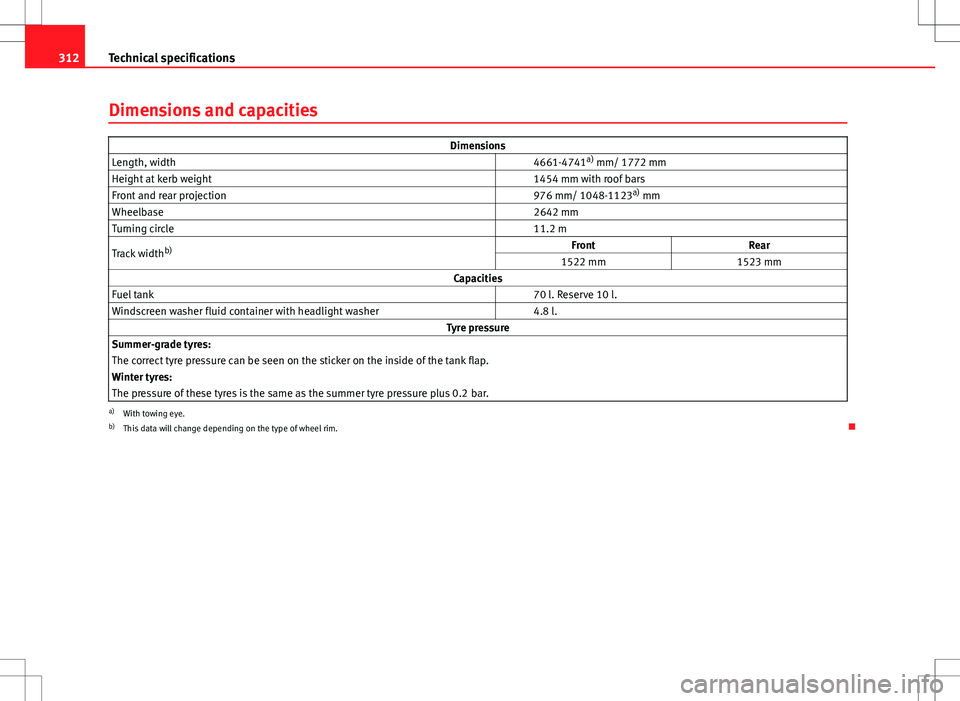
Dimensions and capacities
Dimensions
Length, width 4661-4741a)
mm/ 1772 mm
Height at kerb weight 1454 mm with roof bars
Front and rear projection 976 mm/ 1048-1123a)
mm
Wheelbase 2642 mm
Turning circle 11.2 m
Track width b) Front
Rear
1522 mm 1523 mm
Capacities
Fuel tank 70 l. Reserve 10 l.
Windscreen washer fluid container with headlight washer 4.8 l.
Tyre pressure
Summer-grade tyres:
The correct tyre pressure can be seen on the sticker on the inside of the tank flap.
Winter tyres:
The pressure of these tyres is the same as the summer tyre pressure plus 0.2 bar.
a) With towing eye.
b) This data will change depending on the type of wheel rim.
Page 318 of 325
EmergenciesChanging a wheel . . . . . . . . . . . . . . . . . . . 262
Disconnecting the battery . . . . . . . . . . . . . 246
Jack . . . . . . . . . . . . . . . . . . . . . . . . . . . 259, 264
Sunroof emergency activation . . . . . . . . . . 116
Tools . . . . . . . . . . . . . . . . . . . . . . . . . . . . . . 259
Tyre mobility system . . . . . . . . . . . . . . . . . . 260
Engine Running in . . . . . . . . . . . . . . . . . . . . . . . . . 201
Starting . . . . . . . . . . . . . . . . . . . . . . . . . . . . 174
Stop . . . . . . . . . . . . . . . . . . . . . . . . . . . . . . . 175
Engine compartment Safety instructions . . . . . . . . . . . . . . . . . . . 234
Engine coolant G 12 plus-plus . . . . . . . . . . . . . . . . . . . . . . 238
G 13 . . . . . . . . . . . . . . . . . . . . . . . . . . . . . . . 238
Specifications . . . . . . . . . . . . . . . . . . . . . . . 238
Engine oil . . . . . . . . . . . . . . . . . . . . . . . . . . . . . 235 Checking oil level . . . . . . . . . . . . . . . . . . . . 237
Checking the level . . . . . . . . . . . . . . . . . . . . 83
Consumption . . . . . . . . . . . . . . . . . . . . . . . 237
Engine oil pressure too low . . . . . . . . . . . . . 81
Oil properties . . . . . . . . . . . . . . . . . . . . . . . 236
Oil sensor defective . . . . . . . . . . . . . . . . . . . 83
Topping up . . . . . . . . . . . . . . . . . . . . . . . . . 238
Engine speed governing . . . . . . . . . . . . . . . . . . 83
Environment . . . . . . . . . . . . . . . . . . . . . . . . . . . 203 Environmental friendliness . . . . . . . . . . . . 205
Roof racks . . . . . . . . . . . . . . . . . . . . . . . . . . 153
Environmentally friendly driving . . . . . . . . . . . 203
Environmental tip Avoiding pollution . . . . . . . . . . . . . . . . . . . 231 ESC . . . . . . . . . . . . . . . . . . . . . . . . . . . . . . . . . . . 71
see also Electronic Stability Control . . . . . 172
Exhaust gas purification system . . . . . . . . . . . 202
Exterior mirrors . . . . . . . . . . . . . . . . . . . . . . . . . 219
F
Fastening rings . . . . . . . . . . . . . . . . . . . . . . . . . . 17
Floor mats . . . . . . . . . . . . . . . . . . . . . . . . . . . . . . 16
Fog lights . . . . . . . . . . . . . . . . . . . . . . . . . . . . . 119
Front airbags . . . . . . . . . . . . . . . . . . . . . . . . . . . 33 Description . . . . . . . . . . . . . . . . . . . . . . . . . . 33
Operation . . . . . . . . . . . . . . . . . . . . . . . . . . . 34
Safety notes . . . . . . . . . . . . . . . . . . . . . . . . . 36
Front drink holder . . . . . . . . . . . . . . . . . . . . . . . 153
Front passenger airbag deactivation . . . . . . . . 45
Fuel Diesel . . . . . . . . . . . . . . . . . . . . . . . . . . . . . 232
Fuel gauge . . . . . . . . . . . . . . . . . . . . . . . . . . 65
Fuel level low . . . . . . . . . . . . . . . . . . . . . . . . 83
Instantaneous fuel consumption . . . . . . . . 88
Petrol . . . . . . . . . . . . . . . . . . . . . . . . . . . . . . 231
Fuel consumption . . . . . . . . . . . . . . . . . . . 203, 301
Fuel tank opening the fuel tank flap . . . . . . . . . . . . . 230
Fuel: save . . . . . . . . . . . . . . . . . . . . . . . . . . . . . 203
Fuse Assignment . . . . . . . . . . . . . . . . . . . . . . . . . 271
Changing . . . . . . . . . . . . . . . . . . . . . . . . . . 270 G
Gear display . . . . . . . . . . . . . . . . . . . . . . . . . . . . 76
Gear shift pattern . . . . . . . . . . . . . . . . . . . . . . . 186
General overview of the engine compartment 304
Glove compartment . . . . . . . . . . . . . . . . . . . . . 159 Light . . . . . . . . . . . . . . . . . . . . . . . . . . . . . . 125
H Handbrake . . . . . . . . . . . . . . . . . . . . . . . . . . . . 179 Control lamp . . . . . . . . . . . . . . . . . . . . . . . . . 72
Hazard warning lights . . . . . . . . . . . . . . . . . . . 123
Headlight range control . . . . . . . . . . . . . . . . . . 121 Dynamic . . . . . . . . . . . . . . . . . . . . . . . . . . . 122
Faulty . . . . . . . . . . . . . . . . . . . . . . . . . . . . . . . 84
Headlights Adaptive headlights . . . . . . . . . . . . . . . . . . 123
Automatic headlight control . . . . . . . . . . . 118
Automatic headlight control photosensors . .118
Driving abroad . . . . . . . . . . . . . . . . . . . . . . 205
Front fog lights . . . . . . . . . . . . . . . . . . . . . . 119
Headlight range control . . . . . . . . . . . . . . . 121
Headlight washer system . . . . . . . . . . . . . 132
Head restraint Rear seat . . . . . . . . . . . . . . . . . . . . . . . . . . . 142
Head restraints Front seats . . . . . . . . . . . . . . . . . . . . . . . . . 141
Rear seats . . . . . . . . . . . . . . . . . . . . . . . . . . 142
Removing and fitting . . . . . . . . . . . . . . . . . 141
Heated Seats . . . . . . . . . . . . . . . . . . . . . . . . . . . . . . 171
Heated rear window . . . . . . . . . . . . . . . . . . . . . 128
316 Index