ABS Seat Exeo ST 2012 Owner's Guide
[x] Cancel search | Manufacturer: SEAT, Model Year: 2012, Model line: Exeo ST, Model: Seat Exeo ST 2012Pages: 325, PDF Size: 5.56 MB
Page 253 of 325
251
Wheels and tyres
Significant tyre pressure loss
The tyre symbol is displayed and indicates that the tyre pressure
of at least one tyre is insufficient.
– Stop the vehicle.
– Switch the engine off.
– Check the tyre(s).
– Change the wheel if necessary.
Tyre pressure monitoring (RKA+)*
The tyre pressure monitor display on the instrument panel
indicates if the pressure is too low.
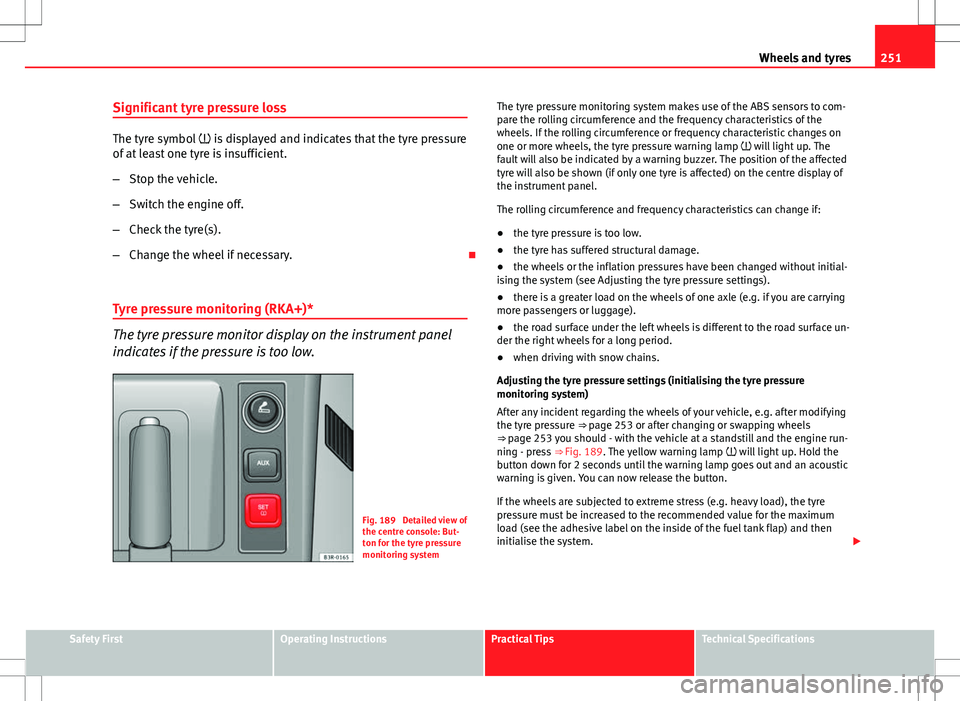
Fig. 189 Detailed view of
the centre console: But-
ton for the tyre pressure
monitoring system The tyre pressure monitoring system makes use of the ABS sensors to com-
pare the rolling circumference and the frequency characteristics of the
wheels. If the rolling circumference or frequency characteristic changes on
one or more wheels, the tyre pressure warning lamp will light up. The
fault will also be indicated by a warning buzzer. The position of the affected
tyre will also be shown (if only one tyre is affected) on the centre display of
the instrument panel.
The rolling circumference and frequency characteristics can change if:
●
the tyre pressure is too low.
● the tyre has suffered structural damage.
● the wheels or the inflation pressures have been changed without initial-
ising the system (see Adjusting the tyre pressure settings).
● there is a greater load on the wheels of one axle (e.g. if you are carrying
more passengers or luggage).
● the road surface under the left wheels is different to the road surface un-
der the right wheels for a long period.
● when driving with snow chains.
Adjusting the tyre pressure settings (initialising the tyre pressure
monitoring system)
After any incident regarding the wheels of your vehicle, e.g. after modifying
the tyre pressure ⇒ page 253 or after changing or swapping wheels
⇒ page 253 you should - with the vehicle at a standstill and the engine run- ning - press ⇒ Fig. 189. The yellow warning lamp will light up. Hold the
button down for 2 seconds until the warning lamp goes out and an acoustic
warning is given. You can now release the button.
If the wheels are subjected to extreme stress (e.g. heavy load), the tyre
pressure must be increased to the recommended value for the maximum
load (see the adhesive label on the inside of the fuel tank flap) and then
initialise the system.
Safety FirstOperating InstructionsPractical TipsTechnical Specifications
Page 279 of 325

277
If and when
Changing the dipped beam headlight bulb
The procedure for changing the bulb is the same on both
sides.
Fig. 210 Dipped beam
headlights
Fig. 211 Dipped beam
headlights
– Switch off the ignition and the lights. –
Raise the bonnet.
– Move the brace ⇒ Fig. 210 1
in the direction of the arrow and
remove the rigid cover, separating the brace side and then re-
moving the two tabs from the other end of the cover.
– Pull the connector ⇒ Fig. 211 2
from the bulb.
– Unclip the retainer spring ⇒ Fig. 211 3
pressing inwards to the
right.
– Remove the bulb and fit the new one in the headlight casing
with the tab upwards, starting to position it from below.
– Clip on the spring, raising it and pressing it slightly while turn-
ing it anticlockwise. To ensure correct lighting, the filament
must be vertical. When changing the bulb, you can check the
position of the bulb through the headlight glass.
– Connect the connector to the bulb.
– Fit the cover, first inserting the side tabs and then closing the
cover and the brace. Make sure that the gasket sits well on the
casing cover during the operation.
– Check whether the new bulb is working.
– Have the headlight settings checked as soon as possible.
Safety FirstOperating InstructionsPractical TipsTechnical Specifications
Page 280 of 325
278If and when
Changing the side light bulb (outside of vehicle)
The procedure for changing the bulb is the same on both
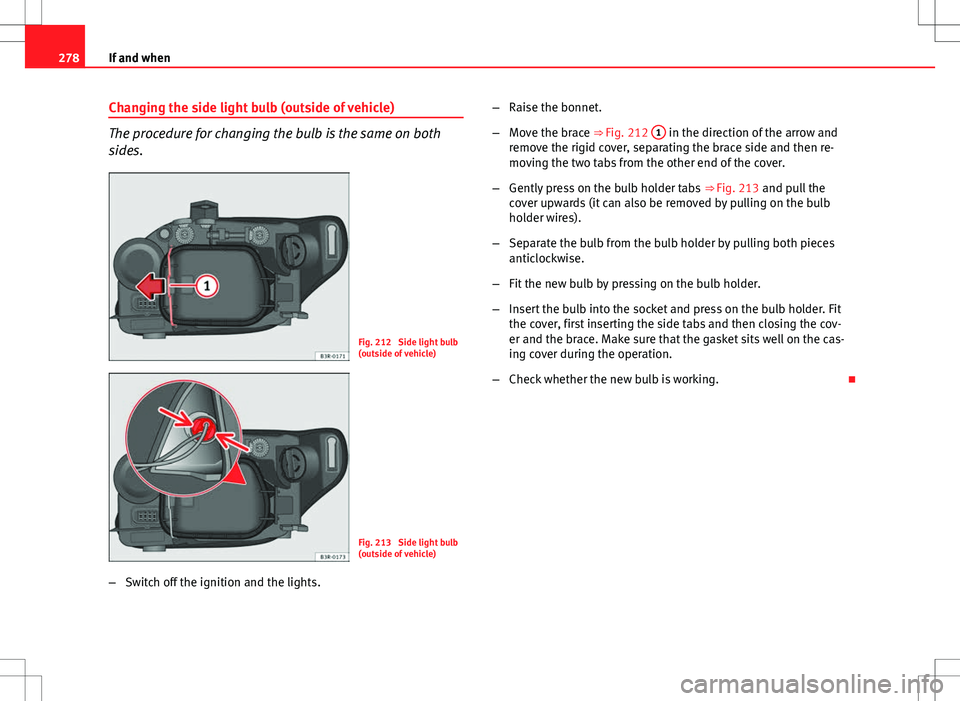
sides.
Fig. 212 Side light bulb
(outside of vehicle)
Fig. 213 Side light bulb
(outside of vehicle)
– Switch off the ignition and the lights. –
Raise the bonnet.
– Move the brace ⇒ Fig. 212 1
in the direction of the arrow and
remove the rigid cover, separating the brace side and then re-
moving the two tabs from the other end of the cover.
– Gently press on the bulb holder tabs ⇒ Fig. 213 and pull the
cover upwards (it can also be removed by pulling on the bulb
holder wires).
– Separate the bulb from the bulb holder by pulling both pieces
anticlockwise.
– Fit the new bulb by pressing on the bulb holder.
– Insert the bulb into the socket and press on the bulb holder. Fit
the cover, first inserting the side tabs and then closing the cov-
er and the brace. Make sure that the gasket sits well on the cas-
ing cover during the operation.
– Check whether the new bulb is working.
Page 281 of 325
279
If and when
Changing the side light bulb (inside of vehicle)
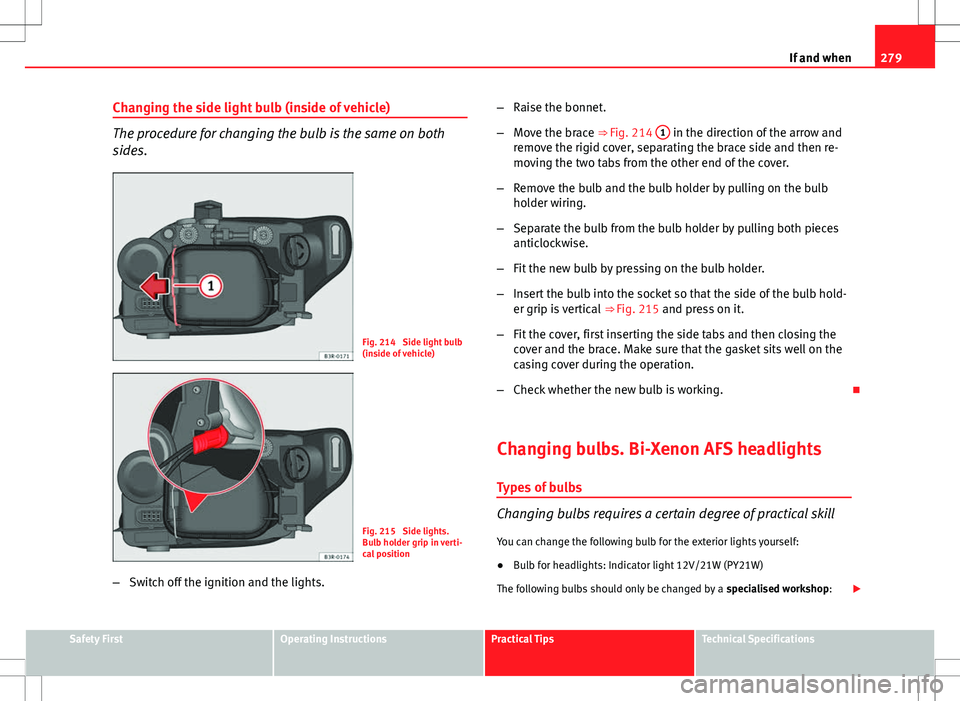
The procedure for changing the bulb is the same on both
sides.
Fig. 214 Side light bulb
(inside of vehicle)
Fig. 215 Side lights.
Bulb holder grip in verti-
cal position
– Switch off the ignition and the lights. –
Raise the bonnet.
– Move the brace ⇒ Fig. 214 1
in the direction of the arrow and
remove the rigid cover, separating the brace side and then re-
moving the two tabs from the other end of the cover.
– Remove the bulb and the bulb holder by pulling on the bulb
holder wiring.
– Separate the bulb from the bulb holder by pulling both pieces
anticlockwise.
– Fit the new bulb by pressing on the bulb holder.
– Insert the bulb into the socket so that the side of the bulb hold-
er grip is vertical ⇒ Fig. 215 and press on it.
– Fit the cover, first inserting the side tabs and then closing the
cover and the brace. Make sure that the gasket sits well on the
casing cover during the operation.
– Check whether the new bulb is working.
Changing bulbs. Bi-Xenon AFS headlights Types of bulbs
Changing bulbs requires a certain degree of practical skill
You can change the following bulb for the exterior lights yourself:
● Bulb for headlights: Indicator light 12V/21W (PY21W)
The following bulbs should only be changed by a specialised workshop:
Safety FirstOperating InstructionsPractical TipsTechnical Specifications
Page 287 of 325
285
If and when
Remove the bulb holder
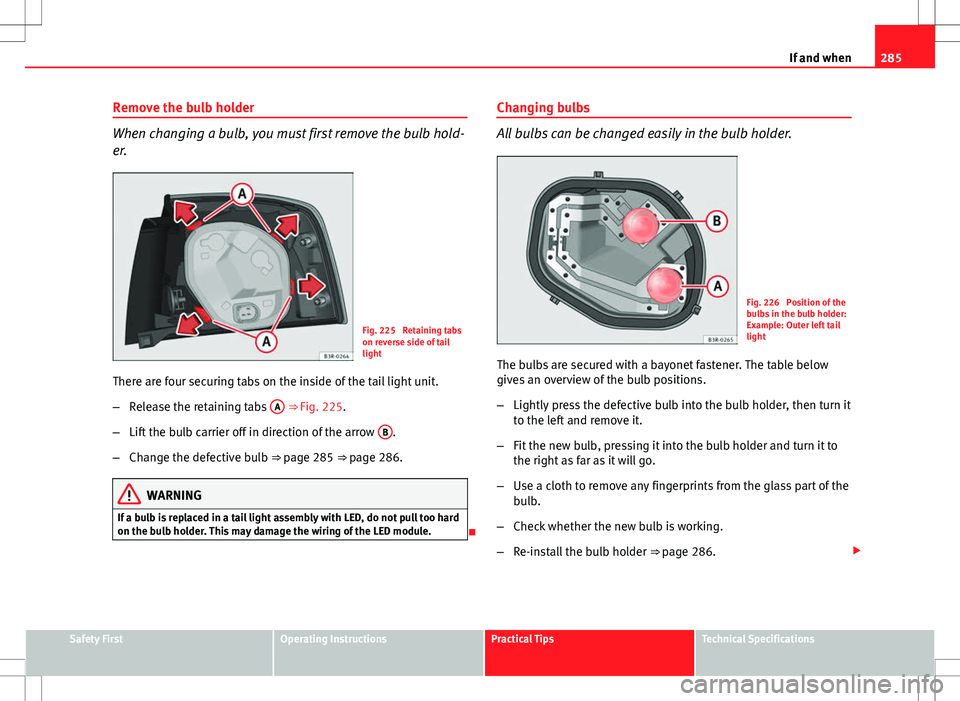
When changing a bulb, you must first remove the bulb hold-
er.
Fig. 225 Retaining tabs
on reverse side of tail
light
There are four securing tabs on the inside of the tail light unit.
– Release the retaining tabs A
⇒ Fig. 225.
– Lift the bulb carrier off in direction of the arrow B
.
– Change the defective bulb ⇒ page 285 ⇒ page 286.
WARNING
If a bulb is replaced in a tail light assembly with LED, do not pull too hard
on the bulb holder. This may damage the wiring of the LED module.
Changing bulbs
All bulbs can be changed easily in the bulb holder.
Fig. 226 Position of the
bulbs in the bulb holder:
Example: Outer left tail
light
The bulbs are secured with a bayonet fastener. The table below
gives an overview of the bulb positions.
– Lightly press the defective bulb into the bulb holder, then turn it
to the left and remove it.
– Fit the new bulb, pressing it into the bulb holder and turn it to
the right as far as it will go.
– Use a cloth to remove any fingerprints from the glass part of the
bulb.
– Check whether the new bulb is working.
– Re-install the bulb holder ⇒ page 286.
Safety FirstOperating InstructionsPractical TipsTechnical Specifications
Page 289 of 325
287
If and when
– Position the bulb holder on the tail light and align it so that it is
securely seated.
– Press the bulb holder into the tail light until it engages.
– Check that all four retaining tabs ⇒ Fig. 228 -arrows- have en-
gaged.
– Re-install the tail light unit ⇒ page 287.
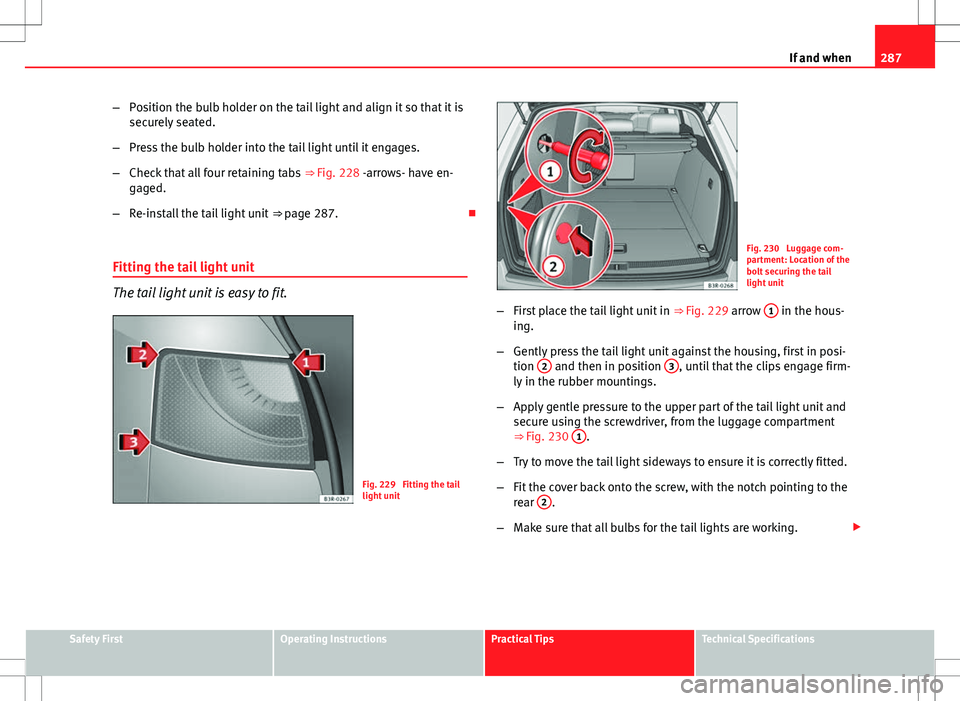
Fitting the tail light unit
The tail light unit is easy to fit.
Fig. 229 Fitting the tail
light unit
Fig. 230 Luggage com-
partment: Location of the
bolt securing the tail
light unit
– First place the tail light unit in ⇒ Fig. 229 arrow 1
in the hous-
ing.
– Gently press the tail light unit against the housing, first in posi-
tion 2
and then in position 3, until that the clips engage firm-
ly in the rubber mountings.
– Apply gentle pressure to the upper part of the tail light unit and
secure using the screwdriver, from the luggage compartment
⇒ Fig. 230 1
.
– Try to move the tail light sideways to ensure it is correctly fitted.
– Fit the cover back onto the screw, with the notch pointing to the
rear 2
.
– Make sure that all bulbs for the tail lights are working.
Safety FirstOperating InstructionsPractical TipsTechnical Specifications
Page 291 of 325
289
If and when
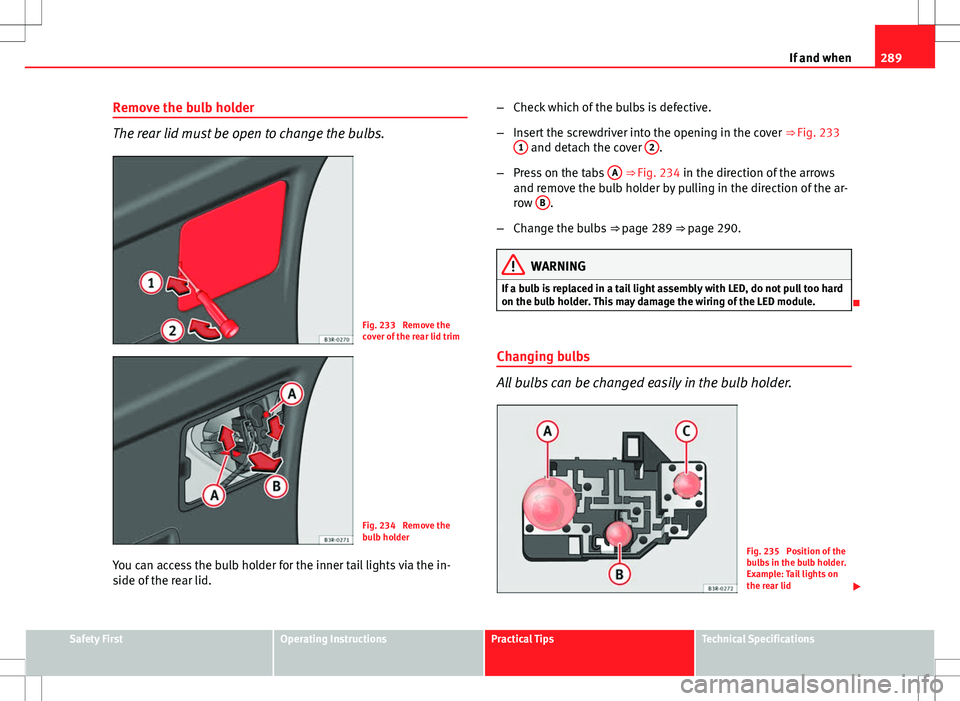
Remove the bulb holder
The rear lid must be open to change the bulbs.
Fig. 233 Remove the
cover of the rear lid trim
Fig. 234 Remove the
bulb holder
You can access the bulb holder for the inner tail lights via the in-
side of the rear lid. –
Check which of the bulbs is defective.
– Insert the screwdriver into the opening in the cover ⇒ Fig. 233
1
and detach the cover 2.
– Press on the tabs A
⇒ Fig. 234 in the direction of the arrows
and remove the bulb holder by pulling in the direction of the ar-
row B
.
– Change the bulbs ⇒ page 289 ⇒ page 290.
WARNING
If a bulb is replaced in a tail light assembly with LED, do not pull too hard
on the bulb holder. This may damage the wiring of the LED module.
Changing bulbs
All bulbs can be changed easily in the bulb holder.
Fig. 235 Position of the
bulbs in the bulb holder.
Example: Tail lights on
the rear lid
Safety FirstOperating InstructionsPractical TipsTechnical Specifications
Page 293 of 325
291
If and when
Position of the bulbs
Pos.
⇒ Fig. 235Bulb function
AReverse lightsP21W LLBRear fog lightH21W
Fitting the bulb holder
The bulb holder is easy to fit. – Position the bulb holder on the tail light and align it so that it is
securely seated.
– Press the bulb holder into the tail light until it engages.
– Fit the cover back in the interior trim so that it engages.
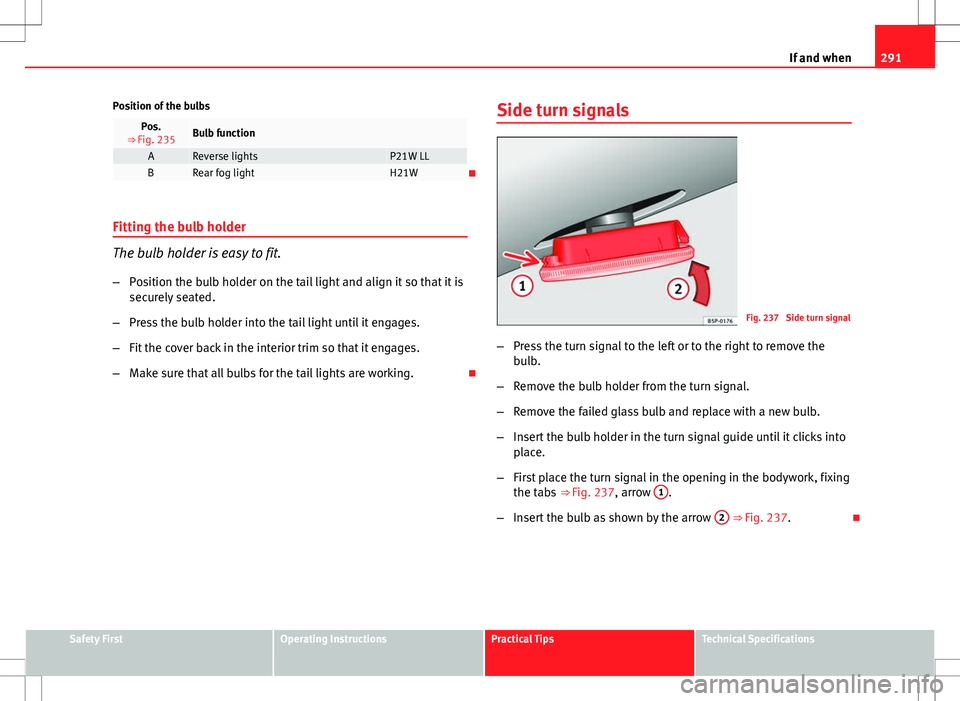
– Make sure that all bulbs for the tail lights are working. Side turn signals
Fig. 237 Side turn signal
– Press the turn signal to the left or to the right to remove the
bulb.
– Remove the bulb holder from the turn signal.
– Remove the failed glass bulb and replace with a new bulb.
– Insert the bulb holder in the turn signal guide until it clicks into
place.
– First place the turn signal in the opening in the bodywork, fixing
the tabs ⇒ Fig. 237, arrow 1
.
– Insert the bulb as shown by the arrow 2
⇒ Fig. 237.
Safety FirstOperating InstructionsPractical TipsTechnical Specifications