ABS Seat Exeo ST 2012 User Guide
[x] Cancel search | Manufacturer: SEAT, Model Year: 2012, Model line: Exeo ST, Model: Seat Exeo ST 2012Pages: 325, PDF Size: 5.56 MB
Page 94 of 325
92Cockpit
Controlling the menu
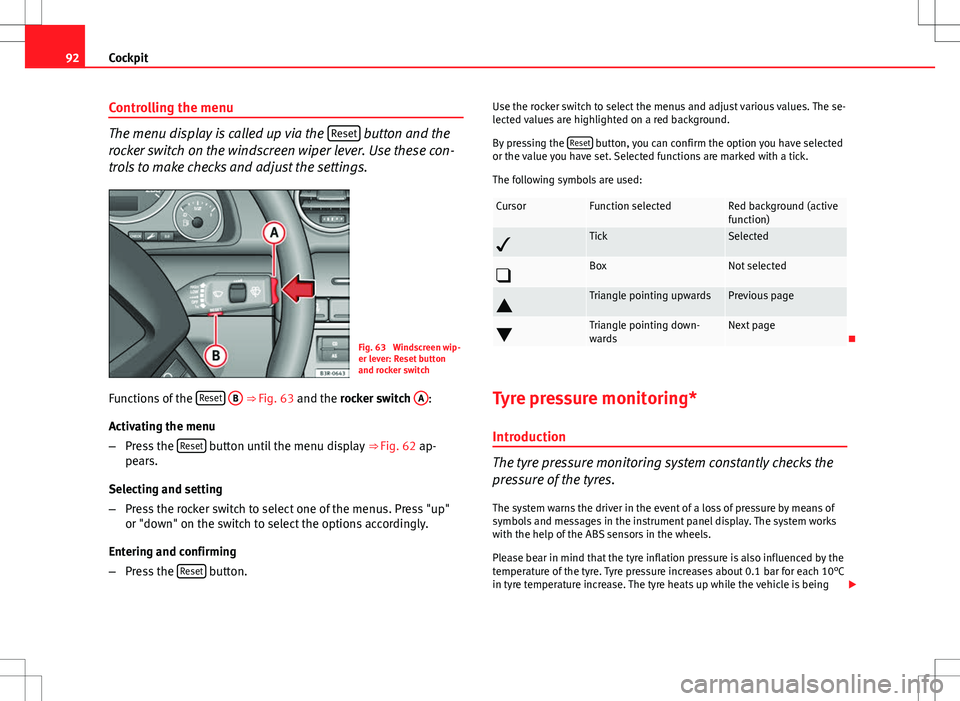
The menu display is called up via the Reset button and the
rocker switch on the windscreen wiper lever. Use these con-
trols to make checks and adjust the settings.
Fig. 63 Windscreen wip-
er lever: Reset button
and rocker switch
Functions of the Reset
B ⇒
Fig. 63 and the rocker switch A:
Activating the menu
– Press the Reset
button until the menu display
⇒ Fig. 62 ap-
pears.
Selecting and setting
– Press the rocker switch to select one of the menus. Press "up"
or "down" on the switch to select the options accordingly.
Entering and confirming
– Press the Reset
button. Use the rocker switch to select the menus and adjust various values. The se-
lected values are highlighted on a red background.
By pressing the
Reset
button, you can confirm the option you have selected
or the value you have set. Selected functions are marked with a tick.
The following symbols are used:
CursorFunction selectedRed background (active
function)
TickSelected
BoxNot selected
Triangle pointing upwardsPrevious page
Triangle pointing down-
wardsNext page
Tyre pressure monitoring* Introduction
The tyre pressure monitoring system constantly checks the
pressure of the tyres.
The system warns the driver in the event of a loss of pressure by means of
symbols and messages in the instrument panel display. The system works
with the help of the ABS sensors in the wheels.
Please bear in mind that the tyre inflation pressure is also influenced by the
temperature of the tyre. Tyre pressure increases about 0.1 bar for each 10°C
in tyre temperature increase. The tyre heats up while the vehicle is being
Page 160 of 325
158Seats and storage compartments
WARNING
● Heavy appliances or connectors (for example, adapters) which hang
down directly from the Europlug socket may damage the socket with the
resultant risk of injury.
● Ensure that appliances connected to the socket are secure to prevent
them from being thrown around the vehicle in the event of sharp braking
or an accident. This could result in severe injury or loss of life ⇒ page 16,
Storing objects.
● Never spill liquid over the power socket– there is a risk of death. If
any moisture enters the socket, ensure that it is thoroughly dry before
using.
● Improper use of the sockets or electrical accessories can lead to seri-
ous injuries or cause a fire, with the resultant risk of injury.
● Children must never be left alone in the vehicle with the engine run-
ning. They could cause an accident.
● Appliances connected to the socket do not behave in the same way as
when they are connected to the mains power supply. They may overheat
during use and cause injury.
● When using adapters and extension leads, the childproof safety de-
vice on the 230 volt socket is disconnected and the socket is live. Risk of
injury!.
● Never insert objects which conduct electricity, such as a needle, in
the pins of the 230 volt socket. There is a risk of death.
● Always switch off electrical appliances connected to the socket if the
inverter goes off as a result of overheating. Failure to comply could result
in injuries.CAUTION
● The instructions for handling appliances connected to the socket must
be observed.
● If the power consumption of the appliances connected exceeds 150
watts, the socket inverter will overheat. If the temperature exceeds a certain
value, the inverter will switch off. It may also switch off if the outside tem-
perature is very high, even if the power consumption is normal. The inverter
will switch on again automatically after it has cooled down. Appliances con-
nected to the socket, and which have been left switched on, will automati-
cally come back on ⇒
.
● Do not connect neon lamps to the socket. For technical reasons, these
could break down.
● Do not connect 115 volt appliances to the 230 volt power socket, as
they could be damaged. If you have any queries, please check the manufac-
turer's label for details of the power supply accepted by the appliance.
● With some adapters, for example for laptops, their built-in overload dis-
connection system prevents the equipment from switching on in the event
of an excessive start-up current. In this case, disconnect the adapter from
the power supply and try to reconnect after ten seconds.
Note
● Non-insulated equipment may cause interference to the radio or vehicle
electronics.
● The Europlug socket has a built-in childproof device and only carries live
current when the Europlug is correctly plugged in.
● Some appliances may not operate correctly in the absence of adequate
power (watts).
Page 175 of 325

173
Driving
The Electronic Stability Control (ESC) contains the electronic differential lock
(EDL) and the traction control system (ASR). The ESC works together with
the ABS. If a fault in the ABS occurs, both warning lamps light up, but if the
ESC fails, only the ESC warning lamp lights up.
The ESC system is started automatically when the engine is started.
The ESC system is always active and cannot be switched off. The ESC switch
only switches the ASR off.
The ASR can be deactivated when wheel spin is desirable.
For example:
● When driving with snow chains.
● When driving in deep snow or on loose surfaces.
● When the vehicle is stuck, to rock it backwards and forwards.
Press the button to switch the ASR back on when you no longer need wheel
spin.
Situations in which the warning lamp lights
●
On switching the ignition on, it lights up for about two seconds to carry
out a function control.
● The warning lamp will start flashing when the vehicle is moving if the
ESC or the ASR is activated.
● It will light up continuously if there is a fault in the ESC.
WARNING
● Do not forget that the electronic stability control ESC cannot defy the
laws of physics. This should be kept in mind, particularly on slippery and
wet roads and when towing a trailer.
● Always adapt your driving style to suit the condition of the roads and
the traffic situation. The greater safety provided by the ESC should not
encourage you to run any risks.
● Please refer to the corresponding warning notes on ESC in
⇒ page 195, Intelligent technology.
Ignition lock Ignition key positions
The ignition key is used to start and stop the engine.
Fig. 145 Ignition key po-
sitions
Safety FirstOperating InstructionsPractical TipsTechnical Specifications
Page 197 of 325
195
Intelligent technology
Practical Tips Intelligent technology
Electronic Stability Control (ESC)
General Observations
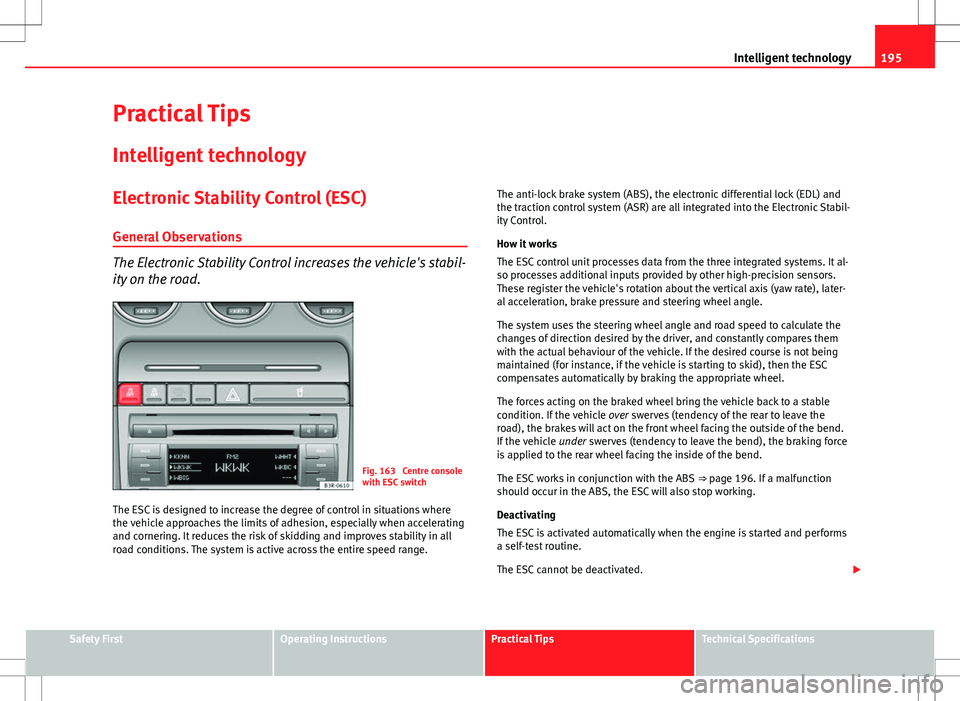
The Electronic Stability Control increases the vehicle's stabil-
ity on the road.
Fig. 163 Centre console
with ESC switch
The ESC is designed to increase the degree of control in situations where
the vehicle approaches the limits of adhesion, especially when accelerating
and cornering. It reduces the risk of skidding and improves stability in all
road conditions. The system is active across the entire speed range. The anti-lock brake system (ABS), the electronic differential lock (EDL) and
the traction control system (ASR) are all integrated into the Electronic Stabil-
ity Control.
How it works
The ESC control unit processes data from the three integrated systems. It al-
so processes additional inputs provided by other high-precision sensors.
These register the vehicle's rotation about the vertical axis (yaw rate), later-
al acceleration, brake pressure and steering wheel angle.
The system uses the steering wheel angle and road speed to calculate the
changes of direction desired by the driver, and constantly compares them
with the actual behaviour of the vehicle. If the desired course is not being
maintained (for instance, if the vehicle is starting to skid), then the ESC
compensates automatically by braking the appropriate wheel.
The forces acting on the braked wheel bring the vehicle back to a stable
condition. If the vehicle
over swerves (tendency of the rear to leave the
road), the brakes will act on the front wheel facing the outside of the bend.
If the vehicle under swerves (tendency to leave the bend), the braking force
is applied to the rear wheel facing the inside of the bend.
The ESC works in conjunction with the ABS ⇒ page 196. If a malfunction
should occur in the ABS, the ESC will also stop working.
Deactivating
The ESC is activated automatically when the engine is started and performs
a self-test routine.
The ESC cannot be deactivated.
Safety FirstOperating InstructionsPractical TipsTechnical Specifications
Page 198 of 325

196Intelligent technology
WARNING
The ESC is not able to overcome the physical limits of adhesion. Even
with ESC, you should always adjust your speed to suit the road and traffic
conditions. Please bear this in mind, especially on wet or slippery road
surfaces. Do not let the extra safety features tempt you into taking any
risks when driving. Failure to do so could result in an accident.
Anti-lock brake system (ABS)
ABS prevents the wheels from locking up under braking.
The anti-lock brake system (ABS) is an important part of the vehicle's active
safety system. However, the ABS will not necessarily guarantee shorter
stopping distances in all conditions. For instance, on loose gravel or fresh
snow on top of an icy surface (conditions which anyway require extreme
care and reduced speed), the stopping distance with ABS may even be
slightly longer.
How the ABS works
The system runs an automatic self-check when the vehicle reaches a road
speed of about 6 km/h. This may be accompanied by a noise from the ABS
pump.
When one of the wheels is turning very slowly in relation to the road speed
and is close to locking up, the system will reduce the brake pressure on that
wheel. The driver is made aware of this adjustment process by a vibration of
the brake pedal and an audible noise. This is a deliberate warning to the
driver that one or more of the wheels is tending to lock up and the ABS con-
trol function has intervened. In this situation it is important to keep the
brake pedal fully depressed so the ABS can regulate the brake application,
but do not “pump” the brake pedal.
WARNING
The grip provided by ABS is still subject to the physical limits of adhe-
sion. Always bear this in mind, especially on wet or slippery roads. If you
notice that the ABS is working (to counteract locked wheels under brak-
ing), you should reduce speed immediately to suit the road and traffic
conditions. Do not let the extra safety features tempt you into taking any
risks when driving. Failure to do so could result in an accident.
Note
If a malfunction should occur in the ABS, this is indicated by a warning lamp
⇒ page 70.
Brake assist system
The brake assist system helps the driver to achieve optimum
braking effect.
The brake assist system helps to increase braking power and thus to ach-
ieve a shorter stopping distance. If the driver presses the brake pedal very
quickly, the brake assist system automatically boosts the braking force to
the maximum level, up to the point where the anti-lock brake function (ABS)
intervenes to stop the wheels from locking. You should then keep the brake
pedal pressed until the vehicle has braked to the required speed. The brake
assist system switches itself off as soon as you release the brake pedal.
The brake assist system will not be operative if there is a malfunction in the
ABS or the ESC.
Page 199 of 325
197
Intelligent technology
WARNING
Please remember that the accident risk always increases if you drive too
fast, especially in corners or on a slippery road, or if you follow too close
behind the vehicle in front of you. An increased accident risk cannot be
compensated even by the brake assist system. Risk of accident.
Electronic differential lock (EDL)
The electronic differential lock prevents the loss of traction
caused if one wheel starts spinning. General notes
The electronic differential lock (EDL) helps the vehicle to start moving, ac-
celerate and climb a gradient in slippery conditions where this may other-
wise be difficult or even impossible.
How it works
The EDL works automatically, without the driver's involvement. With the aid
of the ABS sensors, the system monitors the rotational speed of the drive
wheels ⇒ page 196. If a considerable difference in revs is detected (approx.
100 rpm) in the speed of the drive wheels, e.g. when only one part of the
surface supporting the wheels is slippery, the system applies the brake to
slow down the skidding wheel so that more of the power is directed to the
other wheels. The systems works up to a speed of approx. 80 km/h. The
system will make noise while it is working.
Starting the vehicle
If one wheel has less grip and starts spinning (for instance, if one of the
drive wheels is on ice), keep pressing the accelerator gradually until the ve-
hicle starts moving. Overheating of the brakes
To prevent the brake disk of the braked wheel from overheating, the EDL
cuts out automatically if subjected to excessive loads. In this case, the vehi-
cle will continue to run and will have the same running properties as those
of another without EDL.
The EDL will switch on again automatically when the brake has cooled
down.
WARNING
● When accelerating on a uniformly slippery surface (for instance all
four wheels on ice or snow), press the accelerator gradually and careful-
ly. Despite EDL, the drive wheels may otherwise start to spin. This could
impair the vehicle's stability. Risk of accident.
● Even with EDL, you should always adjust your speed to suit the road
and traffic conditions. Do not let the extra safety features tempt you into
taking any risks when driving. Failure to do so could result in an accident.
Note
If the ABS warning lamp lights up, this can also mean there is a fault in the
EDL. Take the vehicle to a specialised workshop as soon as possible.
Traction control system (ASR)
The traction control system prevents the drive wheels from
spinning when the vehicle is accelerating. General notes
The traction control system (ASR) is one of the functions incorporated in the
Electronic Stability Control (ESC)
Safety FirstOperating InstructionsPractical TipsTechnical Specifications
Page 200 of 325
198Intelligent technology
The traction control system (ASR) helps the car to start moving, accelerate
and climb a gradient in slippery conditions where this may otherwise be dif-
ficult or even impossible.
How it works
The ASR works automatically, i.e. without the driver's involvement. With the
aid of the ABS sensors , the ASR monitors the speed of the driven wheels
⇒ page 196. If the wheels start to spin, the engine speed is reduced auto-
matically to match the amount of grip available. The system is active across
the entire speed range.
The ASR works in conjunction with the ABS. If a failure occurs in the ABS,
the ASR will also stop working.
In general, the ASR should be left switched on at all times. It should only be
switched off manually in particular circumstances where a certain amount of
wheel slip may be desirable. Examples:
● when driving with snow chains
● when driving in deep snow or on loose surfaces
● when rocking the vehicle backwards and forwards to free it.
The ASR should be switched on again afterwards as soon as possible.
Note
To ensure that the ASR works properly, all four wheels must be fitted with
identical tyres. The difference in size of the wheels may lead to an unde-
sired reduction in engine power. Also see ⇒ page 255.Brakes
General notes
New brake pads
New brake pads do not provide optimal performance during the first
200 km; first they must be “run in”. However, the reduced braking capacity
may be compensated by pressing on the brake pedal a little harder. Avoid
overloading the brakes during run-in.
Wear
The rate of wear on the brake pads depends a great deal on how you drive
and the conditions in which the vehicle is operated. Negative factors are, for
instance, city traffic, frequent short trips or hard driving with abrupt starts
and stops.
Wet roads or road salt
In certain conditions, such as in heavy rain, or after washing the vehicle or
driving through water, the full braking effect can be delayed by moisture (or
in winter by ice) on the discs and brake pads. In this case the brakes should
be dried by pressing the brake pedal several times.
The effectiveness of the brakes can also be temporarily reduced if the vehi-
cle is driven for some distance without using the brakes when there is a lot
of salt on the road in winter. In this case, the layer of salt on the brake discs
and pads has to wear off before braking.
Corrosion
There may be a tendency for corrosion to form on the discs and dirt to build
up on the brake pads if the vehicle is used infrequently or the brakes are
not used very often.
If the brakes are not used frequently, or if rust has formed on the disks, it is
advisable to clean off the pads and disks by braking firmly a few times at a
moderately high speed ⇒
.
Page 227 of 325
225
Vehicle maintenance and cleaning
CAUTION
● Brushes should only be used to clean the carpet and floor mats! Other
fabrics may be damaged if cleaned with a brush.
● If cream detergents or detergents for delicate garments are applied with
a damp cloth or sponge, they may, for example, leave rings when dry be-
cause of the tensioactive components they contain. Generally, such rings
are very difficult or almost impossible to remove.
CAUTION
● Do not let water soak into Alcantara ®
under any circumstances.
● Do not use leather cleaning products, solvents, wax polish, shoe cream,
stain removers or similar products on Alcantara ®
.
● Never use brushes for cleaning damp material as they could damage the
surface.
Cleaning and maintenance of natural leather upholstery
Consult a professional cleaning workshop if you have any doubts on clean-
ing and maintaining the leather equipment in your car.
Maintenance and treatment
Nappa natural leather is delicate because it has no additional protective
layer.
● After cleaning, regularly apply a conditioner with sun-screen and im-
pregnating action. These products nourish the leather, soften it and make it
more breathable, as well as re-hydrating it. They also provide it with a pro-
tective film.
● Clean the leather every two or three months and remove stains as they
appear.
● Treat the leather regularly (about twice a year) with a suitable mainte-
nance product. ●
Apply as few cleaning and maintenance products as possible, always
using a dry, lint-free cotton or woollen cloth. Do not apply cleaning and
maintenance products directly to the leather.
● Remove recent ball-point pen and ink stains, lipstick, shoe cream and
similar stains as soon as possible.
● Maintain the colour of the leather. To do this, use a special cream espe-
cially coloured for leather to achieve the same overall colour, if necessary.
● Afterwards, go over it with a soft cloth.
Cleaning
SEAT recommends using a slightly damp cotton or woollen cloth for general
cleaning purposes.
Generally, the leather should never be soaked at any point, nor should wa-
ter penetrate the seams.
Before cleaning the leather upholstery, bear in mind the following recom-
mendations ⇒ page 224, Cleaning the fabric on heated seats and electrical-
ly adjustable seats or seats with airbag components.CAUTION
● On no account use solvents, wax polish, shoe cream, stain removers or
similar materials on leather.
● If the stain remains on the leather for long, it will soak in and be impos-
sible to remove.
● In the event of spilt liquids, dry immediately with an absorbent cloth to
prevent the liquid penetrating through the leather or seams.
● If the car is left standing in the sun for long periods, the leather should
be protected against direct sunlight to prevent it from fading.
Note
The leather will usually change colour slightly with use.
Safety FirstOperating InstructionsPractical TipsTechnical Specifications
Page 247 of 325
245
Checking and refilling levels
Topping up and changing the brake fluid
It is best to have the brake fluid changed by a professional. Brake fluid absorbs moisture. Therefore, in the course of time it will absorb
water from the air. If the water content in the brake fluid is too high, the
brake system could corrode. In addition, the boiling point of the brake fluid
will be considerably reduced. This could adversely affect the braking ability
in certain circumstances.
For this reason the brake fluid must be changed periodically.
Your vehicle's Service Plan will tell you when the brake fluid has to be re-
newed.
We recommend you have the brake fluid changed as part of a regular In-
spection Service at a Technical Service. They are familiar with the procedure
and have the necessary special tools and spare parts as well as the proper
facilities for disposing of the old fluid.
Be sure to always use the correct brake fluid. Only use brake fluid that ex-
pressly meets VW 501 14 standards.
You can buy VW 501 14 standard brake fluid in a SEAT dealership or SEAT
Official Service. If none is available, use only high quality brake fluid that
meets DIN ISO 4925 CLASS 4 standards, or USA Standards FMVSS 116 DOT
4.
Using any other kind of brake fluid or one that is not of a high quality may
affect operation of the brake system and reduce its effectiveness. Never use
a brake fluid if the container does not state that it complies with VW 501 14,
DIN ISO 4925 CLASS 4 standards, or USA standards FMVSS 116 DOT 4.WARNING
● Brake fluid must always be kept closed in its original container. Keep
out of the reach of children. Failure to comply could result in poisoning.
● If the brake fluid is left in the system for too long and the brakes are
subjected to heavy use, vapour bubbles may form in the brake system.
This would seriously affect the efficiency of the brakes and the safety of
the vehicle, leading to the risk of accident.
CAUTION
Please note that brake fluid will attack the paintwork on contact.
For the sake of the environment
The brake pads and fluid must be collected and disposed of according the
applicable regulations. The SEAT Technical Service network has the neces-
sary equipment and qualified personnel for collecting and disposing of this
waste material.
Vehicle battery General notes
All work on batteries requires specialist knowledge.
The battery is virtually maintenance-free and is checked in the Inspection
Services.
We recommend replacing the battery after 5 years.
Safety FirstOperating InstructionsPractical TipsTechnical Specifications
Page 248 of 325
246Checking and refilling levels
Disconnecting the battery
If the battery is disconnected, some of the vehicle's functions will become
inoperative (e.g. electric windows). These functions will require resetting af-
ter the battery is reconnected. For this reason, the battery should only be
disconnected from the vehicle's electrical system when absolutely necessa-
ry.
Long periods of non-use
The battery will gradually lose its charge because certain electrical equip-
ment continues to draw current even when the ignition is off. If you park the
vehicle for long periods of time in winter you should take the battery out of
the vehicle and store it in a place protected from frost. This way it will not
freeze and become damaged. At warm outside temperatures it is sufficient
to disconnect the negative terminal of the battery. Even when the battery is
not connected you should charge it from time to time.
Winter operation
The battery is drained more in cold weather, which means that the starting
power is reduced. For this reason, have the battery checked and charged if
necessary before the start of winter.
Replacing the battery
A replacement battery must have the same capacity, voltage and current rat-
ing. It must also have the same dimensions as the original, factory-fitted
battery and have sealed caps. The SEAT batteries which have been specially
developed fulfil the maintenance, performance and safety specifications for
your vehicle.
We recommend you use maintenance-free batteries.
WARNING
● All work on batteries requires specialist knowledge. If work is re-
quired on the battery, this should be performed by a Technical Service or
specialised workshop. Danger of caustic burns and explosion!
● The battery must not be opened. Never try to change the battery's liq-
uid level. Explosive gas is released from the battery that could cause an
explosion.
CAUTION
● The battery holder and clamps must always be correctly secured.
● Before starting any work on the battery, always observe the warnings
listed under ⇒
.
For the sake of the environment
Batteries contain toxic substances including sulphuric acid and lead.
Therefore, they must be disposed of in line with environmental regulations
and must not be disposed of with ordinary household waste. Make sure dis-
connected batteries cannot tip over. Sulphuric acid could be spilt!
Important safety warnings for handling a vehicle battery
The battery is located at the back of the engine compartment ⇒ page 304.
Wear eye protection
Battery acid is very corrosive and caustic. Wear protective
gloves and eye protection!
Fires, sparks, open flames and smoking are prohibited!