turn signal Seat Exeo ST 2012 Owner's Guide
[x] Cancel search | Manufacturer: SEAT, Model Year: 2012, Model line: Exeo ST, Model: Seat Exeo ST 2012Pages: 325, PDF Size: 5.56 MB
Page 278 of 325
276If and when
Note
Although it is not necessary, previously remove the rigid cover ⇒ Fig. 210
for easier turn signal bulb changes.
Changing the main headlight bulb
The procedure for changing the bulb is the same on both
sides.
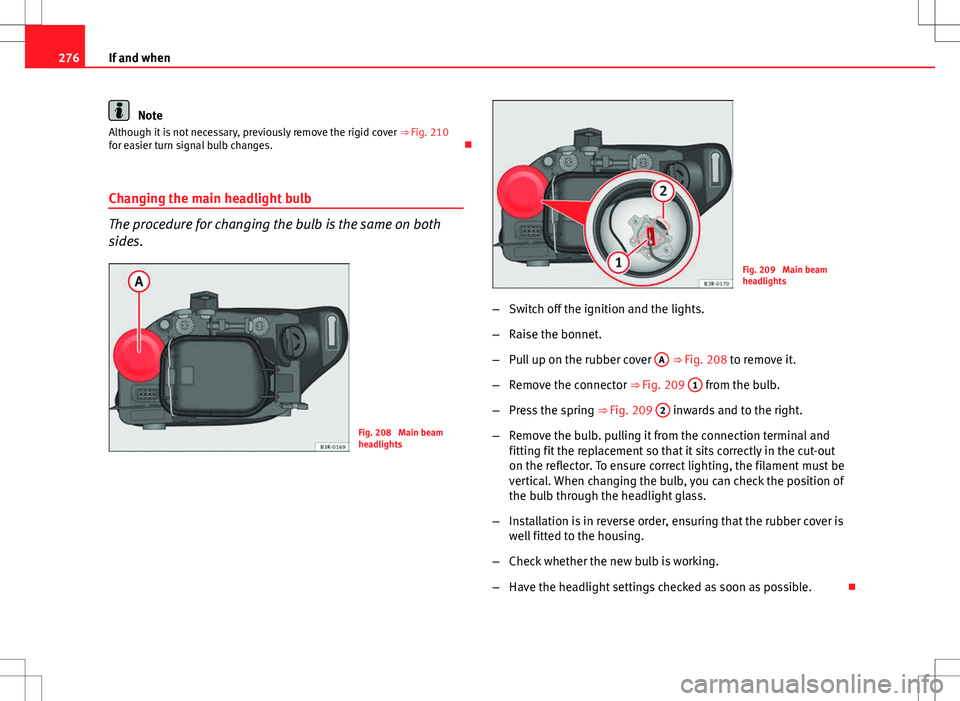
Fig. 208 Main beam
headlights
Fig. 209 Main beam
headlights
– Switch off the ignition and the lights.
– Raise the bonnet.
– Pull up on the rubber cover A
⇒ Fig. 208 to remove it.
– Remove the connector ⇒ Fig. 209 1
from the bulb.
– Press the spring ⇒ Fig. 209 2
inwards and to the right.
– Remove the bulb. pulling it from the connection terminal and
fitting fit the replacement so that it sits correctly in the cut-out
on the reflector. To ensure correct lighting, the filament must be
vertical. When changing the bulb, you can check the position of
the bulb through the headlight glass.
– Installation is in reverse order, ensuring that the rubber cover is
well fitted to the housing.
– Check whether the new bulb is working.
– Have the headlight settings checked as soon as possible.
Page 282 of 325

280If and when
● Main headlight lamps: Xenon ⇒
lights.
● Sources of the DRL (daylight) light unit and position.
WARNING
● Take particular care when working on components in the engine com-
partment if the engine is warm - risk of burns!
● Bulbs are highly sensitive to pressure. The glass can break when you
touch the bulb, causing injury.
● The high voltage element of gas discharge bulbs* (xenon light) must
be handled correctly. Otherwise, there is a risk of death.
● When changing bulbs, please take care not to injure yourself on sharp
parts in the headlight housing.
CAUTION
● Remove the ignition key before working on the electric system. If not, a
short circuit could occur.
● Switch off the lights or parking lights before you change a bulb.
For the sake of the environment
Please ask your specialist retailer how to dispose of used bulbs in the prop-
er manner.
Note
● Depending on weather conditions (cold or wet), the front lights, the fog
lights, the tail lights and the turn signals may be temporarily misted. This
has no influence on the useful life of the lighting system. By switching on
the lights, the area through which the beam of light is projected will quickly
be demisted. However, the edges may continue to be misted.
● Please check at regular intervals that all lighting (especially the exterior
lighting) on your vehicle is functioning properly. This is not only in the inter-
est of your own safety, but also in that of all other road users. ●
Before changing a bulb, make sure you have the correct new bulb.
● Do not touch the glass part of the bulb with your bare hands, use a cloth
or paper towel instead. Otherwise, the fingerprints left on the glass will va-
porise as a result of the heat generated by the bulb, be deposited on the
reflector and impair its surface.
Removing the air duct
The air duct has to be removed to gain access to the bulbs
for the right-side headlight.
Fig. 216 Air duct on
right side of vehicle
– Unscrew bolts A
⇒ Fig. 216.
– Detach air duct from guide B
and take it out.
Page 283 of 325
281
If and when
Fitting the air duct
Once the bulb(s) for the right-side headlight have been
changed, the air duct must be re-installed.
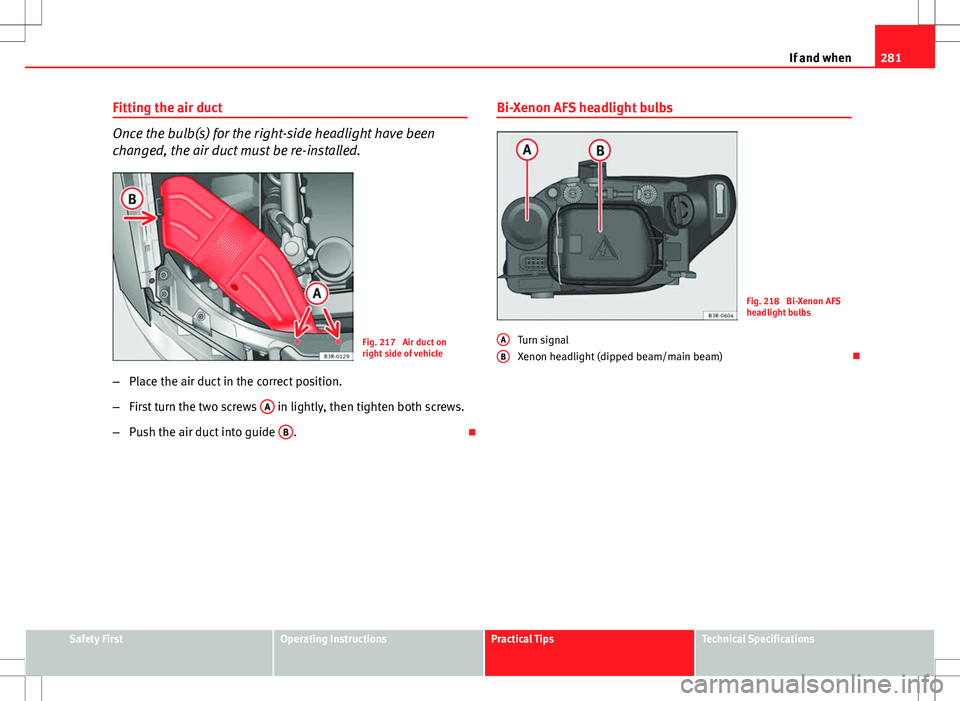
Fig. 217 Air duct on
right side of vehicle
– Place the air duct in the correct position.
– First turn the two screws A
in lightly, then tighten both screws.
– Push the air duct into guide B
. Bi-Xenon AFS headlight bulbs
Fig. 218 Bi-Xenon AFS
headlight bulbs
Turn signal
Xenon headlight (dipped beam/main beam)
A
B
Safety FirstOperating InstructionsPractical TipsTechnical Specifications
Page 284 of 325

282If and when
Changing the turn signal bulb
The procedure for changing the bulb is the same on both
sides.
Fig. 219 Turn signal
Fig. 220 Turn signal
– Switch off the ignition and the lights. –
Raise the bonnet.
– Pull the rubber cap ⇒ Fig. 219 to remove it.
– Remove the bulb holder by pulling on the grip and turning it an-
ticlockwise ⇒ Fig. 220.
– Replace the blown bulb in the bulb holder (press and turn anti-
clockwise to remove) with a new bulb (press and turn clockwise
to insert).
– Insert the bulb holder into the socket with the tab facing up-
wards and the grip horizontal. Press it against the socket and
turn clockwise. When changing the bulb, you can check the po-
sition of the bulb through the headlight glass.
– Fit the rubber cap and tighten, making sure it fit properly into
the headlight casing.
– Check whether the new bulb is working.
Changing the xenon bulb
The procedure for changing the bulb is the same on both sides.
WARNING
This type of bulb should be changed at a specialised workshop.
Page 285 of 325
283
If and when
Changing tail light bulbs (on side panel)
Overview of tail lights
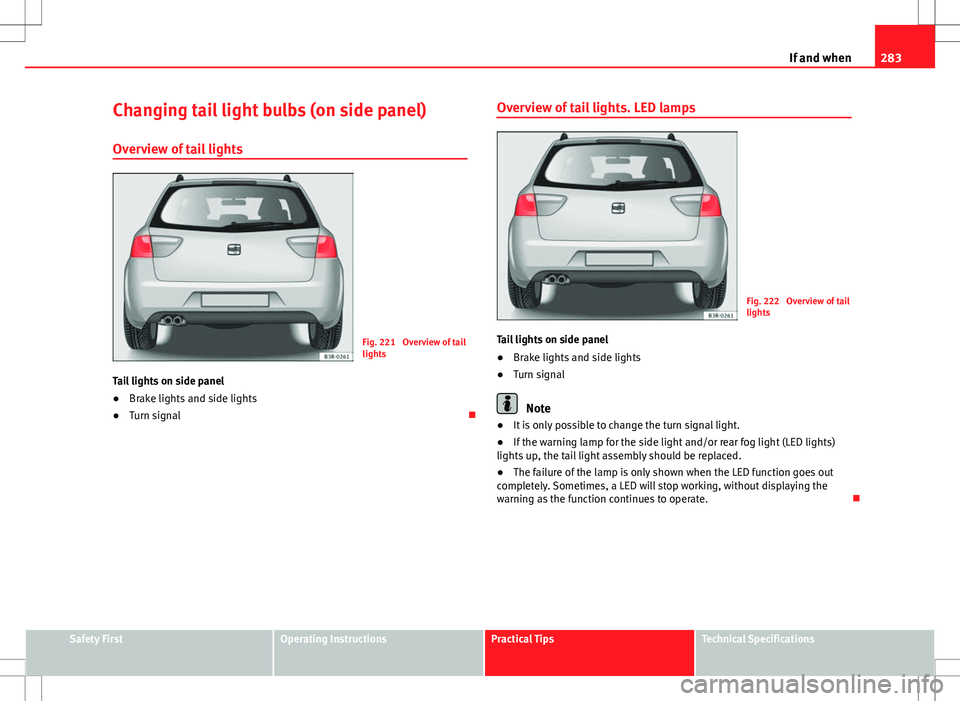
Fig. 221 Overview of tail
lights
Tail lights on side panel
● Brake lights and side lights
● Turn signal Overview of tail lights. LED lamps
Fig. 222 Overview of tail
lights
Tail lights on side panel
● Brake lights and side lights
● Turn signal
Note
● It is only possible to change the turn signal light.
● If the warning lamp for the side light and/or rear fog light (LED lights)
lights up, the tail light assembly should be replaced.
● The failure of the lamp is only shown when the LED function goes out
completely. Sometimes, a LED will stop working, without displaying the
warning as the function continues to operate.
Safety FirstOperating InstructionsPractical TipsTechnical Specifications
Page 288 of 325
286If and when
Position of the bulbs
Pos.
⇒ Fig. 226Bulb function
ATurn signalP21WBBrake lights and side lightsP21W LL
Changing bulbs. LED lamps
All bulbs can be changed easily in the bulb holder.
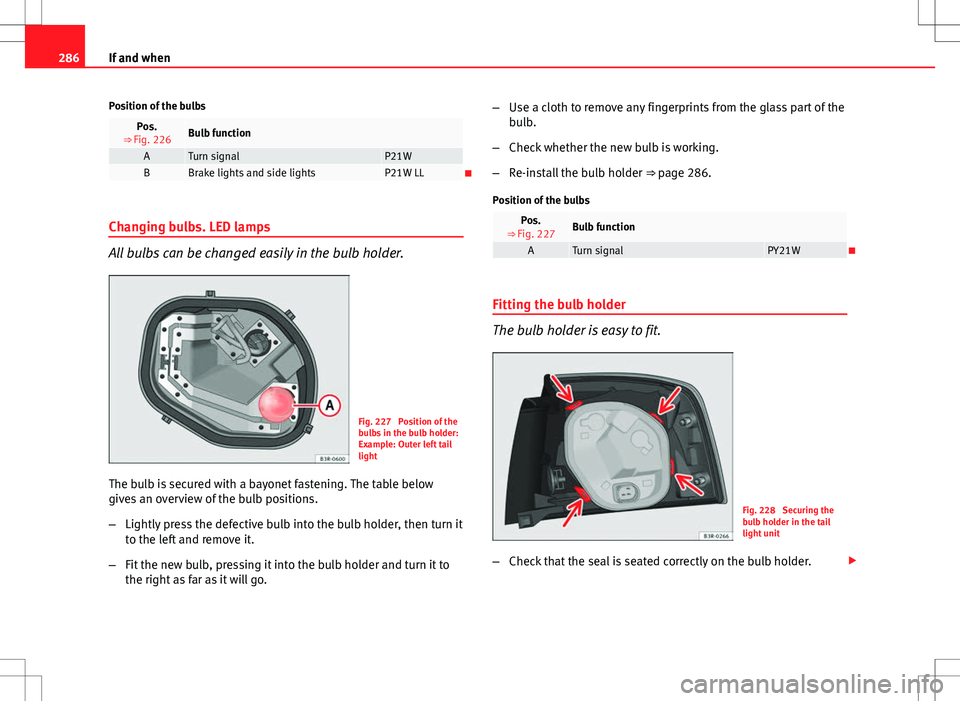
Fig. 227 Position of the
bulbs in the bulb holder:
Example: Outer left tail
light
The bulb is secured with a bayonet fastening. The table below
gives an overview of the bulb positions.
– Lightly press the defective bulb into the bulb holder, then turn it
to the left and remove it.
– Fit the new bulb, pressing it into the bulb holder and turn it to
the right as far as it will go. –
Use a cloth to remove any fingerprints from the glass part of the
bulb.
– Check whether the new bulb is working.
– Re-install the bulb holder ⇒ page 286.
Position of the bulbs
Pos.
⇒ Fig. 227Bulb function
ATurn signalPY21W
Fitting the bulb holder
The bulb holder is easy to fit.
Fig. 228 Securing the
bulb holder in the tail
light unit
– Check that the seal is seated correctly on the bulb holder.
Page 293 of 325
291
If and when
Position of the bulbs
Pos.
⇒ Fig. 235Bulb function
AReverse lightsP21W LLBRear fog lightH21W
Fitting the bulb holder
The bulb holder is easy to fit. – Position the bulb holder on the tail light and align it so that it is
securely seated.
– Press the bulb holder into the tail light until it engages.
– Fit the cover back in the interior trim so that it engages.
– Make sure that all bulbs for the tail lights are working. Side turn signals
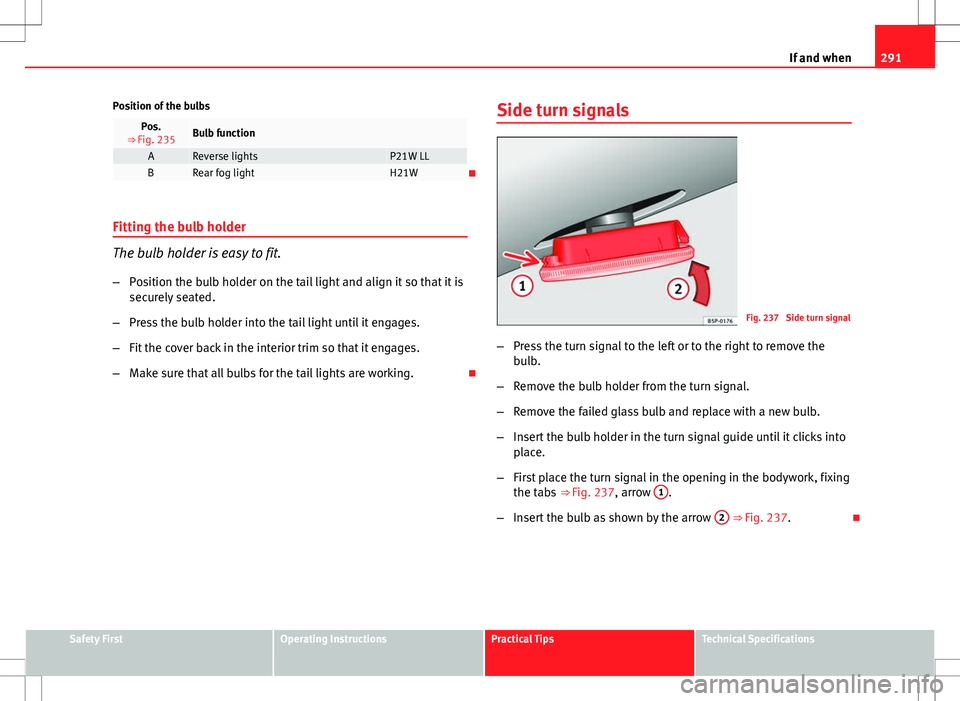
Fig. 237 Side turn signal
– Press the turn signal to the left or to the right to remove the
bulb.
– Remove the bulb holder from the turn signal.
– Remove the failed glass bulb and replace with a new bulb.
– Insert the bulb holder in the turn signal guide until it clicks into
place.
– First place the turn signal in the opening in the bodywork, fixing
the tabs ⇒ Fig. 237, arrow 1
.
– Insert the bulb as shown by the arrow 2
⇒ Fig. 237.
Safety FirstOperating InstructionsPractical TipsTechnical Specifications
Page 300 of 325
298If and when
Do not pull too hard with the towing vehicle and take care to avoid jerking
the tow rope. When towing on an unpaved road, there is always a risk of
overloading and damaging the anchorage points.
The ignition of the vehicle being towed must be switched on to prevent the
steering wheel from locking and also to allow the use of the turn signals,
horn, windscreen wipers and washers.
As the brake servo does not work if the engine is not running, you must ap-
ply considerably more pressure to the brake pedal than you normally would.
As the power assisted steering does not work if the engine is not running,
you will need more strength to steer than you normally would.
Towing vehicles with an automatic gearbox
● Put the selector lever into position “N”.
● Do not drive faster than 50 km/h.
● Do not tow further than 50 km.
● If a breakdown vehicle is used, the vehicle must be towed with the front
wheels raised.
Note
● Observe legal requirements when towing or tow-starting.
● Switch on the hazard warning lights of both vehicles. However, observe
any regulations to the contrary.
● For technical reasons, vehicles with an automatic gearbox must not be
tow-started.
● If damage to your vehicle means that there is no lubricant in the gear-
box, you must raise the drive wheels while the vehicle is being towed.
● If the vehicle has to be towed more than 50 km, the front wheels should
be raised during towing, and towing should be carried out by a qualified
person. ●
The steering wheel is locked when the vehicle has no electrical power.
The vehicle must then be towed with the front wheels raised. Towing should
be carried out by a qualified person.
● The towing eye should always be kept in the vehicle. Please refer to the
notes ⇒ page 297, Tow-starting.
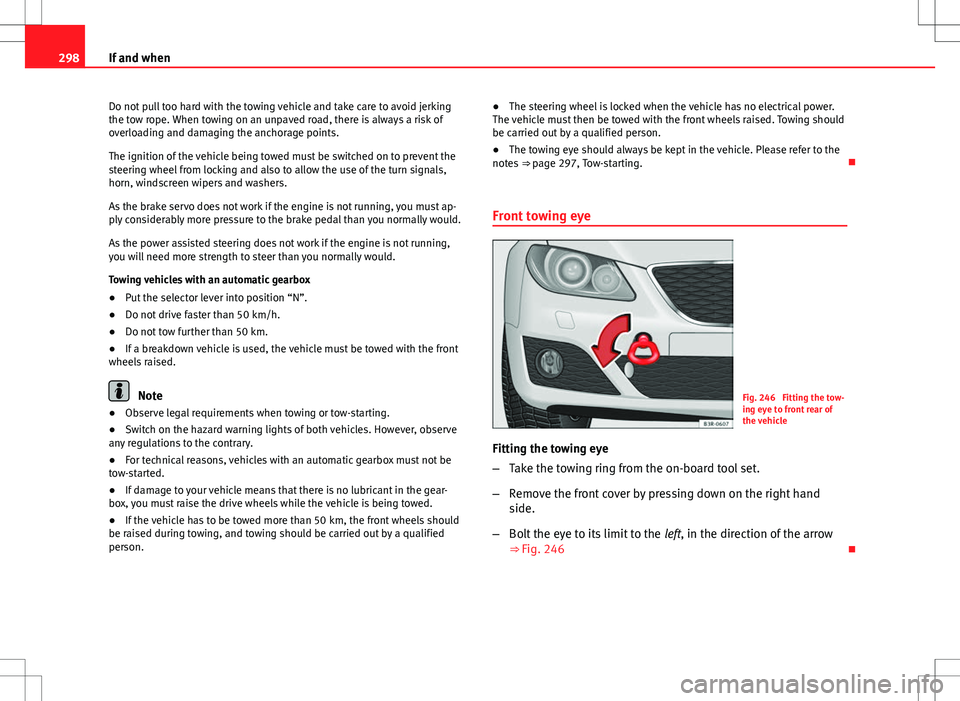
Front towing eyeFig. 246 Fitting the tow-
ing eye to front rear of
the vehicle
Fitting the towing eye
– Take the towing ring from the on-board tool set.
– Remove the front cover by pressing down on the right hand
side.
– Bolt the eye to its limit to the left, in the direction of the arrow
⇒ Fig. 246
Page 322 of 325
Emergency activation . . . . . . . . . . . . . . . . . 116
Opening . . . . . . . . . . . . . . . . . . . . . . . . . . . 115
Snow chains . . . . . . . . . . . . . . . . . . . . . . . 258, 303
Solar-powered blower/sunroof . . . . . . . . . . . . 170
Solar sunroof . . . . . . . . . . . . . . . . . . . . . . . . . . 116
Spare keys . . . . . . . . . . . . . . . . . . . . . . . . . . . . . 99
Spare parts . . . . . . . . . . . . . . . . . . . . . . . . . . . . 228
Spare wheel Steel rim . . . . . . . . . . . . . . . . . . . . . . . . . . . 261
Speedometer . . . . . . . . . . . . . . . . . . . . . . . . . . . 65
Speed warning . . . . . . . . . . . . . . . . . . . . . . . 84, 85
Speed warning function . . . . . . . . . . . . . . . . . . . 85
Start-Stop Activating and deactivating . . . . . . . . . . . . 177
Function . . . . . . . . . . . . . . . . . . . . . . . . . . . 176
Steam jets . . . . . . . . . . . . . . . . . . . . . . . . . . . . . 218
Steering Locking . . . . . . . . . . . . . . . . . . . . . . . . . . . . 173
Manual steering wheel adjustment . . . . . 172
Steering wheel controls . . . . . . . . . . . . . . . . . . . 94
Stopping the engine . . . . . . . . . . . . . . . . . . . . 175
Sun visors . . . . . . . . . . . . . . . . . . . . . . . . . . . . . 128
Switches on the driver door Electric windows . . . . . . . . . . . . . . . . . . . . . 112
Symbols Red symbols in central display . . . . . . . . . . 80
Yellow symbols on central display . . . . . . . 82
T Technical modifications . . . . . . . . . . . . . . . . . . 228
The danger of not using the seat belt . . . . . . . . 21 The environment
Heated rear window . . . . . . . . . . . . . . . . . . 128
Leaks . . . . . . . . . . . . . . . . . . . . . . . . . . . . . . 235
Warming up the engine . . . . . . . . . . . . . . . 174
Tightening torque of wheel bolts . . . . . . . . . . 303
tiptronic . . . . . . . . . . . . . . . . . . . . . . . . . . . . . . 187
tiptronic mode . . . . . . . . . . . . . . . . . . . . . . . . . 192
Tools . . . . . . . . . . . . . . . . . . . . . . . . . . . . . . . . . 259
Tow-starting . . . . . . . . . . . . . . . . . . . . . . . . . . . 297
Towing . . . . . . . . . . . . . . . . . . . . . . . . . . . . 206, 297 Accessories . . . . . . . . . . . . . . . . . . . . . . . . . 208
Notes on towing . . . . . . . . . . . . . . . . . 206, 207
Removable towing bracket . . . . . . . . . . . . 209
Technical requirements . . . . . . . . . . . . . . . 206
Towing a trailer . . . . . . . . . . . . . . . . . . . . . . . . . 302
Towing bracket, fitting . . . . . . . . . . . . . . . . . . . 214
Towing eye . . . . . . . . . . . . . . . . . . . . . . . . . . . . 297
Towing eyes . . . . . . . . . . . . . . . . . . . . . . . . . . . 298
Tow starting General notes . . . . . . . . . . . . . . . . . . . . . . . 297
Traction control system How the system works . . . . . . . . . . . . . . . . 197
Traction control system (ASR) warning lamp . . . . . . . . . . . . . . . . . . . . . . . . 71
Trailer weights . . . . . . . . . . . . . . . . . . . . . . . . . 302
Trip recorder . . . . . . . . . . . . . . . . . . . . . . . . . . . . 65
Turn signal lamps Hazard warning lights . . . . . . . . . . . . . . . . . 71
Trailer turn signals . . . . . . . . . . . . . . . . . . . . 69
Turn signals . . . . . . . . . . . . . . . . . . . . . . . . . 71
Turn signals . . . . . . . . . . . . . . . . . . . . . . . . . . . 124
Tyre mobility system . . . . . . . . . . . . . . . . . . . . . 260 Tyre Mobility System . . . . . . . . . . . . . . . . . . . . 266
Tyre pressure . . . . . . . . . . . . . . . . . . . 69, 93, 249
Loss . . . . . . . . . . . . . . . . . . . . . . . . . . . . . . . 251
Tyre pressure monitoring . . . . . . . . . . . . . . . . . 250
Tyre pressure monitoring system . . . . . . . . . . . 92
Tyre pressures . . . . . . . . . . . . . . . . . . . . . . . . . . 303
Tyre repair kit Tyre Mobility System . . . . . . . . . . . . . . . . . 266
Tyres and wheels Dimensions . . . . . . . . . . . . . . . . . . . . . . . . . 255
Tyres service life . . . . . . . . . . . . . . . . . . . . . . . . 253
Tyres tread depth . . . . . . . . . . . . . . . . . . . . . . . 253
Tyres with directional tread pattern . . . . . . . . 249
U Underbody protection . . . . . . . . . . . . . . . . . . . 221
Upholstery Treating your upholstery . . . . . . . . . . . . . . 223
V
Vehicle care synthetic leather . . . . . . . . . . . . . . . . . . . . 226
Treating your upholstery . . . . . . . . . . . . . . 223
Vehicle data . . . . . . . . . . . . . . . . . . . . . . . . . . . 301
Vehicle identification data . . . . . . . . . . . . . . . . 301
Vehicle identification number . . . . . . . . . . . . . 301
Vehicle keys . . . . . . . . . . . . . . . . . . . . . . . . . . . . 99
Vehicle maintenance electrically adjustable seats . . . . . . . . . . . 224
heated seats . . . . . . . . . . . . . . . . . . . . . . . . 224
320 Index