height Seat Ibiza 2017 Edition 11.17 User Guide
[x] Cancel search | Manufacturer: SEAT, Model Year: 2017, Model line: Ibiza, Model: Seat Ibiza 2017Pages: 312, PDF Size: 6.51 MB
Page 157 of 312
Seats and head restraints
backrests are tilted to the rear, the greater
the risk
of
injury due to improper positioning
of the belt web!
● Exercise caution when securing the seat
height into f
orwards/backwards position. In-
juries can be caused if the seat height is ad-
justed without due care and attention.
● To move the seat forwards and backwards,
pul
l upwards and not sideways on the lever,
as the force exerted on it in that direction
could damage it. Adjusting the front head restraints
Read the additional information carefully
› ›
›
page 19
Adjust the head restraint ›››
page 19 so
that as far as possible the top of the head re-
straint is level with the top of your head.
When this is not possible, try to get as close
as possible to this position. WARNING
● Never driv e if
the head restraints have been
removed. Risk of injury.
● After refitting the head restraint, you must
alwa
ys adjust it properly for height to achieve
optimal protection.
● Please observe the safety warnings ›››
in
Corr ect
adjustment of front head restraints on
page 79. Note
● When fitting the he a
d restraints again, in-
sert the tubes as far as possible into the
guides without pressing the button. Adjustment of the rear head restraints
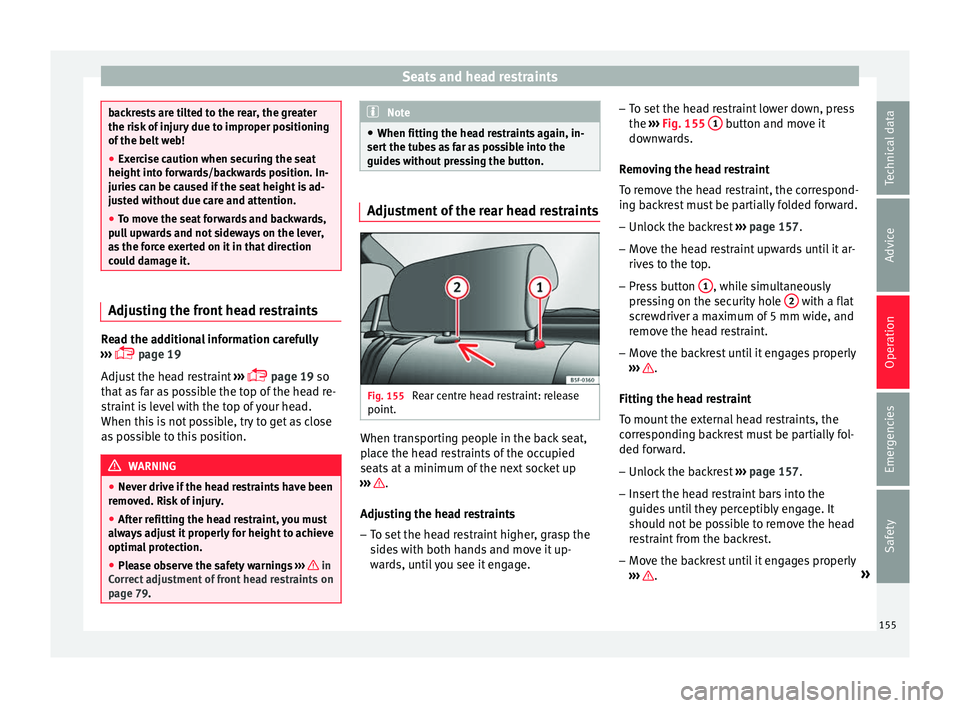
Fig. 155
Rear centre head restraint: release
point . When transporting people in the back seat,
p
l
ac
e the head restraints of the occupied
seats at a minimum of the next socket up
››› .
Adju s
tin
g the head restraints
– To set the head restraint higher, grasp the
sides
with both hands and move it up-
wards, until you see it engage. –
To set the he
ad restraint lower down, press
the ››› Fig. 155 1 button and move it
do wn
w
ards.
Removing the head restraint
To remove the head restraint, the correspond-
ing backrest must be partially folded forward. – Unlock the backrest ›››
page 157.
– Move the head restraint upwards until it ar-
rives
to the top.
– Press button 1 , while simultaneously
pr e
s
sing on the security hole 2 with a flat
s c
r
ewdriver a maximum of 5 mm wide, and
remove the head restraint.
– Move the backrest until it engages properly
›››
.
Fittin g the he
a
d restraint
To mount the external head restraints, the
corresponding backrest must be partially fol-
ded forward.
– Unlock the backrest ›››
page 157.
– Insert the head restraint bars into the
guides u
ntil they perceptibly engage. It
should not be possible to remove the head
restraint from the backrest.
– Move the backrest until it engages properly
›››
.
»
155
Technical data
Advice
Operation
Emergencies
Safety
Page 160 of 312
Operation
WARNING
● Ple a
se be careful when folding back the
backrest! Injuries can be caused if the seat
height is adjusted without due care and at-
tention.
● Do no trap or damage seat belts when rais-
ing the bac
krest.
● After raising the backrest, check it has en-
gaged pr
operly in position. Do this by pulling
on the central seat belt or directly on the
backrest and check that the position lever is
in the neutral position.
● The three point automatic seat belt only
works
correctly when the backrest of the cen-
tral seat is correctly engaged. Transport and practical
equipment
Pr actic
a
l equipment
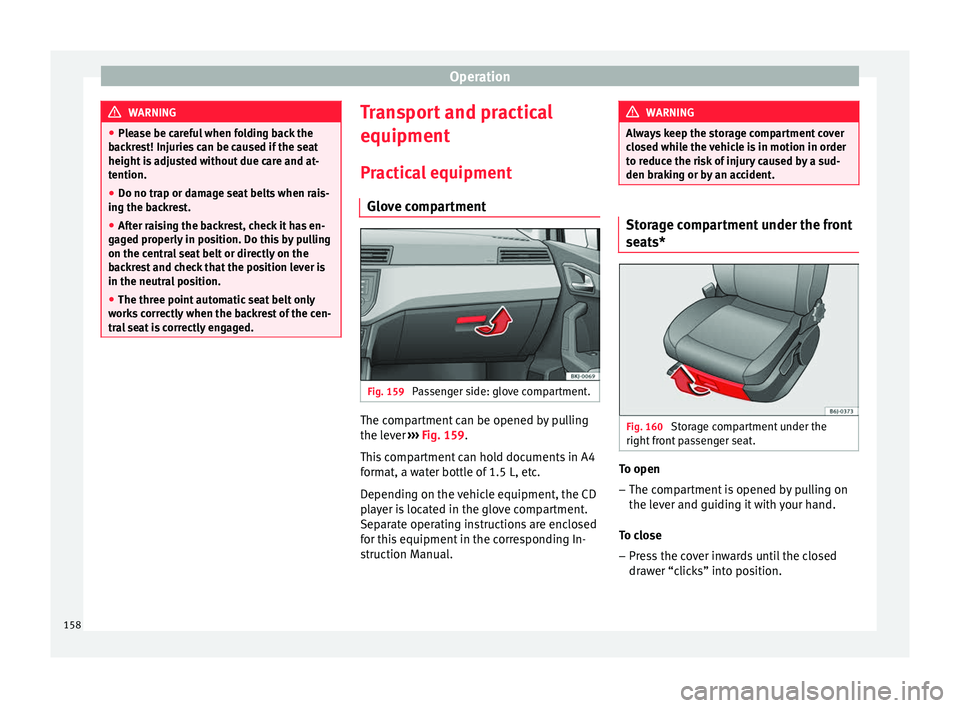
Glove compartment Fig. 159
Passenger side: glove compartment. The compartment can be opened by pulling
the l
ev
er ›
›› Fig. 159.
This compartment can hold documents in A4
format, a water bottle of 1.5 L, etc.
Depending on the vehicle equipment, the CD
player is located in the glove compartment.
Separate operating instructions are enclosed
for this equipment in the corresponding In-
struction Manual. WARNING
Always keep the storage compartment cover
clo sed whi
le the vehicle is in motion in order
to reduce the risk of injury caused by a sud-
den braking or by an accident. Storage compartment under the front
seat
s* Fig. 160
Storage compartment under the
right fr
ont
passenger seat. To open
– The compartment is opened by pulling on
the l ev
er and guidin
g it with your hand.
To close – Press the cover inwards until the closed
draw
er “clicks” into position.
158
Page 166 of 312
Operation
Variable floor in the tilted position
When the v
ari
able floor is tilted you can ac-
cess the spare wheel/anti-puncture kit area.
● Lift the variable floor in the high position
usin
g handle 1 , pull it up and push it to-
w ar
d
s the backrest of the rear seats until the
floor folds along the hinge line and the mov-
able part of the floor is resting on itself.
● Rest the floor on its housings ›››
Fig. 171
(arrows). WARNING
During a sudden driving or braking manoeu-
vre, or in the ev ent
of an accident, objects
could be flung though the interior and cause
serious or fatal injuries.
● Always secure objects, even when the lug-
gage c
ompartment floor is properly lifted.
● Only objects that do not protrude more
than 2/3 the height of
the floor may be car-
ried between the rear seat and the raised lug-
gage compartment floor.
● Only objects that do not weigh than ap-
prox
imately 7.5 kg may be carried between
the rear seat and the raised luggage compart-
ment floor. CAUTION
● The max imum w
eight that can be loaded on
the luggage compartment variable floor in
the top position is 150 kg. ●
Do not l et
the luggage compartment floor
fall when closing it. Always carefully guide it
downwards in a controlled manner. Other-
wise, the lining and the floor of the luggage
compartment could be damaged. Note
SEAT recommends the use of straps to secure
o b j
ects to retaining rings. Roof carrier*
Intr oduction The vehicle roof has been designed to opti-
mi
se aer
ody
namics. For this reason, cross
bars or conventional roof carrier systems can-
not be secured to the roof water drains.
As the roof water drains are integrated in the
roof to reduce air resistance, only SEAT-ap-
proved cross bars and roof carrier systems
can be used.
Cases in which cross bars and the roof carri-
er system should be disassembled.
● When they are not used.
● When the vehicle is washed in a car wash.
● When the vehicle height exceeds the maxi-
mum height, for e x
ample, in some garages. WARNING
When heavy or bulky loads are transported
on the roof c
arrier system, car driving per-
formance is affected, as the centre of gravity
shifts and there is greater wind resistance.
● Always secure the load properly using belts
or retainin
g straps that are suitable and in a
good condition.
● Bulky, heavy, long or flat loads have a neg-
ative effect
on aerodynamics, the centre of
gravity and driving performance.
● Avoid sudden braking and manoeuvres.
● Adapt your speed and driving style at all
times t
o suit visibility, weather, road and traf-
fic conditions. CAUTION
● Remo v
e the cross bars and the roof carrier
system before entering a car wash.
● Vehicle height is increased by the installa-
tion of cr
oss bars or a roof carrier system and
the load secured on them. For this purpose,
check that your vehicle's height does not sur-
pass the headspace limit, for example, for un-
derpasses or for entering garage doors.
● Cross bars, a roof carrier system and the
load sec
ured on them should not interfere
with the roof aerial or hamper the path of the
panoramic sun roof ››› page 144 and the rear
lid.
● On opening the rear lid make sure that it
does not
knock into the roof load.164
Page 206 of 312
Operation
To prevent dazzling, you must apply stickers
t o c
er
tain parts of the headlight lenses. Fur-
ther information is available at any Technical
Service.
Driving on flooded roads To prevent damage to the vehicle when driv-
ing thr
ough w
ater, for example, along a floo-
ded road, please observe the following:
● The water should never come above the
low er edg
e of the bodywork.
● Drive at pedestrian speed. WARNING
After driving through water, mud, sludge,
etc ., the br
aking effect can be delayed slight-
ly due to moisture build-up on the discs and
brake pads. Applying the brakes carefully
several times will remove the moisture and
restore the full braking effect. CAUTION
● Drivin g thr
ough flooded areas may severely
damage vehicle components such as the en-
gine, transmission, running gear or electrical
system.
● Whenever driving through water, the Start-
Stop sys
tem* must be switched off
››› page 204. Note
● Check the depth of
the water before enter-
ing the flooded zone.
● Do not stop in the water, drive in reverse, or
stop the en
gine in any situation.
● Note that vehicles travelling in the opposite
direction ma
y splash water that could exceed
the maximum permitted water height for your
vehicle.
● Avoid driving through salt water (corro-
sion). Driver assistance systems
St ar
t
-Stop System*
Related video Fig. 185
Convenience Description and operation
The Start-Stop system helps save fuel and re-
duc
e C
O
2 emi
ssions.
In Start-Stop mode, the engine will automati-
cally switch off when the vehicle stops or is
stopping; for example when stopping at traf-
fic lights. The ignition remains switched on
during the stopping phase. The engine auto-
matically switches back on when required. In
204
Page 246 of 312
Operation
WARNING
The towing bracket ball coupling must be
st or
ed securely in the luggage compartment
to prevent them being flung through the vehi-
cle and causing injury. Note
● By l
aw, the ball coupling must be removed
if a trailer is not being towed if it obscures
the number plate. Driving with a trailer
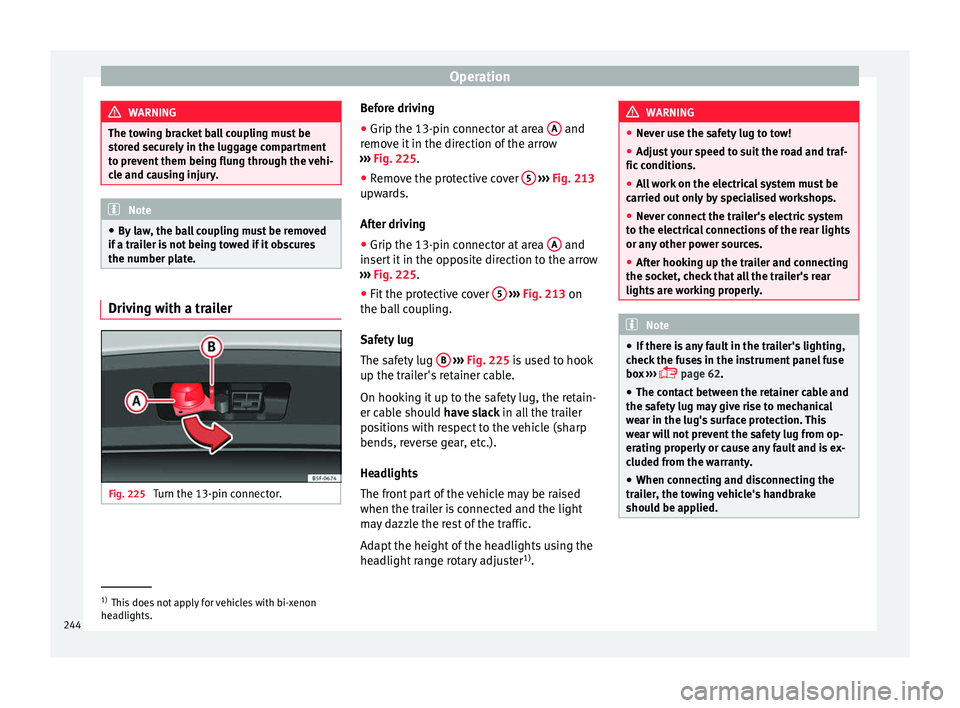
Fig. 225
Turn the 13-pin connector. Before driving
●
Grip the 13-pin connector at area A and
r emo
v
e it in the direction of the arrow
››› Fig. 225.
● Remove the protective cover 5
› ››
Fig. 213
up w
ards.
After driving
● Grip the 13-pin connector at area A and
in ser
t
it in the opposite direction to the arrow
››› Fig. 225.
● Fit the protective cover 5
› ›
› Fig. 213
on
the ball coupling.
Safety lug
The safety lug B
› ›
› Fig. 225
is used to hook
up the trailer's retainer cable.
On hooking it up to the safety lug, the retain-
er cable should have slack in all the trailer
positions with respect to the vehicle (sharp
bends, reverse gear, etc.).
Headlights
The front part of the vehicle may be raised
when the trailer is connected and the light
may dazzle the rest of the traffic.
Adapt the height of the headlights using the
headlight range rotary adjuster 1)
. WARNING
● Never u se the s
afety lug to tow!
● Adjust your speed to suit the road and traf-
fic condition
s.
● All work on the electrical system must be
carried out on
ly by specialised workshops.
● Never connect the trailer's electric system
to the electric
al connections of the rear lights
or any other power sources.
● After hooking up the trailer and connecting
the socket, c
heck that all the trailer's rear
lights are working properly. Note
● If ther e i
s any fault in the trailer's lighting,
check the fuses in the instrument panel fuse
box ›››
page 62.
● The contact between the retainer cable and
the safety
lug may give rise to mechanical
wear in the lug's surface protection. This
wear will not prevent the safety lug from op-
erating properly or cause any fault and is ex-
cluded from the warranty.
● When connecting and disconnecting the
trail
er, the towing vehicle's handbrake
should be applied. 1)
This does not apply for vehicles with bi-xenon
hea dlights.
244
Page 267 of 312
Checking and refilling levels
●
Wait u
ntil no more steam, smoke or coolant
is emitted from the bonnet, then carefully
open the bonnet.
● When working in the engine compartment,
alwa
ys observe the safety warnings
››› page 263. Closing the bonnet
–
Slightly lift the bonnet. –
Rel
e
ase the bonnet stay and replace it in its
support.
– At a height of approximately 30 cm let it fall
so it lock
s.
If the bonnet does not close, do not press
downwards. Open it again and let it fall as
mentioned above. WARNING
If the bonnet is not closed properly, it could
open whil e
you are driving and completely
obscure your view of the road. Risk of acci-
dent.
● After closing the bonnet, always check that
it is
properly secured. The bonnet must be
flush with the surrounding body panels. ●
If y
ou notice that the bonnet latch is not se-
cured when the vehicle is moving, stop the
vehicle immediately and close the bonnet
properly. Risk of accident. 265
Technical data
Advice
Operation
Emergencies
Safety
Page 279 of 312
Wheels
For the sake of the environment
Under-inflated tyres will increase fuel con-
sumption. New tyres and wheels
New tyres and wheels have to be run in.
The tyr
e
s and wheel rims are an essential
part of the vehicle's design. Those approved
by SEAT are specially matched to the charac-
teristics of the vehicle and make a major con-
tribution to good road-holding and safe han-
dling ››› .
T y
r
es should be replaced at least in pairs and
not individually (i.e. both front tyres or both
rear tyres together). A knowledge of tyre des-
ignations makes it easier to choose the cor-
rect tyres. Radial tyres have the tyre designa-
tions marked on the sidewall, for example:
195/55 R16 91V
This contains the following information:
Tyre width in mm
Height/width ratio in %
Tyre construction: Radial
Rim diameter in inches
Load rating code
Speed rating
195
55
R
16
91
V The tyres could also have the following infor-
mation:
● A direction of
rotation symbol
● “Reinforced” denotes heavy-duty tyres.
The manufact
uring date is also indicated on
the tyre sidewall (possibly only on the outer
side of the wheel).
“DOT... 1116...” means, for example, that the
tyre was produced in the 11th week of 2016.
We recommend that work on tyres and
wheels be carried out by a Technical Service.
They are familiar with the procedure and
have the necessary special tools and spare
parts as well as the proper facilities for dis-
posing of the old tyres.
Any technical service has full information on
the technical requirements when installing or
changing tyres, wheels or wheel trims. WARNING
● We r ec
ommend that you use only wheels
and tyres which have been approved by SEAT
for your model. Failure to do so could impair
vehicle handling. Risk of accident.
● Avoid running the vehicle on tyres that are
more than 6
years old. If you have no alterna-
tive, you should drive slowly and with extra
care at all times.
● Never use old tyres or those with an un-
known “his
tory of use”. ●
If wheel trims
are retrofitted, you must en-
sure that the flow of air to the brakes is not
restricted. This could cause the brake system
to overheat.
● All four wheels must be fitted with radial
tyre
s of the same type, size (rolling circumfer-
ence) and the same tread pattern. For the sake of the environment
Old tyres must be disposed of according to
the l aw
s in the country concerned. Note
● A S EA
T Service Centre should be consulted
to find out whether wheels or tyres of differ-
ent sizes to those originally fitted by SEAT
can be fitted, and to find out about the com-
binations allowed between the front axle
(axle 1) and the rear axle (axle 2).
● For technical reasons, it is not generally
poss
ible to use the wheels from other vehi-
cles. This can also apply to wheels of the
same model. The use of wheels or tyres
which have not been approved by SEAT for
use with your model may invalidate the vehi-
cle's type approval for use on public roads.
● If the spare tyre is not the same as the
tyre
s that are mounted on the vehicle (e.g.
winter tyres) you should only use the spare
tyre for a short period of time and drive with
extra care. Refit the normal road wheel as
soon as possible. 277
Technical data
Advice
Operation
Emergencies
Safety
Page 297 of 312
Technical specifications
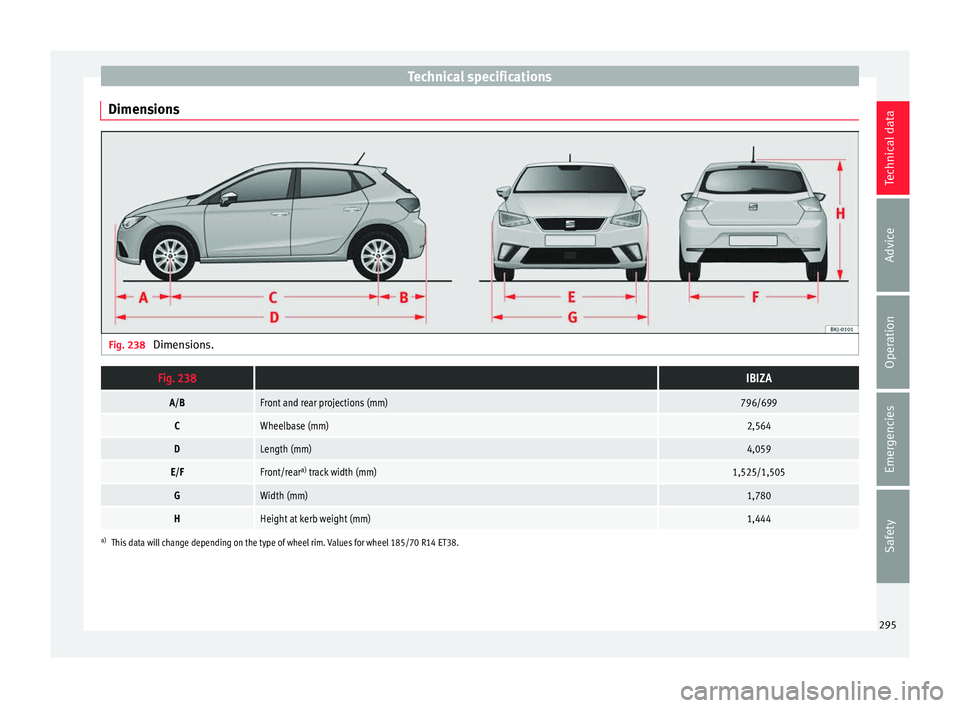
Dimensions Fig. 238
Dimensions.Fig. 238 IBIZA
A/BFront and rear projections (mm)796/699
CWheelbase (mm)2,564
DLength (mm)4,059
E/FFront/rear a)
track width (mm)1,525/1,505
GWidth (mm)1,780
HHeight at kerb weight (mm)1,444
a) This data will change depending on the type of wheel rim. Values for wheel 185/70 R14 ET38.
295
Technical data
Advice
Operation
Emergencies
Safety
Page 308 of 312
Index
Start-Stop system driv er me
s
sages . . . . . . . . . . . . . . . . . . . . . . . . 207
lamps . . . . . . . . . . . . . . . . . . . . . . . . . . . . . . . . 205
operation . . . . . . . . . . . . . . . . . . . . . . . . . . . . . . 204
starting and stopping the engine . . . . . . . . . . 205
switching off and on . . . . . . . . . . . . . . . . . . . . . 207
Start-Stop System the engine does not switch off . . . . . . . . . . . . 206
the engine starts by itself . . . . . . . . . . . . . . . . 206
Starter button . . . . . . . . . . . . . . . . . . . . . . . . . . . . 178
Starting the engine . . . . . . . . . . . . . . . . . . 175, 176 after the fuel tank has run dry . . . . . . . . . . . . . 176
diesel . . . . . . . . . . . . . . . . . . . . . . . . . . . . . . . . . 176
petrol . . . . . . . . . . . . . . . . . . . . . . . . . . . . . . . . . 175
Starting the vehicle . . . . . . . . . . . . . . . . . . . . . . . . 31
Steel wheel rims cleaning . . . . . . . . . . . . . . . . . . . . . . . . . . . . . . 253
Steering . . . . . . . . . . . . . . . . . . . . . . . . . . . . 77, 197 control lamp . . . . . . . . . . . . . . . . . . . . . . . . . . . 198
electromechanical . . . . . . . . . . . . . . . . . . . . . . 199
power . . . . . . . . . . . . . . . . . . . . . . . . . . . . . . . . 199
power-assisted steering . . . . . . . . . . . . . . . . . . 199
steering column lock . . . . . . . . . . . . . . . . . . . . 198
Steering wheel adjustment . . . . . . . . . . . . . . . . . . . . . . . . . . . . . 20
gear shift paddles (automatic gearbox) . . . . . 192
Steering wheel controls . . . . . . . . . . . . . . . . . . . . 124
Steering wheel height adjustment . . . . . . . . . . . . 77
Storage compartment of front door panel . . . . . . . . . . . . . . . . . . . . . . 159
on the front passenger side . . . . . . . . . . . . . . . 158
right front seat . . . . . . . . . . . . . . . . . . . . . . . . . 158
storage pocket in the seat . . . . . . . . . . . . . . . . 159
Storage compartments . . . . . . . . . . . . . . . . . . . . 158
Sun blinds Anti-trap function (sunroof) . . . . . . . . . . . . . . . 145
sliding sunroof . . . . . . . . . . . . . . . . . . . . . . . . . 145 Sunroof . . . . . . . . . . . . . . . . . . . . . . . . . . . . . . . . . 144
anti-trap fu nction . . . . . . . . . . . . . . . . . . . . . . . 145
closing . . . . . . . . . . . . . . . . . . . . . . . . . . . . . . . . 144
opening . . . . . . . . . . . . . . . . . . . . . . . . . . . . . . . 144
operating malfunction . . . . . . . . . . . . . . . . . . . 144
Sun visors . . . . . . . . . . . . . . . . . . . . . . . . . . . . . . . 151
Switch hazard warning lights . . . . . . . . . . . . . . . . . . . 150
Switching off the engine . . . . . . . . . . . . . . . . . . . 177
Switching off the lights . . . . . . . . . . . . . . . . . . . . 146
Switching on the lights . . . . . . . . . . . . . . . . . . . . 146
Switching the ignition on and off . . . . . . . . 31, 175
T Tail light bulbs . . . . . . . . . . . . . . . . . . . . . . . . . . . 109
Tail lights summary . . . . . . . . . . . . . . . . . . . . . . . . . . . . . . 109
Taking care of your vehicle interior . . . . . . . . . . . . . . . . . . . . . . . . . . . . . . . . 254
Technical data roof load . . . . . . . . . . . . . . . . . . . . . . . . . . . . . . 165
Technical modifications . . . . . . . . . . . . . . . . . . . . 247
Technical specifications . . . . . . . . . . . . . . . . . . . . 281
Temperature display engine oil . . . . . . . . . . . . . . . . . . . . . . . . . . . . . . 42
outside temperature . . . . . . . . . . . . . . . . . . . . . . 41
Temporary spare wheel . . . . . . . . . . . . . . . . . . . . 279
Textiles: cleaning . . . . . . . . . . . . . . . . . . . . . . . . . 254
Tightening torque wheel bolts . . . . . . . . . . . . . . . . . . . . . . . . . . . . . 69
Tightening torque of wheel bolts . . . . . . . . . . . . 283
Tiptronic (automatic gearbox) . . . . . . . . . . 190, 192
Top speed . . . . . . . . . . . . . . . . . . . . . . . . . . . . . . . . 42
Top Tether . . . . . . . . . . . . . . . . . . . . . . . . . . . . . 27, 30
Top Tether system . . . . . . . . . . . . . . . . . . . . . . 27, 30
Tow-starting . . . . . . . . . . . . . . . . . . . . . . . . . 71, 100
Tow-starting the engine . . . . . . . . . . . . . . . . . . . . 101 Towing a trailer . . . . . . . . . . . . . . . . . . . . . . . . . . . 242
Tow
ing bracket
retrofitting . . . . . . . . . . . . . . . . . . . . . . . . . . . . . 245
Towing bracket device . . . . . . . . . . . . . . . . . . . . . 237 ball coupling . . . . . . . . . . . . . . . . . . . . . . . . . . . 243
description . . . . . . . . . . . . . . . . . . . . . . . . . . . . 237
Towing device bracket operation and care . . . . . . . . . . . . . . . . . . . . . . 241
Towing the vehicle . . . . . . . . . . . . . . . . . . . . 70, 100
Towline anchorages . . . . . . . . . . . . . . . . . . . . . . . . 70 rear . . . . . . . . . . . . . . . . . . . . . . . . . . . . . . . . . . 102
Tow rope . . . . . . . . . . . . . . . . . . . . . . . . . . . . . . . . 242
Traction control system . . . . . . . . . . . 183, 184, 185 control lamp . . . . . . . . . . . . . . . . . . . . . . . . . . . 184
Trailer . . . . . . . . . . . . . . . . . . . . . . . . . . . . . . . . . . 237 connecting . . . . . . . . . . . . . . . . . . . . . . . 243, 244
driving with a trailer . . . . . . . . . . . . . . . . . . . . . 244
electrical socket . . . . . . . . . . . . . . . . . . . . . . . . 243
hitching . . . . . . . . . . . . . . . . . . . . . . . . . . . . . . . 243
mode . . . . . . . . . . . . . . . . . . . . . . . . . . . . . . . . . 282
parking aid . . . . . . . . . . . . . . . . . . . . . . . . . . . . 233
rear lights . . . . . . . . . . . . . . . . . . . . . . . . . . . . . 242
safety lug . . . . . . . . . . . . . . . . . . . . . . . . . . . . . 244
tow rope . . . . . . . . . . . . . . . . . . . . . . . . . . . . . . 242
Trailer turn signals control lamp . . . . . . . . . . . . . . . . . . . . . . . . . . . 148
Trailer weights . . . . . . . . . . . . . . . . . . . . . . . . . . . 282
Transporting children . . . . . . . . . . . . . . . . . . . . . . . 92
Transporting items fastening rings . . . . . . . . . . . . . . . . . . . . . . . . . 162
roof carrier . . . . . . . . . . . . . . . . . . . . . . . . . . . . . 164
roof carrier system . . . . . . . . . . . . . . . . . . . . . . 164
Transporting objects roof carrier system . . . . . . . . . . . . . . . . . . . . . . 165
Turn signal lever . . . . . . . . . . . . . . . . . . . . . . . . . . 147
Turn signals control lamp . . . . . . . . . . . . . . . . . . . . . . . . . . . 148
306