light Seat Ibiza 5D 2005 User Guide
[x] Cancel search | Manufacturer: SEAT, Model Year: 2005, Model line: Ibiza 5D, Model: Seat Ibiza 5D 2005Pages: 252, PDF Size: 7.56 MB
Page 42 of 252
Airbag system
40•
There must be no other persons, animals or objects between the occu-
pants of the outer seats and the deployment space of the curtain airbags
so that the curtain airbag can deploy without restriction and provide the
greatest possible protection. Therefore, sun blinds which have not been
expressly approved for use in your vehicle may not be attached to the side
windows ⇒ page 162, “Accessories, parts replacement and modifica-
tions”.
•
The built-in coat hooks should be used only for lightweight clothing. Do
not leave any heavy or sharp-edged objects in the pockets. When using the
coat hooks, do not hang the clothes on coat hangers.
•
The airbags provide protection for one accident only, if they have been
deployed they must be replaced.
•
Any work on the curtain airbag system or removal and installation of
the airbag components for other repairs (such as removal of the roof lining)
should only be performed by qualified workshop. Otherwise, a fault may be
introduced into the operat ion of the airbag system.
•
Do not attempt to modify components of the airbag system in any way.
•
The side and head airbags are managed through sensors located in the
interior of the front doors. To ensure the correct functioning of the side and
head airbags neither the doors nor the door panels should be modified in
any way (e.g. fitting loudspeakers). If the front door is damaged in any way,
this may affect the correct working of the system. All work carried out on
the front door must be made in a qualified workshop.WARNING (continued)
ibiza_ingles Seite 40 Mittwoch, 5. Oktober 2005 5:17 17
Page 44 of 252

Airbag system
42
– Check that the warning lamp “ AIRBAG OFF” in the dash panel does ⇒ page 41, fig. 26 not light up when the ign it i
on is
switched on ⇒.
WARNING
•
The driver is responsible for the proper position of the key-operated
switch.
•
You should deactivate the front passenger airbag only if you have to use
a rear-facing child seat in exceptional cases ⇒ page 43, “Child safety”.
•
Never install a rear-facing child seat on the front passenger seat unless
the front passenger airbag has been disabled. Risk of potentially fatal inju-
ries to the child! However, if it is necessary in exceptional circumstances to
transport a child in a rear-facing child seat on the front passenger seat, you
must always disable the front passenger airbag.
•
As soon as the child seat is no longer needed on the front passenger
seat, enable the front passenger airbag again.
•
Only deactivate the passenger airbag when the ignition is off, other-
wise a fault may occur in the airbag system, this will create a danger that
in case of an accident, the airbag does not deploy properly or does not
deploy at all.
•
If, while the front passenger airbag is deactivated, the indicator
AIRBAG OFF on the instrument panel does not remain lit, this may indicate
an airbag fault:
−Have the airbag system inspected immediately by a qualified work-
shop.
− Do not use a child seat on the front passenger seat! The front
passenger airbag could be triggered despite the fact that there is a fault
in the system and, as a result, a child could sustain serious or fatal inju-
ries.
− It is not certain whether the fron t passenger airbag will deploy
during an accident! Inform your passengers of this.
•
When using the ignition key to activate / deactivate the passenger
frontal airbag, only the passenger frontal and side airbag will be activated
/ deactivated. The curtain airbag on the passenger side will remain
active.WARNING (continued)
ibiza_ingles Seite 42 Mittwoch, 5. Oktober 2005 5:17 17
Page 53 of 252

Cockpit51
Safety First
Operating instructions
Tips and Maintenance
Te c h n i c a l D a t a
Operating instructionsCockpitOverviewOverview of the instrument panel
This overview will help you to familiarise yourself with the
controls and displays quickly.
Door release lever
Air vent
Light switch . . . . . . . . . . . . . . . . . . . . . . . . . . . . . . . . . . . . . . . . .
Light dimmer for instrument panel ligh ting* . . . . . . . . . . . . . .
Headlight range control* . . . . . . . . . . . . . . . . . . . . . . . . . . . . . .
Turn signal and dipped beam lever and cruise control system*
Instrument panel an d warning lights:
− Instruments . . . . . . . . . . . . . . . . . . . . . . . . . . . . . . . . . . . . . . .
− Indication lamps . . . . . . . . . . . . . . . . . . . . . . . . . . . . . . . . . . .
Horn (works only when the igni tion is on)/ and driver front
airbag* . . . . . . . . . . . . . . . . . . . . . . . . . . . . . . . . . . . . . . . . . . . . .
Steering and starter lock . . . . . . . . . . . . . . . . . . . . . . . . . . . . . .
Windscreen wiperand and windscreen wash lever and opera-
tion of the multi-function display * . . . . . . . . . . . . . . . . . . . . . .
Switch for hazard warning lights . . . . . . . . . . . . . . . . . . . . . . . .
Switch for heated rear window . . . . . . . . . . . . . . . . . . . . . . . . . .
Airbag disconnected warning light* . . . . . . . . . . . . . . . . . . . . .
Cup holder* . . . . . . . . . . . . . . . . . . . . . . . . . . . . . . . . . . . . . . . . . Radio casing*/Radio navigation system*
Passenger airbag* . . . . . . . . . . . . . . . . . . . . . . . . . . . . . . . . . . .
Glove box/Stowage compartment . . . . . . . . . . . . . . . . . . . . . . .
Switches for:
−
Heating and ventilation . . . . . . . . . . . . . . . . . . . . . . . . . . . . .
− Air conditioning* . . . . . . . . . . . . . . . . . . . . . . . . . . . . . . . . . .
− Climatronic* . . . . . . . . . . . . . . . . . . . . . . . . . . . . . . . . . . . . . .
Ashtray/ cigarette lighter/socket . . . . . . . . . . . . . . . . . . . . . . . .
Handbrake lever . . . . . . . . . . . . . . . . . . . . . . . . . . . . . . . . . . . . .
Automatic / manual gearbox lever * . . . . . . . . . . . . . . . . . . . .
Pedals . . . . . . . . . . . . . . . . . . . . . . . . . . . . . . . . . . . . . . . . . . . . .
Steering column control lever* . . . . . . . . . . . . . . . . . . . . . . . . .
Stowage compartment . . . . . . . . . . . . . . . . . . . . . . . . . . . . . . . .
Bonnet release lever . . . . . . . . . . . . . . . . . . . . . . . . . . . . . . . . . .
Control for adjusting electric wing mirrors* . . . . . . . . . . . . . . .
Central locking button* . . . . . . . . . . . . . . . . . . . . . . . . . . . . . . .
Electric window controls* . . . . . . . . . . . . . . . . . . . . . . . . . . . . . .
Note
Some of the items of equipment listed here are fitted only on certain models
or are optional extras.
A1A2A3
88
A4
89
A5
89
A6
91, 135
A7
52
60
A8
28
A9
125
A10
94, 55
A11
90
A12
89
A13
29
A14
108
A15A16
31
A17
106
A18
113
116
119
A19
109
A20
134
A21
130, 129
A22
14
A23
123
A24
107
A25
171
A26
98
A27
72
A28
83
ibiza_ingles Seite 51 Mittwoch, 5. Oktober 2005 5:17 17
Page 55 of 252
Cockpit53
Safety First
Operating instructions
Tips and Maintenance
Te c h n i c a l D a t a
Rev counter
The rev. counter displays the engine speed in revolutions per
minute.The start of the red zone on the dial ⇒ page 52, fig. 32 indicates the
maximum engine speed which may be used briefly when the engine is warm
and after it has been run in properly. However, it is advisable to change up a
gear or move the selector lever to D (or li ft your foot off the accelerator) before
the needle reaches the red zone.
Caution
The rev counter needle must never enter the red zone on the scale. Risk of
engine damage.
For the sake of the environment
Changing up a gear early will help you to save fuel and minimise engine
noise.
Engine coolant temperature display
This gauge shows the engine coolant temperature.
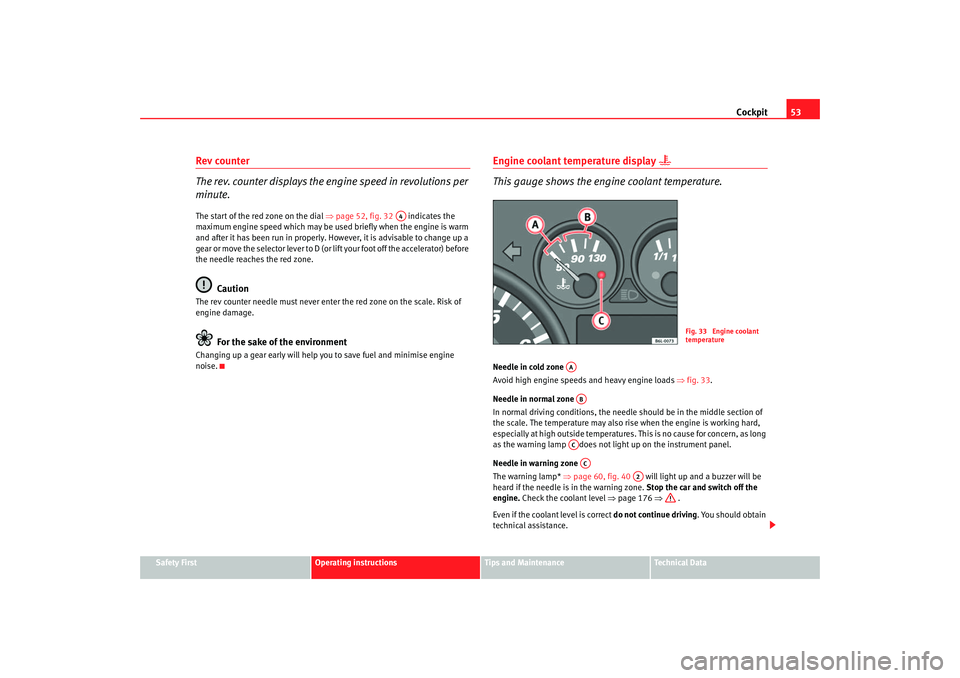
Needle in cold zone
Avoid high engine speeds and heavy engine loads ⇒fig. 33.
Needle in normal zone
In normal driving conditions, the needle should be in the middle section of
the scale. The temperature may also rise when the engine is working hard,
especially at high outside temperatures. This is no cause for concern, as long
as the warning lamp does not li ght up on the instrument panel.
Needle in warning zone
The warning lamp* ⇒page 60, fig. 40 will light up and a buzzer will be
heard if the needle is in the warning zone. Stop the car and switch off the
engine. Check the coolant level ⇒ page 176 ⇒ .
Even if the coolant level is correct do not continue driving. You should obtain
technical assistance.
A4
Fig. 33 Engine coolant
temperature
AAABACAC
A2
ibiza_ingles Seite 53 Mittwoch, 5. Oktober 2005 5:17 17
Page 56 of 252

Cockpit
54
WARNING
When working in the engine compartment, always bear in mind the safety
wa rnings ⇒ page 169.
Caution
Accessories in front of the air inlet reduce the cooling effect of the coolant. At
high outside temperatures and high engine loads, there is a risk of the
engine overheating.Fuel gauge
and reserve indicator
Details of the instrument panel: Fuel gauge
The fuel tank has a capacity of approx. 45 litres. When the needle reaches the red area of the reserve zone
⇒fig. 34 , the
warning lamp w ill light and an acoustic s ignal will sound reminding the driver
to refuel. At this point there are still about 7 litres of fuel in the tank.
SpeedometerThe speedometer is equipped with a digital odometer and a trip counter, in
addition to a service intervals display.
During the running-in period, the instructions shown on ⇒page 143 should
be followedDigital display in the instrument panelDigital clock*– Turn the setting knob ⇒page 52, fig. 32 anti-clockwise to
the stop to set the hour. If the kn ob is turned briefly anti-clock-
wise the clock will advance one hour further.
– Turn the setting knob clockwise to the limit stop to set the minutes. If the knob is turned briefly clockwise the clock will
advance one minute further.
Fig. 34 Fuel gauge
A5
ibiza_ingles Seite 54 Mittwoch, 5. Oktober 2005 5:17 17
Page 57 of 252
Cockpit55
Safety First
Operating instructions
Tips and Maintenance
Te c h n i c a l D a t a
Ambient temperature display*
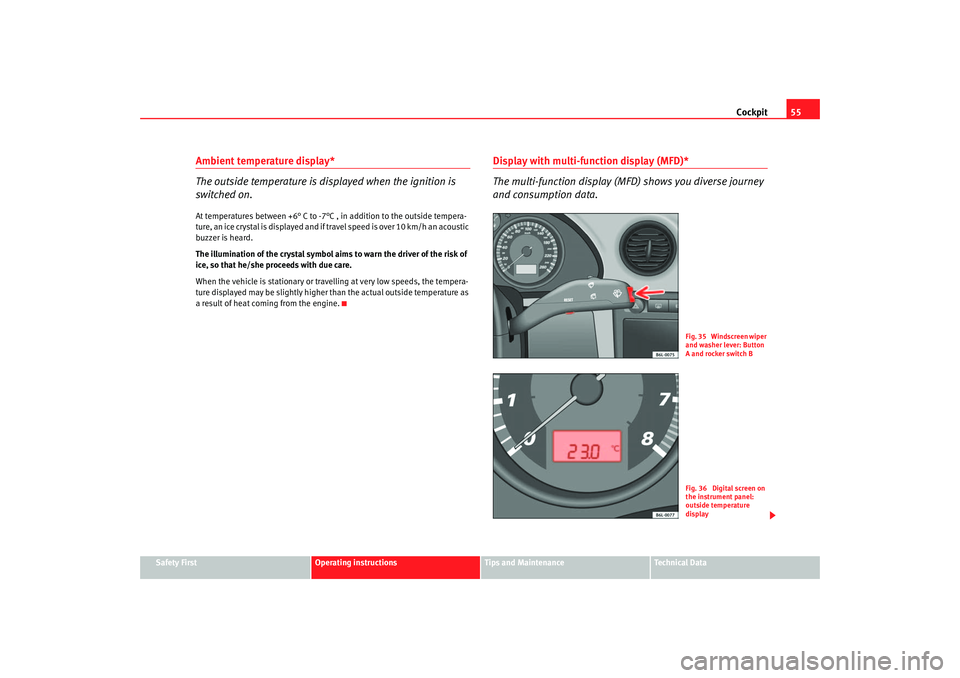
The outside temperature is displayed when the ignition is
switched on.At temperatures be tween +6° C to -7°C , in addition to the outside tempe ra-
ture, an ice crystal is displayed and if travel speed is over 10 km/h an acoustic
buzzer is heard.
The illumination of the crystal symbol ai ms to warn the driver of the risk of
ice, so that he/she proceeds with due care.
When the vehicle is stationary or travelling at very low speeds, the tempera-
ture displayed may be slightly higher than the actual outside temperature as
a result of heat coming from the engine.
Display with multi-function display (MFD)*
The multi-function display (M FD) shows you diverse journey
and consumption data.
Fig. 35 Windscreen wiper
and washer lever: Button
A and rocker switch BFig. 36 Digital screen on
the instrument panel:
outside temperature
display
ibiza_ingles Seite 55 Mittwoch, 5. Oktober 2005 5:17 17
Page 59 of 252
Cockpit57
Safety First
Operating instructions
Tips and Maintenance
Te c h n i c a l D a t a
Memory displays
•
Time
•
Journey duration
•
Average speed
•
Distance
•
Distance to empty (the distance you can travel with the remaining fuel)
•
Average fuel consumption
•
Current fuel consumption
Time
The time is also displayed when the ignition is switched off. The clock can be
set with the right-hand rotating button below the rev counter “digital clock”.
min - Journey duration
The display shows the amount of time which has elapsed since the ignition
was switched on.
The maximum display value in both me mories is 99 hours and 59 minutes.
The memory will automatically be deleted once this value has been reached.
Ø mph - Average speed
The average speed will be shown after a distance of approximately 100
metres has been travelled. Dashes will appear in the display until that time.
The display will be updated every 5 seconds whilst the vehicle is in motion.
Miles - Distance travelled
The display shows the distance travelled since the ignition was switched on.
The maximum display value in both memories is 9999 miles. The memory will
automatically be deleted once this value has been reached.
Miles - Fuel range
The fuel range is calculated using the fi gures for tank content and current fuel
consumption. It shows how far the vehicle can travel using the same condi-
tions as a reference. Ø litre/100km - Average fuel consumption
The average fuel consumption will be shown
⇒page 56, fig. 38 after a
distance of approximately 100 metres has been travelled. Dashes will appear
in the display until that time. The display will be updated every 5 seconds
whilst the vehicle is in motion. The amount of fuel used will not be shown.
ltr/100km or ltr/hr - Current fuel consumption
The display will show the current fuel consumption in litre/km whilst the
vehicle is in motion or in litre/hour when the vehicle is in a stationary position
with the engine running.
Using this display you can see how your driving style affects fuel consump-
tion ⇒page 151.
Ambient temperature display
The measurement margin extends from -45° C to +58° C. At temperatures
lower than +4° C, an “ice crystal symbol” is displayed and a “warning”
sounds if the vehicle is moving at more than 20 km/h (ice warning). This
symbol will flash for about 10 seconds and remains lit until the exterior
temperature rises above +4° C or 6° C if it was already lit.
WARNING
There could be black ice on the road surface even if the “snowflake symbol”
is not shown. You should, for this reason, not rely exclusively on this
display - Risk of accident!
Note
When the vehicle is stationary or travelling at very low speeds, the tempera-
ture displayed may be slightly higher than the actual ambient temperature as
a result of the heat radiated from the engine.
ibiza_ingles Seite 57 Mittwoch, 5. Oktober 2005 5:17 17
Page 63 of 252
Cockpit61
Safety First
Operating instructions
Tips and Maintenance
Te c h n i c a l D a t a
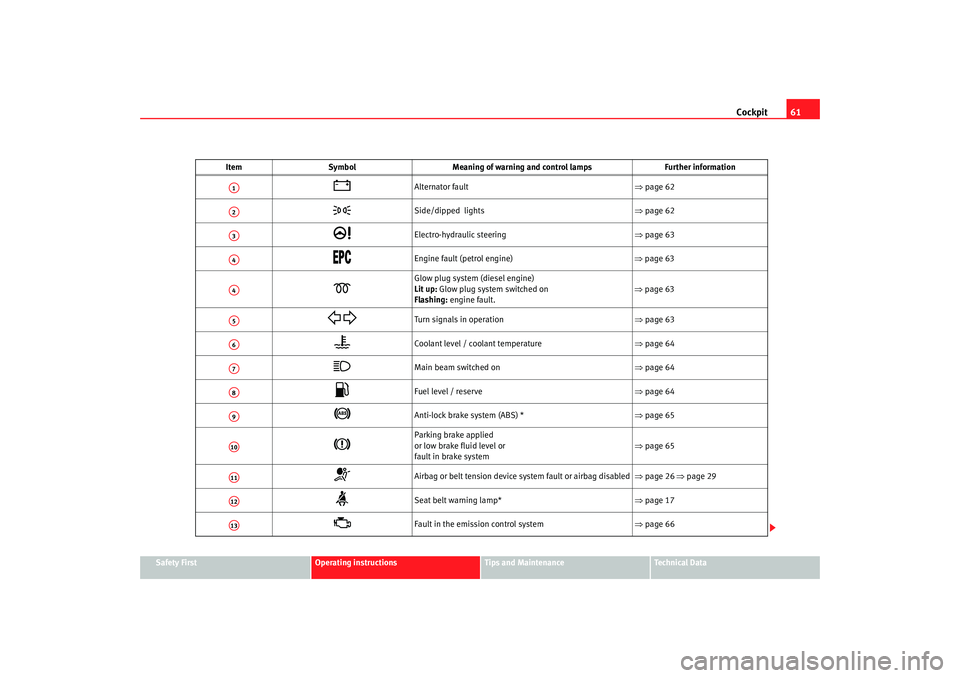
Item
Symbol Meaning of warning and control lamps Further information
Alternator fault ⇒page 62
Side/dipped lights ⇒page 62
Electro-hydraulic steering ⇒page 63
Engine fault (petrol engine) ⇒ page 63
Glow plug system (diesel engine)
Lit up: Glow plug system switched on
Flashing: engine fault.
⇒ page 63
Turn signals in operation ⇒page 63
Coolant level / coolant temperature ⇒page 64
Main beam switched on ⇒page 64
Fuel level / reserve ⇒page 64
Anti-lock brake system (ABS) * ⇒page 65
Parking brake applied
or low brake fluid level or
fault in brake system ⇒
page 65
Airbag or belt tension device system fault or airbag disabled ⇒page 26 ⇒page 29
Seat belt warning lamp* ⇒page 17
Fault in the emission control system ⇒page 66
A1A2A3A4A4A5A6A7A8A9A10A11A12A13
ibiza_ingles Seite 61 Mittwoch, 5. Oktober 2005 5:17 17
Page 64 of 252
Cockpit
62
WARNING
•
Failure to observe warning lamps and warning messages can result in
serious personal injury or damage to your vehicle.
•
The risk of an accident increases if your vehicle breaks down. Use a
warning triangle to draw the attention of other road users to your
stationary vehicle so that it does not represent a danger.
•
The engine compartment of any motor vehicle is a dangerous area!
Before you open the bonnet to work on the engine or in the engine compart-
ment, you must switch off the engine and allow it to cool to reduce the risk
of scalding or other injuries. Read and observe the relevant warnings
⇒ page 169.Note
•
The appropriate warning lamp for a fa ult will light up in vehicles without
warning or information texts in the display.
•
In vehicles with warning or information texts in the display, the appro-
priate warning lamp for a fault will ligh t up and a warning or information text
will also appear in the display.
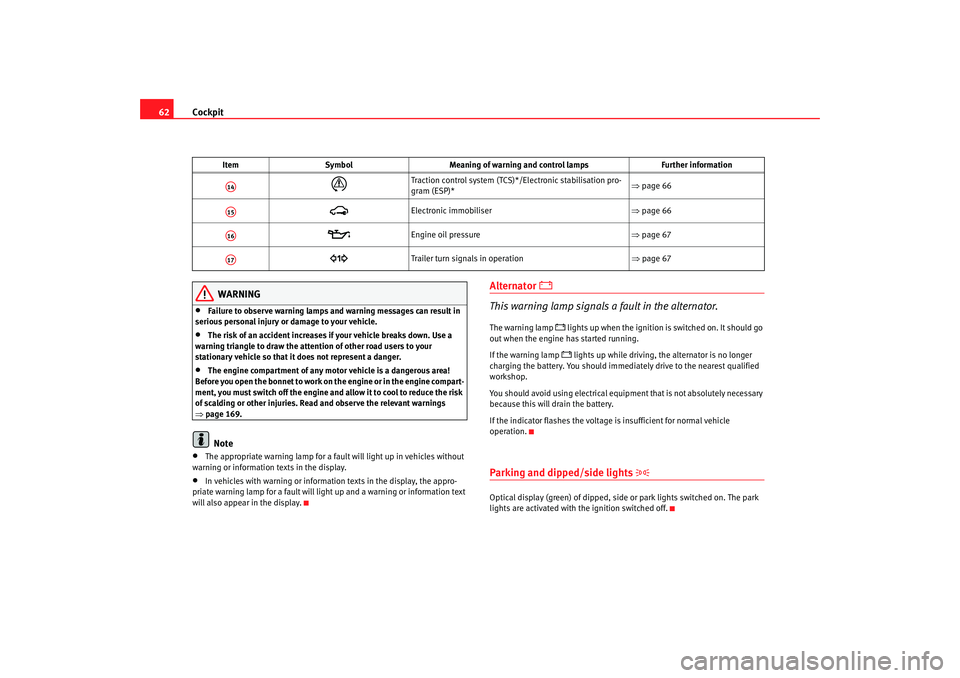
Alternator
This warning lamp signals a fault in the alternator.The warning lamp
lights up when the ignition is switched on. It should go
out when the engine has started running.
If the warning lamp lights up while driving, the alternator is no longer
charging the battery. You should immediately drive to the nearest qualified
workshop.
You should avoid using electrical equipment that is not absolutely necessary
because this will drain the battery.
If the indicator flashes the voltage is insufficient for normal vehicle
operation.
Parking and dipped/side lights
Optical display (green) of dipped, side or park lights switched on. The park
lights are activated with the ignition switched off.
Traction control system (TCS)*/Electronic stabilisation pro-
gram (ESP)* ⇒
page 66
Electronic immobiliser ⇒page 66
Engine oil pressure ⇒page 67
Trailer turn signals in operation ⇒page 67
Item
Symbol Meaning of warning and control lamps Further information
A14A15A16A17
ibiza_ingles Seite 62 Mittwoch, 5. Oktober 2005 5:17 17
Page 65 of 252
Cockpit63
Safety First
Operating instructions
Tips and Maintenance
Te c h n i c a l D a t a
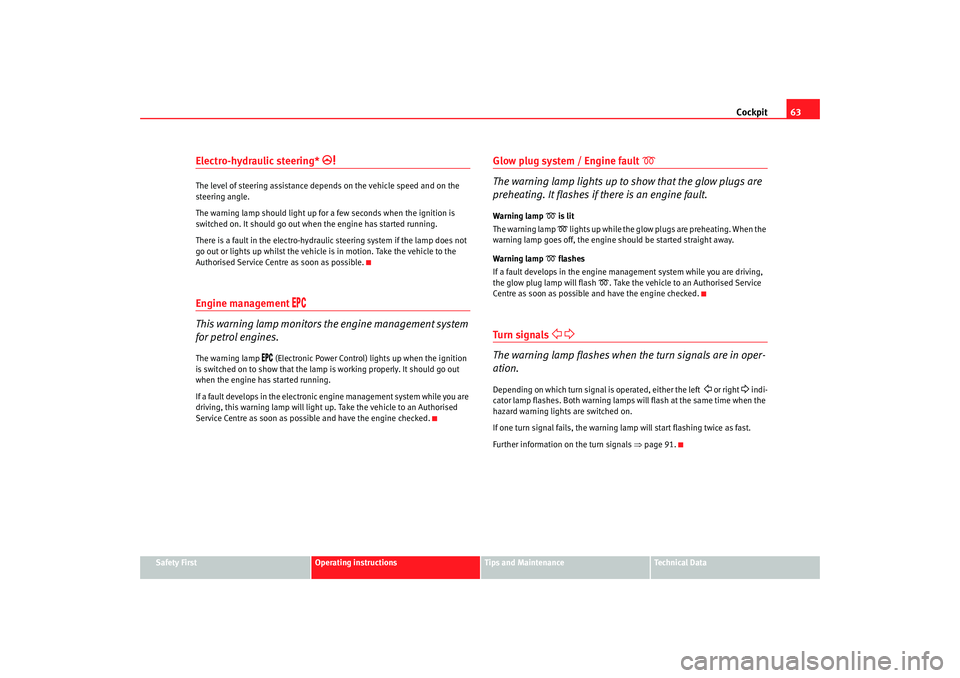
Electro-hydraulic steering*
The level of steering assistance depends on the vehicle speed and on the
steering angle.
The warning lamp should light up for a few seconds when the ignition is
switched on. It should go out when the engine has started running.
There is a fault in the electro-hydraulic steering system if the lamp does not
go out or lights up whilst the vehicle is in motion. Take the vehicle to the
Authorised Service Centre as soon as possible.Engine management
This warning lamp monitors th e engine management system
for petrol engines.The warning lamp
(Electronic Power Control) lights up when the ignition
is switched on to show that the lamp is working properly. It should go out
when the engine has started running.
If a fault develops in the electronic engine management system while you are
driving, this warning lamp will light up. Take the vehicle to an Authorised
Service Centre as soon as possible and have the engine checked.
Glow plug system / Engine fault
The warning lamp lights up to show that the glow plugs are
preheating. It flashes if there is an engine fault.
Warning lamp
is lit
The warning lamp lights up while the glow plugs are preheating. When the
warning lamp goes off, the engine should be started straight away.
Warning lamp
flashes
If a fault develops in the engine management system while you are driving,
the glow plug lamp will flash
. Take the vehicle to an Authorised Service
Centre as soon as possible and have the engine checked.
Tu r n si g nals
The warning lamp flashes when the turn signals are in oper-
ation.Depending on which turn signal is operated, either the left
or right
indi-
cator lamp flashes. Both warning lamps will flash at the same time when the
hazard warning lights are switched on.
If one turn signal fails, the warning lamp will start flashing twice as fast.
Further information on the turn signals ⇒page 91.
ibiza_ingles Seite 63 Mittwoch, 5. Oktober 2005 5:17 17