coolant level Seat Ibiza 5D 2007 User Guide
[x] Cancel search | Manufacturer: SEAT, Model Year: 2007, Model line: Ibiza 5D, Model: Seat Ibiza 5D 2007Pages: 272, PDF Size: 8.32 MB
Page 189 of 272
Checking and refilling levels187
Safety First
Operating instructions
Tips and Maintenance
Te c h n i c a l D a t a
•
Before opening the bonnet, read and observe the warnings
⇒ page 180, “Safety instructions on working in the engine compartment”.
•
Wait for the engine to cool down. Hot oil may cause burn injuries.
•
Wear eye protection to avoid injuries caused by splashes of oil.
•
When removing the oil drain plug with your fingers, keep your arm hori-
zontal to help prevent oil from running down your arm.
•
Wash your skin thoroughly if it comes into contact with engine oil.
•
Engine oil is poisonous! Used oil must be stored in a safe place out of
the reach of children until it is disposed of.Caution
No additives should be used with engine oil. This could result in engine
damage. Any damage caused by the use of such additives would not be
covered by the factory warranty.
For the sake of the environment
•
Because of the disposal problems, the necessa ry special tools and
specialist knowledge required, we reco mmend that you have the engine oil
and filter changed by an Authorised Service Centre.
•
Never pour oil down drains or into the ground.
•
Use a suitable container when draining the used oil. It has to be large
enough to hold all the engine oil.
CoolantCoolant specifications
Coolant is a mixture of water and at least 40% coolant addi-
tive.The cooling system must be filled with a mixture of water and at least 40 % of
our coolant additive G 12+ or an addi tive with the specification TT-VW 774 F
(it is dyed purple). This mixture gives the necessary frost protection down to
-25
°C and protects the al loy parts of the cooling system again st corrosion. It
also prevents scaling and raises the boiling point of the coolant.
The concentration of coolant must always be at least 40% - even if frost
protection is not required.
If greater frost protection is required in very cold climates, the proportion of
the antifreeze additive G 12+ can be increased. However, the percentage of
coolant additives should not exceed 60%, as this would reduce the frost
protection. It would also reduce th e cooling effect. A mixture with 60%
coolant addit ive will give f rost protection to approx. -40
°C.
WARNING
•
The coolant additive is toxic. There is a toxic risk. Always keep the
coolant additive in the original container which should be stored out of the
reach of children. The same applies to coolant which you have drained off.
•
The coolant additive G 12+ must be added in sufficient quantities to
provide anti-freeze protection at the coldest ambient temperatures that
can be expected. At extremely cold ambient temperatures, the coolant
could freeze, causing the vehicle to breakdown. As the heater would also
not work in this situat ion, there is a risk of suffering exposure!
WARNING (continued)
IBI_ANG_0707 Seite 187 Montag, 6. August 2007 3:59 15
Page 190 of 272
Checking and refilling levels
188
Caution•
Other additives may give considerably inferior corrosion protection. The
resulting corrosion in the cooling system can lead to a loss of coolant,
causing serious damage to the engine.
•
The coolant additive G 12+ (purple) ca n be mixed with the additive G 12
(red) or G 11. Never mix G12 (red colour) with G 11.
Checking the coolant level and topping up
The correct coolant level is important for fault-free func-
tioning of the engine cooling system.Before opening the bonnet, read and observe the warnings ⇒ in
“Safety instructions on working in the engine compartment” on
page 180. Opening the coolant expansion tank
– Switch off the engine and allow it to cool.
– To prevent scalding, cover the cap on the expansion tank with a
thick cloth and carefully unscrew the cap ⇒.
Checking coolant level
– Look into the open coolant expansion tank and read off the coolant level.
– If the level is underneath the “MIN” mark, top up with coolant.
Topping up coolant
–Only use new coolant.
– Do not fill above the “MAX” mark.
Closing the coolant expansion tank
– Screw the cap on again tightly.
The position of the coolant expansion re servoir is shown in the corresponding
engine compartment diagram ⇒page 242.
Make sure that the coolant meets the required specifications ⇒page 187.
Do not use a different type of additive if coolant additive G 12+, is not avail-
able. In this case use only water and bring the coolant concentration back up
to the correct level as soon as possible by putting in the specified additive
⇒ page 187.
Always top up with new coolant.
Do not fill above the “MAX” mark. Otherwise the excess coolant will be forced
out of the cooling system when the engine is hot.
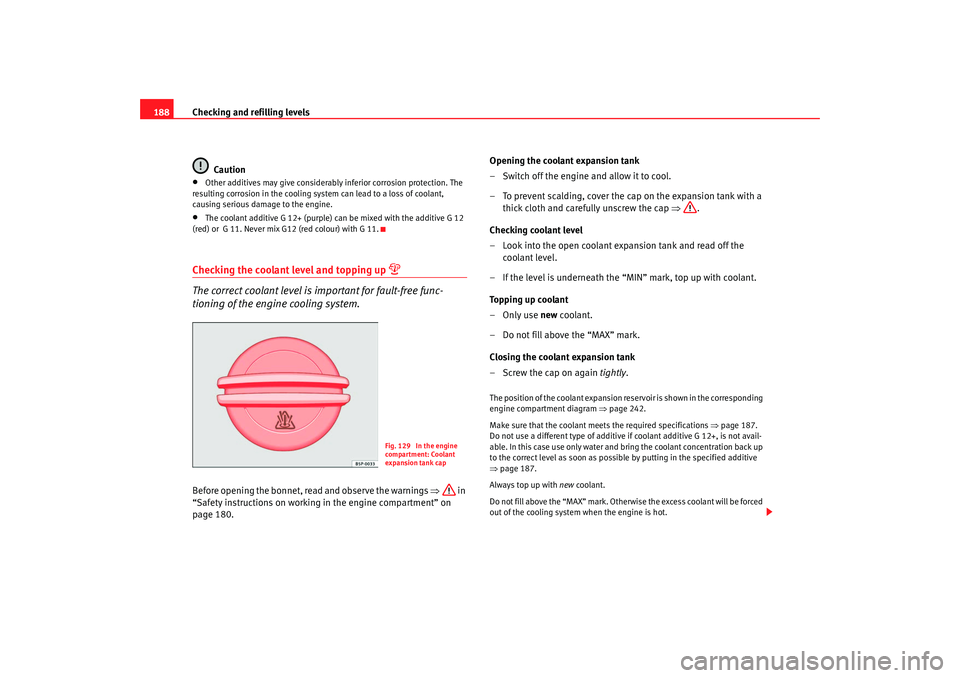
Fig. 129 In the engine
compartment: Coolant
expansion tank cap
IBI_ANG_0707 Seite 188 Montag, 6. August 2007 3:59 15
Page 191 of 272
Checking and refilling levels189
Safety First
Operating instructions
Tips and Maintenance
Te c h n i c a l D a t a
The coolant additive G 12+ (dyed purple) may be mixed with G 12 (dyed red)
and also with G 11.
WARNING
Any work carried out in the engine compartment or on the engine must be
carried out cautiously.•
When working in the engine compartment, always observe the safety
warnings ⇒ page 180.
•
When the engine is warm or hot, the cooling system is pressurised! Do
not unscrew the cap on the expansion t ank when the engine is hot. This is
a burn injury risk.Caution
•
When mixed with other additives the colour of G 12 will change to brown.
If this occurs you should have the coolant changed immediately. Failure to do
so will result in engine damage!
•
If a lot of coolant has been lost, wait for the engine to cool down before
putting in cold coolant. This avoids damaging the engine. Large coolant
losses are an indication of leaks in the cooling system. See a specialised
workshop immediately and have the c ooling system checked. Otherwise,
there is a risk of engine damage.
Washer fluid and windscreen wiper bladesTopping up washer fluid
The water for cleaning the windscreen should always be
mixed with washer fluid.The windscreen washer and the headlight washing system are supplied with
fluid from the windscreen washer fluid container in the engine compartment.
The container holds approx. 2 litres; in vehicles with headlamp washers* it
holds approx. 4.5 litres.
The reservoir is located on the right-hand side of the engine compartment.
Plain water is not enough to clean th e windscreen and headlights. We recom-
mend that you always add a product to the windscreen washer fluid.
Approved windscreen cleaning products exist on the market with high deter-
gent and anti-freeze properties, these may be added all-year-round. Please
follow the dilution instructions on the packaging.
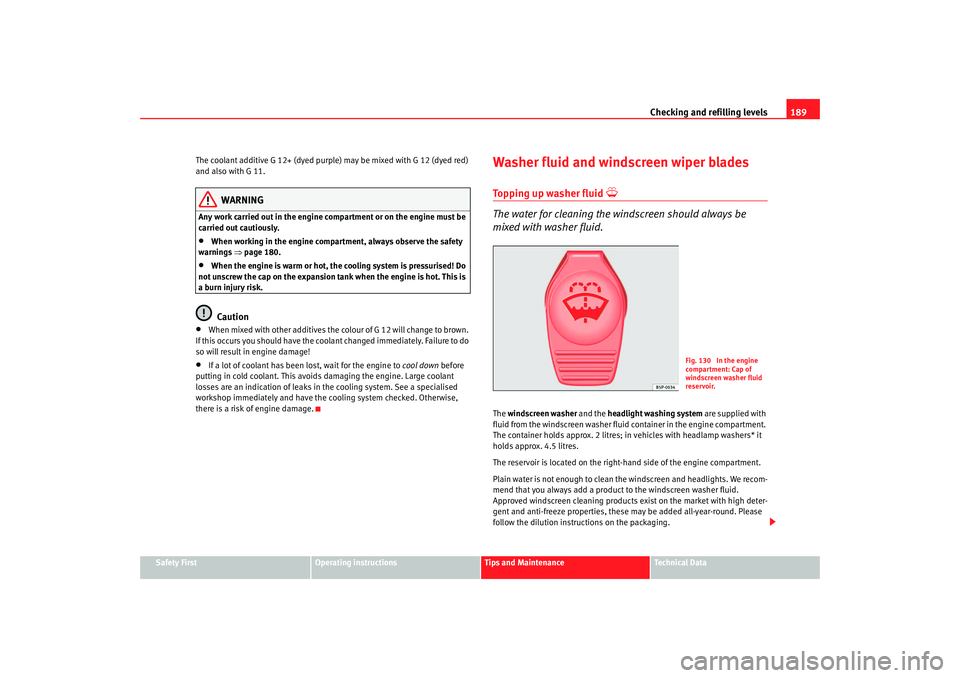
Fig. 130 In the engine
compartment: Cap of
windscreen washer fluid
reservoir.
IBI_ANG_0707 Seite 189 Montag, 6. August 2007 3:59 15
Page 265 of 272
Index263
Coolant . . . . . . . . . . . . . . . . . . . . . . . . . . . 187, 188
Coolant Level . . . . . . . . . . . . . . . . . . . . . . . . . . . 188
Coolant level
warning light . . . . . . . . . . . . . . . . . . . . . . . . . 63
Coolant Loss . . . . . . . . . . . . . . . . . . . . . . . . . . . 188
Coolant temperature Display . . . . . . . . . . . . . . . . . . . . . . . . . . . . . . 53
Safety instructions . . . . . . . . . . . . . . . . . . . . . 64
Correct adjustment of front head restraints . . . . 12
Cruise control system . . . . . . . . . . . . . . . . . . . . 142
Curtain airbags . . . . . . . . . . . . . . . . . . . . . . . . . . 37 Description . . . . . . . . . . . . . . . . . . . . . . . . . . . 37
Function . . . . . . . . . . . . . . . . . . . . . . . . . . . . . 38
Safety notes . . . . . . . . . . . . . . . . . . . . . . . . . . 38DDanger of fitting a child seat on the front passenger seat . . . . . . . . . . . . . . . . . . . . . . . . . . . . . . . 27
Deep Water in Cupra version . . . . . . . . . . . . . . 151
Diesel . . . . . . . . . . . . . . . . . . . . . . . . . . . . . . . . . 179
Diesel engine Winter driving . . . . . . . . . . . . . . . . . . . . . . . . 180
Diesel engine particulate filter* . . . . . . . . . . . . 153
Differential lock . . . . . . . . . . . . . . . . . . . . . . . . . 150
Differential lock fault (EDL) warning lamp . . . . . . . . . . . . . . . . . . . . . . . . . 67
Digital clock . . . . . . . . . . . . . . . . . . . . . . . . . . . . . 54
Dipped headlights . . . . . . . . . . . . . . . . . . . . . . . . 90
Disabling front passenger airbag Safety notes . . . . . . . . . . . . . . . . . . . . . . . . . . 41 Disabling the airbag
Disabling front passenger airbag . . . . . . . . . 40
Displays in the Mult i-function display
Memory displays . . . . . . . . . . . . . . . . . . . . . . 56
Door lock cylinders . . . . . . . . . . . . . . . . . . . . . . 167
Door release lever . . . . . . . . . . . . . . . . . . . . . . . . 51
Doors Childproof locks . . . . . . . . . . . . . . . . . . . . . . . 74
Unlocking and locking . . . . . . . . . . . . . . . . . 70
Drive wheels traction control system . . . . . . . . 148
Driving Driving abroad . . . . . . . . . . . . . . . . . . . . . . . 153
Economically / With Respect for the Environment . . . . . . . . . . . . . . . . . . . . . . . 160
With a trailer . . . . . . . . . . . . . . . . . . . . . . . . . 159
with a trailer . . . . . . . . . . . . . . . . . . . . . . . . . 158
Driving abroad . . . . . . . . . . . . . . . . . . . . . . . . . . 153 Headlights . . . . . . . . . . . . . . . . . . . . . . . . . . 154
Driving economically . . . . . . . . . . . . . . . . . . . . . 160
Driving safety . . . . . . . . . . . . . . . . . . . . . . . . . . . . . 8
Driving with respect for the environment . . . . . 160
Duplicate keys . . . . . . . . . . . . . . . . . . . . . . . . . . . 77
Dust filter . . . . . . . . . . . . . . . . . . . . . . . . . . . . . . 128
Dynamic headlight range control . . . . . . . . . . . . 91
EEDL . . . . . . . . . . . . . . . . . . . . . . . . . . . . . . . . . . . 150
EDS Warning lamp . . . . . . . . . . . . . . . . . . . . . . . . . 64
Electrical sockets . . . . . . . . . . . . . . . . . . . . . . . . 114 Electrohydraulic steering
warning lamp . . . . . . . . . . . . . . . . . . . . . . . . . 62
Electronic differential lock . . . . . . . . . . . . . . . . 150 Warning lamp . . . . . . . . . . . . . . . . . . . . . . . . 64
Electronic immobiliser . . . . . . . . . . . . . . . . 67, 133
Electronic stabilisation program . . . . . . . . . . . 149
Electronic stabilisation programme . . . . . . . . . . 66 Description . . . . . . . . . . . . . . . . . . . . . . . . . . 131
Warning lamp . . . . . . . . . . . . . . . . . . . . . . . 132
Electronic stabilisation programme (ESP) warning lamp . . . . . . . . . . . . . . . . . . . . . . . . . 66
Emission control system warning lamp . . . . . . . . . . . . . . . . . . . . . . . . . 65
Engine Running in . . . . . . . . . . . . . . . . . . . . . . . . . . 151
Engine compartment Working in the engine compartment . . . . . 180
Engine coolant . . . . . . . . . . . . . . . . . . . . . . . . . . 187
Engine fault warning lamp . . . . . . . . . . . . . . . . . . . . . . . . . 63
Engine management Warning lamp . . . . . . . . . . . . . . . . . . . . . . . . 63
Engine oil . . . . . . . . . . . . . . . . . . . . . . . . . . . . . . 183 Changing . . . . . . . . . . . . . . . . . . . . . . . . . . . 186
Checking level . . . . . . . . . . . . . . . . . . . . . . . 185
Oil properties . . . . . . . . . . . . . . . . . . . . . . . . 184
Specifications . . . . . . . . . . . . . . . . . . . . . . . 183
Topping up . . . . . . . . . . . . . . . . . . . . . . . . . . 186
Engine oil dipstick . . . . . . . . . . . . . . . . . . . . . . . 185
Engine oil pressure Warning lamp . . . . . . . . . . . . . . . . . . . . . . . . 67
IBI_ANG_0707 Seite 263 Montag, 6. August 2007 3:59 15