maintenance Seat Ibiza 5D 2007 User Guide
[x] Cancel search | Manufacturer: SEAT, Model Year: 2007, Model line: Ibiza 5D, Model: Seat Ibiza 5D 2007Pages: 272, PDF Size: 8.32 MB
Page 23 of 272
Seat belts21
Safety First
Operating instructions
Tips and Maintenance
Te c h n i c a l D a t a
– Adjust the seat and head restraint correctly.
– To fasten the belt, take hold of the latch plate and pull it slowly
across your chest and lap.
– Insert the latch plate into the buckle for the appropriate seat and push it down until it is securely locked with an audible click
⇒page 20, fig. 11.
– Pull the belt to ensure that the latch plate is securely engaged in the buckle.The seat belts are equipped with an automatic retractor on the shoulder
strap. Full freedom of movement is permitted when the shoulder belt is pulled
slowly. However, during sudden braking, during travel in mountains or bends
and during acceleration, the automati c retractor on the shoulder belt is
locked.
The automatic belt retractors on the front seats are fitted with belt tension
devices ⇒page 24.
WARNING
•
An incorrectly worn seat belt web can cause severe injuries in the event
of an accident.
•
The seat belts offer best protection only when the backrests are in an
upright position and the seat belt s have been fastened properly.
•
Never put the latch plate in the buckle of another seat. If you do this, the
seat belt will not protect you properly and the risk of injury is increased.
•
If an occupant is incorrectly belted in, the belt cannot protect him or her
properly. An incorrectly positioned belt web can cause extremely severe
injuries.
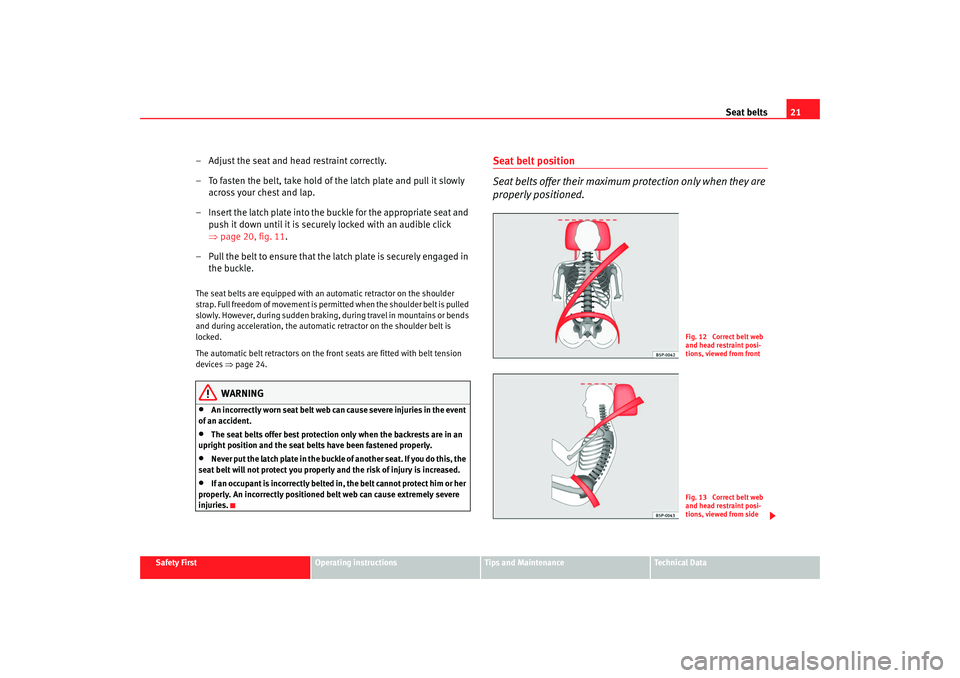
Seat belt position
Seat belts offer their maximum pr otection only when they are
properly positioned.
Fig. 12 Correct belt web
and head restraint posi-
tions, viewed from frontFig. 13 Correct belt web
and head restraint posi-
tions, viewed from side
IBI_ANG_0707 Seite 21 Montag, 6. August 2007 3:59 15
Page 25 of 272
Seat belts23
Safety First
Operating instructions
Tips and Maintenance
Te c h n i c a l D a t a
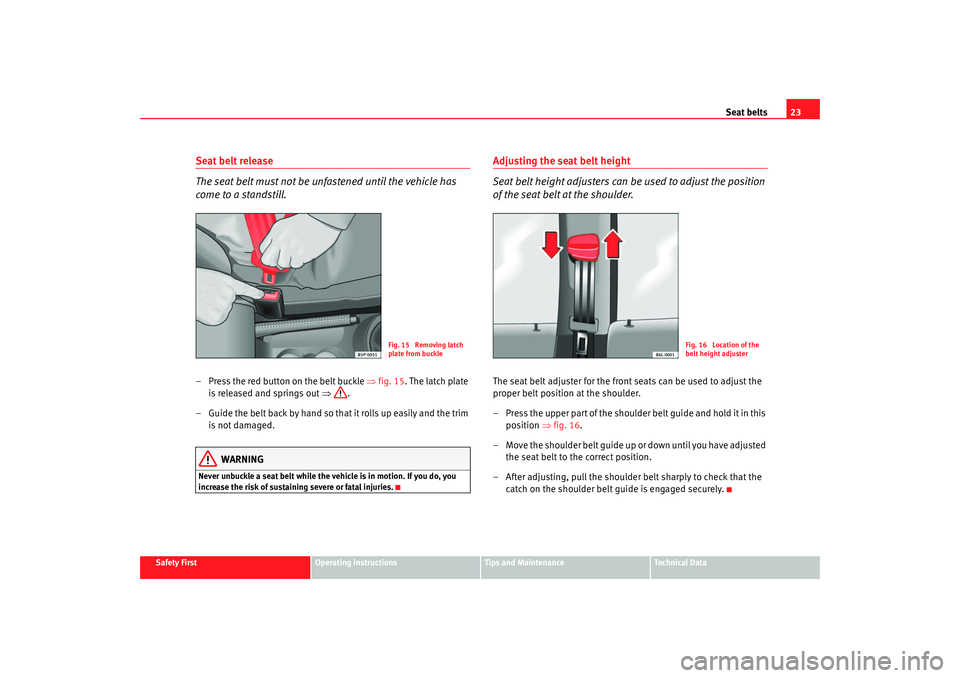
Seat belt release
The seat belt must not be unfastened until the vehicle has
come to a standstill.– Press the red button on the belt buckle ⇒fig. 15. The latch plate
is released and springs out ⇒ .
– Guide the belt back by hand so that it rolls up easily and the trim is not damaged.
WARNING
Never unbuckle a seat belt while the vehicle is in motion. If you do, you
increase the risk of sustaining severe or fatal injuries.
Adjusting the seat belt height
Seat belt height adjusters can be used to adjust the position
of the seat belt at the shoulder.The seat belt adjuster for the front seats can be used to adjust the
proper belt position at the shoulder.
– Press the upper part of the shoulder belt guide and hold it in this position ⇒fig. 16 .
– Move the shoulder belt guide up or down until you have adjusted the seat belt to the correct position.
– After adjusting, pull the shoulder belt sharply to check that the catch on the shoulder belt guide is engaged securely.
Fig. 15 Removing latch
plate from buckle
Fig. 16 Location of the
belt height adjuster
IBI_ANG_0707 Seite 23 Montag, 6. August 2007 3:59 15
Page 27 of 272
Seat belts25
Safety First
Operating instructions
Tips and Maintenance
Te c h n i c a l D a t a
So that the effectiveness of the belt tension device is not reduced and that
removed parts do not cause
any injuries or environmental pollution, regula-
tions, which are known to the qualifi ed workshops, must be observed.
WARNING
•
If repairs are not carried out by a professional, or if the belt tension
devices are used incorrectly, the risk of severe or fatal injuries increases.
The belt tension devices may fail to trigger or may trigger in the wrong
circumstances.
•
Never attempt to repair, adjust, remove or install parts of the belt
tension devices or seat belts.
•
The belt tension device and seat be lt including its automatic retractor
cannot be repaired.
•
Any work on the belt tension devi ces and seat belts, including the
removal and refitting of system parts in conjunction with other repair work,
must be performed by a qualified workshop only.
•
The belt tension devices will only provide protection for one accident
and must be changed it they have been activated.
IBI_ANG_0707 Seite 25 Montag, 6. August 2007 3:59 15
Page 29 of 272
Airbag system27
Safety First
Operating instructions
Tips and Maintenance
Te c h n i c a l D a t a
•
Always properly adjust the front seats.
The danger of fitting a child seat on the front passenger seat
Rear-facing child seats must never be used on the front
passenger seat when the front passenger airbag is enabled.An enabled front airbag on the front passenger side is potentially a major
danger to a child. The front passenger seat is life threatening to a child if you
transport the child in a rear-facing child seat. You should always transport all
children up to 12 years of age on the rear seat.
If a rear-facing child seat is secured to the front passenger seat, an inflating
airbag can strike it with such great force that critical or fatal injuries may
result.
Therefore we urgently recommend that you transport children on the rear
seats. That is the safest place in the vehicle for children. Alternatively, the
front passenger airbag can be disabled with a key-operated switch
⇒page 40. When transporting children, use a child seat appropriate to the
age and size of each child.
For those vehicles that do not include a key lock switch to turn the airbag off,
an Authorised Service Centre must be consulted.
WARNING
•
If a child seat is secured to the front passenger seat, the risk to the child
of sustaining critical or fatal injuries in the event of an accident increases.
•
Never secure a rear-facing child seat to the front passenger seat if the
front passenger airbag is enabled. The child can suffer critical or fatal inju-
ries when the front passenger airbag is triggered.
•
An inflating front passenger airbag can strike the rear-facing child seat
and hurl it with great force against the door, the roof or the backrest.
•
If, under special circumstances, it should be necessary to transport a
child in a rear-facing child seat on the front passenger seat, it is absolutely
essential that you observe the following safety measures:
−Disable the front passenger airbag ⇒page 40, “Deactivating
airbags*”.
− The child seat must be approved by the child seat manufacturer for
use on a front passenger seat with front or side airbag.
− Follow the installation instructio ns of the child seat manufacturer
and absolutely observe all warnings
− Before properly installing the child seat, push the front passenger
seat all the way to the rear so that the greatest possible distance to the
front passenger airbag is ensured.
− Ensure that no objects prevent the front passenger seat from being
pushed completely back.
− The backrest of the front passenger seat must be in an upright
position.
Warning lamp for airbag and belt tension device system
This warning lamp monitors the airbag and belt tension
device system.The warning lamp monitors all airbags and belt tension devices in the
vehicle, including control units and wiring connections.
WARNING (continued)
WARNING (continued)
IBI_ANG_0707 Seite 27 Montag, 6. August 2007 3:59 15
Page 31 of 272
Airbag system29
Safety First
Operating instructions
Tips and Maintenance
Te c h n i c a l D a t a
Front airbagsDescription of front airbags
The airbag system is not a substitute for the seat belts.
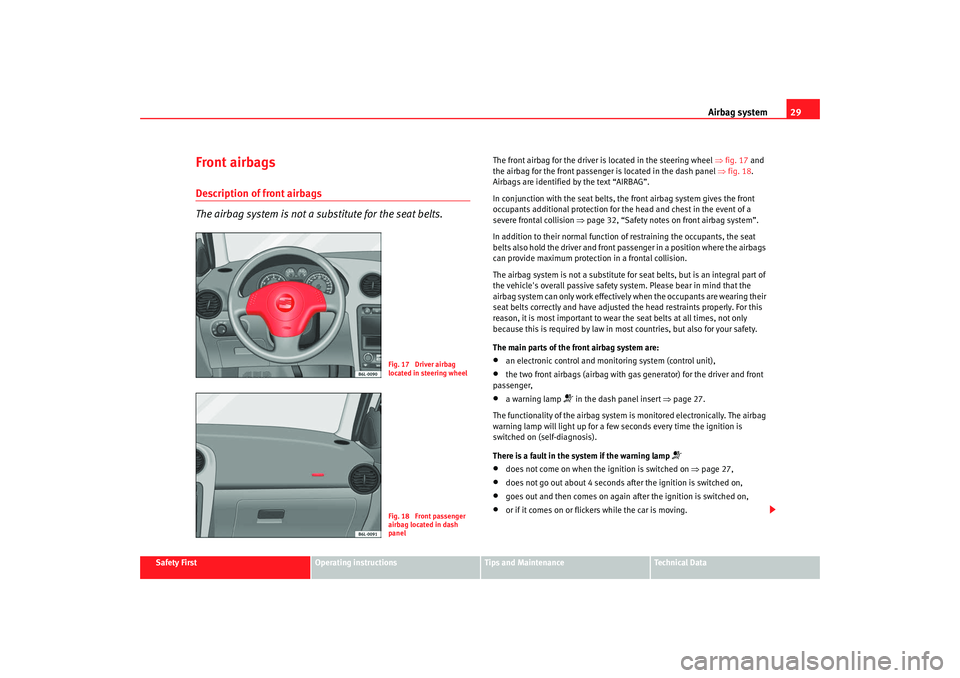
The front airbag for the driver is located in the steering wheel ⇒fig. 17 and
the airbag for the front passenger is located in the dash panel ⇒fig. 18 .
Airbags are identified by the text “AIRBAG”.
In conjunction with the seat belts, the front airbag system gives the front
occupants additional protection for the head and chest in the event of a
severe frontal collision ⇒page 32, “Safety notes on front airbag system”.
In addition to their normal function of restraining the occupants, the seat
belts also hold the driver and front pas senger in a position where the airbags
can provide maximum protection in a frontal collision.
The airbag system is not a substitute for seat belts, but is an integral part of
the vehicle's overall passive safety system. Please bear in mind that the
airbag system can only work effectively when the occupants are wearing their
seat belts correctly and have adjusted the head restraints properly. For this
reason, it is most important to wear the seat belts at all times, not only
because this is required by law in most countries, but also for your safety.
The main parts of the front airbag system are:•
an electronic control and monitoring system (control unit),
•
the two front airbags (airbag with gas generator) for the driver and front
passenger,
•
a warning lamp
in the dash panel insert ⇒page 27.
The functionality of the airbag system is monitored electronically. The airbag
warning lamp will light up for a few seconds every time the ignition is
switched on (self-diagnosis).
There is a fault in the system if the warning lamp
•
does not come on when the ignition is switched on ⇒page 27,
•
does not go out about 4 seconds after the ignition is switched on,
•
goes out and then comes on again after the ignition is switched on,
•
or if it comes on or flickers while the car is moving.
Fig. 17 Driver airbag
located in steering wheelFig. 18 Front passenger
airbag located in dash
panel
IBI_ANG_0707 Seite 29 Montag, 6. August 2007 3:59 15
Page 33 of 272
Airbag system31
Safety First
Operating instructions
Tips and Maintenance
Te c h n i c a l D a t a
In order to provide the desired extra protection in an accident, the airbags
have to deploy extremely rapidly (within
fractions of a second). A fine dust may develop when the airbag deploys. Th
is is normal and is no indication
that there was a fire in the vehicle.
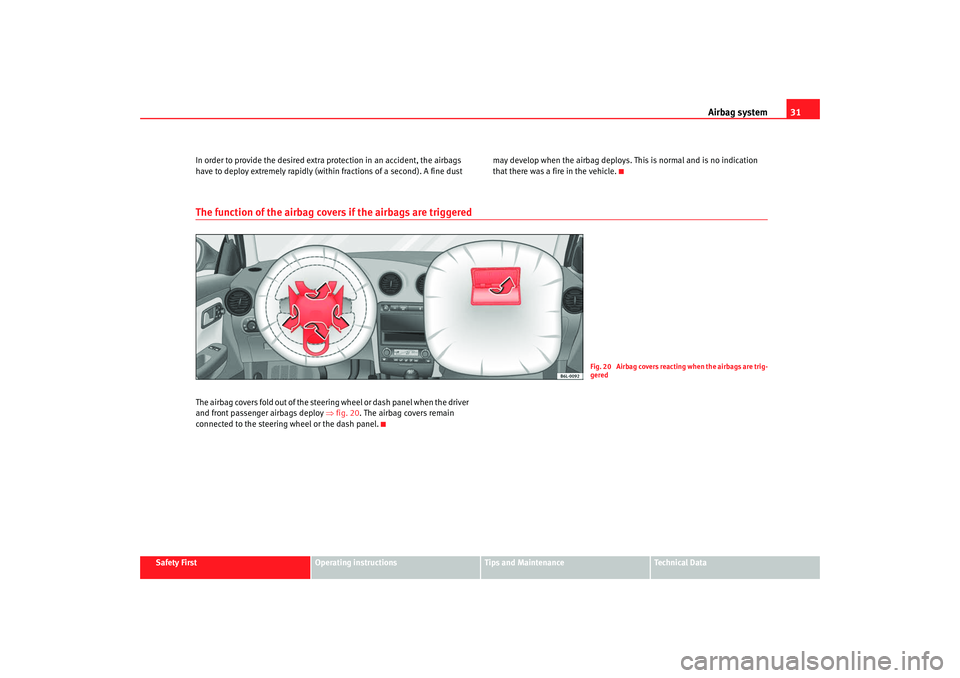
The function of the airbag covers if the airbags are triggeredThe airbag covers fold out of the steering wheel or dash panel when the driver
and front passenger airbags deploy ⇒fig. 20 . The airbag covers remain
connected to the steering wheel or the dash panel.
Fig. 20 Airbag covers reacting when the airbags are trig-
gered
IBI_ANG_0707 Seite 31 Montag, 6. August 2007 3:59 15
Page 35 of 272
Airbag system33
Safety First
Operating instructions
Tips and Maintenance
Te c h n i c a l D a t a
Side airbagsDescription of side airbags
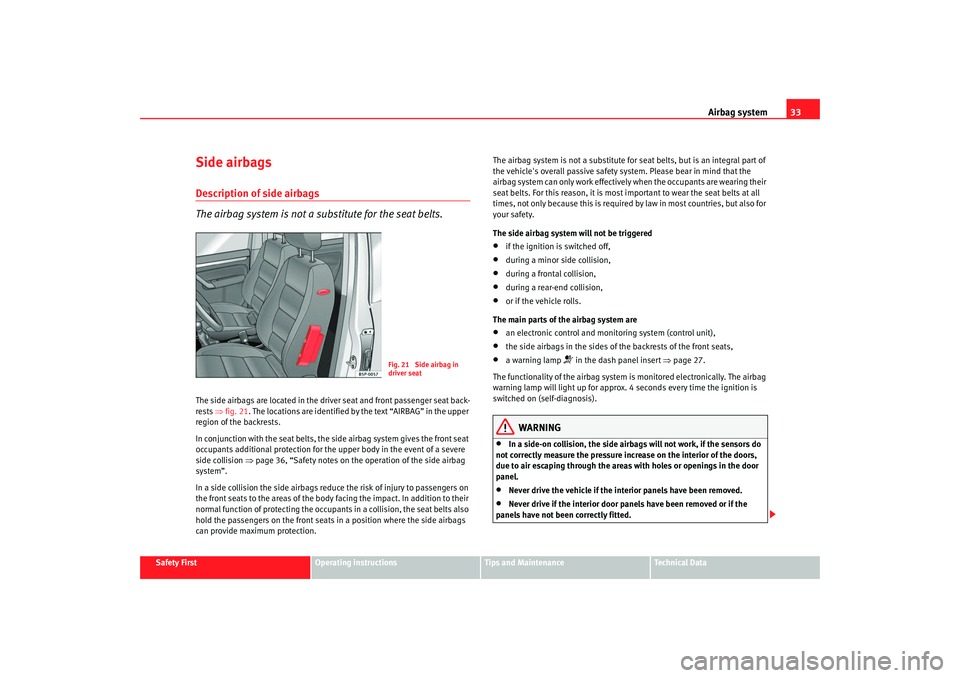
The airbag system is not a substitute for the seat belts.The side airbags are located in the driver seat and front passenger seat back-
rests ⇒fig. 21. The locations are identified by the text “AIRBAG” in the upper
region of the backrests.
In conjunction with the seat belts, the side airbag system gives the front seat
occupants additional protection for the upper body in the event of a severe
side collision ⇒ page 36, “Safety notes on the operation of the side airbag
system”.
In a side collision the side airbags reduce the risk of injury to passengers on
the front seats to the areas of the body facing the impact. In addition to their
normal function of protecting the occupants in a collision, the seat belts also
hold the passengers on the front seats in a position where the side airbags
can provide maximum protection. The airbag system is not a substitute for seat belts, but is an integral part of
the vehicle's overall passive safety system. Please bear in mind that the
airbag system can only work effectively when the occupants are wearing their
seat belts. For this reason, it is most important to wear the seat belts at all
times, not only because this is required
by law in most countries, but also for
your safety.
The side airbag system will not be triggered
•
if the ignition is switched off,
•
during a minor side collision,
•
during a frontal collision,
•
during a rear-end collision,
•
or if the vehicle rolls.
The main parts of the airbag system are
•
an electronic control and monitoring system (control unit),
•
the side airbags in the sides of the backrests of the front seats,
•
a warning lamp
in the dash panel insert ⇒page 27.
The functionality of the airbag system is monitored electronically. The airbag
warning lamp will light up for approx. 4 seconds every time the ignition is
switched on (self-diagnosis).
WARNING
•
In a side-on collision, the side airbags will not work, if the sensors do
not correctly measure the pressure incr ease on the interior of the doors,
due to air escaping through the areas with holes or openings in the door
panel.
•
Never drive the vehicle if the interior panels have been removed.
•
Never drive if the interior door pane ls have been removed or if the
panels have not been correctly fitted.
Fig. 21 Side airbag in
driver seat
IBI_ANG_0707 Seite 33 Montag, 6. August 2007 3:59 15
Page 37 of 272
Airbag system35
Safety First
Operating instructions
Tips and Maintenance
Te c h n i c a l D a t a
The special design of the airbag allows the controlled escape of the propel-
lant gas when an occupant puts pressure on the bag. Thus, the head and
chest are surrounded and protected by the airbag.
IBI_ANG_0707 Seite 35 Montag, 6. August 2007 3:59 15
Page 39 of 272
Airbag system37
Safety First
Operating instructions
Tips and Maintenance
Te c h n i c a l D a t a
Curtain airbagsDescription of curtain airbags
The airbag system is not a substitute for the seat belts.The curtain airbags are located on both sides in the interior above the doors
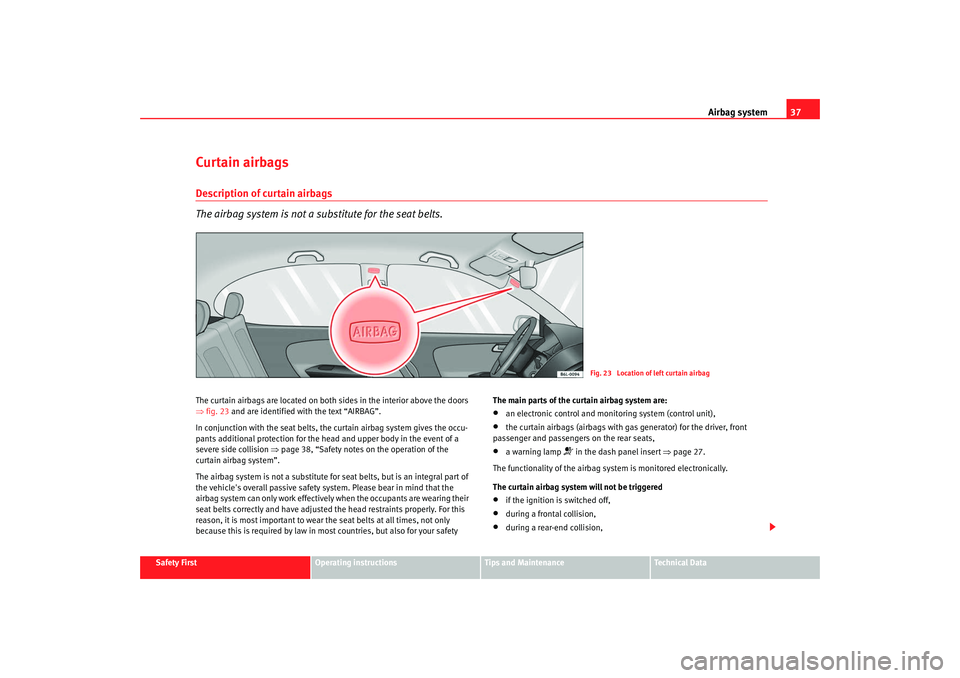
⇒fig. 23 and are identified with the text “AIRBAG”.
In conjunction with the seat belts, th e curtain airbag system gives the occu-
pants additional protection for the head and upper body in the event of a
severe side collision ⇒ page 38, “Safety notes on the operation of the
curtain airbag system”.
The airbag system is not a substitute for seat belts, but is an integral part of
the vehicle's overall passive safety system. Please bear in mind that the
airbag system can only work effectively when the occupants are wearing their
seat belts correctly and have adjusted the head restraints properly. For this
reason, it is most important to wear the seat belts at all times, not only
because this is required by law in most countries, but also for your safety The main parts of the curtain airbag system are:
•
an electronic control and monitoring system (control unit),
•
the curtain airbags (airbags with gas generator) for the driver, front
passenger and passengers on the rear seats,
•
a warning lamp
in the dash panel insert ⇒page 27.
The functionality of the airbag system is monitored electronically.
The curtain airbag system will not be triggered
•
if the ignition is switched off,
•
during a frontal collision,
•
during a rear-end collision,
Fig. 23 Location of left curtain airbag
IBI_ANG_0707 Seite 37 Montag, 6. August 2007 3:59 15
Page 41 of 272
Airbag system39
Safety First
Operating instructions
Tips and Maintenance
Te c h n i c a l D a t a
greatest possible protection. Therefore, sun blinds which have not been
expressly approved for use in your vehicle may not be attached to the side
windows.
•
The built-in coat hooks should be used only for lightweight clothing. Do
not leave any heavy or sharp-edged obje cts in the pockets. When using the
coat hooks, do not hang th e clothes on coat hangers.
•
The airbags provide protection for one accident only, if they have been
deployed they must be replaced.
•
Any work on the curtain airbag system or removal and installation of
the airbag components for other repairs (such as removal of the roof lining)
should only be performed by a qualified workshop. Otherwise, a fault may
be introduced into the operation of the airbag system.
•
Do not attempt to modify components of the airbag system in any way.
•
The side and head airbags are managed through sensors located in the
interior of the front doors. To ensure the correct functioning of the side and
head airbags neither the doors nor the door panels should be modified in
any way (e.g. fitting loudspeakers). If the front door is damaged in any way,
this may affect the correct working of the system. All work carried out on
the front door must be made in a qualified workshop.WARNING (continued)
IBI_ANG_0707 Seite 39 Montag, 6. August 2007 3:59 15