heating Seat Ibiza 5D 2007 Owner's Guide
[x] Cancel search | Manufacturer: SEAT, Model Year: 2007, Model line: Ibiza 5D, Model: Seat Ibiza 5D 2007Pages: 272, PDF Size: 8.32 MB
Page 162 of 272
Driving and the environment
160Speed
The stability of the vehicle and trailer is reduced with increasing speed. For
this reason it is advisable not to drive at the maximum permissible speed in
unfavourable road, weather or wind conditions. This applies especially when
driving downhill.
You should always reduce speed immediately if the trailer shows the slightest
sign of snaking . Never try to stop the “snaking” by increasing speed.
Always brake in good time. If the trailer has an overrun brake, apply the
brakes gently at first and then firmly. This will pr event the jerking that can be
caused by the trailer wheels locking. Select a low gear in good time before
going down a steep descent. This enables you to use the engine braking to
slow down the vehicle.
Heating
At very high temperatures and during prolonged ascents, driving in a low gear
and high engine speed, always monitor the temperature indicator for the
coolant ⇒page 51.
Electronic Stabilisation Program*
Do not switch off the ESP* when towing a trailer. The ESP* makes it easier to
stabilise if the trailer starts to snake.Driving economically and with respect for the
environmentGeneral ObservationsFuel consumption, environmental pollution and wear to the engine, brakes
and tyres depends in large part on your driving style. Fuel consumption may
be reduced from 10 to 15 % by driving defensively and economically. Below we will give you some suggestions to "alleviate" some of the strain in the
environment and, at the same time, your wallet.
Anticipate the traffic situation well in advance
A vehicle uses most fuel when accele
rating. When you anticipate the situa-
tion, you will have to brake less often and, thus, accelerate less. If it is
possible, let the vehicle roll with a gear engaged, for example, if you see a red
light ahead.
Change gear early to save energy
An effective way of saving fuel is to change up through the gears quickly.
Running the engine at high rpm in the lower gears uses an unnecessary
amount of fuel.
Manual gearbox: Change from first to second gear as quickly as possible. We
recommend that, whenever possible, you change to a higher gear upon
reaching 2,000 rpms.
Automatic gearbox: Accelerate slowly and avoid the “kick-down” position.
Avoid driving at high speed
We advise you not to drive at the top speed permitted by the vehicle. Fuel
consumption, exhaust emissions and noise levels all increase very rapidly at
higher speeds. Driving at moderate speeds will help to save fuel.
Avoid idling
It is worthwhile switching off the engine when waiting in a traffic jam, at level
crossings or at traffic lights with a long red phase. The fuel saved after only
30 - 40 seconds is greater than the amount of fuel needed to restart the
engine.
The engine takes a very long time to warm up when it is running at idling
speed. Mechanical wear and pollutant emissions are also especially high
during this initial warm-up phase. It is therefore best to drive off immediately
after starting the engine . Avoid running the engine at high speed.
IBI_ANG_0707 Seite 160 Montag, 6. August 2007 3:59 15
Page 163 of 272
Driving and the environment161
Safety First
Operating instructions
Tips and Maintenance
Te c h n i c a l D a t a
Periodic maintenance
Periodic maintenance work guarantees
that, before beginning a journey, you
will not waste fuel. A well-serviced engine gives you the benefit of improved
fuel efficiency as well as maximum reliability and an enhanced resale value.
A maladjusted engine may mean an increase of 10 % over normal fuel
consumption.
Check the oil level every time you fill the tank. Oil consumption depends to a
great extent on the engine load and engine speed. It is quite normal that the
oil consumption of a new engine only reaches its lowest level after a certain
mileage. This means that the oil consumption can only be properly assessed
after about 5,000 km. Depending on your personal driving style, oil consump-
tion can be up to 0.5 litres per 1,000 km.
Avoid short journeys
To reduce the consumption and emission of polluting gases, the engine and
the exhaust filtration systems should reach the optimum service tempera-
ture .
With the engine cold, fuel consumption is proportionally higher. The engine
does not warm up and fuel consumption does not regularise until having
driven some four kilometres. This is the reason why we recommend avoiding
short trips wherever possible.
Maintain the correct tyre pressures
Bear in mind that keeping the tyres at an adequate pressure saves fuel. If the
tyre pressures are just 1 bar too low, this can put the fuel consumption up by
as much as 5 %. Due to the greater rolling resistance, under-inflation also
increases tyre wear and impairs handling.
The tyre pressures should always be checked when the tyres are cold.
Do not use winter tyres all through the year: they will increase fuel consump-
tion by up to 10 %. Avoid unnecessary weight
Every kilo of
extra weight will put up the fuel consumption, so it is worth
checking the luggage compartment occasionally to make sure that no unnec-
essary loads are being transported.
Save electrical energy
The engine activates the alternator, whic h produces electricity. With the need
for electricity, fuel consumption is also increased. Because of this, always
turn off electrical equipme nt when you do not need them. Examples of equip-
ment that use a lot of electricity are: the fan at high speeds, the rear window
heating or the seat heaters*.
Logbook
A good way of keeping a check on fuel consumption is to take regular notes.
You will be able to note the variations (both positive and negative) and react
accordingly.
Environmental friendlinessEnvironmental protection is a top priori ty in the design, choice of materials
and production of your new Seat.
Design measures for economical recycling•
Joints and connections designed for ease of dismantling
•
Modular construction to facilitate dismantling
•
Increased use of single-grade materials
•
Plastic parts and elastomers are labelled in accordance with ISO 1043,
ISO 11469 and ISO 1629
Choice of materials
•
Nearly all materials used can be recycled
•
Similar types of plastics grouped together for easy recycling
IBI_ANG_0707 Seite 161 Montag, 6. August 2007 3:59 15
Page 169 of 272
Cleaning and caring for your vehicle167
Safety First
Operating instructions
Tips and Maintenance
Te c h n i c a l D a t a
If possible use a de-icing spray to remove ice. If you use an ice scraper, push
it in one direction only. Do not move it to and fro.
Use window cleaner or a silicone remover to clean off rubber, oil, grease and
silicone deposits.
Wax deposits have to be removed with a special cleaner which is available
from your Authorised Service Centre. Wax deposits on the windscreen could
cause the wiper blades to judder. A window cleanser specifically for removing
wax will stop the blades juddering if added to the windscreen washer fluid.
Grease removing cleansers will not remove wax deposits.
Caution
•
Never use warm or hot water to remove snow and ice from windows and
mirrors. This could cause the glass to crack!
•
The heating element for the rear window is located on the inner side of the
window. To prevent damage, do not put stickers over the heating elements on
the inside of the window.
Cleaning windscreen wiper bladesClean wiper blades are essential for clear vision.
1. Use a soft cloth to remove dust and dirt from the windscreen wiper blades.
2. Use window cleanser to clean the windscreen wiper blades. Use a sponge or a cloth to remove stubborn stains.
Care of rubber seals
If rubber seals are well looked after, they will not freeze so
quickly.1. Use a soft cloth to remove dust and dirt from the rubber seals.
2. Apply a specialist care product to the rubber seals.The weather strips on the doors, windows, bonnet and rear lid will remain
pliable and last longer if they are treated with a suitable care product (for
example silicone spray).
Caring for rubber seals will also prevent premature ageing and leaks. The
doors will be easier to open. If rubber seals are well looked after, they will not
freeze so quickly in winter.Door lock cylinders
The door lock cylinders can freeze up in winter.To de-ice the lock cylinders you should only use spray with lubricating and
anti-corrosive properties.Cleaning chrome parts1. Clean chrome parts with a damp cloth.
2. Polish chrome parts with a soft, dry cloth.
IBI_ANG_0707 Seite 167 Montag, 6. August 2007 3:59 15
Page 181 of 272
Checking and refilling levels179
Safety First
Operating instructions
Tips and Maintenance
Te c h n i c a l D a t a
Petrol additives
Petrol additives improve the quality of the petrol.The quality of the petrol influences running behaviour, performance and
service life of the engine. For this reason you should use good quality petrol
containing additives. These additives will help to prevent corrosion, keep the
fuel system clean and prevent deposits from building up in the engine.
If good quality petrol with additives is not available or engine problems occur,
the required additives must be added during refuelling.DieselDiesel*Diesel fuel must correspond to DIN EN 590 (EN = “European standard”). It
must have a cetane number (CN) of at least 51. The cetane number indicates
the ignition quality of the diesel fuel.
Notes on filling with fuel ⇒page 177.RME fuel*
Only those vehicles fitted with special equipment (number PR
2G0 for biodiesel use) may use biodiesel corresponding to
the standard DIN EN 14214.The biodiesel fuel must comply wit h the DIN EN 14.214 (FAME) Standard.•
Biodiesel is a methylester obtained from rapeseed oil.
•
DIN is a German abbreviation for “Deutsches Institut für Normung e.V.”,
the German standards institute.
•
EN means European Norm.
•
FAME is the English abbreviation for “ Fatty Acid Methyl Ester”
If the date sticker of the vehicle in cludes the number PR 2G0 optional equip-
ment) this means that that vehicle has been prepared for biodiesel use.
Your Authorised Service Centre or automobile association will be able to
advise on where you can obtain RME biodiesel fuel.
Your Authorised Service Centre can also be consulted to know if the vehicle
has been prepared for biodiesel use.
Things to note about RME fuel (biodiesel)
•
The performance of a vehicle using biodiesel maybe somewhat reduced.
•
Fuel consumption of a vehicle using biodiesel may be slightly higher.
•
RME fuel can be used in winter at temperatures down to approx. -10°C.
•
At outside temperatures below -10° C, we recommend using winter diesel
fuel.Caution
•
RME fuel can damage the fuel system in vehicles which are not suitably
adjusted.
•
If you decide to use biodiesel in your vehicle, please use only RME fuel
which is DIN E 14,214 compliant.
•
If you use biodiesel that does not me et the required standard, the fuel
filter could become clogged.Note
•
In case of low exterior temperatures and a fuel biodiesel percentage of
higher than 50%, an increase in gas emission may occur during operation of
the independent heating.
IBI_ANG_0707 Seite 179 Montag, 6. August 2007 3:59 15
Page 217 of 272
If and when215
Safety First
Operating instructions
Tips and Maintenance
Te c h n i c a l D a t a
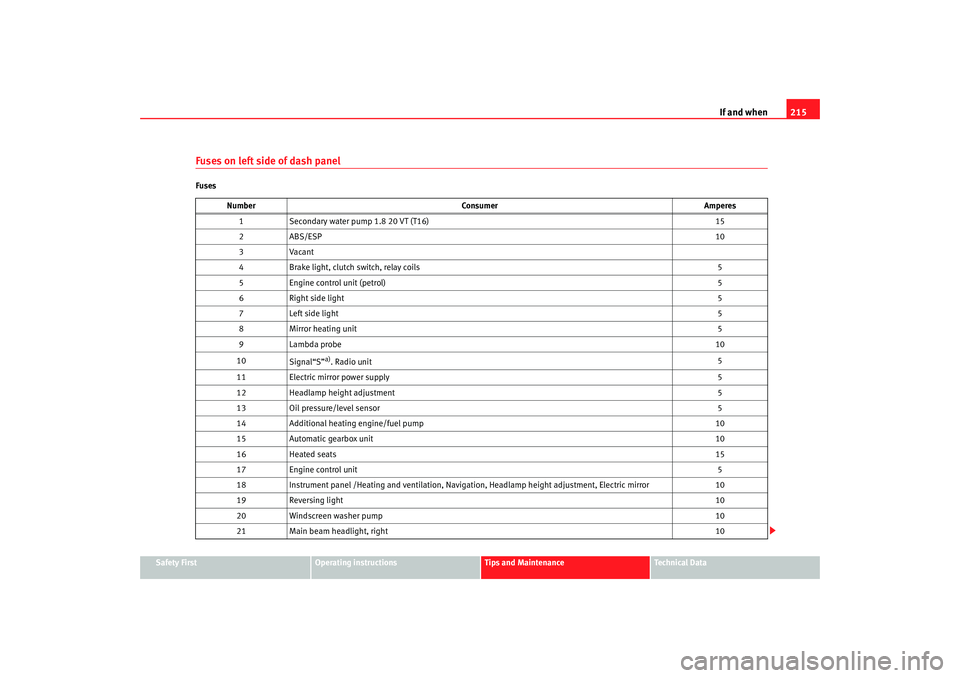
Fuses on left side of dash panelFuses
Number Consumer Amperes
1 Secondary water pump 1.8 20 VT (T16) 15
2A BS/E S P 10
3 Vacant
4 Brake light, clutch switch, relay coils 5
5 Engine control unit (petrol) 5
6 Right side light 5
7 Left side light 5
8 Mirror heating unit 5
9 Lambda probe 10
10 Signal“S”
a). Radio unit 5
11 Electric mirror power supply 5
12 Headlamp height adjustment 5
13 Oil pressure/level sensor 5
14 Additional heating engine/fuel pump 10
15 Automatic gearbox unit 10
16 Heated seats 15
17 Engine control unit 5
18 Instrument panel /Heating and ventilation, Navigation, Headlamp height adjustment, Electric mirror 10
19 Reversing light 10
20 Windscreen washer pump 10
21 Main beam headlight, right 10
IBI_ANG_0707 Seite 215 Montag, 6. August 2007 3:59 15
Page 218 of 272
If and when
216
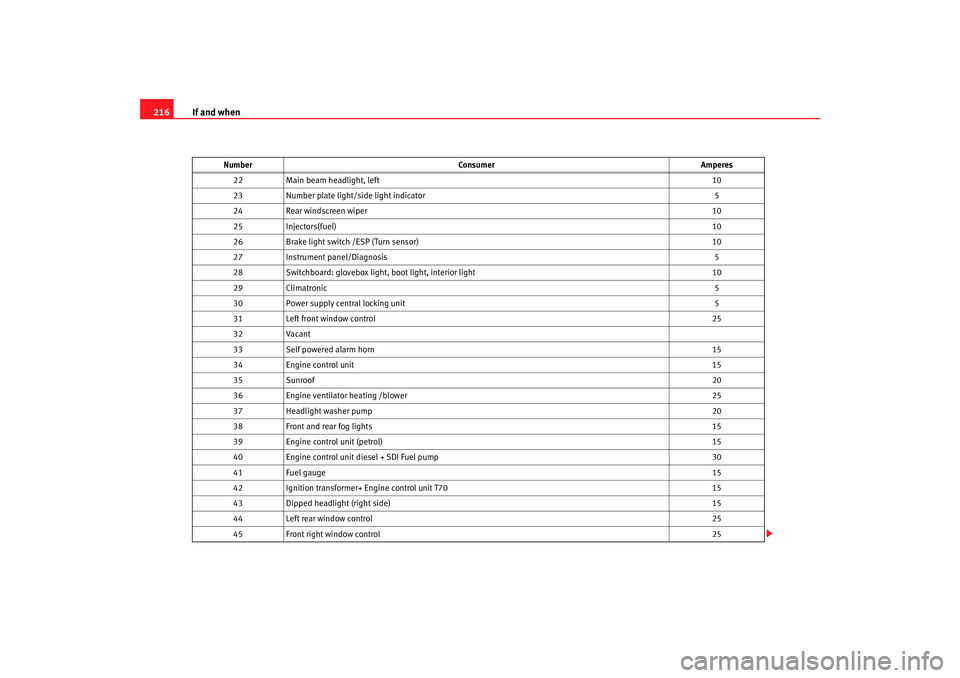
22 Main beam headlight, left 10
23 Number plate light/si de light indicator 5
24 Rear windscreen wiper 10
25 Injectors(fuel) 10
26 Brake light switch /ESP (Turn sensor) 10
27 Instrument panel/Diagnosis 5
28 Switchboard: glovebox light, boot light, interior light 10
29 Climatronic 5
30 Power supply central locking unit 5
31 Left front window control 25
32 Vacant
33 Self powered alarm horn 15
34 Engine control unit 15
35 Sunroof 20
36 Engine ventilator heating /blower 25
37 Headlight washer pump 20
38 Front and rear fog lights 15
39 Engine control unit (petrol) 15
40 Engine control unit diesel + SDI Fuel pump 30
41 Fuel gauge 15
42 Ignition transformer+ Engine control unit T70 15
43 Dipped headlight (right side) 15
44 Left rear window control 25
45 Front right window control 25
Number
Consumer Amperes
IBI_ANG_0707 Seite 216 Montag, 6. August 2007 3:59 15
Page 219 of 272

If and when217
Safety First
Operating instructions
Tips and Maintenance
Te c h n i c a l D a t a
Fuses below steering wheel in relay holderPTC fuses46
Windscreen wiper unit 20
47 Heated rear window unit 20
48 Indicator unit 15
49 Cigarette lighter 15
50 Locking unit 15
51 Radio/CD/GPS/Telephone 20
52 Horn 20
53 Dipped headlight (left side) 15
54 Right rear window control 25a)The signal “S”is a system which includes the starter and steering lock and enables, after the ignition is switched off and with out removing the key from the steering and starter lock,
certain electrical components to be switched on, including for example, the radio, the courtesy light, etc. This function is de activated on removing the key from the steering and starter
lock.
Number Consumer Amperes
1 PTCs (Supplementary electrical heating using air) 40
2 PTCs (Supplementary electrical heating using air) 40
3 PTCs (Supplementary electrical heating using air) 40
Number
Consumer Amperes
IBI_ANG_0707 Seite 217 Montag, 6. August 2007 3:59 15
Page 220 of 272
If and when
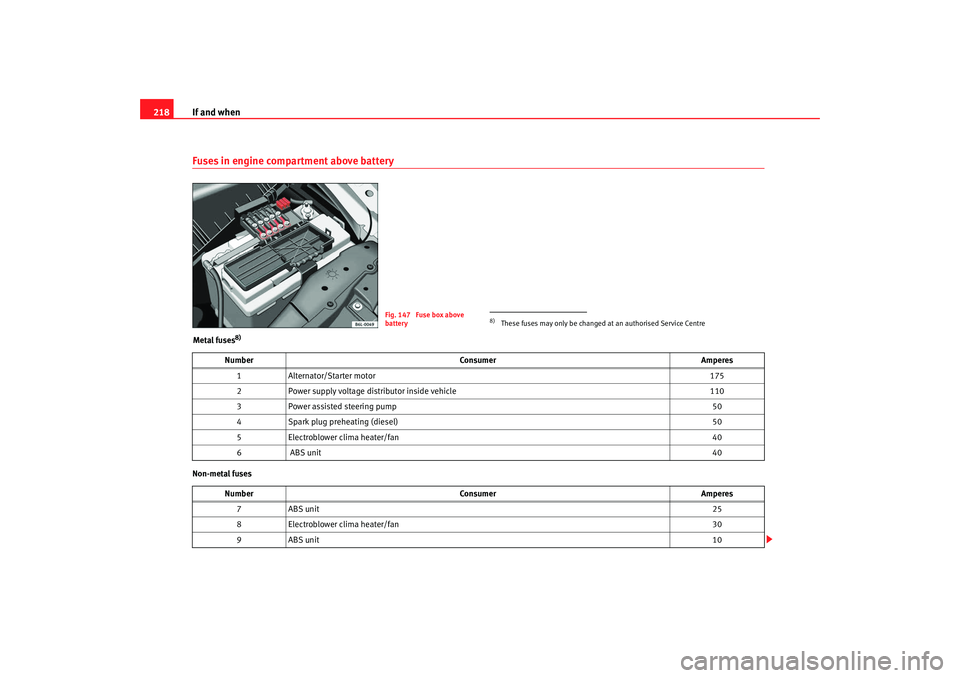
218Fuses in engine compartment above batteryMetal fuses
8)
Non-metal fuses
Fig. 147 Fuse box above
battery
8)These fuses may only be changed at an authorised Service Centre
Number Consumer Amperes
1 Alternator/Starter motor 175
2 Power supply voltage distributor inside vehicle 110
3 Power assisted steering pump 50
4 Spark plug preheating (diesel) 50
5 Electroblower clima heater/fan 40
6 A BS u nit 40
Number Consumer Amperes
7A BS u nit 25
8 Electroblower clima heater/fan 30
9A BS u nit 10
IBI_ANG_0707 Seite 218 Montag, 6. August 2007 3:59 15
Page 266 of 272
Index
264Environment . . . . . . . . . . . . . . . . . . . . . . . . . . . 160
Environmental friendliness . . . . . . . . . . . . 161
Environmental tip Avoiding pollution . . . . . . . . . . . . . . . . . . . . 178
ESP . . . . . . . . . . . . . . . . . . . . . . . . . . . . . . . . 66, 149
Exhaust gasses purification system . . . . . . . . 152
Exterior mirrors . . . . . . . . . . . . . . . . . . . . . . . . . 166
External aerial . . . . . . . . . . . . . . . . . . . . . . . . . . 173FFloor mats . . . . . . . . . . . . . . . . . . . . . . . . . . . . . . 14
Fog lights . . . . . . . . . . . . . . . . . . . . . . . . . . . . . . . 90
Front airbags . . . . . . . . . . . . . . . . . . . . . . . . . . . . 29 Description . . . . . . . . . . . . . . . . . . . . . . . . . . 29
Function . . . . . . . . . . . . . . . . . . . . . . . . . . . . . 30
Safety notes . . . . . . . . . . . . . . . . . . . . . . . . . . 32
Front ashtray . . . . . . . . . . . . . . . . . . . . . . . . . . . 113
Front cup holder* . . . . . . . . . . . . . . . . . . . . . . . 112
Front interior light . . . . . . . . . . . . . . . . . . . . . . . . 95
Front passenger airbag deactivation . . . . . . . . . 40
Front reading light . . . . . . . . . . . . . . . . . . . . . . . . 95
Front seat adjustment Lumbar support . . . . . . . . . . . . . . . . . . . . . . 107
Fuel Diesel . . . . . . . . . . . . . . . . . . . . . . . . . . . . . . 179
Petrol . . . . . . . . . . . . . . . . . . . . . . . . . . . . . . 178
Fuel level Indicator . . . . . . . . . . . . . . . . . . . . . . . . . . . . . 54
Fuel reserve . . . . . . . . . . . . . . . . . . . . . . . . . . . . . 64 Fuel Tank
Opening the fuel tank flap . . . . . . . . . . . . . 177
Fuel tank See Fuel reserve . . . . . . . . . . . . . . . . . . . . . . 64
Fuel: save . . . . . . . . . . . . . . . . . . . . . . . . . . . . . . 160
Fuses . . . . . . . . . . . . . . . . . . . . . . . . . . . . . . . . . 213
GG 12 . . . . . . . . . . . . . . . . . . . . . . . . . . . . . . . . . . 187
Gear shift pattern . . . . . . . . . . . . . . . . . . . . . . . 136
General overview of the engine compartment 242
Glove compartment . . . . . . . . . . . . . . . . . . . . . . 110
Glow plug system . . . . . . . . . . . . . . . . . . . . . . . 135 warning lamp . . . . . . . . . . . . . . . . . . . . . . . . . 63HHandbrake . . . . . . . . . . . . . . . . . . . . . . . . . . . . . 141Warning lamp . . . . . . . . . . . . . . . . . . . . 65, 141
Hazard warning lights . . . . . . . . . . . . . . . . . . . . . 92
head restraints Adjusting . . . . . . . . . . . . . . . . . . . . . . . 105, 106
adjustment of the head restraint angle . . . 106
Removing . . . . . . . . . . . . . . . . . . . . . . . . . . . 106
Headlight flasher . . . . . . . . . . . . . . . . . . . . . . . . 94
Headlight range control . . . . . . . . . . . . . . . . . . . 91
Headlights . . . . . . . . . . . . . . . . . . . . . . . . . . . . . . 90 Driving abroad . . . . . . . . . . . . . . . . . . . . . . . 154
Fog lights . . . . . . . . . . . . . . . . . . . . . . . . . . . . 90
Washer system . . . . . . . . . . . . . . . . . . . . . . 100 Heated front seats . . . . . . . . . . . . . . . . . . . . . . 108
Heating and ventilation . . . . . . . . . . . . . . . . . . 119
Heating system . . . . . . . . . . . . . . . . . . . . . . . . . 120
High pressure cleaners . . . . . . . . . . . . . . . . . . . 165
Horn . . . . . . . . . . . . . . . . . . . . . . . . . . . . . . . . . . . 51
How to jump start description . . . . . . . . . . . . . 231
IIdentification number . . . . . . . . . . . . . . . . . . . . 238
Ignition key . . . . . . . . . . . . . . . . . . . . . . . . . . . . 132
Ignition lock . . . . . . . . . . . . . . . . . . . . . . . . . . . . 132
Indicator lights
indication lamp . . . . . . . . . . . . . . . . . . . . . . . 63
Instrument and switch lighting . . . . . . . . . . . . . 91
Instrument lighting . . . . . . . . . . . . . . . . . . . . . . . 51
Instrument panel . . . . . . . . . . . . . . . . . . . . . . . . . 51
Instruments . . . . . . . . . . . . . . . . . . . . . . . . . . . . . 52
Intermittent wipe, windscreen . . . . . . . . . . . . . . 97
ISOFIX and Toptether system . . . . . . . . . . . . . . . 48JJump leads . . . . . . . . . . . . . . . . . . . . . . . . . . . . . 230
Jump-starting . . . . . . . . . . . . . . . . . . . . . . . . . . . 230KKey tab . . . . . . . . . . . . . . . . . . . . . . . . . . . . . . . . . 76
Keys . . . . . . . . . . . . . . . . . . . . . . . . . . . . . . . . . . . 76
IBI_ANG_0707 Seite 264 Montag, 6. August 2007 3:59 15
Page 267 of 272
Index265
LLights . . . . . . . . . . . . . . . . . . . . . . . . . . . . . . . . . . 90
Load compartment
See Luggage compartment . . . . . . . . . . . . . . 15
Locks . . . . . . . . . . . . . . . . . . . . . . . . . . . . . . . . . 167
Luggage compartment . . . . . . . . . . . . . . . 15, 116 See also Luggage compartment . . . . . . . . . . 15
Luggage compartment cover . . . . . . . . . . . . . . 117MMain beam . . . . . . . . . . . . . . . . . . . . . . . . . . . . . . 94
Main beam headlights Indicator lamp . . . . . . . . . . . . . . . . . . . . . . . . 64
Main headlight lamps . . . . . . . . . . . . . . . . . . . . 220
Manual gearbox . . . . . . . . . . . . . . . . . . . . . . . . . 136
Manual heating . . . . . . . . . . . . . . . . . . . . . . . . . 120 controls . . . . . . . . . . . . . . . . . . . . . . . . . . . . 119
Manual heating system Defrosting the windscreen . . . . . . . . . . . . . 120
Demisting the windscreen and side windows . .120
MFD . . . . . . . . . . . . . . . . . . . . . . . . . . . . . . . . . . . . 55
Mileage display . . . . . . . . . . . . . . . . . . . . . . . . . . 58
Mirrors courtesy mirror . . . . . . . . . . . . . . . . . . . . . . . . 96
Interior mirror . . . . . . . . . . . . . . . . . . . . . . . . 101
Wing mirrors . . . . . . . . . . . . . . . . . . . . . . . . . 102
Mobile phone . . . . . . . . . . . . . . . . . . . . . . . . . . . 173
Modifications . . . . . . . . . . . . . . . . . . . . . . . . . . . 172 Multi-function display . . . . . . . . . . . . . . . . . . . . . 55
NNumber of seats . . . . . . . . . . . . . . . . . . . . . . . . . 16OObservations . . . . . . . . . . . . . . . . . . . . . . . . . . . 153
Octane number . . . . . . . . . . . . . . . . . . . . . . . . . 178
Oil . . . . . . . . . . . . . . . . . . . . . . . . . . . . . . . . . . . . 183
Oil change . . . . . . . . . . . . . . . . . . . . . . . . . . . . . 186
Oil properties . . . . . . . . . . . . . . . . . . . . . . . . . . . 184
One-touch opening and closing
Electric windows . . . . . . . . . . . . . . . . . . . . . . 85
Opening and locking . . . . . . . . . . . . . . . . . . . . . . 83
Overview Control lamps . . . . . . . . . . . . . . . . . . . . . . . . . 60
Instrument panel . . . . . . . . . . . . . . . . . . . . . . 51
Instruments . . . . . . . . . . . . . . . . . . . . . . . . . . 52
Warning lamps . . . . . . . . . . . . . . . . . . . . . . . . 60PPaintworkPolishing . . . . . . . . . . . . . . . . . . . . . . . . . . . 166
Waxing . . . . . . . . . . . . . . . . . . . . . . . . . . . . . 166
Parking . . . . . . . . . . . . . . . . . . . . . . . . . . . . . . . . 141
Parking lights . . . . . . . . . . . . . . . . . . . . . . . . . . . . 94
Parts . . . . . . . . . . . . . . . . . . . . . . . . . . . . . . . . . . 172
Pedals . . . . . . . . . . . . . . . . . . . . . . . . . . . . . . . . . . 14 Petrol . . . . . . . . . . . . . . . . . . . . . . . . . . . . . . . . . 178
Trips to foreign countries . . . . . . . . . . . . . . 153
Petrol additives . . . . . . . . . . . . . . . . . . . . . . . . . 179
Petrol engines, starting . . . . . . . . . . . . . . . . . . . 133
Physical principles of a frontal collision . . . . . . 17
Plastic key tab . . . . . . . . . . . . . . . . . . . . . . . . . . . 76
Plastic parts . . . . . . . . . . . . . . . . . . . . . . . . . . . . 166
Pollen filter . . . . . . . . . . . . . . . . . . . . . . . . . . . . . 128
RRadio frequency remote control Changing the battery . . . . . . . . . . . . . . . . . . . 79
Radio wave remote control . . . . . . . . . . . . . . . . . 78
Rain sensor* . . . . . . . . . . . . . . . . . . . . . . . . . . . . 98
Rear cupholder* . . . . . . . . . . . . . . . . . . . . . . . . . 113
Rear fog lamp indicator lamp . . . . . . . . . . . . . . . . . . . . . . . . 90
Rear seat bench . . . . . . . . . . . . . . . . . . . . . . . . . 109
Rear seats, folding down . . . . . . . . . . . . . . . . . . . . . . . . 109
Rear window heating Heating element wires . . . . . . . . . . . . . . . . 167
Rear window wiper . . . . . . . . . . . . . . . . . . . . . . . 99
Rear-view mirror . . . . . . . . . . . . . . . . . . . . . . . . . 101
Rearview mirrors . . . . . . . . . . . . . . . . . . . . . . . . 101
Refuelling . . . . . . . . . . . . . . . . . . . . . . . . . . . . . . 177
Remote control key Buttons . . . . . . . . . . . . . . . . . . . . . . . . . . . . . . 78
Synchronising . . . . . . . . . . . . . . . . . . . . . . . . 79
IBI_ANG_0707 Seite 265 Montag, 6. August 2007 3:59 15