brake pads Seat Ibiza 5D 2007 Owner's manual
[x] Cancel search | Manufacturer: SEAT, Model Year: 2007, Model line: Ibiza 5D, Model: Seat Ibiza 5D 2007Pages: 272, PDF Size: 8.32 MB
Page 143 of 272
Driving141
Safety First
Operating instructions
Tips and Maintenance
Te c h n i c a l D a t a
HandbrakeUsing the handbrake
The handbrake should be applied firmly to prevent the
vehicle from accidentally rolling away.Always apply the handbrake when you leave your vehicle and when
you park.
Applying the handbrake
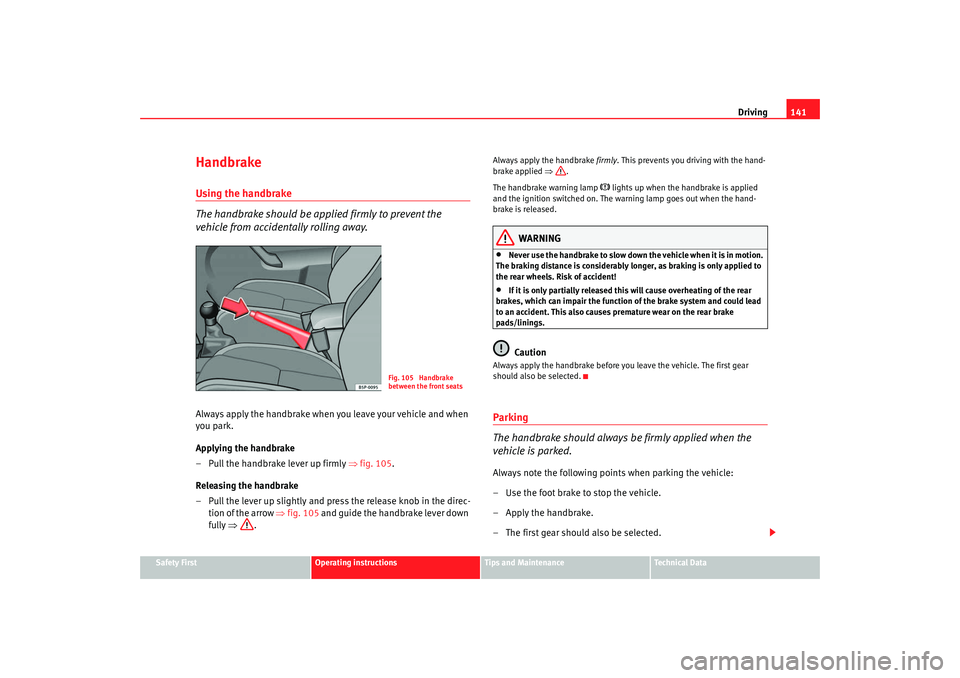
– Pull the handbrake lever up firmly ⇒ fig. 105.
Releasing the handbrake
– Pull the lever up slightly and press the release knob in the direc- tion of the arrow ⇒fig. 105 and guide the handbrake lever down
fully ⇒ .
Always apply the handbrake firmly. This prevents you driving with the hand-
brake applied ⇒.
The handbrake warning lamp
lights up when the handbrake is applied
and the ignition switched on. The wa rning lamp goes out when the hand-
brake is released.
WARNING
•
Never use the handbrake to slow down the vehicle when it is in motion.
The braking distance is considerably longer, as braking is only applied to
the rear wheels. Ri sk of accident!
•
If it is only partially released this will cause overheating of the rear
brakes, which can impair the function of the brake system and could lead
to an accident. This also causes premature wear on the rear brake
pads/linings.Caution
Always apply the handbrake before you leave the vehicle. The first gear
should also be selected.Parking
The handbrake should always be firmly applied when the
vehicle is parked.Always note the following points when parking the vehicle:
– Use the foot brake to stop the vehicle.
–Apply the handbrake.
– The first gear should also be selected.
Fig. 105 Handbrake
between the front seats
IBI_ANG_0707 Seite 141 Montag, 6. August 2007 3:59 15
Page 153 of 272
Driving and the environment151
Safety First
Operating instructions
Tips and Maintenance
Te c h n i c a l D a t a
Driving and the environmentRunning-inRunning in a new engine
The engine needs to be run-in over the first 1,500 km.Up to 1,000 kilometres
– Do not drive faster than three quarters of top speed.
– Do not accelerate hard.
– Avoid high engine revolutions.
– Do not tow a trailer.
From 1000 to 1500 km
–Speeds can be gradually increased to the maximum road speed
or maximum permissible engine speed (rpm).During its first few hours of running, the internal fric tion in the engine is
greater than later on when all the moving parts have bedded in.
For the sake of the environment
If the engine is run in gently, the life of the engine will be increased and its oil
consumption reduced.
Deep water (Cupra version)The speed of the vehicle through puddles and passages of water must not
exceed 25 km/h.Running in tyres and brake pads
New tyres should be run-in carefully for the first 500 km. New
brake pads should be run-in carefully for the first 200 km.During the first 200 km, you can compensate for the reduced braking effect
by applying more pressure to the brake pedal. If you need to make an emer-
gency stop, the braking distance will be longer with new brake pads than with
brake pads which have been run-in.
WARNING
•
New tyres do not give maximum grip to start with, and require running-
in. This may cause an accident. Drive particularly carefully in the first 500
km.
•
New brake pads must be “run in” and do not have the correct friction
properties during the first 200 km. However, the reduced braking capacity
may be compensated by pressing on the brake pedal a little harder.
IBI_ANG_0707 Seite 151 Montag, 6. August 2007 3:59 15
Page 154 of 272
Driving and the environment
152Braking effect and braking distance
The braking effect and braking distance are influenced by
driving situations and road conditions.The efficiency of the brakes depends directly on the brake pad wear. The rate
of wear of the brake pads depends to a great extent on the conditions under
which the vehicle is operated and the way the vehicle is driven. If you often
drive in town traffic, drive short distances or have a sporty driving style, we
recommend that you have the thickness of your brake pads checked by an
Authorised Service Centre more frequently than recommended in the Service
Schedule.
If you drive with wet brakes, for example, after crossing areas of water, in
heavy rainfall or even after washing the car, the effect of the brakes is less-
ened as the brake discs are wet or even frozen (in winter): The brakes should
be “dried” by pressing the pedal to restore full braking effect.
WARNING
Longer braking distances and faults in the brake system increase the risk
of accidents.•
New brake pads must be run in and do not have the correct friction
during the first 200 km. However, the reduced braking capacity may be
compensated by pressing on the brake pedal a little harder. This also
applies when new brake pads are fitted.
•
If brakes are wet or frozen, or if you are driving on roads which have
been gritted with salt, braking power may set in later than normal.
•
On steep descents if the brakes are excessively used they will over
heat. Before driving down a long steep gradient, it is advisable to reduce
speed and change to a lower gear (or mo ve the selector lever to a lower gear
if your vehicle has automatic transmission). This makes use of engine
braking and relieves the brakes.
•
Never let the brakes “rub” by applying light pressure. Continuous
braking will cause the brakes to overheat and will increase the braking
distance. Apply and then release the brakes alternately.
•
Never let the vehicle coast with the engine switched off. The braking
distance is increased considerably as the brake servo does not function.
•
Very heavy use of the brakes may cause a vapour lock if the brake fluid
is left in the system for too long . This impairs the braking effect.
•
Non-standard or damaged front spoilers could restrict the airflow to the
brakes and cause them to overheat. Observe the relevant instructions
before purchasing accessories ⇒page 172, “Modifications”.
•
If a brake circuit fails, the braking distance will be increased consider-
ably. Contact a qualified workshop immediately and avoid unnecessary
journeys.
Exhaust gasses purification systemCatalytic converter*To conserve the useful life of the catalytic converter
– Always use unleaded petrol.
– Do not run the fuel tank dry.
– For engine oil changes, do not replenish with too much engine oil ⇒page 186, “Topping up engine oil ”.
– Never tow the vehicle to start it, use jump leads if necessary ⇒page 230.
WARNING (continued)
IBI_ANG_0707 Seite 152 Montag, 6. August 2007 3:59 15
Page 166 of 272
Cleaning and caring for your vehicle
164Care of the vehicle exteriorAutomatic car washesThe paint is so durable that the car can normally be washed without problems
in an automatic car wash. However, the effect on the paint depends to a large
extent on the design of the car wash, the brushes used, the filtering of the
wash water and the type of detergents and wax solutions used, etc.
Before going through a car wash, be sure to take the usual precautions such
as closing the windows and sunroof. There is nothing to note apart from that.
If the vehicle has special accessories such as spoilers or a roof carrier or two-
way radio aerial, etc., it is advisable to consult the car wash operator.
After the car has been washed, the brakes could hesitate to respond as the
brake discs and pads will be wet, or even frozen in winter. “Dry ” the brakes
by braking several times.
WARNING
Moisture, ice and salt on the brakes may affect braking efficiency. Risk of
accident.
Caution
Before putting the vehicle in a carwash tunne l, do not tighten the aerial if it is
folded as this may cause damage.Washing by handWashing the vehicle
– First soften the dirt with plenty of water and rinse off. – Clean the vehicle with a soft spon
ge, a glove or a brush. Start on
the roof and work your way down. Use only light pressure.
– Rinse the sponge or glove as much as possible.
– Special car shampoo should only be used for very stubborn dirt.
– Clean the wheels, sill panels etc. last using a different sponge or glove.
– Rinse the vehicle thoroughly with water.
– Dry the surface of the vehicle gently using a chamois leather.
–If it is cold , dry the rubber seals and the surfaces they touch with
a cloth to prevent them freezing. Apply silicone spray to the
rubber seals.
After cleaning the vehicle
– If possible, avoid sudden braking directly after washing the vehicle. You must “dry” the brakes by applying the brakes care-
fully several times ⇒page 152, “Braking effect and braking
distance”.
WARNING
•
The ignition must always be switched off before the vehicle is washed.
•
Protect your hands and arms from cuts on sharp metal edges when
cleaning the underbody, the inside of the wheel housings etc. Risk of
injury.
•
Moisture, ice and salt on the brakes may affect braking efficiency. Risk
of accident.
IBI_ANG_0707 Seite 164 Montag, 6. August 2007 3:59 15
Page 194 of 272
Checking and refilling levels
192
WARNING
Do not drive unless you have good visibility through all windows!•
Clean the windscreen wiper blades and all windows regularly.
•
The wiper blades should be changed once or twice a year.Caution
•
A damaged or dirty window wiper could scratch the rear window.
•
Never use fuel, nail varnish remover, paint thinner or similar products to
clean the window.
•
Never move the windscreen wiper by hand. This could cause damage.
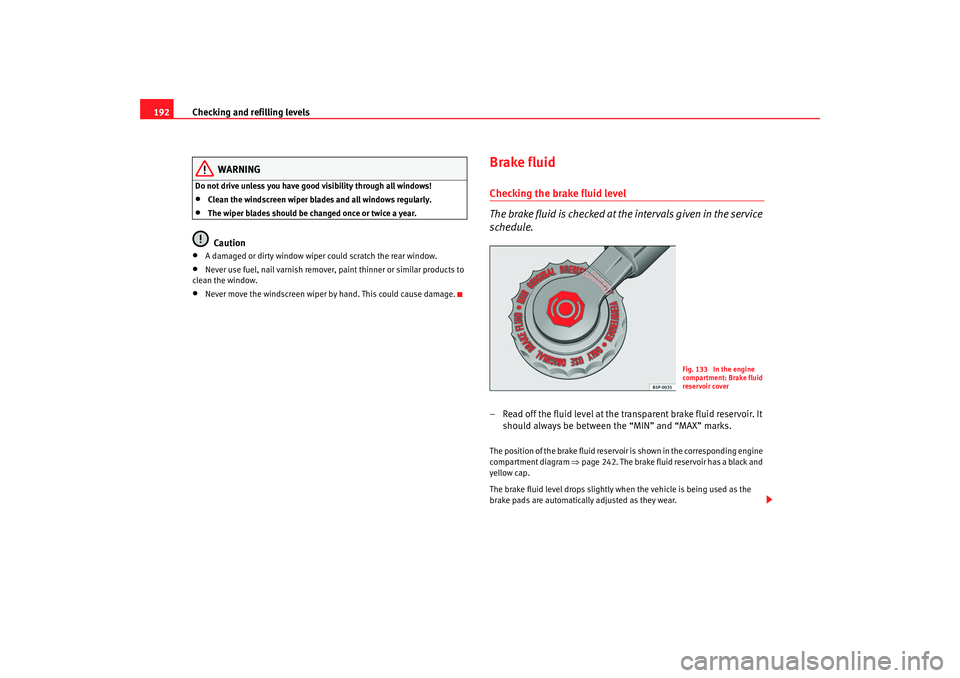
Brake fluidChecking the brake fluid level
The brake fluid is checked at the intervals given in the service
schedule.– Read off the fluid level at the transparent brake fluid reservoir. It should always be between the “MIN” and “MAX” marks.The position of the brake fluid reservoir is shown in the corresponding engine
compartment diagram ⇒page 242. The brake fluid reservoir has a black and
yellow cap.
The brake fluid level drops slightly when the vehicle is being used as the
brake pads are automatically adjusted as they wear.
Fig. 133 In the engine
compartment: Brake fluid
reservoir cover
IBI_ANG_0707 Seite 192 Montag, 6. August 2007 3:59 15
Page 263 of 272
Index261
Index
AABS . . . . . . . . . . . . . . . . . . . . . . . . . . . . . . . . . . . 148
Warning lamp . . . . . . . . . . . . . . . . . . . . . . . . . 64
Accessories . . . . . . . . . . . . . . . . . . . . . . . . . . . . 172
Acoustic signal . . . . . . . . . . . . . . . . . . . . . . . . . . 16
Acoustic warning . . . . . . . . . . . . . . . . . . . . . . . . 132
Adjustable service interval display . . . . . . . . . . 58
Adjusting simp le headlights
driving on the left . . . . . . . . . . . . . . . . . . . . 154
driving on the right . . . . . . . . . . . . . . . . . . . 154
Adjusting the seat belt height . . . . . . . . . . . . . . 23
Air conditioning system Climatronic . . . . . . . . . . . . . . . . . . . . . . . . . . 125
General notes . . . . . . . . . . . . . . . . . . . . . . . . 128
Air conditioning* . . . . . . . . . . . . . . . . . . . . . . . . 122
Air outlets . . . . . . . . . . . . . . . . . . . . . . . . . . . . . . 121
Air recirculation Semi-automatic air conditi oning . . . . . . . . 124
Air recirculation mode Climatronic . . . . . . . . . . . . . . . . . . . . . . . . . . 127
Airbag covers . . . . . . . . . . . . . . . . . . . . . . . . . . . . 31
Airbag system . . . . . . . . . . . . . . . . . . . . . . . . . . . 26 Curtain airbags . . . . . . . . . . . . . . . . . . . . . . . 37
Front airbags . . . . . . . . . . . . . . . . . . . . . . . . . 29
Side airbags . . . . . . . . . . . . . . . . . . . . . . . . . . 33
Warning lamp . . . . . . . . . . . . . . . . . . . . . . . . . 27 Airbags
Care . . . . . . . . . . . . . . . . . . . . . . . . . . . . . . . . 28
Disposal . . . . . . . . . . . . . . . . . . . . . . . . . . . . . 28
Safety notes . . . . . . . . . . . . . . . . . . . . . . . . . . 28
Alarm system Switching off . . . . . . . . . . . . . . . . . . . . . . . . . 81
Alterations to the vehicle . . . . . . . . . . . . . . . . . 172
Alternator Warning lamp . . . . . . . . . . . . . . . . . . . . . . . . . 62
Ambient temperature display . . . . . . . . . . . . 55, 57
Anti-freeze . . . . . . . . . . . . . . . . . . . . . . . . . . . . . 187
Anti-lock brake system . . . . . . . . . . . . . . . . . . . 148 Warning lamp . . . . . . . . . . . . . . . . . . . . . . . . . 64
Anti-theft alarm system . . . . . . . . . . . . . . . . . . . . 80 Switching off . . . . . . . . . . . . . . . . . . . . . . . . . 81
Anti-theft wheel bolts . . . . . . . . . . . . . . . . . . . . 208
Aquaplaning . . . . . . . . . . . . . . . . . . . . . . . . . . . 198
Athermic windscreen* . . . . . . . . . . . . . . . . . . . . 100
Automatic anti-dazzle interior mirror* Activating the anti-dazzle function . . . . . . 101
Deactivating anti-dazzle function . . . . . . . . 101
Automatic car washes . . . . . . . . . . . . . . . . . . . . 164
Automatic gearbox . . . . . . . . . . . . . . . . . . . . . . 137 Instructions for driving . . . . . . . . . . . . . . . . 139
Kick-down feature . . . . . . . . . . . . . . . . . . . . 139
Selector lever positions . . . . . . . . . . . . . . . . 138
Automatic wiper/wash function for the rear window 99 Auxiliary audio connection: AUX-IN . . . . . . . . . 115
BBall coupling . . . . . . . . . . . . . . . . . . . . . . . . . . . 159
BAS . . . . . . . . . . . . . . . . . . . . . . . . . . . . . . . . . . . 147
Battery
Changing . . . . . . . . . . . . . . . . . . . . . . . . . . . 195
Charging . . . . . . . . . . . . . . . . . . . . . . . . . . . . 195
Winter conditions . . . . . . . . . . . . . . . . . . . . 194
Belt tension device Disposal . . . . . . . . . . . . . . . . . . . . . . . . . . . . . 24
Warning lamp . . . . . . . . . . . . . . . . . . . . . . . . 27
Belt tension devices . . . . . . . . . . . . . . . . . . . . . . 24
Biodiesel . . . . . . . . . . . . . . . . . . . . . . . . . . . . . . 179
Bonnet . . . . . . . . . . . . . . . . . . . . . . . . . . . . . . . . 182
Boot* . . . . . . . . . . . . . . . . . . . . . . . . . . . . . . 96, 230
Brake assist system . . . . . . . . . . . . . . . . . . . . . 147
Brake fluid . . . . . . . . . . . . . . . . . . . . . . . . . . . . . 192 Changing . . . . . . . . . . . . . . . . . . . . . . . . . . . 193
Brake pads . . . . . . . . . . . . . . . . . . . . . . . . 151, 152
Brake servo . . . . . . . . . . . . . . . . . . . . . . . 147, 152
Brake system . . . . . . . . . . . . . . . . . . . . . . . . . . . 192 Warning lamp . . . . . . . . . . . . . . . . . . . . . . . . 65
Brakes . . . . . . . . . . . . . . . . . . . . . . . . . . . . . . . . 152
Braking distance . . . . . . . . . . . . . . . . . . . . . . . . 152
Bulb changes general notes . . . . . . . . . . . . . . . . . . . . . . . . 219
IBI_ANG_0707 Seite 261 Montag, 6. August 2007 3:59 15
Page 268 of 272
Index
266Removing and fitting the wheel . . . . . . . . . . . . 210
Repairs
Airbags . . . . . . . . . . . . . . . . . . . . . . . . . . . . . . 28
Replacement keys . . . . . . . . . . . . . . . . . . . . . . . . 77
Replacing lamps fog lights . . . . . . . . . . . . . . . . . . . . . . . . . . . 225
Rev counter . . . . . . . . . . . . . . . . . . . . . . . . . . . . . 53
Reverse gear Manual gearbox . . . . . . . . . . . . . . . . . . . . . 136
RME fuel (biodiesel) . . . . . . . . . . . . . . . . . . . . . 179
Roll-back function Sliding/tilting roof . . . . . . . . . . . . . . . . . . . . 89
Windows . . . . . . . . . . . . . . . . . . . . . . . . . . . . 86
Roof aerial* . . . . . . . . . . . . . . . . . . . . . . . . . . . . 173
Roof carrier* . . . . . . . . . . . . . . . . . . . . . . . . . . . . 118
Rubber seals . . . . . . . . . . . . . . . . . . . . . . . . . . . 167
Running in Brake pads . . . . . . . . . . . . . . . . . . . . . . . . . . 151
Engine . . . . . . . . . . . . . . . . . . . . . . . . . . . . . 151
Tyres . . . . . . . . . . . . . . . . . . . . . . . . . . . . . . . 151
Running in tyres . . . . . . . . . . . . . . . . . . . . . . . . 151SSafe driving . . . . . . . . . . . . . . . . . . . . . . . . . . . . . . 7
Safety . . . . . . . . . . . . . . . . . . . . . . . . . . . . . . . . . . . 8
Safety equipment . . . . . . . . . . . . . . . . . . . . . . . . . 7
Safety instructions Coolant temperature . . . . . . . . . . . . . . . . . . . 64 Safety notes
Belt tension devices . . . . . . . . . . . . . . . . . . . 24
Curtain airbags . . . . . . . . . . . . . . . . . . . . . . . 38
Disabling front passenger airbag . . . . . . . . 41
Front airbags . . . . . . . . . . . . . . . . . . . . . . . . . 32
Side airbags . . . . . . . . . . . . . . . . . . . . . . . . . 36
Using child seats . . . . . . . . . . . . . . . . . . . . . . 43
Using seat belts . . . . . . . . . . . . . . . . . . . . . . 19
Safety system- safe . . . . . . . . . . . . . . . . . . . . . . . 71
Seals . . . . . . . . . . . . . . . . . . . . . . . . . . . . . . . . . 167
Seat adjustment . . . . . . . . . . . . . . . . . . . . 104, 107
Seat belt position Pregnant women . . . . . . . . . . . . . . . . . . . . . . 22
Seat belts . . . . . . . . . . . . . . . . . . . . . . . . . . . . 21
Seat belt release . . . . . . . . . . . . . . . . . . . . . . . . . 23
Seat belt warning lamp . . . . . . . . . . . . . . . . . . . . 16
Seat belts . . . . . . . . . . . . . . . . . . . . . . . . . . . . . . . 16 adjustment . . . . . . . . . . . . . . . . . . . . . . . . . . 20
Incorrectly fastened . . . . . . . . . . . . . . . . . . . 24
Not worn . . . . . . . . . . . . . . . . . . . . . . . . . . . . 18
Safety notes . . . . . . . . . . . . . . . . . . . . . . . . . . 19
Warning lamp . . . . . . . . . . . . . . . . . . . . . . . . 16
Seat belts protect . . . . . . . . . . . . . . . . . . . . . . . . 19
Seat heating . . . . . . . . . . . . . . . . . . . . . . . . . . . 108
Seats . . . . . . . . . . . . . . . . . . . . . . . . . . . . . . . . . . 16
Selective opening* . . . . . . . . . . . . . . . . . . . . . . . 72
Semiautomatic air conditioning controls . . . . . . . . . . . . . . . . . . . . . . . . . . . . 122
Shoes . . . . . . . . . . . . . . . . . . . . . . . . . . . . . . . . . . 14 Side airbags . . . . . . . . . . . . . . . . . . . . . . . . . . . . 33
Description . . . . . . . . . . . . . . . . . . . . . . . . . . 33
Function . . . . . . . . . . . . . . . . . . . . . . . . . . . . . 34
Safety notes . . . . . . . . . . . . . . . . . . . . . . . . . . 36
Side lights . . . . . . . . . . . . . . . . . . . . . . . . . . . . . . 90
Sitting position Driver . . . . . . . . . . . . . . . . . . . . . . . . . . . . . . . . 9
Front passenger . . . . . . . . . . . . . . . . . . . . . . 10
Incorrect sitting position . . . . . . . . . . . . . . . 13
Passengers . . . . . . . . . . . . . . . . . . . . . . . . . . 11
Sitting position, occupants . . . . . . . . . . . . . . . . . 9
Sliding/tilting roof . . . . . . . . . . . . . . . . . . . . . . . 87
Snow chains . . . . . . . . . . . . . . . . . . . . . . . 201, 241
Soot accumulation in the diesel engine particulate
filter *
Indicator . . . . . . . . . . . . . . . . . . . . . . . . . . . . 66
Spare wheel . . . . . . . . . . . . . . . . . . . . . . . . . . . . 203
Spares . . . . . . . . . . . . . . . . . . . . . . . . . . . . . . . . 172
Speedometer . . . . . . . . . . . . . . . . . . . . . . . . . . . . 54
Starting Petrol engines . . . . . . . . . . . . . . . . . . . 134
Starting the engine . . . . . . . . . . . . . . . . . . 133, 134 After the fuel tank has been run dry . . . . . 135
Steam cleaners . . . . . . . . . . . . . . . . . . . . . . . . . 165
Steering . . . . . . . . . . . . . . . . . . . . . . . . . . . . . . . 130 Steering lock . . . . . . . . . . . . . . . . . . . . . . . . 132
Steering wheel controls . . . . . . . . . . . . . . . . . . . 68
Steering wheel height adjustment . . . . . . . . . 130
Stowage front right seats . . . . . . . . . . . . . . . . . . . . . . 111
Stowage compartment Front passenger side . . . . . . . . . . . . . . . . . 110
IBI_ANG_0707 Seite 266 Montag, 6. August 2007 3:59 15