warning light Seat Ibiza 5D 2010 Repair Manual
[x] Cancel search | Manufacturer: SEAT, Model Year: 2010, Model line: Ibiza 5D, Model: Seat Ibiza 5D 2010Pages: 266, PDF Size: 7.04 MB
Page 162 of 266
Driving and the environment
160
CautionNever run the fuel tank completely dry because the irregularity of the fuel
supply may cause ignition problems. This allows unburnt fuel to enter the
exhaust system, which could cause overheating and damage the catalytic
converter.
For the sake of the environment
Even when the emission control system is working perfectly, there may be a
smell of sulphur from the exhaust gas under some conditions. This depends
on the sulphur content of the fuel used. Quite often the problem can be
solved by changing to another brand of fuel.Diesel engine particulate filter*
The diesel engine particulate filter eliminates soot produced
by burning diesel.
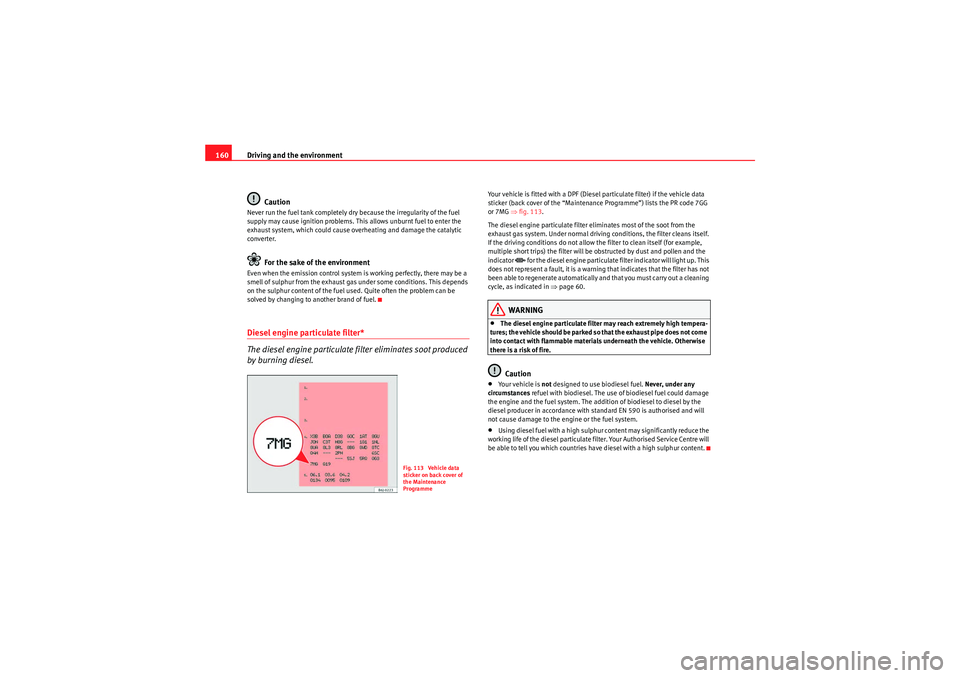
Your vehicle is fitted with a DPF (Diesel particulate filter) if the vehicle data
sticker (back cover of the “Maintenance Programme”) lists the PR code 7GG
or 7MG ⇒fig. 113 .
The diesel engine particulate filter eliminates most of the soot from the
exhaust gas system. Under normal driving conditions, the filter cleans itself.
If the driving conditions do not allow the filter to clean itself (for example,
multiple short trips) the filter will be obstructed by dust and pollen and the
indicator
for the diesel engine particulate filter indicator will light up. This
does not represent a fault, it is a warning that indicates that the filter has not
been able to regenerate automatically and that you must carry out a cleaning
cycle, as indicated in ⇒page 60.
WARNING
•The diesel engine particulate filter may reach extremely high tempera-
tures; the vehicle should be parked so that the exhaust pipe does not come
into contact with flammable materials underneath the vehicle. Otherwise
there is a risk of fire.Caution
•Your vehicle is not designed to use biodiesel fuel. Never, under any
circumstances refuel with biodiesel. The use of biodiesel fuel could damage
the engine and the fuel system. The addition of biodiesel to diesel by the
diesel producer in accordance with standard EN 590 is authorised and will
not cause damage to the engine or the fuel system.•Using diesel fuel with a high sulphur content may significantly reduce the
working life of the diesel particulate filter. Your Authorised Service Centre will
be able to tell you which countries have diesel with a high sulphur content.
Fig. 113 Vehicle data
sticker on back cover of
the Maintenance
Programme
Ibiza_EN.book Seite 160 Mittwoch, 1. September 2010 5:24 17
Page 166 of 266
Driving and the environment
164figures for your specific model, which may be lower than these figures for the
towing bracket, are given in the vehicle documents or in ⇒Section “Tech-
nical Data”.
Distributing the load
Distribute loads in the trailer so that heavy objects are as near to the axle as
possible. Loads carried in the trailer must be secured to prevent them
moving.
Tyre pressure
Set tyre pressure to the maximum permissible pressure shown on the sticker
on the inside of the fuel tank flap. Set the tyre pressure of the trailer tyres in
accordance with the trailer manufacturer’s recommendations.
Exterior mirrors
Check whether you can see enough of the road behind the trailer with the
standard mirrors. If this is not the case, you should have additional mirrors
fitted. Both exterior mirrors should be mounted on hinged extension
brackets. Adjust the mirrors to give sufficient vision to the rear.
WARNING
Never transport people in a trailer. This could result in fatal accidents.
Note
•Towing a trailer places additional demands on the vehicle. We recom-
mend additional services between the normal inspection intervals if the
vehicle is used frequently for towing a trailer.•Find out whether special regulations apply to towing a trailer in your
country.
Ball coupling of towing bracket*The ball coupling is provided with instructions on fitting and removing the
ball coupling of the towing bracket.
WARNING
The towing bracket ball coupling must be stored securely in the luggage
compartment to prevent them being flung through the vehicle and causing
injury.
Note
•By law, the ball coupling must be re moved if a trailer is not being towed
and it obscures the number plate.Driving tips
Driving with a trailer always requires extra care.Weight distribution
The weight distribution of a loaded trailer with an unladen vehicle is very
unfavourable. However, if this cannot be avoided, drive extra slowly to allow
for the unbalanced weight distribution.
Speed
The stability of the vehicle and trailer is reduced with increasing speed. For
this reason, it is advisable not to drive at the maximum permissible speed in
an unfavourable road, weather or wind conditions. This applies especially
when driving downhill.
You should always reduce speed immediately if the trailer shows the slightest
sign of snaking . Never try to stop the “snaking” by increasing speed.
Ibiza_EN.book Seite 164 Mittwoch, 1. September 2010 5:24 17
Page 168 of 266
Vehicle maintenance and cleaning
166Vehicle maintenance and cleaningGeneral notesRegular washing and care help maintain the value of your
vehicle.Vehicle maintenance
Regular care and washing help to maintain the value of the vehicle. This may
also be one of the requirements for acknowledging warranty claims in the
event of bodywork corrosion or paint defects.
The best way to protect your vehicle against the harmful effects of the envi-
ronment is through correct maintenance and frequent washing. The longer
substances such as insect remains, bird droppings, resinous tree sap, road
dirt, industrial deposits, tar, soot or road salt and other aggressive materials
remain on the vehicle, the more damage they do to the paintwork. High
temperatures (for instance in strong sunlight) further intensify the corrosive
effect.
After winter, a period when salt is put on the roads, it is important to have the
underside of the vehicle washed thoroughly.
Products for vehicle maintenance
Car care products are available in your Authorised Service Centre. Keep the
product instructions until you have used them up.
WARNING
•Car care products can be toxic. Because of this, they must always be
kept closed in their original container. Keep them out of the reach of chil-
dren. Failure to comply could result in poisoning.•Always read and observe the instructions and warnings on the package
before using vehicle care products. Improper use could cause health prob- lems or damage the vehicle. The use of certain products may produce
noxious vapours; they should be used in well ventilated areas.
•Never use fuel, turpentine, engine oil, nail varnish remover or other
volatile fluids. These are toxic and highly flammable. Risk of fire and explo-
sion.•Before washing your vehicle, or carrying out any maintenance, switch
the engine off, apply the handbrake firmly and remove the key from the
ignition.Caution
Never attempt to remove dirt, mud or dust if the surface of the vehicle is dry.
Never use a dry cloth or sponge for cleaning purposes. This could damage the
paintwork or the windows of your vehicle. Soak dirt, mud or dust with plenty
of water.
For the sake of the environment
•When purchasing products for your vehicle maintenance, select the ones
which are not harmful to the environment.•The waste from car care products should no t be disposed of with ordinar y
household waste. Observe the disposal information on the package.WARNING (continued)
Ibiza_EN.book Seite 166 Mittwoch, 1. September 2010 5:24 17
Page 169 of 266
Vehicle maintenance and cleaning167
Safety First
Operating Instructions
Practical Tips
Technical Specifications
Care of the vehicle exteriorAutomatic car washing tunnelThe vehicle paintwork is so durable that the vehicle can normally be washed
without problems in an automatic car wash tunnel. However, the paintwork
wear depends to a large extent on the kind of the car wash tunnel, the
brushes used, its water filtering and the type of cleaning and preservative
products.
Before going through a car wash, be sure to take the usual precautions such
as closing the windows and sunroof. There is nothing to note apart from that.
If the vehicle has special accessories such as spoilers or a roof rack or two-
way radio aerial, etc., it is advisable to consult the car wash tunnel operator.
After washing, the brakes could take some time to respond as the brake discs
and pads could be wet, or even frozen in winter. Dry the brakes by braking
several times.
WARNING
Water, ice and salt on the brakes can reduce braking efficiency. Risk of acci-
dent.
Caution
Before putting the vehicle through the car washing tunnel, do not tighten the
aerial if it is folded because it can be damaged.
Washing by handVehicle washing
– First soften the dirt and rinse it off with water.
– Clean your vehicle from top to bottom with a soft sponge, a glove or a brush. Use very light pressure.
– Rinse the sponge or glove often with clean water.
– Special car shampoo should only be used for very stubborn dirt.
– Leave the wheels, sill panels etc. until last, using a different sponge or glove.
– Rinse the vehicle thoroughly with water.
– Dry the vehicle surface gently with a chamois leather.
–In cold temperature , dry the rubber seals and their surfaces to
prevent them from freezing. Apply silicone spray to the rubber
seals.
After washing the vehicle
– After washing, avoid sudden and sharp braking. Dry the brakes by braking several times.
WARNING
•Wash your vehicle with the ignition switched off.•Protect your hands and arms from cuts on sharp metal edges when
cleaning the underbody, the inside of the wheel housings etc. Risk of
injury.
Ibiza_EN.book Seite 167 Mittwoch, 1. September 2010 5:24 17
Page 170 of 266
Vehicle maintenance and cleaning
168•Water, ice and salt on the brakes can reduce braking efficiency. Risk of
accident.Caution
•Never remove dirt, mud or dust if the vehicle surface is dry. Never use a
dry cloth or sponge for cleaning purposes. This could scratch the paintwork
or glass on your vehicle.•Washing the vehicle in low temperatures: when washing the vehicle with
a hose, do not direct water into the lock cylinders or the gaps around the
doors, tailgate, or sunroof. Risk of freezing.For the sake of the environment
To protect environment, the vehicle should be washed only in specially
provided wash bays. This prevents toxic, oil-laden waste water entering the
sewerage system. In some places, washing vehicles outside wash bays is
prohibited.
Note
Do not wash the vehicle in direct sunlight.Washing the vehicle with a high pressure cleaner
Be particularly careful when using a high pressure cleaner!– Always observe the instructions for the high-pressure cleaner,
particularly those concerning the pressure and the spraying
distance. – Increase the spraying distance for soft materials and painted
bumpers.
– Do not use a high pressure cleaner to remove ice or snow from windows ⇒page 169.
– Never use concentrated jet nozzles (“rotating jets”) ⇒.
– After washing, avoid sudden and sharp braking. Dry the brakes by braking several times ⇒page 158.
WARNING
•Never wash tyres with a concentrated jet (“rotating nozzle”). Even at
large spraying distances and short cleaning times, visible and invisible
damage can occur to the tyres. This may cause an accident.•Water, ice and salt on the brakes can reduce braking efficiency. Risk of
accident.Caution
•Do not use water hotter than 60 °C. This could damage the vehicle.•To avoid damage to the vehicle, keep a sufficient distance from sensitive
materials such as flexible hoses, plastic, soundproofing material, etc. This is
also important for bumpers painted in the colour of the bodywork. The closer
the nozzle is to the surface, the greater the wear on the material.Vehicle paint maintenance
Regular waxing protects the paintwork.You need to apply wax to your vehicle if water does not form small drops and
run off the paintwork when it is clean .
WARNING (continued)
Ibiza_EN.book Seite 168 Mittwoch, 1. September 2010 5:24 17
Page 176 of 266
Vehicle maintenance and cleaning
174
– Apply these products very sparingly.
– Then wipe off with a soft, dry cloth.SEAT does everything possible to preserve the genuine qualities of this
natural product. Due to the natural properties of the specially selected hides
employed, the finished leather has a certain sensitivity to grease and dirt, etc.
so a degree of care is required in everyday use and when looking after the
leather.
Dust and grit in the pores and seams can scratch and damage the surface. If
the vehicle is under solar radiation for long periods, the leather should be
protected to prevent it from fading. However, slight colour variations in high-
quality natural leather are normal.
Caution
•Do not use solvents, wax polish, shoe cream, spot removers or similar
products on leather.•To avoid damage, stubborn stains should be removed by a specialised
workshop.Seat belt cleaning
A dirty belt may not work properly.Check all seat belts regularly and keep them clean.
Seat belt cleaning
– Pull the dirty seat belt right out and unroll it.
– Clean dirty seat belts with a gentle soap solution.
–Allow it to dry. – Do not roll the seat belt up until it is dry.
If large stains form on the belts, it will not retract correctly into the automatic
belt retractor.
WARNING
•Do not use chemical cleaning agents on the seat belts, as this can
impair the strength of the webbing. Ensure that belts do not come into
contact with corrosive fluids.•Check the condition of the seat belts at regular intervals. If you notice
that the belt webbing, fittings, retractor mechanism or buckle of any of the
belts is damaged, the belt must be replaced by a specialised workshop.•Do not attempt to repair a damaged seat belt yourself. The seat belts
must not be removed or modified in any way.Caution
After cleaning, allow seat belts to dry completely before rolling them up.
Otherwise, the belt retractors could become damaged.
Ibiza_EN.book Seite 174 Mittwoch, 1. September 2010 5:24 17
Page 187 of 266
Checking and refilling levels185
Safety First
Operating Instructions
Practical Tips
Technical Specifications
Opening the bonnet
The bonnet is released from inside the vehicle.
Before opening the bonnet ensure that the windscreen wipers are in
rest position.
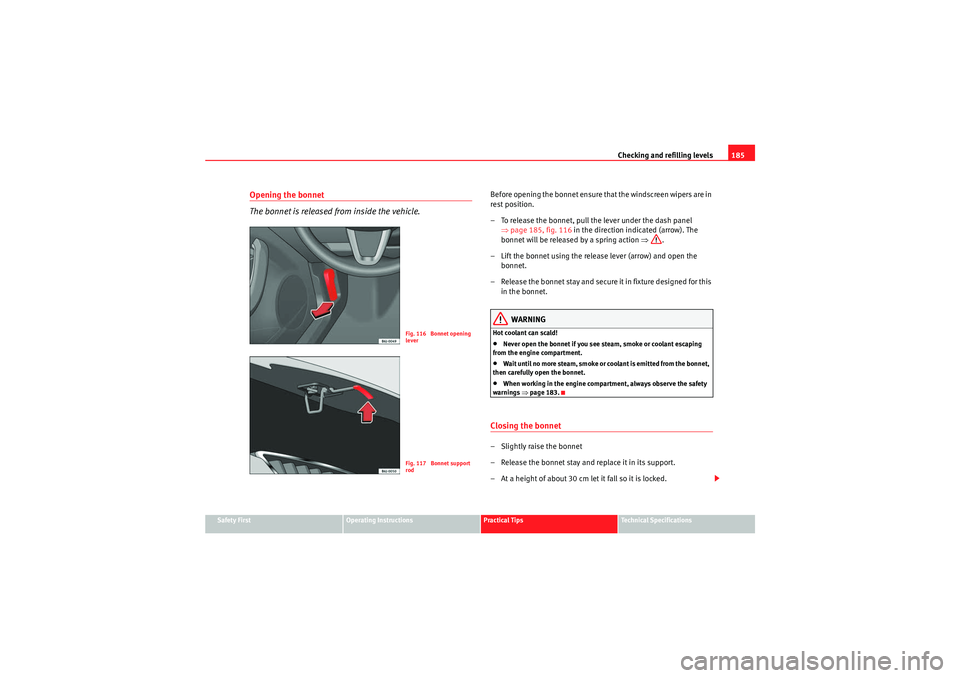
– To release the bonnet, pull the lever under the dash panel
⇒page 185, fig. 116 in the direction indicated (arrow). The
bonnet will be released by a spring action ⇒.
– Lift the bonnet using the release lever (arrow) and open the bonnet.
– Release the bonnet stay and secure it in fixture designed for this
in the bonnet.
WARNING
Hot coolant can scald!•Never open the bonnet if you see steam, smoke or coolant escaping
from the engine compartment.•Wait until no more steam, smoke or coolant is emitted from the bonnet,
then carefully open the bonnet.•When working in the engine compartment, always observe the safety
warnings ⇒page 183.
Closing the bonnet– Slightly raise the bonnet
– Release the bonnet stay and replace it in its support.
– At a height of about 30 cm let it fall so it is locked.
Fig. 116 Bonnet opening
leverFig. 117 Bonnet support
rod
Ibiza_EN.book Seite 185 Mittwoch, 1. September 2010 5:24 17
Page 194 of 266
Checking and refilling levels
192
Caution•If you notice a change in the colour of the liquid because it has been in
use for a long time, it is re commended to change it, as it will have lost some
of its properties and could cause damage to the vehicle.•If a lot of coolant fluid has been lost, wait for the engine to cool down
before putting in cold coolant. This avoids damaging the engine. Large
coolant losses are an indication of leaks in the cooling system. See a special-
ised workshop immediately and have the cooling system checked. Other-
wise, there is a risk of engine damage.Washer fluid and windscreen wiper bladesTopping up washer fluid
Y
The water for cleaning the windscreen should always be
mixed with washer fluid.
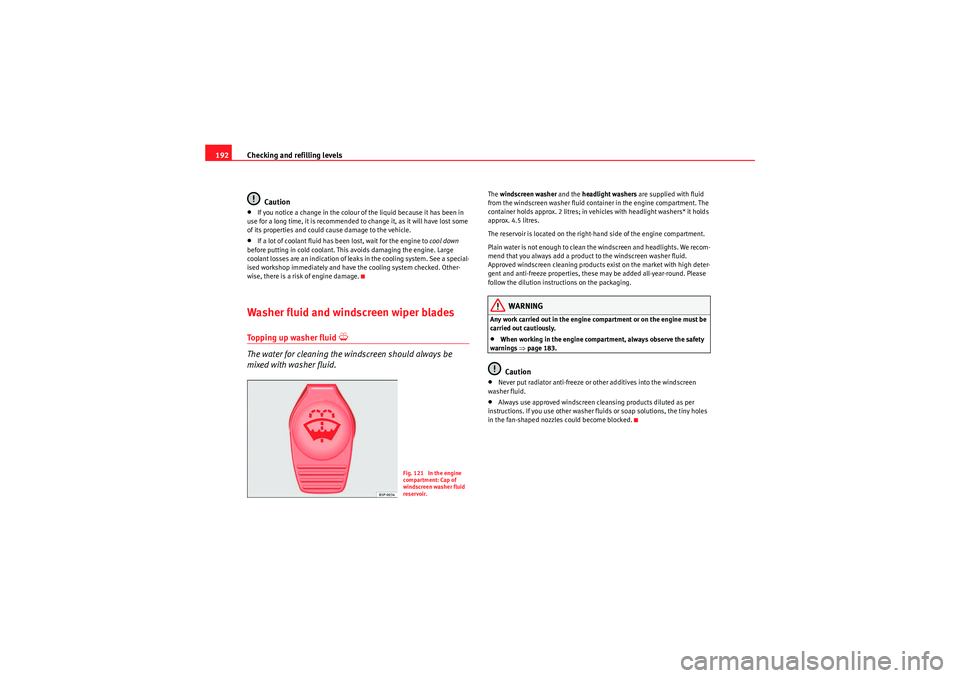
The windscreen washer and the headlight washers are supplied with fluid
from the windscreen washer fluid container in the engine compartment. The
container holds approx. 2 litres; in vehicles with headlight washers* it holds
approx. 4.5 litres.
The reservoir is located on the right-hand side of the engine compartment.
Plain water is not enough to clean th e windscreen and headlights. We recom-
mend that you always add a product to the windscreen washer fluid.
Approved windscreen cleaning products exist on the market with high deter-
gent and anti-freeze properties, these may be added all-year-round. Please
follow the dilution instructions on the packaging.
WARNING
Any work carried out in the engine compartment or on the engine must be
carried out cautiously.•When working in the engine compartment, always observe the safety
warnings ⇒page 183.Caution
•Never put radiator anti-freeze or other additives into the windscreen
washer fluid.•Always use approved windscreen cleansing products diluted as per
instructions. If you use other washer fluids or soap solutions, the tiny holes
in the fan-shaped nozzles could become blocked.
Fig. 121 In the engine
compartment: Cap of
windscreen washer fluid
reservoir.
Ibiza_EN.book Seite 192 Mittwoch, 1. September 2010 5:24 17
Page 197 of 266
Checking and refilling levels195
Safety First
Operating Instructions
Practical Tips
Technical Specifications
Brake fluidChecking the brake fluid level
The brake fluid is checked at the intervals given in the service
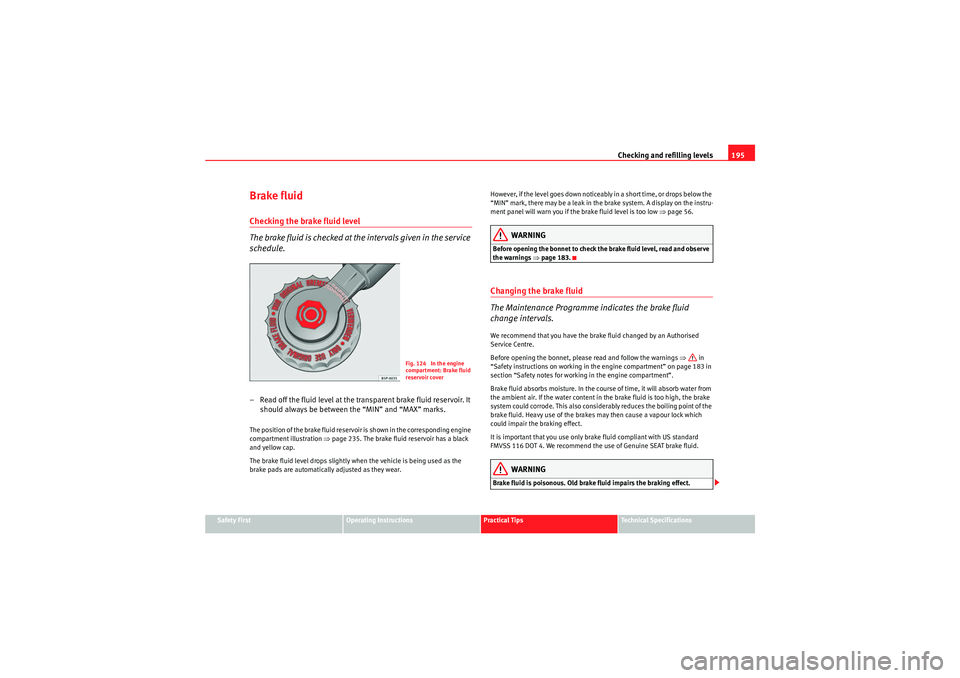
schedule.– Read off the fluid level at the transparent brake fluid reservoir. It
should always be between the “MIN” and “MAX” marks.The position of the brake fluid reservoir is shown in the corresponding engine
compartment illustration ⇒page 235. The brake fluid reservoir has a black
and yellow cap.
The brake fluid level drops slightly when the vehicle is being used as the
brake pads are automatically adjusted as they wear. However, if the level goes down noticeably in a short time, or drops below the
“MIN” mark, there may be a leak in the brake system. A display on the instru-
ment panel will warn you if the brake fluid level is too low
⇒page 56.
WARNING
Before opening the bonnet to check the brake fluid level, read and observe
the warnings ⇒page 183.Changing the brake fluid
The Maintenance Programme indicates the brake fluid
change intervals.We recommend that you have the brake fluid changed by an Authorised
Service Centre.
Before opening the bonnet, please read and follow the warnings ⇒ in
“Safety instructions on working in the engine compartment” on page 183 in
section “Safety notes for working in the engine compartment”.
Brake fluid absorbs moisture. In the course of time, it will absorb water from
the ambient air. If the water content in the brake fluid is too high, the brake
system could corrode. This also considerably reduces the boiling point of the
brake fluid. Heavy use of the brakes may then cause a vapour lock which
could impair the braking effect.
It is important that you use only brake fluid compliant with US standard
FMVSS 116 DOT 4. We recommend the use of Genuine SEAT brake fluid.
WARNING
Brake fluid is poisonous. Old brake fluid impairs the braking effect.
Fig. 124 In the engine
compartment: Brake fluid
reservoir cover
Ibiza_EN.book Seite 195 Mittwoch, 1. September 2010 5:24 17
Page 199 of 266
Checking and refilling levels197
Safety First
Operating Instructions
Practical Tips
Technical Specifications
charge. Never short the battery terminals. High-energy sparks can cause
injury.
•A highly explosive mixture of gases is released when the battery is
under charge. The batteries should be charged in a well-ventilated room
only.•Keep children away from acid and batteries.•Before working on the electrical system, you must switch off the
engine, the ignition and all consumers. The negative cable on the battery
must be disconnected. When a light bulb is changed, you need only switch
off the light.•Deactivate the anti-theft alarm by unlocking the vehicle before you
disconnect the battery! The alarm will otherwise be triggered.•When disconnecting the battery from the vehicle electrical system,
disconnect first the negative cable and then the positive cable.•Switch off all electrical consumers before reconnecting the battery.
Reconnect first the positive cable and then the negative cable. Never
reverse the polarity of the connections. This could cause an electrical fire.•Never charge a frozen battery, or one which has thawed. This could
result in explosions and chemical burns. Always replace a battery which
has frozen. A flat battery can freeze at temperatures around 0 °C.•Ensure that the vent hose is always connected to the battery.•Never use a defective battery. This could cause an explosion. Replace a
damaged battery immediately.•For vehicles with the battery in the luggage compartment: Check that
the battery gas ventilation hose is securely attached.Caution
•Never disconnect the battery if the ignition is switched on or if the engine
is running. This could damage the electrical system or electronic compo-
nents.
•Do not expose the battery to direct sunlight over a long period of time, as
the intense ultraviolet radiation can damage the battery housing.•If the vehicle is left standing in cold conditions for a long period, protect
the battery from freezing. If it freezes it will be damaged.Checking the electrolyte level
The electrolyte level should be checked regularly in high-
mileage vehicles, in hot countries and in older batteries.– Open the engine bonnet and the battery cover ⇒ in “Safety
instructions on working in the engine compartment” on
page 183 ⇒ in “Warnings on handling the battery” on
page 196. For vehicles with the battery under the spare wheel,
open the tailgate and lift the floor covering. The battery is located
next to the spare wheel.
– Check the colour display in the "magic eye" on the top of the battery.
– If there are air bubbles in the window, tap the window gently until they disperse.The position of the battery is shown in the corresponding engine compart-
ment diagram ⇒page 235. The location of the battery in the luggage
compartment can be seen in ⇒page 235, fig. 159 .
The “magic eye” indicator, located on the top of the battery changes colour,
depending on the charge state and electrolyte level of the battery.
There are two different colours:•Black: correct charge status.
WARNING (continued)
Ibiza_EN.book Seite 197 Mittwoch, 1. September 2010 5:24 17