belt Seat Ibiza 5D 2012 Owner's Guide
[x] Cancel search | Manufacturer: SEAT, Model Year: 2012, Model line: Ibiza 5D, Model: Seat Ibiza 5D 2012Pages: 280, PDF Size: 3.66 MB
Page 46 of 280
44Child safety
Child seats
Categorisation of child seats into groups
Use only child seats that are officially approved and suitable
for the child. Child seats are subject to the regulation ECE-R 44. ECE-R stands for: Eco-
nomic Commission for Europe Regulation
The child seats are grouped into 5 categories: Group 0: up to 10 kg
Group 0+: up to 13 kg
Group 1: from 9 to 18 kg
Group 2: from 15 to 25 kg
Group 3: from 22 to 36 kg
Child seats that have been tested and approved under the ECE R44 stand-
ard bear the test mark on the seat (the letter E in a circle with the test num-
ber below it). Group 0 and 0+ child seats
A suitable child seat and a correctly adjusted seat belt can
help you to protect your child.
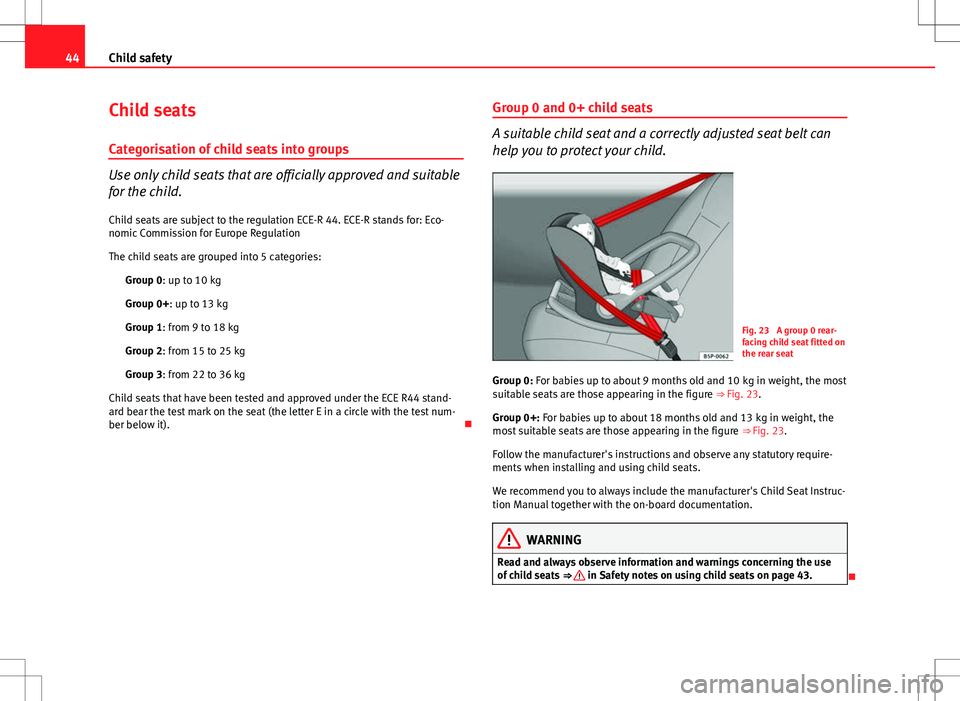
Fig. 23 A group 0 rear-
facing child seat fitted on
the rear seat
Group 0: For babies up to about 9 months old and 10 kg in weight, the most
suitable seats are those appearing in the figure ⇒ Fig. 23.
Group 0+: For babies up to about 18 months old and 13 kg in weight, the
most suitable seats are those appearing in the figure ⇒ Fig. 23.
Follow the manufacturer's instructions and observe any statutory require-
ments when installing and using child seats.
We recommend you to always include the manufacturer's Child Seat Instruc-
tion Manual together with the on-board documentation.
WARNING
Read and always observe information and warnings concerning the use
of child seats ⇒
in Safety notes on using child seats on page 43.
Page 47 of 280
45
Child safety
Group 1 child seats
A suitable child seat and a correctly adjusted seat belt can
help you to protect your child.
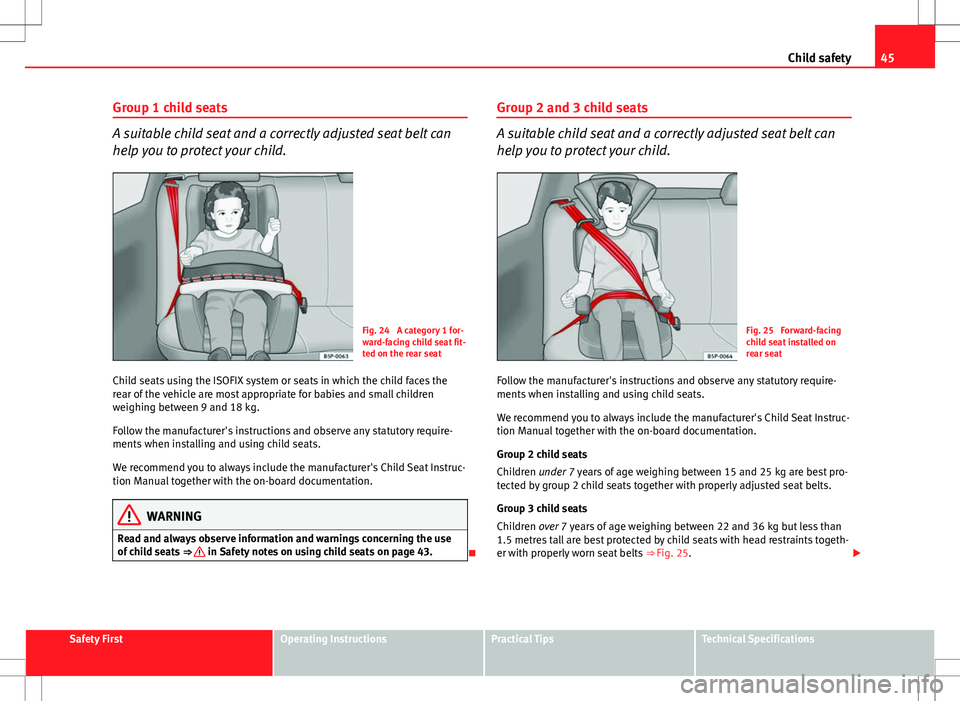
Fig. 24 A category 1 for-
ward-facing child seat fit-
ted on the rear seat
Child seats using the ISOFIX system or seats in which the child faces the
rear of the vehicle are most appropriate for babies and small children
weighing between 9 and 18 kg.
Follow the manufacturer's instructions and observe any statutory require-
ments when installing and using child seats.
We recommend you to always include the manufacturer's Child Seat Instruc-
tion Manual together with the on-board documentation.
WARNING
Read and always observe information and warnings concerning the use
of child seats ⇒
in Safety notes on using child seats on page 43.Group 2 and 3 child seats
A suitable child seat and a correctly adjusted seat belt can
help you to protect your child.
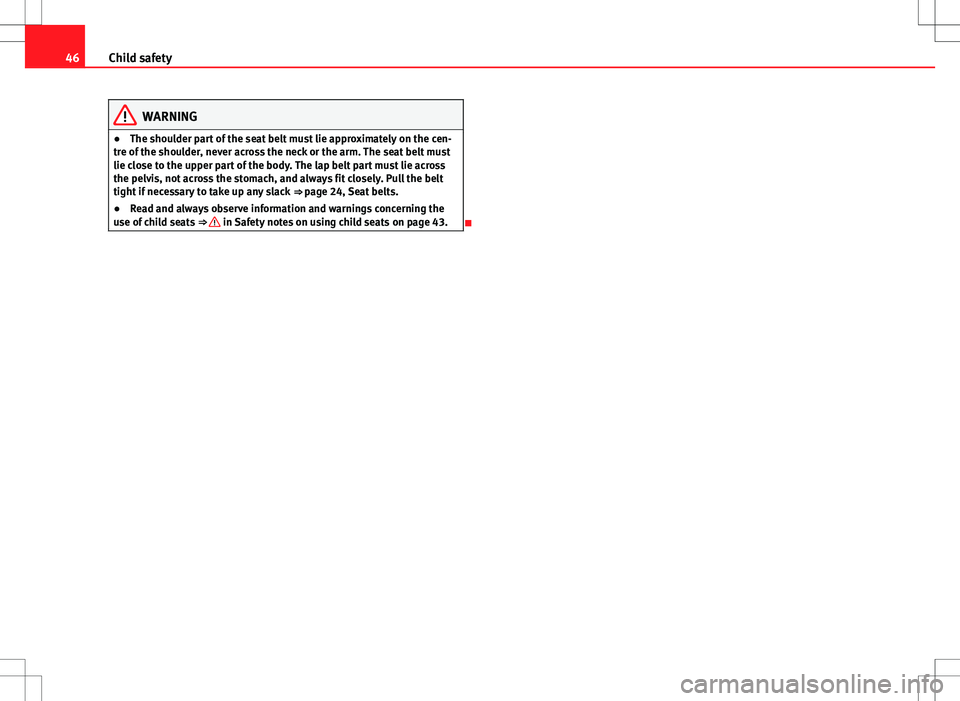
Fig. 25 Forward-facing
child seat installed on
rear seat
Follow the manufacturer's instructions and observe any statutory require-
ments when installing and using child seats.
We recommend you to always include the manufacturer's Child Seat Instruc-
tion Manual together with the on-board documentation.
Group 2 child seats
Children under 7 years of age weighing between 15 and 25 kg are best pro-
tected by group 2 child seats together with properly adjusted seat belts.
Group 3 child seats
Children over 7 years of age weighing between 22 and 36 kg but less than
1.5 metres tall are best protected by child seats with head restraints togeth-
er with properly worn seat belts ⇒ Fig. 25.
Safety FirstOperating InstructionsPractical TipsTechnical Specifications
Page 48 of 280
46Child safety
WARNING
● The shoulder part of the seat belt must lie approximately on the cen-
tre of the shoulder, never across the neck or the arm. The seat belt must
lie close to the upper part of the body. The lap belt part must lie across
the pelvis, not across the stomach, and always fit closely. Pull the belt
tight if necessary to take up any slack ⇒ page 24, Seat belts.
● Read and always observe information and warnings concerning the
use of child seats ⇒
in Safety notes on using child seats on page 43.
Page 49 of 280
47
Child safety
Securing child seats
Ways to secure a child seat
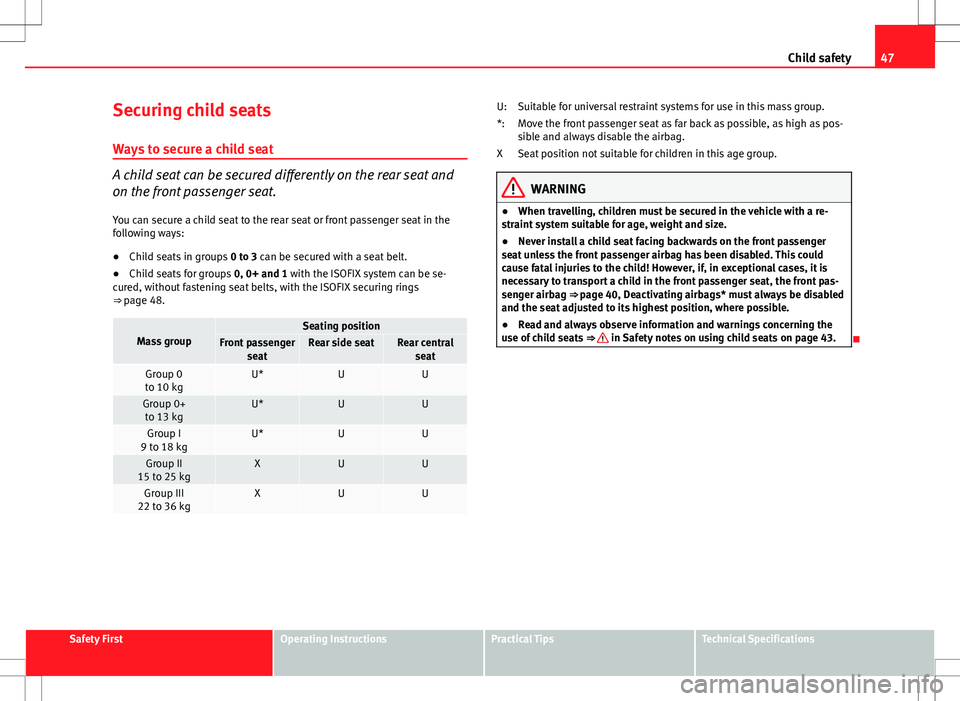
A child seat can be secured differently on the rear seat and
on the front passenger seat. You can secure a child seat to the rear seat or front passenger seat in the
following ways:
● Child seats in groups 0 to 3 can be secured with a seat belt.
● Child seats for groups 0, 0+ and 1 with the ISOFIX system can be se-
cured, without fastening seat belts, with the ISOFIX securing rings
⇒ page 48.
Mass groupSeating positionFront passenger seatRear side seatRear centralseat
Group 0
to 10 kgU*UU
Group 0+ to 13 kgU*UU
Group I
9 to 18 kgU*UU
Group II
15 to 25 kgXUU
Group III
22 to 36 kgXUU
Suitable for universal restraint systems for use in this mass group.
Move the front passenger seat as far back as possible, as high as pos-
sible and always disable the airbag.
Seat position not suitable for children in this age group.
WARNING
● When travelling, children must be secured in the vehicle with a re-
straint system suitable for age, weight and size.
● Never install a child seat facing backwards on the front passenger
seat unless the front passenger airbag has been disabled. This could
cause fatal injuries to the child! However, if, in exceptional cases, it is
necessary to transport a child in the front passenger seat, the front pas-
senger airbag ⇒ page 40, Deactivating airbags* must always be disabled
and the seat adjusted to its highest position, where possible.
● Read and always observe information and warnings concerning the
use of child seats ⇒
in Safety notes on using child seats on page 43.
U:
*:
X
Safety FirstOperating InstructionsPractical TipsTechnical Specifications
Page 51 of 280
49
Child safety
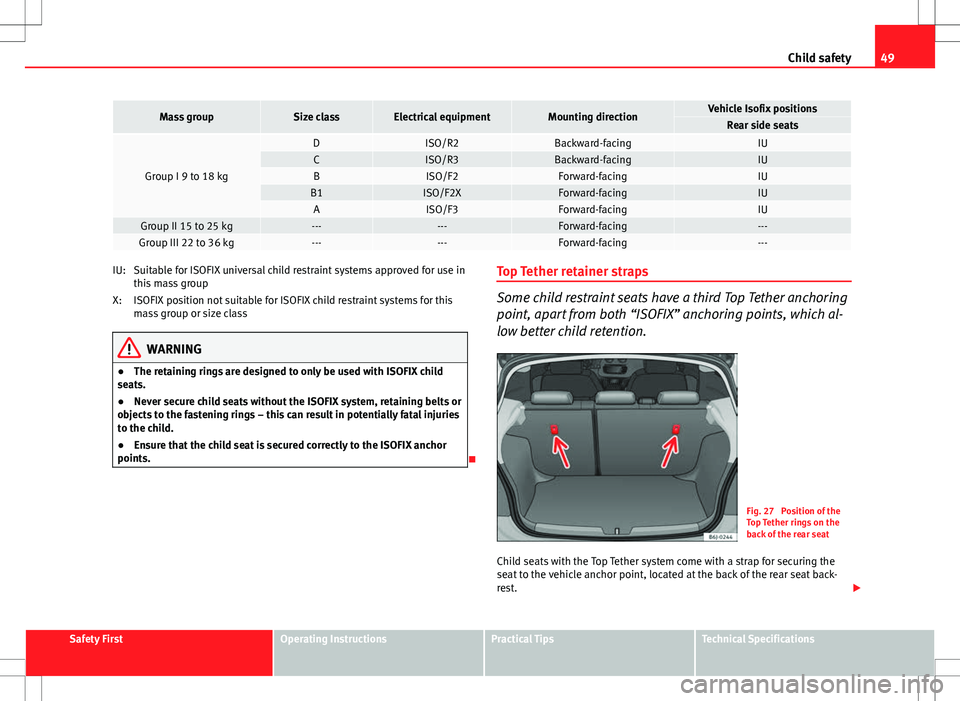
Mass groupSize classElectrical equipmentMounting directionVehicle Isofix positionsRear side seats
Group I 9 to 18 kg
DISO/R2Backward-facingIUCISO/R3Backward-facingIUBISO/F2Forward-facingIUB1ISO/F2XForward-facingIUAISO/F3Forward-facingIUGroup II 15 to 25 kg------Forward-facing---Group III 22 to 36 kg------Forward-facing---
Suitable for ISOFIX universal child restraint systems approved for use in
this mass group
ISOFIX position not suitable for ISOFIX child restraint systems for this
mass group or size class
WARNING
● The retaining rings are designed to only be used with ISOFIX child
seats.
● Never secure child seats without the ISOFIX system, retaining belts or
objects to the fastening rings – this can result in potentially fatal injuries
to the child.
● Ensure that the child seat is secured correctly to the ISOFIX anchor
points.
IU:
X:
Top Tether retainer straps
Some child restraint seats have a third Top Tether anchoring
point, apart from both “ISOFIX” anchoring points, which al-
low better child retention.
Fig. 27 Position of the
Top Tether rings on the
back of the rear seat
Child seats with the Top Tether system come with a strap for securing the
seat to the vehicle anchor point, located at the back of the rear seat back-
rest.
Safety FirstOperating InstructionsPractical TipsTechnical Specifications
Page 52 of 280
50Child safety
The retainer strap is used to reduce forwards movements of the safety seat
in a crash, helping reduce the risk of injuries to the head from hitting the
inside of the vehicle.
It is foreseen that an EU Directive will introduce requirements related to the
retention of child restraint systems by means of ISOFIX and Top Tether an-
chorages (probably compulsory for new types from 2010), which will entail
improved retention of the child restraint seat and less head movement in
case of frontal collisions.
Use of retainer straps on rear-facing seats
At present there are very few rear-facing child safety seats fitted with a re-
tainer strap. Please carefully read and follow the safety seat manufacturer's
instructions for information on how to install the retainer strap properly.
WARNING
An undue installation of the safety seat will increase the risk of injury in
the event of a crash.
● Never tie the retainer strap to a hook in the luggage compartment.
● Never secure or tie luggage or other items to the lower anchorages
(ISOFIX) or the upper ones (Top Tether).
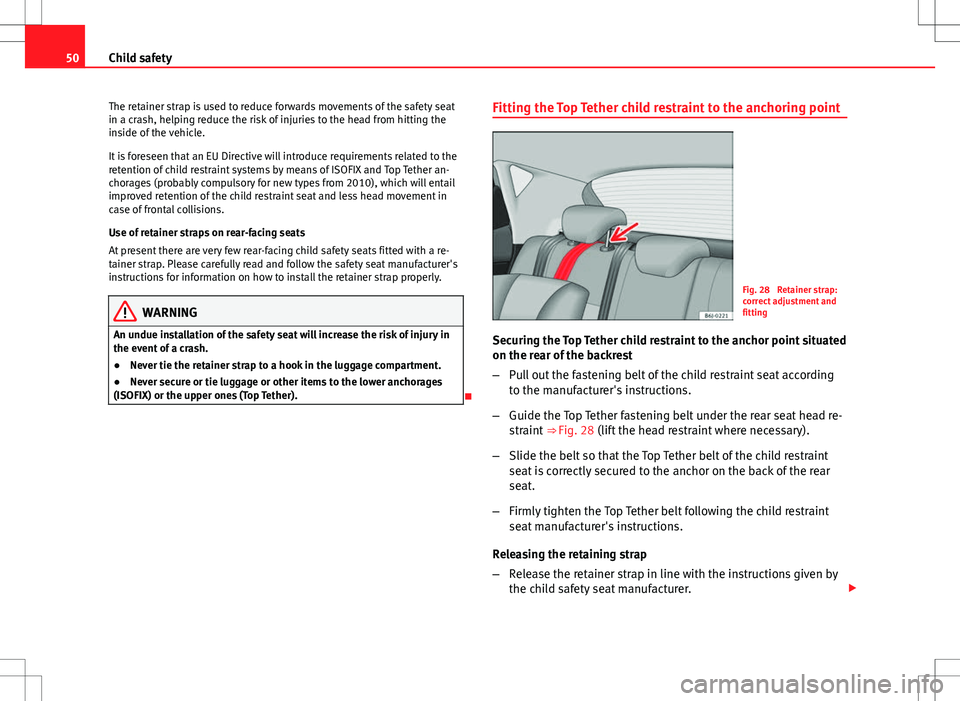
Fitting the Top Tether child restraint to the anchoring point
Fig. 28 Retainer strap:
correct adjustment and
fitting
Securing the Top Tether child restraint to the anchor point situated
on the rear of the backrest
– Pull out the fastening belt of the child restraint seat according
to the manufacturer's instructions.
– Guide the Top Tether fastening belt under the rear seat head re-
straint ⇒ Fig. 28 (lift the head restraint where necessary).
– Slide the belt so that the Top Tether belt of the child restraint
seat is correctly secured to the anchor on the back of the rear
seat.
– Firmly tighten the Top Tether belt following the child restraint
seat manufacturer's instructions.
Releasing the retaining strap
– Release the retainer strap in line with the instructions given by
the child safety seat manufacturer.
Page 66 of 280
64Cockpit
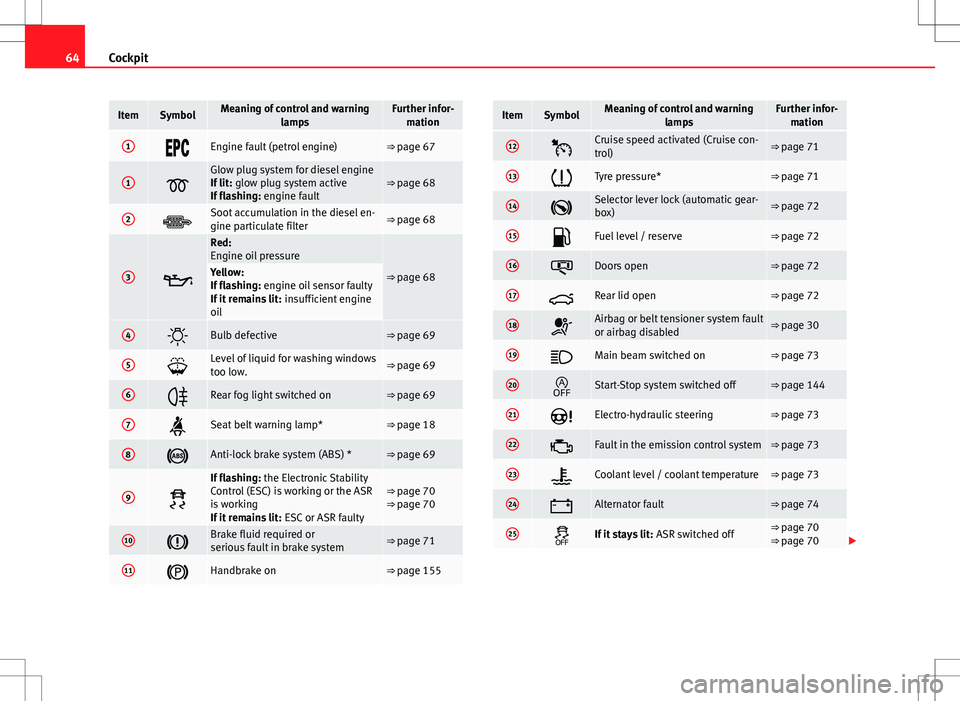
ItemSymbolMeaning of control and warning
lampsFurther infor-mation
1Engine fault (petrol engine)⇒ page 67
1
Glow plug system for diesel engine
If lit: glow plug system active
If flashing: engine fault⇒ page 68
2Soot accumulation in the diesel en-
gine particulate filter⇒ page 68
3
Red:
Engine oil pressure
⇒ page 68Yellow:
If flashing: engine oil sensor faulty
If it remains lit: insufficient engine
oil
4Bulb defective⇒ page 69
5Level of liquid for washing windows
too low.⇒ page 69
6Rear fog light switched on⇒ page 69
7Seat belt warning lamp*⇒ page 18
8Anti-lock brake system (ABS) *⇒ page 69
9
If flashing: the Electronic Stability
Control (ESC) is working or the ASR
is working
If it remains lit: ESC or ASR faulty⇒ page 70
⇒ page 70
10Brake fluid required or
serious fault in brake system⇒ page 71
11Handbrake on⇒ page 155
ItemSymbolMeaning of control and warning
lampsFurther infor-mation
12Cruise speed activated (Cruise con-
trol)⇒ page 71
13Tyre pressure*⇒ page 71
14Selector lever lock (automatic gear-
box)⇒ page 72
15Fuel level / reserve⇒ page 72
16Doors open⇒ page 72
17Rear lid open⇒ page 72
18Airbag or belt tensioner system fault
or airbag disabled⇒ page 30
19Main beam switched on⇒ page 73
20Start-Stop system switched off⇒ page 144
21Electro-hydraulic steering⇒ page 73
22Fault in the emission control system⇒ page 73
23Coolant level / coolant temperature⇒ page 73
24Alternator fault⇒ page 74
25If it stays lit: ASR switched off⇒ page 70
⇒ page 70
Page 115 of 280
113
Seats and storage compartments
Seats and storage compartments The importance of correct seat adjustment
Proper seat adjustment optimises the level of protection of-
fered by seat belts and airbags.
Your vehicle has five seats, two in the front and three in the rear. Each seat
is equipped with a three-point seat belt.
The driver seat and the front passenger seat can be adjusted in many ways
to suit the physical requirements of the vehicle occupants. The correct seat
position is very important for:
● a fast and easy operation of all controls on the instrument panel,
● a relaxed posture which does not cause drowsiness,
● a safe driving ⇒ page 7,
● ensuring that the seat belts and airbag system provide maximum pro-
tection ⇒ page 18.
WARNING
● If the driver and passengers assume improper sitting positions, they
may sustain critical injuries.
● Never transport more than the permitted amount of people in your ve-
hicle.
● Every vehicle occupant must properly fasten and wear the seat belt
belonging to his or her seat. Children must be protected with an appro-
priate child restraint system ⇒ page 42, Child safety.
● The front seats and all head restraints must always be adjusted to
body size and the seat belt must always be properly adjusted to provide
you and your passengers with optimum protection.
WARNING (Continued)
● Always keep your feet on the footwell when the vehicle is moving;
never rest them on the dash panel, out of the window or on the seat. This
is also applied to passengers. An incorrect sitting position exposes you
to an increased risk of injury in case of a sudden braking or an accident.
If the airbag is triggered, you could sustain severe injuries due to an in-
correct sitting position.
● It is important for the driver and front passenger to keep a distance of
at least 25 cm from the steering wheel and dash panel. Failure to respect
the minimum distance means that the airbag will not protect you. Risk of
fatal injury. The distance between the driver and the steering wheel or
between the front passenger and the dash panel should always be as
great as possible.
● Adjust the driver or front passenger seat only when the vehicle is sta-
tionary. Otherwise, your seat could move unexpectedly while the vehicle
is moving. This could increase the risk of an accident and therefore, in-
jury. In addition, while adjusting your seat, you will assume an incorrect
sitting position. Risk of fatal accidents.
● Special guidelines apply to installing a child seat on the front passen-
ger seat. When installing a child seat, please observe the warnings de-
scribed in ⇒ page 42, Child safety.
Safety FirstOperating InstructionsPractical TipsTechnical Specifications
Page 116 of 280
114Seats and storage compartments
Head restraints
Correct adjustment of head restraints
Properly adjusted head restraints are an important part of
passenger protection and can reduce the risk of injuries in
most accident situations.
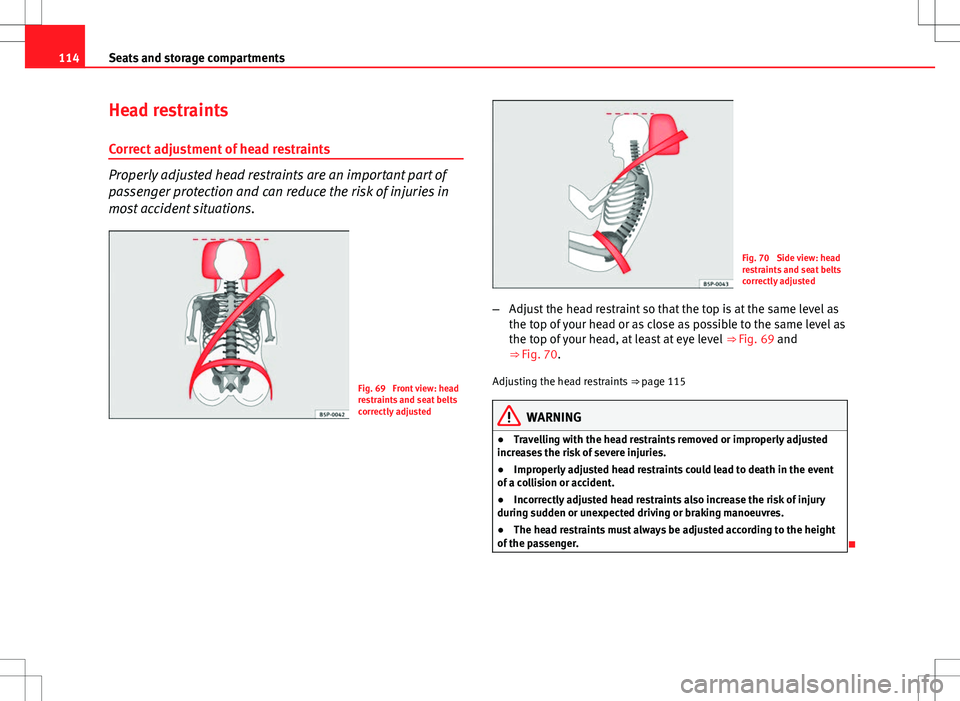
Fig. 69 Front view: head
restraints and seat belts
correctly adjusted
Fig. 70 Side view: head
restraints and seat belts
correctly adjusted
– Adjust the head restraint so that the top is at the same level as
the top of your head or as close as possible to the same level as
the top of your head, at least at eye level ⇒ Fig. 69 and
⇒ Fig. 70.
Adjusting the head restraints ⇒ page 115
WARNING
● Travelling with the head restraints removed or improperly adjusted
increases the risk of severe injuries.
● Improperly adjusted head restraints could lead to death in the event
of a collision or accident.
● Incorrectly adjusted head restraints also increase the risk of injury
during sudden or unexpected driving or braking manoeuvres.
● The head restraints must always be adjusted according to the height
of the passenger.
Page 118 of 280
116Seats and storage compartments
Front seats
Adjustment of the front seats
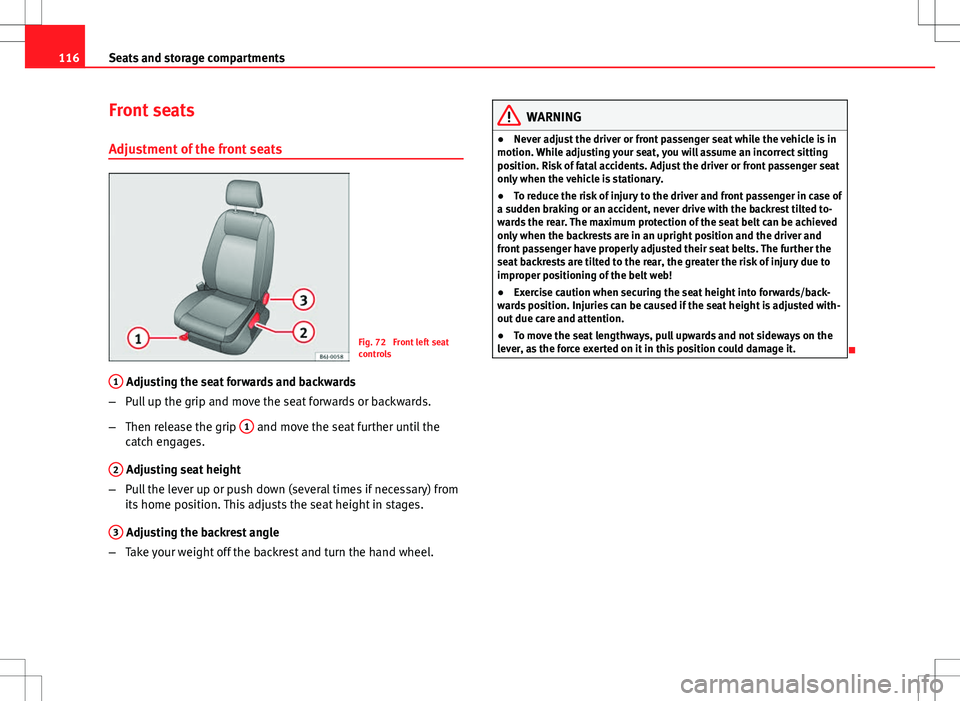
Fig. 72 Front left seat
controls
1
Adjusting the seat forwards and backwards
– Pull up the grip and move the seat forwards or backwards.
– Then release the grip 1
and move the seat further until the
catch engages.
2
Adjusting seat height
– Pull the lever up or push down (several times if necessary) from
its home position. This adjusts the seat height in stages.
3
Adjusting the backrest angle
– Take your weight off the backrest and turn the hand wheel.
WARNING
● Never adjust the driver or front passenger seat while the vehicle is in
motion. While adjusting your seat, you will assume an incorrect sitting
position. Risk of fatal accidents. Adjust the driver or front passenger seat
only when the vehicle is stationary.
● To reduce the risk of injury to the driver and front passenger in case of
a sudden braking or an accident, never drive with the backrest tilted to-
wards the rear. The maximum protection of the seat belt can be achieved
only when the backrests are in an upright position and the driver and
front passenger have properly adjusted their seat belts. The further the
seat backrests are tilted to the rear, the greater the risk of injury due to
improper positioning of the belt web!
● Exercise caution when securing the seat height into forwards/back-
wards position. Injuries can be caused if the seat height is adjusted with-
out due care and attention.
● To move the seat lengthways, pull upwards and not sideways on the
lever, as the force exerted on it in this position could damage it.