technical specifications Seat Ibiza 5D 2012 Repair Manual
[x] Cancel search | Manufacturer: SEAT, Model Year: 2012, Model line: Ibiza 5D, Model: Seat Ibiza 5D 2012Pages: 280, PDF Size: 3.66 MB
Page 125 of 280
123
Seats and storage compartments
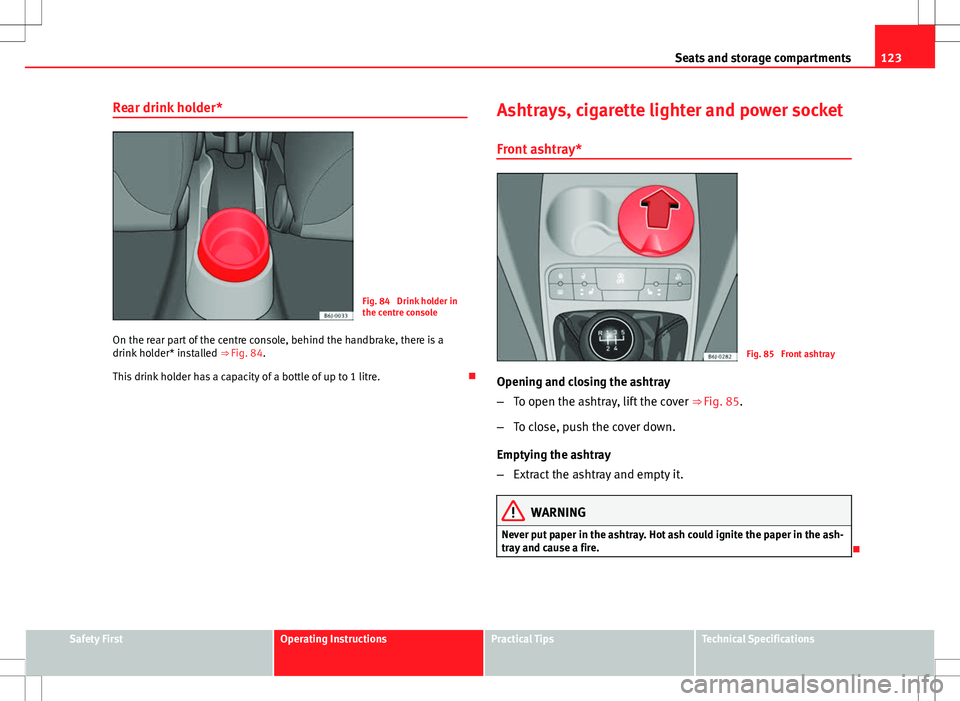
Rear drink holder*
Fig. 84 Drink holder in
the centre console
On the rear part of the centre console, behind the handbrake, there is a
drink holder* installed ⇒ Fig. 84.
This drink holder has a capacity of a bottle of up to 1 litre. Ashtrays, cigarette lighter and power socket
Front ashtray*
Fig. 85 Front ashtray
Opening and closing the ashtray
– To open the ashtray, lift the cover ⇒ Fig. 85.
– To close, push the cover down.
Emptying the ashtray
– Extract the ashtray and empty it.
WARNING
Never put paper in the ashtray. Hot ash could ignite the paper in the ash-
tray and cause a fire.
Safety FirstOperating InstructionsPractical TipsTechnical Specifications
Page 127 of 280
125
Seats and storage compartments
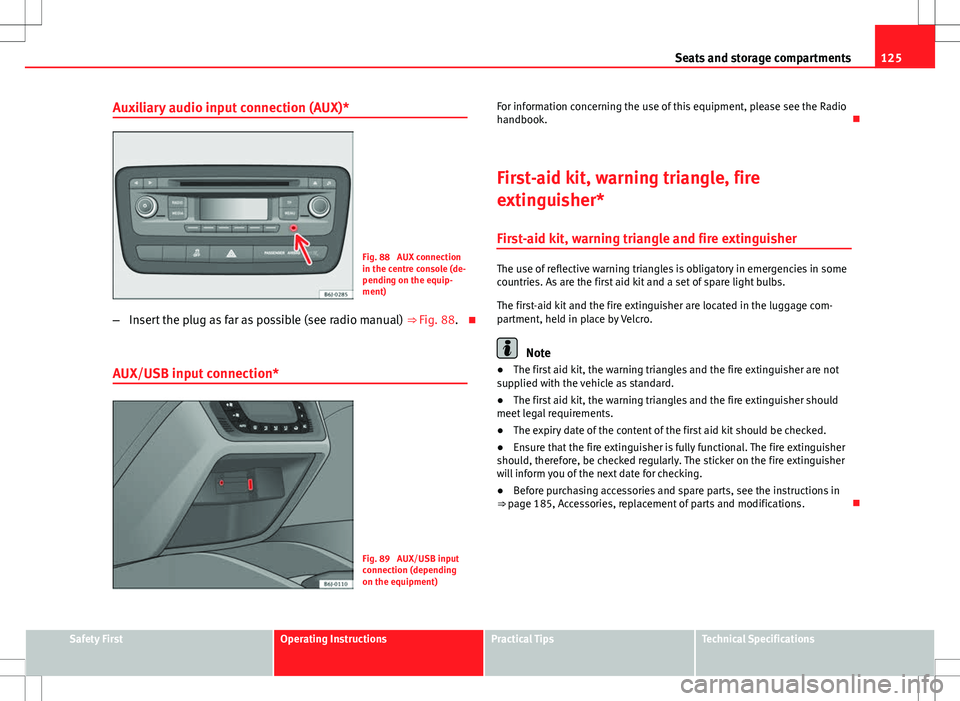
Auxiliary audio input connection (AUX)*
Fig. 88 AUX connection
in the centre console (de-
pending on the equip-
ment)
– Insert the plug as far as possible (see radio manual) ⇒ Fig. 88.
AUX/USB input connection*
Fig. 89 AUX/USB input
connection (depending
on the equipment) For information concerning the use of this equipment, please see the Radio
handbook.
First-aid kit, warning triangle, fire
extinguisher* First-aid kit, warning triangle and fire extinguisher
The use of reflective warning triangles is obligatory in emergencies in some
countries. As are the first aid kit and a set of spare light bulbs.
The first-aid kit and the fire extinguisher are located in the luggage com-
partment, held in place by Velcro.
Note
● The first aid kit, the warning triangles and the fire extinguisher are not
supplied with the vehicle as standard.
● The first aid kit, the warning triangles and the fire extinguisher should
meet legal requirements.
● The expiry date of the content of the first aid kit should be checked.
● Ensure that the fire extinguisher is fully functional. The fire extinguisher
should, therefore, be checked regularly. The sticker on the fire extinguisher
will inform you of the next date for checking.
● Before purchasing accessories and spare parts, see the instructions in
⇒ page 185, Accessories, replacement of parts and modifications.
Safety FirstOperating InstructionsPractical TipsTechnical Specifications
Page 129 of 280
127
Seats and storage compartments
CAUTION
● Before closing the rear lid, ensure that the rear shelf is correctly fitted.
● An overloaded luggage compartment could mean that the rear shelf is
not correctly seated and it may be bent or damaged.
● If the luggage compartment is overloaded, remove the tray.
Note
● Ensure that, when placing items of clothing on the luggage compart-
ment cover, rear visibility is not reduced.
Roof rack*
Please observe the following points if you intend to carry loads on the roof:
● For safety reasons, only luggage racks and accessories supplied by SEAT
Official Services should be used.
● It is imperative to precisely follow the fitting instructions included for the
rack, taking special care when fitting the front bar in the holes designed for
this and the rear bar between the marks on the upper part of the rear door
frame while respecting the correct direction of travel indicated in the instal-
lation manual. Not following these instructions may damage the bodywork.
● Pay special attention to the tightening torque of the attachment bolts
and check them following a short journey. If necessary, retighten the bolts
and check them at regular intervals. ●
Distribute the load evenly. A maximum load of 40 kg only is permitted
for each roof rack system support bar, the load must be distributed evenly
along the entire length. However, the maximum load permitted for the en-
tire roof (including the support system) of 75 kg must not be exceeded nor
should the total weight of the vehicle be exceeded. See the Technical Data
section.
● When transporting heavy or large objects on the roof, any change in the
normal vehicle behaviour due to a change in the centre of gravity or an in-
creased wind resistance must be taken into account. For this reason, a suit-
able speed and driving style must be used.
● For those vehicles fitted with a sliding/tilting sunroof*, ensure that it
does not interfere with the load on the roof rack system when opened.
Safety FirstOperating InstructionsPractical TipsTechnical Specifications
Page 131 of 280
129
Air conditioning
WARNING
● For your safety, the windows should never be fogged up or covered
with snow or ice. This is essential to ensure good visibility. Please famili-
arise yourself with the correct operation of the heating and ventilation
system, including the demist/defrost functions for the windows.
● In air recirculation mode, no cold air from the outside enters the vehi-
cle interior. The windows can quickly fog over if the heating is switched
off. Therefore, never leave the air recirculation mode switched on for a
long time (risk of accident).
Note
● Please consider the general notes ⇒ page 136.
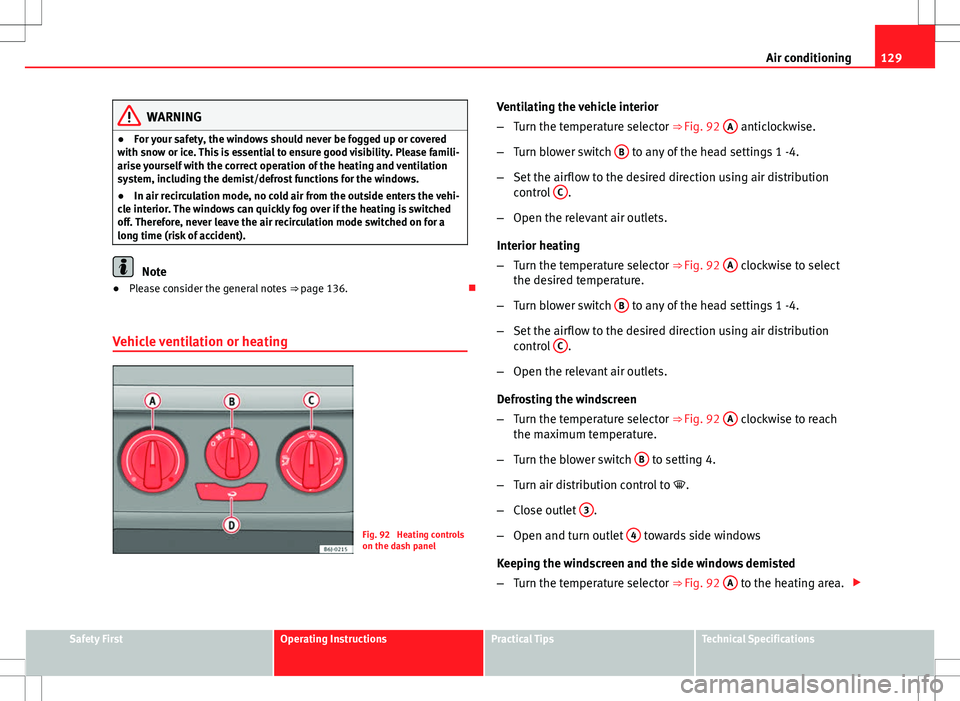
Vehicle ventilation or heating
Fig. 92 Heating controls
on the dash panel Ventilating the vehicle interior
–
Turn the temperature selector ⇒ Fig. 92 A
anticlockwise.
– Turn blower switch B
to any of the head settings 1 -4.
– Set the airflow to the desired direction using air distribution
control C
.
– Open the relevant air outlets.
Interior heating
– Turn the temperature selector ⇒ Fig. 92 A
clockwise to select
the desired temperature.
– Turn blower switch B
to any of the head settings 1 -4.
– Set the airflow to the desired direction using air distribution
control C
.
– Open the relevant air outlets.
Defrosting the windscreen
– Turn the temperature selector ⇒ Fig. 92 A
clockwise to reach
the maximum temperature.
– Turn the blower switch B
to setting 4.
– Turn air distribution control to .
– Close outlet 3
.
– Open and turn outlet 4
towards side windows
Keeping the windscreen and the side windows demisted
– Turn the temperature selector ⇒ Fig. 92 A
to the heating area.
Safety FirstOperating InstructionsPractical TipsTechnical Specifications
Page 133 of 280
131
Air conditioning
Air distribution C
Switch on symbolMain air output through outlets:
1,2
5
1, 2, 5
-3, 4
Outlets 3 and 4 can be closed or opened separately and the air flow di-
rected as required.
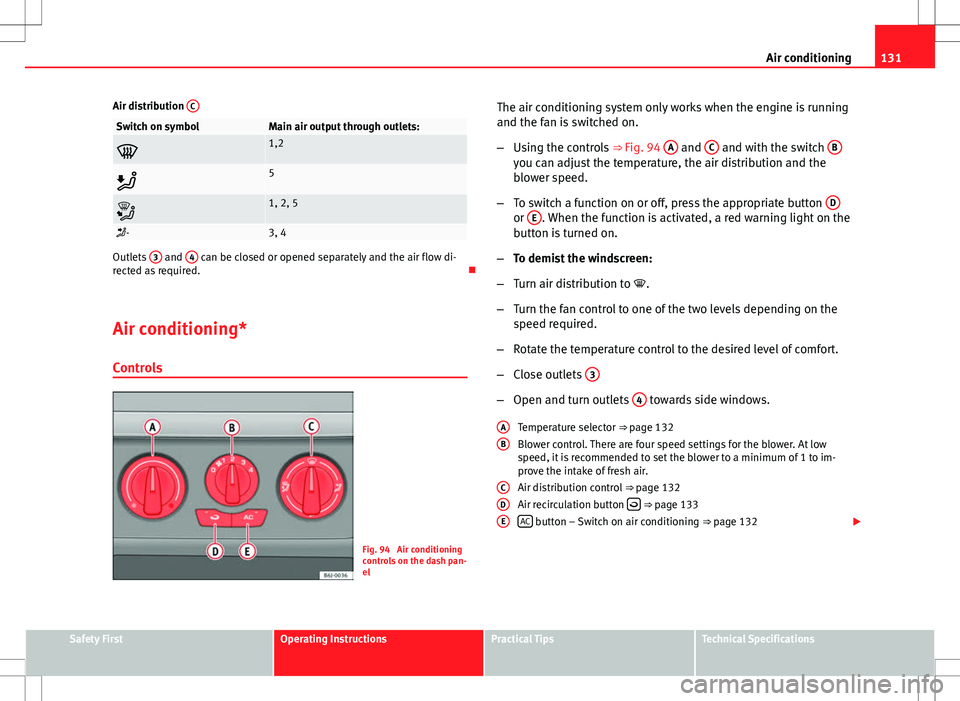
Air conditioning* Controls
Fig. 94 Air conditioning
controls on the dash pan-
el The air conditioning system only works when the engine is running
and the fan is switched on.
–
Using the controls ⇒ Fig. 94 A
and C and with the switch Byou can adjust the temperature, the air distribution and the
blower speed.
– To switch a function on or off, press the appropriate button D
or E. When the function is activated, a red warning light on the
button is turned on.
– To demist the windscreen:
– Turn air distribution to .
– Turn the fan control to one of the two levels depending on the
speed required.
– Rotate the temperature control to the desired level of comfort.
– Close outlets 3
–
Open and turn outlets 4 towards side windows.
Temperature selector ⇒ page 132
Blower control. There are four speed settings for the blower. At low
speed, it is recommended to set the blower to a minimum of 1 to im-
prove the intake of fresh air.
Air distribution control ⇒ page 132
Air recirculation button
⇒ page 133
AC button – Switch on air conditioning ⇒ page 132
A
B
CDE
Safety FirstOperating InstructionsPractical TipsTechnical Specifications
Page 135 of 280
133
Air conditioning
● The outside temperature is below +3 °C.
● The air conditioning system compressor has been temporarily switched
off because of an increased engine coolant temperature.
● The air conditioner fuse is faulty.
● Another fault in the vehicle. Have the air conditioning checked by a spe-
cialised workshop.
Air recirculation
Air recirculation mode prevents fumes or unpleasant smells
from coming from the outside.
When air recirculation mode is switched on (button ⇒ Fig. 95
with warn-
ing lamp) strong odours in the outside air do not enter the vehicle interior,
for example when passing through a tunnel or in a traffic jam.
When the outside temperature is low, air recirculation mode improves heat-
ing performance by heating air from the interior instead of cold air from the
outside.
When the outside temperature is high, air recirculation mode improves cool-
ing performance by cooling air from the interior instead of warm air from
outside.
For safety reasons, the air recirculation should not be switched on when the
air distribution control is set to the windscreen setting .
WARNING
In air recirculation mode, no cold air from the outside enters the vehicle
interior. If the air conditioner is switched off, the windows can quickly
mist over. Therefore, never leave the air recirculation mode switched on
for a long time (risk of accident).
Note
● When engaging reverse gear, the air recirculation is connected automat-
ically to prevent the entrance of exhaust gases in the vehicle on travelling
backwards. The control lamp on the button
does not light up.
● If the temperature control is turned to the coldest setting (blue point)
and the switch AC
is activated, the “Air recirculation” function is automati-
cally activated in order to cool the vehicle rapidly using less energy; its
function control lamp will light.
● If the function is not deactivated by pressing the button, this will deacti-
vate after approx. 20 min.
Economic use of the air conditioning
When the air conditioning is switched on, the compressor consumes engine
power and has influence on fuel consumption. Consider the following
points in order to have the system operating in the minimum possible time.
● If the vehicle interior has overheated due to an excessive solar radiation,
it is best to open the windows or doors to allow the hot air to escape.
● While in motion, the air conditioning should not be switched on if the
windows or the sunroof* are open.
Safety FirstOperating InstructionsPractical TipsTechnical Specifications
Page 137 of 280
135
Air conditioning
Automatic mode
In automatic mode air temperature, air flow and distribution
are automatically regulated so that a specified temperature
is attained as quickly as possible, and then maintained. Switching on automatic mode
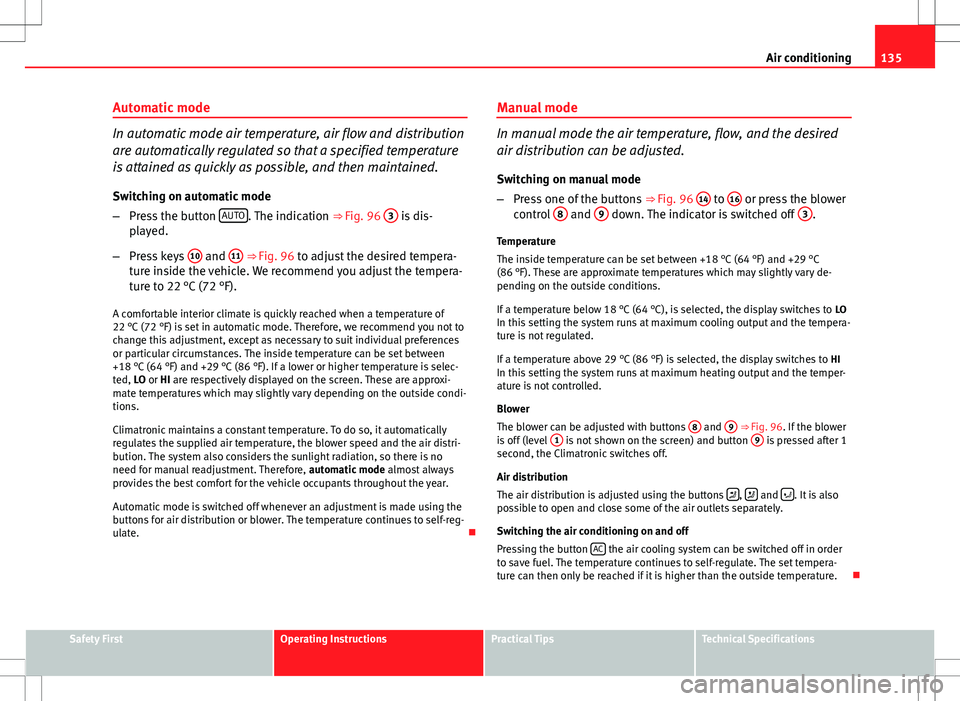
– Press the button AUTO
. The indication
⇒ Fig. 96 3 is dis-
played.
– Press keys 10
and 11 ⇒ Fig. 96 to adjust the desired tempera-
ture inside the vehicle. We recommend you adjust the tempera-
ture to 22 °C (72 °F).
A comfortable interior climate is quickly reached when a temperature of
22 °C (72 °F) is set in automatic mode. Therefore, we recommend you not to
change this adjustment, except as necessary to suit individual preferences
or particular circumstances. The inside temperature can be set between
+18 °C (64 °F) and +29 °C (86 °F). If a lower or higher temperature is selec-
ted, LO or HI are respectively displayed on the screen. These are approxi-
mate temperatures which may slightly vary depending on the outside condi-
tions.
Climatronic maintains a constant temperature. To do so, it automatically
regulates the supplied air temperature, the blower speed and the air distri-
bution. The system also considers the sunlight radiation, so there is no
need for manual readjustment. Therefore, automatic mode almost always
provides the best comfort for the vehicle occupants throughout the year.
Automatic mode is switched off whenever an adjustment is made using the
buttons for air distribution or blower. The temperature continues to self-reg-
ulate. Manual mode
In manual mode the air temperature, flow, and the desired
air distribution can be adjusted.
Switching on manual mode
– Press one of the buttons ⇒ Fig. 96 14
to 16 or press the blower
control 8 and 9 down. The indicator is switched off 3.
Temperature
The inside temperature can be set between +18 °C (64 °F) and +29 °C
(86 °F). These are approximate temperatures which may slightly vary de-
pending on the outside conditions.
If a temperature below 18 °C (64 °C), is selected, the display switches to LO
In this setting the system runs at maximum cooling output and the tempera-
ture is not regulated.
If a temperature above 29 °C (86 °F) is selected, the display switches to HI
In this setting the system runs at maximum heating output and the temper-
ature is not controlled.
Blower
The blower can be adjusted with buttons 8
and 9 ⇒ Fig. 96. If the blower
is off (level 1 is not shown on the screen) and button 9 is pressed after 1
second, the Climatronic switches off.
Air distribution
The air distribution is adjusted using the buttons
, and . It is also
possible to open and close some of the air outlets separately.
Switching the air conditioning on and off
Pressing the button AC
the air cooling system can be switched off in order
to save fuel. The temperature continues to self-regulate. The set tempera-
ture can then only be reached if it is higher than the outside temperature.
Safety FirstOperating InstructionsPractical TipsTechnical Specifications
Page 139 of 280
137
Air conditioning
● The air conditioner operates most effectively with the windows and the
sliding/tilting sunroof* closed. However, if the temperature inside the vehi-
cle is excessive because of the sun, the air inside can be cooled faster by
opening the windows for a short time.
● Do not smoke while air recirculation mode is on, as smoke drawn into
the air conditioning system leaves a residue on the evaporator, producing a
permanent unpleasant odour.
● At low outside temperatures the compressor switches off automatically.
The AUTO
button cannot be switched on either.
● It is advisable to connect the air conditioning at least once a month, to
lubricate the system gaskets and prevent leaks. If a decrease in the cooling
capacity is detected, a Technical Service should be consulted to check the
system.
● To ensure correct operation, the grilles on both sides of the screen must
not be obstructed
● When the engine is under extreme strain, switch off the compressor for a
moment.
Safety FirstOperating InstructionsPractical TipsTechnical Specifications
Page 141 of 280
139
Driving
Safety Electronic stability control (ESC)*
The ESC helps make driving safer in extreme driving condi-
tions.
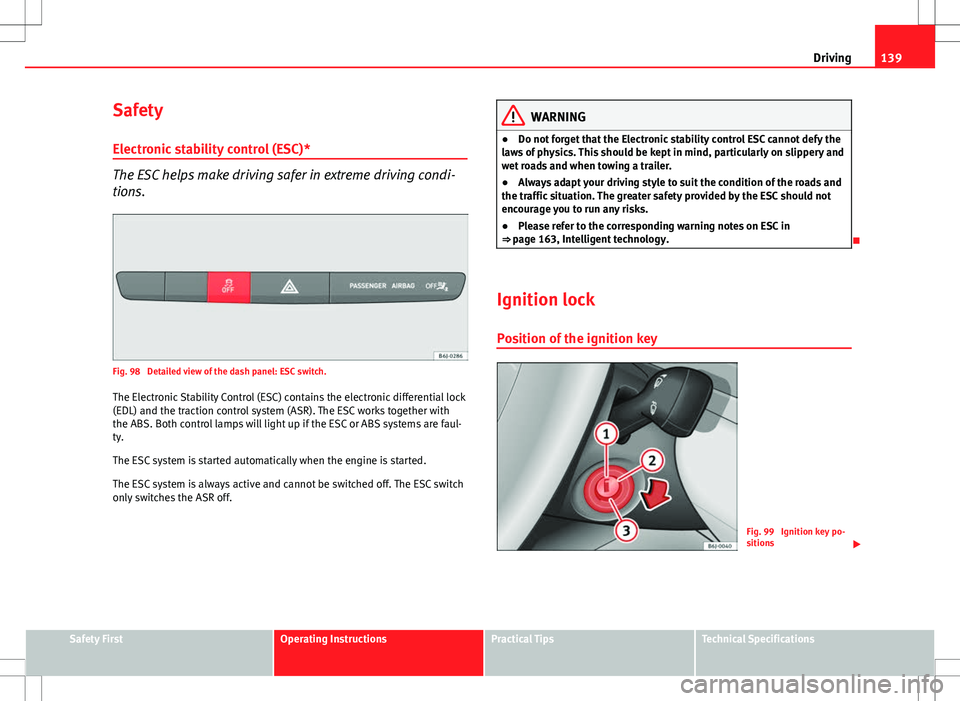
Fig. 98 Detailed view of the dash panel: ESC switch.
The Electronic Stability Control (ESC) contains the electronic differential lock
(EDL) and the traction control system (ASR). The ESC works together with
the ABS. Both control lamps will light up if the ESC or ABS systems are faul-
ty.
The ESC system is started automatically when the engine is started.
The ESC system is always active and cannot be switched off. The ESC switch
only switches the ASR off.
WARNING
● Do not forget that the Electronic stability control ESC cannot defy the
laws of physics. This should be kept in mind, particularly on slippery and
wet roads and when towing a trailer.
● Always adapt your driving style to suit the condition of the roads and
the traffic situation. The greater safety provided by the ESC should not
encourage you to run any risks.
● Please refer to the corresponding warning notes on ESC in
⇒ page 163, Intelligent technology.
Ignition lock Position of the ignition key
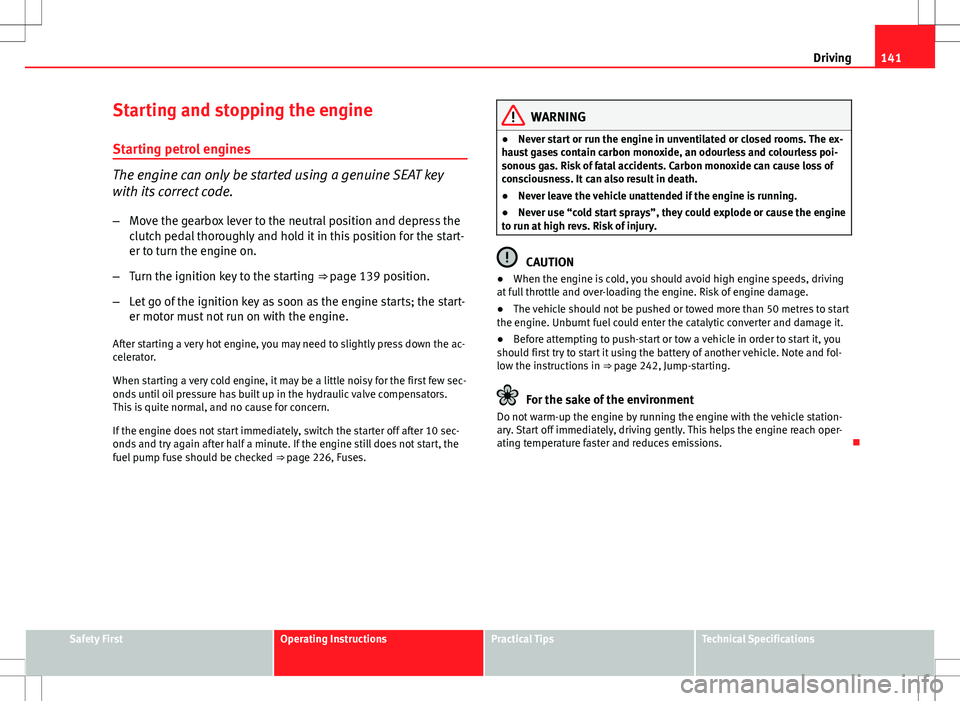
Fig. 99 Ignition key po-
sitions
Safety FirstOperating InstructionsPractical TipsTechnical Specifications
Page 143 of 280
141
Driving
Starting and stopping the engine Starting petrol engines
The engine can only be started using a genuine SEAT key
with its correct code.
– Move the gearbox lever to the neutral position and depress the
clutch pedal thoroughly and hold it in this position for the start-
er to turn the engine on.
– Turn the ignition key to the starting ⇒ page 139 position.
– Let go of the ignition key as soon as the engine starts; the start-
er motor must not run on with the engine.
After starting a very hot engine, you may need to slightly press down the ac-
celerator.
When starting a very cold engine, it may be a little noisy for the first few sec-
onds until oil pressure has built up in the hydraulic valve compensators.
This is quite normal, and no cause for concern.
If the engine does not start immediately, switch the starter off after 10 sec-
onds and try again after half a minute. If the engine still does not start, the
fuel pump fuse should be checked ⇒ page 226, Fuses.
WARNING
● Never start or run the engine in unventilated or closed rooms. The ex-
haust gases contain carbon monoxide, an odourless and colourless poi-
sonous gas. Risk of fatal accidents. Carbon monoxide can cause loss of
consciousness. It can also result in death.
● Never leave the vehicle unattended if the engine is running.
● Never use “cold start sprays”, they could explode or cause the engine
to run at high revs. Risk of injury.
CAUTION
● When the engine is cold, you should avoid high engine speeds, driving
at full throttle and over-loading the engine. Risk of engine damage.
● The vehicle should not be pushed or towed more than 50 metres to start
the engine. Unburnt fuel could enter the catalytic converter and damage it.
● Before attempting to push-start or tow a vehicle in order to start it, you
should first try to start it using the battery of another vehicle. Note and fol-
low the instructions in ⇒ page 242, Jump-starting.
For the sake of the environment
Do not warm-up the engine by running the engine with the vehicle station-
ary. Start off immediately, driving gently. This helps the engine reach oper-
ating temperature faster and reduces emissions.
Safety FirstOperating InstructionsPractical TipsTechnical Specifications