refuelling Seat Ibiza 5D 2012 Owner's manual
[x] Cancel search | Manufacturer: SEAT, Model Year: 2012, Model line: Ibiza 5D, Model: Seat Ibiza 5D 2012Pages: 280, PDF Size: 3.66 MB
Page 6 of 280
Accessories, replacement of parts and
modifications . . . . . . . . . . . . . . . . . . . . . . . . . . . . . 185
Accessories and spare parts . . . . . . . . . . . . . . . . 185
Technical modifications . . . . . . . . . . . . . . . . . . . . 185
Roof aerial* . . . . . . . . . . . . . . . . . . . . . . . . . . . . . . 186
Mobile telephones and two-way radios . . . . . . . . 186
Fitting a towing bracket* . . . . . . . . . . . . . . . . . . . 187
Checking and refilling levels . . . . . . . . . . . . . . . 189
Refuelling . . . . . . . . . . . . . . . . . . . . . . . . . . . . . . . 189
LPG system* . . . . . . . . . . . . . . . . . . . . . . . . . . . . . 191
Petrol . . . . . . . . . . . . . . . . . . . . . . . . . . . . . . . . . . . 194
Diesel . . . . . . . . . . . . . . . . . . . . . . . . . . . . . . . . . . . 194
Working in the engine compartment . . . . . . . . . . 195
Engine oil . . . . . . . . . . . . . . . . . . . . . . . . . . . . . . . . 198
Coolant . . . . . . . . . . . . . . . . . . . . . . . . . . . . . . . . . 202
Washer fluid and windscreen wiper blades . . . . 204
Brake fluid . . . . . . . . . . . . . . . . . . . . . . . . . . . . . . . 208
Vehicle battery . . . . . . . . . . . . . . . . . . . . . . . . . . . 209
Wheels . . . . . . . . . . . . . . . . . . . . . . . . . . . . . . . . . . 211
If and when . . . . . . . . . . . . . . . . . . . . . . . . . . . . . . . 218
Vehicle tools, spare wheel . . . . . . . . . . . . . . . . . . 218
Wheel change . . . . . . . . . . . . . . . . . . . . . . . . . . . . 219
Tyre repair kit* (Tyre Mobility-System) . . . . . . . . . 224
Fuses . . . . . . . . . . . . . . . . . . . . . . . . . . . . . . . . . . . 226
Bulb change . . . . . . . . . . . . . . . . . . . . . . . . . . . . . 229
Single headlight bulb change . . . . . . . . . . . . . . . 231
Double headlight bulb change . . . . . . . . . . . . . . . 233
Changing the bulbs of AFS headlights . . . . . . . . 237
Changing the fog light bulbs . . . . . . . . . . . . . . . . 238
Changing the rear, side and interior light bulbs . 239
Jump-starting . . . . . . . . . . . . . . . . . . . . . . . . . . . . . 242
Towing and tow-starting . . . . . . . . . . . . . . . . . . . . 246 Technical Specifications
. . . . . . . . . . . 249
Description of specifications . . . . . . . . . . . . . . . 249
Important information . . . . . . . . . . . . . . . . . . . . . 249
Information on fuel consumption . . . . . . . . . . . . 251
Towing a trailer . . . . . . . . . . . . . . . . . . . . . . . . . . . 251
Wheels . . . . . . . . . . . . . . . . . . . . . . . . . . . . . . . . . . 252
Technical specifications . . . . . . . . . . . . . . . . . . . . 253
Checking fluid levels . . . . . . . . . . . . . . . . . . . . . . . 253
Petrol engine 1.2 44 kW (60 PS) . . . . . . . . . . . . . 254
Petrol engine 1.2 51 kW (70 PS) . . . . . . . . . . . . . 255
Petrol engine 1.2 TSI 63 kW (85 PS) . . . . . . . . . . 256
Petrol engine/LPG 1.6 60 kW (81 PS) . . . . . . . . . 257
Petrol engine 1.4 63 kW (85 PS) . . . . . . . . . . . . . 258
Petrol engine 1.2 TSI 77 kW (105 PS) . . . . . . . . . 259
Petrol engine 1.2 TSI 77 kW (105 PS) Start-Stop 260
Petrol engine 1.6 77 kW (105 PS) . . . . . . . . . . . . 261
Petrol engine 1.4 110 kW (150 PS) . . . . . . . . . . . 262
Diesel engine 1.2 TDI CR 55 kW (75 PS) DPF
Start-Stop Ecomotive . . . . . . . . . . . . . . . . . . . . . . 263
Diesel engine 1.2 TDI CR 55 kW (75 PS) DPF . . . . 264
Diesel engine 1.6 TDI CR 66 kW (90 PS) DPF . . . . 265
Diesel engine 1.6 TDI CR 77 kW (105 PS) with/
without DPF . . . . . . . . . . . . . . . . . . . . . . . . . . . . . . 266
Diesel engine 2.0 TDI CR 105 kW (143 PS) DPF . 267
Dimensions and capacities . . . . . . . . . . . . . . . . . 268
Index . . . . . . . . . . . . . . . . . . . . . . . . . . . . . . . . . . . 269
4Table of Contents
Page 58 of 280
56Cockpit
Rev counter
The rev counter displays the engine speed in revolutions per
minute.
The start of the red zone ⇒ Fig. 30 1
indicates the maximum engine speed
operating at service temperature. However, it is advisable to change up into
a higher gear, move the selector lever to D or lift your foot off the accelerator
before the needle reaches the red zone.
CAUTION
To prevent possible engine malfunctions, the rev counter needle should not
reach the red zone. The start of the red zone on the dial is different for some
engine versions.
For the sake of the environment
Changing up into higher gears sooner, following the recommended gear in-
dications ⇒ Fig. 33 will help you to reduce fuel consumption, emissions and
also engine noise.
Speedometer
The speedometer is equipped with a digital odometer and a trip recorder, in
addition to a service intervals display.
During the running-in period, the instructions shown on ⇒ page 168
should be followed. LPG system*
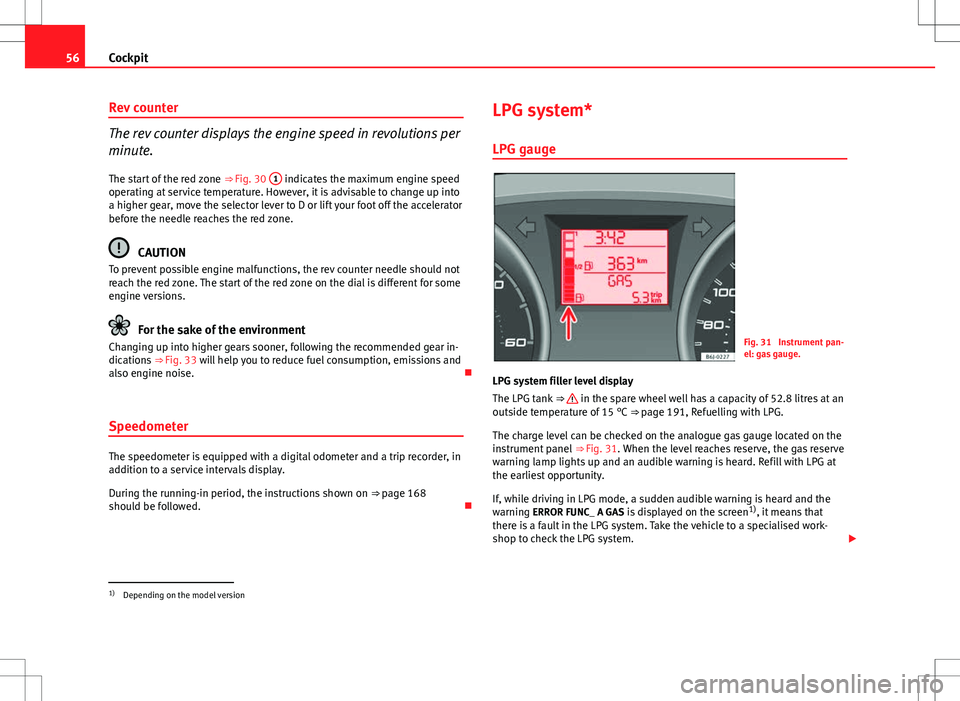
LPG gauge
Fig. 31 Instrument pan-
el: gas gauge.
LPG system filler level display
The LPG tank ⇒
in the spare wheel well has a capacity of 52.8 litres at an
outside temperature of 15 °C ⇒ page 191, Refuelling with LPG.
The charge level can be checked on the analogue gas gauge located on the
instrument panel ⇒ Fig. 31. When the level reaches reserve, the gas reserve
warning lamp lights up and an audible warning is heard. Refill with LPG at
the earliest opportunity.
If, while driving in LPG mode, a sudden audible warning is heard and the
warning ERROR FUNC_ A GAS is displayed on the screen 1)
, it means that
there is a fault in the LPG system. Take the vehicle to a specialised work-
shop to check the LPG system.
1)
Depending on the model version
Page 144 of 280
142Driving
Starting diesel engines
The engine can only be started using a genuine SEAT key
with its correct code.
– Move the gearbox lever to the neutral position and depress the
clutch pedal thoroughly and hold it in this position for the start-
er to turn the engine on.
– Turn the ignition key to the starting position.
– Turn the ignition key to position ⇒ Fig. 99 2
. The warning lamp
will light for engine pre-heating.
– When the lamp turns off, turn the ignition key to position 3
to
start the engine. Do not press the accelerator.
– Let go of the ignition key as soon as the engine starts, the start-
er motor must not be allowed to run on with the engine.
When starting a very cold engine, it may be a little noisy for the first few sec-
onds until oil pressure has built up in the hydraulic valve compensators.
This is quite normal, and no cause for concern.
If there are problems starting the engine, see the ⇒ page 242.
Glow plug system for the diesel engine
To avoid unnecessary discharging of the battery, do not use any other major
electrical equipment while the glow plugs are pre-heating.
Start the engine as soon as the glow plug warning lamp goes out.
Starting the diesel engine after the fuel tank has been completely run dry
If the fuel tank has been completely run dry, it may take longer than normal
(up to one minute) to start a diesel engine after refuelling. This is because
the fuel system must eliminate air first.
WARNING
● Never start or run the engine in unventilated or closed rooms. The ex-
haust gases contain carbon monoxide, an odourless and colourless poi-
sonous gas. Risk of fatal accidents. Carbon monoxide can cause loss of
consciousness. It can also result in death.
● Never leave the vehicle unattended if the engine is running.
● Never use “cold start sprays”, they could explode or cause the engine
to run at high revs. Risk of injury.
CAUTION
● When the engine is cold, you should avoid high engine speeds, driving
at full throttle and over-loading the engine. Risk of engine damage.
● The vehicle should not be pushed or towed more than 50 metres to start
the engine. Unburnt fuel could enter the catalytic converter and damage it.
● Before attempting to push-start or tow a vehicle in order to start it, you
should first try to start it using the battery of another vehicle. Note and fol-
low the instructions in ⇒ page 242, Jump-starting.
For the sake of the environment
Do not warm-up the engine by running the engine with the vehicle station-
ary. You should drive off as soon as you start the engine. This helps the en-
gine reach operating temperature faster and reduces emissions.
Switching off the engine
– Stop the vehicle.
– Turn the ignition key to position ⇒ Fig. 99 1
.
After switching the engine off, the radiator fan may run on for up to 10 mi-
nutes. It is also possible that the fan turns itself on once more if the coolant
Page 145 of 280
143
Driving
temperature increases due to the heat accumulated in the engine compart-
ment or due to its prolonged exposure to solar radiation.
WARNING
● Never switch the engine off until the vehicle is completely stationary.
● The brake servo works only when the engine is running. With the en-
gine switched off, more strength is needed to brake. As normal brake op-
eration cannot be performed, risk of accidents and serious injury may ex-
ist.
● The steering lock can be immediately blocked once the key is re-
moved from the ignition. The vehicle cannot be steered. Risk of accident.
CAUTION
When the engine has been running under a heavy load for a long period,
heat can accumulate in the engine compartment and cause engine damage.
For this reason, you should idle the engine for approx. 2 minutes before you
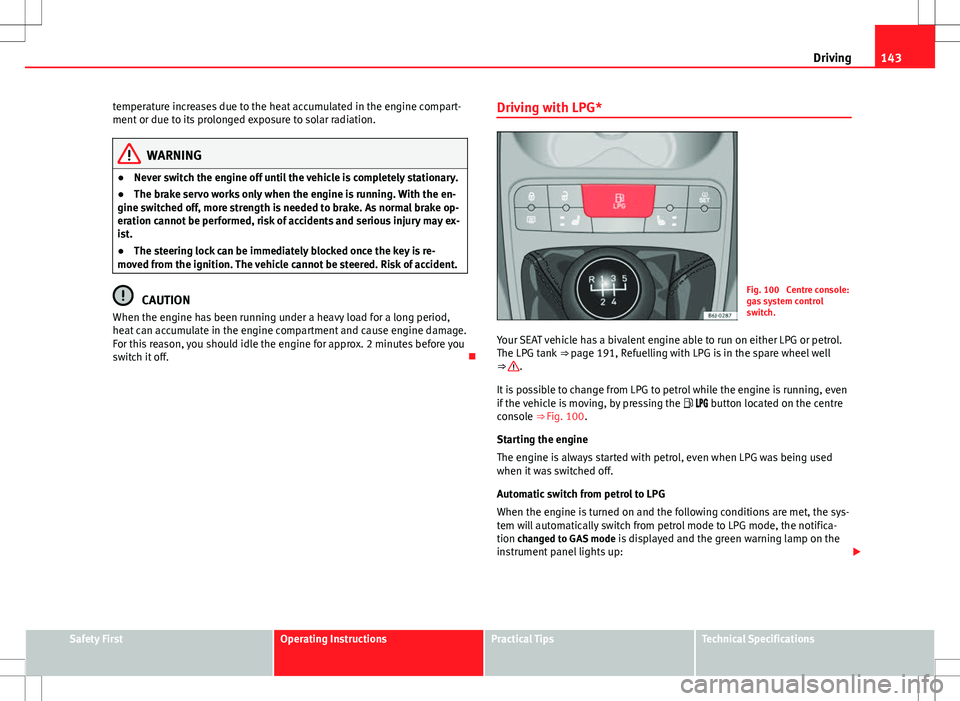
switch it off. Driving with LPG*Fig. 100 Centre console:
gas system control
switch.
Your SEAT vehicle has a bivalent engine able to run on either LPG or petrol.
The LPG tank ⇒ page 191, Refuelling with LPG is in the spare wheel well
⇒
.
It is possible to change from LPG to petrol while the engine is running, even
if the vehicle is moving, by pressing the button located on the centre
console ⇒ Fig. 100.
Starting the engine
The engine is always started with petrol, even when LPG was being used
when it was switched off.
Automatic switch from petrol to LPG
When the engine is turned on and the following conditions are met, the sys-
tem will automatically switch from petrol mode to LPG mode, the notifica-
tion changed to GAS mode is displayed and the green warning lamp on the
instrument panel lights up:
Safety FirstOperating InstructionsPractical TipsTechnical Specifications
Page 175 of 280
173
Driving and the environment
● Reduction of volatile compounds in plastics
● CFC-free refrigerant in air conditioner
Compliance with prohibited materials regulation : cadmium, lead, mercury,
chrome VI.
Manufacturing methods
● Use of recycled material for manufacturing plastic parts
● Solvent-free cavity sealing
● Solvent-free wax for protecting the vehicles in transit
● Solvent-free adhesives
● No CFCs used in production
● Surplus materials used extensively for energy conversion and building
materials
● Overall water consumption reduced
● Heat recovery systems
● The use of water-soluble paints
Driving abroad Observations
To drive abroad, the following must be taken into consideration:
● For vehicles fitted with a catalytic converter ensure that unleaded petrol
is available for the journey. See the chapter “Refuelling”. Automobile organ-
isations will have information about service station networks selling unlea-
ded fuel.
● In some countries, it is possible that your vehicle model is not sold, and
therefore spare parts are not available or the Technical Services can only
carry out limited repairs. SEAT importers and distributors will gladly provide information about the
technical preparations that you vehicle requires and also about necessary
maintenance and repair possibilities.
Adhesive strips for headlights
If you have to drive a right-hand drive vehicle in a left-hand drive country, or
vice versa, the asymmetric dipped beam headlights will dazzle oncoming
traffic.
To prevent dazzling, you must apply stickers to certain parts of the head-
light lenses. Further information is available at your Technical Service.
In vehicles with adaptive headlights, the rotation system must previously be
disconnected. To do this, please go to a specialised workshop.
Trailer towing What do you need to bear in mind when towing a trailer?
Your vehicle may be used to tow a trailer when fitted with the correct equip-
ment.
If the vehicle is supplied with a factory-fitted towing bracket it will already
have the necessary technical modifications and meet the statutory require-
ments for towing a trailer. If you wish to retrofit a towing bracket, consult
⇒ page 187.
Connectors
Your vehicle is fitted with a 12-pin connector for the electrical connection
between the trailer and the vehicle.
Safety FirstOperating InstructionsPractical TipsTechnical Specifications
Page 191 of 280
189
Checking and refilling levels
Checking and refilling levels Refuelling
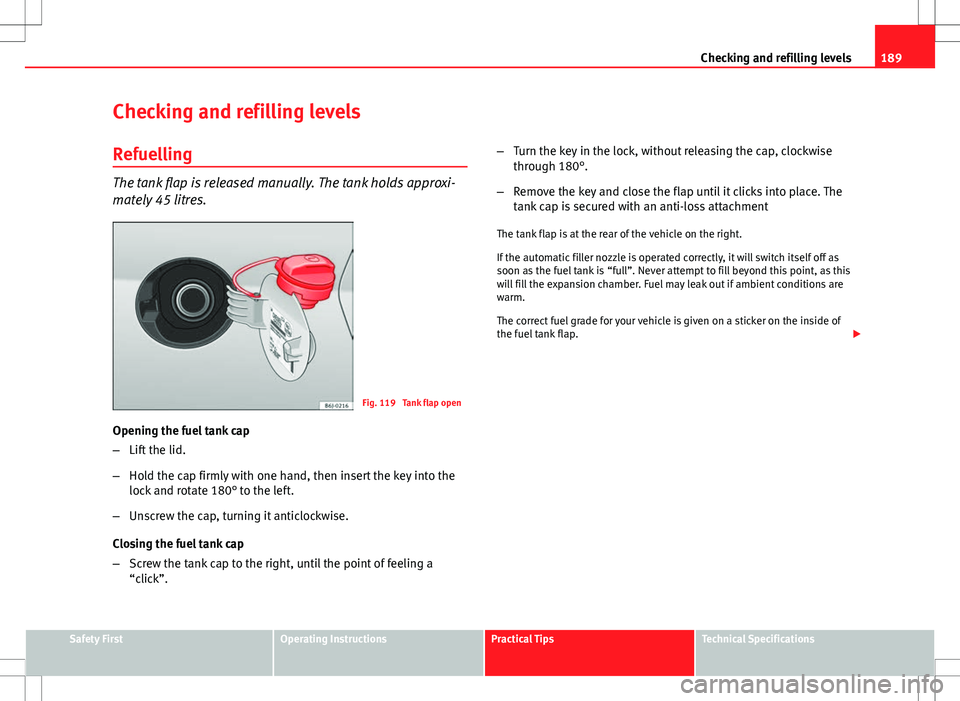
The tank flap is released manually. The tank holds approxi-
mately 45 litres.
Fig. 119 Tank flap open
Opening the fuel tank cap
– Lift the lid.
– Hold the cap firmly with one hand, then insert the key into the
lock and rotate 180° to the left.
– Unscrew the cap, turning it anticlockwise.
Closing the fuel tank cap
– Screw the tank cap to the right, until the point of feeling a
“click”. –
Turn the key in the lock, without releasing the cap, clockwise
through 180°.
– Remove the key and close the flap until it clicks into place. The
tank cap is secured with an anti-loss attachment
The tank flap is at the rear of the vehicle on the right.
If the automatic filler nozzle is operated correctly, it will switch itself off as
soon as the fuel tank is “full”. Never attempt to fill beyond this point, as this
will fill the expansion chamber. Fuel may leak out if ambient conditions are
warm.
The correct fuel grade for your vehicle is given on a sticker on the inside of
the fuel tank flap.
Safety FirstOperating InstructionsPractical TipsTechnical Specifications
Page 193 of 280
191
Checking and refilling levels
LPG system*
Refuelling with LPG
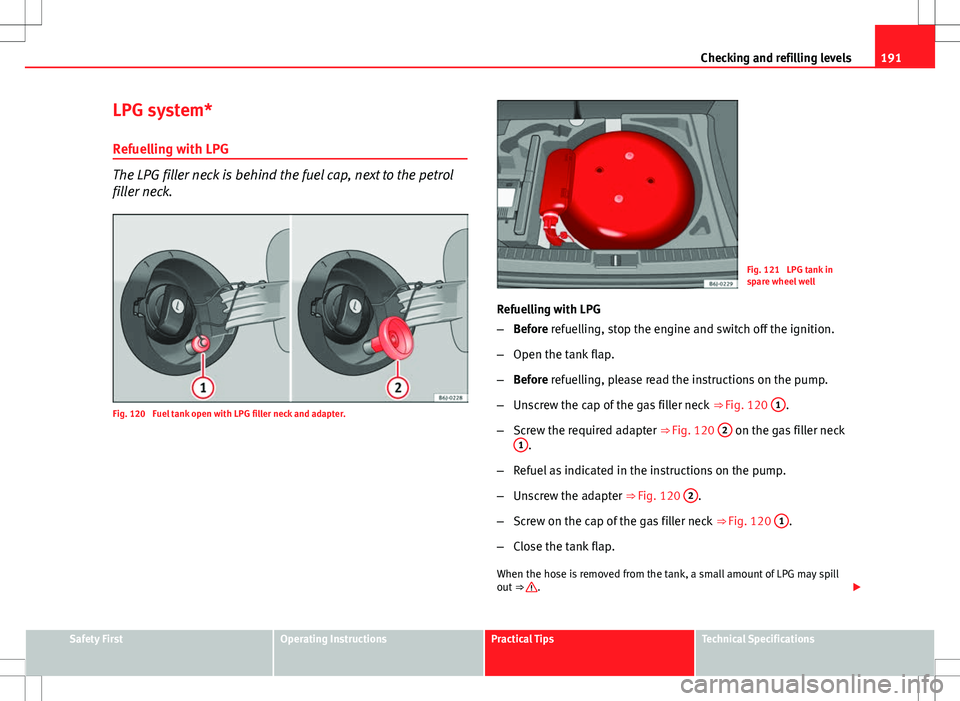
The LPG filler neck is behind the fuel cap, next to the petrol
filler neck.
Fig. 120 Fuel tank open with LPG filler neck and adapter.
Fig. 121 LPG tank in
spare wheel well
Refuelling with LPG
– Before refuelling, stop the engine and switch off the ignition.
– Open the tank flap.
– Before refuelling, please read the instructions on the pump.
– Unscrew the cap of the gas filler neck ⇒ Fig. 120 1
.
– Screw the required adapter ⇒ Fig. 120 2
on the gas filler neck
1.
– Refuel as indicated in the instructions on the pump.
– Unscrew the adapter ⇒ Fig. 120 2
.
– Screw on the cap of the gas filler neck ⇒ Fig. 120 1
.
– Close the tank flap.
When the hose is removed from the tank, a small amount of LPG may spill
out ⇒
.
Safety FirstOperating InstructionsPractical TipsTechnical Specifications
Page 194 of 280
192Checking and refilling levels
The LPG tank ⇒ Fig. 121 in the spare wheel well has a capacity of 52.8 li-
tres. If the outside temperatures are very low, it may not be possible to com-
pletely fill the LPG tank.
Pump attachments
There are a variety of types of LPG pump, and the methods of use may vary.
Therefore, let the pump operator fill the tank when refuelling for the first
time or fill from another pump.
Noises when refuelling with LPG
When refuelling with LPG, noises may be heard. These noises are insignifi-
cant.
WARNING
Failure to refuel or handle LPG in the correct way could result in a fire,
cause an explosion or lead to injuries.
● LPG is a highly explosive and inflammable substance. It may cause
severe burns and other injury.
● Switch off the engine before refuelling.
● Always switch off mobile phones and any other radiophony applian-
ces, as electromagnetic waves may produce sparks and cause a fire.
● Do not remain in the vehicle while refuelling. If it is absolutely neces-
sary to enter the vehicle, close the door and touch a metal surface before
touching the attachment again. This will prevent the generation of static
electricity and any possible fires while refuelling.
● Small quantities of LPG may leak out after refuelling. If LPG comes in-
to contact with skin, there is a risk of freezing.
● Do not smoke and always keep bare flames away from the tank during
refuelling. Failure to do so may lead to an explosion.
Adapter for the liquid petroleum gas (LPG) filler neck
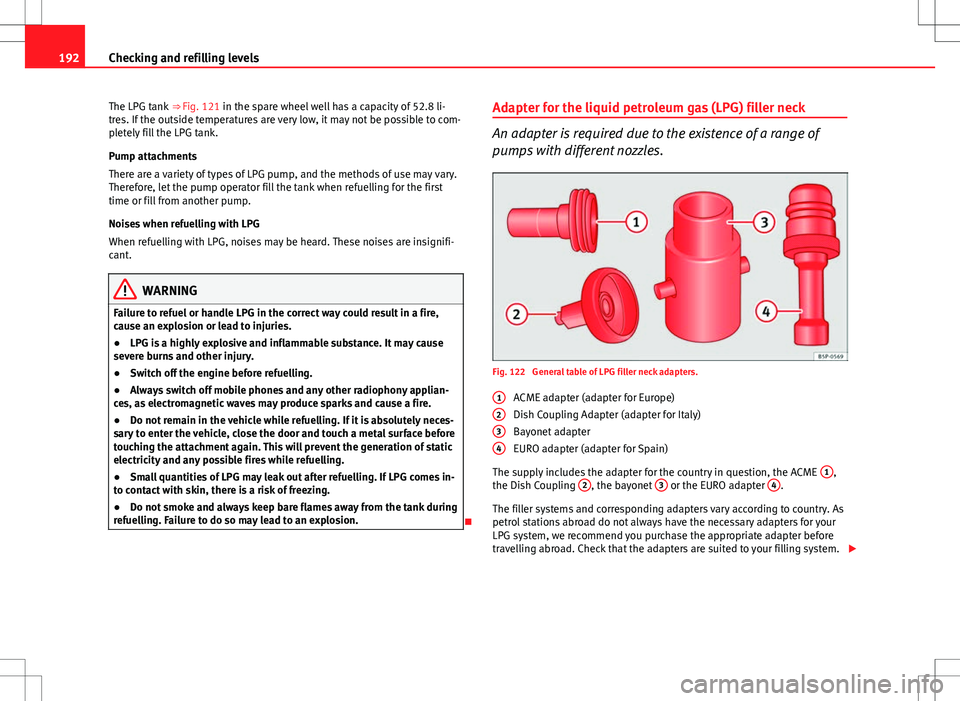
An adapter is required due to the existence of a range of
pumps with different nozzles.
Fig. 122 General table of LPG filler neck adapters.
ACME adapter (adapter for Europe)
Dish Coupling Adapter (adapter for Italy)
Bayonet adapter
EURO adapter (adapter for Spain)
The supply includes the adapter for the country in question, the ACME 1
,
the Dish Coupling 2, the bayonet 3 or the EURO adapter 4.
The filler systems and corresponding adapters vary according to country. As
petrol stations abroad do not always have the necessary adapters for your
LPG system, we recommend you purchase the appropriate adapter before
travelling abroad. Check that the adapters are suited to your filling system.
1
234
Page 196 of 280
194Checking and refilling levels
Petrol
Petrol types
The correct petrol types are listed on a sticker inside the fuel
tank flap.Only unleaded petrol conforming to standard DIN EN 228 may be used for
vehicles with catalytic converters (EN = “European Standard”).
Fuel types are differentiated by the octane rating, e.g: 91, 95, 98 RON (RON
= “Research Octane Number”, unit for determining the knock resistance of
petrol). You may use petrol with a higher octane number than the one rec-
ommended for your engine. However, this has no advantage in terms of fuel
consumption and engine power.
CAUTION
● Even one tankful of leaded fuel would permanently impair the efficiency
of the catalytic converter.
● High engine speed and full throttle can damage the engine when using
petrol with an octane rating lower than the correct grade for the engine.
For the sake of the environment
Just one full tank of leaded fuel would seriously impair the efficiency of the
catalytic converter.
Petrol additives
Petrol additives improve the quality of the petrol.
The quality of the petrol influences the performance, power and life of the
engine. For this reason, you should use good quality petrol containing addi- tives. These additives will help to prevent corrosion, keep the fuel system
clean and prevent deposits from building up in the engine.
If good quality petrol with additives is not available or engine problems oc-
cur, the required additives must be added during refuelling.
Diesel Diesel*
Diesel fuel must conform to DIN EN 590 (EN = “European Standard”). It
must have a cetane number (CN) of at least 51. The cetane number indi-
cates the ignition quality of the diesel fuel.
Notes on refuelling ⇒ page 189.
Biodiesel*
CAUTION
● Your vehicle is not designed to use biodiesel fuel. Never, under any cir-
cumstances refuel with biodiesel. The use of biodiesel fuel could damage
the engine and the fuel system. The addition of biodiesel to diesel fuel by
the diesel manufacturer in accordance with standard EN 590 or DIN 51628
is authorised and will not cause damage to the engine or the fuel system.
● The diesel engine has been designed to be used exclusively with diesel
fuel conforming to standard EN 590. Never refuel or use petrol, kerosene,
fuel oil or any other type of fuel. If you accidentally fill up the vehicle with
the wrong type of fuel, do not start the engine. Seek assistance from speci-
alised personnel. The composition of these fuels may severely damage the
fuel system and the engine.
Page 275 of 280
Jump leads . . . . . . . . . . . . . . . . . . . . . . . . . . . . 242
K Keys . . . . . . . . . . . . . . . . . . . . . . . . . . . . . . . . . . . 85
L
Leather cleaning . . . . . . . . . . . . . . . . . . . . . . . . 183
Leaving Home function . . . . . . . . . . . . . . . . . . 102
Lights . . . . . . . . . . . . . . . . . . . . . . . . . . . . . . . . . 98
Load compartment in the luggage compart- ment
see Loading the luggage compartment . . . 16
Loading the luggage compartment . . . . . . . . . . 16
Locks . . . . . . . . . . . . . . . . . . . . . . . . . . . . . . . . . 180
LPG . . . . . . . . . . . . . . . . . . . . . . . . . . 56, 143, 191
LPG system Driving . . . . . . . . . . . . . . . . . . . . . . . . . . . . . 143
Filler neck adapter . . . . . . . . . . . . . . . . . . . 192
Level indicator . . . . . . . . . . . . . . . . . . . . . . . 56
Refuelling . . . . . . . . . . . . . . . . . . . . . . . . . . 191
Luggage compartment . . . . . . . . . . . . . . . . . . . 126 see also Loading the luggage compartment . .16
Luggage compartment light . . . . . . . . . . 106, 242
M
Main beam . . . . . . . . . . . . . . . . . . . . . . . . . 98, 104
Main beam headlights control lamp . . . . . . . . . . . . . . . . . . . . . . . . . 73 Maintenance
Airbags . . . . . . . . . . . . . . . . . . . . . . . . . . . . . 31
Maintenance and cleaning . . . . . . . . . . . . . . . 176
Manual gearbox . . . . . . . . . . . . . . . . . . . . . . . . 147
Manual heating . . . . . . . . . . . . . . . . . . . . . . . . 129 controls . . . . . . . . . . . . . . . . . . . . . . . . . . . . 128
Manual heating system Defrosting the windscreen . . . . . . . . . . . . . 129
Demisting the windscreen and side win-dows . . . . . . . . . . . . . . . . . . . . . . . . . . . . . 129
MFI . . . . . . . . . . . . . . . . . . . . . . . . . . . . . . . . . . . . 59
Mirrors Exterior mirrors . . . . . . . . . . . . . . . . . . . . . . 111
Interior rear vision mirror . . . . . . . . . . . . . . 110
vanity mirror . . . . . . . . . . . . . . . . . . . . . . . . 107
Mobile phone . . . . . . . . . . . . . . . . . . . . . . . . . . 186
Multifunction display . . . . . . . . . . . . . . . . . . . . . 59
N
Number of seats . . . . . . . . . . . . . . . . . . . . . . . . . 18
O
Observations . . . . . . . . . . . . . . . . . . . . . . . . . . 173
Octane number . . . . . . . . . . . . . . . . . . . . . . . . . 194
Odometer . . . . . . . . . . . . . . . . . . . . . . . . . . . . . . 61
Oil change . . . . . . . . . . . . . . . . . . . . . . . . . . . . . 201
Oil properties . . . . . . . . . . . . . . . . . . . . . . . . . . 199
One-touch opening and closing Electric windows . . . . . . . . . . . . . . . . . . . . . . 94
Opening and locking . . . . . . . . . . . . . . . . . . . . . 91 Operation when a fault occurs
panoramic/tilting sunroof . . . . . . . . . . . . . . 97
Outside temperature display . . . . . . . . . . . . . . . 58
Outside temperature indicator . . . . . . . . . . . . . 60
Overview Control lamps . . . . . . . . . . . . . . . . . . . . . 63, 65
Dash panel . . . . . . . . . . . . . . . . . . . . . . . . . . 53
Instruments . . . . . . . . . . . . . . . . . . . . . . . . . 55
Warning lamps . . . . . . . . . . . . . . . . . . . . 63, 65
P
Paintwork Polishing . . . . . . . . . . . . . . . . . . . . . . . . . . . 179
Panoramic sunroof . . . . . . . . . . . . . . . . . . . . . . . 96
Parking . . . . . . . . . . . . . . . . . . . . . . . . . . . . . . . 156
Parking lights . . . . . . . . . . . . . . . . . . . . . . . . . . 104
Passenger see Correct sitting position . . . . . . . 10, 11, 12
Pedals . . . . . . . . . . . . . . . . . . . . . . . . . . . . . . . . . 16
Petrol . . . . . . . . . . . . . . . . . . . . . . . . . . . . . . . . . 194 Driving abroad . . . . . . . . . . . . . . . . . . . . . . 173
Petrol additives . . . . . . . . . . . . . . . . . . . . . . . . 194
Physical principles of a frontal collision . . . . . . 20
Plastic parts . . . . . . . . . . . . . . . . . . . . . . . . . . . 179
Plastic parts cleaning . . . . . . . . . . . . . . . . . . . . 182
Pollen filter . . . . . . . . . . . . . . . . . . . . . . . . . . . . 136
Pollution filter . . . . . . . . . . . . . . . . . . . . . . . . . . 136
Power sockets . . . . . . . . . . . . . . . . . . . . . . . . . . 124
Products for vehicle maintenance . . . . . . . . . . 176
273
Index