engine Seat Ibiza SC 2008 User Guide
[x] Cancel search | Manufacturer: SEAT, Model Year: 2008, Model line: Ibiza SC, Model: Seat Ibiza SC 2008Pages: 258, PDF Size: 7.93 MB
Page 63 of 258
Cockpit61
Safety First
Operating instructions
Practical tips
Te c h n i c a l D a t a
Engine oil pressure
This warning lamp indicates that the engine oil pressure is
too low.If this warning symbol starts to flash, and is accompanied by three audible
warnings , switch off the engine and check the oil level. If the oil level is too
low, add more oil.
If the symbol flashes although the oil level is correct, do not drive on. The
engine must not even run at idle speed. Obtain technical assistance.Bulb defect*
The indicator lights up when a bulb is not functioning.The indicator
lights up when there is a fault on the flasher lights, head-
lights, position light and fog lights.
Rear fog light*
This warning lamp lights up when the rear fog light is switched on
. Further
information ⇒page 88.
Anti-lock brake system (ABS)
A warning lamp system monitors the ABS.
The warning lamp
should light up for a few seconds when the ignition is
switched on. It goes out again after th e system has run through an automatic
test sequence.
There is a fault in the ABS if:
•
The warning lamp
does not light up when the ignition is switched on.
•
The warning lamp does not go out again after a few seconds.
•
The warning lamp lights up when the vehicle is moving.
The vehicle can still be braked in the normal way (except that the ABS control
function will not function). Please take the vehicle to a qualified workshop as
soon as possible. For further information on the ABS see the ⇒page 150
If there is a fault in the ABS, the ESP* and the tyre pressure warning lamp will
also light up.
Brake system fault
If the ABS warning lamp
lights up together with the brake warning lamp
, this indicates not only a fault in the ABS function, but also a possible fault
in the brake system. ⇒
WARNING
•
Before opening the bonnet, read and observe the warnings on
⇒ page 181, “Working in the engine compartment”.
•
If the brake warning lamp
should light up together with the ABS
warning lamp
, stop the vehicle immediately and check the brake fluid
level in the reservoir ⇒page 193, “Brake fluid”. If the fluid level has
dropped below the “MIN” mark you must not drive on. Risk of accident.
Obtain technical assistance.
Ibiza SC_EN.book Seite 61 Dienstag, 8. Juli 2008 5:36 17
Page 64 of 258
Cockpit
62•
If the brake fluid level is correct, the fault in the brake system may have
been caused by a failure of the ABS system. This could cause the rear
wheels to lock quickly when you brake. This could cause the rear to break
away. Risk of skidding. Stop the vehicle and seek technical assistance.
Differential lock fault (EDL)*
EDL operates along with the ABS in vehicles equipped with an
Electronic Stabilisation Program (ESP)*A malfunction in the EDL is indicated by the ABS warning lamp
. Please
take the vehicle to a qualified workshop as soon as possible. For further infor-
mation on the EDL ⇒page 152, “Electronic differential lock (EDL)*”
Traction control system (TCS)*
The traction control system prevents the driven wheels from
spinning when the vehicle is acceleratingThe warning lamp lights up when the ignition is switched on and should turn
out after about 2 seconds.
When the TCS is operating while driving, its warning lamp flashes rapidly. If
there is a fault in the system, the diode is lit permanently.
It will also come on if a fault should occur in the ABS because the TCS oper-
ates in conjunction with the ABS. For further information see ⇒page 149,
“Brakes” If ESP* button is activated, TCS function deactivates and the warning lamp
flashes slowly. By pressing again, TCS function is reactivated and the warning
lamp switched off.
Electronic stabilisation programme (ESP)*
This warning lamp monitors the electronic stabilisation
programme.
This programme includes the ABS, EDL and TCS.
The warning lamp
has the following functions:
•
It will light for about 2 seconds when the ignition is switched on while a
test of the function is carried out.
•
It flashes rapidly when the ESP is activated while driving.
•
It will light up continuously if there is a malfunction in the ESP.
•
It will also come on if a fault should occur in the ABS because the ESP
operates in conjunction with the ABS.
If the ESP warning lamp
lights up and stays on after the engine is started,
this may mean that the control system has temporarily switched off the ESP.
In this case the ESP can be reactivated by switching the ignition off and then
on again. If the warning lamp goes out, this means the system is fully
functional.
WARNING (continued)
Ibiza SC_EN.book Seite 62 Dienstag, 8. Juli 2008 5:36 17
Page 67 of 258
Cockpit65
Safety First
Operating instructions
Practical tips
Te c h n i c a l D a t a
Tailgate open*
The warning lamp
should switch off when the tailgate is fully closed.
Main beam headlights
This warning lamp lights up when the main beams are on.The warning lamp
is switched on once main beams are on or once the
headlight flasher is operating.
Further information ⇒page 93
Electro-hydraulic steering*
The level of steering assistance depends on the vehicle speed and on the
steering wheel turning speed.
The warning lamp should light up for a few seconds when the ignition is
switched on. It should go out once the engine is started.
There is a fault in the electro-hydraulic steering system if the lamp does not
go out or lights up whilst the vehicle is in motion. Take the vehicle to the
Authorised Service Centre as soon as possible.
Note
When towing the vehicle with the engine stopped or due to a fault in the
power steering, this will not operate. The vehicle can still be steered, but it
will require greater force to turn the steering wheel.
Emission control system*
This warning lamp monitors the exhaust system.
Warning lamp
flashes:
When there is misfiring that can damage the catalytic converter. Reduce
speed and drive carefully to the nearest qualified workshop to have the
engine checked.
Warning lamp is lit:
If a fault has developed during driving which has reduced the quality of the
exhaust gas (e.g. lambda probe fault). Reduce speed and drive carefully to
the nearest qualified workshop to have the engine checked.
Coolant Level* / temperature
The warning lamp lights up if the coolant temperature is too
high or if the coolant level is too low.There is a fault if:•
The warning symbol does not go out again after a few seconds.
•
The warning lamp lights up or flashes while the vehicle is moving, while
three acoustic warning signals ⇒ are emitted.
This means that either the coolant level is too low or the coolant temperature
is too high.
Coolant temperature too high
If the warning li ght lights up, stop the vehicle, switch the engine off and wait
for it to cool down. Check the coolant level.
If the coolant level is correct, the over heating may be caused by a malfunction
of the radiator fan. Check the radiator fan fuse and have it replaced if neces-
sary ⇒page 211.
Ibiza SC_EN.book Seite 65 Dienstag, 8. Juli 2008 5:36 17
Page 68 of 258
Cockpit
66If the warning lamp lights up again after driving on for a short distance, stop
the vehicle and switch the engine off . Contact an Authorised Service Centre
or a qualified workshop.
Coolant level too low
If the warning li ght lights up, stop the vehicle, switch the engine off and wait
for it to cool down. First check the coolant level. If the level is underneath the
“MIN” mark, top up with coolant ⇒.
WARNING
•
If your vehicle is immobilised for any technical reasons, move it to a
safe distance from traffic. Turn the engine off, turn the hazard lights on and
place the warning triangle.
•
Never open the bonnet if you can see or hear steam or coolant escaping
from the engine compartment. Risk of scalding. Wait until you can no
longer see or hear escaping steam or coolant.
•
The engine compartment is a dangerous area! Before carrying out any
work in the engine compartment, swit ch off the engine and allow it to cool
down. Always note the corresponding warnings. ⇒page 181
Alternator
This warning lamp signals a fault in the alternator.
The warning lamp
lights up when the ignition is switched on. It should go
out when the engine has started running.
If the warning lamp lights up while driving, the alternator is no longer
charging the battery. You should immediately drive to the nearest qualified
workshop.
You should avoid using electrical equipm ent that is not absolutely necessary
because this will drain the battery. If the indicator flashes the voltage is insufficient for normal vehicle
operation.
Turn sig nals
The warning lamp flashes when the indicators are in opera-
tion.Depending on which indicator is operating, either the left
or right
indi-
cator lamp flashes. Both warning lamps will flash at the same time when the
hazard warning lights are switched on.
If any of both indicators fails, the warni ng lamp will start flashing twice faster
than normal.
Further information on the indicators ⇒page 93.
Electronic immobiliser* “Safe”
This warning lamp flashes if an unauthorised key is used.Inside the key there is a chip that deac tivates the electronic immobiliser auto-
matically when the key is inserted into the ignition. The immobiliser will be
activated again automatically as soon as you pull the key out of the ignition
lock.
The instrument panel displays shows the following message
6): SAFE . The
vehicle cannot be started in this case
The engine can, however, be started if the appropriate coded SEAT genuine
key is used.
6)Depending on the version of the model.
Ibiza SC_EN.book Seite 66 Dienstag, 8. Juli 2008 5:36 17
Page 78 of 258
Unlocking and locking
76KeysSet of keys
The set of keys includes a remote control, a key without a
remote control and a plastic key tab with the number of the
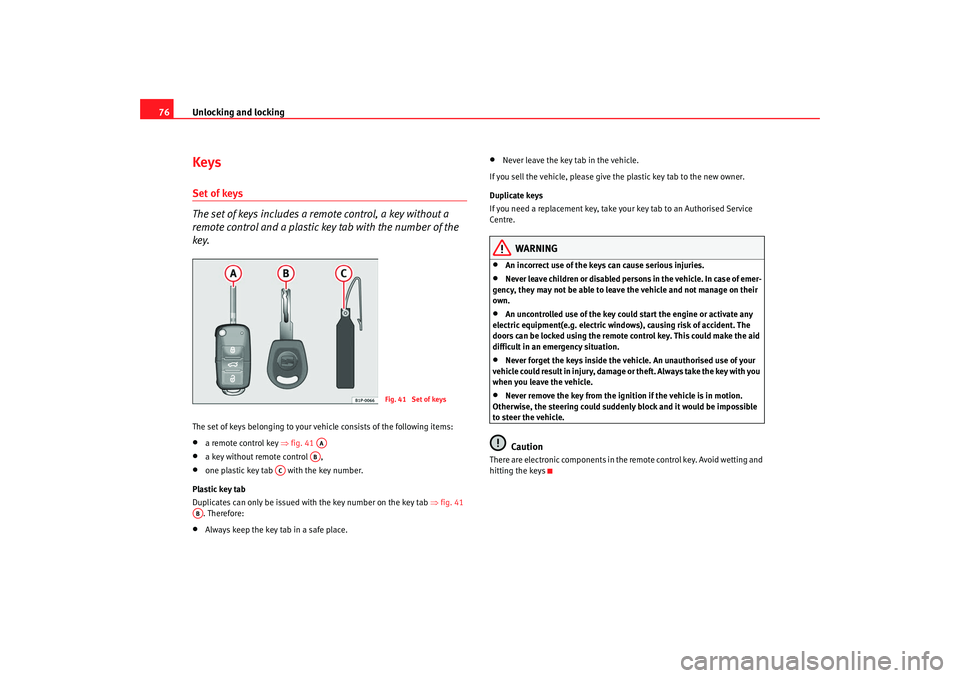
key.The set of keys belonging to your vehicle consists of the following items:•
a remote control key ⇒fig. 41
•
a key without re mote control ,
•
one plastic key tab with the key number.
Plastic key tab
Duplicates can only be issued wi th the key number on the key tab ⇒fig. 41
. Therefore:
•
Always keep the key tab in a safe place.
•
Never leave the key tab in the vehicle.
If you sell the vehicle, please give the plastic key tab to the new owner.
Duplicate keys
If you need a replacement key, take your key tab to an Authorised Service
Centre.
WARNING
•
An incorrect use of the keys can cause serious injuries.
•
Never leave children or disabled persons in the vehicle. In case of emer-
gency, they may not be able to leave the vehicle and not manage on their
own.
•
An uncontrolled use of the key could start the engine or activate any
electric equipment(e.g. electric windows), causing risk of accident. The
doors can be locked using the remote control key. This could make the aid
difficult in an emergency situation.
•
Never forget the keys inside the vehicle. An unauthorised use of your
vehicle could result in injury, damage or theft. Always take the key with you
when you leave the vehicle.
•
Never remove the key from the ignition if the vehicle is in motion.
Otherwise, the steering could suddenly block and it would be impossible
to steer the vehicle.Caution
There are electronic compon ents in the remote control key. Avoid wetting and
hitting the keys
Fig. 41 Set of keys
AAAB
AC
AB
Ibiza SC_EN.book Seite 76 Dienstag, 8. Juli 2008 5:36 17
Page 80 of 258
Unlocking and locking
78•
Never leave children or disabled persons in the vehicle. In case of emer-
gency, they may not be able to leave the vehicle and not manage on their
own.
•
Never forget the keys inside the vehicle. Otherwise, this could result in
serious injuries, accidents or even the theft of your vehicle. Always take the
key with you when you leave the vehicle.
•
An uncontrolled use of the key could start the engine or activate any
electric equipment(e.g. electric wind ows), causing risk of accident. The
vehicle can be locked when using th e remote control key. This could
complicate the aid in cas of emergency.Note
•
The remote control key functions only when you are in its range
⇒ page 77, fig. 43 .
•
If the vehicle cannot be unlocked or locked by using the radio-frequency
remote control, the remote control key will have to be re-synchronised. For
this, go to your Technical Service.
Changing the batteryIf the battery indicator does not flash when the buttons are pushed, the
battery must be replaced.
Caution
The use of inappropriate batteries may damage the radio frequency remote
control. For this reason, always replac e the dead battery with another of the
same size and power.
For the sake of the environment
The flat batteries must be thrown away in accordance with regulations
governing the protection of the environment.Anti-theft alarm system*Description of anti-theft alarm system*
The anti-theft alarm triggers if unauthorised movements are
detected around the vehicle.The anti-theft alarm makes it more difficult to break into the vehicle or steal
it. The system will initiate acoustic and optical warning signals when your
vehicle is tried to be forced.
The anti-theft alarm system is auto matically connected on locking the
vehicle. For this, either rotate the key in the locking position or press button on the radio-frequency remote control*. The system is immediately
activated and the indicator light located on the driver's door will flash along
with the indicators, indicating that the alarm and the locking security system
(double lock) have been turned on.
If any of the doors or the bonnet are open, they will not be included in the
protection zones of the vehicle when the alarm is connected. If the door or the
bonnet are subsequently closed, they will be automatically included in the
protection areas of the vehicle and the indicators will flash accordingly when
the doors close.•
The indicator light will flash twice on opening and deactivating the alarm..
•
The indicator light will flash once on closing and activating the alarm.
WARNING (continued)
A2
Ibiza SC_EN.book Seite 78 Dienstag, 8. Juli 2008 5:36 17
Page 85 of 258
Unlocking and locking83
Safety First
Operating instructions
Practical tips
Te c h n i c a l D a t a
WindowsOpening or closing the windows electrically*
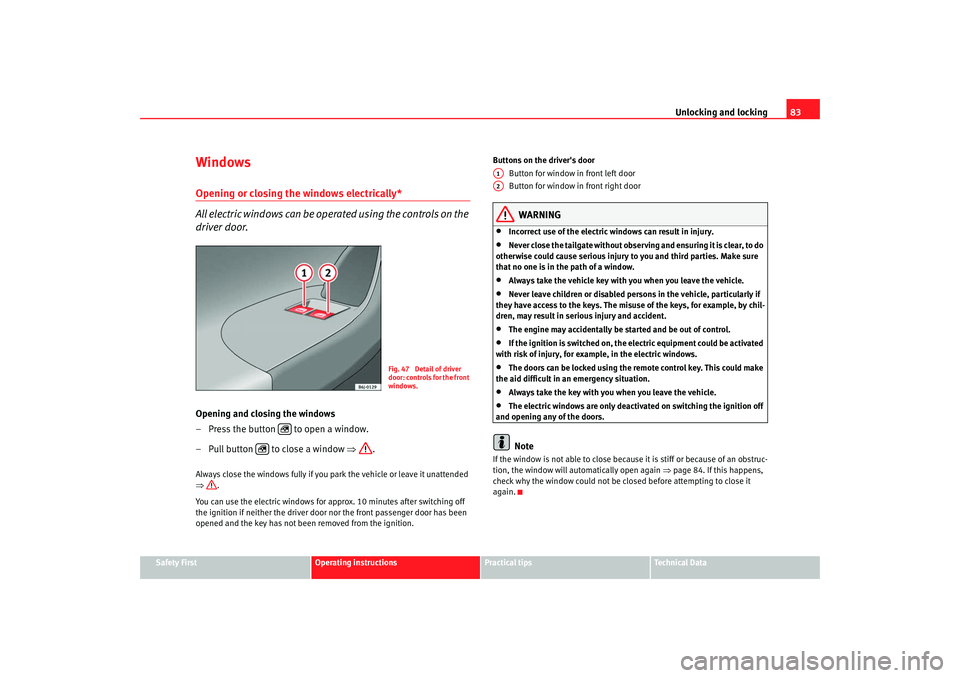
All electric windows can be operated using the controls on the
driver door.Opening and closing the windows
– Press the button to open a window.
– Pull button to close a window ⇒.Always close the windows fully if you park the vehicle or leave it unattended
⇒.
You can use the electric windows for approx. 10 minutes after switching off
the ignition if neither the driver door nor the front passenger door has been
opened and the key has not been removed from the ignition. Buttons on the driver's door
Button for window in front left door
Button for window in front right door
WARNING
•
Incorrect use of the electric windows can result in injury.
•
Never close the tailgate without observin g and ensuring it is clear, to do
otherwise could cause serious injury to you and third parties. Make sure
that no one is in the path of a window.
•
Always take the vehicle key with you when you leave the vehicle.
•
Never leave children or disabled persons in the vehicle, particularly if
they have access to the keys. The misuse of the keys, for example, by chil-
dren, may result in serious injury and accident.
•
The engine may accidentally be started and be out of control.
•
If the ignition is switched on, the el ectric equipment could be activated
with risk of injury, for exampl e, in the electric windows.
•
The doors can be locked using the remote control key. This could make
the aid difficult in an emergency situation.
•
Always take the key with you when you leave the vehicle.
•
The electric windows are only deactivated on switching the ignition off
and opening any of the doors.Note
If the window is not able to close becau se it is stiff or because of an obstruc-
tion, the window will automatically open again ⇒ page 84. If this happens,
check why the window could not be closed before attempting to close it
again.
Fig. 47 Detail of driver
door: controls for the front
windows.
A1A2
Ibiza SC_EN.book Seite 83 Dienstag, 8. Juli 2008 5:36 17
Page 88 of 258
Unlocking and locking
86
Opening the panoramic/tilting sunroof
– Press and keep pressed down button . The roof starts opening until the button is released.
Automatic closing of the panoramic/tilting sunroof
– Press button once only; the roof starts closing automatically until it is completely closed.
Automatic opening of the panoramic/ tilting sunroof
– Press button once only. The roof starts opening automatically until it is completely open.
Restoring one-touch opening and closing
– Close the roof manually until it is completely closed. Release the button
– Press the closing button again, keeping it pressed down, until a complete opening and closing cycle has taken place.Always close the panoramic/ tilting roof fully if you park the vehicle or leave
it unattended ⇒ .
The tilting roof can be operated for up to about ten minutes after the ignition
has been switched off, provided the dr iver door and the front passenger door
are not opened.
Sunroof blind
The sunroof blind is opened and clo sed manually (independently of the
sliding/ tilting roof).
WARNING
•
Incorrect use of the tilting roof can result in injury.
•
Never close the tilting sunroof without observing and ensuring it is
clear to do, otherwise it may cause serious injury to you and others. Make
sure that no one is in the path of the tilting roof.
•
Always take the vehicle key with you when you leave the vehicle.
•
Never leave children or disabled persons in the vehicle, particularly if
they have access to the keys. Unsupervised use of a key could mean that
the engine is started or that electric al equipment is used (e.g. electric
tilting sunroof) with a ri sk of accident. The doors can be locked using the
remote control key. This could make the aid difficult in an emergency situ-
ation.
•
The tilting sunroof continues to function until one of the front doors is
opened and the key removed from the ignition.
•
Ensure that no object and/or end is between the glass and the roof
when the one-touch opening/closing function is reset.
Convenience closing*Using the door lock
– Hold the key in the door lock of the driver's door in the locking
position until the tilting sunroof is closed.
– Release the key to interrupt this function.
Using the remote control
– Push the lock button on the remote control for about 3 seconds. The tilting roof closes.
– Press the unlock button to interrupt the function.
AA
ABAA
WARNING (continued)
Ibiza SC_EN.book Seite 86 Dienstag, 8. Juli 2008 5:36 17
Page 93 of 258
Lights and visibility91
Safety First
Operating instructions
Practical tips
Te c h n i c a l D a t a
– Push the light lever to the main beam position
.
– Dipped headlights come on when the door is opened.
You have 2 mins. from when the key is taken out of the ignition switch to when
the lights flash; after this, the Coming home function will not activate. To acti-
vate it again, repeat the operation.
When the system is activated, dipped headlights remain on for 30 secs. after
closing the door. If the door is open for more than 3 mins., the system will not
remain active after the 3 mins., which means that the dipped lights will not
light up.
Note
•
If the vehicle is often used during the night for short trips and the Coming
home function is used, the battery will considerably discharge. To avoid this,
make longer journeys whenever possible.
•
Observe all relevant statutory requirements when using the lighting
systems described here.
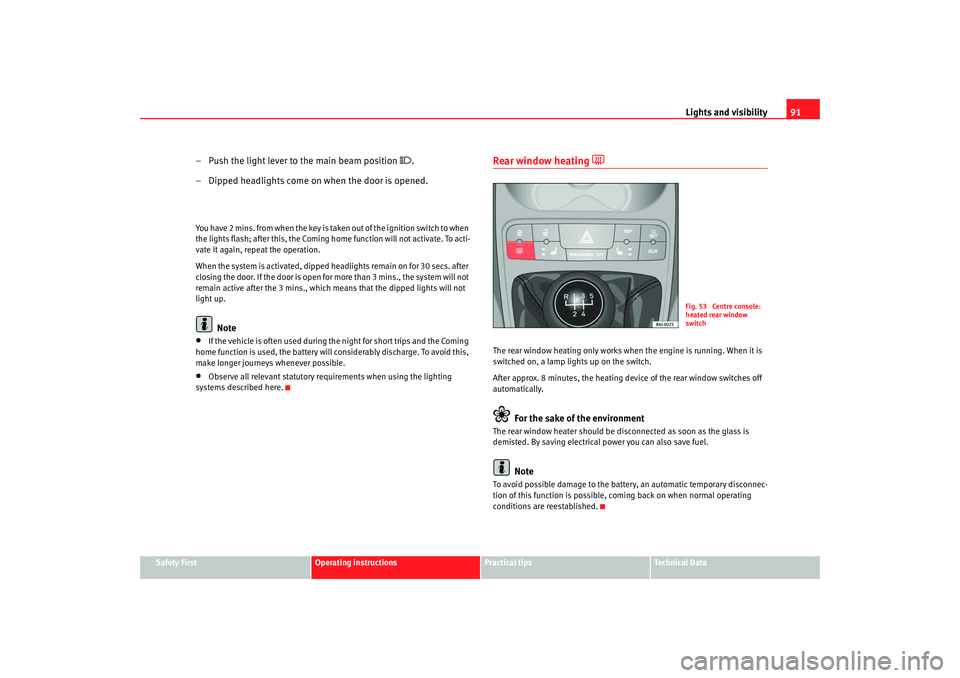
Rear window heating
The rear window heating only works when the engine is running. When it is
switched on, a lamp lights up on the switch.
After approx. 8 minutes, the heating device of the rear window switches off
automatically.
For the sake of the environment
The rear window heater should be disconnected as soon as the glass is
demisted. By saving electrical power you can also save fuel.
Note
To avoid possible damage to the battery, an automatic temporary disconnec-
tion of this function is possible, coming back on when normal operating
conditions are reestablished.
Fig. 53 Centre console:
heated rear window
switch
Ibiza SC_EN.book Seite 91 Dienstag, 8. Juli 2008 5:36 17
Page 94 of 258
Lights and visibility
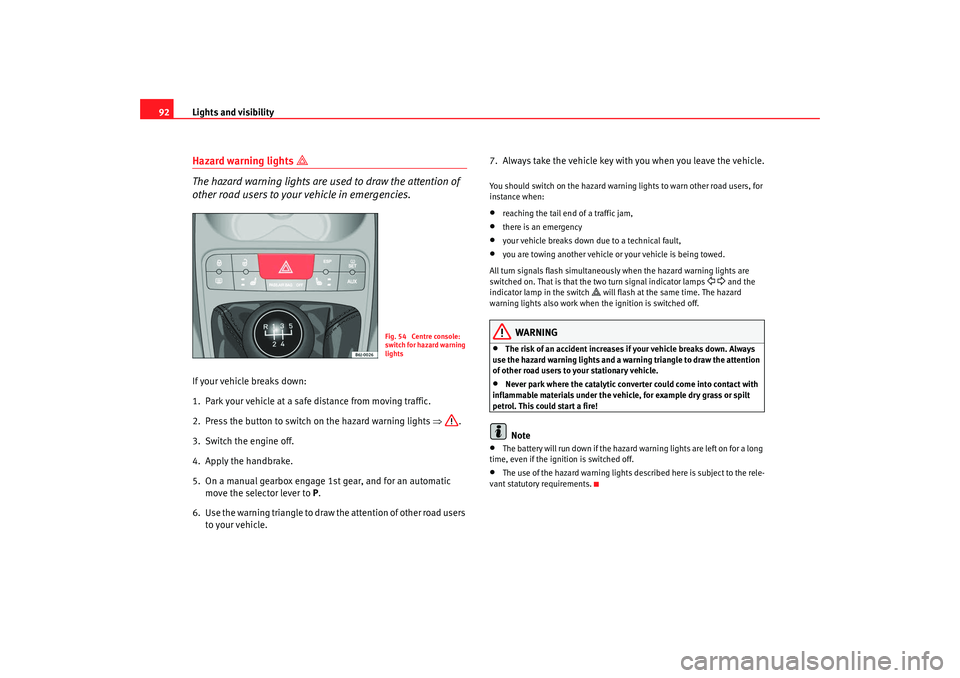
92Hazard warning lights
The hazard warning lights are used to draw the attention of
other road users to your vehicle in emergencies.
If your vehicle breaks down:
1. Park your vehicle at a safe distance from moving traffic.
2. Press the button to switch on the hazard warning lights ⇒.
3. Switch the engine off.
4. Apply the handbrake.
5. On a manual gearbox engage 1st gear, and for an automatic move the selector lever to P .
6. Use the warning triangle to draw the attention of other road users to your vehicle. 7. Always take the vehicle key with you when you leave the vehicle.
You should switch on the hazard warning lights to warn other road users, for
instance when:•
reaching the tail end of a traffic jam,
•
there is an emergency
•
your vehicle breaks down due to a technical fault,
•
you are towing another vehicle or your vehicle is being towed.
All turn signals flash simultaneously when the hazard warning lights are
switched on. That is that the two turn signal indicator lamps
and the
indicator lamp in the switch
will flash at the same time. The hazard
warning lights also work when the ignition is switched off.
WARNING
•
The risk of an accident increases if your vehicle breaks down. Always
use the hazard warning lights and a warning triangle to draw the attention
of other road users to your stationary vehicle.
•
Never park where the catalytic convert er could come into contact with
inflammable materials under the vehicle, for example dry grass or spilt
petrol. This could start a fire!Note
•
The battery will run down if the hazard warning lights are left on for a long
time, even if the ignition is switched off.
•
The use of the hazard warni ng lights described here is subject to the rele-
vant statutory requirements.
Fig. 54 Centre console:
switch for hazard warning
lights
Ibiza SC_EN.book Seite 92 Dienstag, 8. Juli 2008 5:36 17