service Seat Ibiza SC 2008 User Guide
[x] Cancel search | Manufacturer: SEAT, Model Year: 2008, Model line: Ibiza SC, Model: Seat Ibiza SC 2008Pages: 258, PDF Size: 7.93 MB
Page 68 of 258
Cockpit
66If the warning lamp lights up again after driving on for a short distance, stop
the vehicle and switch the engine off . Contact an Authorised Service Centre
or a qualified workshop.
Coolant level too low
If the warning li ght lights up, stop the vehicle, switch the engine off and wait
for it to cool down. First check the coolant level. If the level is underneath the
“MIN” mark, top up with coolant ⇒.
WARNING
•
If your vehicle is immobilised for any technical reasons, move it to a
safe distance from traffic. Turn the engine off, turn the hazard lights on and
place the warning triangle.
•
Never open the bonnet if you can see or hear steam or coolant escaping
from the engine compartment. Risk of scalding. Wait until you can no
longer see or hear escaping steam or coolant.
•
The engine compartment is a dangerous area! Before carrying out any
work in the engine compartment, swit ch off the engine and allow it to cool
down. Always note the corresponding warnings. ⇒page 181
Alternator
This warning lamp signals a fault in the alternator.
The warning lamp
lights up when the ignition is switched on. It should go
out when the engine has started running.
If the warning lamp lights up while driving, the alternator is no longer
charging the battery. You should immediately drive to the nearest qualified
workshop.
You should avoid using electrical equipm ent that is not absolutely necessary
because this will drain the battery. If the indicator flashes the voltage is insufficient for normal vehicle
operation.
Turn sig nals
The warning lamp flashes when the indicators are in opera-
tion.Depending on which indicator is operating, either the left
or right
indi-
cator lamp flashes. Both warning lamps will flash at the same time when the
hazard warning lights are switched on.
If any of both indicators fails, the warni ng lamp will start flashing twice faster
than normal.
Further information on the indicators ⇒page 93.
Electronic immobiliser* “Safe”
This warning lamp flashes if an unauthorised key is used.Inside the key there is a chip that deac tivates the electronic immobiliser auto-
matically when the key is inserted into the ignition. The immobiliser will be
activated again automatically as soon as you pull the key out of the ignition
lock.
The instrument panel displays shows the following message
6): SAFE . The
vehicle cannot be started in this case
The engine can, however, be started if the appropriate coded SEAT genuine
key is used.
6)Depending on the version of the model.
Ibiza SC_EN.book Seite 66 Dienstag, 8. Juli 2008 5:36 17
Page 78 of 258
Unlocking and locking
76KeysSet of keys
The set of keys includes a remote control, a key without a
remote control and a plastic key tab with the number of the
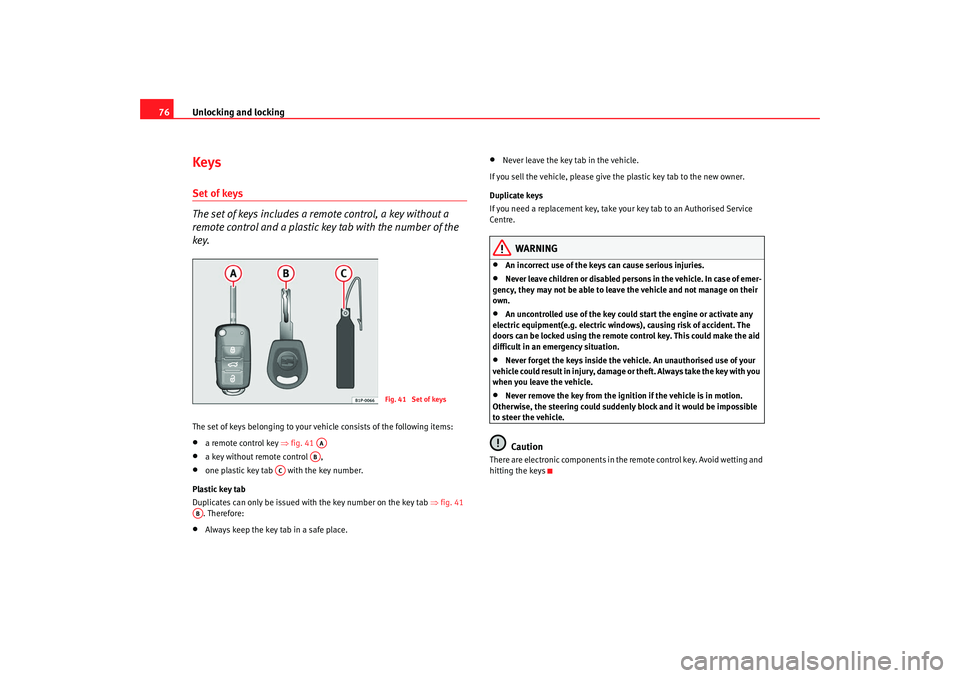
key.The set of keys belonging to your vehicle consists of the following items:•
a remote control key ⇒fig. 41
•
a key without re mote control ,
•
one plastic key tab with the key number.
Plastic key tab
Duplicates can only be issued wi th the key number on the key tab ⇒fig. 41
. Therefore:
•
Always keep the key tab in a safe place.
•
Never leave the key tab in the vehicle.
If you sell the vehicle, please give the plastic key tab to the new owner.
Duplicate keys
If you need a replacement key, take your key tab to an Authorised Service
Centre.
WARNING
•
An incorrect use of the keys can cause serious injuries.
•
Never leave children or disabled persons in the vehicle. In case of emer-
gency, they may not be able to leave the vehicle and not manage on their
own.
•
An uncontrolled use of the key could start the engine or activate any
electric equipment(e.g. electric windows), causing risk of accident. The
doors can be locked using the remote control key. This could make the aid
difficult in an emergency situation.
•
Never forget the keys inside the vehicle. An unauthorised use of your
vehicle could result in injury, damage or theft. Always take the key with you
when you leave the vehicle.
•
Never remove the key from the ignition if the vehicle is in motion.
Otherwise, the steering could suddenly block and it would be impossible
to steer the vehicle.Caution
There are electronic compon ents in the remote control key. Avoid wetting and
hitting the keys
Fig. 41 Set of keys
AAAB
AC
AB
Ibiza SC_EN.book Seite 76 Dienstag, 8. Juli 2008 5:36 17
Page 80 of 258
Unlocking and locking
78•
Never leave children or disabled persons in the vehicle. In case of emer-
gency, they may not be able to leave the vehicle and not manage on their
own.
•
Never forget the keys inside the vehicle. Otherwise, this could result in
serious injuries, accidents or even the theft of your vehicle. Always take the
key with you when you leave the vehicle.
•
An uncontrolled use of the key could start the engine or activate any
electric equipment(e.g. electric wind ows), causing risk of accident. The
vehicle can be locked when using th e remote control key. This could
complicate the aid in cas of emergency.Note
•
The remote control key functions only when you are in its range
⇒ page 77, fig. 43 .
•
If the vehicle cannot be unlocked or locked by using the radio-frequency
remote control, the remote control key will have to be re-synchronised. For
this, go to your Technical Service.
Changing the batteryIf the battery indicator does not flash when the buttons are pushed, the
battery must be replaced.
Caution
The use of inappropriate batteries may damage the radio frequency remote
control. For this reason, always replac e the dead battery with another of the
same size and power.
For the sake of the environment
The flat batteries must be thrown away in accordance with regulations
governing the protection of the environment.Anti-theft alarm system*Description of anti-theft alarm system*
The anti-theft alarm triggers if unauthorised movements are
detected around the vehicle.The anti-theft alarm makes it more difficult to break into the vehicle or steal
it. The system will initiate acoustic and optical warning signals when your
vehicle is tried to be forced.
The anti-theft alarm system is auto matically connected on locking the
vehicle. For this, either rotate the key in the locking position or press button on the radio-frequency remote control*. The system is immediately
activated and the indicator light located on the driver's door will flash along
with the indicators, indicating that the alarm and the locking security system
(double lock) have been turned on.
If any of the doors or the bonnet are open, they will not be included in the
protection zones of the vehicle when the alarm is connected. If the door or the
bonnet are subsequently closed, they will be automatically included in the
protection areas of the vehicle and the indicators will flash accordingly when
the doors close.•
The indicator light will flash twice on opening and deactivating the alarm..
•
The indicator light will flash once on closing and activating the alarm.
WARNING (continued)
A2
Ibiza SC_EN.book Seite 78 Dienstag, 8. Juli 2008 5:36 17
Page 86 of 258
Unlocking and locking
84One-touch opening and closing*
One-touch opening and closing means you do not have to
hold down the button.The buttons ⇒page 83, fig. 47 and have two posiitons for
opening the windows and two for closing them. This makes it easier
to open and close windows to the desired position.
One-touch closing
– Pull up the window button briefly up to the second position. The window closes fully.
One-touch opening
– Push down the window button briefly up to the second position. The window opens fully.
Restoring one-touch opening and closing
– The automatic open and close function will not work if the battery has been temporarily disconnected. The function can be restored
as follows:
– Close the window as far as it will go by lifting and holding the window switch.
– Release the switch and then lift it again for one second. This will reactivate the automatic function.If you push (or pull) a button to the fi rst stage, the window will open (or close)
until you release the button. If you push or lift the button briefly to the second
stage, the window will open (one-touch opening) or close (one-touch closing)
automatically. If you operate the button while the window is opening or
closing, it stops at this position. The one-touch opening and closing function will not function once the igni-
tion has been switched off.
The one-touch function and roll-back function will not work if there is a
malfunction in the electric windows. Co
ntact an Authorised Service Centre.
Roll-back function
The roll-back function reduces the ri s k o f i n j u r y w h e n th e el ec -
tric windows close.•
If a window is obstructed when clos ing automatically, the window stops
at this point and lowers immediately ⇒.
•
Next, check why the window does not close before attempting it again.
•
If you try within the following 10 seconds and the window closes again
with difficulty or there is an obstr uction, the automatic closing will stop
working for 10 seconds.
•
If the window is still obstructed, the window will stop at this point.
•
If there is no obvious reason why the window cannot be closed, try to
close it again by pulling the tab within ten seconds. The window closes with
great force The roll-back function is deactivated.
If more than 10 seconds pass, the window will open fully when you operate
one of the buttons. One-touch closing is reactivated.
The one-touch function and roll-back function will not work if there is a
malfunction in the electric windows. Contact an Authorised Service Centre.
WARNING
•
Incorrect use of the electric windows can result in injury.
A1
A2
Ibiza SC_EN.book Seite 84 Dienstag, 8. Juli 2008 5:36 17
Page 111 of 258
Seats and stowage109
Safety First
Operating instructions
Practical tips
Te c h n i c a l D a t a
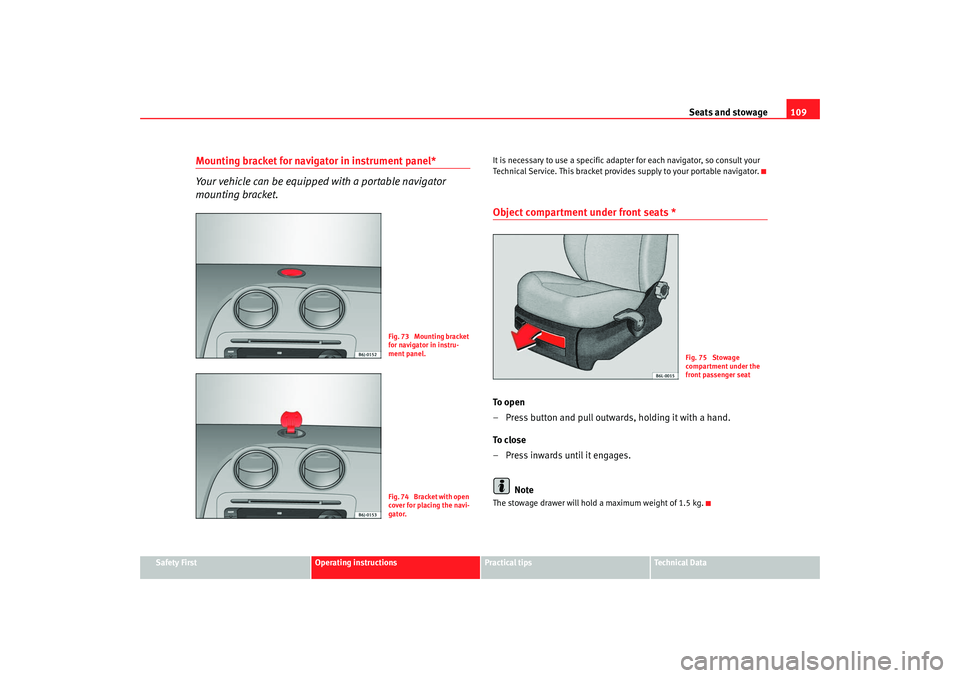
Mounting bracket for navigator in instrument panel*
Your vehicle can be equipped with a portable navigator
mounting bracket.
It is necessary to use a specific adapter for each navigator, so consult your
Technical Service. This bracket provides supply to your portable navigator.Object compartment under front seats *To o p e n
– Press button and pull outwards, holding it with a hand.
To close
– Press inwards until it engages.
NoteThe stowage drawer will hold a maximum weight of 1.5 kg.
Fig. 73 Mounting bracket
for navigator in instru-
ment panel.F i g . 7 4 B r a c k e t w i t h o p e n
cover for placing the navi-
gator.
Fig. 75 Stowage
compartment under the
front passenger seat
Ibiza SC_EN.book Seite 109 Dienstag, 8. Juli 2008 5:36 17
Page 128 of 258
Heating, Ventilation and Air conditioning
126When the outside temperature is high, air recirculation mode improves
cooling performance by cooling air from the interior instead of warm air from
outside.
For safety reasons, it is not recommended to switch air recirculation on when
the air distribution cont rol is being adjusted to the windscreen setting
.
WARNING
In air recirculation mode, no cold air from the outside enters the vehicle
interior. If the air conditioning syst em is switched off, the windows can
quickly mist over. Therefore, never leave the air recirculation mode
switched on for a long time (risk of accident).
Note
When engaging reverse gear, the air recirculation is connected automatically
to prevent the entrance of exhaust fumes in the vehicle on travelling back-
wards. In this case the symbol for air recirculation is not displayed.General notesThe impurity filter
The impurity filter (a combined particle filter and active carbon filter) serves
as a barrier against impurities in the ambient air, including dust and pollen.
For the air conditioning system to work with maximum efficiency, the pollen
filter must be replaced at the specified intervals in the Maintenance Program.
If the filter loses efficiency prematurely due to use in areas reaching very high
pollution levels, the pollen filter must be changed more frequently than
stated in the Service Schedule.
Caution
•
If you suspect that the air conditioni ng is damaged, switch it off with
button to prevent further damage and have it checked by a qualified
workshop.
•
Repairs to the air conditioning system require specialist knowledge and
special tools. Therefore, we recommend yo u to take the vehicle to a qualified
workshop.Note
•
If the humidity and temperature outside the vehicle are high, condensa-
tion can drip off the evaporator in the cooling system and so forming a puddle
underneath the vehicle. This is completely normal and there is no need to
suspect a leak.
•
Keep the air intake slots in front of the windscreen free of snow, ice and
leaves to ensure heating and cooling are not impaired, and to prevent the
windows from misting over.
•
The air from the vents flows through the vehicle interior and is extracted
by slots designed for this purpose. Therefore, do not cover these slots with
items of clothing or other objects.
•
The air conditioning system operates most effectively with the windows
and the sliding/tilting roof* closed. Howe ver, if the vehicle has been over-
heated by sun, the air inside can be cooled quicklier by opening the windows
for a short time.
•
Do not smoke while air recirculation mode is on, as smoke drawn into the
air conditioning system leaves a r esidue on the evaporator, producing a
permanent unpleasant odour.
•
At low outside temperatures the compressor switches off automatically.
The button cannot be switched on either.
•
It is advisable to connect the air conditioning at least once a month, to
lubricate the system gaskets and prevent leaks. If a decrease in the cooling
capacity is detected, an Authorised Service Centre should be consulted to
check the system.
ACAUTO
Ibiza SC_EN.book Seite 126 Dienstag, 8. Juli 2008 5:36 17
Page 130 of 258
Driving
128DrivingAddressAdjusting the steering wheel position
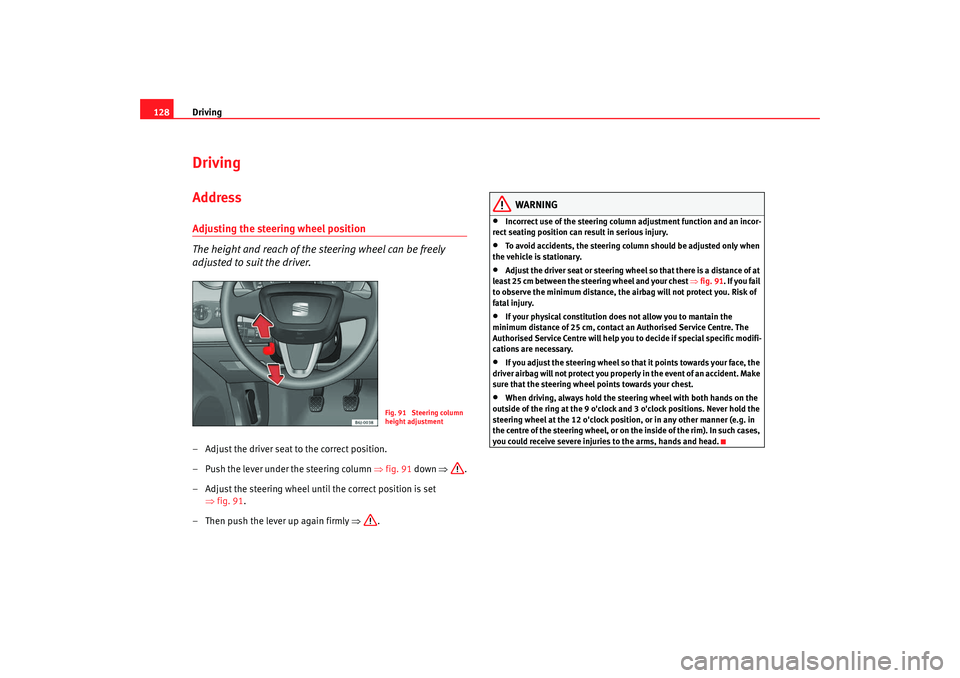
The height and reach of the steering wheel can be freely
adjusted to suit the driver.– Adjust the driver seat to the correct position.
– Push the lever under the steering column ⇒fig. 91 down ⇒ .
– Adjust the steering wheel until the correct position is set ⇒fig. 91 .
– Then push the lever up again firmly ⇒.
WARNING
•
Incorrect use of the steering column adjustment function and an incor-
rect seating position can result in serious injury.
•
To avoid accidents, the steering column should be adjusted only when
the vehicle is stationary.
•
Adjust the driver seat or steering wheel so that there is a distance of at
least 25 cm between the steering wheel and your chest ⇒fig. 91 . If you fail
to observe the minimum distance, the airbag will not protect you. Risk of
fatal injury.
•
If your physical constitution does not allow you to mantain the
minimum distance of 25 cm, contact an Authorised Service Centre. The
Authorised Service Centre will help yo u to decide if special specific modifi-
cations are necessary.
•
If you adjust the steering wheel so th at it points towards your face, the
driver airbag will not protect you properly in the event of an accident. Make
sure that the steering wheel points towards your chest.
•
When driving, always hold the steering wheel with both hands on the
outside of the ring at the 9 o'clock and 3 o'clock positions. Never hold the
steering wheel at the 12 o'clock position, or in any other manner (e.g. in
the centre of the steering wheel, or on th e inside of the rim). In such cases,
you could receive severe injuries to the arms, hands and head.
Fig. 91 Steering column
height adjustment
Ibiza SC_EN.book Seite 128 Dienstag, 8. Juli 2008 5:36 17
Page 144 of 258
Driving
142
– Switch the engine off and remove the key from the ignition lock. Turn the steering wheel slightly to engage the steering lock.
– Always take you car keys with you when you leave the vehicle ⇒ .Additional notes on parking the vehicle on gradients:
Turn the steering wheel so that the vehicle rolls against the kerb if it started
to roll.•
If the vehicle is parked facing downhill , turn the front wheels so that they
point towards the kerb .
•
If the vehicle is parked facing uphill, turn the front wheels so that they
point away from the kerb .
•
Secure the vehicle as normal by applying the handbrake firmly and
engaging first gear.
WARNING
•
Take measures to reduce the risk of injury when you leave your vehicle
unattended.
•
Never park where the hot exhaust system could ignite inflammable
materials, such as dry grass, low bushes, spilt fuel etc.
•
Never allow vehicle occupants to remain in the vehicle when it is
locked. They would be unable to open the vehicle from the inside, and
could become trapped in the vehicle in an emergency. In the event of an
emergency, locked doors will delay assistance to occupants.
•
Never leave children alone in the vehicle. They could set the vehicle in
motion, for example, by releasing the handbrake or the gear lever /
selector lever.
•
Depending on weather conditions, it may become extremely hot or cold
inside the vehicle. This can be fatal.
Starting on an uphill*
This function is only included in vehicles with ESP.This device helps when starting uphill.
These are the basic operation conditions: doors closed, brake pedal pressed
down and vehicle in neutral. The system gets activated on engaging gear.
After removing your foot from the brake pedal, the braking force is maintained
for a few seconds to prevent the vehicle from moving backward when putting
into gear. This short space of time is enough to start the vehicle with ease.
This system also works when reversing uphill.
WARNING
•
If you do not start the vehicle immedi ately after taking your foot off the
brake pedal, the vehicle may start to roll back under certain conditions.
Depress the brake pedal or use the hand brake immediately.
•
If the engine stalls, depress the brake pedal or use the hand brake
immediately.
•
When following a line of traffic uphill, if you want to prevent the vehicle
from rolling back accidentally when starting off, hold the brake pedal down
for a few seconds before starting off.Note
The Official Service or a specialist workshop can tell you if your vehicle is
equipped with this system.
Ibiza SC_EN.book Seite 142 Dienstag, 8. Juli 2008 5:36 17
Page 145 of 258
Driving143
Safety First
Operating instructions
Practical tips
Te c h n i c a l D a t a
Acoustic parking aid system*Rear parking aid
The parking aid system will use an acoustic signal to warn of
the approach of any object towards the rear of the vehicle.Description
The acoustic parking aid system will measure the distance between the rear
of the vehicle and any possible obstacle using four ultrasonic sensors located
on the rear bumper. The measuring range of the sensors starts at approxi-
mately and depending on the nature of the obstacle at a distance of:•
side of the rear bumper: 0.6 m
•
middle of the rear bumper: 1.6 m
Activation
The system is activated by engagement of the reverse gear. A brief acoustic
signal confirms the activation and correct function of the system.
Reverse gear
The distance warning will begin as soon as an obstacle is detected by the
system. The frequency of the bleeps emitted by the system will increase
rapidly as the vehicle approaches the obstacle.
Within a short distance of about 30c m, a continuous signal sounds (stop
signal). The driver should not reverse any further.
Models with a factory-fitted towing bracket: When the vehicle is less than
0.35 m away from the obstacle the warn ing tone will sound continuously. The
driver should then not reverse any further.
The warning tone decreases by 30% after 3 seconds from the start of the
system. Provided that it is not in continuous
mode, the tone on the parking aid system
stops when it detects a wall parallel to the vehicle.
Trailer towing
For factory-fitted vehicles eith a towing bar, the parking aid system will not be
activated by the engagement of the reverse gear when pulling a trailer, as the
trailer's electric connector will be plugged into the vehicle.
Possible faults
If a continuous bleep sounds for some seconds when the reverse gear is
engaged, this indicates that there is a fault in the parking aid system.
If the fault continues until the ignition is turned off, the acoustic signal
warning of the fault will not be emitted every time the system is reactivated
(by engaging the reverse gear). Thus, the system ready indication will not
sound either. Have the fault repaired by an Authorised Service Centre as soon
as possible.
If there is no ready signal or no acou stic warning signal, then the parking aid
loudspeaker is faulty and may not warn of obstacles.
To ensure that the system works properly, the sensors must be kept clean and
free of ice and snow.
WARNING
•
The sensors have blind spots in which obstacles may not be detected.
•
Always look out for small children and animals because the system will
not always detect them. Always pay attention when reversing to avoid acci-
dents.
•
The parking aid is not a replacement for driver awareness. The driver
must take full responsibility for parking and other manoeuvres.
Ibiza SC_EN.book Seite 143 Dienstag, 8. Juli 2008 5:36 17
Page 155 of 258
Driving and the environment153
Safety First
Operating instructions
Practical tips
Te c h n i c a l D a t a
Driving and the environmentRunning-inRunning in a new engine
The engine needs to be run-in over the first 1,500 km.Up to 1,000 kilometres
– Do not drive faster than three quarters of top speed.
– Do not accelerate hard.
– Avoid high engine revolutions.
– Do not tow a trailer.
From 1000 to 1500 km
–Speeds can be gradually increased to the maximum road speed
or maximum permissible engine speed (rpm).During its first few hours of running, the internal fric tion in the engine is
greater than later on, when all the moving parts have bedded in.
For the sake of the environment
If the engine is run in gent ly, its life will be increased and its oil consumption,
reduced.
Running in tyres and brake pads
New tyres should be run-in carefully for the first 500 km. New
brake pads should be run-in carefully for the first 200 km.During the first 200 km, you can compensate for the reduced braking effect
by applying more pressure to the brake pedal. In case of a sharp braking, the
braking distance will be longer with new brake pads than with brake pads
which have been run-in.
WARNING
•
At first, new tyres do not give maximum grip, and require running-in.
This may cause an accident. Drive particularly carefully in the first 500 km.
•
New brake pads must be “run in” and do not have the correct friction
properties during the first 200 km. However, the reduced braking capacity
may be compensated by pressing on the brake pedal a little harder.
Braking effect and braking distance
The braking effect and braking distance are influenced by
driving situations and road conditions.The efficiency of the brakes depends directly on the brake pad wear. The rate
of wear of the brake pads depends to a great extent on the conditions under
which the vehicle is operated and the way the vehicle is driven. If you often
drive in town traffic, drive short distances or have a sporty driving style, we
recommend that you have the thickness of your brake pads checked by an
Authorised Service Centre more freque ntly than recommended in the Service
Schedule.
Ibiza SC_EN.book Seite 153 Dienstag, 8. Juli 2008 5:36 17