tailgate Seat Ibiza SC 2008 User Guide
[x] Cancel search | Manufacturer: SEAT, Model Year: 2008, Model line: Ibiza SC, Model: Seat Ibiza SC 2008Pages: 258, PDF Size: 7.93 MB
Page 82 of 258
Unlocking and locking
80The interior monitor and the anti-towing alarm are automatically switched on
again next time the vehicle is locked.
The interior monitor and anti-towing alarm (tilt sensor) are automatically
switched on when the anti-theft alarm is switched on. In order to activate it,
all the doors and the tailgate must be closed.
If you wish to disconnect the interior monitor and the anti-towing system, it
must be done each time that the vehicle is locked; if not, they will connect
automatically.
The interior monitor and the anti-towing system should be disconnected if
animals are left inside the locked vehicle (otherwise, their movements will
trigger the alarm) or when, for example, the vehicle is transported or has to
be towed with only one axle on the ground.
False alarms
The interior monitor only operates co rrectly if the vehicle is completely
closed. Please observe legal requirements when doing so.
The following cases may cause a false alarm:•
opened windows (partially or fully)
•
panoramic glass roof/sunblind open (partially or completely).
•
movement of objects inside the vehicle, such as loose papers, items
hanging from the rear view mirror (air fresheners), etc.Note
•
If the vehicle is relocked and the al arm is activated without the volumetric
sensor function, relocking will activate the alarm with all its functions, except
the volumetric sensor. This function is reactivated when the alarm is switched
on again, unless it is deliberately switched off.
•
If the alarm has been triggered by the volumetric sensor, this will be indi-
cated by a flashing of the indicator on the driver's door. The flash is different
to the flash indicating the alarm is activated.
•
The vibration of a mobile phone left inside the vehicle may cause the inte-
rior monitor alarm to trigger, as both sensors react to movements and shakes
inside the vehicle.
•
If on activating the alarm, any door or the tailgate is open, only the alarm
will be activated. The inte rior monitor and the anti-towing system will only be
activated once all the doors are closed (including the tailgate).
Ibiza SC_EN.book Seite 80 Dienstag, 8. Juli 2008 5:36 17
Page 83 of 258
Unlocking and locking81
Safety First
Operating instructions
Practical tips
Te c h n i c a l D a t a
Ta i l g a t eUnlocking and locking
The operation of the tailgate opening system is electric. It is
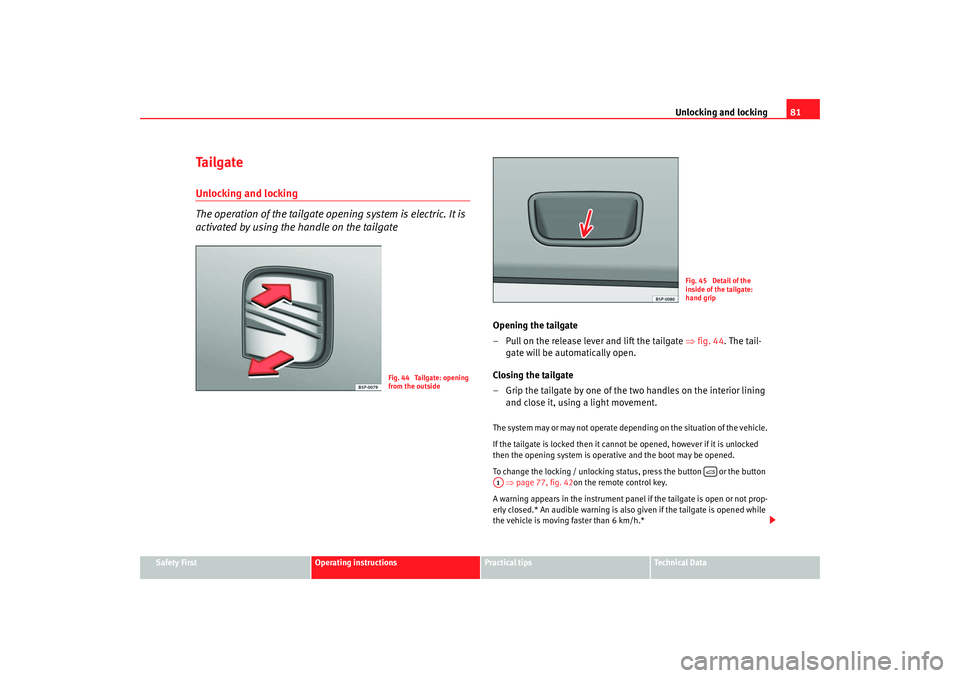
activated by using the handle on the tailgate
Opening the tailgate
– Pull on the release lever and lift the tailgate ⇒ fig. 44. The tail-
gate will be automatically open.
Closing the tailgate
– Grip the tailgate by one of the two handles on the interior lining and close it, using a light movement.The system may or may not operate depending on the situation of the vehicle.
If the tailgate is locked then it cannot be opened, however if it is unlocked
then the opening system is operat ive and the boot may be opened.
To change the locking / unlocking status, press the button or the button ⇒ page 77, fig. 42 on the remote control key.
A warning appears in the inst rument panel if the tailgate is open or not prop-
erly closed.* An audible warning is also given if the tailgate is opened while
the vehicle is moving faster than 6 km/h.*
Fig. 44 Tailgate: opening
from the outside
Fig. 45 Detail of the
inside of the tailgate:
hand grip
A1
Ibiza SC_EN.book Seite 81 Dienstag, 8. Juli 2008 5:36 17
Page 84 of 258
Unlocking and locking
82
WARNING
•
Always close the tailgate properly. Risk of accident or injury.
•
The tailgate must not be opened when the reverse or rear fog lights are
lit. This may damage the pilot lights
•
Do not close the tailgate by pushing it down with your hand on the rear
window. The glass could smash. Risk of injury!
•
Ensure the tailgate is locked after closing it. If not, it may open unex-
pectedly while driving.
•
Never allow children to play in or around the vehicle. A locked vehicle
can be subjected to extremely high and low temperatures, depending on
the time of year, thus causing serious injuries/illness. It could even have
fatal consequences. Close and lock both the tailgate and all the other doors
when you are not using the vehicle.
•
Closing the tailgate without observin g and ensuring it is clear could
cause serious injury to you and to third parties. Make sure that no one is in
the path of the tailgate.
•
Never drive with the tailgate open or half-closed, exhaust gases may
penetrate into the interior of the vehicle. Danger of poisoning!
•
If you only open the tailgate, do not leave the key inside. The vehicle
will not be opened if the key is left inside.
Emergency opening
This allows the vehicle to be opened if the central locking
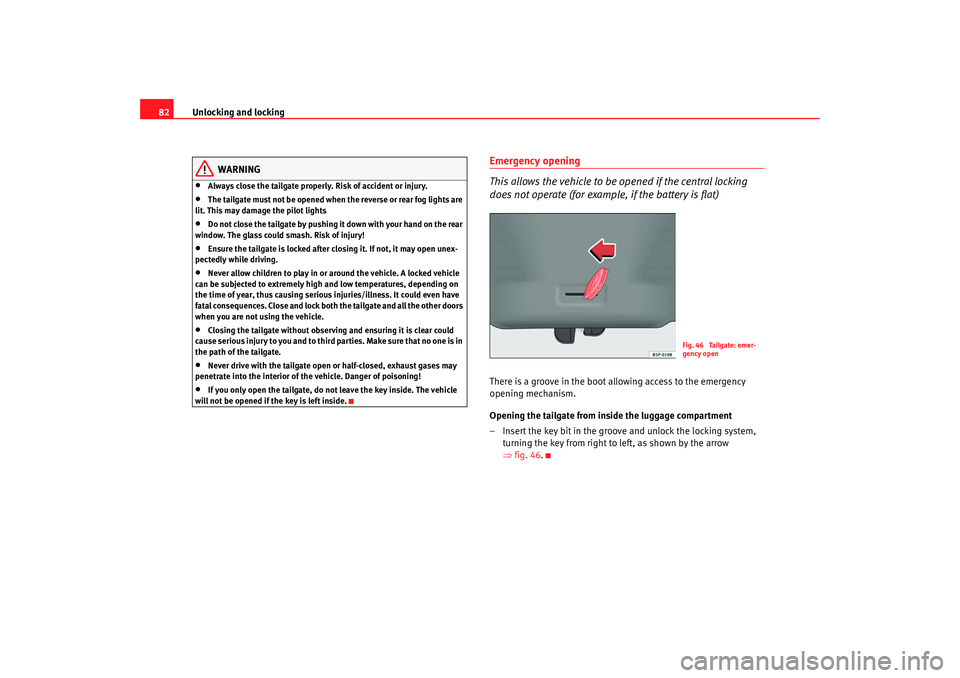
does not operate (for example, if the battery is flat)There is a groove in the boot allowing access to the emergency
opening mechanism.
Opening the tailgate from inside the luggage compartment
– Insert the key bit in the groove and unlock the locking system, turning the key from right to left, as shown by the arrow
⇒fig. 46.
Fig. 46 Tailgate: emer-
gency open
Ibiza SC_EN.book Seite 82 Dienstag, 8. Juli 2008 5:36 17
Page 85 of 258
Unlocking and locking83
Safety First
Operating instructions
Practical tips
Te c h n i c a l D a t a
WindowsOpening or closing the windows electrically*
All electric windows can be operated using the controls on the
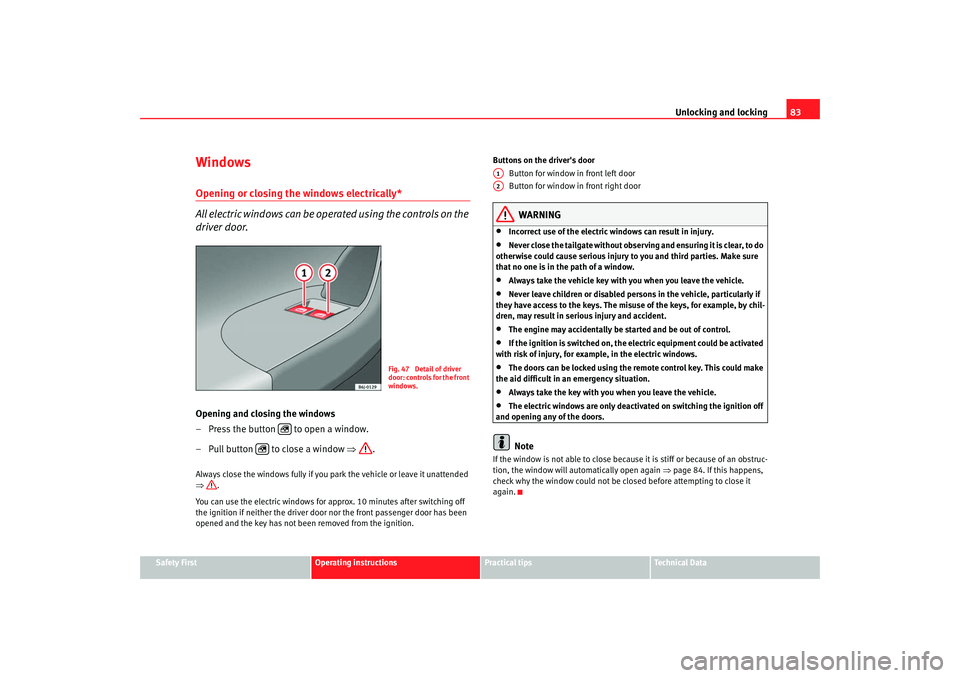
driver door.Opening and closing the windows
– Press the button to open a window.
– Pull button to close a window ⇒.Always close the windows fully if you park the vehicle or leave it unattended
⇒.
You can use the electric windows for approx. 10 minutes after switching off
the ignition if neither the driver door nor the front passenger door has been
opened and the key has not been removed from the ignition. Buttons on the driver's door
Button for window in front left door
Button for window in front right door
WARNING
•
Incorrect use of the electric windows can result in injury.
•
Never close the tailgate without observin g and ensuring it is clear, to do
otherwise could cause serious injury to you and third parties. Make sure
that no one is in the path of a window.
•
Always take the vehicle key with you when you leave the vehicle.
•
Never leave children or disabled persons in the vehicle, particularly if
they have access to the keys. The misuse of the keys, for example, by chil-
dren, may result in serious injury and accident.
•
The engine may accidentally be started and be out of control.
•
If the ignition is switched on, the el ectric equipment could be activated
with risk of injury, for exampl e, in the electric windows.
•
The doors can be locked using the remote control key. This could make
the aid difficult in an emergency situation.
•
Always take the key with you when you leave the vehicle.
•
The electric windows are only deactivated on switching the ignition off
and opening any of the doors.Note
If the window is not able to close becau se it is stiff or because of an obstruc-
tion, the window will automatically open again ⇒ page 84. If this happens,
check why the window could not be closed before attempting to close it
again.
Fig. 47 Detail of driver
door: controls for the front
windows.
A1A2
Ibiza SC_EN.book Seite 83 Dienstag, 8. Juli 2008 5:36 17
Page 97 of 258
Lights and visibility95
Safety First
Operating instructions
Practical tips
Te c h n i c a l D a t a
Note
If not all the vehicle doors are closed, the interior lights will be switched off
after approx. 10 minutes, providing the key has been removed and the cour-
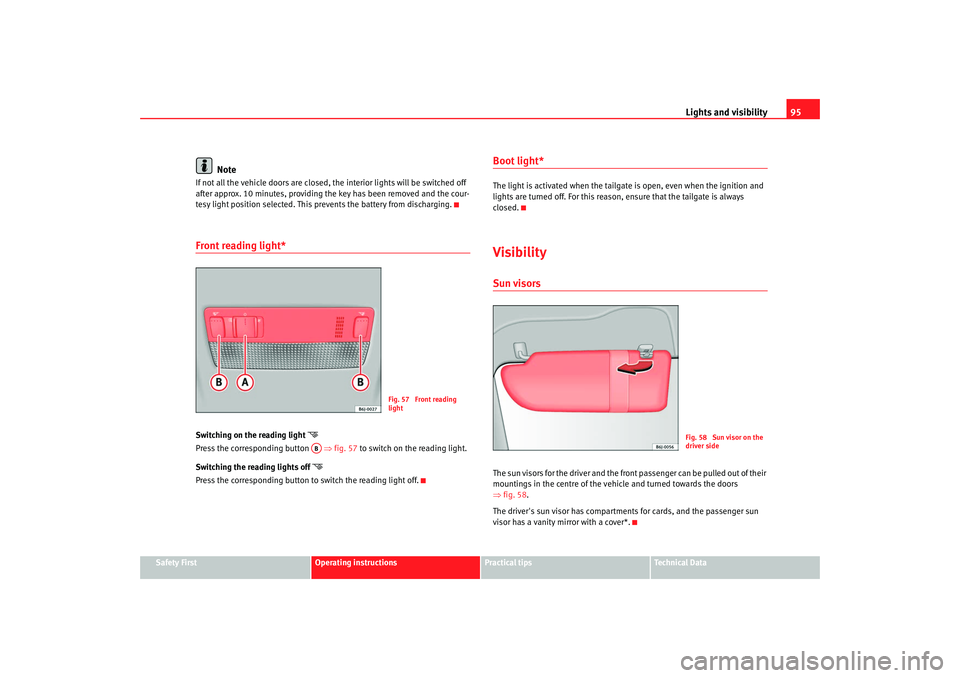
tesy light position selected. This prevents the battery from discharging.Front reading light*Switching on the reading light
Press the correspo nding button ⇒ fig. 57 to
swit ch on the reading light.
Switching the reading lights off
Press the correspondin g button to switch the reading light off.
Boot light*The light is activated when the tailgate is open, even when the ignition and
lights are turned off. For this reason, ensure that the tailgate is always
closed.VisibilitySun visorsThe sun visors for the driver and the front passenger can be pulled out of their
mountings in the centre of the vehicle and turned towards the doors
⇒ fig. 58 .
The driver's sun visor has compartments for cards, and the passenger sun
visor has a vanity mirror with a cover*.
Fig. 57 Front reading
light
AB
Fig. 58 Sun visor on the
driver side
Ibiza SC_EN.book Seite 95 Dienstag, 8. Juli 2008 5:36 17
Page 117 of 258
Seats and stowage115
Safety First
Operating instructions
Practical tips
Te c h n i c a l D a t a
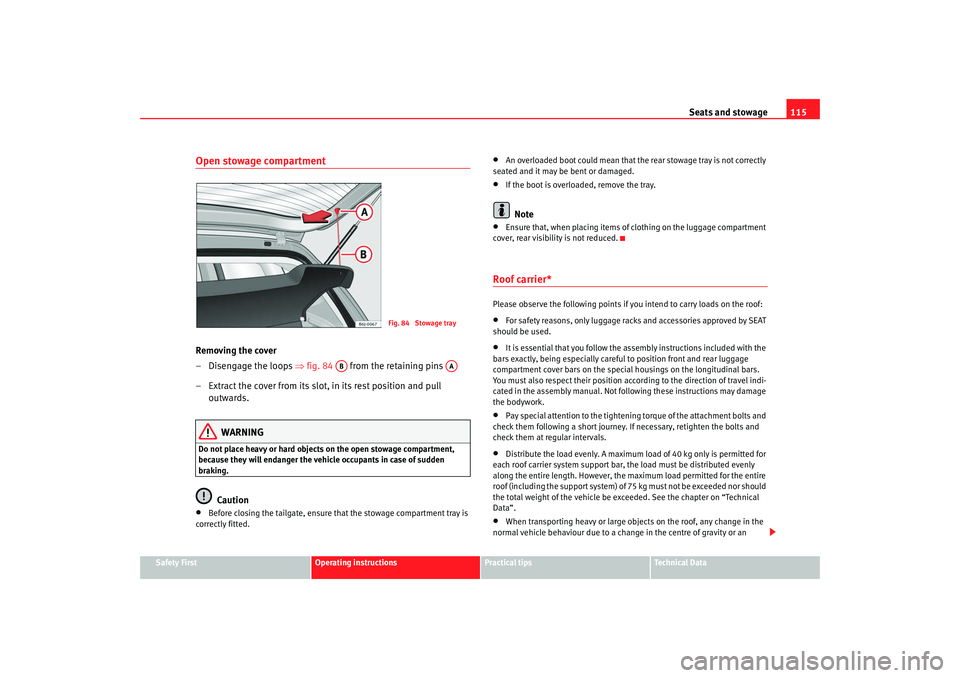
Open stowage compartmentRemoving the cover
– Disengage the loops ⇒fig. 84 from the retaining pins
– Extract the cover from its slot, in its rest position and pull outwards.
WARNING
Do not place heavy or ha rd objects on the open stowage compartment,
because they will endanger the vehicle occupants in case of sudden
braking.
Caution
•
Before closing the tailgate, ensure that the stowage compartment tray is
correctly fitted.
•
An overloaded boot could mean that the rear stowage tray is not correctly
seated and it may be bent or damaged.
•
If the boot is overloaded, remove the tray.Note
•
Ensure that, when placing items of clothing on the luggage compartment
cover, rear visibility is not reduced.
Roof carrier*Please observe the following points if you intend to carry loads on the roof:•
For safety reasons, only luggage racks and accessories approved by SEAT
should be used.
•
It is essential that you follow the assembly instructions included with the
bars exactly, being especially careful to position front and rear luggage
compartment cover bars on the specia l housings on the longitudinal bars.
You must also respect their position according to the direction of travel indi-
cated in the assembly manual. Not following these instructions may damage
the bodywork.
•
Pay special attention to the tightening torque of the attachment bolts and
check them following a short journey. If necessary, retighten the bolts and
check them at regular intervals.
•
Distribute the load evenly. A maximum load of 40 kg only is permitted for
each roof carrier system support bar, the load must be distributed evenly
along the entire length. However, the maximum load permitted for the entire
roof (including the support system) of 75 kg must not be exceeded nor should
the total weight of the vehicle be exceeded. See the chapter on “Technical
Data”.
•
When transporting heavy or large objects on the roof, any change in the
normal vehicle behaviour due to a change in the centre of gravity or an
Fig. 84 Stowage tray
AB
AA
Ibiza SC_EN.book Seite 115 Dienstag, 8. Juli 2008 5:36 17
Page 168 of 258
Your vehicle maintenance and cleaning
166•
Water, ice and salt on the brakes can reduce braking efficiency. Risk of
accident.Caution
•
Never remove dirt, mud or dust if the vehicle surface is dry. Never use a
dry cloth or sponge for cleaning purposes. This could scratch the paintwork
or glass on your vehicle.
•
Washing the vehicle in low temperatures: when washing the vehicle with
a hose, do not direct water into the lo ck cylinders or the gaps around the
doors, tailgate, or sunroof. Risk of freezing.For the sake of the environment
To protect environment, the car should be washed only in specially provided
wash bays. This prevents toxic, oil-laden waste water entering the sewerage
system. In some districts, washing vehic les outside wash bays is prohibited.
Note
Do not wash the vehicle in direct sunlight.Washing the car with a high pressure cleaner
Be particularly careful when using a high pressure cleaner!– Always observe the instructions for the high-pressure cleaner,
particularly those concerning the pressure and the spraying
distance . – Increase the spraying distance for soft materials and painted
bumpers.
– Do not use a high pressure cleaner to remove ice or snow from windows ⇒page 167.
– Never use concentrated jet nozzles (“rotating jets”) ⇒.
– Directly after washing, avoid sudden and sharp braking. “Dry” ⇒page 153 the brakes by braking several times.
WARNING
•
Never wash tyres with a concentrated jet (“rotating nozzle”). Even at
large spraying distances and short cleaning times, visible and invisible
damage can occur to the tyres. This may cause an accident.
•
Water, ice and salt on the brakes can reduce braking efficiency. Risk of
accident.Caution
•
Do not use water hotter than 60°C. This could damage the car.
•
To avoid damage to the vehicle, keep a sufficient distance from sensitive
materials such as flexible hoses, plastic, soundproofing material, etc. This is
also important for bumpers painted as th e paintwork. The closer the nozzle is
to the surface, the greater the wear on the material.
WARNING (continued)
Ibiza SC_EN.book Seite 166 Dienstag, 8. Juli 2008 5:36 17
Page 226 of 258
If and when
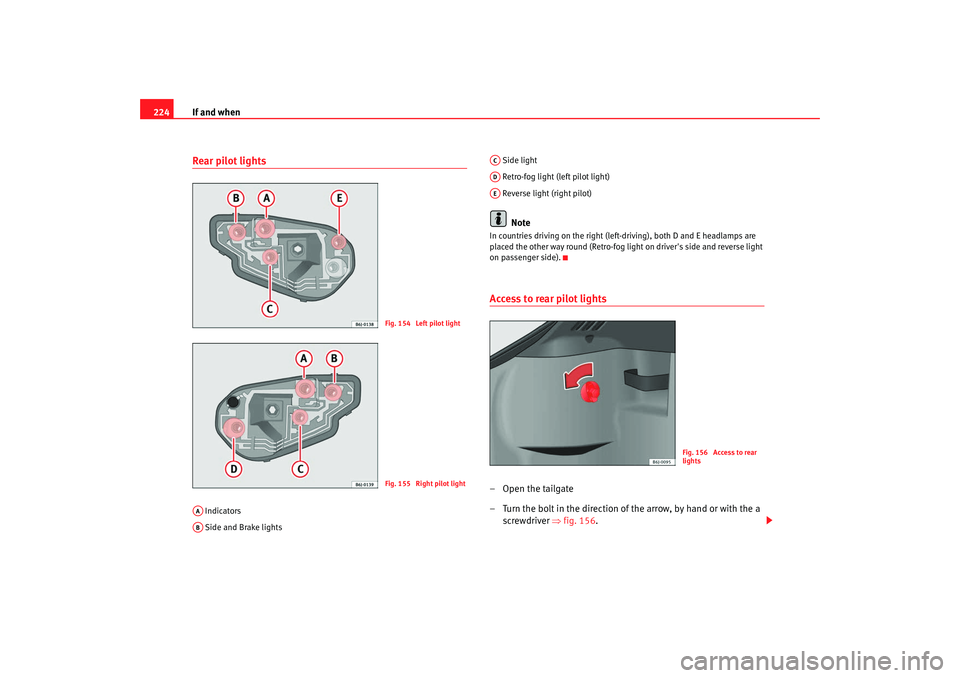
224Rear pilot lights Indicators
Side and Brake lights Side light
Retro-fog light (left pilot light)
Reverse light (right pilot)
Note
In countries driving on the right (lef
t-driving), both D and E headlamps are
placed the other way round (Retro-fog light on driver's side and reverse light
on passenger side).Access to rear pilot lights–Open the tailgate
– Turn the bolt in the direction of the arrow, by hand or with the a
screwdriver ⇒fig. 156 .
Fig. 154 Left pilot lightFig. 155 Right pilot light
AAAB
ACADAE
Fig. 156 Access to rear
lights
Ibiza SC_EN.book Seite 224 Dienstag, 8. Juli 2008 5:36 17
Page 255 of 258
Index253
Sunroof blind
Sliding/tilting roof . . . . . . . . . . . . . . . . . . . . . 86
Switch Hazard warning lights . . . . . . . . . . . . . . . . . . 92
Rear window heating . . . . . . . . . . . . . . . . . . . 91
Switches Electric windows . . . . . . . . . . . . . . . . . . . . . . 83
Sliding/tilting roof . . . . . . . . . . . . . . . . . . . . . 85
Switching off the engine . . . . . . . . . . . . . . . . . . 132TTailgate . . . . . . . . . . . . . . . . . . . . . . . . . . . . . . . . . 81 Emergency opening . . . . . . . . . . . . . . . . . . . . 82
warning lamp . . . . . . . . . . . . . . . . . . . . . . . . . 65
Tank fuel level . . . . . . . . . . . . . . . . . . . . . . . . . . . . . 52
reserve indicator . . . . . . . . . . . . . . . . . . . . . . 52
tank capacity . . . . . . . . . . . . . . . . . . . . . . . . . 52
TCS . . . . . . . . . . . . . . . . . . . . . . . . . . . . . . . . . . . 150
TCS (Traction control system) Warning lamp . . . . . . . . . . . . . . . . . . . . . . . . . 62
Technical modifications . . . . . . . . . . . . . . . . . . 173
The danger of not using the seat belt . . . . . . . . 19
Tightening torque of wheel bolts . . . . . . . . . . . 237
Tilting roof . . . . . . . . . . . . . . . . . . . . . . . . . . . . . . 85
Tools . . . . . . . . . . . . . . . . . . . . . . . . . . . . . . . . . . 203
Tow starting Comments . . . . . . . . . . . . . . . . . . . . . . . . . . 230
Towing . . . . . . . . . . . . . . . . . . . . . . . . . . . . . . . . 230
Towing a trailer . . . . . . . . . . . . . . . . . . . . 160, 236 Towing bracket . . . . . . . . . . . . . . . . . . . . . . . . . 161
Towing bracket, fitting . . . . . . . . . . . . . . . . . . . 176
Towing eye . . . . . . . . . . . . . . . . . . . . . . . . . . . . . 230
Tow-starting . . . . . . . . . . . . . . . . . . . . . . . . . . . . 230
Traction control system
warning lamp . . . . . . . . . . . . . . . . . . . . . . . . . 62
Trailer eyes . . . . . . . . . . . . . . . . . . . . . . . . . . . . . 231
Trailer turn signals Warning lamp . . . . . . . . . . . . . . . . . . . . . . . . . 93
Trailer weights . . . . . . . . . . . . . . . . . . . . . . . . . . 236
Trips, checklist . . . . . . . . . . . . . . . . . . . . . . . . . . . . 8
Turn signals . . . . . . . . . . . . . . . . . . . . . . . . . . . . . 93 Warning lamp . . . . . . . . . . . . . . . . . . . . . . 66, 93
Two-way radio . . . . . . . . . . . . . . . . . . . . . . . . . . 174
Type plate . . . . . . . . . . . . . . . . . . . . . . . . . . . . . . 234
Tyre Mobility-System (Tyre repair kit) . . . . . . . . 204
Tyre monitor indicator . . . . . . . . . . . . . . . . . . . . . 63
Tyre pressure . . . . . . . . . . . . . . . . . . . . . . . . . . . 197
Tyre pressures . . . . . . . . . . . . . . . . . . . . . . . . . . 236
Tyre repair kit . . . . . . . . . . . . . . . . . . . . . . 204, 209
Tyre-Mobility-System (Tyre repair kit) . . . . . . . . 209
Tyres and wheels Dimensions . . . . . . . . . . . . . . . . . . . . . . . . . 199
Tyres service life . . . . . . . . . . . . . . . . . . . . . . . . 198
Tyres tread depth . . . . . . . . . . . . . . . . . . . . . . . . 199
Tyres with directional tread pattern . . . . . . . . . 197
UUnderbody maintenance . . . . . . . . . . . . . . . . . . 170
VVehicle battery . . . . . . . . . . . . . . . . . . . . . . . . . . 195
Vehicle data . . . . . . . . . . . . . . . . . . . . . . . . . . . . 234
Vehicle identification data . . . . . . . . . . . . . . . . 234
Vehicle identification number . . . . . . . . . . . . . 234
Vehicle interior heating or cooling system . . . 121
Vehicle Maintenance Exterior . . . . . . . . . . . . . . . . . . . . . . . . . . . . . 165
Vehicle modifications . . . . . . . . . . . . . . . . . . . . 173
Vehicle paintwork Products for vehicle maintenance . . . . . . . 164
Waxing . . . . . . . . . . . . . . . . . . . . . . . . . . . . . 167
Vehicle tools Storage . . . . . . . . . . . . . . . . . . . . . . . . . . . . . 203
Vehicle wallet storage . . . . . . . . . . . . . . . . . . . . 108
Vehicle washing . . . . . . . . . . . . . . . . . . . . . . . . 165
Ventilation . . . . . . . . . . . . . . . . . . . . . . . . . . . . . 118
Ventilation slits . . . . . . . . . . . . . . . . . . . . . . . . . . 15WWarning lamp . . . . . . . . . . . . . . . . . . . . . . . . . . . 27
Warning lamps . . . . . . . . . . . . . . . . . . . . . . . . . . . 57
Warning triangle . . . . . . . . . . . . . . . . . . . . . . . . 113
Washer fluid . . . . . . . . . . . . . . . . . . . . . . . . . . . . 190
Washing by hand . . . . . . . . . . . . . . . . . . . . . . . . 165
Washing tunnel . . . . . . . . . . . . . . . . . . . . . . . . . 165
Washing with high pressure cleaners . . . . . . . 166
Water in the windscreen washer tank . . . . . . . 190
Ibiza SC_EN.book Seite 253 Dienstag, 8. Juli 2008 5:36 17