clutch Seat Ibiza SC 2008 Owner's manual
[x] Cancel search | Manufacturer: SEAT, Model Year: 2008, Model line: Ibiza SC, Model: Seat Ibiza SC 2008Pages: 258, PDF Size: 7.93 MB
Page 11 of 258
Safe driving9
Safety First
Operating instructions
Practical tips
Te c h n i c a l D a t a
– When travelling long distances, take breaks regularly - at least
every two hours.
– If possible, avoid driving when you are tired or are in tension.
WARNING
When driving safety is impaired during a trip, the risk of injury and acci-
dents increases.Proper sitting position for occupantsProper sitting position for driver
The proper sitting position for the driver is important for a
safe and relaxed driving.
For your own safety and to reduce the risk of injury in the event of an
accident, we recommend the following adjustments for the driver:
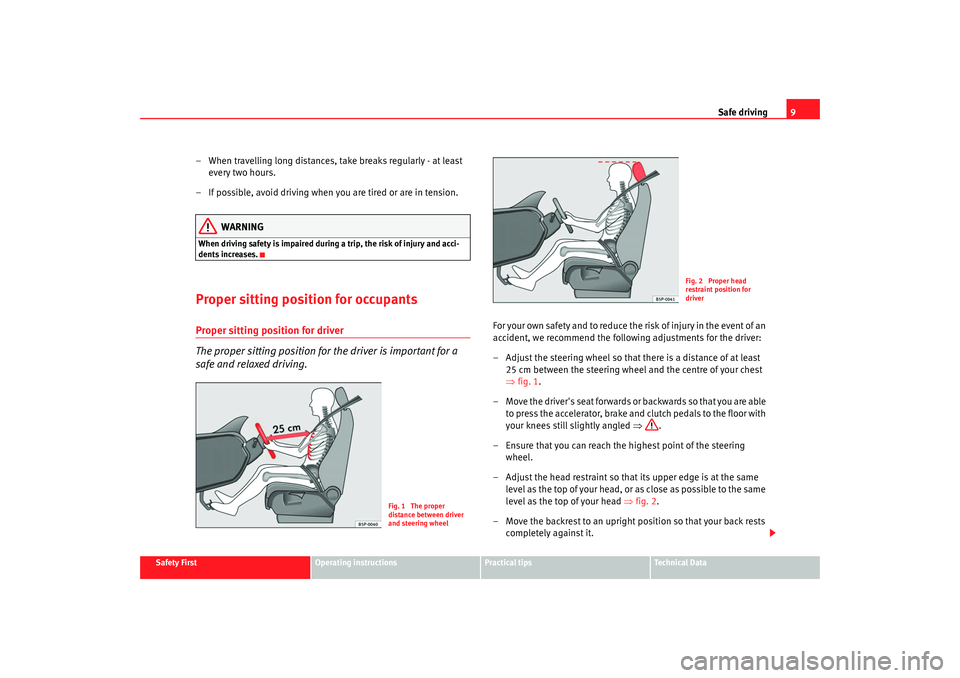
– Adjust the steering wheel so that there is a distance of at least
25 cm between the steering wheel and the centre of your chest
⇒ fig. 1.
– Move the driver's seat forwards or backwards so that you are able to press the accelerator, brake and clutch pedals to the floor with
your knees still slightly angled ⇒.
– Ensure that you can reach the highest point of the steering wheel.
– Adjust the head restraint so that its upper edge is at the same level as the top of your head, or as close as possible to the same
level as the top of your head ⇒fig. 2.
– Move the backrest to an upright position so that your back rests completely against it.
Fig. 1 The proper
distance between driver
and steering wheel
Fig. 2 Proper head
restraint position for
driver
Ibiza SC_EN.book Seite 9 Dienstag, 8. Juli 2008 5:36 17
Page 16 of 258
Safe driving
14•
never lean out of a window,
•
never put your feet out of a window,
•
never put your feet on the dash panel,
•
never put your feet on the surface of a seat,
•
never travel in a foot well ,
•
never travel on a seat without wearing the seat belt,
•
never carry any person in the luggage compartment.
WARNING
•
Every incorrect sitting position increases the risk of severe injuries.
•
Sitting in an incorrect position exposes the occupants to severe injuries
if airbags trigger, by striking a passenger who has assumed an incorrect
sitting position.
•
Before the vehicle moves, assume the proper sitting position and main-
tain it throughout the trip. Before every trip, instruct your passengers to
assume the proper sitting position and to maintain it during the trip
⇒ page 9, “Proper sitting position for occupants”.
Pedal areaPedals
The operation of all pedals must never be impaired by objects
or floor mats.– Ensure that you can always press the accelerator, brake and
clutch pedals unimpaired to the floor. – Ensure that the pedals can return unimpaired to their initial posi-
tions.
Use only floor mats which leave the pedal area free and can be securely
fastened on the foot well.
If a brake circuit fails, the brake pedal must be pressed down thoroughly in
order to stop the vehicle.
Wear suitable shoes
Always wear shoes which support your feet properly and give you a good
feeling for the pedals.
WARNING
•
Restricting pedal operation can lead to critical situations while driving.
•
Never place objects on the driver footwell. An object could move into
the pedal area and impair pedal operatio n. In the event of a sudden driving
or braking manoeuvre, you will not be able to operate the brake, clutch or
accelerator pedal. Risk of accident!
Floor mats on the driver side
Only floor mats may be used which can be securely fastened
in the foot well and do not impair operation of the pedals.– Ensure that the floor mats are securely fastened during the trip and do not obstruct the pedals ⇒.Only use floor mats which leave the pedals clear and which are secured to
prevent them from slipping. You can obta in suitable floor mats from a quali-
fied dealership.
Ibiza SC_EN.book Seite 14 Dienstag, 8. Juli 2008 5:36 17
Page 133 of 258
Driving131
Safety First
Operating instructions
Practical tips
Te c h n i c a l D a t a
The immobiliser will be activated again automatically as soon as you pull the
key out of the ignition lock.
The engine can only be started using a genuine SEAT key with its correct code.
Note
A perfect operation of the vehicle is ensured if genuine SEAT keys are used.Starting and stopping the engineStarting petrol engines
The engine can only be started using a genuine SEAT key with
its correct code.– Move the gear lever to the ne
utral position and depress the
clutch pedal thoroughly and hold it in this position for the starter
to turn the engine on.
– Turn the ignition key to the starting ⇒page 130 position.
– Let go of the ignition key as soon as the engine starts; the starter motor must not run on with the engine.After starting a very hot engine, you may need to slightly press down the
accelerator.
When starting a very cold engine, it may be a little noisy for the first few
seconds until oil pressure has built up in the hydraulic valve compensators.
This is quite normal, and no cause for concern. If the engine does not start immediately, switch the starter off after
10 seconds and try again after half a minute. If the engine still does not start,
the fuel pump fuse should be checked
⇒page 211, “Fuses”.
WARNING
•
Never start or run the engine in unventilated or closed rooms. The
exhaust fumes contain carbon mono xide, an odourless and colourless
poisonous gas. Risk of fatal accidents. Carbon monoxide can cause loss of
consciousness. It can also cause death.
•
Never leave the vehicle unattended if the engine is running.
•
Never use “cold start sprays”, they could explode or cause the engine
to run at high revs. Risk of injury.Caution
•
When the engine is cold, you should avoid high engine speeds, driving at
full throttle and over-loading the engine. Risk of engine damage.
•
The vehicle should not be pushed or towed more than 50 metres to start
the engine. Unburnt fuel could enter th e catalytic converter and damage it.
•
Before attempting to push-start or tow a vehicle in order to start it, you
should first try to start it using the batt ery of another vehicle. Note and follow
the instructions ⇒page 227, “Jump-starting”.For the sake of the environment
Do not warm-up the engine by running th e engine with the vehicle stationary.
You should drive off as soon as you start the engine. This helps the engine
reach operating temperature faster and reduces emissions.
Ibiza SC_EN.book Seite 131 Dienstag, 8. Juli 2008 5:36 17
Page 134 of 258
Driving
132Starting diesel engines
The engine can only be started using a genuine SEAT key with
its correct code.– Move the gear lever to the neutral position and depress the
clutch pedal thoroughly and hold it in this position for the starter
to turn the engine on.
– Turn the ignition key to the starting position.
– Turn the ignition key to position ⇒page 130, fig. 93 . The
indication lamp
will light for engine pre-heating.
– When the warning lamp turns off, turn the key to position to start the engine. Do not press the accelerator.
– Let go of the ignition key as soon as the engine starts, the starter motor must not be allowed to run on with the engine.
When starting a very cold engine, it ma y be a little noisy for the first few
seconds until oil pressure has built up in the hydraulic valve compensators.
This is quite normal, and no cause for concern.
If there are problems starting the engine, see the ⇒page 227.
Glow plug system for the diesel engine
To avoid unnecessary discharging of the battery, do not use any other major
electrical equipment while th e glow plugs are pre-heating.
Start the engine as soon as the glow plug warning lamp turns off.
Starting the engine after the fuel tank has been completely run dry
If the fuel tank has been completely run dry, it may take longer than normal
(up to one minute) to start the engine afte r refuelling with diesel fuel. This is
because the system must eliminate air first.
WARNING
•
Never start or run the engine in unventilated or closed rooms. The
exhaust fumes contain carbon monoxide, an odourless and colourless
poisonous gas. Risk of fatal accidents. Carbon monoxide can cause loss of
consciousness. It can also cause death.
•
Never leave the vehicle unattended if the engine is running.
•
Never use “cold start sprays”, they could explode or cause the engine
to run at high revs. Risk of injury.Caution
•
When the engine is cold, you should av oid high engine speeds, driving at
full throttle and over-loading the engine. Risk of engine damage.
•
The vehicle should not be pushed or towed more than 50 metres to start
the engine. Unburnt fuel could enter the catalytic converter and damage it.
•
Before attempting to push-start or tow a vehicle in order to start it, you
should first try to start it using the battery of another vehicle. Note and follow
the instructions ⇒page 227, “Jump-starting”.For the sake of the environment
Do not warm-up the engine by running th e engine with the vehicle stationary.
You should drive off as soon as you start the engine. This helps the engine
reach operating temperature faster and reduces emissions.Switching the engine off– Stop the engine.
– Turn the ignition key to position ⇒page 130, fig. 93 .
A1
A2
A0
Ibiza SC_EN.book Seite 132 Dienstag, 8. Juli 2008 5:36 17
Page 135 of 258
Driving133
Safety First
Operating instructions
Practical tips
Te c h n i c a l D a t a
After switching the engine off, the ra
diator fan may run on for up to 10
minutes. It is also possible that the fa n turns itself on once more if the coolant
temperature increases due to the heat accumulated in the engine compart-
ment or due to its prolonged exposure to solar radiation.
WARNING
•
Never switch the engine off until the vehicle is completely stationary.
•
The brake servo works only when the engine is running. With the
engine switched off, more strength is needed to brake. As normal brake
operation cannot be performed, risk of accidents and serious injury may
exist.
•
The steering lock can be immediately blocked once the key is removed
from the ignition lock. The vehicle cannot be steered. Risk of accident.Caution
If the engine has been driven hard for a long period, the engine could over-
heat when it is switched off. Risk of engine damage. For this reason, you
should idle the engine for approx. 2 minutes before you switch it off.
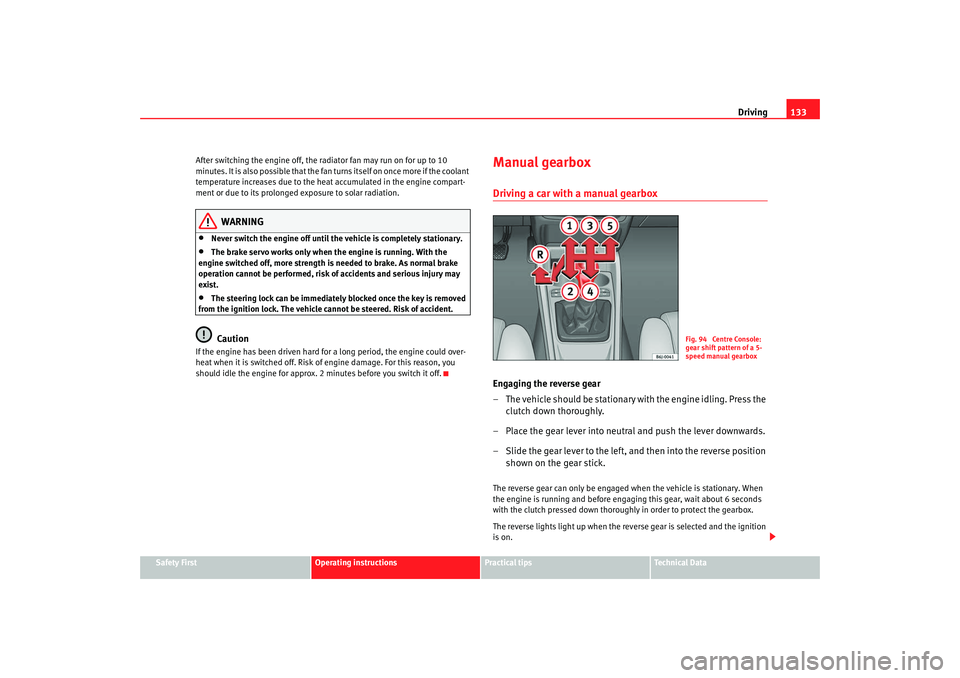
Manual gearboxDriving a car with a manual gearboxEngaging the reverse gear
– T h e v e h i c l e s h o u l d b e s t a t i o n a r y with the engine idling. Press the
clutch down thoroughly.
– Place the gear lever into neutral and push the lever downwards.
– Slide the gear lever to the left, and then into the reverse position shown on the gear stick.The reverse gear can only be engaged when the vehicle is stationary. When
the engine is running and before engaging this gear, wait about 6 seconds
with the clutch pressed down thoroughly in order to protect the gearbox.
The reverse lights light up when the reve rse gear is selected and the ignition
is on.
Fig. 94 Centre Console:
gear shift pattern of a 5-
speed manual gearbox
Ibiza SC_EN.book Seite 133 Dienstag, 8. Juli 2008 5:36 17
Page 136 of 258
Driving
134
WARNING
•
When the engine is running, the vehicle will start to move as soon as a
gear is engaged and the clutch released.
•
Never select the reverse gear when the vehicle is in motion. Risk of acci-
dent.Note
•
Do not rest your hand on the gear r est when driving. The pressure of your
hand could cause premature wear on the selector forks in the gearbox.
•
When changing gear, you should always depress the clutch down fully to
avoid unnecessary wear and damage.
•
Do not hold the car “on the clutch” uphills. This causes premature wear
and damage to the clutch.
Automatic gearbox*Gearbox programmes
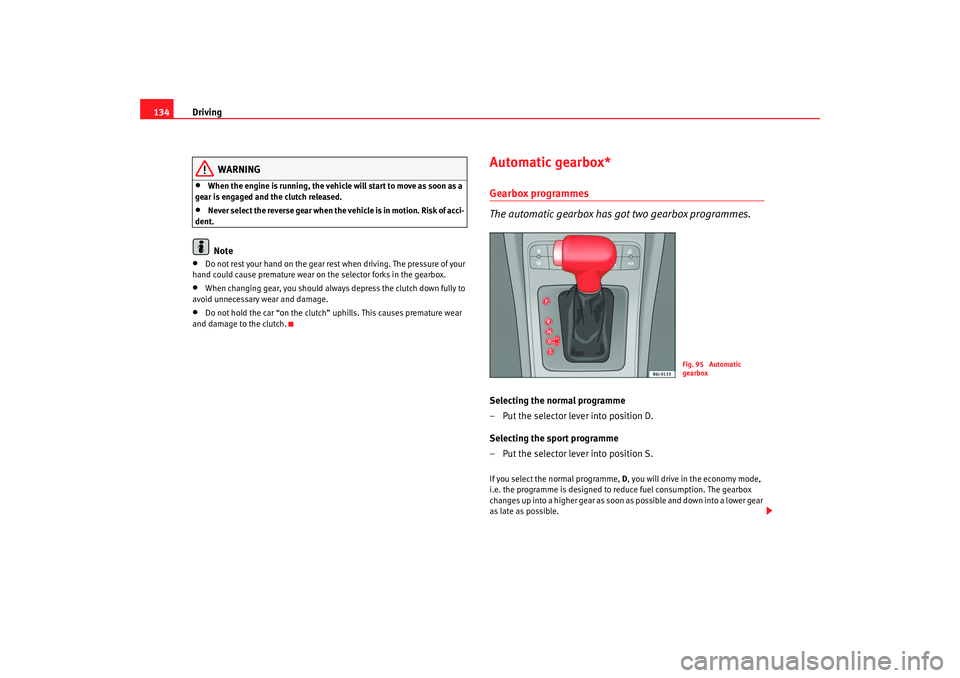
The automatic gearbox has got two gearbox programmes.Selecting the normal programme
– Put the selector lever into position D.
Selecting the sport programme
– Put the selector lever into position S.If you select the normal programme, D, you will drive in the economy mode,
i.e. the programme is designed to reduce fuel consumption. The gearbox
changes up into a higher gear as soon as possible and down into a lower gear
as late as possible.
Fig. 95 Automatic
gearbox
Ibiza SC_EN.book Seite 134 Dienstag, 8. Juli 2008 5:36 17
Page 149 of 258
Driving147
Safety First
Operating instructions
Practical tips
Te c h n i c a l D a t a
•
if the clutch pedal is depressed,
•
if the vehicle is accelerated to over 180 km/h,
•
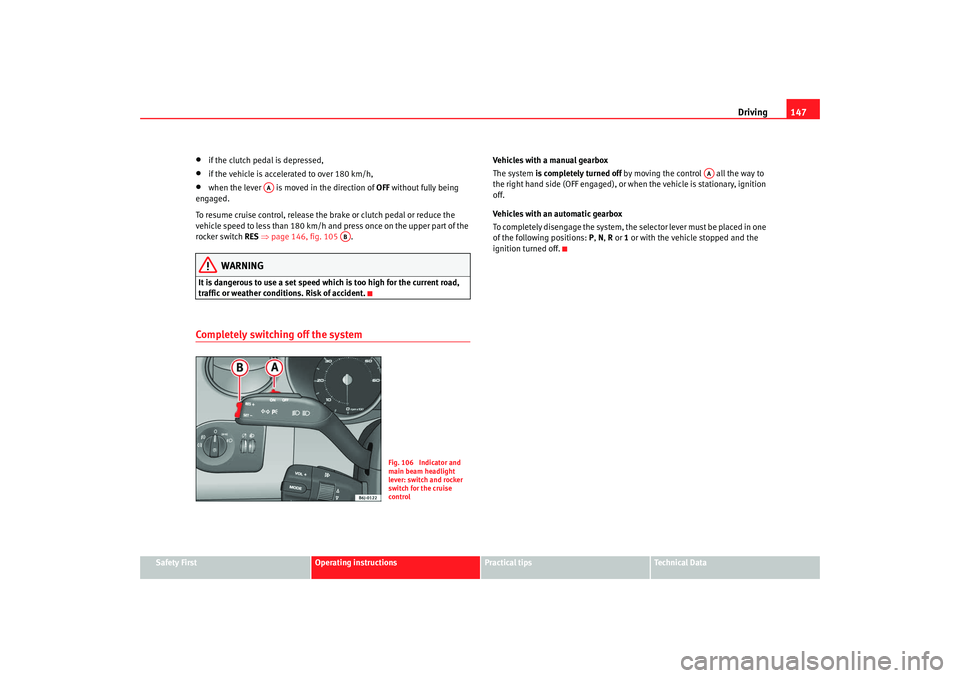
when the lever is move d in the direction of OFF without fully being
engaged.
To resume cruise control, release the brake or clutch pedal or reduce the
vehicle speed to less than 180 km/h and press once on the upper part of the
rocker switch RES ⇒page 146, fig. 105 .
WARNING
It is dangerous to use a set speed wh ich is too high for the current road,
traffic or weather conditions. Risk of accident.Completely switching off the system
Vehicles with a manual gearbox
The system is completely turned off by moving the control all the way to
the right hand side (OFF engaged), or when the vehicle is stationary, ignition
off.
Vehicles with an automatic gearbox
To completely disengage the system, the selector lever must be placed in one
of the following positions: P, N , R or 1 or with the vehicle stopped and the
ignition turned off.
AA
AB
Fig. 106 Indicator and
main beam headlight
lever: switch and rocker
switch for the cruise
control
AA
Ibiza SC_EN.book Seite 147 Dienstag, 8. Juli 2008 5:36 17
Page 215 of 258
If and when213
Safety First
Operating instructions
Practical tips
Te c h n i c a l D a t a
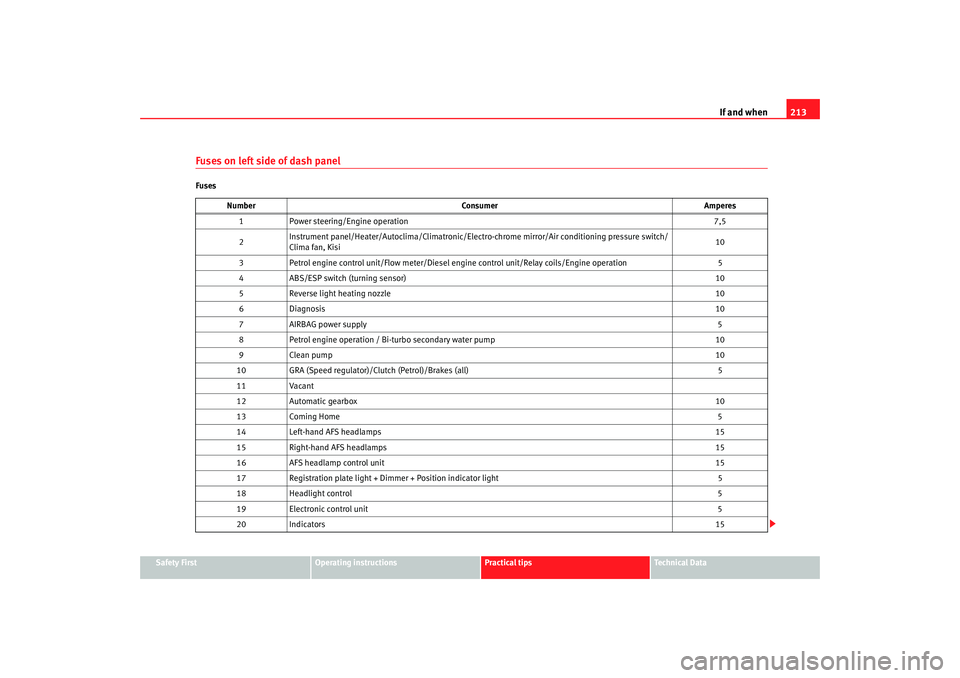
Fuses on left side of dash panelFuses
Number Consumer Amperes
1 Power steering/Engine operation 7,5
2 Instrument panel/Heate
r/Autoclima/Climatronic/Electro-chrome mirror/Air conditioning pressure switch/
Clima fan, Kisi 10
3 Petrol engine control unit/Flow meter/Diesel engine control unit/Relay coils/Engine operation 5
4 ABS/ESP switch (turning sensor) 10
5 Reverse light heating nozzle 10
6 Diagnosis 10
7 AIRBAG power supply 5
8 Petrol engine operation / Bi-turbo secondary water pump 10
9C le a n p um p 10
10 GRA (Speed regulator)/Clutch (Petrol)/Brakes (all) 5
11 Vacant
12 Automatic gearbox 10
13 Coming Home 5
14 Left-hand AFS headlamps 15
15 Right-hand AFS headlamps 15
16 AFS headlamp control unit 15
17 Registration plate light + Di mmer + Position indicator light 5
18 Headlight control 5
19 Electronic control unit 5
20 Indicators 15
Ibiza SC_EN.book Seite 213 Dienstag, 8. Juli 2008 5:36 17
Page 216 of 258
If and when
214
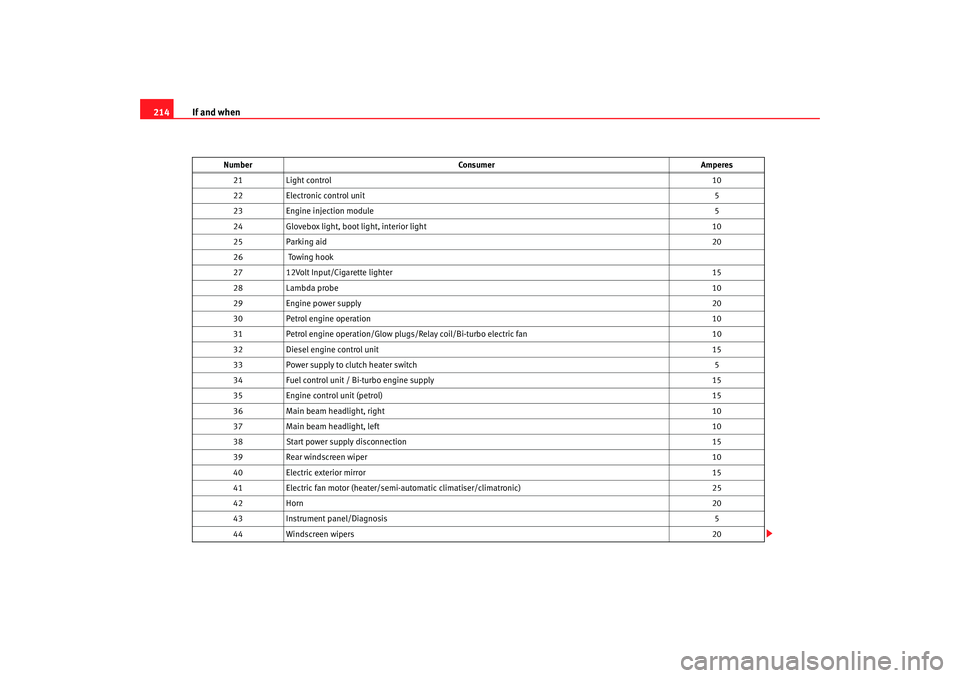
21 Light control 10
22 Electronic control unit 5
23 Engine injection module 5
24 Glovebox light, boot light, interior light 10
25 Parking aid 20
26 Towing hook
27 12Volt Input/Cigarette lighter 15
28 Lambda probe 10
29 Engine power supply 20
30 Petrol engine operation 10
31 Petrol engine operation/Glow plugs/Relay coil/Bi-turbo electric fan 10
32 Diesel engine control unit 15
33 Power supply to clutch heater switch 5
34 Fuel control unit / Bi-turbo engine supply 15
35 Engine control unit (petrol) 15
36 Main beam headlight, right 10
37 Main beam headlight, left 10
38 Start power supply disconnection 15
39 Rear windscreen wiper 10
40 Electric exterior mirror 15
41 Electric fan motor (heater/semi-automatic climatiser/climatronic) 25
42 Horn 20
43 Instrument panel/Diagnosis 5
44 Windscreen wipers 20
Number
Consumer Amperes
Ibiza SC_EN.book Seite 214 Dienstag, 8. Juli 2008 5:36 17
Page 232 of 258
If and when
230To w i n g a n d t o w - s t a r t i n gTo w - s t a r t i n g *
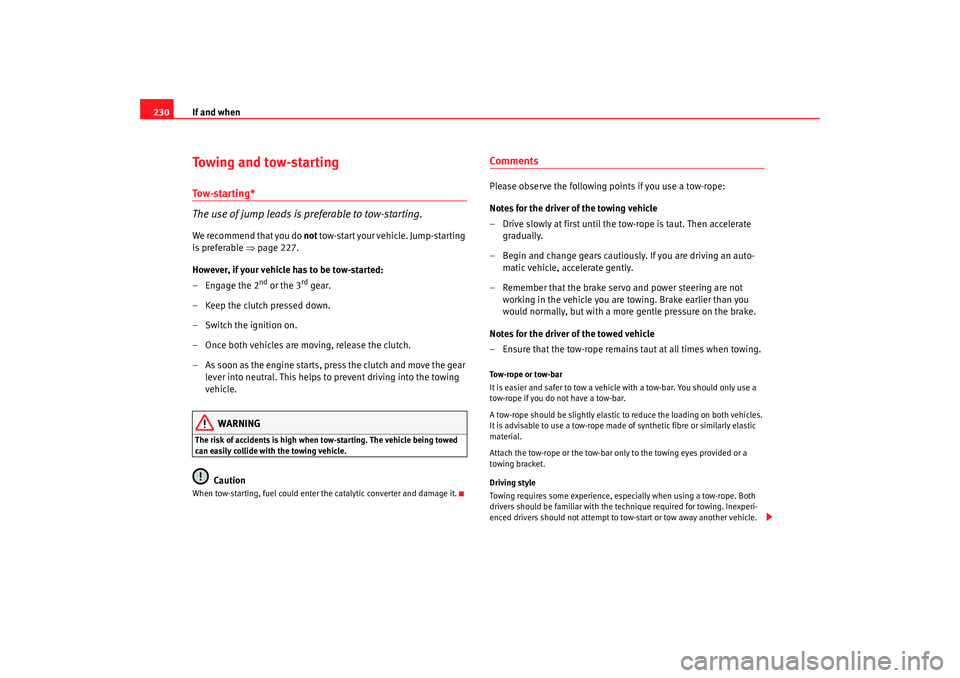
The use of jump leads is preferable to tow-starting.We recommend that you do not t o w - s t a r t yo u r v e h i c l e . J u m p - s ta r t i n g
is preferable ⇒page 227.
However, if your vehicle has to be tow-started:
– Engage the 2
nd or the 3
rd gear.
– Keep the clutch pressed down.
– Switch the ignition on.
– Once both vehicles are moving, release the clutch.
– As soon as the engine starts, press the clutch and move the gear lever into neutral. This helps to prevent driving into the towing
vehicle.
WARNING
The risk of accidents is high when tow-starting. The vehicle being towed
can easily collide with the towing vehicle.
Caution
When tow-starting, fuel could enter the catalytic converter and damage it.
CommentsPlease observe the following points if you use a tow-rope:
Notes for the driver of the towing vehicle
– Drive slowly at first until the tow-rope is taut. Then accelerate gradually.
– Begin and change gears cautiously. If you are driving an auto- matic vehicle, accelerate gently.
– Remember that the brake servo and power steering are not working in the vehicle you are towing. Brake earlier than you
would normally, but with a more gentle pressure on the brake.
Notes for the driver of the towed vehicle
– Ensure that the tow-rope remains taut at all times when towing.Tow-rope or tow-bar
It is easier and safer to tow a vehicle with a tow-bar. You should only use a
tow-rope if you do not have a tow-bar.
A tow-rope should be slightly elastic to reduce the loading on both vehicles.
It is advisable to use a tow-rope made of synthetic fibre or similarly elastic
material.
Attach the tow-rope or the tow-bar only to the towing eyes provided or a
towing bracket.
Driving style
Towing requires some experience, espec ially when using a tow-rope. Both
drivers should be familiar with the te chnique required for towing. Inexperi-
enced drivers should not attempt to tow-start or tow away another vehicle.
Ibiza SC_EN.book Seite 230 Dienstag, 8. Juli 2008 5:36 17