mirror Seat Ibiza SC 2008 Owner's manual
[x] Cancel search | Manufacturer: SEAT, Model Year: 2008, Model line: Ibiza SC, Model: Seat Ibiza SC 2008Pages: 258, PDF Size: 7.93 MB
Page 5 of 258
Contents3
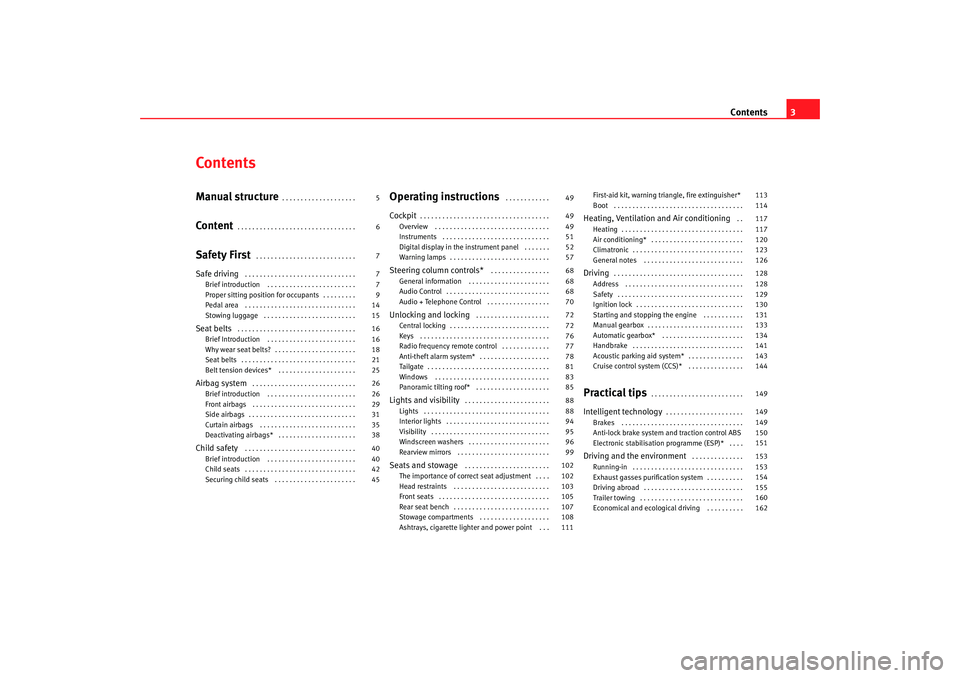
ContentsManual structure
. . . . . . . . . . . . . . . . . . . .
Content
. . . . . . . . . . . . . . . . . . . . . . . . . . . . . . . .
Safety First
. . . . . . . . . . . . . . . . . . . . . . . . . . .
Safe driving
. . . . . . . . . . . . . . . . . . . . . . . . . . . . . .
Brief introduction . . . . . . . . . . . . . . . . . . . . . . . .
Proper sitting position for occupants . . . . . . . . .
Pedal area . . . . . . . . . . . . . . . . . . . . . . . . . . . . . .
Stowing luggage . . . . . . . . . . . . . . . . . . . . . . . . .
Seat belts
. . . . . . . . . . . . . . . . . . . . . . . . . . . . . . . .
Brief Introduction . . . . . . . . . . . . . . . . . . . . . . . .
Why wear seat belts? . . . . . . . . . . . . . . . . . . . . . .
Seat belts . . . . . . . . . . . . . . . . . . . . . . . . . . . . . . .
Belt tension devices* . . . . . . . . . . . . . . . . . . . . .
Airbag system
. . . . . . . . . . . . . . . . . . . . . . . . . . . .
Brief introduction . . . . . . . . . . . . . . . . . . . . . . . .
Front airbags . . . . . . . . . . . . . . . . . . . . . . . . . . . .
Side airbags . . . . . . . . . . . . . . . . . . . . . . . . . . . . .
Curtain airbags . . . . . . . . . . . . . . . . . . . . . . . . . .
Deactivating airbags* . . . . . . . . . . . . . . . . . . . . .
Child safety
. . . . . . . . . . . . . . . . . . . . . . . . . . . . . .
Brief introduction . . . . . . . . . . . . . . . . . . . . . . . .
Child seats . . . . . . . . . . . . . . . . . . . . . . . . . . . . . .
Securing child seats . . . . . . . . . . . . . . . . . . . . . .
Operating instructions
. . . . . . . . . . . .
Cockpit
. . . . . . . . . . . . . . . . . . . . . . . . . . . . . . . . . . .
Overview . . . . . . . . . . . . . . . . . . . . . . . . . . . . . . .
Instruments . . . . . . . . . . . . . . . . . . . . . . . . . . . . .
Digital display in the instrument panel . . . . . . .
Warning lamps . . . . . . . . . . . . . . . . . . . . . . . . . . .
Steering column controls*
. . . . . . . . . . . . . . . .
General information . . . . . . . . . . . . . . . . . . . . . .
Audio Control . . . . . . . . . . . . . . . . . . . . . . . . . . . .
Audio + Telephone Control . . . . . . . . . . . . . . . . .
Unlocking and locking
. . . . . . . . . . . . . . . . . . . .
Central locking . . . . . . . . . . . . . . . . . . . . . . . . . . .
Keys . . . . . . . . . . . . . . . . . . . . . . . . . . . . . . . . . . .
Radio frequency remote control . . . . . . . . . . . . .
Anti-theft alarm system* . . . . . . . . . . . . . . . . . . .
Tailgate . . . . . . . . . . . . . . . . . . . . . . . . . . . . . . . . .
Windows . . . . . . . . . . . . . . . . . . . . . . . . . . . . . . .
Panoramic tilting roof* . . . . . . . . . . . . . . . . . . . .
Lights and visibility
. . . . . . . . . . . . . . . . . . . . . . .
Lights . . . . . . . . . . . . . . . . . . . . . . . . . . . . . . . . . .
Interior lights . . . . . . . . . . . . . . . . . . . . . . . . . . . .
Visibility . . . . . . . . . . . . . . . . . . . . . . . . . . . . . . . .
Windscreen washers . . . . . . . . . . . . . . . . . . . . . .
Rearview mirrors . . . . . . . . . . . . . . . . . . . . . . . . .
Seats and stowage
. . . . . . . . . . . . . . . . . . . . . . .
The importance of correct seat adjustment . . . .
Head restraints . . . . . . . . . . . . . . . . . . . . . . . . . .
Front seats . . . . . . . . . . . . . . . . . . . . . . . . . . . . . .
Rear seat bench . . . . . . . . . . . . . . . . . . . . . . . . . .
Stowage compartments . . . . . . . . . . . . . . . . . . .
Ashtrays, cigarette lighter and power point . . . First-aid kit, warning triangle, fire extinguisher*
Boot . . . . . . . . . . . . . . . . . . . . . . . . . . . . . . . . . . .
Heating, Ventilation and Air conditioning
. .
Heating . . . . . . . . . . . . . . . . . . . . . . . . . . . . . . . . .
Air conditioning* . . . . . . . . . . . . . . . . . . . . . . . . .
Climatronic . . . . . . . . . . . . . . . . . . . . . . . . . . . . . .
General notes . . . . . . . . . . . . . . . . . . . . . . . . . . .
Driving
. . . . . . . . . . . . . . . . . . . . . . . . . . . . . . . . . . .
Address . . . . . . . . . . . . . . . . . . . . . . . . . . . . . . . .
Safety . . . . . . . . . . . . . . . . . . . . . . . . . . . . . . . . . .
Ignition lock . . . . . . . . . . . . . . . . . . . . . . . . . . . . .
Starting and stopping the engine . . . . . . . . . . .
Manual gearbox . . . . . . . . . . . . . . . . . . . . . . . . . .
Automatic gearbox* . . . . . . . . . . . . . . . . . . . . . .
Handbrake . . . . . . . . . . . . . . . . . . . . . . . . . . . . . .
Acoustic parking aid system* . . . . . . . . . . . . . . .
Cruise control system (CCS)* . . . . . . . . . . . . . . .
Practical tips
. . . . . . . . . . . . . . . . . . . . . . . . .
Intelligent technology
. . . . . . . . . . . . . . . . . . . . .
Brakes . . . . . . . . . . . . . . . . . . . . . . . . . . . . . . . . .
Anti-lock brake system and traction control ABS
Electronic stabilisation programme (ESP)* . . . .
Driving and the environment
. . . . . . . . . . . . . .
Running-in . . . . . . . . . . . . . . . . . . . . . . . . . . . . . .
Exhaust gasses purification system . . . . . . . . . .
Driving abroad . . . . . . . . . . . . . . . . . . . . . . . . . . .
Trailer towing . . . . . . . . . . . . . . . . . . . . . . . . . . . .
Economical and ecological driving . . . . . . . . . .
5
6
7
7
7
9
14
15
16
16
18
21
25
26
26
29
31
35
38
40
40
42
45 49
49
49
51
52
57
68
68
68
70
72
72
76
77
78
81
83
85
88
88
94
95
96
99
102
102
103
105
107
108
111 113
114
117
117
120
123
126
128
128
129
130
131
133
134
141
143
144
149
149
149
150
151
153
153
154
155
160
162
Ibiza SC_EN.book Seite 3 Dienstag, 8. Juli 2008 5:36 17
Page 10 of 258
Safe driving
8Therefore, information is provided about why this equipment is so important,
how it protects you, what you have to consider when using it and how you and
your passengers can achieve the greatest possible benefit from the safety
equipment fitted. This manual includes important warnings that you and your
passengers should note in order to reduce the risk of injury.
Safety is everyone's business!Before every trip
The driver bears the responsibility for his passengers and the
operational worthiness of the vehicle.For your own safety and the safety of your passengers, always note
the following points before every trip:
– Ensure that the vehicle's lights and turn signals operate flaw- lessly.
– Check tyre pressure.
– Ensure that all windows provide a clear and good view of the surroundings.
– Secure all baggage ⇒page 15.
– Make sure that no objects can interfere with the pedals.
– Adjust front seat, head restraint and mirrors properly acoording to your size.
– Ensure that the passenger in the central rear seat always has the head restraint in the correct position for use. – Instruct passengers to adjust the head restraints according to
their height.
– Protect children with appropriate child seats and properly applied seat belts ⇒page 40.
– Assume the correct sitting position. Instruct your passengers also to assume a proper sitting position ⇒ page 9.
– Fasten your safety belt securely. Instruct your passengers also to fasten their seat belts properly ⇒page 16.
What affects driving safety?
Driving safety is largely determined by your driving style and
the personal behaviour of all occupants.As a driver, you are responsible for yourself and your passengers.
When your concentration or driving safety is affected by any circum-
stance, you endanger yourself as well as others on the road ⇒,
for this reason:
– Do not allow yourself to be distracted from the traffic around you, e.g. by passengers or telephone conversations.
– Never drive when your driving ability is impaired (e.g. by medica- tion, alcohol, drugs).
– Observe traffic laws and speed limits.
– Always reduce your speed as appropriate for road, traffic and weather conditions.
Ibiza SC_EN.book Seite 8 Dienstag, 8. Juli 2008 5:36 17
Page 52 of 258
Cockpit
50
Control for adjusting electric wing mirrors* . . . . . . . . . . . . . . .
Electric window controls* . . . . . . . . . . . . . . . . . . . . . . . . . . . . . . Note
Some of the items of equipment listed here are fitted only on certain
models/model years or are optional extras.A26
100
A27
83
Ibiza SC_EN.book Seite 50 Dienstag, 8. Juli 2008 5:36 17
Page 82 of 258
Unlocking and locking
80The interior monitor and the anti-towing alarm are automatically switched on
again next time the vehicle is locked.
The interior monitor and anti-towing alarm (tilt sensor) are automatically
switched on when the anti-theft alarm is switched on. In order to activate it,
all the doors and the tailgate must be closed.
If you wish to disconnect the interior monitor and the anti-towing system, it
must be done each time that the vehicle is locked; if not, they will connect
automatically.
The interior monitor and the anti-towing system should be disconnected if
animals are left inside the locked vehicle (otherwise, their movements will
trigger the alarm) or when, for example, the vehicle is transported or has to
be towed with only one axle on the ground.
False alarms
The interior monitor only operates co rrectly if the vehicle is completely
closed. Please observe legal requirements when doing so.
The following cases may cause a false alarm:•
opened windows (partially or fully)
•
panoramic glass roof/sunblind open (partially or completely).
•
movement of objects inside the vehicle, such as loose papers, items
hanging from the rear view mirror (air fresheners), etc.Note
•
If the vehicle is relocked and the al arm is activated without the volumetric
sensor function, relocking will activate the alarm with all its functions, except
the volumetric sensor. This function is reactivated when the alarm is switched
on again, unless it is deliberately switched off.
•
If the alarm has been triggered by the volumetric sensor, this will be indi-
cated by a flashing of the indicator on the driver's door. The flash is different
to the flash indicating the alarm is activated.
•
The vibration of a mobile phone left inside the vehicle may cause the inte-
rior monitor alarm to trigger, as both sensors react to movements and shakes
inside the vehicle.
•
If on activating the alarm, any door or the tailgate is open, only the alarm
will be activated. The inte rior monitor and the anti-towing system will only be
activated once all the doors are closed (including the tailgate).
Ibiza SC_EN.book Seite 80 Dienstag, 8. Juli 2008 5:36 17
Page 97 of 258
Lights and visibility95
Safety First
Operating instructions
Practical tips
Te c h n i c a l D a t a
Note
If not all the vehicle doors are closed, the interior lights will be switched off
after approx. 10 minutes, providing the key has been removed and the cour-
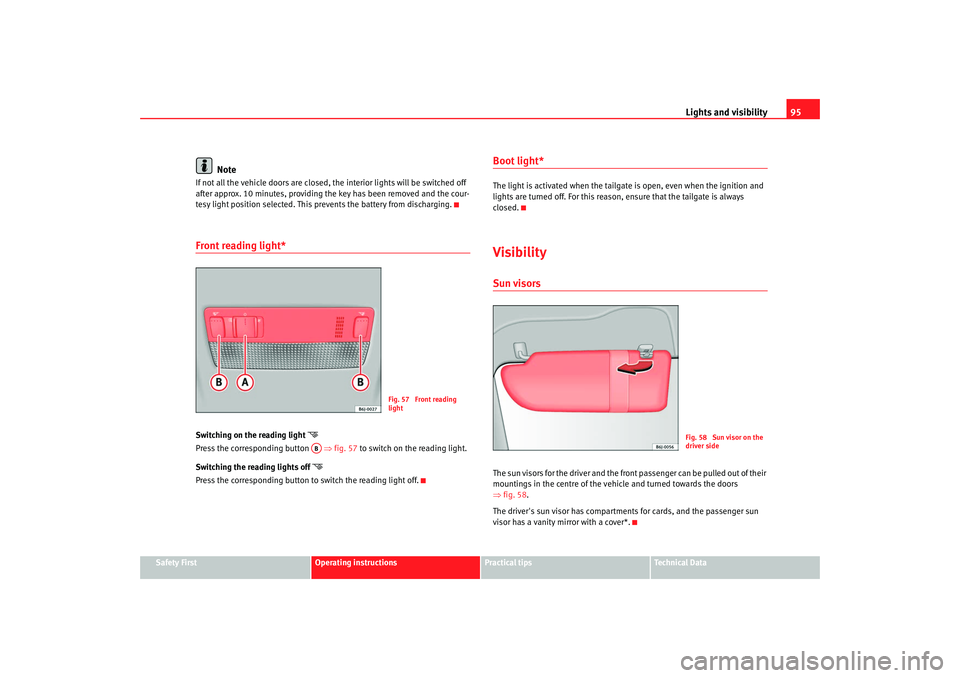
tesy light position selected. This prevents the battery from discharging.Front reading light*Switching on the reading light
Press the correspo nding button ⇒ fig. 57 to
swit ch on the reading light.
Switching the reading lights off
Press the correspondin g button to switch the reading light off.
Boot light*The light is activated when the tailgate is open, even when the ignition and
lights are turned off. For this reason, ensure that the tailgate is always
closed.VisibilitySun visorsThe sun visors for the driver and the front passenger can be pulled out of their
mountings in the centre of the vehicle and turned towards the doors
⇒ fig. 58 .
The driver's sun visor has compartments for cards, and the passenger sun
visor has a vanity mirror with a cover*.
Fig. 57 Front reading
light
AB
Fig. 58 Sun visor on the
driver side
Ibiza SC_EN.book Seite 95 Dienstag, 8. Juli 2008 5:36 17
Page 101 of 258
Lights and visibility99
Safety First
Operating instructions
Practical tips
Te c h n i c a l D a t a
Headlight washer system
The headlight washers clean the headlight lenses.The headlight washers are activated automatically when the windscreen
washer is used and the windscreen wiper lever is pulled towards the steering
wheel for at least 1.5 seconds – provided the dipped headlights or main
beams are switched on. Clean off stubborn dirt (insects, etc.) from the head-
lights at regular intervals, for instance when filling the fuel tank.
Note
•
To ensure that the headlight washers work properly in winter, keep the
nozzle holders in the bumper free of sn ow and remove any ice with a de-icer
spray.
•
To remove water, the windscreen wipers will be activated from time to
time, the headlight wipers will be activated every three cycles.
Rearview mirrorsAdjusting the head restraintsBefore beginning any journey, adjust the rear-view mirrors for correct
visibility.
Interior mirror
It is dangerous to drive if you cannot see clearly through the
rear window.Manual anti-dazzle function for interior mirror
In the basic mirror position, the lever at the bottom edge of the mirror should
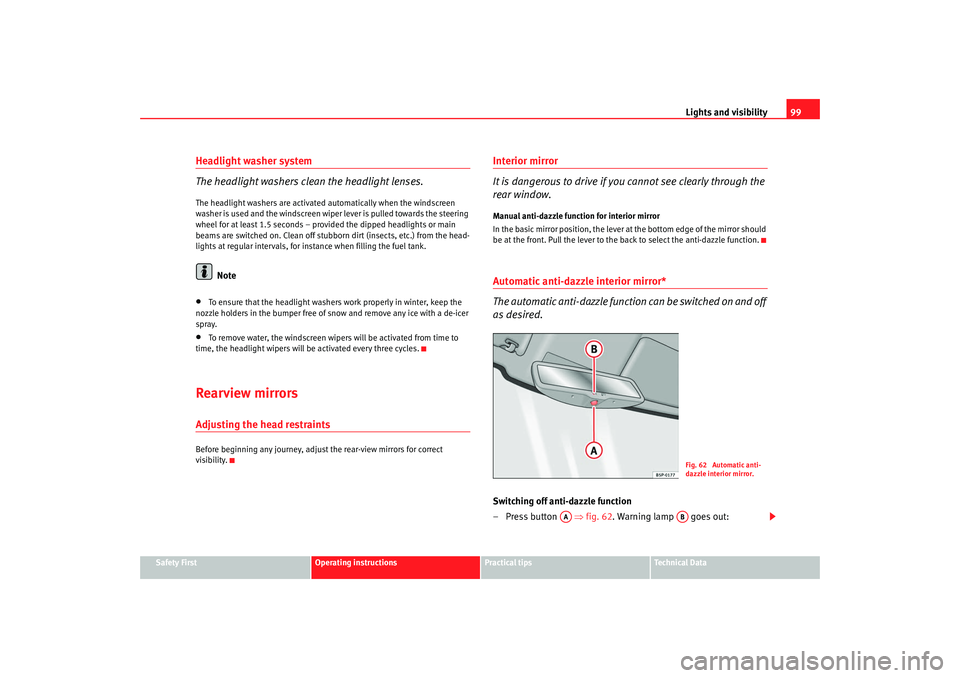
be at the front. Pull the lever to the back to select the anti-dazzle function.Automatic anti-dazzle interior mirror*
The automatic anti-da zzle function can be switched on and off
as desired.Switching off anti-dazzle function
– Press button ⇒ fig. 62. Warning lamp goes out:
Fig. 62 Automatic anti-
dazzle interior mirror.
AA
AB
Ibiza SC_EN.book Seite 99 Dienstag, 8. Juli 2008 5:36 17
Page 102 of 258
Lights and visibility
100
Switching on anti-dazzle function
– Press button ⇒page 99, fig. 62 . Warning lamp is lit.Anti-dazzle function
The anti-dazzle function is activated every time the ignition is switched on.
The green indicator lamp lights up in the mirror housing.
When the anti-dazzle function is activa ted the interior mirror will darken auto-
matically according to the amount of light it receives (for example from the
headlights of a vehicle behind). The anti-dazzle function is cancelled if
reverse gear is engaged.
Note
•
The automatic anti-dazzle function will only work properly if the sun
blind* for the rear window is retracted and there are no other objects
preventing light from reac hing the interior mirror.
•
If you have to stick any type of sticker on the windscreen, do not do so in
front of the sensors. Doing so could pr event the anti-dazzle function from
working well or even from working at all.
Folding in the wing mirrorsThe wing mirrors of the vehicle may be folded in. For this, press the mirror
housing towards the vehicle.
Note
Before washing the vehicle with an automatic car wash, fold in the mirrors to
avoid damage.
Electric wing mirrors*
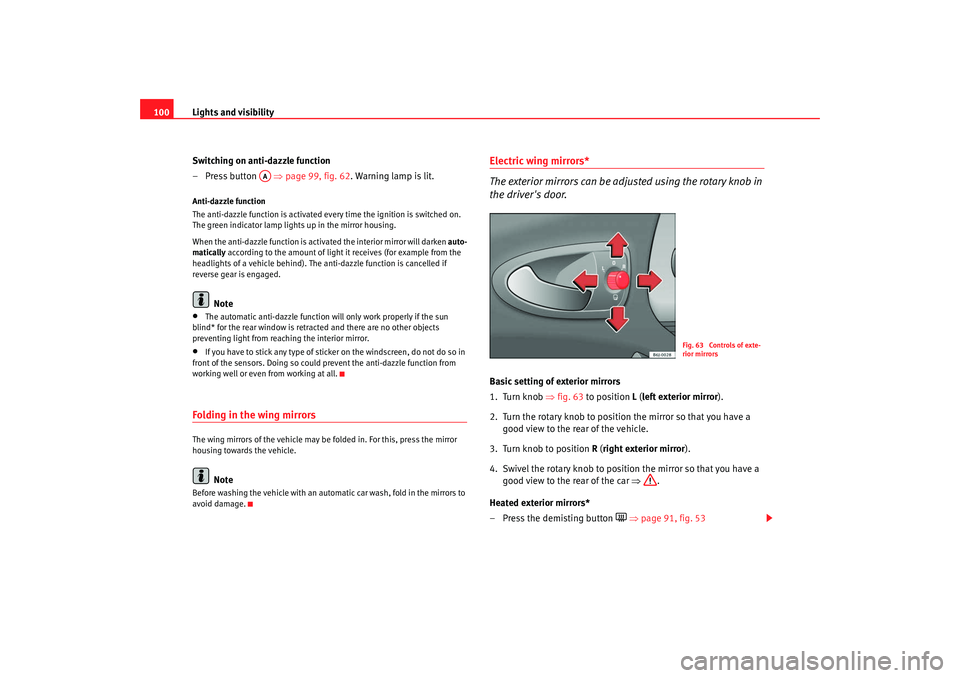
The exterior mirrors can be adjusted using the rotary knob in
the driver's door.Basic setting of exterior mirrors
1. Turn knob ⇒fig. 63 to position L ( left exterior mirror ).
2. Turn the rotary knob to position the mirror so that you have a good view to the rear of the vehicle.
3. Turn knob to position R (right exterior mirror ).
4. Swivel the rotary knob to position the mirror so that you have a good view to the rear of the car ⇒.
Heated exterior mirrors*
– Press the demisting button
⇒ page 91, fig. 53
AA
Fig. 63 Controls of exte-
rior mirrors
Ibiza SC_EN.book Seite 100 Dienstag, 8. Juli 2008 5:36 17
Page 103 of 258
Lights and visibility101
Safety First
Operating instructions
Practical tips
Te c h n i c a l D a t a
– The mirrors demist for some minutes to prevent draining the
battery.
– If necessary, press the button again to repeat the function.
Folding in exterior mirrors*
– Turn the control ⇒page 100, fig. 63 to position
to fold in the
exterior mirrors. You should always fold in the exterior mirrors if
you are driving through an automatic car wash. This will help
prevent damage.
Folding exterior mirrors back out to the extended position*
– Turn the knob to position L or R to fold the exterior mirrors back out ⇒ .
WARNING
•
The rear view convex or aspheric mirror increase the field of vision
however the objects appear smaller and further away in the mirrors. If you
use these mirrors to estimate the distance to vehicles behind you when
changing lane, you could make a mistake. Risk of accident.
•
If possible, use the interior mirror to estimate distances to vehicles
behind you.
•
Make sure that you do not get your finger trapped between the mirror
and the mirror base when folding back the mirrors. Risk of injury!For the sake of the environment
The exterior mirror heating should be switched off when it is no longer
needed. Otherwise, it is an unnecessary fuel waste.
Note
•
If the electrical adjustment ever fails to operate, the mirrors can be
adjusted by hand by lightly pressing the edge of the mirror glass.
•
In vehicles with electric wing mirrors, the following points should be
observed: if, due to an external force (e.g. a knock while manoeuvring), the
adjustment of the mirror housing is altered, the mirror will have to be
completely folded electrically. Do not readjust the mirror housing by hand, as
this will interfere with the mirror adjuster function.
•
The rear view mirrors can be adjusted separately or simultaneously, as
described before.
Ibiza SC_EN.book Seite 101 Dienstag, 8. Juli 2008 5:36 17
Page 146 of 258
Driving
144
Caution•
Please note that low obstacles detected by the system may no longer be
registered by the sensors as the car mo ves closer, so the system will not give
any further warning. Certain kinds of obstacles (such as wire fences, chains,
thin posts or trailer draw bars, high kerbs or painted railings etc) may not
always be detected by the system, so there is a risk of damaging the vehicle
in such cases.
•
In some cases, obstacles with uniform edges and bumps may not be
detected immediately by the system due to their geometry. Take special care
of this type of obstacle such as corners , rectangular objects, etc.., these can
cause damage to the vehicle.
•
Be especially careful when manoeu vring into a corner between two
perpendicular walls. Survey the approach of the wall to the side of the vehicle
(using the mirrors)
•
The parking aid system does not replace use of the mirrors for manoeu-
vres.
•
Distant ultra-sonic sources (hammers, tyres, construction machinery,
other vehicles with PDC) may interfere with the operation of the system.
•
Periodic cleaning of the sensors, take care not to damage or scratch them.
When cleaning with high pressure washers or steam cleaners, the sensors
should be sprayed for only a very short period and from a distance of more
than 10 cm.
Cruise control system (CCS)*Description
The cruise control system is able to maintain the set speed in
the range from approx. 30 km/h to 180 km/h.Once the speed setting has been saved, you may take your foot off the accel-
erator.
WARNING
It could be dangerous to use the cruise control system if it is not possible
to drive at constant speed.•
For safety reasons the cruise control system should not be used in
dense traffic, in sections with bends or where roads are in bad conditions
(e.g. aquaplanning, loose chippings, slippery surfaces, snow). Risk of acci-
dent.
•
Always switch the CCS off when finish to use it in order to avoid an
involuntary use.
•
It is dangerous to use a set speed which is too high for the current road,
traffic or weather conditions. Risk of accident.Note
The cruise control cannot maintain a constant speed when descending down-
hills. The vehicle will accelerate due to its own weight. Use the foot brake to
slow the vehicle.
Ibiza SC_EN.book Seite 144 Dienstag, 8. Juli 2008 5:36 17
Page 162 of 258
Driving and the environment
160On the right headlight, if you are chan ging from driving on the left-hand side
to the right-hand side.
On the left headlight, if you are changing from driving on the left-hand side to
the right-hand side.Trailer towingWhat do you need to bear in mind when towing a trailer?Your vehicle may be used to tow a trailer when fitted with the correct equip-
ment.
If the car is supplied with a factory-fitted towing bracket it will already have
the necessary technical modifications and meet the statutory requirements
for towing a trailer. For the after-market fitting of a trailer towing bracket see
⇒ page 176.
Connectors
Your vehicle is fitted with a 12-pin connector for the electrical connection
between the trailer and the vehicle.
If the trailer has a 7-pin plug you will need to use an adapter cable. This is
available in any SEAT dealer.
Trailer weight / draw bar loading
Never exceed the authorised towing limit. If you do not load the trailer up to
the maximum permitted tr ailer weight, you can then climb correspondingly
steeper slopes.
The maximum trailer weights listed are only applicable for altitudes up to
1,000 m above sea level. With increasing altitude the engine power and
therefore the vehicle's climbing ability are impaired because of the reduced
air density. The maximum trailer weight has to be reduced accordingly. The weight of the vehicle and trailer co
mbination must be reduced by 10% for
every further 1,000 m (or part thereof). The gross combination weight is the
actual weight of the laden vehicle plus the actual weight of the laden trailer.
When possible, operate the trailer with the maximum permitted draw bar
weight on the ball joint of the towing bracket, but do not exceed the specified
limit.
The figures for trailer weights and draw bar weights that are given on the
data plate of the towing bracket are for certification purposes only. The
correct figures for your spec ific model, which may be lower than these figures
for the towing bracket, are given in the registration documents ⇒Section
“Technical data”.
Distributing the load
Distribute loads in the trailer so that heavy objects are as near to the axle as
possible. Loads carried in the trailer must be secured to prevent them
moving.
Tyre pressure
Set tyre pressure to the maximum permissible pressure shown on the sticker
on the inside of the fuel tank flap. Set the tyre pressure of the trailer tyres in
accordance with the trailer manufacturer's recommendations.
Exterior mirrors
Check whether you can see enough of the road behind the trailer with the
standard mirrors. If this is not the case, you should have additional mirrors
fitted. Both exterior mirrors shoul d be mounted on hinged extension
brackets. Adjust the mirrors to give sufficient vision to the rear.
WARNING
Never transport people in a trailer. This could result in fatal accidents.
Ibiza SC_EN.book Seite 160 Dienstag, 8. Juli 2008 5:36 17