service indicator Seat Ibiza SC 2008 Owner's manual
[x] Cancel search | Manufacturer: SEAT, Model Year: 2008, Model line: Ibiza SC, Model: Seat Ibiza SC 2008Pages: 258, PDF Size: 7.93 MB
Page 30 of 258
Airbag system
28Monitoring of airbag and belt tension device system
Both the airbag and belt tension device systems operation is constantly
monitored electronically. The warning lamp
will light up for a few seconds
every time the ignition is switched on (self-diagnosis).
The system must be checked when the warning lamp
:
•
does not light up when the ignition is switched on,
•
after the ignition is switched on, it turns off after 4 seconds,
•
it turns off and then lights up again after the ignition is switched on,
•
lights up or flashes while the car is moving.
In the event of a malfunction, the warning lamp remains on continuously.
Have the airbag system inspected immediately by a qualified workshop.
If any of the airbags are de-activated by the Authorised Service Centre, the
indicator lights for several seconds more after the veri fication and will turn off
if there is no fault.
WARNING
•
If there is a malfunction, the air bag and belt tension device system
cannot properly perform its protective function.
•
If a malfunction occured, have the system checked immediately by a
qualified workshop. Otherwise, in the event of an accident, the airbag
system and belt tension devices may no t be triggered, or may not be trig-
gered correctly.
Repairs, maintenance and disposal of the airbagsThe parts of the airbag system are installed in various places in your vehicle.
If you work on the airbag system or remove and install parts of the system
when performing other repair work, parts of the airbag system may be damaged. The consequence may be that, in the event of an accident, the
airbag inflates incorrectly
or does not inflate at all.
The relevant safety requirements must be observed when the vehicle or
components of the airbag are scrapped. The specialist workshops and the
Vehicle disposal centres are familiar with these requirements.
WARNING
•
If repairs are not carried out by a professional, or if the airbags are used
incorrectly, the risk of severe or fatal injuries is increased. The airbags may
fail to inflate, or could inflate in the wrong circumstances.
•
Do not cover or stick anything on the steering wheel hub or the soft
plastic surface of the airbag unit on the passenger side of the dashboard,
and do not obstruct or modify them in any way.
•
It is important not to attach any objects such as cup holders or tele-
phone mountings to the surfaces covering the airbag units.
•
To clean the steering wheel or dash panel, you may use only a dry or a
water-moistened cloth. Never clean the dash panel and the airbag module
surface with cleansers containing solvents. Solvents cause the surface to
become porous. If the airbag trigger ed, disintegrating plastic parts could
cause substantial injuries.
•
Never attempt to repair, adjust, remove or install parts of the airbag
system.
•
Any work on the airbag system or re moval and installation of the airbag
components for other repairs (such as repairs to the steering wheel) should
be performed only by a qualified workshop. Qualified workshops have the
necessary tools, repair information and qualified personnel.
•
We strongly recommend you to go to a qualified workshop for all work
on the airbag system.
•
Never attempt to alter the front bumper or the body.
•
The airbags provide protection for just one accident; replace them once
they have deployed.
Ibiza SC_EN.book Seite 28 Dienstag, 8. Juli 2008 5:36 17
Page 54 of 258
Cockpit
52Rev counter
The rev. counter displays the engine speed in revolutions per
minute.The start of the red zone ⇒page 51, fig. 30 indicates the maximum
engine speed operating at service temperature. However, it is advisable to
change up a into a higher gear, move the selector lever to D or lift your foot
off the accelerator before the needle reaches the red zone.
Caution
The rev counter needle must never enter the red zone on the scale. Risk of
engine damage.
For the sake of the environment
Changing up into higher gears early will help you to save fuel and minimise
engine noise.SpeedometerThe speedometer is equipped with a digital odometer and a trip counter, in
addition to a service intervals display.
During the running-in period, the instructions shown on ⇒page 153 should
be followed.
Digital display in the instrument panelFuel gauge
and reserve indicator
Instrument panel: fuel gauge
The fuel tank has a capacity of approx. 45 litres.
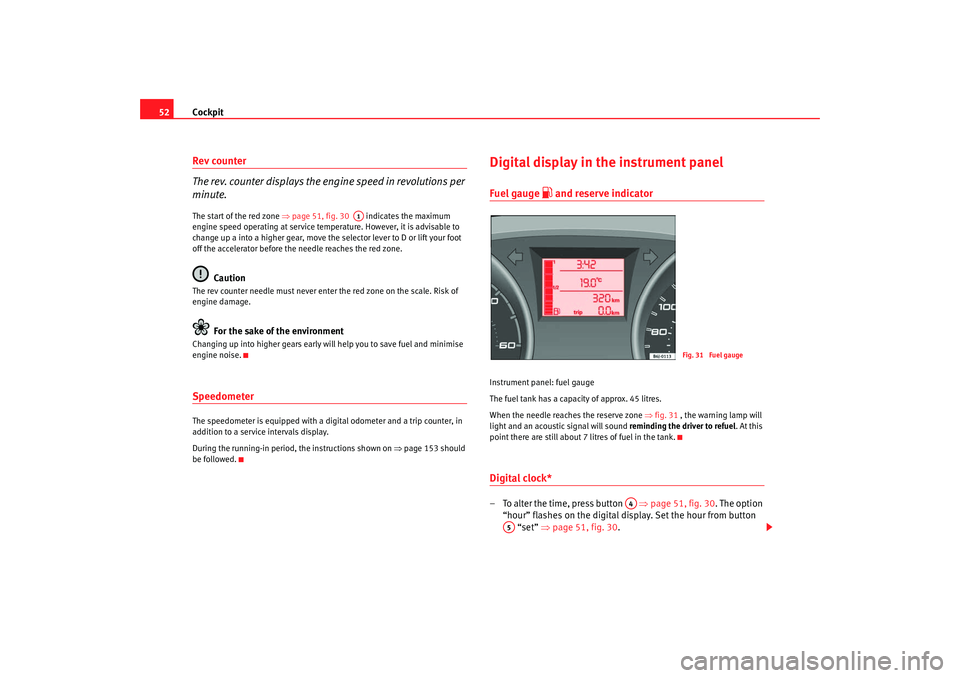
When the needle reaches the reserve zone ⇒fig. 31 , the warning lamp will
light and an acoustic signal will sound reminding the driver to refuel. At this
point there are still about 7 litres of fuel in the tank.Digital clock* – To alter the time, press button ⇒page 51, fig. 30 . The option
“hour” flashes on the digital display. Set the hour from button “set” ⇒ page 51, fig. 30 .
A1
Fig. 31 Fuel gauge
A4
A5
Ibiza SC_EN.book Seite 52 Dienstag, 8. Juli 2008 5:36 17
Page 62 of 258
Cockpit
60
Note•
The appropriate warning lamp for a fa ult will light up in vehicles without
warning or information texts in the display.
•
In vehicles with warning or information texts on the screen, the appro-
priate warning lamp for a fault will ligh t up and a warning or information text
will also appear on the screen.
Engine management
This warning lamp monitors the engine management system
for petrol engines.
The warning lamp
(Electronic Power Control) lights up when the ignition
is switched on to show that the lamp is working properly. It should go out
once the engine is started.
If there is a fault in the electronic engine management system while you are
driving, this warning lamp will light up. Stop the vehicle and seek technical
assistance.
Glow plug system / Engine fault*
The warning lamp lights up to show that the glow plugs are
preheating. It flashes if there is an engine fault.
Warning lamp
is lit
The warning lamp lights up while the glow plugs are preheating. When the
warning lamp goes off, the engine should be started straight away. Warning lamp
flashes
If a fault develops in the engine management system while you are driving,
the glow plug lamp will flash
. Take the vehicle to an Authorised Service
Centre as soon as possible and have the engine checked.
Soot accumulation in the diesel engine particulate filter *
If the indicator lights
you may help the filter clear itself by driving in the
appropriate manner.
To do this, drive about 15 minutes in 4th or 5th gear (automatic gearbox: S
gear range) at a speed of 60 km/h, with the engine running at approximately
2000 rpm. In this way, the pollen build up in the filter is burned. When
cleaning is successful, the indicator turns off.
If the indicator
is not deactivated, bring the vehicle to a specialised work-
shop to repair the fault.
WARNING
•
Always drive according to the road weather conditions, the terrain and
traffic. Driving recommendations should never lead to illegal manoeuvres
in surrounding traffic.
•
The diesel engine particulate filter may reach extremely high tempera-
tures; it should not enter into contact with flammable materials under-
neath the vehicle. Failure to comply could result in fire.
Ibiza SC_EN.book Seite 60 Dienstag, 8. Juli 2008 5:36 17
Page 68 of 258
Cockpit
66If the warning lamp lights up again after driving on for a short distance, stop
the vehicle and switch the engine off . Contact an Authorised Service Centre
or a qualified workshop.
Coolant level too low
If the warning li ght lights up, stop the vehicle, switch the engine off and wait
for it to cool down. First check the coolant level. If the level is underneath the
“MIN” mark, top up with coolant ⇒.
WARNING
•
If your vehicle is immobilised for any technical reasons, move it to a
safe distance from traffic. Turn the engine off, turn the hazard lights on and
place the warning triangle.
•
Never open the bonnet if you can see or hear steam or coolant escaping
from the engine compartment. Risk of scalding. Wait until you can no
longer see or hear escaping steam or coolant.
•
The engine compartment is a dangerous area! Before carrying out any
work in the engine compartment, swit ch off the engine and allow it to cool
down. Always note the corresponding warnings. ⇒page 181
Alternator
This warning lamp signals a fault in the alternator.
The warning lamp
lights up when the ignition is switched on. It should go
out when the engine has started running.
If the warning lamp lights up while driving, the alternator is no longer
charging the battery. You should immediately drive to the nearest qualified
workshop.
You should avoid using electrical equipm ent that is not absolutely necessary
because this will drain the battery. If the indicator flashes the voltage is insufficient for normal vehicle
operation.
Turn sig nals
The warning lamp flashes when the indicators are in opera-
tion.Depending on which indicator is operating, either the left
or right
indi-
cator lamp flashes. Both warning lamps will flash at the same time when the
hazard warning lights are switched on.
If any of both indicators fails, the warni ng lamp will start flashing twice faster
than normal.
Further information on the indicators ⇒page 93.
Electronic immobiliser* “Safe”
This warning lamp flashes if an unauthorised key is used.Inside the key there is a chip that deac tivates the electronic immobiliser auto-
matically when the key is inserted into the ignition. The immobiliser will be
activated again automatically as soon as you pull the key out of the ignition
lock.
The instrument panel displays shows the following message
6): SAFE . The
vehicle cannot be started in this case
The engine can, however, be started if the appropriate coded SEAT genuine
key is used.
6)Depending on the version of the model.
Ibiza SC_EN.book Seite 66 Dienstag, 8. Juli 2008 5:36 17
Page 80 of 258
Unlocking and locking
78•
Never leave children or disabled persons in the vehicle. In case of emer-
gency, they may not be able to leave the vehicle and not manage on their
own.
•
Never forget the keys inside the vehicle. Otherwise, this could result in
serious injuries, accidents or even the theft of your vehicle. Always take the
key with you when you leave the vehicle.
•
An uncontrolled use of the key could start the engine or activate any
electric equipment(e.g. electric wind ows), causing risk of accident. The
vehicle can be locked when using th e remote control key. This could
complicate the aid in cas of emergency.Note
•
The remote control key functions only when you are in its range
⇒ page 77, fig. 43 .
•
If the vehicle cannot be unlocked or locked by using the radio-frequency
remote control, the remote control key will have to be re-synchronised. For
this, go to your Technical Service.
Changing the batteryIf the battery indicator does not flash when the buttons are pushed, the
battery must be replaced.
Caution
The use of inappropriate batteries may damage the radio frequency remote
control. For this reason, always replac e the dead battery with another of the
same size and power.
For the sake of the environment
The flat batteries must be thrown away in accordance with regulations
governing the protection of the environment.Anti-theft alarm system*Description of anti-theft alarm system*
The anti-theft alarm triggers if unauthorised movements are
detected around the vehicle.The anti-theft alarm makes it more difficult to break into the vehicle or steal
it. The system will initiate acoustic and optical warning signals when your
vehicle is tried to be forced.
The anti-theft alarm system is auto matically connected on locking the
vehicle. For this, either rotate the key in the locking position or press button on the radio-frequency remote control*. The system is immediately
activated and the indicator light located on the driver's door will flash along
with the indicators, indicating that the alarm and the locking security system
(double lock) have been turned on.
If any of the doors or the bonnet are open, they will not be included in the
protection zones of the vehicle when the alarm is connected. If the door or the
bonnet are subsequently closed, they will be automatically included in the
protection areas of the vehicle and the indicators will flash accordingly when
the doors close.•
The indicator light will flash twice on opening and deactivating the alarm..
•
The indicator light will flash once on closing and activating the alarm.
WARNING (continued)
A2
Ibiza SC_EN.book Seite 78 Dienstag, 8. Juli 2008 5:36 17
Page 157 of 258
Driving and the environment155
Safety First
Operating instructions
Practical tips
Te c h n i c a l D a t a
Caution
Never fully drain the fuel tank because the irregularity of the fuel supply may
cause ignition problems. This allows unburnt fuel to enter the exhaust
system, which could cause overheating and damage the catalytic converter.
For the sake of the environment
Even when the emission control system is working perfectly, there may be a
smell of sulphur from the exhaust unde r some conditions. This depends on
the sulphur content of the fuel used. Quite often the problem can be solved
by changing to another fuel brand.Diesel engine particulate filter*
The diesel engine particulate filter eliminates soot produced
by burning diesel.The diesel engine dust filter eliminates most of the soot from the exhaust gas
system. Under normal driving conditions, the filter cleans itself. If the driving
conditions do not allow the filter to clean itself (for example, multiple short
trips) the filter will be obstructed by dust and pollen and the indicator
for
the diesel engine particulate filter indicator will light. See under Warning
Lights.
WARNING
•
The diesel engine particulate filter may reach extremely high tempera-
tures; it should not enter into contact with flammable materials under-
neath the vehicle. Failure to comply could result in fire.
Caution
•
The vehicle has not been made to refuel with mixtures of FAME fuel
(biodiesel) over 7%. The diesel particle filter is damaged when the mixture
percentage is exceeded.
Driving abroadObservationsTo drive abroad, the following mu st be taken into consideration:•
For vehicles fitted with a catalytic converter ensure that unleaded petrol is
available for the journey. See the chap ter “Refuelling”. Automobile organisa-
tions will have information about service station networks selling unleaded
fuel.
•
In some countries, it is possible that a vehicle model is sold under condi-
tions where some spare parts are not available or that the Authorised Service
Centre may only carry out limited repairs.
SEAT importers and distributors will gladly provide information about the
technical preparation of your vehicle and also about necessary maintenance
and repair possibilities.
Adhesive strips for headlightsIf you have to drive a right-hand drive vehicle in a left-hand drive country, or
vice versa, the asymmetric dipped beam headlights will dazzle oncoming
traffic.
Ibiza SC_EN.book Seite 155 Dienstag, 8. Juli 2008 5:36 17
Page 163 of 258
Driving and the environment161
Safety First
Operating instructions
Practical tips
Te c h n i c a l D a t a
Note
•
Towing a trailer places additional demands on the vehicle. We recom-
mend additional services between the normal inspection intervals if the
vehicle is used frequently for towing a trailer.
•
Find out whether special regulations apply to towing a trailer in your
country.
Ball coupling of towing bracket*The ball coupling is provided with instructions on fitting and removing the
ball coupling of the towing bracket.
WARNING
The towing bracket ball coupling must be stored securely in the luggage
compartment to prevent them being flung through the vehicle and causing
injury.
Note
•
By law, the ball coupling must be re moved if a trailer is not being towed
and it obscures the number plate.
Driving tips
Driving with a trailer always requires extra care.Weight distribution
The weight distribution of a loaded trailer with an unladen vehicle is very
unfavourable. However, if this cannot be avoided, drive extra slowly to allow
for the unbalanced we ight distribution.
Speed
The stability of the vehicle and trailer is reduced with increasing speed. For
this reason, it is advisable not to drive at the maximum permissible speed in
an unfavourable road, weather or wind conditions. This applies especially
when driving downhill.
You should always reduce speed immediately if the trailer shows the slightest
sign of snaking . Never try to stop the “s naking” by increasing speed.
Always brake in due course. If the trailer has an overrun brake, apply the
brakes gently at first and then, firmly. This will prevent the jerking that can be
caused by the trailer wheel s locking. Select a low gear in due course before
going down a steep downhill. This enables you to use the engine braking to
slow down the vehicle.
Reheating
At very high temperatures and during prolonged slopes, driving in a low gear
and high engine speed, always monitor the temperature indicator for the
coolant ⇒page 49.
Electronic Stabilisation Program*
The ESP* system helps to stabilise the trailer in case of skiding or rocking.
Ibiza SC_EN.book Seite 161 Dienstag, 8. Juli 2008 5:36 17
Page 200 of 258
Checking and refilling levels
198
2. The tyre pressures should only be checked when the tyres are cold. The slightly raised pressures of warm tyres must not be
reduced.
3. Adjust the tyre pressure to the load you are carrying.Tyre pressure
The correct tyre pressure is especially important at high speeds. The pressure
should therefore be checked at least once a month and before starting a
journey.
WARNING
A tyre can easily burst if the pressure is too low, causing an accident!•
At continuously high speeds, a tyre with insufficient pressure flexes
more. In this way it becomes too hot, and this can cause tread separation
and tyre blow-out. Always observ e the recommended tyre pressures.
•
If the tyre pressure is too low or too high, the tyres will wear prema-
turely and the vehicle will not h andle well. Risk of accident!For the sake of the environment
Under-inflated tyres will increase fuel consumption.
Tyre service life
The service life of tyres is dependent on tyre pressure, driving
style and fitting.
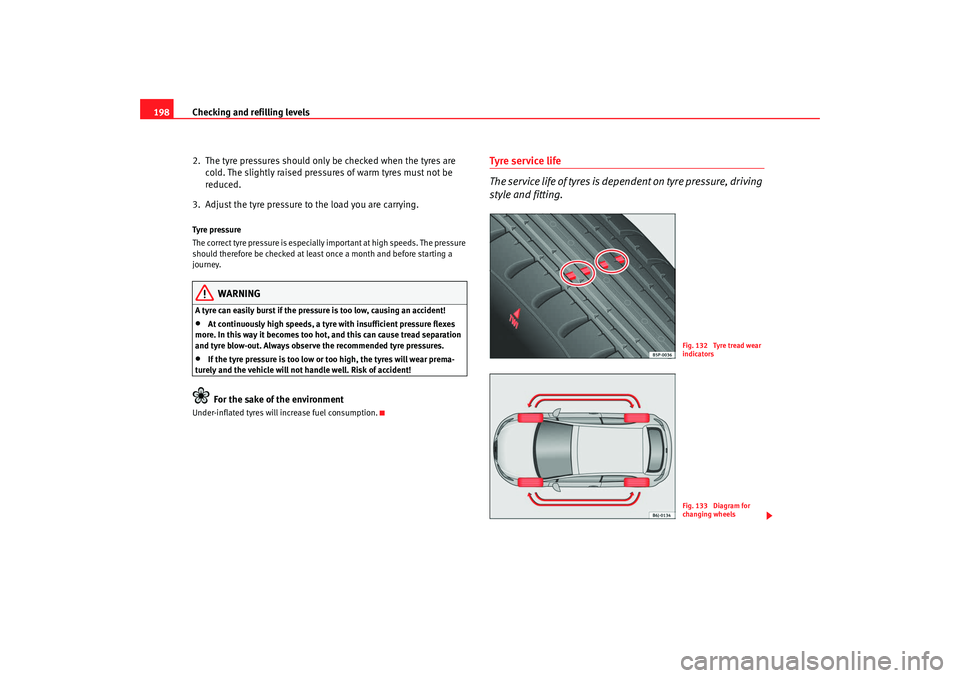
Fig. 132 Tyre tread wear
indicatorsFig. 133 Diagram for
changing wheels
Ibiza SC_EN.book Seite 198 Dienstag, 8. Juli 2008 5:36 17
Page 201 of 258
Checking and refilling levels199
Safety First
Operating instructions
Practical tips
Te c h n i c a l D a t a
Wear indicators
The original tyres on your vehicle have 1.6 mm high “tread wear indicators”
⇒
page 198, fig. 132 , running across the tread. Depending on the make,
there will be six to eight of them evenly spaced around the tyre. Markings on
the tyre sidewall (for instance the letters “TWI” or other symbols) indicate the
positions of the tread wear indicators. The minimum tread depth required by
law is 1.6 mm (measured in the tread grooves next to the tread wear indica-
tors). Worn tyres must be replaced. Different figures may apply in export
countries ⇒.
Tyre pressure
Incorrect tyre pressure causes premature wear and could cause tyre blow-out.
For this reason, the tyre pressure should be checked at least once per month
⇒ page 197.
Driving style
Fast cornering, heavy acceleration and hard braking all increase tyre wear.
Changing wheels around
If the front tyres are worn considerably more than the rear ones it is advisable
to change them around as shown ⇒page 198, fig. 133 . All the tyres will then
last for about the same time.
Wheel balance
The wheels on new vehicles are balanced. However, various factors encoun-
tered in normal driving can cause them to become unbalanced, which results
in steering vibration.
Unbalanced wheels should be rebalanced, as they otherwise cause excessive
wear on steering, suspension and tyres. A wheel must also be rebalanced
when a new tyre is fitted.
Incorrect wheel alignment
Incorrect wheel alignment causes excessive tyre wear, impairing the safety of
the vehicle. If tyres show excessive wear, you should have the wheel align-
ment checked by an Authorised Service Centre.
WARNING
There is a serious danger of accidents if a tyre bursts during driving!•
The tyres must be replaced at the latest when the tread is worn down to
the tread wear indicators. Failure to do so could result in an accident. Worn
tyres do not grip well at high speeds on wet roads. There is also a greater
risk of “aquaplaning”
•
At continuously high speeds, a tyre with insufficient pressure flexes
more. This causes it to overheat. This can cause tread separation and tyre
blow-out. Risk of accident. Always observe the recommended tyre pres-
sures.
•
If tyres show excessive wear, you should have the running gear checked
by an Authorised Service Centre.
•
Keep chemicals such as oil, fuel and brake fluid away from tyres.
•
Damaged wheels and tyres must be replaced immediately!For the sake of the environment
Under-inflated tyres will increase fuel consumption.New tyres and wheels
New tyres and wheels have to be run-in.The tyres and wheel rims are an essential part of the vehicle's design. The
tyres and rims approved by SEAT are specially matched to the characteristics
of the vehicle and make a major contribution to good road holding and safe
handling ⇒.
Tyres should be replaced at least in pair s and not individually (i.e. both front
tyres or both rear tyres together). A knowledge of tyre designations makes it
Ibiza SC_EN.book Seite 199 Dienstag, 8. Juli 2008 5:36 17
Page 249 of 258
Index247
Index
AABS . . . . . . . . . . . . . . . . . . . . . . . . . . . . . . . . . . . 150
Warning lamp . . . . . . . . . . . . . . . . . . . . . . . . . 61
Accessories . . . . . . . . . . . . . . . . . . . . . . . . . . . . 173
Acoustic signal . . . . . . . . . . . . . . . . . . . . . . . . . . 17
Acoustic warning . . . . . . . . . . . . . . . . . . . . . . . . 130
Adjustable service interval display . . . . . . . . . . 56
Air conditioning system Climatronic . . . . . . . . . . . . . . . . . . . . . . . . . . 123
General notes . . . . . . . . . . . . . . . . . . . . . . . . 126
Air conditioning* . . . . . . . . . . . . . . . . . . . . . . . . 120
Air outlets . . . . . . . . . . . . . . . . . . . . . . . . . . . . . . 119
Air recirculation Semi-automatic air conditi oning . . . . . . . . 122
Air recirculation mode Climatronic . . . . . . . . . . . . . . . . . . . . . . . . . . 125
Airbag system . . . . . . . . . . . . . . . . . . . . . . . . . . . 26 Curtain airbags . . . . . . . . . . . . . . . . . . . . . . . 35
Front airbags . . . . . . . . . . . . . . . . . . . . . . . . . 29
Side airbags . . . . . . . . . . . . . . . . . . . . . . . . . . 31
Warning lamp . . . . . . . . . . . . . . . . . . . . . . . . . 27
Alarm system Switching off . . . . . . . . . . . . . . . . . . . . . . . . . 79
Alternator Warning lamp . . . . . . . . . . . . . . . . . . . . . . . . . 66
Ambient temperature display . . . . . . . . . . . . 53, 55
Anti-freeze . . . . . . . . . . . . . . . . . . . . . . . . . . . . . 188 Anti-lock brake system . . . . . . . . . . . . . . . . . . . 150
Warning lamp . . . . . . . . . . . . . . . . . . . . . . . . . 61
Anti-theft alarm system . . . . . . . . . . . . . . . . . . . . 78 Switching off . . . . . . . . . . . . . . . . . . . . . . . . . 79
Anti-theft wheel bolts . . . . . . . . . . . . . . . . . . . . 206
Aquaplaning . . . . . . . . . . . . . . . . . . . . . . . . . . . 199
Automatic anti-dazzle interior mirror* Activating the anti-dazzle function . . . . . . . 99
Deactivating anti-dazzle function . . . . . . . . . 99
Automatic car washing tunnel . . . . . . . . . . . . . 165
Automatic gearbox . . . . . . . . . . . . . . . . . . . . . . 134 Kick-down feature . . . . . . . . . . . . . . . . . . . . 140
Selector lever positions . . . . . . . . . . . . . . . . 138
Automatic wiper/wash function for the rear window 98
AUX input connection/USB* . . . . . . . . . . . . . . . 113
Auxiliary audio input connection: AUX . . . . . . . 113
BBall coupling . . . . . . . . . . . . . . . . . . . . . . . . . . . 161
BAS . . . . . . . . . . . . . . . . . . . . . . . . . . . . . . . . . . . 149
Battery Changing . . . . . . . . . . . . . . . . . . . . . . . . . . . 196
Charging . . . . . . . . . . . . . . . . . . . . . . . . . . . . 196
Winter conditions . . . . . . . . . . . . . . . . . . . . 195
Belt tension device Disposal . . . . . . . . . . . . . . . . . . . . . . . . . . . . . 25
Warning lamp . . . . . . . . . . . . . . . . . . . . . . . . . 27 Belt tension devices . . . . . . . . . . . . . . . . . . . . . . 25
Biodiesel . . . . . . . . . . . . . . . . . . . . . . . . . . . . . . 180
Biodiesel fuel . . . . . . . . . . . . . . . . . . . . . . . . . . . 180
Bonnet . . . . . . . . . . . . . . . . . . . . . . . . . . . . . . . . 183
Boot . . . . . . . . . . . . . . . . . . . . . . . . . . . . . . . . . . 114
Boot* . . . . . . . . . . . . . . . . . . . . . . . . . . . . . . 95, 227
Brake Assist System
Warning lights auto matic lighting . . . . . . . 149
Brake fluid . . . . . . . . . . . . . . . . . . . . . . . . . . . . . 193 Changing . . . . . . . . . . . . . . . . . . . . . . . . . . . 194
Brake pads . . . . . . . . . . . . . . . . . . . . . . . . . . . . . 153
Brake servo . . . . . . . . . . . . . . . . . . . . . . . 149, 153
Brake system . . . . . . . . . . . . . . . . . . . . . . . . . . . 193 Warning lamp . . . . . . . . . . . . . . . . . . . . . . . . 63
Brakes . . . . . . . . . . . . . . . . . . . . . . . . . . . . . . . . 153
Braking distance . . . . . . . . . . . . . . . . . . . . . . . . 153
Bulb changes general notes . . . . . . . . . . . . . . . . . . . . . . . . 218
Bulb defect Indicator . . . . . . . . . . . . . . . . . . . . . . . . . . . . . 61
Buzzer . . . . . . . . . . . . . . . . . . . . . . . . . . . . . . 93, 130
CCar phone . . . . . . . . . . . . . . . . . . . . . . . . . . . . . . 174
Catalytic converter . . . . . . . . . . . . . . . . . . . . . . . 154
Ibiza SC_EN.book Seite 247 Dienstag, 8. Juli 2008 5:36 17