ECU Seat Ibiza SC 2009 User Guide
[x] Cancel search | Manufacturer: SEAT, Model Year: 2009, Model line: Ibiza SC, Model: Seat Ibiza SC 2009Pages: 257, PDF Size: 6.61 MB
Page 24 of 257
Seat belts
22
WARNING
•An incorrectly worn seat belt web can cause severe injuries in the event
of an accident.•The shoulder belt must be positioned around the middle of the
shoulder. The seat belt must lie flat and snugly on the torso ⇒page 21,
fig. 12.•The lap par t of the seat belt must lie across the pelvis, never across the
stomach. The seat belt must lie flat and snugly on the pelvis ⇒page 21,
fig. 13. Pull the belt tight if necessary to take up any slack.•Read and observe the warnings ⇒page 19.
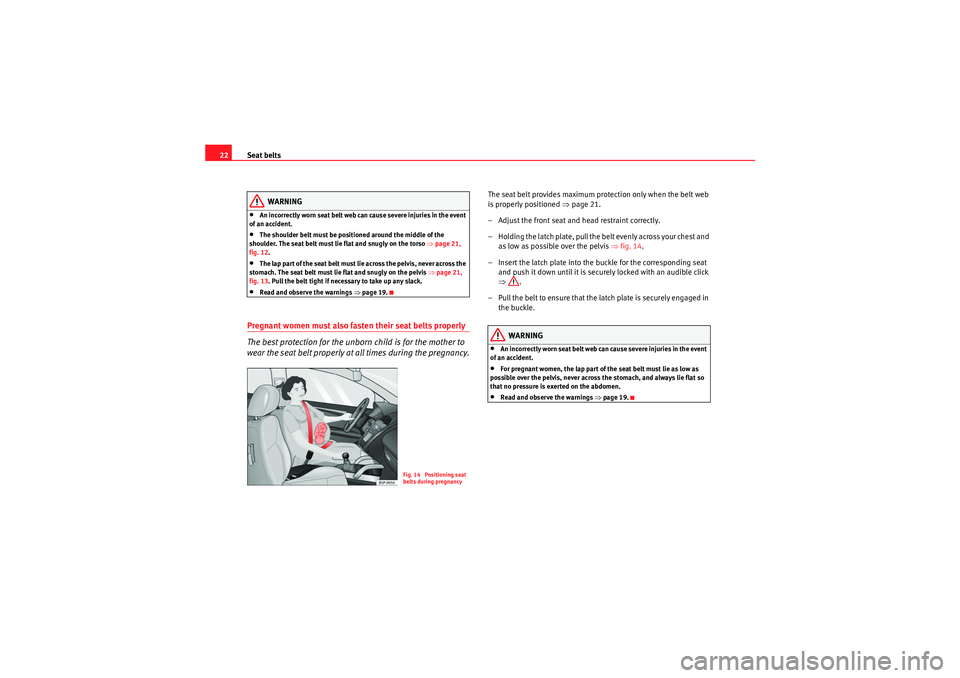
Pregnant women must also fasten their seat belts properly
The best protection for the unborn child is for the mother to
wear the seat belt properly at all times during the pregnancy.
The seat belt provides maximum protection only when the belt web
is properly positioned ⇒page 21.
– Adjust the front seat and head restraint correctly.
– Holding the latch plate, pull the belt evenly across your chest and as low as possible over the pelvis ⇒fig. 14 .
– Insert the latch plate into the buckle for the corresponding seat and push it down until it is securely locked with an audible click
⇒ .
– Pull the belt to ensure that the latch plate is securely engaged in the buckle.
WARNING
•An incorrectly worn seat belt web can cause severe injuries in the event
of an accident.•For pregnant women, the lap part of the seat belt must lie as low as
possible over the pelvis, never across the stomach, and always lie flat so
that no pressure is exerted on the abdomen.•Read and observe the warnings ⇒page 19.
Fig. 14 Positioning seat
belts during pregnancy
IbizaSC_EN.book Seite 22 Mittwoch, 16. September 2009 12:11 12
Page 28 of 257
Airbag system
26•Always properly adjust the front seats.
The danger of fitting a child seat on the front passenger seat
Rear-facing child seats must never be used on the front
passenger seat when the front passenger airbag is enabled.An enabled front airbag on the front passenger side is potentially a major
danger to a child. The front passenger seat is life threatening to a child if
he/she is transported in a rear-facing child seat. You should always transport
all children up to 12 years of age on the rear seat.
If a rear-facing child seat is secured to the front passenger seat, an inflating
airbag can strike it with such great force that critical or fatal injuries may
result.
Therefore we strongly recommend you to transport children on the rear seats.
That is the safest place for children in the vehicle. Alternatively, the front
passenger airbag can be disabled with a key-operated switch ⇒page 36.
When transporting children, use a child seat appropriate to the age and size
of each child.
For those vehicles that do not include a key lock switch to turn the airbag off,
an Authorised Service Centre must be consulted.
WARNING
•If a child seat is secured to the front passenger seat, the risk to the child
of sustaining critical or fatal injuries in the event of an accident increases.•Never secure a rear-facing child seat to the front passenger seat if the
front passenger airbag is enabled. The child can suffer critical or fatal inju-
ries when the front passenger airbag is triggered.
•An inflating front passenger airbag can strike the rear-facing child seat
and hurl it with great force against the door, the roof or the backrest.•If, under special circumstances, it is necessary to transport a child in a
rear-facing child seat on the front passenger seat, it is absolutely essential
that you observe the following safety measures:
−Disable the front passenger airbag ⇒page 36, “Deactivating
airbags*”.
− The child seat must be approved by the child seat manufacturer for
use on a front passenger seat with front or side airbag.
− Follow the installation instructions of the child seat manufacturer
and absolutely observe all warnings
− Before properly installing the child seat, push the front passenger
seat completely backwards so that the greatest possible distance to
the front passenger airbag is ensured.
− Ensure that no objects prevent the front passenger seat from being
pushed completely back.
− The backrest of the front passenger seat must be in an upright
position.
Warning lamp for airbag and belt tension device system
This warning lamp monitors the airbag and belt tension
device system.The warning lamp monitors all airbags and belt tension devices in the
vehicle, including control units and wiring connections.
WARNING (continued)
WARNING (continued)
IbizaSC_EN.book Seite 26 Mittwoch, 16. September 2009 12:11 12
Page 41 of 257
Child safety39
Safety First
Controls and equipment
Practical tips
Technical Data
“Deactivating airbags*”. If the passenger seat has a height adjustment
option, move it to the highest position.
•For those vehicles that do not include a key lock switch to turn the
airbag off, an Authorised Service Centre must be consulted.•All passengers, especially children, must assume the proper sitting
position and be properly belted in while travelling.•Never hold children or babies on your lap, this can result in potentially
fatal injuries to the child!•Never allow a child to be transported in a vehicle without being properly
secured, or to stand up or kneel on a seat while travelling. In an accident,
the child could be flung through the vehicle, causing possibly fatal injuries
to themselves and to the other passengers.•If children assume an improper sitting position when the car is moving,
they expose themselves to greater risk of injury in the event of sudden
braking manoeuvre or in an accident. This is particularly important if the
child is travelling on the front passenger seat and the airbag system is trig-
gered in an accident, as this could cause serious injury or even death.•A suitable child seat can protect your child!•Never leave an unsupervised child alone on a child seat or in the
vehicle.•Depending on weather conditions, it may become extremely hot or cold
inside the vehicle. This can be fatal.•Children who are less than 1.5 metres tall must not wear a normal seat
belt without a child restraint system, as this could cause injuries to the
abdominal and neck areas during a sudden braking manoeuvre or in an
accident.•Do not allow the belt webbing to become twisted or jammed, or to rub
on any sharp edges.•Incorrectly worn seat belts can cause injuries even in a minor collision
or in sudden braking manoeuvres.
•The seat belt provides maximum protection only when the belt web is
properly positioned ⇒page 20, “Seat belts”.•Only one child may occupy a child seat ⇒page 40, “Child seats”.
WARNING (continued)
WARNING (continued)
IbizaSC_EN.book Seite 39 Mittwoch, 16. September 2009 12:11 12
Page 45 of 257
Child safety43
Safety First
Controls and equipment
Practical tips
Technical Data
Securing child seatsWays to secure a child seat
A child seat can be secured differently on the rear seat and on
the front passenger seat.You can secure a child seat to the rear seat or front passenger seat in the
following ways:•Child seats in groups 0 to 3 can be secured with a seat belt.•Child seats for groups 0, 0+ and 1 with the “ISOFIX” system can be
secured, without fastening seat belts, with the “ISOFIX” securing rings
⇒ page 43.
U: Suitable for universal approved restraining systems for use in this age category (universal retention systems are those fitted using the adult
seat belt).
UF Suitable for universal forward-facing retention systems approved for use with this age group.
*: Move the passenger seat as far to rear as possible, as high as possible and always deactivate the airbag.
L: Suitable for retention systems using the “ISOFIX” anchors
X Seat position not suitable for children in this age group.
WARNING
•When travelling, children must be secured in the vehicle with a
restraint system suitable for age, weight and size.•Never install a child seat facing backwards (or rear-facing) on the front
passenger seat unless the front passenger airbag has been disabled. This
could cause fatal injuries to the child! However, if it is necessary, in excep-
tional cases, to transport a child in the front passenger seat, the front
passenger airbag must always be disabled ⇒page 36, “Deactivating
airbags*” and move the seat to its highest position, in case it has this
adjustment.•Read and always observe information and warnings concerning the use
of child seats ⇒ in “Safety notes on using child seats” on page 38.
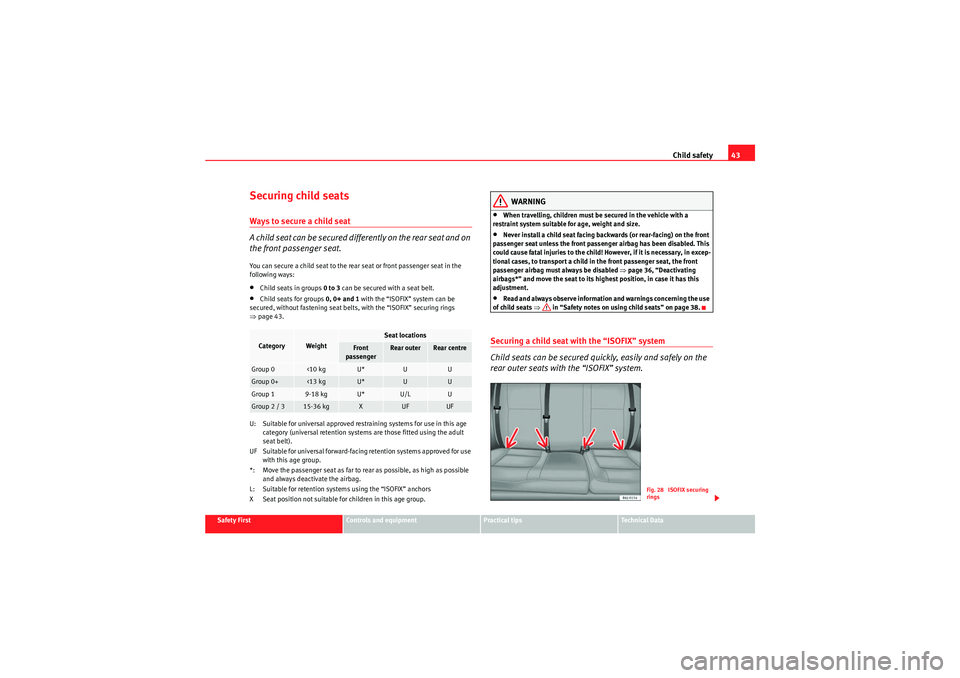
Securing a child seat with the “ISOFIX” system
Child seats can be secured quickly, easily and safely on the
rear outer seats with the “ISOFIX” system.
Category
Weight
Seat locations
Front
passenger
Rear outer
Rear centre
Group 0
<10 kg
U*
U
U
Group 0+
<13 kg
U*
U
U
Group 1
9-18 kg
U*
U/L
U
Group 2 / 3
15-36 kg
X
UF
UF
Fig. 28 ISOFIX securing
rings
IbizaSC_EN.book Seite 43 Mittwoch, 16. September 2009 12:11 12
Page 46 of 257
Child safety
44
When removing or fitting the child seat, please be sure to follow the
manufacturer's instructions.
– Press the child seat onto the “ISOFIX” retaining rings until the child seat can be heard to engage securely. If the child seat is
fitted with any other antirotation system, follow the manufacturer
instructions carefully.
– Pull on both sides of the child seat to ensure that it is secure.Two “ISOFIX” retaining rings are fitted on each rear seat. In some vehicles, the
rings are secured to the seat frame and, in others, they are secured to the rear
floor. The access to “ISOFIX” rings is between the rear back rest and the seat.
Child seats with “ISOFIX” mountings are available in your Authorised Service
Centres.
WARNING
•The retaining rings are designed only to use them with “ISOFIX” child
seats.•Never secure child seats without th e “ISOFIX” system, retaining belts
or objects to the fastening rings – this can result in potentially fatal injuries
to the child.•Ensure that the child seat is secured correctly to the “ISOFIX” anchor
points.
IbizaSC_EN.book Seite 44 Mittwoch, 16. September 2009 12:11 12
Page 72 of 257
Unlocking and locking
70Unlocking and lockingCentral l ockingDescription
The central locking system enables you to lock and unlock all
doors by just pushing on the key button.Central locking can be activated by using any of the following options:•the key , by inserting it into the driver's door cylinder and rotating it in the
opening direction. Depending on the vehicle version, either all doors will be
unlocked or only the driver's door will be unlocked. All doors will be locked on
locking the vehicle using the key.•the interior central locking button ⇒ page 73.•the radio frequency remote control , using the buttons on the key
⇒ page 75.
Various functions are available to improve the vehicle safety:
- “Safe”* Locking system
- Selective unlocking system*
- Self-locking system to prevent involuntary unlocking
- Automatic speed-dependent locking and unlocking system*
- Emergency unlocking systemWARNING
•Locking from the outside carelessly or without good visibility may lead
to bruising, particularly in the case of children.•When locking a vehicle, never leave children unaccompanied inside, as
from the outside it will be difficult to provide assistance if required.
•Keeping the doors locked prevents an intruder from entering, for
example when stopped at a traffic light.Note
For anti-theft security, only the driver's door is fitted with a lock cylinder.Safety system “Safe*”
This is an anti-theft device which consists of a double lock for
the door locks and a deactivation function for the boot in
order to prevent a forced entry (according to country).Activation
The “safe” system is activated when the vehicle is locked using the key or the
remote control.
To activate it with the key, rotate once it is inserted in the door lock cylinder
in the locking direction.
To activate the system using the remote control, press the lock button once
on the remote.
Once this system is activated, opening doors from the outside and the inside
is not possible. The tailgate can not be opened. The central locking button
does not work.
WARNING (continued)
IbizaSC_EN.book Seite 70 Mittwoch, 16. September 2009 12:11 12
Page 75 of 257
Unlocking and locking73
Safety First
Controls and equipment
Practical tips
Technical Data
Central locking button
The central locking button allows you to lock and unlock the
vehicle from the inside.Locking the vehicle
–Press the ⇒fig. 41 ⇒ button.
Unlocking the doors
– Press the button ⇒fig. 41 .The central locking button is still operative when the ignition is switched off.
Except when the "safe" security system is activated.
Please note the following if you lock your vehicle with the central locking
button:•For safety reasons it is not possible to open the doors or the tailgate from
the outside (for instance, when stopped at a traffic light).
•The driver door cannot be locked. This avoids the user from forgetting his
key inside the vehicle.•All doors can be locked separately from inside the car. Do this by pulling
the door release lever once.WARNING
•If the vehicle is locked, children and disabled people may be trapped
inside it.•Repeated operation of central locking will prevent the central locking
button from working for a few seconds. Then, it can only be unlocked if it
has been previously locked. After a few seconds, the central locking
becomes operative again.•The central locking button is not operative when the vehicle is locked
from the outside (with the remote control or the key).Note
•Vehicle locked, button.•Vehicle unlocked, button.
Fig. 41 Central locking
button
IbizaSC_EN.book Seite 73 Mittwoch, 16. September 2009 12:11 12
Page 79 of 257
Unlocking and locking77
Safety First
Controls and equipment
Practical tips
Technical Data
Anti-theft alarm system*Description of anti-theft alarm system*
The anti-theft alarm triggers if unauthorised movements are
detected around the vehicle.The anti-theft alarm makes it more difficult to break into the vehicle or steal
it. The system will emit acoustic and optical warning signals if someone is
trying to force your vehicle.
The anti-theft alarm system is automatically connected on locking the
vehicle. For this, either rotate the key in the locking position or press button
on the radio-frequency remote control*. The system is immediately
activated and the indicator light located on the driver's door will flash along
with the indicators, indicating that the alarm and the locking security system
(double lock) have been turned on.
If any of the doors or the bonnet are open, they will not be included in the
protection zones of the vehicle when the alarm is connected. If the door or the
bonnet are subsequently closed, they will be automatically included in the
protection areas of the vehicle and the indicators will flash accordingly when
the doors close.•The indicator light will flash twice on opening and deactivating the alarm..•The indicator light will flash once on closing and activating the alarm.
When does the system trigger an alarm?
The system triggers an alarm if the following unauthorised actions are carried
out when the car is locked:•Opening of vehicle with mechanical key without switching ignition on
within the next 15 seconds•Opening a door•Opening the bonnet
•Opening the tailgate•Ignition switched on with a non-validated key.•Movements in the driving compartment (vehicles with a volume sensor)•Towing of the vehicle
7)
•Tilt angle (tow-away protection)
7)
•Undue manipulation of the alarm•Battery handling
The acoustic signals sound and the indicators flash for approx. 30 seconds.
This may be repeated up to 10 times depending on the country.
How to switch the alarm off
To deactivate the anti-theft alarm, turn the key to the opening direction, open
the door and switch the ignition on, or press the unlocking button on the
remote control.
In vehicles equipped with an anti-theft alarm system, you have 15 seconds to
insert the key in the ignition lock and activate the ignition if the vehicle is
opened using the driver's door key.
Otherwise, the alarm will trigger for 30 sec. and the ignition will be blocked.Note
•After 28 days, the indicator light will be switched off to prevent the battery
from exhausting if the vehicle has been left parked for a long period of time.
The alarm system remains activated.•The alarm will trigger again if attempts are made to open another protec-
tion zone.•The alarm system can be activated or deactivated using the remote
control ⇒page 75.
A2
7)With vehicles fitted with a tow-away protection
IbizaSC_EN.book Seite 77 Mittwoch, 16. September 2009 12:11 12
Page 104 of 257
Seats and stowage
102Removing or adjusting head restraints
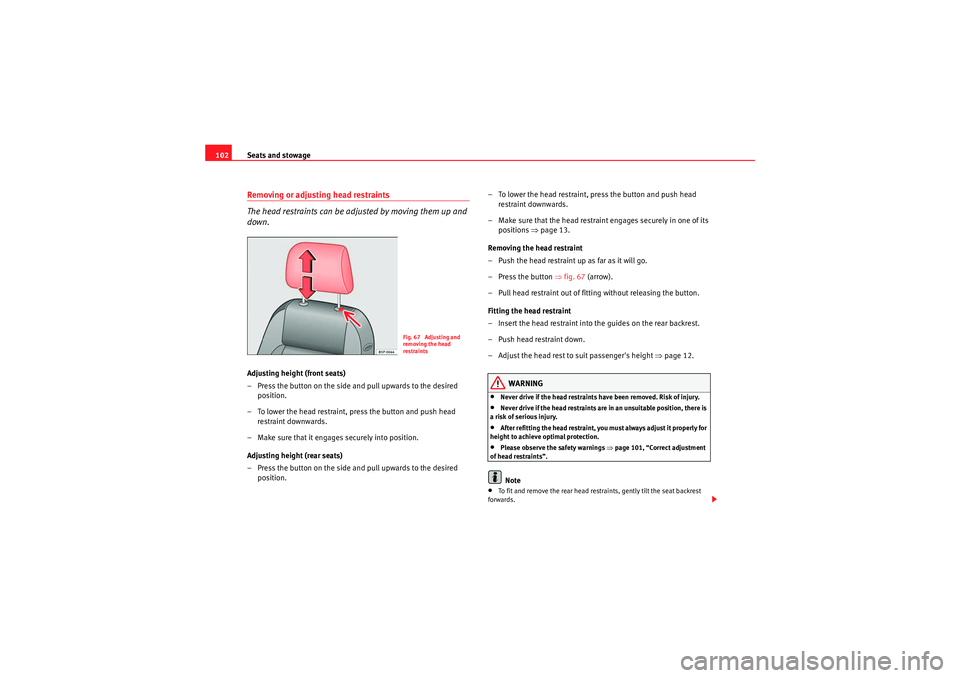
The head restraints can be adjusted by moving them up and
down.Adjusting height (front seats)
– Press the button on the side and pull upwards to the desired
position.
– To lower the head restraint, press the button and push head restraint downwards.
– Make sure that it engages securely into position.
Adjusting height (rear seats)
– Press the button on the side and pull upwards to the desired position. – To lower the head restraint, press the button and push head
restraint downwards.
– Make sure that the head restraint engages securely in one of its positions ⇒page 13.
Removing the head restraint
– Push the head restraint up as far as it will go.
–Press the button ⇒ fig. 67 (arrow).
– Pull head restraint out of fitting without releasing the button.
Fitting the head restraint
– Insert the head restraint into the guides on the rear backrest.
– Push head restraint down.
– Adjust the head rest to suit passenger's height ⇒page 12.
WARNING
•Never drive if the head restraints have been removed. Risk of injury.•Never drive if the head restraints are in an unsuitable position, there is
a risk of serious injury.•After refitting the head restraint, you must always adjust it properly for
height to achieve optimal protection.•Please observe the safety warnings ⇒page 101, “Correct adjustment
of head restraints”.Note
•To fit and remove the rear head restraints, gently tilt the seat backrest
forwards.
Fig. 67 Adjusting and
removing the head
restraints
IbizaSC_EN.book Seite 102 Mittwoch, 16. September 2009 12:11 12
Page 106 of 257
Seats and stowage
104passenger have properly adjusted their seat belts. The further the back-
rests are tilted to the rear, the greater the risk of injury due to improper
positioning of the belt web!•Exercise caution when securing the seat height into forwards/back-
wards position. Injuries can be caused if the backrest is tilted without due
care and attention.•To move the seat lengthways, pull upwards and not sideways on the
lever, as the force exerted on it in this position could damage it.
Heated seats*
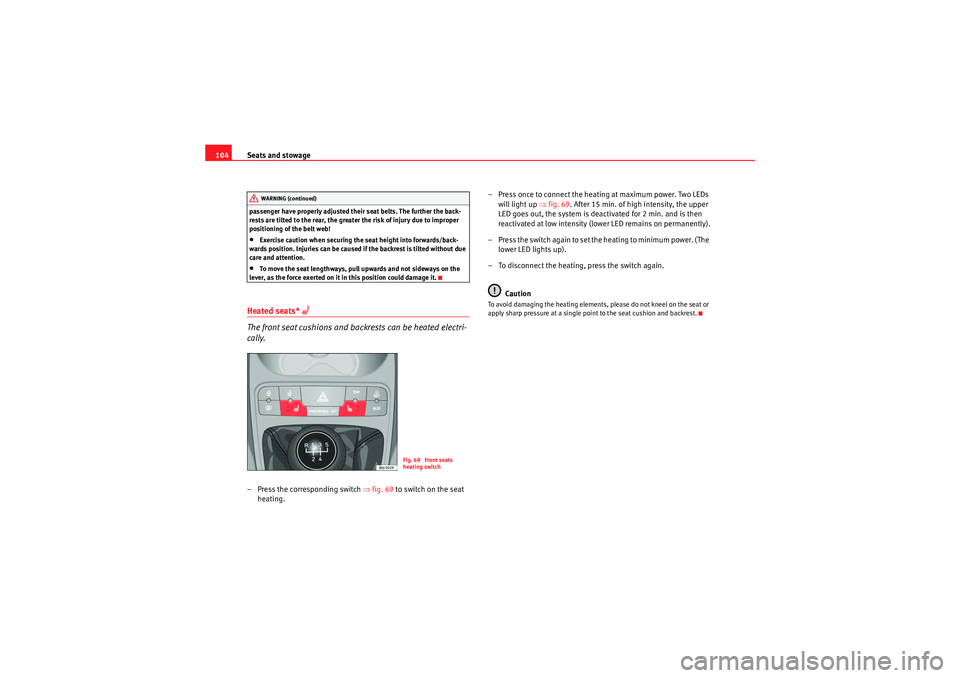
The front seat cushions and backrests can be heated electri-
cally.
– Press the corresponding switch ⇒fig. 69 to switch on the seat
heating. – Press once to connect the heating at maximum power. Two LEDs
will light up ⇒fig. 69 . After 15 min. of high intensity, the upper
LED goes out, the system is deactivated for 2 min. and is then
reactivated at low intensity (lower LED remains on permanently).
– Press the switch again to set the heating to minimum power. (The lower LED lights up).
– To disconnect the heating, press the switch again.
Caution
To avoid damaging the heating elements, please do not kneel on the seat or
apply sharp pressure at a single point to the seat cushion and backrest.
WARNING (continued)
Fig. 69 Front seats
heating switch
IbizaSC_EN.book Seite 104 Mittwoch, 16. September 2009 12:11 12