warning light Seat Ibiza SC 2009 Service Manual
[x] Cancel search | Manufacturer: SEAT, Model Year: 2009, Model line: Ibiza SC, Model: Seat Ibiza SC 2009Pages: 257, PDF Size: 6.61 MB
Page 106 of 257
Seats and stowage
104passenger have properly adjusted their seat belts. The further the back-
rests are tilted to the rear, the greater the risk of injury due to improper
positioning of the belt web!•Exercise caution when securing the seat height into forwards/back-
wards position. Injuries can be caused if the backrest is tilted without due
care and attention.•To move the seat lengthways, pull upwards and not sideways on the
lever, as the force exerted on it in this position could damage it.
Heated seats*
The front seat cushions and backrests can be heated electri-
cally.
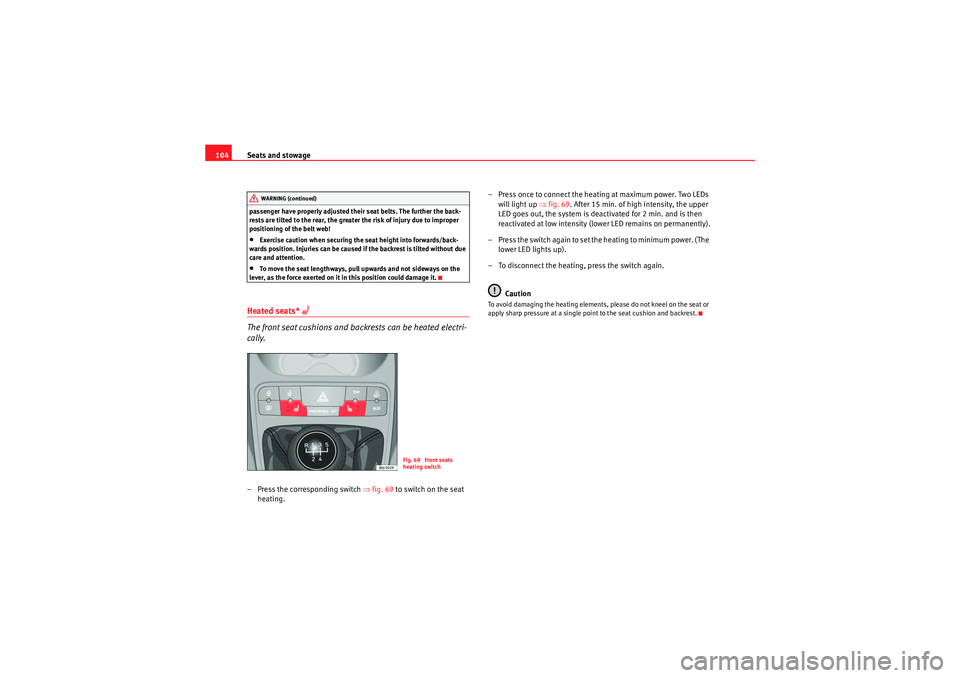
– Press the corresponding switch ⇒fig. 69 to switch on the seat
heating. – Press once to connect the heating at maximum power. Two LEDs
will light up ⇒fig. 69 . After 15 min. of high intensity, the upper
LED goes out, the system is deactivated for 2 min. and is then
reactivated at low intensity (lower LED remains on permanently).
– Press the switch again to set the heating to minimum power. (The lower LED lights up).
– To disconnect the heating, press the switch again.
Caution
To avoid damaging the heating elements, please do not kneel on the seat or
apply sharp pressure at a single point to the seat cushion and backrest.
WARNING (continued)
Fig. 69 Front seats
heating switch
IbizaSC_EN.book Seite 104 Mittwoch, 16. September 2009 12:11 12
Page 112 of 257
Seats and stowage
110Ashtrays, cigarette lighter and power pointFront ashtrayOpening and closing the ashtray
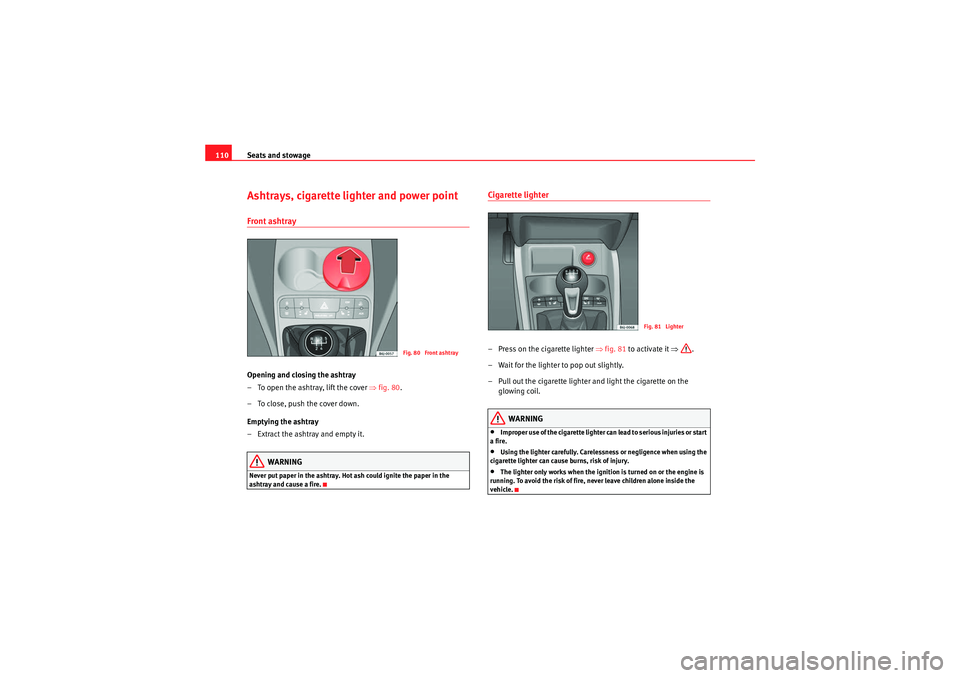
– To open the ashtray, lift the cover ⇒fig. 80 .
– To close, push the cover down.
Emptying the ashtray
– Extract the ashtray and empty it.
WARNING
Never put paper in the ashtray. Hot ash could ignite the paper in the
ashtray and cause a fire.
Cigarette lighter– Press on the cigarette lighter ⇒ fig. 81 to activate it ⇒.
– Wait for the lighter to pop out slightly.
– Pull out the cigarette lighter and light the cigarette on the glowing coil.
WARNING
•Improper use of the cigarette lighter can lead to serious injuries or start
a fire.•Using the lighter carefully. Carelessness or negligence when using the
cigarette lighter can cause burns, risk of injury.•The lighter only works when the ignition is turned on or the engine is
running. To avoid the risk of fire, never leave children alone inside the
vehicle.
Fig. 80 Front ashtray
Fig. 81 Lighter
IbizaSC_EN.book Seite 110 Mittwoch, 16. September 2009 12:11 12
Page 113 of 257
Seats and stowage111
Safety First
Controls and equipment
Practical tips
Technical Data
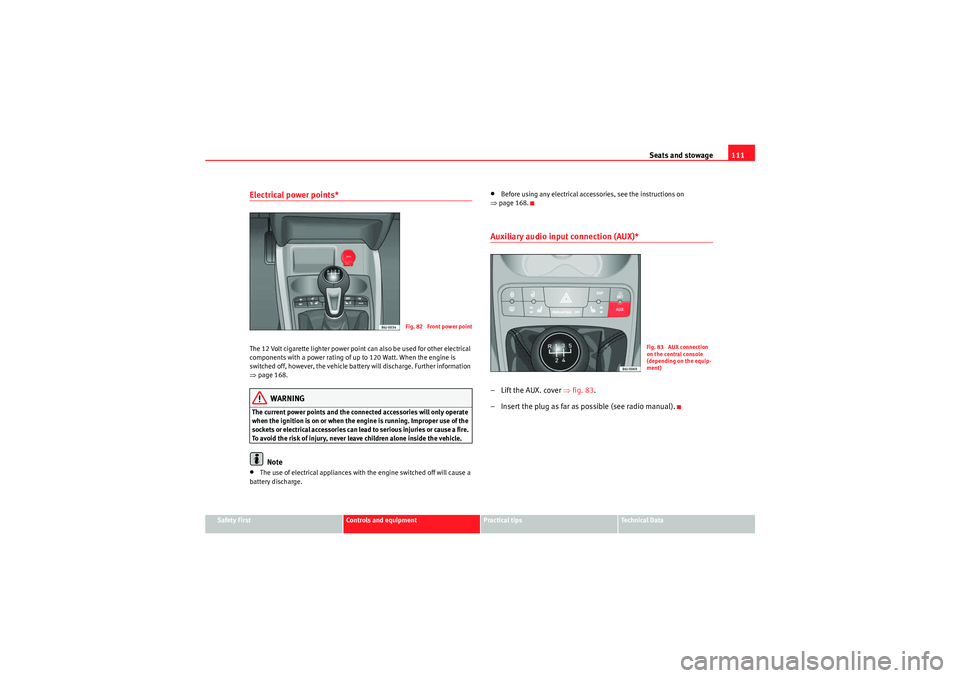
Electrical power points* The 12 Volt cigarette lighter power point can also be used for other electrical
components with a power rating of up to 120 Watt. When the engine is
switched off, however, the vehicle battery will discharge. Further information
⇒page 168.
WARNING
The current power points and the connected accessories will only operate
when the ignition is on or when the engine is running. Improper use of the
sockets or electrical accessories can lead to serious injuries or cause a fire.
To avoid the risk of injury, never leave children alone inside the vehicle.
Note
•The use of electrical appliances with the engine switched off will cause a
battery discharge.
•Before using any electrical accessories, see the instructions on
⇒ page 168.Auxiliary audio input connection (AUX)*– Lift the AUX. cover ⇒fig. 83 .
– Insert the plug as far as possible (see radio manual).
Fig. 82 Front power point
Fig. 83 AUX connection
on the central console
(depending on the equip-
ment)
IbizaSC_EN.book Seite 111 Mittwoch, 16. September 2009 12:11 12
Page 114 of 257
Seats and stowage
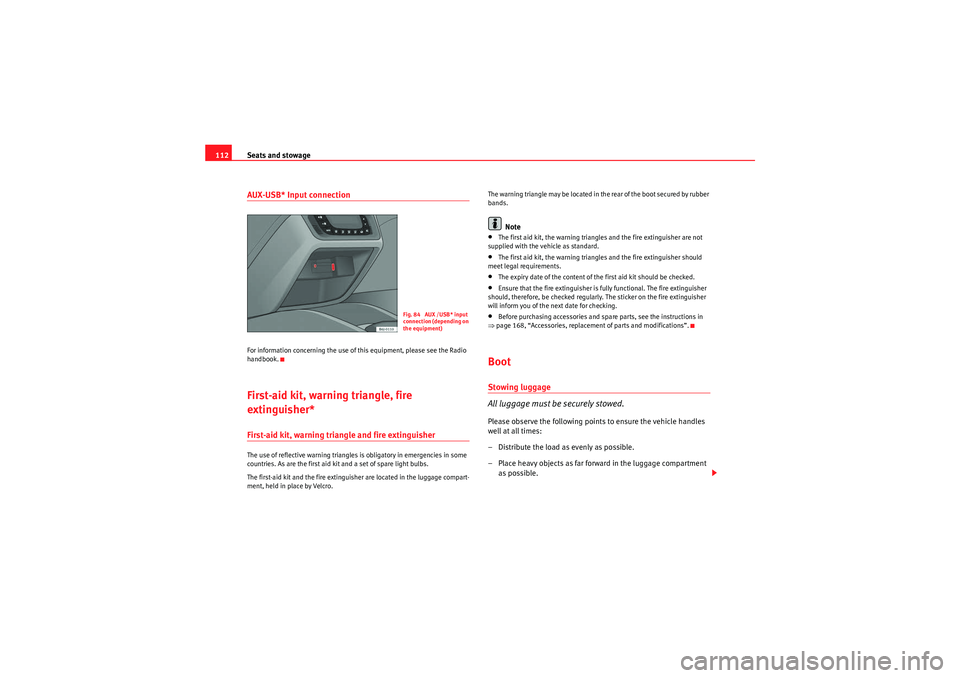
112AUX-USB* Input connectionFor information concerning the use of this equipment, please see the Radio
handbook.First-aid kit, warning triangle, fire
extinguisher*First-aid kit, warning triangle and fire extinguisherThe use of reflective warning triangles is obligatory in emergencies in some
countries. As are the first aid kit and a set of spare light bulbs.
The first-aid kit and the fire extinguisher are located in the luggage compart-
ment, held in place by Velcro. The warning triangle may be located in the rear of the boot secured by rubber
bands.
Note
•The first aid kit, the warning triangles and the fire extinguisher are not
supplied with the vehicle as standard.•The first aid kit, the warning triangles and the fire extinguisher should
meet legal requirements.•The expiry date of the content of the first aid kit should be checked.•Ensure that the fire extinguisher is fully functional. The fire extinguisher
should, therefore, be checked regularly. The sticker on the fire extinguisher
will inform you of the next date for checking.•Before purchasing accessories and spare parts, see the instructions in
⇒ page 168, “Accessories, replacement of parts and modifications”.BootStowing luggage
All luggage must be securely stowed.Please observe the following points to ensure the vehicle handles
well at all times:
– Distribute the load as evenly as possible.
– Place heavy objects as far forward in the luggage compartment
as possible.
Fig. 84 AUX /USB* input
connection (depending on
the equipment)
IbizaSC_EN.book Seite 112 Mittwoch, 16. September 2009 12:11 12
Page 117 of 257
Heating, Ventilation and Air conditioning115
Safety First
Controls and equipment
Practical tips
Technical Data
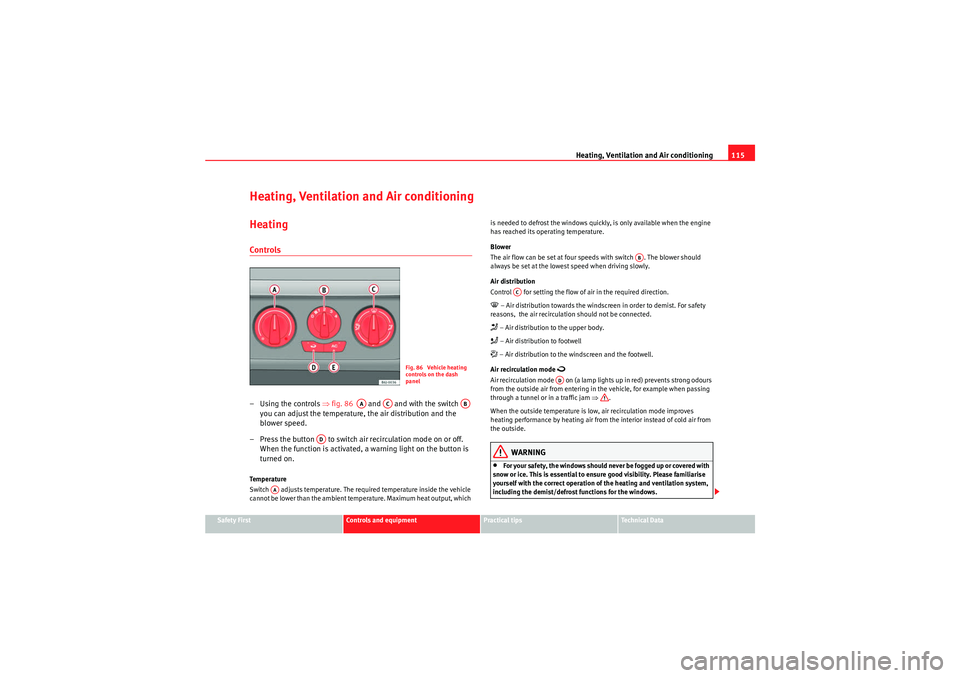
Heating, Ventilation and Air conditioningHeatingControls–Using the controls ⇒fig. 86 and and with the switch
you can adjust the temperature, the air distribution and the
blower speed.
– Press the button to switch ai r recirculation mode on or off.
When the function is activated, a warning light on the button is
turned on.Te m p e r a t u r e
Switch adjusts temperature. The required temperature inside the vehicle
cannot be lower than the ambient temperature. Maximum heat output, which is needed to defrost the windows quickly, is only available when the engine
has reached its operating temperature.
Blower
The air flow can be set at four speeds with switch . The blower should
always be set at the lowest speed when driving slowly.
Air distribution
Control for setting the flow of air in the required direction.
– Air distribution towards the windscreen in order to demist. For safety
reasons, the air recirculation should not be connected. – Air distribution to the upper body. – Air distribution to footwell – Air distribution to the windscreen and the footwell.
Air recirculation mode
Air recirculation mode on (a lamp lights up in red) prevents strong odours
from the outside air from entering in the vehicle, for example when passing
through a tunnel or in a traffic jam ⇒.
When the outside temperature is low, air recirculation mode improves
heating performance by heating air from the interior instead of cold air from
the outside.
WARNING
•For your safety, the windows should never be fogged up or covered with
snow or ice. This is essential to ensure good visibility. Please familiarise
yourself with the correct operation of the heating and ventilation system,
including the demist/defrost functions for the windows.
Fig. 86 Vehicle heating
controls on the dash
panel
AA
AC
AB
AD
AA
AB
AC
AD
IbizaSC_EN.book Seite 115 Mittwoch, 16. September 2009 12:11 12
Page 120 of 257
Heating, Ventilation and Air conditioning
118Air distribution
The outlets and can be closed or opened separately and the air flow
directed according to our need.
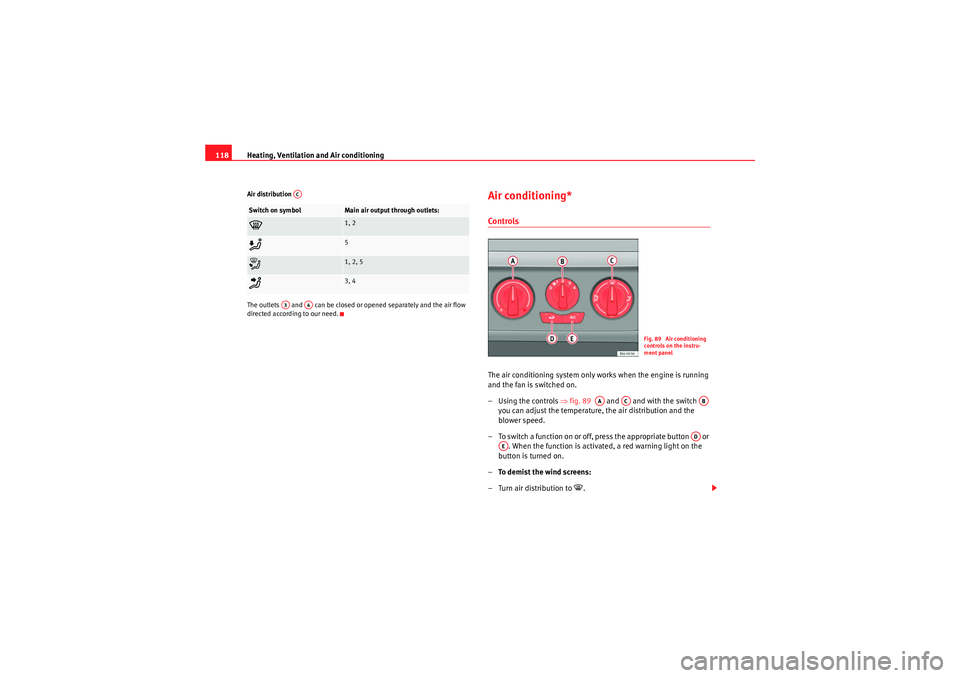
Air conditioning* ControlsThe air conditioning system only works when the engine is running
and the fan is switched on.
– Using the controls ⇒fig. 89 and and with the switch
you can adjust the temperature, the air distribution and the
blower speed.
– To switch a function on or off, press the appropriate button or . When the function is activated, a red warning light on the
button is turned on.
– To demist the wind screens:
– Turn air distribution to
.
Switch on symbol
Main air output through outlets:
1, 2
5
1, 2, 5
3, 4
AC
A3
A4
Fig. 89 Air conditioning
controls on the instru-
ment panel
AA
AC
ABAD
AE
IbizaSC_EN.book Seite 118 Mittwoch, 16. September 2009 12:11 12
Page 121 of 257
Heating, Ventilation and Air conditioning119
Safety First
Controls and equipment
Practical tips
Technical Data
– Turn the fan control to one of the two levels depending on the
speed required.
– Rotate the temperature control to the desired level of comfort.
– Close outlets .
– Open and turn outlets towards side windows.
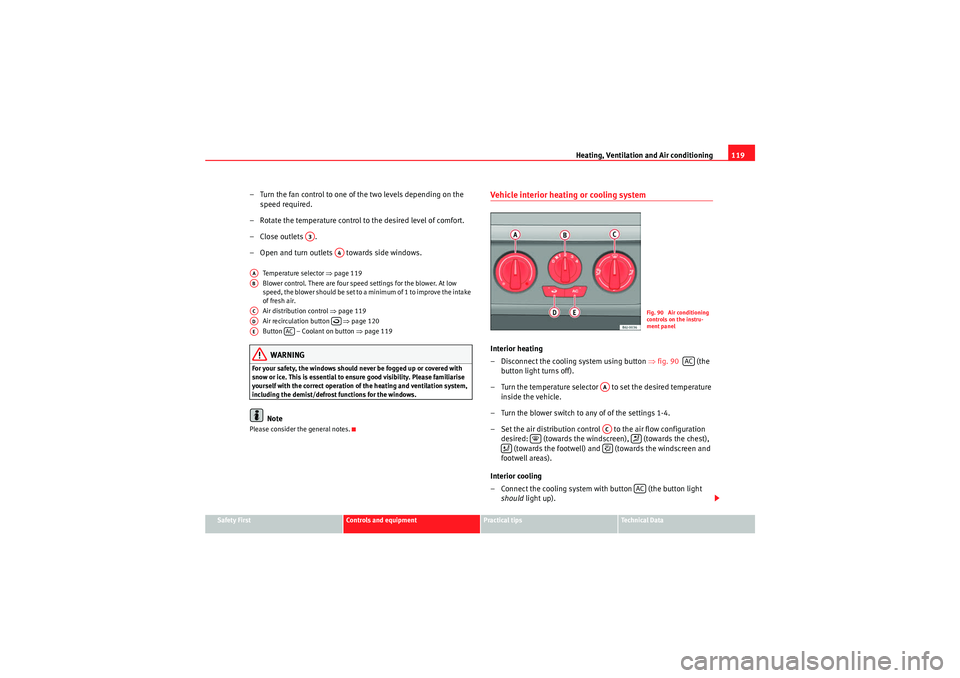
Temperature selector ⇒page 119
Blower control. There are four speed settings for the blower. At low
speed, the blower should be set to a minimum of 1 to improve the intake
of fresh air.
Air distribution control ⇒page 119
Air recirculation button ⇒page 120
Button – Coolant on button ⇒page 119WARNING
For your safety, the windows should never be fogged up or covered with
snow or ice. This is essential to ensure good visibility. Please familiarise
yourself with the correct operation of the heating and ventilation system,
including the demist/defrost functions for the windows.
Note
Please consider the general notes.
Vehicle interior heating or cooling system Interior heating
– Disconnect the cooling system using button ⇒fig. 90 (the
button light turns off).
– Turn the temperature selector to set the desired temperature inside the vehicle.
– Turn the blower switch to any of of the settings 1-4.
– Set the air distribution control to the air flow configuration
desired: (towards the windscreen), (towards the chest), (towards the footwell) and (towards the windscreen and
footwell areas).
Interior cooling
– Connect the cooling system with button (the button light should light up).
A3
A4
AAABACAD
AE
AC
Fig. 90 Air conditioning
controls on the instru-
ment panel
AC
AAAC
AC
IbizaSC_EN.book Seite 119 Mittwoch, 16. September 2009 12:11 12
Page 122 of 257
Heating, Ventilation and Air conditioning
120
– Turn the temperature control switch until the desired interior temperature is reached.
– Turn the blower switch to any of of the settings 1-4.
– Set the air distribution control to the air flow configuration desired: (towards the windscreen), (towards the chest),
(towards the footwell) and (towards the windscreen and
footwell areas).Heating
Maximum heat output, which is needed to defrost the windows quickly, is
only available when the engine has reached its operating temperature.
Coolant system
When the air conditioning is switched on, the temperature and the air
humidity go down. This way, if the outside humidity is extreme, the air condi-
tioning prevents the misting of the windows and therefore, comfort is
improved.
If the air conditioning does not work, this may be due to the following
reasons:•The engine is stationary.•The fan blower is switched off.•The outside temperature is below +3°C.•The cooling system compressor has been temporarily switched off
because of an increased engine coolant temperature.•The air conditioning fuse is faulty.•Another fault in the vehicle. Have the air conditioning checked by a qual-
ified workshop.
Air recirculation
Air recirculation mode prevents fumes or unpleasant smells
from coming from the outside.When air recirculation mode is switched on (button ⇒page 119, fig. 90
with warning lamp) strong odours in the outside air do not enter the vehicle
interior, for example when passing through a tunnel or in a traffic jam.
When the outside temperature is low, air recirculation mode improves
heating performance by heating air from the interior instead of cold air from
the outside.
When the outside temperature is high, air recirculation mode improves
cooling performance by cooling air from the interior instead of warm air from
outside.
For safety reasons, it is not recommended to switch air recirculation on when
the air distribution control is being adjusted to the windscreen setting
.
WARNING
In air recirculation mode, no cold air from the outside enters the vehicle
interior. If the air conditioning system is switched off, the windows can
quickly mist over. Therefore, never leave the air recirculation mode
switched on for a long time (risk of accident).
Note
•When engaging reverse gear, the air recirculation is connected automati-
cally to prevent the entrance of exhaust fumes in the vehicle on travelling
backwards. The control light on the button does not light up.•If the temperature control is turned to the coldest setting (blue point) and
the switch is activated, the “Air recirculation” function is automatically
activated in order to cool the vehicle rapidly using less energy; its function
indicator will light.
AC
IbizaSC_EN.book Seite 120 Mittwoch, 16. September 2009 12:11 12
Page 129 of 257
Driving127
Safety First
Controls and equipment
Practical tips
Technical Data
SafetyElectronic stabilisation programme (ESP)*
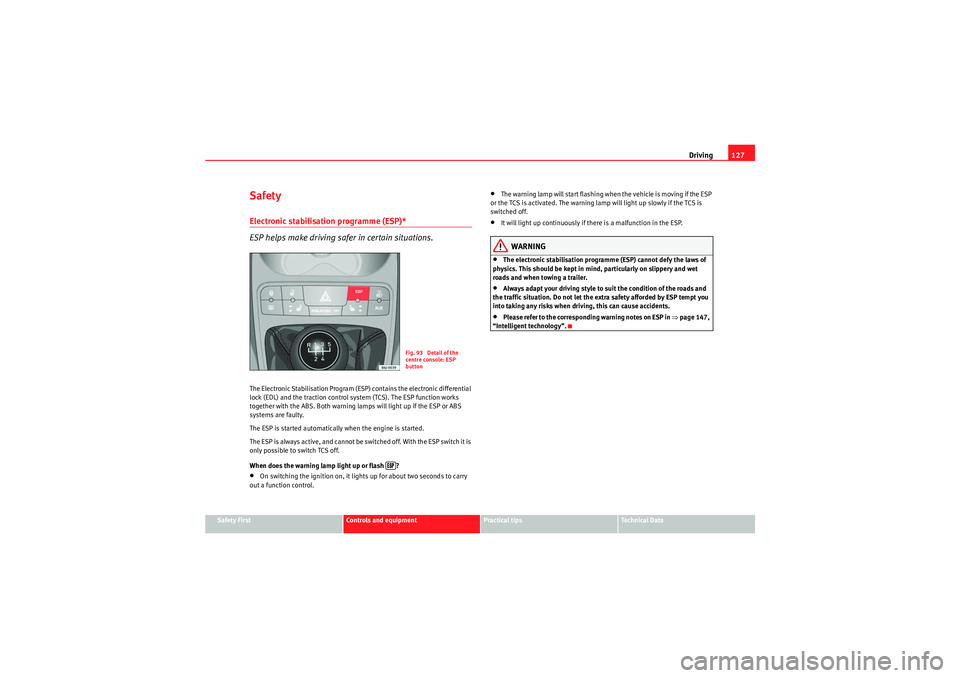
ESP helps make driving safer in certain situations.The Electronic Stabilisation Program (ESP) contains the electronic differential
lock (EDL) and the traction control system (TCS). The ESP function works
together with the ABS. Both warning lamps will light up if the ESP or ABS
systems are faulty.
The ESP is started automatically when the engine is started.
The ESP is always active, and cannot be switched off. With the ESP switch it is
only possible to switch TCS off.
When does the warning lamp light up or flash ?•On switching the ignition on, it lights up for about two seconds to carry
out a function control.
•The warning lamp will start flashing when the vehicle is moving if the ESP
or the TCS is activated. The warning lamp will light up slowly if the TCS is
switched off.•It will light up continuously if there is a malfunction in the ESP.WARNING
•The electronic stabilisation programme (ESP) cannot defy the laws of
physics. This should be kept in mind, particularly on slippery and wet
roads and when towing a trailer.•Always adapt your driving style to suit the condition of the roads and
the traffic situation. Do not let the extra safety afforded by ESP tempt you
into taking any risks when driving, this can cause accidents.•Please refer to the corresponding warning notes on ESP in ⇒page 147,
“Intelligent technology”.
Fig. 93 Detail of the
centre console: ESP
button
IbizaSC_EN.book Seite 127 Mittwoch, 16. September 2009 12:11 12
Page 131 of 257
Driving129
Safety First
Controls and equipment
Practical tips
Technical Data
The immobiliser will be activated again automatically as soon as you pull the
key out of the ignition lock.
The engine can only be started using a genuine SEAT key with its correct code.
Note
A perfect operation of the vehicle is ensured if genuine SEAT keys are used.Starting and stopping the engineStarting petrol engines
The engine can only be started using a genuine SEAT key with
its correct code.– Move the gear lever to the neutral position and depress the
clutch pedal thoroughly and hold it in this position for the starter
to turn the engine on.
– Turn the ignition key to the starting position ⇒ page 128.
– Le t go o f the ig nit io n key as so on as the e ngin e star t s; t he sta r ter motor must not run on with the engine.After starting a very hot engine, you may need to slightly press down the
accelerator.
When starting a very cold engine, it may be a little noisy for the first few
seconds until oil pressure has built up in the hydraulic valve compensators.
This is quite normal, and no cause for concern. If the engine does not start immediately, switch the starter off after
10 seconds and try again after half a minute. If the engine still does not start,
the fuel pump fuse should be checked
⇒page 205, “Fuses”.
WARNING
•Never start or run the engine in unventilated or closed rooms. The
exhaust fumes contain carbon monoxide, an odourless and colourless
poisonous gas. Risk of fatal accidents. Carbon monoxide can cause loss of
consciousness. It can also cause death.•Never leave the vehicle unattended if the engine is running.•Never use “cold start sprays”, they could explode or cause the engine
to run at high revs. Risk of injury.Caution
•When the engine is cold, you should avoid high engine speeds, driving at
full throttle and over-loading the engine. Risk of engine damage.•The vehicle should not be pushed or towed more than 50 metres to start
the engine. Unburnt fuel could enter the catalytic converter and damage it.•Before attempting to push-start or tow a vehicle in order to start it, you
should first try to start it using the battery of another vehicle. Note and follow
the instructions ⇒page 218, “Jump-starting”.For the sake of the environment
Do not warm-up the engine by running the engine with the vehicle stationary.
You should drive off as soon as you start the engine. This helps the engine
reach operating temperature faster and reduces emissions.
IbizaSC_EN.book Seite 129 Mittwoch, 16. September 2009 12:11 12