ESP Seat Ibiza SC 2009 Workshop Manual
[x] Cancel search | Manufacturer: SEAT, Model Year: 2009, Model line: Ibiza SC, Model: Seat Ibiza SC 2009Pages: 257, PDF Size: 6.61 MB
Page 201 of 257
If and when199
Safety First
Controls and equipment
Practical tips
Technical Data
WARNING
Switch on the hazard warning lights on and place the warning triangles in
position. This is for your own safety and also warns other road users.
Caution
If you have to change the wheel on a slope, it is essential to lock the parallel
wheel and on the same axle as that to be changed, with a wedge or similar in
order to immobilise the vehicle.
Note
Please observe legal requirements when doing so.Changing a wheelChange the wheel as described below
– Remove the hub caps or the integral trim .
– Slacken the wheel bolts .
– Raise the car with the jack in the corresponding zone.
– Remove the wheel and then fit the spare wheel.
– Lower the vehicle.
– Tighten the wheel bolts firmly with the box spanner.
– Replace the hub cap.
After changing a wheel
After changing the wheel there are still tasks to complete.– Put the tools and jack back in the luggage compartment.
– Place the wheel with the defective tyre in the luggage compart-
ment and secure it.
– Check the tyre pressure of the newly fitted tyre as soon as possible.
– Have the tightening torque of th e wheel bolts checked as soon as
possible with a torque wrench. Th e prescribed torque must be
120 Nm.
Note•If you notice that the wheel bolts are corroded and difficult to turn when
changing a wheel, they must be replaced before having the wheel bolt torque
checked.•For your safety, drive at moderate speeds until the wheel bolt torque has
been checked.
IbizaSC_EN.book Seite 199 Mittwoch, 16. September 2009 12:11 12
Page 207 of 257
If and when205
Safety First
Controls and equipment
Practical tips
Technical Data
Tyre repair
The following sections describe the procedures for repairing
a tyre.Using the sealing compound
– The instructions on the container give detailed information on
how to use the sealing compound.
Inflating the tyre.
– Remove the air compressor and hose from the container.
– Screw the retaining nut onto the valve.
– Plug the compressor cable into a 12 volt power point.
– Turn on compressor and monitor the pressure shown on the pres- sure gauge.
Completing the repair
– Remove the compressor hose from the valve.
– Fit the valve cap.
– Unplug the compressor from the socket.
– Return all tools to their proper storing location.
NoteThe compressor should never be allowed to run for longer than 6 minutes.
FusesChanging a fuse
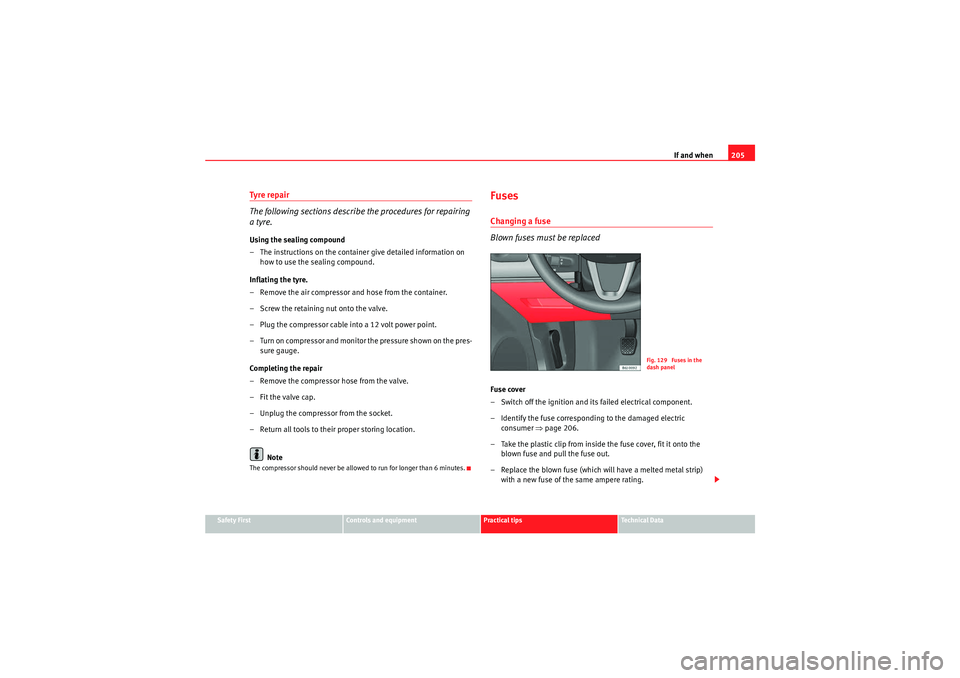
Blown fuses must be replacedFuse cover
– Switch off the ignition and its failed electrical component.
– Identify the fuse corresponding to the damaged electric consumer ⇒page 206.
– Take the plastic clip from inside the fuse cover, fit it onto the blown fuse and pull the fuse out.
– Replace the blown fuse (which will have a melted metal strip) with a new fuse of the same ampere rating.
Fig. 129 Fuses in the
dash panel
IbizaSC_EN.book Seite 205 Mittwoch, 16. September 2009 12:11 12
Page 208 of 257
If and when
206The individual electrical circuits are protected by fuses. The fuses are located
behind a cover at the left-hand end of the dash panel. When the steering
wheel is on the right, the fuses are on the right-hand side of the dash panel,
behind a cover.
The electric windows are protected by circuit breakers . These reset automat-
ically after a few seconds when the overload (caused for example by frozen
windows) has been corrected.
Fuses colour code
WARNING
Never “repair” damaged fuses and never replace them with fuses with a
higher rating. Failure to comply could result in fire. This could also cause
damage to other parts of the electrical system.
Note
•If a newly replaced fuse blows again after a short time, the electrical
system must be checked by a qualified workshop as soon as possible.•If you replace a fuse with higher-rating fuse, you could cause damage to
another location in the electrical system.
•Always keep some spare fuses in the vehicle. These are available from
SEAT dealers.Fuses on left side of dash panelFuses
Colour
Amperes
Beige
5
Brown
7,5
Red
10
Blue
15
Ye ll ow
20
Natural (white)
25
Green
30
Number
Consumer
Amperes
1
Power steering/Engine operation
7,5
2
Diagnostics/Heater/Autoclimate/Cli-
matronic/Electric anti-dazzle mirror/Naviga-
tor/Air-conditioning pressure switch/ Climate
fan/ Kisi/ AFS Control unit/Coming home
relay/Soundaktor
10
3
Petrol engine control unit/Flow meter/Diesel
engine control unit/Relay coils/Engine opera-
tion/Bi-turbo fuel control unit
5
4
ABS/ESP switch (turning sensor)
10
5
Reverse light heating nozzle
10
6
Dash panel
5
7
Rear fog light
5
8
Vaca n t
9
Headlight lever
10
10
Headlight lever/Clutch (Petrol)/Brakes (all)
5
11
Airbag control unit
5
12
Automatic gearbox/ Headlight lever
10
13
Wing mirror control
5
14
Left-hand AFS headlamps
15
IbizaSC_EN.book Seite 206 Mittwoch, 16. September 2009 12:11 12
Page 211 of 257
If and when209
Safety First
Controls and equipment
Practical tips
Technical Data
Bulb changeGeneral notesBefore changing any bulb, first turn off the failed component.
Do not touch the bulb glass. Fingerprints vaporise in the heat, causing a
reduction in the bulb life and condensation on the mirror surface, thus
reducing efficiency.
A bulb should only be replaced by one of the sam e type. The type is inscribed
on the bulb, either on the glass part or on the base.
It is highly recommended to keep a box of spare bulbs in the vehicle. At the
very least, the following spare bulbs, which are essential for road safety,
should be kept in the vehicle.
Double headlamps
Dipped beam - H7 Long Life
Main beam - H7
Position - 2 x W5W Long Life
Indicator - PY21W
Single headlamp
Dipped/Main - H4 Long Life
Position - W5W Long Life
Indicator - PY 21W
Xenon headlights
12)/ self-adjusting*
Dipped and full beam - D1S
13)
Position - W5W Blue Long Life DRL (day light) - P21W Super Long Life
Indicators - PY21W
Fog lights
Fog light/cornering - H11
Rear lights
Fog light - P21W
Reverse gear - R10W
Stop/position - P21 /5W Long Life
Indicator - PY21W
Side indicator
Side indicator - W5W
Registration plate light
Registration plate light - W5W Long Life
Note
•Depending on weather conditions (cold or wet), the front lights, the fog
lights, the rear lights and the indicators may be temporarily misted. This has
no influence on the useful life of the lighting system. By switching on the
lights, the area through which the beam of light is projected will quickly be
demisted. However, the edges may continue to be misted.•Please check at regular intervals that all lighting (especially the exterior
lighting) on your vehicle is functioning pr operly. This is not only in the interest
of your own safety, but also that of all other road users.•D u e t o t h e d i f f i c u l t y i n a cc e s s i n g s o m e o f t h e b u l b s , a n y r e p l a c e m e n t w o r k
should be done by a SEAT dealer. However, there is a description below as to
how to change these bulbs, except for the fog lights.
12)On this type of headlight, the bulb changes must be made by the SEAT dealer, given
that complex elements must be removed from the vehicle and a reset must be made
on the automatic control system incorporated.
13)The Xenon bulbs discharge 2.5 times the light flux and have an average lifespan of 5
times more than that of halogen bulbs, this means that, except due to unusual circum-
stances, there is no need to change the bulbs for the whole life of the vehicle.
IbizaSC_EN.book Seite 209 Mittwoch, 16. September 2009 12:11 12
Page 223 of 257
If and when221
Safety First
Controls and equipment
Practical tips
Technical Data
Towing and tow-startingTo w - s t a r t i n g *
The use of jump leads is pr eferable to tow-starting.We recommend that you do not tow-start your vehicle. Jump-starting
is preferable ⇒page 218.
However, if your vehicle has to be tow-started:
– Engage the 2
nd or the 3
rd gear.
– Keep the clutch pressed down.
– Switch the ignition on.
– Once both vehicles are moving, release the clutch.
– As soon as the engine starts, press the clutch and move the gear lever into neutral. This helps to prevent driving into the towing
vehicle.
WARNING
The risk of accidents is high when tow-starting. The vehicle being towed
can easily collide with the towing vehicle.
Caution
When tow-starting, fuel could enter the catalytic converter and damage it.
CommentsPlease observe the following po ints if you use a tow-rope:
Notes for the driver of the towing vehicle
– Drive slowly at first until the tow-rope is taut. Then accelerate gradually.
– Begin and change gears cautiously. If you are driving an auto- matic vehicle, accelerate gently.
– Remember that the brake servo and power steering are not working in the vehicle you are towing. Brake earlier than you
would normally, but with a more gentle pressure on the brake.
Notes for the driver of the towed vehicle
– Ensure that the tow-rope remains taut at all times when towing.Tow-rope or tow-bar
It is easier and safer to tow a vehicle with a tow-bar. You should only use a
tow-rope if you do not have a tow-bar.
A tow-rope should be slightly elastic to reduce the loading on both vehicles.
It is advisable to use a tow-rope made of synthetic fibre or similarly elastic
material.
Attach the tow-rope or the tow-bar only to the towing eyes provided or a
towing bracket.
Driving style
Towing requires some experience, especially when using a tow-rope. Both
drivers should be familiar with the technique required for towing. Inexperi-
enced drivers should not attempt to tow-start or tow away another vehicle.
IbizaSC_EN.book Seite 221 Mittwoch, 16. September 2009 12:11 12
Page 230 of 257
General notes on the technical data
228Towing a trailerTrailer weightsTrailer weights
The trailer weights and drawbar loads approved are selected in intensive
trials according to precisely defined criteria. The approved trailer weights are
valid for vehicles in the EU for maximum speeds of 80 km/h (in certain
circumstances up to 100 km/h). The figures may be different in other coun-
tries. All data in the official vehicle documents take precedence over these
data ⇒ .
Drawbar load
The maximum permitted weight exerted by the trailer drawbar on the ball joint
of the towing bracket must not exceed 75 kg.
In the interest of road safety, we recommend that you always tow
approaching the maximum drawbar load. The response of the trailer on the
road will be poor if the drawbar load is too small.
If the maximum permissible drawbar load cannot be met (e.g. with small,
empty and light-weight single axle trailers o r ta n d e m a x l e t r a i l e r s wi t h a n a x le
base of less than 1 metre), at least 4% of the actual trailer weight is a legal
stipulation for a drawbar load.
WARNING
•For safet y reas ons , d o not excee d the 8 0 k m/h limit . Th is is als o valid in
countries where higher speeds are permitted.•Never exceed the maximum trailer weights or the draw bar loading. If
the permissible axle load or the permissible total weight is exceeded, the
driving characteristics of the vehicle may change, leading to accidents,
injuries and damage to the vehicle.
WheelsTyre pressure, snow chains, wheel boltsTyre pressures
The sticker with the tyre pressure values can be found on the inside of the
tank flap. The tyre pressure values given there are for cold tyres. The slightly
raised pressures of warm tyres must not be reduced ⇒.
Snow chains
Snow chains may be fitted only to the front wheels, and only to the following
tyres:
Wheel bolts
After the wheels have been changed, the tightening torque of the wheel bolts
s ho uld b e che cke d as s o on as p ossible wit h a to rqu e w re nch ⇒ . The tight-
ening torque for steel and alloy wheels is 120 Nm.
WARNING
•Check the tyre pressure at least once per month. Checking tyre pressure
value is very important. If the tyre pressure is too high or too low, there is
an increased danger of accidents, particularly at high speeds.175/70R14
185/60R15
Chains with links not exceeding 15 mm (including the
chain closure)
215/45R16
Chains with links not exceeding 9 mm (including the
chain closure)
215/40R17
Chains with links not exceeding 7 mm (including the
chain closure)
IbizaSC_EN.book Seite 228 Mittwoch, 16. September 2009 12:11 12
Page 251 of 257
Index249
Diesel engine
Winter driving . . . . . . . . . . . . . . . . . . . . . . . . 176
Diesel engine particulate filter . . . . . . . . . . . . . 154
Differential lock . . . . . . . . . . . . . . . . . . . . . . . . . 150
Differential lock fault (EDL) warning lamp . . . . . . . . . . . . . . . . . . . . . . . . . 60
Digital clock . . . . . . . . . . . . . . . . . . . . . . . . . . . . . 50
Dipped headlights . . . . . . . . . . . . . . . . . . . . . . . . 86
Disabling front passenger airbag Safety notes . . . . . . . . . . . . . . . . . . . . . . . . . . 37
Disabling the airbag Disabling front passenger airbag . . . . . . . . . 36
Displays in the Multi-function display Memory displays . . . . . . . . . . . . . . . . . . . . . . 52
Disposal Airbags . . . . . . . . . . . . . . . . . . . . . . . . . . . . . . 27
Door lock cylinders . . . . . . . . . . . . . . . . . . . . . . 163
Door release lever . . . . . . . . . . . . . . . . . . . . . . . . 47
Doors warning lamp . . . . . . . . . . . . . . . . . . . . . . . . . 62
Drive wheels traction control system . . . . . . . . 148
Driveshaft differential XDS . . . . . . . . . . . . . . . . . . . . . . . . . . . . . . . . 149
Driving Driving abroad . . . . . . . . . . . . . . . . . . . . . . . 156
Economically / With Respect for the Environment . . . . . . . . . . . . . . . . . . . . . . . 154
With a trailer . . . . . . . . . . . . . . . . . . . . . . . . . 158
with a trailer . . . . . . . . . . . . . . . . . . . . . . . . . 156
Driving abroad . . . . . . . . . . . . . . . . . . . . . . . . . . 156 Headlights . . . . . . . . . . . . . . . . . . . . . . . . . . 156 Driving safety . . . . . . . . . . . . . . . . . . . . . . . . . . . . . 8
Duplicate keys . . . . . . . . . . . . . . . . . . . . . . . . . . . 74
Dust filter . . . . . . . . . . . . . . . . . . . . . . . . . . . . . . 124
Dynamic headlight range control . . . . . . . . . . . . 87
EEconomical driving . . . . . . . . . . . . . . . . . . . . . . 154
EDL . . . . . . . . . . . . . . . . . . . . . . . . . . . . . . . . . . . 150
EDS
Warning lamp . . . . . . . . . . . . . . . . . . . . . . . . . 59
Electrical power points . . . . . . . . . . . . . . . . . . . 111
Electrohydraulic steering warning lamp . . . . . . . . . . . . . . . . . . . . . . . . . 63
Electronic differential lock . . . . . . . . . . . . . . . . 150 Warning lamp . . . . . . . . . . . . . . . . . . . . . . . . . 59
Electronic immobiliser . . . . . . . . . . . . . . . . . . . . 128
Electronic stabilisation program . . . . . . . . . . . 149
Electronic stabilisation programme . . . . . . . . . . 60 Description . . . . . . . . . . . . . . . . . . . . . . . . . . 127
Warning lamp . . . . . . . . . . . . . . . . . . . . . . . . 127
Electronic stabilisation programme (ESP) warning lamp . . . . . . . . . . . . . . . . . . . . . . . . . 60
Emission control system warning lamp . . . . . . . . . . . . . . . . . . . . . . . . . 63
Engine Running in . . . . . . . . . . . . . . . . . . . . . . . . . . 152
Engine compartment Working in the engine compartment . . . . . 176
Engine coolant . . . . . . . . . . . . . . . . . . . . . . . . . . 183 Engine fault
warning lamp . . . . . . . . . . . . . . . . . . . . . . . . . 58
Engine management Warning lamp . . . . . . . . . . . . . . . . . . . . . . . . 58
Engine oil . . . . . . . . . . . . . . . . . . . . . . . . . . . . . . 179 Changing . . . . . . . . . . . . . . . . . . . . . . . . . . . 182
Checking level . . . . . . . . . . . . . . . . . . . . . . . 180
Oil properties . . . . . . . . . . . . . . . . . . . . . . . . 180
Specifications . . . . . . . . . . . . . . . . . . . . . . . 179
Topping up . . . . . . . . . . . . . . . . . . . . . . . . . . 181
Engine oil dipstick . . . . . . . . . . . . . . . . . . . . . . . 180
Engine oil pressure Warning lamp . . . . . . . . . . . . . . . . . . . . . . . . 59
Environment . . . . . . . . . . . . . . . . . . . . . . . . . . . . 154 Environmental friendliness . . . . . . . . . . . . . 155
Environmental tip Avoiding pollution . . . . . . . . . . . . . . . . . . . . 174
Environmentally friendly driving . . . . . . . . . . . . 154
ESP . . . . . . . . . . . . . . . . . . . . . . . . . . . . . . . . 60, 149
Exhaust gas purification system . . . . . . . . . . . 153
Exterior mirrors . . . . . . . . . . . . . . . . . . . . . . . . . 162
External aerial . . . . . . . . . . . . . . . . . . . . . . . . . . 169
FFabric trim cleaning . . . . . . . . . . . . . . . . . . . . . . 166
Floor mats . . . . . . . . . . . . . . . . . . . . . . . . . . . . . . 14
Fog lights . . . . . . . . . . . . . . . . . . . . . . . . . . . . . . . 86
Fog lights with cornering function . . . . . . . . . . . 88
Front airbags . . . . . . . . . . . . . . . . . . . . . . . . . . . . 28 Description . . . . . . . . . . . . . . . . . . . . . . . . . . . 28
IbizaSC_EN.book Seite 249 Mittwoch, 16. September 2009 12:11 12