change time Seat Ibiza SC 2009 Owner's manual
[x] Cancel search | Manufacturer: SEAT, Model Year: 2009, Model line: Ibiza SC, Model: Seat Ibiza SC 2009Pages: 257, PDF Size: 6.61 MB
Page 52 of 257
Cockpit
50Rev counter
The rev. counter displays the engine speed in revolutions per
minute.The start of the red zone ⇒ page 49, fig. 30 indicates the maximum
engine speed operating at service temperature. However, it is advisable to
change up a into a higher gear, move the selector lever to D or lift your foot
off the accelerator before the needle reaches the red zone.
Caution
The rev counter needle must never enter the red zone on the scale. Risk of
engine damage.
For the sake of the environment
Changing up into higher gears early will help you to save fuel and minimise
engine noise.SpeedometerThe speedometer is equipped with a digital odometer and a trip counter, in
addition to a service intervals display.
During the running-in period, the instructions shown on ⇒page 152 should
be followed.
Digital display in the instrument panelFuel gauge
and reserve indicator
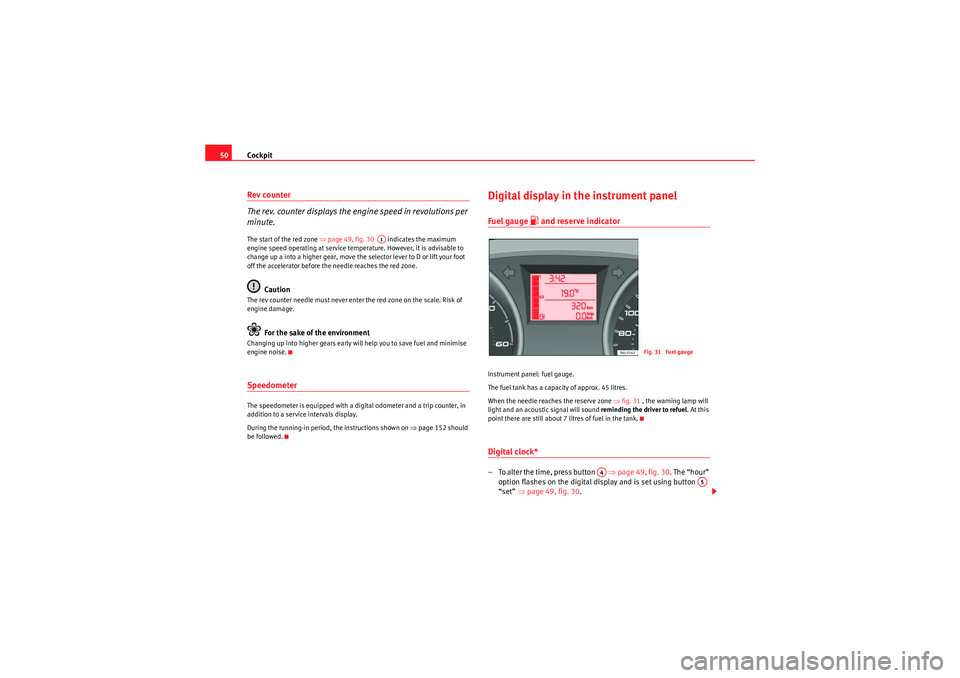
Instrument panel: fuel gauge.
The fuel tank has a capacity of approx. 45 litres.
When the needle reaches the reserve zone ⇒fig. 31 , the warning lamp will
light and an acoustic signal will sound reminding the driver to refuel. At this
point there are still about 7 litres of fuel in the tank.Digital clock* – To alter the time, press button ⇒page 49, fig. 30 . The “hour”
option flashes on the digital display and is set using button
“set” ⇒page 49, fig. 30 .
A1
Fig. 31 Fuel gauge
A4
A5
IbizaSC_EN.book Seite 50 Mittwoch, 16. September 2009 12:11 12
Page 53 of 257
Cockpit51
Safety First
Controls and equipment
Practical tips
Technical Data
– To set the minutes, press button again and select the minute
option. Set from button “set”.Once the operation has been carried out, the system memorises the time.Ambient temperature display
The outside temperature is displayed when the ignition is
switched on.In addition to the outside temperature display, an ice crystal is displayed and,
if vehicle speed is over 10 km/h, a warning tone is heard at temperatures
dropping from between +4°C and -7°C and at temperatures rising from -5°C
up to +6°C.
The illumination of the crystal symbol aims to warn the driver of the risk of
ice, so that he/she proceeds with due care.
When the vehicle is stationary or travelling at very low speeds, the tempera-
ture displayed may be slightly higher than the actual outside temperature as
a result of heat coming from the engine.
Recommended gear display*
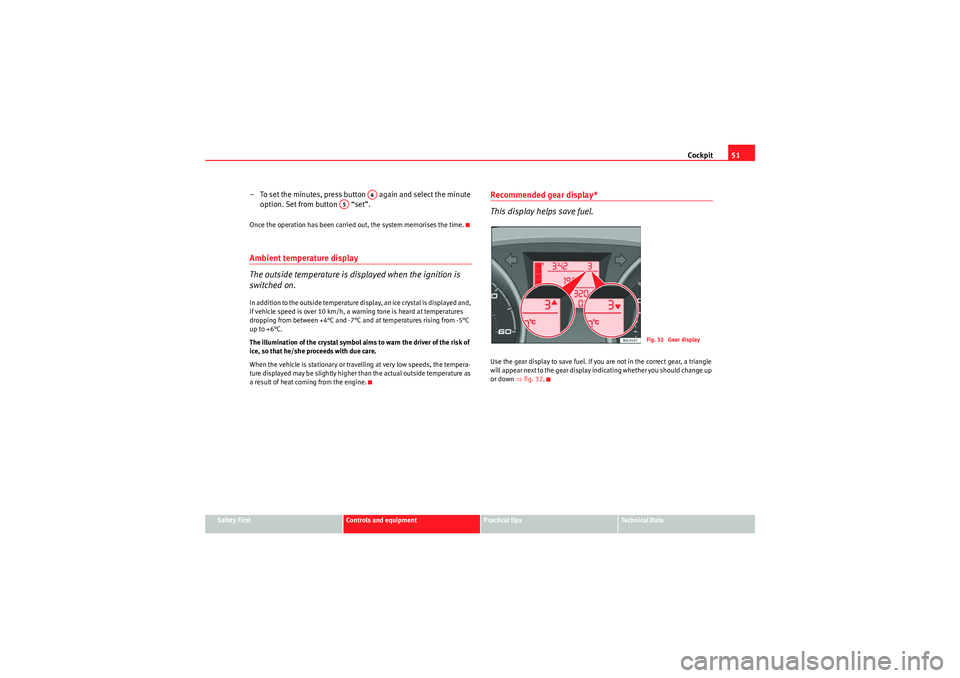
This display helps save fuel.Use the gear display to save fuel. If you are not in the correct gear, a triangle
will appear next to the gear display indicating whether you should change up
or down ⇒ fig. 32.
A4
A5
Fig. 32 Gear display
IbizaSC_EN.book Seite 51 Mittwoch, 16. September 2009 12:11 12
Page 93 of 257
Lights and visibility91
Safety First
Controls and equipment
Practical tips
Technical Data
Indicator and main beam headlight lever
The indicator and main beam lever also operates the parking
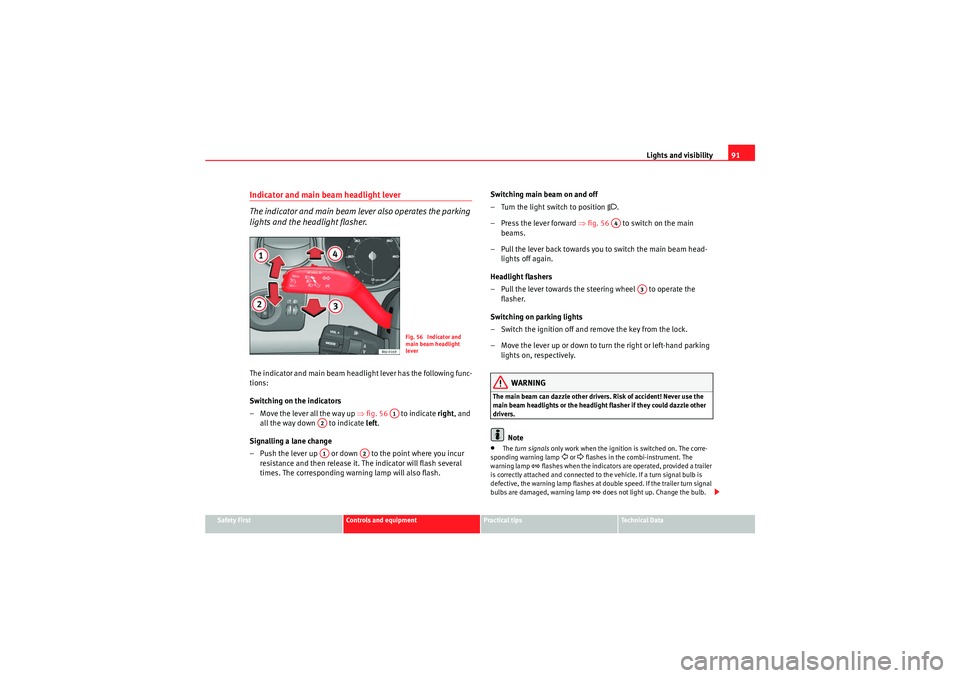
lights and the headlight flasher.The indicator and main beam headlight lever has the following func-
tions:
Switching on the indicators
– Move the lever all the way up ⇒fig. 56 to indicate right, and
all the way down to indicate left.
Signalling a lane change
– Push the lever up or down to the point where you incur resistance and then release it. The indicator will flash several
times. The corresponding warning lamp will also flash. Switching main beam on and off
– Turn the light switch to position
.
– Press the lever forward ⇒fig. 56 to switch on the main
beams.
– Pull the lever back towards you to switch the main beam head- lights off again.
Headlight flashers
– Pull the lever towards the steering wheel to operate the flasher.
Switching on parking lights
– Switch the ignition off and remove the key from the lock.
– Move the lever up or down to turn the right or left-hand parking lights on, respectively.
WARNING
The main beam can dazzle other drivers. Risk of accident! Never use the
main beam headlights or the headligh t flasher if they could dazzle other
drivers.
Note
• The turn signals only work when the ignition is switched on. The corre-
sponding warning lamp
or flashes in the combi-instrument. The
warning lamp
flashes when the indicators are operated, provided a trailer
is correctly attached and connected to the vehicle. If a turn signal bulb is
defective, the warning lamp flashes at double speed. If the trailer turn signal
bulbs are damaged, warning lamp
does not light up. Change the bulb.
Fig. 56 Indicator and
main beam headlight
lever
A1
A2A1
A2
A4
A3
IbizaSC_EN.book Seite 91 Mittwoch, 16. September 2009 12:11 12
Page 126 of 257
Heating, Ventilation and Air conditioning
124When the outside temperature is low, air recirculation mode improves
heating performance by heating air from the interior instead of cold air from
the outside.
When the outside temperature is high, air recirculation mode improves
cooling performance by cooling air from the interior instead of warm air from
outside.
For safety reasons, it is not recommended to switch air recirculation on when
the air distribution control is being adjusted to the windscreen setting
.
WARNING
In air recirculation mode, no cold air from the outside enters the vehicle
interior. If the air conditioning system is switched off, the windows can
quickly mist over. Therefore, never leave the air recirculation mode
switched on for a long time (risk of accident).
Note
When engaging reverse gear, the air reci rculation is connected automatically
to prevent the entrance of exhaust fumes in the vehicle on travelling back-
wards. In this case the symbol for air recirculation is not displayed.General notesThe impurity filter
The impurity filter (a combined particle filter and active carbon filter) serves
as a barrier against impurities in the ambient air, including dust and pollen.
For the air conditioning system to work with maximum efficiency, the pollen
filter must be replaced at the specified intervals in the Maintenance Program. If the filter loses efficiency prematurely due to use in areas reaching very high
pollution levels, the pollen filter must be changed more frequently than
stated in the Service Schedule.
Caution
•If you suspect that the air conditioning is damaged, switch it off with
button to prevent further damage and have it checked by a qualified
workshop.•Repairs to the air conditioning system require specialist knowledge and
special tools. Therefore, we recommend you to take the vehicle to a qualified
workshop.Note
•If the humidity and temperature outside the vehicle are high, condensa-
tion can drip off the evaporator in the cooling system and so forming a puddle
underneath the vehicle. This is completely normal and there is no need to
suspect a leak.•Keep the air intake slots in front of the windscreen free of snow, ice and
leaves to ensure heating and cooling are not impaired, and to prevent the
windows from misting over.•The air from the vents flows through the vehicle interior and is extracted
by slots designed for this purpose. Therefore, do not cover these slots with
items of clothing or other objects.•The air conditioning system operates most effectively with the windows
and the sliding/tilting roof* closed. However, if the vehicle has been over-
heated by sun, the air inside can be cooled quicklier by opening the windows
for a short time.•Do not smoke while air recirculation mode is on, as smoke drawn into the
air conditioning system leaves a residue on the evaporator, producing a
permanent unpleasant odour.•At low outside temperatures the compressor switches off automatically.
The button cannot be switched on either.
ACAUTO
IbizaSC_EN.book Seite 124 Mittwoch, 16. September 2009 12:11 12
Page 136 of 257
Driving
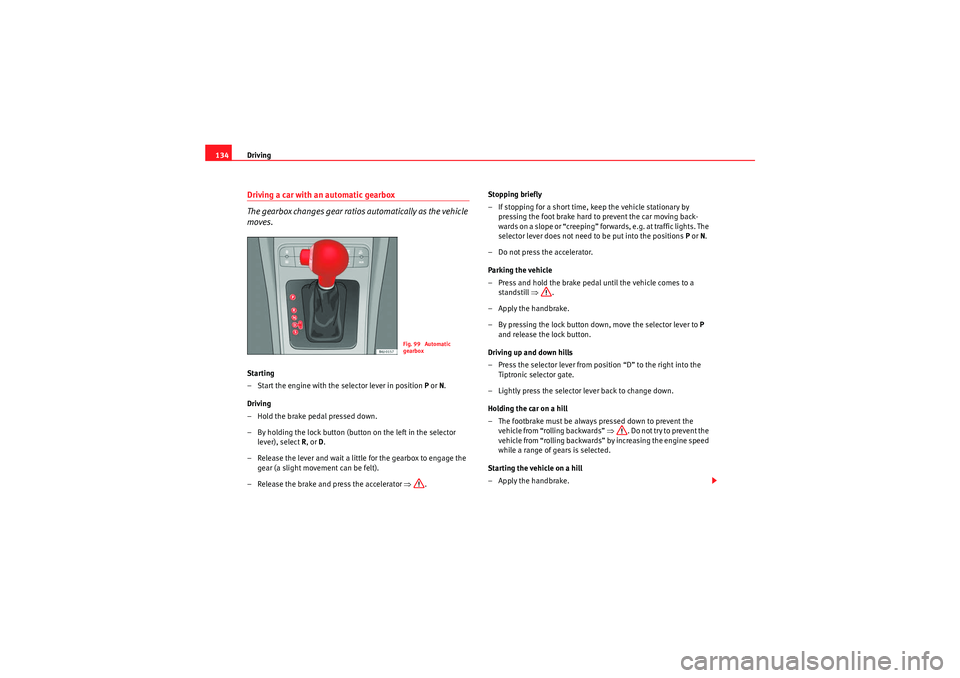
134Driving a car with an automatic gearbox
The gearbox changes gear ratios automatically as the vehicle
moves.Starting
– Start the engine with the selector lever in position P or N.
Driving
– Hold the brake pedal pressed down.
– By holding the lock button (button on the left in the selector lever), select R, or D.
– Release the lever and wait a little for the gearbox to engage the gear (a slight movement can be felt).
– Release the brake and press the accelerator ⇒. Stopping briefly
– If stopping for a short time, keep the vehicle stationary by
pressing the foot brake hard to prevent the car moving back-
wards on a slope or “creeping” forwards, e.g. at traffic lights. The
selector lever does not need to be put into the positions P or N.
– Do not press the accelerator.
Parking the vehicle
– Press and hold the brake pedal until the vehicle comes to a standstill ⇒.
– Apply the handbrake.
– By pressing the lock button down, move the selector lever to P
and release the lock button.
Driving up and down hills
– Press the selector lever from position “D” to the right into the Tiptronic selector gate.
– Lightly press the selector lever back to change down.
Holding the car on a hill
– The footbrake must be always pressed down to prevent the vehicle from “rolling backwards” ⇒. Do not try to prevent the
vehicle from “rolling backwards” by increasing the engine speed
while a range of gears is selected.
Starting the vehicle on a hill
– Apply the handbrake.
Fig. 99 Automatic
gearbox
IbizaSC_EN.book Seite 134 Mittwoch, 16. September 2009 12:11 12
Page 137 of 257
Driving135
Safety First
Controls and equipment
Practical tips
Technical Data
– With a selected gear, accelerate slowly and at the same time,
release the handbrake.The steeper the slope, the lower the gear.required This increases the braking
effect of the engine. For example, when driving down a very steep slope in 3rd
gear. If the engine brake effect is not enough, the vehicle will speed up. The
automatic gearbox automatically changes up to prevent the engine over-
revving. Use the foot brake to reduce speed and change into 3rd gear again
using Tiptronic* ⇒.
Your vehicle has an automatic interlock which prevents the selector lever
from being put into a position for driving forwards or in reverse from positions
P or N if the brake pedal is not depressed.
The ignition key cannot be removed unless the selector lever is in position P.
Warning lamp “Pressing brake pedal”
When the warning lamp next to the selector lever lights up, press the brake
pedal. This is necessary when the automatic gearbox selector lever is moved
out of positions P or N. At the same time, a text message or the instructions
to perform necessary operations may appear on the dash panel.
WARNING
•As a driver, you should never leave your vehicle if the engine is running
and a gear is engaged. If you have to leave your vehicle while the engine is
running, you must apply the parking brake and engage parking lock P.•If the engine is running and D or R are engaged, you will need to hold
vehicle stopped by depressing the brake pedal. The car would keep on
creeping forward as the power transmission is not fully interrupted even
when the engine is idling.•Never accelerate when changing gear or you may cause an accident.•Never move the selector lever to R or P when driving. Risk of accident!•Before driving down a long, steep slop e, it is advisable to reduce speed
and change into a lower gear.
•If you stop the vehicle up hill, always hold the foot brake strongly
depressed down to stop it from rolling back.•Never allow the brake to rub and do not use the brake pedal too often
or for long periods. Constant braking will cause the brakes to overheat and
will considerably reduce the brake effect. This increases the braking
distance and could cause the brake system to fail.•Never allow the car to roll down a mountain or a slope with the lever in
the N or D position, regardless of whether the engine is running or not.Caution
•If you stop the vehicle up hills, do not attempt to stop it from rolling back
by depressing the accelerator when a gear has been selected. Otherwise, the
automatic gearbox may overheat causing damage. Pull the handbrake up or
fully depress the brake pedal to prevent the vehicle from rolling away.•If you allow the car to roll when the engine is not running, or with the
selector lever in position N, a lack of lubrication in the automatic gearbox will
damage it.WARNING (continued)
IbizaSC_EN.book Seite 135 Mittwoch, 16. September 2009 12:11 12
Page 139 of 257
Driving137
Safety First
Controls and equipment
Practical tips
Technical Data
Changing gears in the normal or sport programme using the steering wheel
paddle levers
If the paddle levers ⇒
page 136, fig. 101 are used in the normal or sport
programme, the system switches temporarily to “Tiptronic” mode. To exit
“Tiptronic” mode again, press the right paddle lever towards the steering
wheel for approximately one second. You will also leave “Tiptronic” mode if
the paddle levers are not moved for a certain time.
Note
•The gear paddle levers on the steering wheel can be operated with the
gear stick in any position and with the vehicle in motion.Selector lever positions
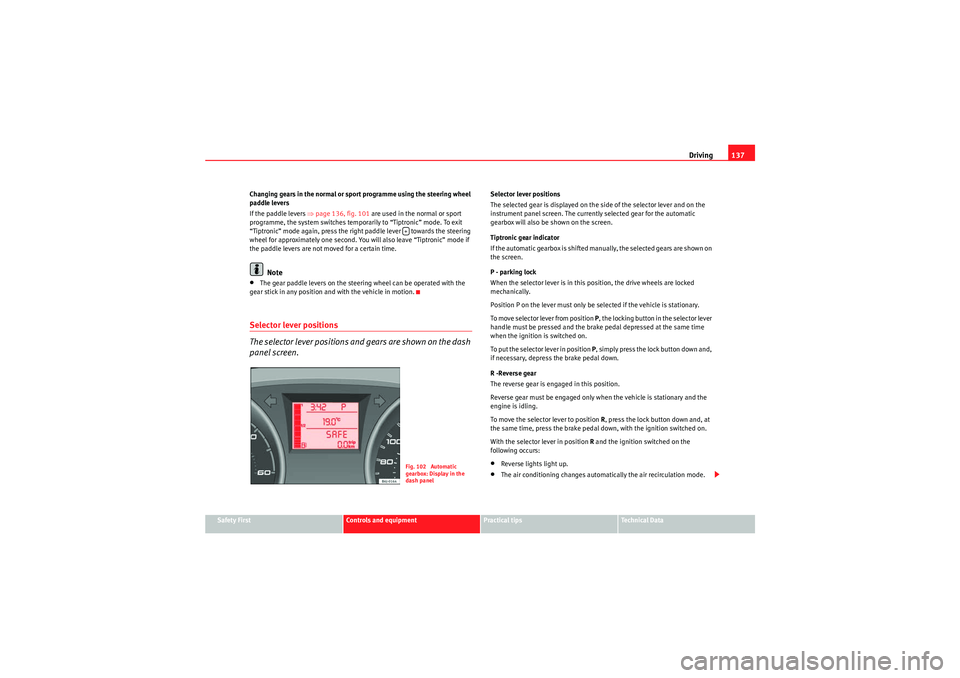
The selector lever positions and gears are shown on the dash
panel screen.
Selector lever positions
The selected gear is displayed on the side of the selector lever and on the
instrument panel screen. The currently selected gear for the automatic
gearbox will also be shown on the screen.
Tiptronic gear indicator
If the automatic gearbox is shifted manually, the selected gears are shown on
the screen.
P - parking lock
When the selector lever is in this position, the drive wheels are locked
mechanically.
Position P on the lever must only be selected if the vehicle is stationary.
To move selector lever from position P, the locking button in the selector lever
handle must be pressed and the brak e pedal depressed at the same time
when the ignition is switched on.
To put the selector lever in position P, simply press the lock button down and,
if necessary, depress the brake pedal down.
R -Reverse gear
The reverse gear is engaged in this position.
Reverse gear must be engaged only when the vehicle is stationary and the
engine is idling.
To move the selector lever to position R, press the lock button down and, at
the same time, press the brake pedal down, with the ignition switched on.
With the selector lever in position R and the ignition switched on the
following occurs:•Reverse lights light up.•The air conditioning changes automatically the air recirculation mode.
+Fig. 102 Automatic
gearbox: Display in the
dash panel
IbizaSC_EN.book Seite 137 Mittwoch, 16. September 2009 12:11 12
Page 156 of 257
Driving and the environment
154Diesel engine particulate filter*
The diesel engine particulate filter eliminates soot produced
by burning diesel.The diesel engine dust filter eliminates most of the soot from the exhaust gas
system. Under normal driving conditions, the filter cleans itself. If the driving
conditions do not allow the filter to clean itself (for example, multiple short
trips) the filter will be obstructed by dust and pollen and the indicator
for
the diesel engine particulate filter indicator will light. See under Warning
Lights.
WARNING
•The diesel engine particulate filter may reach extremely high tempera-
tures; it should not enter into contact with flammable materials under-
neath the vehicle. Failure to comply could result in fire.Caution
•The vehicle is not designed for refuelling with mixtures of FAME fuel
(biodiesel) over 7%, in accordance with DIN 51628. The diesel particle filter
will be damaged if this mixture percentage is exceeded.Economical and environmentally friendly
drivingEconomical and environmentally friendly drivingFuel consumption, environmental pollution and wear to the engine, brakes
and tyres depend to a large extent on your driving style. By adopting an economical driving style and anticipating the traffic situation ahead, you can
easily reduce fuel consumption by 10-15%. Some tips on how to help you
reduce pollution while saving money are listed below.
As you drive try to anticipate the traffic situation
A vehicle uses most fuel when accelerating. When you anticipate the situa-
tion, you have to brake less frequently and therefore accelerate less. If
possible, let the vehicle roll with a gear engaged
, for example, if you see a red
light ahead. The braking effect achieved in this way helps to reduce wear on
brakes and tyres; emissions and fuel consumption are reduced to zero
(disconnection due to inertia).
Change gear early to save energy
An effective way of saving fuel is to change up quickly through the gears.
Running the engine at high rpm in lower gears uses an unnecessary amount
of fuel.
Manual gearbox: Change from first to second gear as quickly as possible. We
recommend that, whenever possible, you change to a higher gear when you
reach 2,000 rpm.
Automatic gearbox: Accelerate in moderation and avoid the “kick-down” (full
throttle) position.
Avoid driving at high speed
We advise you not to drive at the top speed permitted for the vehicle. Fuel
consumption, exhaust emissions and noise levels all increase very rapidly at
higher speeds. Driving at moderate speeds will help to save fuel.
Avoid idling
It is worthwhile to switch off the engine when waiting in a traffic jam, at level
crossings or at traffic lights with a long red phase. The fuel saved after only
30 - 40 seconds is greater than the amount of fuel needed to restart the
engine.
The engine takes a very long time to warm up when it is running at idling
speed. Mechanical wear and pollutant emissions are also especially high
IbizaSC_EN.book Seite 154 Mittwoch, 16. September 2009 12:11 12
Page 181 of 257
Checking and refilling levels179
Safety First
Controls and equipment
Practical tips
Technical Data
•Wait until no more steam, smoke or coolant is emitted from the bonnet,
then carefully open the bonnet.•When working in the engine compartment, always observe the safety
warnings ⇒page 176.
Closing the bonnet– Slightly raise the bonnet
– Release the bonnet stay and replace it in its support.
– At a height of about 30 cm let it fall so it is locked.If the bonnet does not close, do not press downwards. Open it once more and
let it fall as before.
WARNING
If the bonnet is not closed properly, it could open while you are driving and
completely obscure your view of the road. Risk of accident.•After closing the bonnet, always check that it is properly secured. The
bonnet must be flush with the surrounding body panels.•If you notice that the bonnet latch is not secured when the vehicle is
moving, stop the vehicle immediately and close the bonnet properly. Risk
of accident.
Engine oilEngine oil specifications
The engine oil used must conform with exact specifications.Specifications
The engine comes with a special, high quality, multi grade oil that can be
used in all seasons of the year except for those regions affected by extreme
cold.
As the use of good quality oil is necessary for the correct operation and long
service life of the engine, when it becomes necessary to replenish or change
the oil, always use an oil that complies to the VW standards.
If it is not possible to find oil conforming to the VW standards then oil
conforming to the ACEA or API standards with an appropriate viscosity at
atmospheric temperature should be used instead. The use of this type of oil
may have some repercussions on the performance of the engine for example,
long starting time, increased consumption and a higher emission level.
If a top up is required then different oils may be mixed as long as they all
conform to the VW standards.
The specifications (VW standards) set out in the following page should
appear on the container of the service oil; the container will display together
the different standards for petrol and diesel engines, the oil can be used for
both types of engines.
WARNING (continued)
IbizaSC_EN.book Seite 179 Mittwoch, 16. September 2009 12:11 12
Page 187 of 257
Checking and refilling levels185
Safety First
Controls and equipment
Practical tips
Technical Data
Caution
•If you notice a change in the colour of the liquid because it has been in
use for a long time, it should be changed, as it will have lost some of its prop-
erties and could cause damage to the vehicle.•If a lot of coolant has been lost, wait for the engine to cool down before
putting in cold coolant. This avoids damaging the engine. Large coolant
losses are an indication of leaks in the cooling system. See a specialised
workshop immediately and have the cooling system checked. Otherwise,
there is a risk of engine damage.Washer fluid and windscreen wiper bladesTopping up washer fluid
The water for cleaning the windscreen should always be
mixed with washer fluid.
The windscreen washer and the headlight washing system are supplied with
fluid from the windscreen washer fluid container in the engine compartment.
The container holds approx. 2 litres; in vehicles with headlamp washers* it
holds approx. 4.5 litres.
The reservoir is located on the right-hand side of the engine compartment.
Plain water is not enough to clean the windscreen and headlights. We recom-
mend that you always add a product to the windscreen washer fluid.
Approved windscreen cleaning products exist on the market with high deter-
gent and anti-freeze properties, these may be added all-year-round. Please
follow the dilution instructions on the packaging.
WARNING
Any work carried out in the engine compartment or on the engine must be
carried out cautiously.•When working in the engine compartment, always observe the safety
warnings ⇒page 176.Caution
•Never put radiator anti-freeze or other additives into the windscreen
washer fluid.•Always use approved windscreen cleansing products diluted as per
instructions. If you use other washer fluids or soap solutions, the tiny holes
in the fan-shaped nozzles could become blocked.
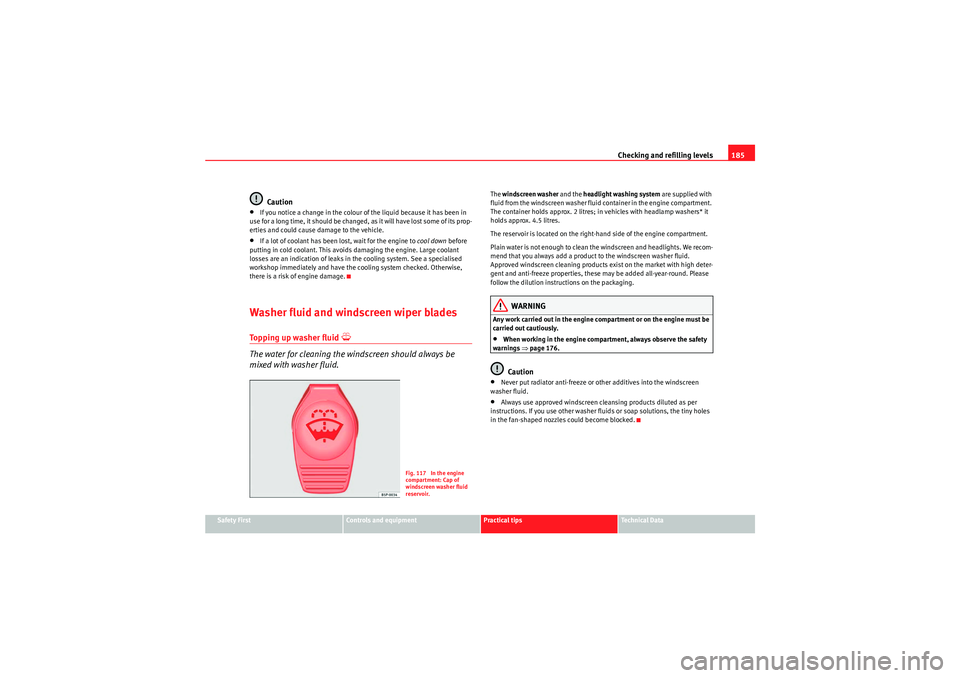
Fig. 117 In the engine
compartment: Cap of
windscreen washer fluid
reservoir.
IbizaSC_EN.book Seite 185 Mittwoch, 16. September 2009 12:11 12