tyre pressure Seat Ibiza SC 2009 Owner's manual
[x] Cancel search | Manufacturer: SEAT, Model Year: 2009, Model line: Ibiza SC, Model: Seat Ibiza SC 2009Pages: 257, PDF Size: 6.61 MB
Page 10 of 257
Safe driving
8Therefore, information is provided about why this equipment is so important,
h o w i t p r o t e c t s yo u , w h a t yo u ha v e to co n s i d e r w h e n u s i n g i t a n d h o w yo u a n d
your passengers can achieve the greatest possible benefit from the safety
equipment fitted. This manual includes important warnings that you and your
passengers should note in order to reduce the risk of injury.
Safety is everyone's business!Before every trip
The driver bears the responsibility for his passengers and the
operational worthiness of the vehicle.For your own safety and the safety of your passengers, always note
the following points before every trip:
– Ensure that the vehicle's lights and turn signals operate flaw-
lessly.
– Check tyre pressure.
– Ensure that all windows provide a clear and good view of the surroundings.
– Ensure that all luggage is correctly secured ⇒page 15.
– Make sure that no objects can interfere with the pedals.
– Adjust front seat, head restraint and mirrors properly according to your size.
– Ensure that the passenger in the central rear seat always has the head restraint in the co rrect position for use. – Instruct passengers to adjust the head restraints according to
their height.
– Protect children with appropriate child seats and properly applied seat belts ⇒page 38.
– Assume the correct sitting position. Instruct your passengers also to assume a proper sitting position ⇒page 9.
– Fasten your safety belt securely. Instruct your passengers also to fasten their seat belts properly ⇒ page 16.
What affects driving safety?
Driving safety is largely determined by your driving style and
the personal behaviour of all occupants.As a driver, you are responsible for yourself and your passengers.
When your concentration or driving safety is affected by any circum-
stance, you endanger yourself as well as others on the road ⇒,
for this reason:
– Do not allow yourself to be distracted from the traffic around you, e.g. by passengers or telephone conversations.
– Never drive when your driving abil ity is impaired (e.g. by medica-
tion, alcohol, drugs).
– Observe traffic laws and speed limits.
– Always reduce your speed as appropriate for road, traffic and weather conditions.
IbizaSC_EN.book Seite 8 Mittwoch, 16. September 2009 12:11 12
Page 49 of 257
Cockpit47
Safety First
Controls and equipment
Practical tips
Technical Data
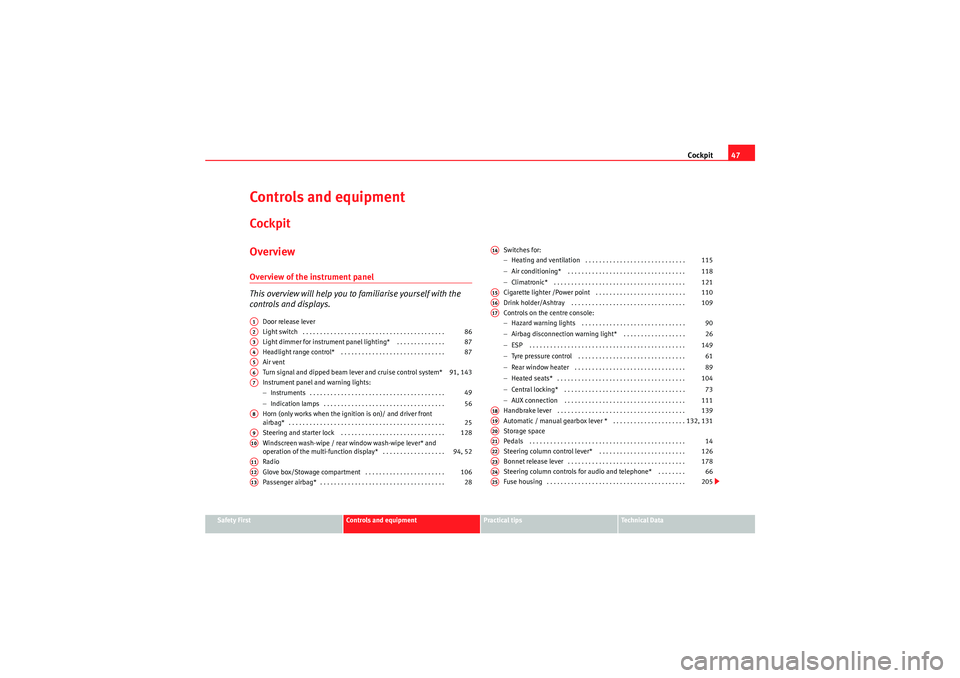
Controls and equipmentCockpitOverviewOverview of the instrument panel
This overview will help you to familiarise yourself with the
controls and displays.
Door release lever
Light switch . . . . . . . . . . . . . . . . . . . . . . . . . . . . . . . . . . . . . . . . .
Light dimmer for instrument panel lighting* . . . . . . . . . . . . . .
Headlight range control* . . . . . . . . . . . . . . . . . . . . . . . . . . . . . .
Air vent
Turn signal and dipped beam lever and cruise control system*
Instrument panel and warning lights:
− Instruments . . . . . . . . . . . . . . . . . . . . . . . . . . . . . . . . . . . . . . .
− Indication lamps . . . . . . . . . . . . . . . . . . . . . . . . . . . . . . . . . . .
Horn (only works when the ignition is on)/ and driver front
airbag* . . . . . . . . . . . . . . . . . . . . . . . . . . . . . . . . . . . . . . . . . . . . .
Steering and starter lock . . . . . . . . . . . . . . . . . . . . . . . . . . . . . .
Windscreen wash-wipe / rear window wash-wipe lever* and
operation of the multi-function display* . . . . . . . . . . . . . . . . . .
Radio
Glove box/Stowage compartment . . . . . . . . . . . . . . . . . . . . . . .
Passenger airbag* . . . . . . . . . . . . . . . . . . . . . . . . . . . . . . . . . . . . Switches for:
−
Heating and ventilation . . . . . . . . . . . . . . . . . . . . . . . . . . . . .
− Air conditioning* . . . . . . . . . . . . . . . . . . . . . . . . . . . . . . . . . .
− Climatronic* . . . . . . . . . . . . . . . . . . . . . . . . . . . . . . . . . . . . . .
Cigarette lighter /Power point . . . . . . . . . . . . . . . . . . . . . . . . . .
Drink holder/Ashtray . . . . . . . . . . . . . . . . . . . . . . . . . . . . . . . . .
Controls on the centre console:
− Hazard warning lights . . . . . . . . . . . . . . . . . . . . . . . . . . . . . .
− Airbag disconnection warning light* . . . . . . . . . . . . . . . . . .
− ESP . . . . . . . . . . . . . . . . . . . . . . . . . . . . . . . . . . . . . . . . . . . . .
− Tyre pressure control . . . . . . . . . . . . . . . . . . . . . . . . . . . . . . .
− Rear window heater . . . . . . . . . . . . . . . . . . . . . . . . . . . . . . . .
− Heated seats* . . . . . . . . . . . . . . . . . . . . . . . . . . . . . . . . . . . . .
− Central locking* . . . . . . . . . . . . . . . . . . . . . . . . . . . . . . . . . . .
− AUX connection . . . . . . . . . . . . . . . . . . . . . . . . . . . . . . . . . . .
Handbrake lever . . . . . . . . . . . . . . . . . . . . . . . . . . . . . . . . . . . . .
Automatic / manual gearbox lever * . . . . . . . . . . . . . . . . . . . . .
Storage space
Pedals . . . . . . . . . . . . . . . . . . . . . . . . . . . . . . . . . . . . . . . . . . . . .
Steering column control lever* . . . . . . . . . . . . . . . . . . . . . . . . .
Bonnet release lever . . . . . . . . . . . . . . . . . . . . . . . . . . . . . . . . . .
Steering column controls for audio and telephone* . . . . . . . .
Fuse housing . . . . . . . . . . . . . . . . . . . . . . . . . . . . . . . . . . . . . . . .
A1A2
86
A3
87
A4
87
A5A6
91, 143
A7
49
56
A8
25
A9
128
A10
94, 52
A11A12
106
A13
28
A14
115
118
121
A15
110
A16
109
A17
90
26
149 61
89
104 73
111
A18
139
A19
132, 131
A20A21
14
A22
126
A23
178
A24
66
A25
205
IbizaSC_EN.book Seite 47 Mittwoch, 16. September 2009 12:11 12
Page 59 of 257
Cockpit57
Safety First
Controls and equipment
Practical tips
Technical Data
WARNING
•Failure to observe warning lamps and warning messages can result in
serious personal injuries or damage to your vehicle.•The risk of an accident increases if your vehicle breaks down. Use a
warning triangle to draw the attention of other road users in order to
prevent danger to thirds.
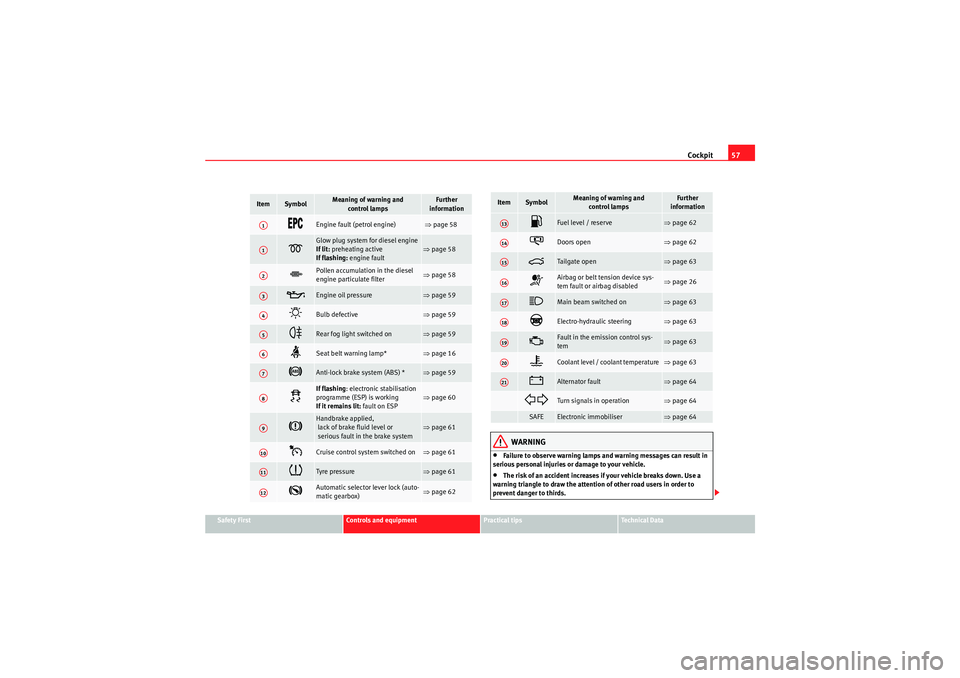
Item
Symbol
Meaning of warning and
control lamps
Further
information
Engine fault (petrol engine)
⇒ page 58
Glow plug system for diesel engine
If lit: preheating active
If flashing: engine fault
⇒page 58
Pollen accumulation in the diesel
engine particulate filter
⇒page 58
Engine oil pressure
⇒page 59
Bulb defective
⇒page 59
Rear fog light switched on
⇒page 59
Seat belt warning lamp*
⇒page 16
Anti-lock brake system (ABS) *
⇒page 59
If flashing : electronic stabilisation
programme (ESP) is working
If it remains lit: fault on ESP
⇒page 60
Handbrake applied,
lack of brake fluid level or
serious fault in the brake system
⇒page 61
Cruise control system switched on
⇒page 61
Tyre pressure
⇒page 61
Automatic selector lever lock (auto-
matic gearbox)
⇒page 62
A1A1A2A3A4A5A6A7A8A9A10A11A12
Fuel level / reserve
⇒ page 62
Doors open
⇒page 62
Tailgate op e n
⇒page 63
Airbag or belt tension device sys-
tem fault or airbag disabled
⇒page 26
Main beam switched on
⇒page 63
Electro-hydraulic steering
⇒page 63
Fault in the emission control sys-
tem
⇒page 63
Coolant level / coolant temperature
⇒page 63
Alternator fault
⇒page 64
Turn signals in operation
⇒page 64
SAFE
Electronic immobiliser
⇒page 64
Item
Symbol
Meaning of warning and
control lamps
Further
information
A13A14A15A16A17A18A19A20A21
IbizaSC_EN.book Seite 57 Mittwoch, 16. September 2009 12:11 12
Page 61 of 257
Cockpit59
Safety First
Controls and equipment
Practical tips
Technical Data
•The diesel engine particulate filter may reach extremely high tempera-
tures; it should not enter into contact with flammable materials under-
neath the vehicle. Failure to comply could result in fire.
Engine oil pressure
This warning lamp indicates that the engine oil pressure is
too low.If this warning symbol starts to flash, and is accompanied by three audible
warnings , switch off the engine and check the oil level. If the oil level is too
low, top up with oil.
If the symbol flashes although the oil level is correct, do not drive on. The
engine must not even run at idle speed. Obtain technical assistance.Bulb defect*
The indicator lights up when a bulb is not functioning.The indicator
lights up when there is a fault on the flasher lights, head-
lights, position light and fog lights.
Rear fog light*
This warning lam p lights up when the rear fog light is switched on
. Further
information ⇒page 86.
Anti-lock brake system (ABS)
A warning lamp system monitors the ABS.
The warning lamp
should light up for a few seconds when the ignition is
switched on. It goes out again after the system has run through an automatic
test sequence.
There is a fault in the ABS if:
•The warning lamp
does not light up when the ignition is switched on.
•The warning lamp does not go out again after a few seconds.•The warning lamp lights up when the vehicle is moving.
The vehicle can still be braked in the normal way (except that the ABS control
function will not function). Please take the vehicle to a qualified workshop as
soon as possible. For further information on the ABS see the ⇒page 148.
If there is a fault in the ABS, the ESP* and the tyre pressure warning lamp will
also light up.
Brake system fault
If the ABS warning lamp
lights up together with the brake warning lamp
, this indicates not only a fault in the ABS function, but also a possible fault
in the brake system ⇒.
WARNING
•Before opening the bonnet, read and observe the warnings on
⇒ page 176, “Working in the engine compartment”.•If the brake warning lamp
should light up together with the ABS
warning lamp
, stop the vehicle immediately and check the brake fluid
level in the reservoir ⇒ page 188, “Brake fluid”. If the fluid level has
dropped below the “MIN” mark you must not drive on. Risk of accident.
Obtain technical assistance.
WARNING (continued)
IbizaSC_EN.book Seite 59 Mittwoch, 16. September 2009 12:11 12
Page 63 of 257
Cockpit61
Safety First
Controls and equipment
Practical tips
Technical Data
Brake system* / handbrake
The warning lamp lights up if the handbrake is applied, if the
brake fluid level falls too low or if there is a fault in the brake
system.
This warning lamp
lights up if
•If the handbrake is applied•If the brake fluid level is too low ⇒page 188•If there is a fault in the brake system
This warning lamp can light up together with the anti-lock brake system
warning lamp.WARNING
•If the brake warning lamp does not go out, or if it lights up when
driving, the brake fluid level ⇒page 188, “Brake fluid” in the reservoir is
too low. Risk of accident. Stop the vehicle and do not drive on. Obtain tech-
nical assistance.•If the brake warning lamp
lights up together with the ABS warning
lamp
, the control function of the ABS could be out of action. This could
cause the rear wheels to lock quickly when you brake. This could cause the
rear to break away. Risk of skidding. Stop the vehicle and seek technical
assistance.
Cruise control system*
The warning lamp comes on when the cruise control system
is switched on.The warning lamp
lights up when the cruise control system is switched on.
Further notes on the cruise control system ⇒page 143.
Tyre pressure*
The tyre monitor
5) co m p a r e s w h e e l r e v o l u t i o ns a n d wi t h t h is i n f o r m a t i o n , t h e
diameter of each wheel using the ESP sensors. If the diameter of a wheel
changes, the tyre monitor indicator lights . The wheel diameter changes
when:
•Tyre pressure is insufficient.5)Depending on the model version
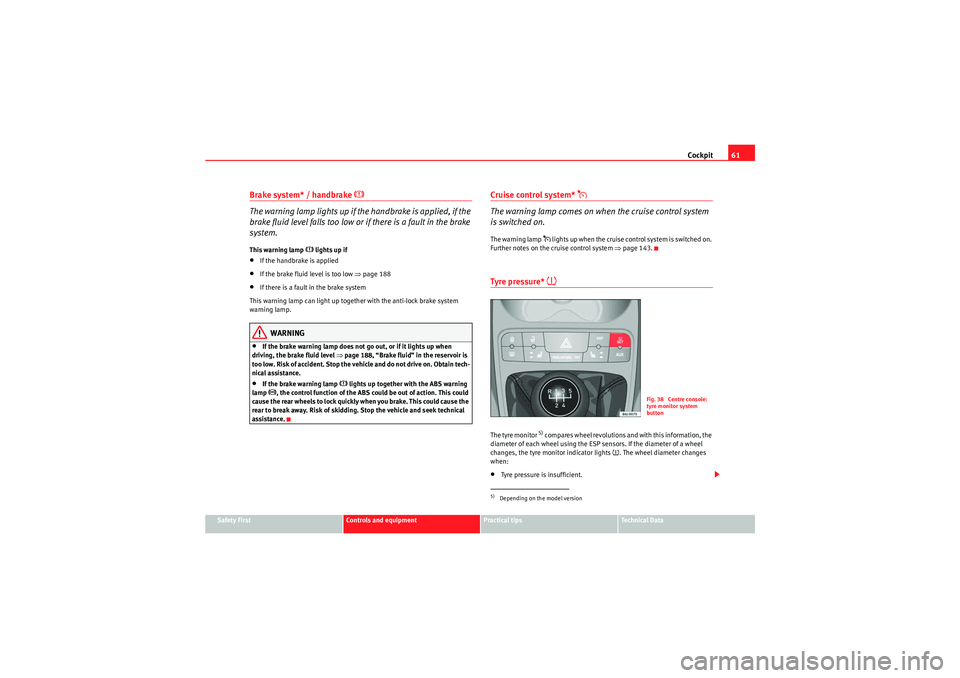
Fig. 38 Centre console:
tyre monitor system
button
IbizaSC_EN.book Seite 61 Mittwoch, 16. September 2009 12:11 12
Page 64 of 257
Cockpit
62•The tyre structure is damaged.•The vehicle is unbalanced because of a load.•The wheels of one axle are under more pressure (for example, driving with
a trailer or on extreme slopes).•The vehicle is fitted with snow chains.•The emergency wheel is fitted.•The wheel on one axle is changed.
Tyre pressure adjustment
Following the modification to tyre pressure or changing one or more wheels,
the button ⇒page 61, fig. 38 must be kept pressed while the ignition is on
until an acoustic signal is heard.
If the wheels are under excessive load (for example, driving with a trailer or
heavy load), the tire pressure must be increased to the recommended value
for a full load (see the sticker on the inside of the fuel flap). If the tyre m onitor
system button is pressed down, the new tyre pressures are confirmed.
The tyre pressure monitor indicator
lights up
If the tyre pressure of one wheel is much lower than the value set by the
driver, then the tyre pressure monitor indicator ⇒ will light up.
WARNING
•When the tyre pressure indicator lights, reduce speed immediately and
avoid any sudden manoeuvre or braking. Stop when possible, and check
the tyre pressure and status.•The driver is responsible for correct tyre pressure. For this reason, tyre
pressure must be regularly checked.•Under certain circumstances (for example, when driving in a sports-like
manner, in winter conditions or on a dirt track) the tyre monitor indicator
may light or function incorrectly.
Note
If the battery is disconnected, the yellow indicator
lights up after turning
the ignition on. This should turn off after a brief journey.
Speed selector lever lock*
The footbrake must be depressed when this warning lamp lights up. This is
necessary when the automatic gearbox* selector lever is moved out of the
positions P or N.Fuel level / reserve
This symbol lights up to indicate that the fuel tank under the
reserve level.It lights up when only 7 litres of fuel remain in the tank. Moreover, an audible
warning* is heard. It reminds you to fuel up the fuel tank as soon as possible
⇒ page 173.Indicates that the doors are open*
This indicator lights if one of the doors or the tailgate is open.The warning light
should go off when all the doors are closed correctly.
IbizaSC_EN.book Seite 62 Mittwoch, 16. September 2009 12:11 12
Page 144 of 257
Driving
142Reverse gear
The distance warning will begin as soon as an obstacle is detected by the
system. The frequency of the bleeps emitted by the system will increase
rapidly as the vehicle approaches the obstacle.
Within a short distance of about 30 cm, a continuous signal sounds (stop
signal). The driver should not reverse any further.
Models with a factory-fitted towing bracket: When the vehicle is less than
0.35 m away from the obstacle the warning tone will sound continuously. The
driver should then not reverse any further.
The warning tone decreases by 30% after 3 seconds from the start of the
system.
Provided that it is not in continuous mode, the tone on the parking aid system
stops when it detects a wall parallel to the vehicle.
Trailer towing
For factory-fitted vehicles with a towing bar, the parking aid system will not
be activated by the engagement of the reverse gear when pulling a trailer, as
the trailer's electric connector will be plugged into the vehicle.
Possible faults
If a continuous bleep sounds for some seconds when the reverse gear is
engaged, this indicates that there is a fault in the parking aid system.
If the fault continues until the ignition is turned off, the acoustic signal
warning of the fault will not be emitted every time the system is reactivated
(by engaging the reverse gear). Thus, the system ready indication will not
sound either. Have the fault repaired by an Authorised Service Centre as soon
as possible.
If there is no ready signal or no acoustic warning signal, then the parking aid
loudspeaker is faulty and may not warn of obstacles.
To ensure that the system works properly, the sensors must be kept clean and
free of ice and snow.
WARNING
•The sensors have blind spots in which obstacles may not be detected.•Always look out for small children and animals because the system will
not always detect them. Always pay attention when reversing to avoid acci-
dents.•The parking aid is not a replacement for driver awareness. The driver
must take full responsibility for parking and other manoeuvres.Caution
•Please note that low obstacles detected by the system may no longer be
registered by the sensors as the car moves closer, so the system will not give
any further warning. Certain kinds of obstacles (such as wire fences, chains,
thin posts or trailer draw bars, high kerbs or painted railings etc) may not
always be detected by the system, so there is a risk of damaging the vehicle
in such cases.•In some cases, obstacles with uniform edges and bumps may not be
detected immediately by the system due to their geometry. Take special care
of this type of obstacle such as corners, rectangular objects, etc.., these can
cause damage to the vehicle.•Be especially careful when manoeuvring into a corner between two
perpendicular walls. Survey the approach of the wall to the side of the vehicle
(using the mirrors)•The parking aid system does not replace use of the mirrors for manoeu-
vres.•Distant ultra-sonic sources (hammers, tyres, construction machinery,
other vehicles with PDC) may interfere with the operation of the system.•Periodic cleaning of the sensors, take care not to damage or scratch them.
When cleaning with high pressure washers or steam cleaners, the sensors
should be sprayed for only a very short period and from a distance of more
than 10 cm.
IbizaSC_EN.book Seite 142 Mittwoch, 16. September 2009 12:11 12
Page 150 of 257
Intelligent technology
148•The brake assist system cannot defy the laws of physics. Slippery and
wet roads are dangerous even with the brake assist system! Therefore, it is
essential that you adjust your speed to suit the road and traffic conditions.
Do not let the extra safety features tempt you into taking any risks when
driving.
Anti-lock brake system and traction control
ABSAnti-lock brake system (ABS)
The anti-lock brake system prevents the wheels locking
during braking.The anti-lock brake system (ABS) is an important part of the vehicle's active
safety system.
How the ABS works
If one of the wheels is turns too slowly in relation to the road speed, and is
close to locking, the system will reduce the braking pressure for this wheel.
The driver is made aware of this control process by a pulsating of the brake
pedal and audible noise. This is a deliberate warning to the driver that one or
more of the wheels is tending to lock and the ABS control function has inter-
vened. In this situation it is important to keep the brake pedal fully depressed
so the ABS can regulate the brake application. Do not “pump”.
If you brake hard on a slippery road surface, the best possible control is
retained as the wheels do not lock. However, ABS will not necessarily gu
arantee shorter braking distances in all
conditions. The braking distance could even be longer if you brake on gravel
or on fresh snow covering a slippery surface.
WARNING
•The anti-lock brake system cannot defy the laws of physics. Slippery
and wet roads are dangerous even with ABS! If you notice that the ABS is
working (to counteract locked wheels under braking), you should reduce
speed immediately to suit the road and traffic conditions. Do not let the
extra safety features tempt you into taking any risks when driving.•The effectiveness of ABS is also determined by the tyres fitted
⇒ page 191.•If the running gear or brakes are modified, the effectiveness of the ABS
could be severely limited.
Traction control system (TCS)*
The traction control system prevents the drive wheels from
spinning when the car is accelerating. The system always
includes ABSDescription and operation of the traction control system during acceleration
(TCS)
TCS reduces engine power to help prevent the drive wheels of front-wheel
drive vehicles losing traction during acceleration. The system works in the
entire speed range in conjunction with ABS. If a malfunction should occur in
the ABS, the TCS will also be out of action.
TCS helps the vehicle to start moving, accelerate and climb a gradient in slip-
pery conditions where this may otherwise be difficult or even impossible.
WARNING (continued)
IbizaSC_EN.book Seite 148 Mittwoch, 16. September 2009 12:11 12
Page 157 of 257
Driving and the environment155
Safety First
Controls and equipment
Practical tips
Technical Data
during this initial warm-up phase. It is therefore best to drive off immediately
after starting the engine. When doing this, avoid running the engine at high
speed.
Periodic maintenance
Periodic maintenance work guarantees that, before beginning a journey, you
will not consume more than the required amount of fuel. A well-serviced
engine gives you the benefit of improved fuel efficiency as well as maximum
reliability and an enhanced resale value.
A badly serviced engine can consume up to 10% more fuel than necessary.
Avoid short journeys
To reduce the consumption and emission of polluting gases, the engine and
the exhaust filtration systems should reach the optimum
service tempera-
ture .
With the engine cold, fuel consumption is proportionally much higher. The
engine does not warm up and fuel consumption does not regularise until
having driven some four kilometres. This is the reason why we recommend
avoiding short trips wherever possible.
Maintain the correct tyre pressures
Bear in mind that keeping the tyres at an adequate pressure saves fuel. If the
tyre pressures are just 1 bar too low, this can put the fuel consumption up by
as much as 5 %. Due to the greater rolling resistance, under-inflation also
increases tyre wear and impairs handling.
The tyre pressures should always be checked when the tyres are cold.
Do not use winter tyres all year round: they will increase fuel consumption by
up to 10 %.
Avoid unnecessary weight
Every kilo of extra weight will put up the fuel consumption, so it is worth
checking the luggage compartment occasionally to make sure that no unnec-
essary loads are being carried. A roof carrier is often left in place for the sake of convenience, even when it is
no longer needed. At a speed of 100-120 km/h your car will use about 12%
more fuel as a result of the extra wind resistance caused by the roof carrier
even when it is not in use.
Saving electrical energy
The engine activates the alternator, which produces electricity. With the need
for electricity, fuel consumption is also increased. Because of this, always
turn off electrical equipment when you do not need it. Examples of equipment
that use a lot of electricity are: the fan at high speeds, the rear window
heating or the seat heaters*.
Environmental friendlinessEnvironmental protection is a top priority in the design, choice of materials
and production of your new Seat.
Design measures for economical recycling•Joints and connections designed for easy dismantling•Modular construction to facilitate dismantling•Increased use of single-grade materials•Plastic parts and elastomers are labelled in accordance with ISO 1043,
ISO 11469 and ISO 1629
Choice of materials•Nearly all materials used can be recycled•Similar types of plastics grouped together for easy recycling•Recycled materials used in manufacture•Reduction of volatile compounds in plastics•CFC-free refrigerant in air conditioning
IbizaSC_EN.book Seite 155 Mittwoch, 16. September 2009 12:11 12
Page 159 of 257
Driving and the environment157
Safety First
Controls and equipment
Practical tips
Technical Data
If the trailer has a 7-pin plug
you will need to use an adapter cable. This is
available in any SEAT dealer.
Trailer weight / draw bar loading
Never exceed the authorised towing limit. If you do not load the trailer up to
the maximum permitted trailer weight, you can then climb correspondingly
steeper slopes.
The maximum trailer weights listed are only applicable for altitudes up to
1,000 m above sea level. With increasing altitude the engine power and
therefore the vehicle's climbing ability are impaired because of the reduced
air density. The maximum trailer weight has to be reduced accordingly. The
weight of the vehicle and trailer combination must be reduced by 10% for
every further 1,000 m (or part thereof). The gross combination weight is the
actual weight of the laden vehicle plus the actual weight of the laden trailer.
When possible, operate the trailer with the maximum permitted draw bar
weight on the ball joint of the towing bracket, but do not exceed the specified
limit.
The figures for trailer weights and draw bar weights that are given on the
data plate of the towing bracket are for certification purposes only. The
correct figures for your specific model, which may be lower than these figures
for the towing bracket, are given in the registration documents ⇒Section
“Technical data”.
Distributing the load
Distribute loads in the trailer so that heavy objects are as near to the axle as
possible. Loads carried in the trailer must be secured to prevent them
moving.
Tyre pressure
Set tyre pressure to the maximum permissible pressure shown on the sticker
on the inside of the fuel tank flap. Set the tyre pressure of the trailer tyres in
accordance with the trailer manufacturer's recommendations. Exterior mirrors
Check whether you can see enough of the road behind the trailer with the
standard mirrors. If this is not the case, you should have additional mirrors
fitted. Both exterior mirrors should be mounted on hinged extension
brackets. Adjust the mirrors to give sufficient vision to the rear.
WARNING
Never transport people in a trailer. This could result in fatal accidents.
Note
•Towing a trailer places additional demands on the vehicle. We recom-
mend additional services between the normal inspection intervals if the
vehicle is used frequently for towing a trailer.•Find out whether special regulations apply to towing a trailer in your
country.Ball coupling of towing bracket*The ball coupling is provided with instructions on fitting and removing the
ball coupling of the towing bracket.
WARNING
The towing bracket ball coupling must be stored securely in the luggage
compartment to prevent them being flung through the vehicle and causing
injury.
IbizaSC_EN.book Seite 157 Mittwoch, 16. September 2009 12:11 12