air condition Seat Ibiza SC 2010 Owner's Guide
[x] Cancel search | Manufacturer: SEAT, Model Year: 2010, Model line: Ibiza SC, Model: Seat Ibiza SC 2010Pages: 266, PDF Size: 7.02 MB
Page 161 of 266
Driving and the environment159
Safety First
Operating Instructions
Practical Tips
Technical Specifications
change down into a lower gear or range (depending on the type of trans-
mission). This makes use of engine braking and relieves the brakes.
•Never let the brakes “drag” by applying light pressure. Continuous
braking will cause the brakes to overheat and the braking distance will
increase. Apply and then release the brakes alternately.•Never let the vehicle run with the engine switched off. The braking
distance is increased considerably when the brake servo is not active.•If the brake fluid loses its viscosity and is subjected to heavy use,
vapour bubbles can form in the brake system. This reduces the efficiency of
the brakes.•Non-standard or damaged front spoilers could restrict the airflow to the
brakes and cause them to overheat. Before purchasing accessories please
observe the relevant instructions ⇒page 175, “Technical modifications”.•If a brake circuit fails, the braking distance will be increased consider-
ably. Contact a specialised workshop immediately and avoid unnecessary
journeys.
Exhaust gas purification systemCatalytic converter*To maintain the useful life of the catalytic converter
– Use only unleaded petrol with petrol engines, as lead damages the catalytic converter.
– Do not let the fuel get too low in the tank. – For engine oil changes, do not replenish with too much engine oil
⇒page 188, “Topping up engine oil E”.
– Never tow the vehicle to start it, use jump leads if necessary ⇒page 225.
If you notice misfiring, uneven running or loss of power when the vehicle is
moving, reduce speed immediately and have the vehicle inspected at the
nearest specialised workshop. In general, the exhaust gas warning lamp will
light up when any of the described symptoms occur ⇒page 58. If this
happens, unburnt fuel can enter the exhaust system and escape into the envi-
ronment. The catalytic converter can also be damaged by overheating.
WARNING
The catalytic converter reaches very high temperatures! There is a risk of
fire.•Never park where the catalytic converter could come into contact with
dry grass or flammable materials under the vehicle.•Do not apply additional underseal or anti-corrosion coatings to the
exhaust pipes, catalytic converter or the heat shields on the exhaust
system. These materials could catch fire when the vehicle is being driven.Caution
Never run the fuel tank completely dry because the irregularity of the fuel
supply may cause ignition problems. This allows unburnt fuel to enter the
exhaust system, which could cause overheating and damage the catalytic
converter.
For the sake of the environment
Even when the emission control system is working perfectly, there may be a
smell of sulphur from the exhaust gas under some conditions. This depends
WARNING (continued)
IbizaSC_EN.book Seite 159 Donnerstag, 2. September 2010 6:10 18
Page 164 of 266
Driving and the environment
162Save electricity
The engine activates the alternator, which produces electricity. With the need
for electricity, fuel consumption is also increased. Because of this, always
turn off electrical components when you do not need them. Examples of
components that use a lot of electricity are: the fan at high speeds, the rear
window heating or the seat heaters*.
Note
•If you vehicle has Start-Stop, it is not recommended to disconnect this
function.•It is recommended to close the windows when driving at more than 60
km/h•Do not drive with your foot resting on the clutch pedal, as the pressure can
make the plate spin, more fuel will be used and it can burn the clutch plate
lining, causing a serious fault.•Do not hold the vehicle on a hill with the clutch, use the foot brake or hand
brake, using the latter to start. The fuel consumption will be lower and you will
prevent the clutch plate from being damaged.•On descents, use the engine brake, changing to the gear that is more suit-
able for the slope. The fuel consumption will be lower and the brakes will not
suffer.Environmental friendlinessEnvironmental protection is a top priority in the design, choice of materials
and production of your new Seat.
Design measures for economical recycling•Joints and connections designed for easy dismantling•Modular construction to facilitate dismantling•Increased use of single-grade materials
•Plastic parts and elastomers are rated in accordance with ISO 1043, ISO
11469 and ISO 1629
Choice of materials•Nearly all materials used can be recycled•Similar types of plastics grouped together for easy recycling•Recycled materials used in manufacture•Reduction of volatile compounds in plastics•CFC-free refrigerant in air conditioner
Compliance with prohibited materials regulation : cadmium, lead, mercury,
chrome VI.
Manufacturing methods•Use of recycled material for manufacturing plastic parts•Solvent-free cavity sealing•Solvent-free wax for protecting the vehicles in transit•Solvent-free adhesives•No CFCs used in production•Surplus materials used extensively for energy conversion and building
materials•Overall water consumption reduced•Heat recovery systems•The use of water-soluble paints
IbizaSC_EN.book Seite 162 Donnerstag, 2. September 2010 6:10 18
Page 176 of 266
Vehicle maintenance and cleaning
174
– Apply these products very sparingly.
– Then wipe off with a soft, dry cloth.SEAT does everything possible to preserve the genuine qualities of this
natural product. Due to the natural properties of the specially selected hides
employed, the finished leather has a certain sensitivity to grease and dirt, etc.
so a degree of care is required in everyday use and when looking after the
leather.
Dust and grit in the pores and seams can scratch and damage the surface. If
the vehicle is under solar radiation for long periods, the leather should be
protected to prevent it from fading. However, slight colour variations in high-
quality natural leather are normal.
Caution
•Do not use solvents, wax polish, shoe cream, spot removers or similar
products on leather.•To avoid damage, stubborn stains should be removed by a specialised
workshop.Seat belt cleaning
A dirty belt may not work properly.Check all seat belts regularly and keep them clean.
Seat belt cleaning
– Pull the dirty seat belt right out and unroll it.
– Clean dirty seat belts with a gentle soap solution.
–Allow it to dry. – Do not roll the seat belt up until it is dry.
If large stains form on the belts, it will not retract correctly into the automatic
belt retractor.
WARNING
•Do not use chemical cleaning agents on the seat belts, as this can
impair the strength of the webbing. Ensure that belts do not come into
contact with corrosive fluids.•Check the condition of the seat belts at regular intervals. If you notice
that the belt webbing, fittings, retractor mechanism or buckle of any of the
belts is damaged, the belt must be replaced by a specialised workshop.•Do not attempt to repair a damaged seat belt yourself. The seat belts
must not be removed or modified in any way.Caution
After cleaning, allow seat belts to dry completely before rolling them up.
Otherwise, the belt retractors could become damaged.
IbizaSC_EN.book Seite 174 Donnerstag, 2. September 2010 6:10 18
Page 178 of 266
Accessories, parts replacement and modifications
176
WARNING
Incorrectly performed modifications or other kind of work on your vehicle
can lead to malfunctions and cause accidents.Roof aerial*The vehicle can be fitted with a foldable* and anti-theft* roof aerial, which
can be folded backwards, when, for example, going through an automatic
carwash.
To f o l d
Unscrew the aerial rod, tilting it backwards into a horizontal position and then
screw in again.
To return to working position
Continue in the reverse order to the previous instruction.
Caution
If an automatic car wash tunnel is used, before entering the tunnel, put the
aerial down parallel to the roof and do not tighten to avoid damage.
Mobile telephones and two-way radiosYou will require an external aerial for mobile phones and two-
way radios.SEAT has approved for your vehicle the use of mobile telephones and two-way
radios providing under the following conditions:•The correct installation of an external aerial,•transmitting power of maximum 10 watts.
An only external aerial is needed to give the equipment its optimal reach.
First consult your Authorised Service Centre if you wish to use a mobile tele-
phone or a two-way radio with a transmitting power output in excess of
10 watts. Here you will receive information concerning the technical possibil-
ities for retrofitting this equipment.
Mobile telephones and two-way radios should be only fitted by a specialised
workshop, for example an Authorised Service Centre.WARNING
•Always concentrate primarily on driving. If you are distracted while
driving you could have an accident.•Never attach the telephone mountings to the surfaces covering the
airbag units or within the range of the airbags. There is a high danger of
injury if the airbag is triggered.•Using your mobile telephones or two-way radios in the vehicle without
an external aerial, electromagnetic radiation in the vehicle could exceed
authorised limits. This also may occur to external aerials that have not
been correctly installed.
IbizaSC_EN.book Seite 176 Donnerstag, 2. September 2010 6:10 18
Page 199 of 266
Checking and refilling levels197
Safety First
Operating Instructions
Practical Tips
Technical Specifications
charge. Never short the battery terminals. High-energy sparks can cause
injury.
•A highly explosive mixture of gases is released when the battery is
under charge. The batteries should be charged in a well-ventilated room
only.•Keep children away from acid and batteries.•Before working on the electrical system, you must switch off the
engine, the ignition and all consumers. The negative cable on the battery
must be disconnected. When a light bulb is changed, you need only switch
off the light.•Deactivate the anti-theft alarm by unlocking the vehicle before you
disconnect the battery! The alarm will otherwise be triggered.•When disconnecting the battery from the vehicle electrical system,
disconnect first the negative cable and then the positive cable.•Switch off all electrical consumers before reconnecting the battery.
Reconnect first the positive cable and then the negative cable. Never
reverse the polarity of the connections. This could cause an electrical fire.•Never charge a frozen battery, or one which has thawed. This could
result in explosions and chemical burns. Always replace a battery which
has frozen. A flat battery can freeze at temperatures around 0 °C.•Ensure that the vent hose is always connected to the battery.•Never use a defective battery. This could cause an explosion. Replace a
damaged battery immediately.•For vehicles with the battery in the luggage compartment: Check that
the battery gas ventilation hose is securely attached.Caution
•Never disconnect the battery if the ignition is switched on or if the engine
is running. This could damage the electrical system or electronic compo-
nents.
•Do not expose the battery to direct sunlight over a long period of time, as
the intense ultraviolet radiation can damage the battery housing.•If the vehicle is left standing in cold conditions for a long period, protect
the battery from freezing. If it freezes it will be damaged.Checking the electrolyte level
The electrolyte level should be checked regularly in high-
mileage vehicles, in hot countries and in older batteries.– Open the engine bonnet and the battery cover ⇒ in “Safety
instructions on working in the engine compartment” on
page 183 ⇒ in “Warnings on handling the battery” on
page 196. For vehicles with the battery under the spare wheel,
open the tailgate and lift the floor covering. The battery is located
next to the spare wheel.
– Check the colour display in the "magic eye" on the top of the battery.
– If there are air bubbles in the window, tap the window gently until they disperse.The position of the battery is shown in the corresponding engine compart-
ment diagram ⇒page 235. The location of the battery in the luggage
compartment can be seen in ⇒page 235, fig. 160 .
The “magic eye” indicator, located on the top of the battery changes colour,
depending on the charge state and electrolyte level of the battery.
There are two different colours:•Black: correct charge status.
WARNING (continued)
IbizaSC_EN.book Seite 197 Donnerstag, 2. September 2010 6:10 18
Page 204 of 266
Checking and refilling levels
202•Avoid running the vehicle on tyres that are more than 6 years old. If you
have no alternative, you should drive slowly and with extra care at all
times.•Never use old tyres or those with an unknown history of use.•If wheel trims are retrofitted, you must ensure that the flow of air to the
brakes is not restricted. This could cause them to overheat.•All four wheels must be fitted with radial tyres of the same type, size
(rolling circumference) and the same tread pattern.For the sake of the environment
Old tyres must be disposed of according to the laws in the country concerned.
Note
•For technical reasons, it is not generally possible to use the wheels from
other vehicles. This can also apply to wheels of the same model. The use of
wheels or tyres which have not been approved by SEAT for use with your
model may invalidate the vehicle’s type approval for use on public roads.•If the spare tyre is not the same as the tyres that are mounted on the
vehicle (e.g. winter tyres) you should only use the spare tyre for a short period
of time and drive with extra care. Refit the normal road wheel as soon as
possible.Wheel bolts
Wheel bolts must be tightened to the correct torque.The design of wheel bolts is matched to the rims. If different wheel rims are
fitted, the correct wheel bolts with the right length and correctly shaped bolt heads must be used. This ensures that wheels are fitted securely and that the
brake system functions correctly.
In certain circumstances, you should not use wheel bolts from a different
vehicle, even if it is the same model
⇒page 175.
WARNING
If the wheel bolts are not tightened correctly, the wheel could become
loose while driving. Risk of accident.•The wheel bolts must be clean and turn easily. Never apply grease or oil
to them.•Use only wheel bolts which belong to the wheel.•If the prescribed torque of the wheel bolts is too low, they could loosen
whilst the vehicle is in motion. Risk of accident! If the tightening torque is
too high, the wheel bolts and threads can be damaged.Caution
The prescribed tightening torque for wheel bolts for steel and alloy wheels is
120 Nm.Winter tyres
Winter tyres will improve the vehicles handling on snow and
ice.In winter conditions winter tyres will considerably improve the vehicle’s
handling. The design of summer tyres (width, rubber compound, tread
pattern) gives less grip on ice and snow.
Winter tyres must be inflated to a pressure 0.2 bar higher than the pressures
specified for summer tyres (see sticker on tank flap).
WARNING (continued)
IbizaSC_EN.book Seite 202 Donnerstag, 2. September 2010 6:10 18
Page 215 of 266
If and when213
Safety First
Operating Instructions
Practical Tips
Technical Specifications
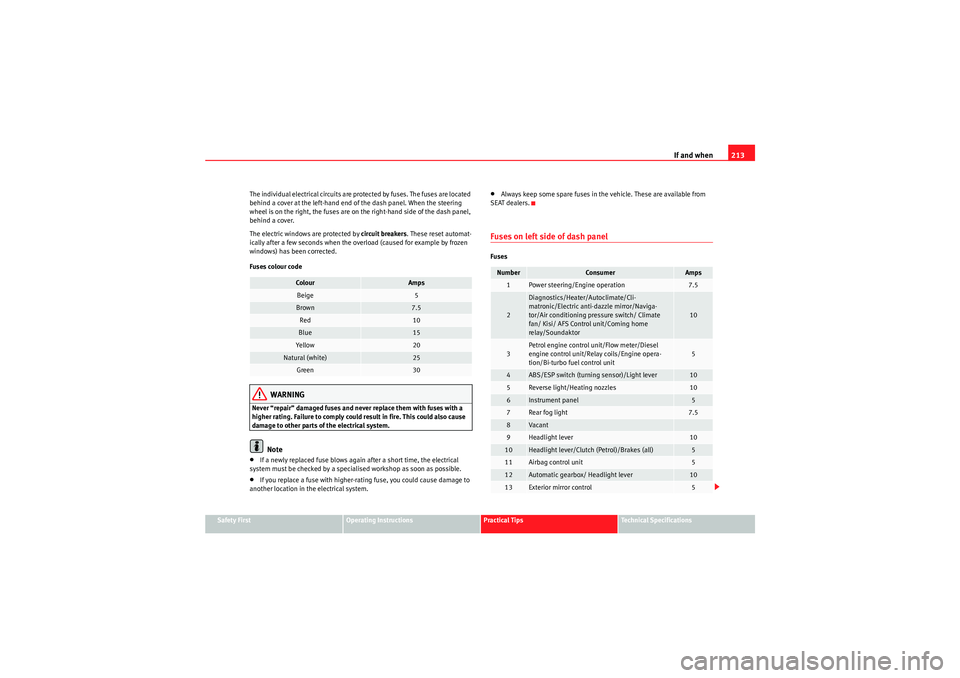
The individual electrical circuits are protected by fuses. The fuses are located
behind a cover at the left-hand end of the dash panel. When the steering
wheel is on the right, the fuses are on the right-hand side of the dash panel,
behind a cover.
The electric windows are protected by
circuit breakers. These reset automat-
ically after a few seconds when the overload (caused for example by frozen
windows) has been corrected.
Fuses colour code
WARNING
Never “repair” damaged fuses and never replace them with fuses with a
higher rating. Failure to comply could result in fire. This could also cause
damage to other parts of the electrical system.
Note
•If a newly replaced fuse blows again after a short time, the electrical
system must be checked by a specialised workshop as soon as possible.•If you replace a fuse with higher-rating fuse, you could cause damage to
another location in the electrical system.
•Always keep some spare fuses in the vehicle. These are available from
SEAT dealers.Fuses on left side of dash panelFuses
Colour
Amps
Beige
5
Brown
7.5
Red
10
Blue
15
Ye l l o w
20
Natural (white)
25
Green
30
Number
Consumer
Amps
1
Power steering/Engine operation
7.5
2
Diagnostics/Heater/Autoclimate/Cli-
matronic/Electric anti-dazzle mirror/Naviga-
tor/Air conditioning pressure switch/ Climate
fan/ Kisi/ AFS Control unit/Coming home
relay/Soundaktor
10
3
Petrol engine control unit/Flow meter/Diesel
engine control unit/Relay coils/Engine opera-
tion/Bi-turbo fuel control unit
5
4
ABS/ESP switch (turning sensor)/Light lever
10
5
Reverse light/Heating nozzles
10
6
Instrument panel
5
7
Rear fog light
7.5
8
Va can t
9
Headlight lever
10
10
Headlight lever/Clutch (Petrol)/Brakes (all)
5
11
Airbag control unit
5
12
Automatic gearbox/ Headlight lever
10
13
Exterior mirror control
5
IbizaSC_EN.book Seite 213 Donnerstag, 2. September 2010 6:10 18
Page 257 of 266
Index255
Index
AABS . . . . . . . . . . . . . . . . . . . . . . . . . . . . . . . . . . . 154
Warning lamp . . . . . . . . . . . . . . . . . . . . . . . . . 63
Accessories . . . . . . . . . . . . . . . . . . . . . . . . . . . . 175
Acoustic signal . . . . . . . . . . . . . . . . . . . . . . . . . . 17
Acoustic warning . . . . . . . . . . . . . . . . . . . . . . . . 131
Adaptive headlights . . . . . . . . . . . . . . . . . . . . . . 93
Air conditioner Climatronic . . . . . . . . . . . . . . . . . . . . . . . . . . 126
General notes . . . . . . . . . . . . . . . . . . . . . . . . 129
Air conditioning* . . . . . . . . . . . . . . . . . . . . . . . . 123
Air outlets . . . . . . . . . . . . . . . . . . . . . . . . . . . . . . 122
Air recirculation Semi-automatic air conditioning . . . . . . . . 125
Air recirculation mode Climatronic . . . . . . . . . . . . . . . . . . . . . . . . . . 128
Airbag system . . . . . . . . . . . . . . . . . . . . . . . . . . . 26 Front airbags . . . . . . . . . . . . . . . . . . . . . . . . . 30
Side airbags . . . . . . . . . . . . . . . . . . . . . . . . . . 33
Warning lamp . . . . . . . . . . . . . . . . . . . . . . . . . 27
Alarm system Switching off . . . . . . . . . . . . . . . . . . . . . . . . . 81
Alternator Warning lamp . . . . . . . . . . . . . . . . . . . . . . . . . 68
Anti-freeze . . . . . . . . . . . . . . . . . . . . . . . . . . . . . 190
Anti-lock brake system . . . . . . . . . . . . . . . . . . . 154 Warning lamp . . . . . . . . . . . . . . . . . . . . . . . . . 63 Anti-theft alarm
Switching off . . . . . . . . . . . . . . . . . . . . . . . . . 81
Anti-theft alarm system . . . . . . . . . . . . . . . . . . . . 81
Anti-theft wheel bolts . . . . . . . . . . . . . . . . . . . . 207
Aquaplaning . . . . . . . . . . . . . . . . . . . . . . . . . . . 201
Aspects to note before setting off . . . . . . . . . . . . 8
Automatic anti-dazzle interior mirror* Activating the anti-dazzle function . . . . . . 102
Deactivating anti-dazzle function . . . . . . . . 102
Automatic car washing tunnel . . . . . . . . . . . . . 167
Automatic gearbox . . . . . . . . . . . . . . . . . . . . . . 138 Kick-down feature . . . . . . . . . . . . . . . . . . . . 145
Selector lever positions . . . . . . . . . . . . . . . . 143
Automatic lighting . . . . . . . . . . . . . . . . . . . . . . . . 91
Automatic windscreen wiper/washer . . . . . . . . . 99
AUX input connection/USB* . . . . . . . . . . . . . . . 117
Auxiliary audio input connection: AUX . . . . . . . 116
BBall coupling . . . . . . . . . . . . . . . . . . . . . . . . . . . 164
Battery Changing . . . . . . . . . . . . . . . . . . . . . . . . . . . 198
Charging . . . . . . . . . . . . . . . . . . . . . . . . . . . . 198
Winter conditions . . . . . . . . . . . . . . . . . . . . 196
Before setting off . . . . . . . . . . . . . . . . . . . . . . . . . . 8
Belt tensioners . . . . . . . . . . . . . . . . . . . . . . . . . . . 25
Biodiesel . . . . . . . . . . . . . . . . . . . . . . . . . . . . . . 182 Biodiesel fuel . . . . . . . . . . . . . . . . . . . . . . . . . . . 182
Bonnet . . . . . . . . . . . . . . . . . . . . . . . . . . . . . . . . 185
Brake fluid . . . . . . . . . . . . . . . . . . . . . . . . . . . . . 195
Changing . . . . . . . . . . . . . . . . . . . . . . . . . . . 195
Brake pads . . . . . . . . . . . . . . . . . . . . . . . . . . . . . 158
Brake servo . . . . . . . . . . . . . . . . . . . . . . . 153, 158
Brake system . . . . . . . . . . . . . . . . . . . . . . . . . . . 195 Warning lamp . . . . . . . . . . . . . . . . . . . . . . . . 65
Brakes . . . . . . . . . . . . . . . . . . . . . . . . . . . . . . . . 158
Braking distance . . . . . . . . . . . . . . . . . . . . . . . . 158
Bulb changes General notes . . . . . . . . . . . . . . . . . . . . . . . 216
Bulb defect Warning lamp . . . . . . . . . . . . . . . . . . . . . . . . 63
Buzzer . . . . . . . . . . . . . . . . . . . . . . . . . . . . . . 96, 131
CCar phone . . . . . . . . . . . . . . . . . . . . . . . . . . . . . . 176
Catalytic converter . . . . . . . . . . . . . . . . . . . . . . . 159
Central locking . . . . . . . . . . . . . . . . . . . . . . . . . . . 74 Automatic speed dependent locking and un-locking system* . . . . . . . . . . . . . . . . . . . . . 76
Locking system for involuntary unlocking . . 76
Selective unlocking system* . . . . . . . . . . . . 75
Unlocking system* . . . . . . . . . . . . . . . . . . . . 76
IbizaSC_EN.book Seite 255 Donnerstag, 2. September 2010 6:10 18
Page 262 of 266
Index
260Rear seat
folding down . . . . . . . . . . . . . . . . . . . . . . . . 110
Rear seats . . . . . . . . . . . . . . . . . . . . . . . . . . . . . 110
Rear shelf . . . . . . . . . . . . . . . . . . . . . . . . . . . . . . 118
Rear view mirrors . . . . . . . . . . . . . . . . . . . . . . . . 102
Rear window automatic wiper/washer . . . . . . 101
Rear window wiper . . . . . . . . . . . . . . . . . . . . . . 101
Recommended gear display . . . . . . . . . . . . . . . . 53
Refuelling . . . . . . . . . . . . . . . . . . . . . . . . . . . . . . 180
Remote control key Buttons . . . . . . . . . . . . . . . . . . . . . . . . . . . . . 79
Synchronising . . . . . . . . . . . . . . . . . . . . . . . . 80
Removing and fitting the wheel . . . . . . . . . . . . 209
Repairs Airbags . . . . . . . . . . . . . . . . . . . . . . . . . . . . . . 28
Replacement keys . . . . . . . . . . . . . . . . . . . . . . . . 78
Replacement of parts . . . . . . . . . . . . . . . . . . . . 175
Rev counter . . . . . . . . . . . . . . . . . . . . . . . . . . . . . 52
Reverse gear Manual gearbox . . . . . . . . . . . . . . . . . . . . . 137
Roll-back function Panorama/ tilting sunroof . . . . . . . . . . . . . . 89
Windows . . . . . . . . . . . . . . . . . . . . . . . . . . . . 86
Roof aerial* . . . . . . . . . . . . . . . . . . . . . . . . . . . . 176
Roof rack* . . . . . . . . . . . . . . . . . . . . . . . . . . . . . 119
Rubber seals . . . . . . . . . . . . . . . . . . . . . . . . . . . 170
Running in Engine . . . . . . . . . . . . . . . . . . . . . . . . . . . . . 158
SSafe . . . . . . . . . . . . . . . . . . . . . . . . . . . . . . . . . . . 74
Safe driving . . . . . . . . . . . . . . . . . . . . . . . . . . . . . . 7
Safe Security system . . . . . . . . . . . . . . . . . . . . . . 74
Safety . . . . . . . . . . . . . . . . . . . . . . . . . . . . . . . . . . . 8
Safety equipment . . . . . . . . . . . . . . . . . . . . . . . . . 7
Safety instructions
Coolant temperature . . . . . . . . . . . . . . . . . . . 68
Safety notes Airbags . . . . . . . . . . . . . . . . . . . . . . . . . . . . . . 28
Deactivating front passenger airbag . . . . . . 38
Front airbags . . . . . . . . . . . . . . . . . . . . . . . . . 32
Seat belt tensioners . . . . . . . . . . . . . . . . . . . 25
Side airbags . . . . . . . . . . . . . . . . . . . . . . . . . 35
Using child seats . . . . . . . . . . . . . . . . . . . . . . 39
Using seat belts . . . . . . . . . . . . . . . . . . . . . . 20
Seals . . . . . . . . . . . . . . . . . . . . . . . . . . . . . . . . . 170
Seat adjustment . . . . . . . . . . . . . . . . . . . . 105, 108
Seat belt cleaning . . . . . . . . . . . . . . . . . . . . . . . 174
Seat belt position Pregnant women . . . . . . . . . . . . . . . . . . . . . . 23
Seat belts . . . . . . . . . . . . . . . . . . . . . . . . . . . . 22
Seat belt protection . . . . . . . . . . . . . . . . . . . . . . 20
Seat belt release . . . . . . . . . . . . . . . . . . . . . . . . . 24
Seat belt tensioner Warning lamp . . . . . . . . . . . . . . . . . . . . . . . . 27
Seat belt warning lamp . . . . . . . . . . . . . . . . . . . . 16
Seat belts . . . . . . . . . . . . . . . . . . . . . . . . . . . . . . . 16 Adjustment . . . . . . . . . . . . . . . . . . . . . . . . . . 21
Incorrectly fastened . . . . . . . . . . . . . . . . . . . 24 Not worn . . . . . . . . . . . . . . . . . . . . . . . . . . . . 19
Safety notes . . . . . . . . . . . . . . . . . . . . . . . . . . 20
Warning lamp . . . . . . . . . . . . . . . . . . . . . . . . 16
Seat heating . . . . . . . . . . . . . . . . . . . . . . . . . . . 109
Selective opening* . . . . . . . . . . . . . . . . . . . . . . . 75
Semiautomatic air conditioning controls . . . . . . . . . . . . . . . . . . . . . . . . . . . . 123
Service interval display . . . . . . . . . . . . . . . . . . . 56
Side airbags . . . . . . . . . . . . . . . . . . . . . . . . . . . . 33 Description . . . . . . . . . . . . . . . . . . . . . . . . . . 33
Operation . . . . . . . . . . . . . . . . . . . . . . . . . . . . 35
Safety notes . . . . . . . . . . . . . . . . . . . . . . . . . . 35
Side lights . . . . . . . . . . . . . . . . . . . . . . . . . . . . . . 90
Sitting position Driver . . . . . . . . . . . . . . . . . . . . . . . . . . . . . . . . 9
Front passenger . . . . . . . . . . . . . . . . . . . . . . 10
Sitting position, occupants . . . . . . . . . . . . . . . . . 9
Snow chains . . . . . . . . . . . . . . . . . . . . . . . 203, 234
Soot accumulation in the diesel engine particulate filter *
Warning lamp . . . . . . . . . . . . . . . . . . . . . . . . 62
Spanner symbol . . . . . . . . . . . . . . . . . . . . . . . . . 57
Spare parts . . . . . . . . . . . . . . . . . . . . . . . . . . . . 175
Spare wheel . . . . . . . . . . . . . . . . . . . . . . . . . . . . 204
Speed selector lever lock warning lamp . . . . . . . . . . . . . . . . . . . . . . . . 66
Speedometer . . . . . . . . . . . . . . . . . . . . . . . . . . . . 52
Starting Petrol engines . . . . . . . . . . . . . . . . . . . 133
Starting petrol engines . . . . . . . . . . . . . . . . . . . 133
IbizaSC_EN.book Seite 260 Donnerstag, 2. September 2010 6:10 18