change time Seat Ibiza SC 2011 Owner's Guide
[x] Cancel search | Manufacturer: SEAT, Model Year: 2011, Model line: Ibiza SC, Model: Seat Ibiza SC 2011Pages: 278, PDF Size: 3.92 MB
Page 228 of 278
226If and when
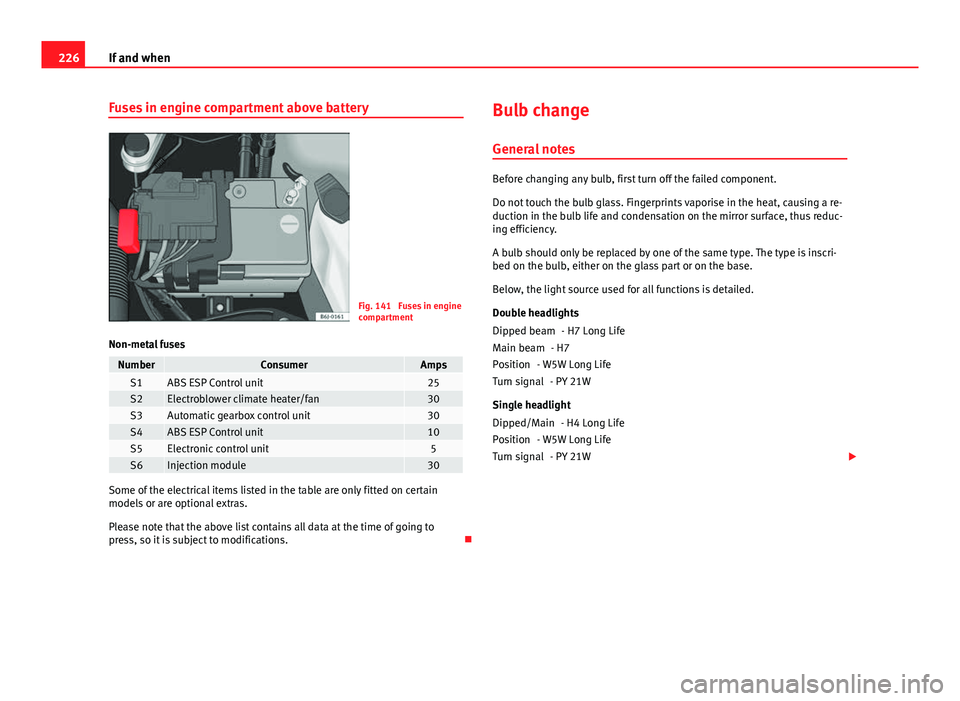
Fuses in engine compartment above battery
Fig. 141 Fuses in engine
compartment
Non-metal fuses
NumberConsumerAmpsS1ABS ESP Control unit25S2Electroblower climate heater/fan30S3Automatic gearbox control unit30S4ABS ESP Control unit10S5Electronic control unit5S6Injection module30
Some of the electrical items listed in the table are only fitted on certain
models or are optional extras.
Please note that the above list contains all data at the time of going to
press, so it is subject to modifications. Bulb change
General notes
Before changing any bulb, first turn off the failed component.
Do not touch the bulb glass. Fingerprints vaporise in the heat, causing a re-
duction in the bulb life and condensation on the mirror surface, thus reduc-
ing efficiency.
A bulb should only be replaced by one of the same type. The type is inscri-
bed on the bulb, either on the glass part or on the base.
Below, the light source used for all functions is detailed.
Double headlights - H7 Long Life
- H7
- W5W Long Life - PY 21W
Single headlight - H4 Long Life
- W5W Long Life - PY 21W
Dipped beam
Main beam
Position
Turn signal
Dipped/Main
Position
Turn signal
Page 229 of 278
227
If and when
Xenon 1)
/adaptive headlights*
- D1S2)
- LED 3)
- LED 3)
- PY 21W
Fog lights - H11
WARNING
● Take particular care when working on components in the engine com-
partment if the engine is warm - risk of burns!
● Bulbs are highly sensitive to pressure. The glass can break when you
touch the bulb, causing injury.
● The high voltage element of gas discharge bulbs* (xenon light) must
be handled correctly. Otherwise, there is a risk of death.
● When changing bulbs, please take care not to injure yourself on sharp
parts in the headlight housing.
CAUTION
● Remove the ignition key before working on the electric system. If not, a
short circuit could occur.
● Switch off the lights or parking lights before you change a bulb.
Dipped and full beam
Position
DRL (day light)
Turn signals
Fog light/cornering
For the sake of the environment
Please ask your specialist retailer how to dispose of used bulbs in the prop-
er manner.
Note
● Depending on weather conditions (cold or wet), the front lights, the fog
lights, the tail lights and the turn signals may be temporarily misted. This
has no influence on the useful life of the lighting system. By switching on
the lights, the area through which the beam of light is projected will quickly
be demisted. However, the edges may continue to be misted.
● Please check at regular intervals that all lighting (especially the exterior
lighting) on your vehicle is functioning properly. This is not only in the inter-
est of your own safety, but also that of all other road users.
● Before changing a bulb, make sure you have the correct new bulb.
● Do not touch the glass part of the bulb with your bare hands, use a cloth
or paper towel instead. Otherwise, the fingerprints left on the glass will va-
porise as a result of the heat generated by the bulb, they will be deposited
on the reflector and will impair its surface.
1)
With these types of headlights, the user can replace the indicator bulb. Replacement of the
dipped/main beam bulb must be done by a Technical Service, given that complex elements
must be removed from the vehicle and the automatic control system that incorporates it
must be reset.
2) The Xenon bulbs discharge 2.5 times the light flux and have an average lifespan of 5 times
more than that of halogen bulbs, this means that, except due to unusual circumstances,
there is no need to change the bulbs for the whole life of the vehicle.
3) In the event that there is a fault in the LEDs, the complete headlight must be replaced.
Safety FirstOperating InstructionsPractical TipsTechnical Specifications
Page 230 of 278
228If and when
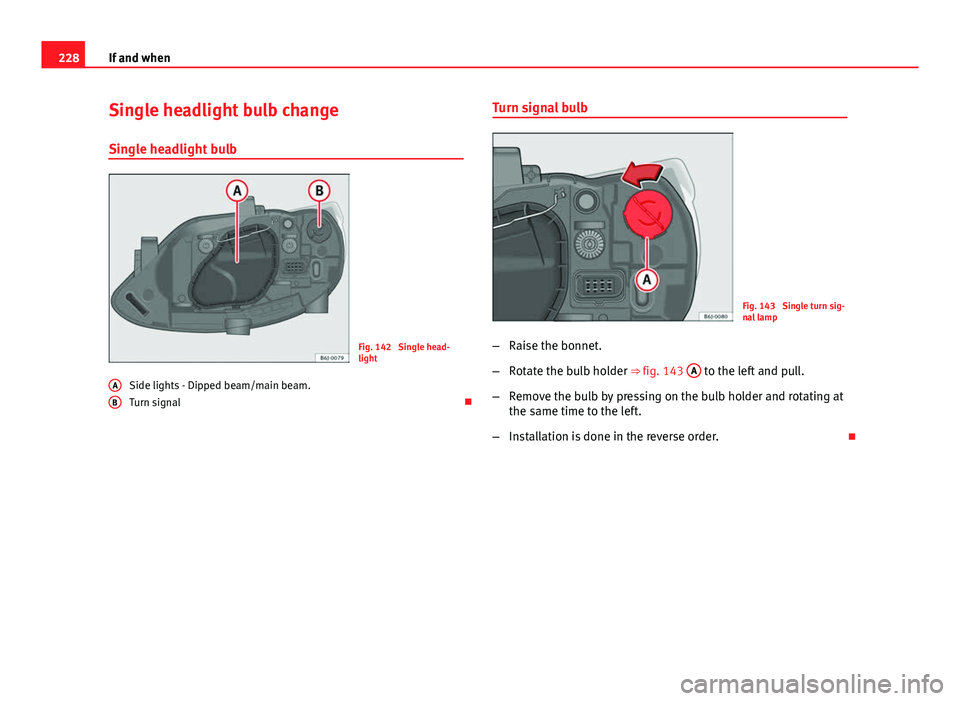
Single headlight bulb change
Single headlight bulb
Fig. 142 Single head-
light
Side lights - Dipped beam/main beam.
Turn signal
A
B
Turn signal bulb
Fig. 143 Single turn sig-
nal lamp
– Raise the bonnet.
– Rotate the bulb holder ⇒ fig. 143 A
to the left and pull.
– Remove the bulb by pressing on the bulb holder and rotating at
the same time to the left.
– Installation is done in the reverse order.
Page 236 of 278
234If and when
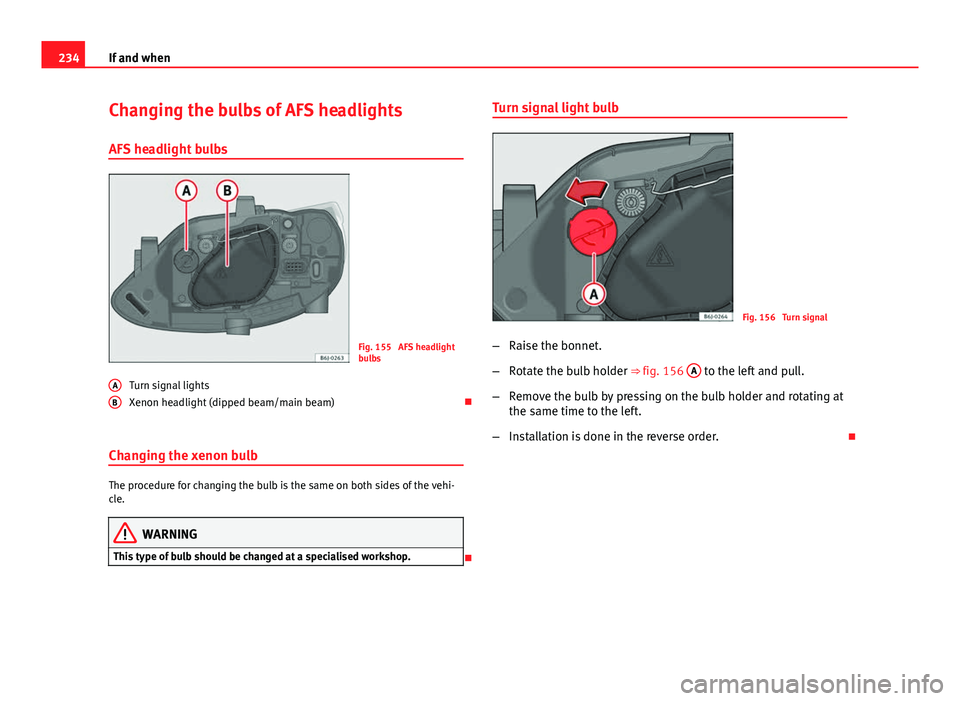
Changing the bulbs of AFS headlights
AFS headlight bulbs
Fig. 155 AFS headlight
bulbs
Turn signal lights
Xenon headlight (dipped beam/main beam)
Changing the xenon bulb
The procedure for changing the bulb is the same on both sides of the vehi-
cle.
WARNING
This type of bulb should be changed at a specialised workshop.
A
B
Turn signal light bulb
Fig. 156 Turn signal
– Raise the bonnet.
– Rotate the bulb holder ⇒ fig. 156 A
to the left and pull.
– Remove the bulb by pressing on the bulb holder and rotating at
the same time to the left.
– Installation is done in the reverse order.
Page 245 of 278
243
If and when
Towing and tow-starting
Tow-starting*
The use of jump leads is preferable to tow-starting.
We recommend that you do not tow-start your vehicle. Jump-start-
ing is preferable ⇒ page 240.
However, if your vehicle has to be tow-started:
– Engage the 2nd or the 3rd gear.
– Keep the clutch pressed down.
– Switch the ignition on.
– Once both vehicles are moving, release the clutch.
– As soon as the engine starts, press the clutch and move the
gear lever into neutral. This helps to prevent driving into the
towing vehicle.
WARNING
The risk of accidents is high when tow-starting. The vehicle being towed
can easily collide with the towing vehicle.
CAUTION
When tow-starting, fuel could enter the catalytic converter and damage it. Comments
Please observe the following points if you use a tow-rope:
Notes for the driver of the towing vehicle
–
Drive slowly at first until the tow-rope is taut. Then accelerate
gradually.
– Begin and change gears cautiously. If you are driving an auto-
matic vehicle, accelerate gently.
– Remember that the brake servo and power steering are not
working in the vehicle you are towing. Brake sooner than nor-
mal and pressing the pedal gently.
Notes for the driver of the towed vehicle
– Ensure that the tow-rope remains taut at all times when towing.
Tow-rope or tow-bar
It is easier and safer to tow a vehicle with a tow-bar. You should only use a
tow-rope if you do not have a tow-bar.
A tow-rope should be slightly elastic to reduce the loading on both vehicles.
It is advisable to use a tow-rope made of synthetic fibre or similarly elastic
material.
Attach the tow-rope or the tow-bar only to the towing eyes provided or a
towing bracket.
Driving style
Towing requires some experience, especially when using a tow-rope. Both
drivers should be familiar with the technique required for towing. Inexper-
ienced drivers should not attempt to tow.
Safety FirstOperating InstructionsPractical TipsTechnical Specifications
Page 271 of 278
D
Danger of fitting a child seat on the front pas- senger seat . . . . . . . . . . . . . . . . . . . . . . . . . . . 30
Dash panel . . . . . . . . . . . . . . . . . . . . . . . . . . . . . 51
Dash panel cleaning . . . . . . . . . . . . . . . . . . . . 180
Daytime running lights . . . . . . . . . . . . . . . . . . . 96
Deactivating front passenger airbag Safety notes . . . . . . . . . . . . . . . . . . . . . . . . . 41
Deactivating the airbag Front passenger airbag . . . . . . . . . . . . . . . . 40
Diesel . . . . . . . . . . . . . . . . . . . . . . . . . . . . . . . . 192
Diesel engine Winter driving . . . . . . . . . . . . . . . . . . . . . . . 193
Diesel engine particulate filter . . . . . . . . . . . . 168
Differential lock . . . . . . . . . . . . . . . . . . . . . . . . 164
Differential lock fault (EDL) Warning lamp . . . . . . . . . . . . . . . . . . . . . . . . 68
Digital clock . . . . . . . . . . . . . . . . . . . . . . . . . . . . 56
Dipped beam headlights . . . . . . . . . . . . . . . . . . 94
Disposal Airbags . . . . . . . . . . . . . . . . . . . . . . . . . . . . . 31
Seat belt tensioners . . . . . . . . . . . . . . . . . . . 27
Door lock cylinders . . . . . . . . . . . . . . . . . . . . . . 178
Door release lever . . . . . . . . . . . . . . . . . . . . . . . 51
Doors warning lamp . . . . . . . . . . . . . . . . . . . . . . . . 71
Double headlight . . . . . . . . . . . . . . . . . . . . . . . 230
Double headlight bulb change dipped beam headlights . . . . . . . . . . . . . . 232
main beam headlights . . . . . . . . . . . . . . . . 231
side light . . . . . . . . . . . . . . . . . . . . . . . . . . . 230 Driver
see Correct sitting position . . . . . . . 10, 11, 12
Driveshaft differential XDS . . . . . . . . . . . . . . . . . . . . . . . . . . . . . . . 163
Drive wheels traction control system . . . . . . . 162
Driving Driving abroad . . . . . . . . . . . . . . . . . . . . . . 171
Economically / Environmentally friendly . 168
With a trailer . . . . . . . . . . . . . . . . . . . . 171, 172
Driving abroad . . . . . . . . . . . . . . . . . . . . . . . . . 171 Headlights . . . . . . . . . . . . . . . . . . . . . . . . . 171
Driving safety . . . . . . . . . . . . . . . . . . . . . . . . . . . . 8
Duplicate keys . . . . . . . . . . . . . . . . . . . . . . . . . . 81
Dust filter . . . . . . . . . . . . . . . . . . . . . . . . . . . . . 133
Dynamic headlight range control . . . . . . . . . . . 96
E
Economical driving . . . . . . . . . . . . . . . . . . . . . . 168
EDL . . . . . . . . . . . . . . . . . . . . . . . . . . . . . . . . . . 164 Warning lamp . . . . . . . . . . . . . . . . . . . . . . . . 67
Electrical sockets . . . . . . . . . . . . . . . . . . . . . . . 121
Electro-hydraulic steering Warning lamp . . . . . . . . . . . . . . . . . . . . . . . . 71
Electronic differential lock . . . . . . . . . . . . . . . . 164 Warning lamp . . . . . . . . . . . . . . . . . . . . . . . . 67
Electronic immobiliser . . . . . . . . . . . . . . . . . . . 137
Electronic Stability Programme . . . . . . . . . 69, 163 Description . . . . . . . . . . . . . . . . . . . . . . . . . 136
Electronic Stability Programme (ESP) Warning lamp . . . . . . . . . . . . . . . . . . . . . . . . 69 Emission control system
Warning lamp . . . . . . . . . . . . . . . . . . . . . . . . 72
Engine Running in . . . . . . . . . . . . . . . . . . . . . . . . . 166
Engine compartment Working in the engine compartment . . . . 193
Engine coolant . . . . . . . . . . . . . . . . . . . . . . . . . 200
Engine fault Warning lamp . . . . . . . . . . . . . . . . . . . . . . . . 66
Engine management Warning lamp . . . . . . . . . . . . . . . . . . . . . . . . 66
Engine oil . . . . . . . . . . . . . . . . . . . . . . . . . . . . . 196 Changing . . . . . . . . . . . . . . . . . . . . . . . . . . 199
Checking engine oil level . . . . . . . . . . . . . . 197
Oil properties . . . . . . . . . . . . . . . . . . . . . . . 197
Specifications . . . . . . . . . . . . . . . . . . . . . . . 196
Topping up . . . . . . . . . . . . . . . . . . . . . . . . . 198
Engine oil dipstick . . . . . . . . . . . . . . . . . . . . . . 197
Engine oil pressure Warning lamp . . . . . . . . . . . . . . . . . . . . . . . . 67
Environment . . . . . . . . . . . . . . . . . . . . . . . . . . . 168 Environmental friendliness . . . . . . . . . . . . 170
Environmentally friendly driving . . . . . . . . . . . 168
Environmental tip Avoiding pollution . . . . . . . . . . . . . . . . . . . 188
ESP . . . . . . . . . . . . . . . . . . . . . . . . . . . . . . . 69, 163 see also Electronic Stability Programme . . 136
Exhaust gas purification system . . . . . . . . . . . 167
Exterior mirrors . . . . . . . . . . . . . . . . . . . . . . . . . 177
External aerial . . . . . . . . . . . . . . . . . . . . . . . . . . 184
269
Index
Page 277 of 278

SEAT S.A. is permanently concerned about continuous development of its t\
ypes and models. For this reason we ask you to under-
stand, that at any given time, changes regarding shape, equipment and te\
chnique may take place on the car delivered. For this reason
no right at all may derive based on the data, drawings and descriptions \
in this current handbook.
All texts, illustrations and standards in this handbook are based on the\
status of information at the time of printing. Except for error
or omission, the information included in the current handbook is valid a\
s of the date of closing print.
Re-printing, copying or translating, whether total or partial is not all\
owed unless SEAT allows it in written form.
SEAT reserves all rights in accordance with the “Copyright” Act.
All rights on changes are reserved.
❀This paper has been manufactured using bleached non-chlorine cellulose.
© SEAT S.A. - Reprint: 15.12.11
Portada IBIZA_interior.indd 304/01/12 10:00