ECU Seat Ibiza SC 2012 Owner's Guide
[x] Cancel search | Manufacturer: SEAT, Model Year: 2012, Model line: Ibiza SC, Model: Seat Ibiza SC 2012Pages: 280, PDF Size: 3.67 MB
Page 198 of 280
196Checking and refilling levels
WARNING (Continued)
● Wait until no more steam, smoke or coolant is emitted from the bon-
net, then carefully open the bonnet.
● When working in the engine compartment, always observe the safety
warnings ⇒ page 193.
Closing the bonnet
– Slightly raise the bonnet
– Release the bonnet stay and replace it in its support.
– At a height of about 30 cm let it fall so it is locked.
If the bonnet does not close, do not press downwards. Open it once more
and let it fall as before.
WARNING
If the bonnet is not closed properly, it could open while you are driving
and completely obscure your view of the road. Risk of accident.
● After closing the bonnet, always check that it is properly secured. The
bonnet must be flush with the surrounding body panels.
● If you notice that the bonnet latch is not secured when the vehicle is
moving, stop the vehicle immediately and close the bonnet properly.
Risk of accident.
Engine oil
General notes
The engine comes with a special, multi-grade oil that can be used all year
round.
Because the use of high-quality oil is essential for the correct operation of
the engine and its long useful life, when topping up or changing oil, use on-
ly those oils that comply with VW standards.
The specifications (VW standards) set out in the following page should ap-
pear on the container of the service oil; when the container displays the
specific standards for petrol and diesel engines together, it means that the
oil can be used for both types of engines.
We recommend that the oil change, indicated in the Maintenance Pro-
gramme, be performed by a Technical Service or a specialised workshop.
The correct oil specifications for your engine are listed in ⇒ page 197, Oil
properties.
Service intervals
Service intervals can be flexible (LongLife service) or fixed (dependent on
time/distance travelled).
If the PR code that appears on the back of the “Maintenance Programme”
booklet is QG1, this means that your vehicle has the LongLife service pro-
grammed. If it has the codes QG0 or QG2 the interval service is dependent
on time/distance travelled.
Flexible service intervals (LongLife service intervals*)
Special oils and processes have been developed which, depending on the
characteristics and individual driving profiles, enable the extension of the
oil change service (LongLife service intervals).
Page 206 of 280
204Checking and refilling levels
To change the blades it is necessary to change the rest position of
the wipers to the service position.
Do not change the windscreen wipers when out of the service posi-
tion, as it could cause paint to flake off the bonnet due to friction
with the windscreen wiper arm.
Service position (For changing wiper blades)
–Ensure that the wiper blades are not frozen.
– Turn ignition on and off and then (before approx. 9 sec.) move
the windscreen wiper lever to the intermittent wipe position.
The windscreen wipers will move to the service position
⇒ Fig. 128.
Removing the wiper blade
– Lift the windscreen wiper arm.
– Press on the securing tab ⇒ Fig. 129.
– Extract the wiper blade from the wiper arm.
Fitting the wiper blade
– Insert the wiper blade onto the windscreen wiper arm until it
clicks into place.
– Place the windscreen wiper arms to their initial position.
If the windscreen wipers smear , they should be replaced if they are dam-
aged, or cleaned if they are soiled.
If this does not produce the desired results, the setting angle of the wind-
screen wiper arms might be incorrect. They should be checked by a special-
ised workshop and corrected if necessary.
WARNING
Do not drive unless you have good visibility through all windows!
● Clean the windscreen wiper blades and all windows regularly.
● The wiper blades should be changed once or twice a year.
CAUTION
● Damaged or dirty windscreen wipers could scratch the windscreen.
● Never use fuel, nail varnish remover, paint thinner or similar products to
clean the windows. This could damage the windscreen wiper blades.
● Never move the windscreen wiper or windscreen wiper arm manually.
This could cause damage.
● To avoid damage to the bonnet and the windscreen wiper arms, the lat-
ter should only be lifted off the windscreen when in service position.
Note
● The windscreen wiper arms can be moved to the service position only
when the bonnet is properly closed.
● You can also use the service position, for example, if you want to fix a
cover over the windscreen in the winter to keep it clear of ice.
Page 210 of 280
208Checking and refilling levels
WARNING (Continued)
● Fires, sparks, open flames and smoking are prohibited. When han-
dling cables and electrical equipment, avoid causing sparks and electro-
static charge. Never short the battery terminals. High-energy sparks can
cause injury.
● A highly explosive mixture of gases is released when the battery is
under charge. The batteries should be charged in a well-ventilated room
only.
● Keep children away from acid and batteries.
● Before working on the electrical system, you must switch off the en-
gine, the ignition and all consumers. The negative cable on the battery
must be disconnected. When a light bulb is changed, you need only
switch off the light.
● Deactivate the anti-theft alarm by unlocking the vehicle before you
disconnect the battery! The alarm will otherwise be triggered.
● When disconnecting the battery from the vehicle on-board network,
disconnect first the negative cable and then the positive cable.
● Switch off all electrical consumers before reconnecting the battery.
Reconnect first the positive cable and then the negative cable. Never re-
verse the polarity of the connections. This could cause an electrical fire.
● Never charge a frozen battery, or one which has thawed. This could
result in explosions and chemical burns. Always replace a battery which
has frozen. A flat battery can freeze at temperatures around 0°C.
● Ensure that the vent hose is always connected to the battery.
● Never use a defective battery. This could cause an explosion. Replace
a damaged battery immediately.
● For vehicles with the battery in the luggage compartment: Check that
the battery gas ventilation hose is securely attached.CAUTION
● Never disconnect the battery if the ignition is switched on or if the en-
gine is running. This could damage the electrical system or electronic com-
ponents.
● Do not expose the battery to direct sunlight over a long period of time,
as the intense ultraviolet radiation can damage the battery housing.
● If the vehicle is left standing in cold conditions for a long period, protect
the battery from freezing. If it freezes it will be damaged.
Checking the electrolyte level
The electrolyte level should be checked regularly in high-
mileage vehicles, in hot countries and in older batteries. – Open the engine bonnet and the battery cover ⇒
in Safety in-
structions on working in the engine compartment on page 194
⇒
in Warnings on handling the battery on page 207. For vehi-
cles with the battery under the spare wheel, open the rear lid
and lift the floor covering. The battery is located next to the
spare wheel.
– Check the colour display in the "magic eye" on the top of the
battery.
– If there are air bubbles in the window, tap the window gently
until they disperse.
The position of the battery is shown in the corresponding engine compart-
ment diagram ⇒ page 251. The location of the battery in the luggage com-
partment can be seen in ⇒ Fig. 175.
The “magic eye” indicator, located on the top of the battery changes colour,
depending on the charge state and electrolyte level of the battery.
Page 215 of 280
213
Checking and refilling levels
WARNING
● We recommend that you use only wheels and tyres which have been
approved by SEAT for your model. Failure to do so could impair vehicle
handling. Risk of accident.
● Avoid running the vehicle on tyres that are more than 6 years old. If
you have no alternative, you should drive slowly and with extra care at all
times.
● Never use old tyres or those with an unknown history of use.
● If wheel trims are retrofitted, you must ensure that the flow of air to
the brakes is not restricted. This could cause the brake system to over-
heat.
● All four wheels must be fitted with radial tyres of the same type, size
(rolling circumference) and the same tread pattern.
For the sake of the environment
Old tyres must be disposed of according to the laws in the country con-
cerned.
Note
● For technical reasons, it is not generally possible to use the wheels from
other vehicles. This can also apply to wheels of the same model. The use of
wheels or tyres which have not been approved by SEAT for use with your
model may invalidate the vehicle's type approval for use on public roads.
● If the spare wheel is not the same as the tyres that are mounted on the
vehicle (e.g. winter tyres) you should only use the spare tyre for a short peri-
od of time and drive with extra care. Refit the normal road wheel as soon as
possible. Wheel bolts
Wheel bolts must be tightened to the correct torque.
The design of wheel bolts is matched to the rims. If different wheel rims are
fitted, the correct wheel bolts with the right length and correctly shaped
bolt heads must be used. This ensures that wheels are fitted securely and
that the brake system functions correctly.
In certain circumstances, you should not use wheel bolts from a different
vehicle, even if it is the same model ⇒ page 183.
WARNING
If the wheel bolts are not tightened correctly, the wheel could become
loose while driving. Risk of accident.
● The wheel bolts must be clean and turn easily. Never apply grease or
oil to them.
● Use only wheel bolts which belong to the wheel.
● If the prescribed torque of the wheel bolts is too low, they could loos-
en whilst the vehicle is in motion. Risk of accident! If the tightening tor-
que is too high, the wheel bolts and threads can be damaged.
CAUTION
The prescribed tightening torque for wheel bolts for steel and alloy wheels
is 120 Nm.
Safety FirstOperating InstructionsPractical TipsTechnical Specifications
Page 220 of 280
218If and when
WARNING
Switch on the hazard warning lights and place the warning triangles in
position. This is for your own safety and also warns other road users.
CAUTION
If you have to change the wheel on a slope, it is essential to lock the parallel
wheel on the same axle as that to be changed, with a wedge or similar in
order to immobilise the vehicle.
Note
Please observe legal requirements when doing so.
Changing a wheel
Change the wheel as described below
– Remove the hub caps or the integral trim .
– Slacken the wheel bolts .
– Raise the vehicle with the jack at the corresponding point.
– Remove the wheel and then fit the spare wheel.
– Lower the vehicle.
– Tighten the wheel bolts firmly with the box spanner.
– Replace the hub cap. After changing a wheel
After changing the wheel there are still tasks to complete.
– Put the tools and jack back in the luggage compartment.
– Place the wheel with the defective tyre in the luggage compart-
ment and secure it.
– Check the tyre pressure of the newly fitted tyre as soon as pos-
sible.
– Have the tightening torque of the wheel bolts checked as soon
as possible with a torque wrench. The prescribed torque must
be 120 Nm.
Note
● If you notice that the wheel bolts are corroded and difficult to turn when
changing a wheel, they must be replaced before having the wheel bolt tight-
ening torque checked.
● For safety reasons, drive at moderate speeds until the wheel bolt tight-
ening torque has been checked.
Page 221 of 280
219
If and when
Wheel covers*
The wheel covers must be removed for access to the wheel
bolts
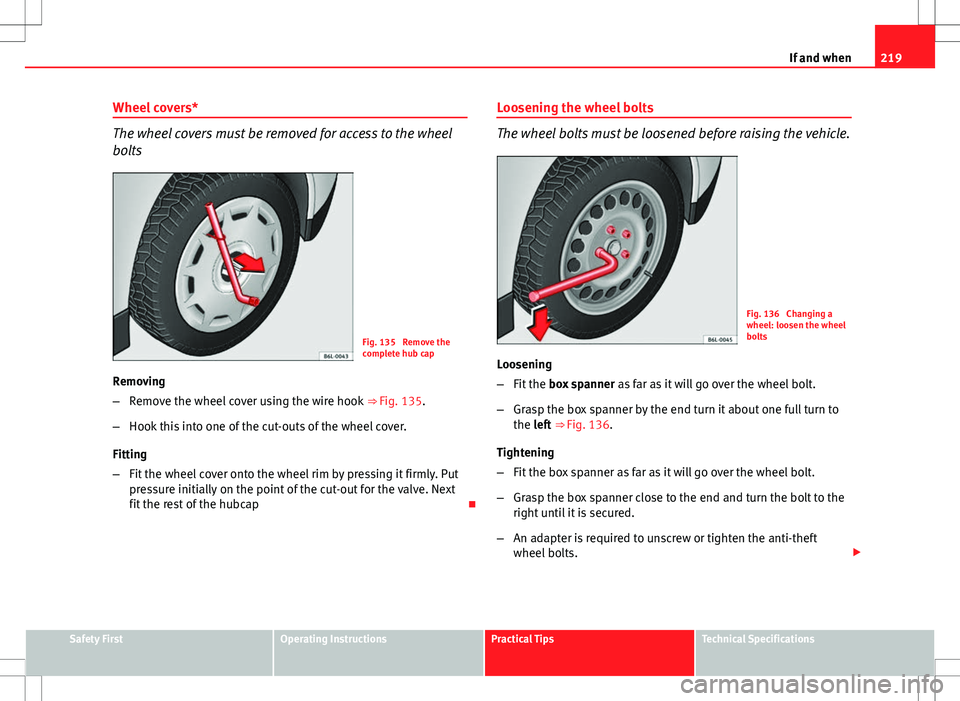
Fig. 135 Remove the
complete hub cap
Removing
– Remove the wheel cover using the wire hook ⇒ Fig. 135.
– Hook this into one of the cut-outs of the wheel cover.
Fitting
– Fit the wheel cover onto the wheel rim by pressing it firmly. Put
pressure initially on the point of the cut-out for the valve. Next
fit the rest of the hubcap Loosening the wheel bolts
The wheel bolts must be loosened before raising the vehicle.
Fig. 136 Changing a
wheel: loosen the wheel
bolts
Loosening
– Fit the box spanner as far as it will go over the wheel bolt.
– Grasp the box spanner by the end turn it about one full turn to
the left ⇒ Fig. 136.
Tightening
– Fit the box spanner as far as it will go over the wheel bolt.
– Grasp the box spanner close to the end and turn the bolt to the
right until it is secured.
– An adapter is required to unscrew or tighten the anti-theft
wheel bolts.
Safety FirstOperating InstructionsPractical TipsTechnical Specifications
Page 272 of 280
C
Car care Exterior . . . . . . . . . . . . . . . . . . . . . . . . . . . . 175
Car phone . . . . . . . . . . . . . . . . . . . . . . . . . . . . . 184
Catalytic converter . . . . . . . . . . . . . . . . . . . . . . 168
CCS . . . . . . . . . . . . . . . . . . . . . . . . . . . . . . . . . . 158
Central lock button Locking . . . . . . . . . . . . . . . . . . . . . . . . . . . . . 83
Unlocking . . . . . . . . . . . . . . . . . . . . . . . . . . . 83
Central locking . . . . . . . . . . . . . . . . . . . . . . . . . . 80 Automatic speed dependent locking andunlocking system* . . . . . . . . . . . . . . . . . . 82
Locking system for involuntary unlocking . 82
Selective unlocking system* . . . . . . . . . . . . 81
Unlocking system* . . . . . . . . . . . . . . . . . . . . 82
Cetane number . . . . . . . . . . . . . . . . . . . . . . . . . 192
Changing bulbs interior light and reading light . . . . . . . . . 240
Changing bulbs on tail lights . . . . . . . . . . . . . 238
Changing gear see Manual gearbox . . . . . . . . . . . . . . . . . . 146
Changing gear in tiptronic mode . . . . . . . . . . 150
Changing single headlight bulbs Turn signal bulb . . . . . . . . . . . . . . . . . . . . . 229
Changing the AFS headlight bulbs Xenon lights . . . . . . . . . . . . . . . . . . . . . . . . 235
Changing the bulbs AFS headlight bulbs . . . . . . . . . . . . . . . . . . 235
fog light bulbs . . . . . . . . . . . . . . . . . . . . . . 236
luggage compartment light . . . . . . . . . . . . 241
number plate light . . . . . . . . . . . . . . . . . . . 239
Side turn signal lights . . . . . . . . . . . . . . . . 239 Changing the main headlight bulb
turn signal lights . . . . . . . . . . . . . . . . . . . . 233
Changing the main headlight bulbs turn signal lights . . . . . . . . . . . . . . . . . . . . 235
Changing the single headlight bulbs Dipped/main beam . . . . . . . . . . . . . . . . . . 230
Side light . . . . . . . . . . . . . . . . . . . . . . . . . . 230
Changing windscreen wiper blades . . . . . . . . 203
Chassis number . . . . . . . . . . . . . . . . . . . . . . . . 248
Checking . . . . . . . . . . . . . . . . . . . . . . . . . . . . . . 208
Checking battery electrolyte level . . . . . . . . . . 208
Checking engine oil level . . . . . . . . . . . . . . . . . 198
Child safety . . . . . . . . . . . . . . . . . . . . . . . . . . . . . 42
Child seat Categorisation in groups . . . . . . . . . . . . . . . 44
Group 1 . . . . . . . . . . . . . . . . . . . . . . . . . . . . . 45
Group 2 . . . . . . . . . . . . . . . . . . . . . . . . . . . . . 45
Group 3 . . . . . . . . . . . . . . . . . . . . . . . . . . . . . 45
Groups 0 and 0+ . . . . . . . . . . . . . . . . . . . . . . 44
Safety notes . . . . . . . . . . . . . . . . . . . . . . . . . 42
Securing . . . . . . . . . . . . . . . . . . . . . . . . . . . . 47
Child seats . . . . . . . . . . . . . . . . . . . . . . . . . . . . . 44 ISOFIX system . . . . . . . . . . . . . . . . . . . . . . . . 48
on the front passenger seat . . . . . . . . . . . . . 30
Top Tether system . . . . . . . . . . . . . . . . . . . . 49
Cigarette lighter . . . . . . . . . . . . . . . . . . . . . . . . 123
Cleaning alloy wheel rims . . . . . . . . . . . . . . . . 179
Cleaning chrome . . . . . . . . . . . . . . . . . . . . . . . 178
Cleaning engine compartment . . . . . . . . . . . . 180
Cleaning steel wheel rims . . . . . . . . . . . . . . . . 179
Cleaning windows . . . . . . . . . . . . . . . . . . . . . . 177 Climatronic
automatic mode . . . . . . . . . . . . . . . . . . . . . 134
controls . . . . . . . . . . . . . . . . . . . . . . . . . . . . 133
General notes . . . . . . . . . . . . . . . . . . . . . . . 135
manual mode . . . . . . . . . . . . . . . . . . . . . . . 134
Clock . . . . . . . . . . . . . . . . . . . . . . . . . . . . . . . . . . 58
Cloth seat covers cleaning . . . . . . . . . . . . . . . . 181
Cockpit . . . . . . . . . . . . . . . . . . . . . . . . . . . . . . . . 53
Coming Home function . . . . . . . . . . . . . . . . . . 101
Compartment for on-board documentation . . 119
Control Exterior mirrors . . . . . . . . . . . . . . . . . . . . . . 110
control lamp . . . . . . . . . . . . . . . . . . . . . . . . . . . . 30
Control lamps . . . . . . . . . . . . . . . . . . . . . . . . . . . 63
Control lighting . . . . . . . . . . . . . . . . . . . . . . . . . . 53
Controls Electric windows . . . . . . . . . . . . . . . . . . . . . . 92
Convenience closing Sliding/tilting sunroof . . . . . . . . . . . . . . . . . 95
Windows . . . . . . . . . . . . . . . . . . . . . . . . . . . . 94
Convenience opening Windows . . . . . . . . . . . . . . . . . . . . . . . . . . . . 94
Coolant . . . . . . . . . . . . . . . . . . . . . . . . . . . 200, 201
Coolant level . . . . . . . . . . . . . . . . . . . . . . . . . . . 201 control lamp . . . . . . . . . . . . . . . . . . . . . . . . . 74
Coolant loss . . . . . . . . . . . . . . . . . . . . . . . . . . . 201
Coolant temperature Safety instructions . . . . . . . . . . . . . . . . . . . . 74
Correct adjustment of front head restraints . . . 13
270 Index
Page 276 of 280
Petrol additives . . . . . . . . . . . . . . . . . . . . . . . . 192
Physical principles of a frontal collision . . . . . . 20
Plastic parts . . . . . . . . . . . . . . . . . . . . . . . . . . . 177
Plastic parts cleaning . . . . . . . . . . . . . . . . . . . . 180
Pollen filter . . . . . . . . . . . . . . . . . . . . . . . . . . . . 135
Pollution filter . . . . . . . . . . . . . . . . . . . . . . . . . . 135
Power sockets . . . . . . . . . . . . . . . . . . . . . . . . . . 123
Products for vehicle maintenance . . . . . . . . . . 174
R Radio frequency remote control . . . . . . . . . . . . 85 Changing the battery . . . . . . . . . . . . . . . . . . 86
Rain sensor* . . . . . . . . . . . . . . . . . . . . . . . . . . . 107
Rear drink holder* . . . . . . . . . . . . . . . . . . . . . . 122
Rear fog light Control lamp . . . . . . . . . . . . . . . . . . . . . . 69, 97
Rear head restraints . . . . . . . . . . . . . . . . . . . . . . 14
Rear lid . . . . . . . . . . . . . . . . . . . . . . . . . . . . . . . . 90 control lamp . . . . . . . . . . . . . . . . . . . . . . . . . 73
Emergency opening . . . . . . . . . . . . . . . . . . . 91
Rear seat folding down . . . . . . . . . . . . . . . . . . . . . . . . 117
Rear seats . . . . . . . . . . . . . . . . . . . . . . . . . . . . . 117
Rear shelf . . . . . . . . . . . . . . . . . . . . . . . . . . . . . 125
Rear view mirrors . . . . . . . . . . . . . . . . . . . . . . . 109
Rear window automatic wiper/washer . . . . . . 108
Rear window wiper . . . . . . . . . . . . . . . . . . . . . . 108
Recommended gear display . . . . . . . . . . . . . . . 58
Refuelling . . . . . . . . . . . . . . . . . . . . . . . . . . . . . 187 Remote control key
Buttons . . . . . . . . . . . . . . . . . . . . . . . . . . . . . 85
Synchronising . . . . . . . . . . . . . . . . . . . . . . . . 86
Removing and fitting the wheel . . . . . . . . . . . 221
Repairs Airbags . . . . . . . . . . . . . . . . . . . . . . . . . . . . . 31
Replacement keys . . . . . . . . . . . . . . . . . . . . . . . 84
Replacement of parts . . . . . . . . . . . . . . . . . . . . 183
Rev counter . . . . . . . . . . . . . . . . . . . . . . . . . . . . . 56
Reverse gear Manual gearbox . . . . . . . . . . . . . . . . . . . . . 146
Roll-back function panoramic/tilting sunroof . . . . . . . . . . . . . . 96
Windows . . . . . . . . . . . . . . . . . . . . . . . . . . . . 93
Roof aerial* . . . . . . . . . . . . . . . . . . . . . . . . . . . . 184
Roof rack* . . . . . . . . . . . . . . . . . . . . . . . . . . . . . 126
Rubber seals . . . . . . . . . . . . . . . . . . . . . . . . . . . 178
Running in Engine . . . . . . . . . . . . . . . . . . . . . . . . . . . . . 167
S Safe . . . . . . . . . . . . . . . . . . . . . . . . . . . . . . . . . . . 80
Safe driving . . . . . . . . . . . . . . . . . . . . . . . . . . . . . 7
Safe Security system . . . . . . . . . . . . . . . . . . . . . 80
Safety . . . . . . . . . . . . . . . . . . . . . . . . . . . . . . . . . . 8
Safety equipment . . . . . . . . . . . . . . . . . . . . . . . . . 7
Safety instructions Coolant temperature . . . . . . . . . . . . . . . . . . 74
Safety notes Airbags . . . . . . . . . . . . . . . . . . . . . . . . . . . . . 31
Deactivating front passenger airbag . . . . . . 40 Front airbags . . . . . . . . . . . . . . . . . . . . . . . . 36
Seat belt tensioners . . . . . . . . . . . . . . . . . . . 27
Side airbags . . . . . . . . . . . . . . . . . . . . . . . . . 38
Using child seats . . . . . . . . . . . . . . . . . . . . . 42
Using seat belts . . . . . . . . . . . . . . . . . . . . . . 22
Seals . . . . . . . . . . . . . . . . . . . . . . . . . . . . . . . . . 178
Seat adjustment . . . . . . . . . . . . . . . . . . . . 112, 115
Seat belt cleaning . . . . . . . . . . . . . . . . . . . . . . 182
Seat belt control lamp . . . . . . . . . . . . . . . . . . . . 18
Seat belt position Pregnant women . . . . . . . . . . . . . . . . . . . . . 25
Seat belts . . . . . . . . . . . . . . . . . . . . . . . . . . . 25
Seat belt protection . . . . . . . . . . . . . . . . . . . . . . 22
Seat belt release . . . . . . . . . . . . . . . . . . . . . . . . 26
Seat belts . . . . . . . . . . . . . . . . . . . . . . . . . . . . . . 18 Adjustment . . . . . . . . . . . . . . . . . . . . . . . . . . 24
control lamp . . . . . . . . . . . . . . . . . . . . . . . . . 18
Incorrectly fastened . . . . . . . . . . . . . . . . . . . 27
Not worn . . . . . . . . . . . . . . . . . . . . . . . . . . . . 21
Safety notes . . . . . . . . . . . . . . . . . . . . . . . . . 22
Seat belt tensioner control lamp . . . . . . . . . . . . . . . . . . . . . . . . . 30
Seat heating . . . . . . . . . . . . . . . . . . . . . . . . . . . 116
Selective opening* . . . . . . . . . . . . . . . . . . . . . . . 81
Semiautomatic air conditioning controls . . . . . . . . . . . . . . . . . . . . . . . . . . . . 130
Service interval display . . . . . . . . . . . . . . . . . . . 61
Side airbags . . . . . . . . . . . . . . . . . . . . . . . . . . . . 37 Description . . . . . . . . . . . . . . . . . . . . . . . . . . 37
Operation . . . . . . . . . . . . . . . . . . . . . . . . . . . 38
Safety notes . . . . . . . . . . . . . . . . . . . . . . . . . 38
Side lights . . . . . . . . . . . . . . . . . . . . . . . . . . . . . . 97
274Index