air condition Seat Ibiza SC 2012 Owner's manual
[x] Cancel search | Manufacturer: SEAT, Model Year: 2012, Model line: Ibiza SC, Model: Seat Ibiza SC 2012Pages: 280, PDF Size: 3.67 MB
Page 5 of 280
Table of Contents
Manual structure . . . . . . . . . . . . . . . . . . . . 5
Content . . . . . . . . . . . . . . . . . . . . . . . . . . . . . . . . 6
Safety First . . . . . . . . . . . . . . . . . . . . . . . . . . . . 7
Safe driving . . . . . . . . . . . . . . . . . . . . . . . . . . . . . . . 7
Brief introduction . . . . . . . . . . . . . . . . . . . . . . . . . 7
Proper sitting position for occupants . . . . . . . . . 10
Pedal area . . . . . . . . . . . . . . . . . . . . . . . . . . . . . . . 16
Storing objects . . . . . . . . . . . . . . . . . . . . . . . . . . . 16
Seat belts . . . . . . . . . . . . . . . . . . . . . . . . . . . . . . . . . 18
Brief introduction . . . . . . . . . . . . . . . . . . . . . . . . . 18
Why wear seat belts? . . . . . . . . . . . . . . . . . . . . . . 20
Seat belts . . . . . . . . . . . . . . . . . . . . . . . . . . . . . . . 24
Belt tensioners* . . . . . . . . . . . . . . . . . . . . . . . . . . 27
Airbag system . . . . . . . . . . . . . . . . . . . . . . . . . . . . . 29
Brief introduction . . . . . . . . . . . . . . . . . . . . . . . . . 29
Front airbags . . . . . . . . . . . . . . . . . . . . . . . . . . . . . 33
Side airbags . . . . . . . . . . . . . . . . . . . . . . . . . . . . . 37
Deactivating airbags* . . . . . . . . . . . . . . . . . . . . . . 40
Child safety . . . . . . . . . . . . . . . . . . . . . . . . . . . . . . . 42
Brief introduction . . . . . . . . . . . . . . . . . . . . . . . . . 42
Child seats . . . . . . . . . . . . . . . . . . . . . . . . . . . . . . . 44
Securing child seats . . . . . . . . . . . . . . . . . . . . . . . 47
Operating Instructions . . . . . . . . . . . . . 53
Cockpit . . . . . . . . . . . . . . . . . . . . . . . . . . . . . . . . . . . 53
Overview . . . . . . . . . . . . . . . . . . . . . . . . . . . . . . . . 53
Instruments . . . . . . . . . . . . . . . . . . . . . . . . . . . . . . 55 LPG system* . . . . . . . . . . . . . . . . . . . . . . . . . . . . . 56
Digital instrument panel display . . . . . . . . . . . . . 57
Warning lamps . . . . . . . . . . . . . . . . . . . . . . . . . . . 63
Steering column controls* . . . . . . . . . . . . . . . . . 76
General information . . . . . . . . . . . . . . . . . . . . . . . 76
Audio Control . . . . . . . . . . . . . . . . . . . . . . . . . . . . . 77
Audio + Telephone Control . . . . . . . . . . . . . . . . . . 78
Opening and closing . . . . . . . . . . . . . . . . . . . . . . 80
Central locking . . . . . . . . . . . . . . . . . . . . . . . . . . . 80
Keys . . . . . . . . . . . . . . . . . . . . . . . . . . . . . . . . . . . . 84
Radio frequency remote control* . . . . . . . . . . . . . 85
Anti-theft alarm system* . . . . . . . . . . . . . . . . . . . 87
Rear lid . . . . . . . . . . . . . . . . . . . . . . . . . . . . . . . . . . 90
Windows . . . . . . . . . . . . . . . . . . . . . . . . . . . . . . . . 92
Panoramic tilting sunroof* . . . . . . . . . . . . . . . . . . 94
Lights and visibility . . . . . . . . . . . . . . . . . . . . . . . . 97
Lights . . . . . . . . . . . . . . . . . . . . . . . . . . . . . . . . . . . 97
Interior lights . . . . . . . . . . . . . . . . . . . . . . . . . . . . . 104
Visibility . . . . . . . . . . . . . . . . . . . . . . . . . . . . . . . . . 105
Windscreen wipers . . . . . . . . . . . . . . . . . . . . . . . . 106
Rear view mirrors . . . . . . . . . . . . . . . . . . . . . . . . . . 109
Seats and storage compartments . . . . . . . . . . 112
The importance of correct seat adjustment . . . . . 112
Head restraints . . . . . . . . . . . . . . . . . . . . . . . . . . . 113
Front seats . . . . . . . . . . . . . . . . . . . . . . . . . . . . . . . 115
Rear seats . . . . . . . . . . . . . . . . . . . . . . . . . . . . . . . 117
Storage compartment . . . . . . . . . . . . . . . . . . . . . . 119
Ashtrays, cigarette lighter and power socket . . . 122
First-aid kit, warning triangle, fire extinguisher* 124
Luggage compartment . . . . . . . . . . . . . . . . . . . . . 125
Air conditioning . . . . . . . . . . . . . . . . . . . . . . . . . . . 127
Heating . . . . . . . . . . . . . . . . . . . . . . . . . . . . . . . . . 127
Air conditioning* . . . . . . . . . . . . . . . . . . . . . . . . . . 130 Climatronic . . . . . . . . . . . . . . . . . . . . . . . . . . . . . . 133
General notes . . . . . . . . . . . . . . . . . . . . . . . . . . . . 135
Driving . . . . . . . . . . . . . . . . . . . . . . . . . . . . . . . . . . . . 137
Steering . . . . . . . . . . . . . . . . . . . . . . . . . . . . . . . . . 137
Safety . . . . . . . . . . . . . . . . . . . . . . . . . . . . . . . . . . . 138
Ignition lock . . . . . . . . . . . . . . . . . . . . . . . . . . . . . . 138
Starting and stopping the engine . . . . . . . . . . . . 140
Start-Stop function* . . . . . . . . . . . . . . . . . . . . . . . 143
Manual gearbox . . . . . . . . . . . . . . . . . . . . . . . . . . 146
Automatic gearbox* . . . . . . . . . . . . . . . . . . . . . . . 147
Handbrake . . . . . . . . . . . . . . . . . . . . . . . . . . . . . . . 154
Acoustic parking aid system* . . . . . . . . . . . . . . . 156
Cruise speed* (Cruise control system) . . . . . . . . 158
Practical Tips . . . . . . . . . . . . . . . . . . . . . . . . . 162
Intelligent technology . . . . . . . . . . . . . . . . . . . . . 162
Brakes . . . . . . . . . . . . . . . . . . . . . . . . . . . . . . . . . . 162
Anti-lock brake system and traction control ABS 163
Electronic Stability Control (ESC)* . . . . . . . . . . . . 164
Driving and the environment . . . . . . . . . . . . . . . 167
Running-in . . . . . . . . . . . . . . . . . . . . . . . . . . . . . . . 167
Exhaust gas purification system . . . . . . . . . . . . . 168
Economical and environmentally friendly driving 169
Driving abroad . . . . . . . . . . . . . . . . . . . . . . . . . . . . 171
Trailer towing . . . . . . . . . . . . . . . . . . . . . . . . . . . . . 172
Vehicle maintenance and cleaning . . . . . . . . . 174
General notes . . . . . . . . . . . . . . . . . . . . . . . . . . . . 174
Care of the vehicle exterior . . . . . . . . . . . . . . . . . . 175
Vehicle interior maintenance . . . . . . . . . . . . . . . . 180
3
Table of Contents
Page 8 of 280
6Content
Content
This manual is structured to provide the information you need in an organ-
ised way. The content of this Manual is divided into sections which belong
to chapters (e.g. “Air conditioning”). The entire manual is divided into five
large parts which are:
1. Safety First Information about the vehicle equipment relating to passive safety such as
seat belts, airbags, seats, etc.
2. Operating instructions
Information about the distribution of controls in the driver position of your
vehicle, about the seat adjustment possibilities, about how to create a suit-
able climate in the vehicle interior, etc.
3. Practical Tips Advice relating to the driving, caring and maintenance of your vehicle and
certain problems you can solve yourself.
4. Technical specifications
Figures, values and the dimensions of your vehicle.
5. Alphabetic index
At the end of this manual there is a detailed alphabetical index, this will
help you to quickly find the information you require.
Page 10 of 280
8Safe driving
you and your passengers can achieve the greatest possible benefit from the
safety equipment fitted. This manual includes important warnings that you
and your passengers should note in order to reduce the risk of injury.
Safety is everyone's business!
Before setting off
The driver is always responsible for the safety of the passen-
gers and the safe operation of the vehicle.
For your own safety and the safety of your passengers, always note
the following points before every trip:
– Make sure that the vehicle's lights and turn signals are working
properly.
– Check tyre pressure.
– Ensure that all windows provide a clear and good view of the
surroundings.
– Ensure that all luggage is correctly secured ⇒ page 16.
– Make sure that no objects can interfere with the pedals.
– Adjust front seat, head restraint and rear vision mirrors properly
according to your size.
– Ensure that the passenger in the central rear seat always has
the head restraint in the correct position for use.
– Instruct passengers to adjust the head restraints according to
their height. –
Protect children with appropriate child seats and properly ap-
plied seat belts ⇒ page 42.
– Assume the correct sitting position. Instruct your passengers al-
so to assume a proper sitting position. ⇒ page 10.
– Fasten your seat belt securely. Instruct your passengers also to
fasten their seat belts properly. ⇒ page 18.
What affects driving safety?
Driving safety is largely determined by your driving style
and the personal behaviour of all vehicle occupants.
As a driver, you are responsible for yourself and your passengers.
When your concentration or driving safety is affected by any cir-
cumstance, you endanger yourself as well as others on the road
⇒
, for this reason:
– Always pay attention to traffic and do not get distracted by pas-
sengers or telephone calls.
– Never drive when your driving ability is impaired (e.g. by medi-
cation, alcohol, drugs).
– Observe traffic laws and speed limits.
– Always reduce your speed as appropriate for road, traffic and
weather conditions.
– When travelling long distances, take breaks regularly - at least
every two hours.
– If possible, avoid driving when you are tired or stressed.
Page 25 of 280
23
Seat belts
WARNING
● If the seat belts are worn incorrectly or not at all, the risk of severe
injuries increases. The optimal protection from seat belts can be ach-
ieved only if you use them properly.
● Fasten your seat belt before every trip - even when driving in town.
The other vehicle occupants must also wear the seat belts at all times,
otherwise they run the risk of being injured.
● The seat belt cannot offer its full protection if the seat belt is not
positioned correctly.
● Never allow two passengers (even children) to share the same seat
belt.
● Always keep both feet in the footwell in front of your seat as long as
the vehicle is in motion.
● Never unbuckle a seat belt while the vehicle is in motion. Risk of fatal
injury.
● The seat belt must never be twisted while it is being worn.
● The seat belt should never lie on hard or fragile objects (such as
glasses or pens, etc.) because this can cause injuries.
● Do not allow the seat belt to be damaged or jammed, or to rub on any
sharp edges.
● Never wear the seat belt under the arm or in any other incorrect posi-
tion.
● Loose, bulky clothing (such as an overcoat over a jacket) impairs the
proper fit and function of the seat belts, reducing their capacity to pro-
tect.
● The slot in the seat belt buckle must not be blocked with paper or
other objects, as this can prevent the latch plate from engaging securely.
● Never use seat belt clips, fastening rings or similar instruments to al-
ter the position of the belt webbing.WARNING (Continued)
● Frayed or torn seat belts or damage to the connections, belt retrac-
tors or parts of the buckle could cause severe injuries in the event of an
accident. Therefore, you must check the condition of all seat belts at reg-
ular intervals.
● Seat belts which have been worn in an accident and stretched must
be replaced by a specialised workshop. Renewal may be necessary even
if there is no apparent damage. The belt anchorage should also be
checked.
● Do not attempt to repair a damaged seat belt yourself. The seat belts
must not be removed or modified in any way.
● The belts must be kept clean, otherwise the retractors may not work
properly.
Safety FirstOperating InstructionsPractical TipsTechnical Specifications
Page 45 of 280
43
Child safety
WARNING
● Never install a child seat facing backwards on the front passenger
seat unless the front passenger front airbag has been disabled. Risk of
potentially fatal injuries to the child! However, if it is necessary, in excep-
tional cases, to transport a child in the front passenger seat, the front
passenger front airbag must always be disabled ⇒ page 40, Deactivating
airbags*. If the front passenger seat has a height adjustment option,
move it to the highest position.
● For those vehicles that do not include a key lock switch to deactivate
the airbag, the vehicle must be taken to a Technical Service.
● All vehicle occupants, especially children, must assume the proper
sitting position and be properly belted in while travelling.
● Never hold children or babies on your lap, this can result in potential-
ly fatal injuries to the child!
● Never allow a child to be transported in a vehicle without being prop-
erly secured, or to stand up or kneel on a seat while travelling. In an acci-
dent, the child could be flung through the vehicle, causing possibly fatal
injuries to themselves and to the other vehicle occupants.
● If children assume an improper sitting position when the vehicle is
moving, they expose themselves to greater risk of injury in the event of a
sudden braking manoeuvre or in an accident. This is particularly impor-
tant if the child is travelling on the front passenger seat and the airbag
system is triggered in an accident; as this could cause serious injury or
even death.
● A suitable child seat can protect your child!
● Never leave an unsupervised child alone on a child seat or in the vehi-
cle.
● Depending on weather conditions, it may become extremely hot or
cold inside the vehicle. This can be fatal.WARNING (Continued)
● Children who are less than 1.5 metres tall must not wear a normal
seat belt without a child seat, as this could cause injuries to the abdomi-
nal and neck areas during a sudden braking manoeuvre or in an accident.
● Do not allow the seat belt to become twisted or jammed, or to rub on
any sharp edges.
● Incorrectly worn seat belts can cause injuries even in a minor colli-
sion or in sudden braking manoeuvres.
● The seat belt provides maximum protection only when the seat belt is
properly positioned ⇒ page 24, Seat belts.
● Only one child may occupy a child seat ⇒ page 44, Child seats.
Safety FirstOperating InstructionsPractical TipsTechnical Specifications
Page 55 of 280
53
Cockpit
Operating Instructions Cockpit
Overview Overview of the dash panel
This overview will help you to familiarise yourself with the
controls and displays. Door release lever
Light switch . . . . . . . . . . . . . . . . . . . . . . . . . . . . . . . . . . . . . . . . . . . . . . . 97
Light dimmer for instrument panel lighting* . . . . . . . . . . . . . . . .99
Headlight range control* . . . . . . . . . . . . . . . . . . . . . . . . . . . . . . . . . . 99
Air vents
Turn signal and dipped beam lever and cruise control sys-
tem* . . . . . . . . . . . . . . . . . . . . . . . . . . . . . . . . . . . . . . . . . . . . . . . . . . . . . 103, 158
Instrument panel and warning lamps:
– Instruments . . . . . . . . . . . . . . . . . . . . . . . . . . . . . . . . . . . . . . . . . . . . 55
– Control and warning lamps . . . . . . . . . . . . . . . . . . . . . . . . . . . . . . 63
Horn (only works when the ignition is on)/ and driver
front airbag* . . . . . . . . . . . . . . . . . . . . . . . . . . . . . . . . . . . . . . . . . . . . . . 29
Steering and starter lock . . . . . . . . . . . . . . . . . . . . . . . . . . . . . . . . . . 138
Windscreen wash-wipe/rear window wash-wipe lever* and
operation of the multifunction display* . . . . . . . . . . . . . . . . . . . . .106, 59
Radio
Glove compartment/Storage compartment . . . . . . . . . . . . . . . . .119
Passenger airbag* . . . . . . . . . . . . . . . . . . . . . . . . . . . . . . . . . . . . . . . . 33
1
23456
7
8
910
111213
Switches for:
–
Heating and ventilation . . . . . . . . . . . . . . . . . . . . . . . . . . . . . . . . . 127
– Air conditioning* . . . . . . . . . . . . . . . . . . . . . . . . . . . . . . . . . . . . . . . 130
– Climatronic* . . . . . . . . . . . . . . . . . . . . . . . . . . . . . . . . . . . . . . . . . . . . 133
Cigarette lighter / Power socket . . . . . . . . . . . . . . . . . . . . . . . . . . . . 122
Drink holder/Ashtray . . . . . . . . . . . . . . . . . . . . . . . . . . . . . . . . . . . . . . 121
Controls on the centre console:
- Start-Stop operation button . . . . . . . . . . . . . . . . . . . . . . . . . . . . . . 143
- LPG gas system control button . . . . . . . . . . . . . . . . . . . . . . . . . . . . 142
- Tyre pressure monitoring* . . . . . . . . . . . . . . . . . . . . . . . . . . . . . . . . 72
- Heated rear window . . . . . . . . . . . . . . . . . . . . . . . . . . . . . . . . . . . . . . 101
- Heated seats* . . . . . . . . . . . . . . . . . . . . . . . . . . . . . . . . . . . . . . . . . . . 116
- Central locking* . . . . . . . . . . . . . . . . . . . . . . . . . . . . . . . . . . . . . . . . . . 83
Dash panel switches:
- ESC OFF . . . . . . . . . . . . . . . . . . . . . . . . . . . . . . . . . . . . . . . . . . . . . . . . . 138, 164
- Hazard warning lights . . . . . . . . . . . . . . . . . . . . . . . . . . . . . . . . . . . . 102
- Airbag disconnection warning lamp* . . . . . . . . . . . . . . . . . . . . . .30, 40
Handbrake lever . . . . . . . . . . . . . . . . . . . . . . . . . . . . . . . . . . . . . . . . . . 154
Automatic*/manual gear lever / . . . . . . . . . . . . . . . . . . . . . . . . . . .147, 146
Storage space
Pedals . . . . . . . . . . . . . . . . . . . . . . . . . . . . . . . . . . . . . . . . . . . . . . . . . . . . 16
Steering column control lever* . . . . . . . . . . . . . . . . . . . . . . . . . . . . . 137
Bonnet release lever . . . . . . . . . . . . . . . . . . . . . . . . . . . . . . . . . . . . . . 195
Steering column controls for audio and telephone* . . . . . . . . .76
14
151617
18192021222324
Safety FirstOperating InstructionsPractical TipsTechnical Specifications
Page 69 of 280
67
Cockpit
If several priority 1 faults are detected at the same time, the symbols will be
displayed one after the other for about 2 seconds at a time and will contin-
ue until the fault is corrected.
No menus will be shown in the display for the duration of a priority 1 warn-
ing message.
Examples of priority 1 warning messages (red)
● Brake system symbol with the warning message STOP BRAKE FLUID
INSTRUCTION MANUAL or STOP BRAKE FAULT INSTRUCTION MANUAL .
● Coolant symbol with the warning message STOP SEE COOLANT IN-
STRUCTION MANUAL.
● Engine oil pressure symbol with the warning message STOP ENGINE
OIL PRESSURE LOW! INSTRUCTION MANUAL .
Warning messages, Priority 2 (yellow)
If one of these faults occurs, the warning lamp lights up, and is accompa-
nied by one audible warning. Check the corresponding function as soon as
possible although the vehicle may be used without risk.
If several priority 2 warning messages are detected at the same time, the
symbols are displayed one after the other for about 2 seconds at a time. Af-
ter a set time, the information text will disappear and the symbol will be
shown as a reminder at the side of the display.
Priority 2 warning messages will not be shown until all Priority 1 warning
messages have been dealt with!
Examples of priority 2 warning messages (yellow): 1)
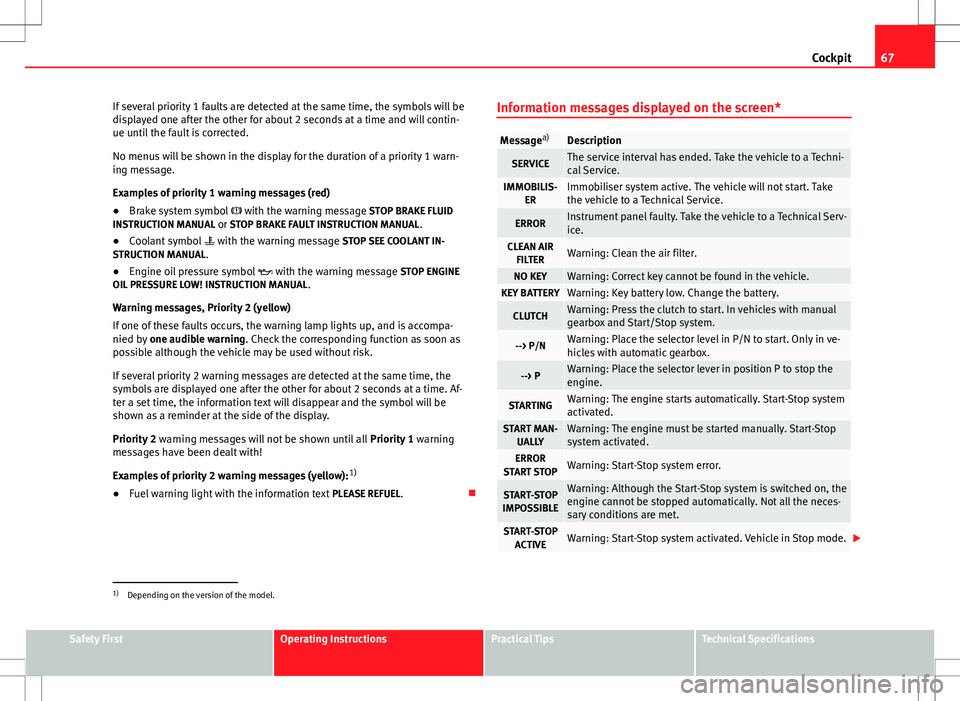
● Fuel warning light with the information text PLEASE REFUEL. Information messages displayed on the screen*
Message
a)Description
SERVICEThe service interval has ended. Take the vehicle to a Techni-
cal Service.
IMMOBILIS-
ERImmobiliser system active. The vehicle will not start. Take
the vehicle to a Technical Service.
ERRORInstrument panel faulty. Take the vehicle to a Technical Serv-
ice.
CLEAN AIRFILTERWarning: Clean the air filter.
NO KEYWarning: Correct key cannot be found in the vehicle.KEY BATTERYWarning: Key battery low. Change the battery.
CLUTCHWarning: Press the clutch to start. In vehicles with manual
gearbox and Start/Stop system.
--> P/NWarning: Place the selector level in P/N to start. Only in ve-
hicles with automatic gearbox.
--> PWarning: Place the selector lever in position P to stop the
engine.
STARTINGWarning: The engine starts automatically. Start-Stop system
activated.
START MAN- UALLYWarning: The engine must be started manually. Start-Stop
system activated.
ERROR
START STOPWarning: Start-Stop system error.
START-STOP
IMPOSSIBLEWarning: Although the Start-Stop system is switched on, the
engine cannot be stopped automatically. Not all the neces-
sary conditions are met.
START-STOP ACTIVEWarning: Start-Stop system activated. Vehicle in Stop mode.
1)
Depending on the version of the model.
Safety FirstOperating InstructionsPractical TipsTechnical Specifications
Page 129 of 280
127
Air conditioning
Air conditioning Heating
Controls
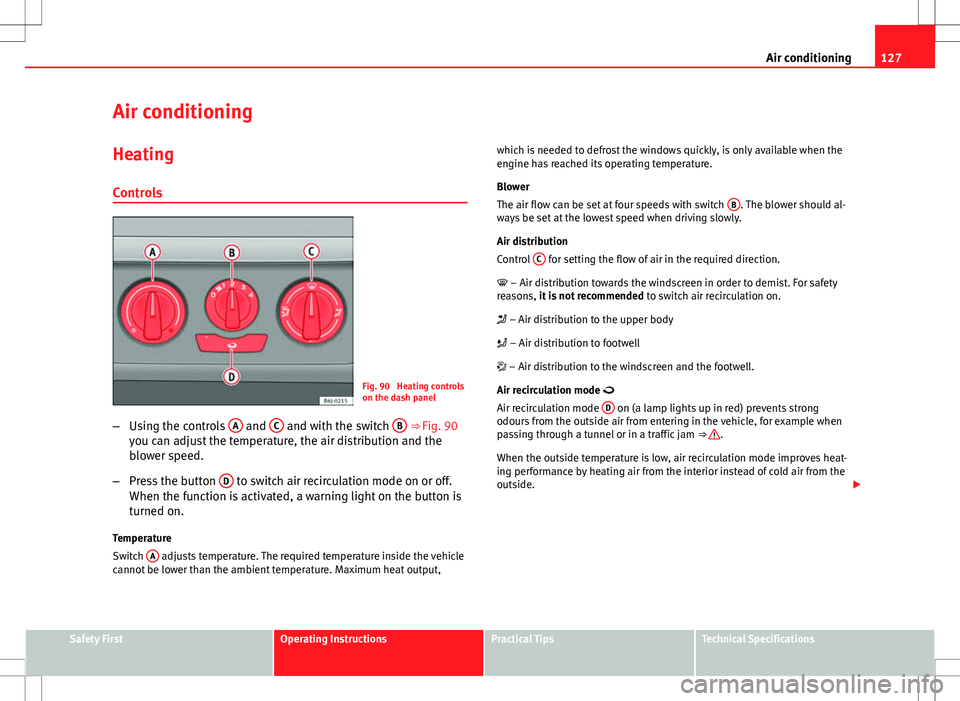
Fig. 90 Heating controls
on the dash panel
– Using the controls A
and C and with the switch B ⇒ Fig. 90
you can adjust the temperature, the air distribution and the
blower speed.
– Press the button D
to switch air recirculation mode on or off.
When the function is activated, a warning light on the button is
turned on.
Temperature
Switch A
adjusts temperature. The required temperature inside the vehicle
cannot be lower than the ambient temperature. Maximum heat output, which is needed to defrost the windows quickly, is only available when the
engine has reached its operating temperature.
Blower
The air flow can be set at four speeds with switch
B
. The blower should al-
ways be set at the lowest speed when driving slowly.
Air distribution
Control C
for setting the flow of air in the required direction.
– Air distribution towards the windscreen in order to demist. For safety
reasons, it is not recommended to switch air recirculation on.
– Air distribution to the upper body
– Air distribution to footwell
– Air distribution to the windscreen and the footwell.
Air recirculation mode
Air recirculation mode D
on (a lamp lights up in red) prevents strong
odours from the outside air from entering in the vehicle, for example when
passing through a tunnel or in a traffic jam ⇒
.
When the outside temperature is low, air recirculation mode improves heat-
ing performance by heating air from the interior instead of cold air from the
outside.
Safety FirstOperating InstructionsPractical TipsTechnical Specifications
Page 130 of 280
128Air conditioning
WARNING
● For your safety, the windows should never be fogged up or covered
with snow or ice. This is essential to ensure good visibility. Please famili-
arise yourself with the correct operation of the heating and ventilation
system, including the demist/defrost functions for the windows.
● In air recirculation mode, no cold air from the outside enters the vehi-
cle interior. The windows can quickly fog over if the heating is switched
off. Therefore, never leave the air recirculation mode switched on for a
long time (risk of accident).
Note
● Please consider the general notes ⇒ page 135.
Vehicle ventilation or heating
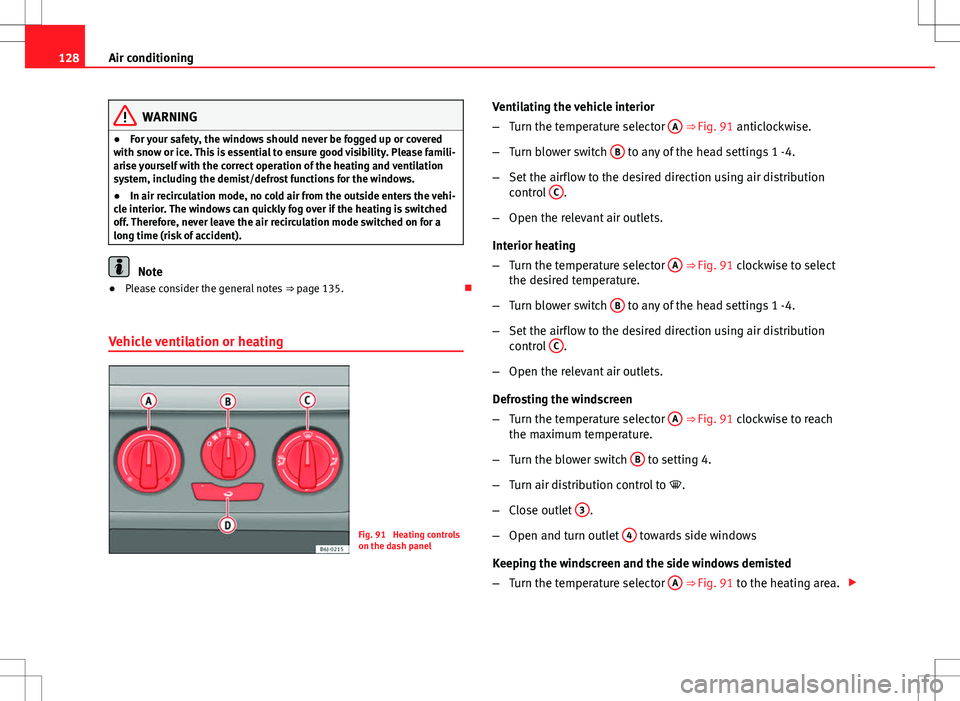
Fig. 91 Heating controls
on the dash panel Ventilating the vehicle interior
–
Turn the temperature selector A
⇒ Fig. 91 anticlockwise.
– Turn blower switch B
to any of the head settings 1 -4.
– Set the airflow to the desired direction using air distribution
control C
.
– Open the relevant air outlets.
Interior heating
– Turn the temperature selector A
⇒ Fig. 91 clockwise to select
the desired temperature.
– Turn blower switch B
to any of the head settings 1 -4.
– Set the airflow to the desired direction using air distribution
control C
.
– Open the relevant air outlets.
Defrosting the windscreen
– Turn the temperature selector A
⇒ Fig. 91 clockwise to reach
the maximum temperature.
– Turn the blower switch B
to setting 4.
– Turn air distribution control to .
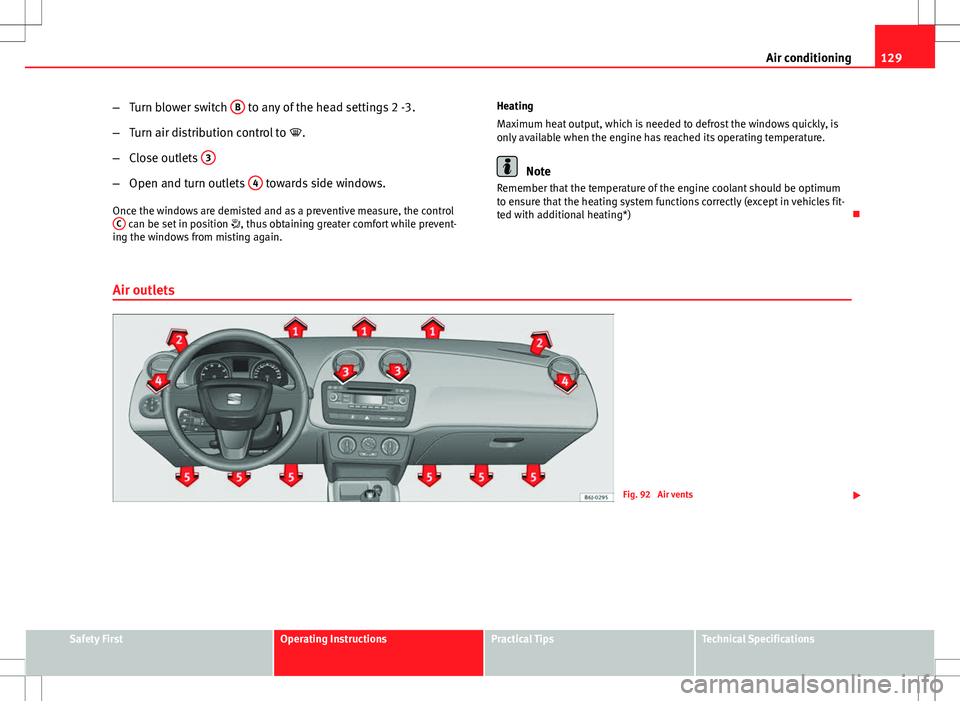
– Close outlet 3
.
– Open and turn outlet 4
towards side windows
Keeping the windscreen and the side windows demisted
– Turn the temperature selector A
⇒ Fig. 91 to the heating area.
Page 131 of 280
129
Air conditioning
– Turn blower switch B
to any of the head settings 2 -3.
– Turn air distribution control to .
– Close outlets 3
–
Open and turn outlets 4 towards side windows.
Once the windows are demisted and as a preventive measure, the control C
can be set in position , thus obtaining greater comfort while prevent-
ing the windows from misting again. Heating
Maximum heat output, which is needed to defrost the windows quickly, is
only available when the engine has reached its operating temperature.
Note
Remember that the temperature of the engine coolant should be optimum
to ensure that the heating system functions correctly (except in vehicles fit-
ted with additional heating*)
Air outlets
Fig. 92 Air vents
Safety FirstOperating InstructionsPractical TipsTechnical Specifications