heating Seat Ibiza SC 2013 Owner's Guide
[x] Cancel search | Manufacturer: SEAT, Model Year: 2013, Model line: Ibiza SC, Model: Seat Ibiza SC 2013Pages: 294, PDF Size: 4.05 MB
Page 182 of 294
180Driving and the environment
recommend that you have the thickness of your brake pads checked by a
Technical Service more frequently than recommended in the Maintenance
Programme.
If you drive with wet brakes, for example, after crossing areas of water, in
heavy rainfall or even after washing the vehicle, the effect of the brakes is
lessened as the brake discs are wet or even frozen (in winter). In this case
the brakes should be dried by pressing the brake pedal several times.
WARNING
Longer braking distances and faults in the brake system increase the risk
of accidents.
● New brake pads must be run in and do not have the correct friction
during the first 200 km. However, the reduced braking capacity may be
compensated by pressing on the brake pedal a little harder. This also ap-
plies when the brake pads have to be changed further on.
● If brakes are wet or frozen, or if you are driving on roads which have
been salted, braking power may be lower than normal.
● On steep slopes, if brakes are excessively used, they will overheat.
Before driving down a long steep slope, it is advisable to reduce speed
and change down into a lower gear or range (depending on the type of
transmission). This makes use of engine braking and relieves the brakes.
● Never let the brakes “drag” by applying light pressure. Continuous
braking will cause the brakes to overheat and the braking distance will
increase. Apply and then release the brakes alternately.
● Never let the vehicle run with the engine switched off. The braking
distance is increased considerably when the brake servo is not active.
● If the brake fluid loses its viscosity and is subjected to heavy use, va-
pour bubbles can form in the brake system. This reduces the efficiency of
the brakes.
WARNING (Continued)
● Non-standard or damaged front spoilers could restrict the airflow to
the brakes and cause them to overheat. Before purchasing accessories
please observe the relevant instructions ⇒ page 196, Technical modifi-
cations.
● If a brake system circuit fails, the braking distance will be increased
considerably. Contact a specialised workshop immediately and avoid un-
necessary journeys.
Exhaust gas purification system Catalytic converter*
To maintain the useful life of the catalytic converter
– Use only unleaded petrol with petrol engines, as lead damages
the catalytic converter.
– Do not let the fuel get too low in the tank.
– For engine oil changes, do not replenish with too much engine
oil ⇒ page 212, Topping up engine oil .
– Never tow the vehicle to start it, use jump leads if necessary
⇒ page 256.
If you notice misfiring, uneven running or loss of power when the vehicle is
moving, reduce speed immediately and have the vehicle inspected at the
nearest specialised workshop. In general, the exhaust gas warning lamp
will light up when any of the described symptoms occur ⇒ page 65. If this
happens, unburnt fuel can enter the exhaust system and escape into the en-
vironment. The catalytic converter can also be damaged by overheating.
Page 183 of 294
181
Driving and the environment
WARNING
The catalytic converter reaches very high temperatures! Risk of fire!
● Never park where the catalytic converter could come into contact with
dry grass or flammable materials under the vehicle.
● Do not apply additional underseal or anti-corrosion coatings to the
exhaust pipes, catalytic converter or the heat shields on the exhaust sys-
tem. These materials could catch fire when the vehicle is being driven.
CAUTION
Never run the fuel tank completely dry because the irregularity of the fuel
supply may cause ignition problems. This allows unburnt fuel to enter the
exhaust system, which could cause overheating and damage the catalytic
converter.
For the sake of the environment
Even when the emission control system is working perfectly, there may be a
smell of sulphur from the exhaust gas under some conditions. This depends
on the sulphur content of the fuel used. Quite often the problem can be
solved by changing to another brand of fuel. Diesel engine particulate filter*
The diesel particulate filter eliminates soot produced by
burning diesel.
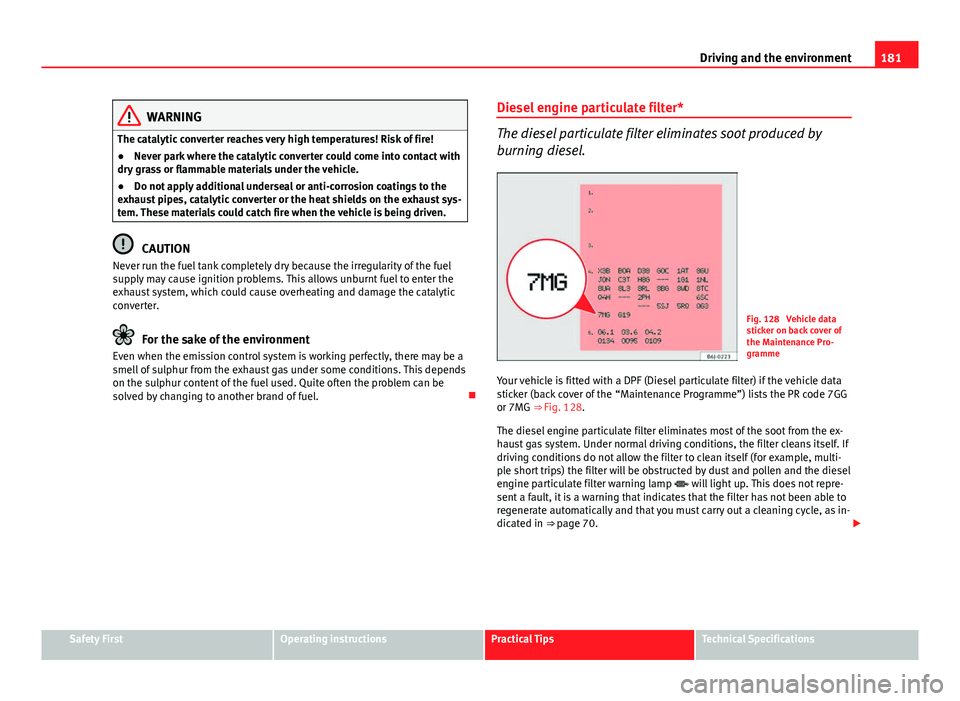
Fig. 128 Vehicle data
sticker on back cover of
the Maintenance Pro-
gramme
Your vehicle is fitted with a DPF (Diesel particulate filter) if the vehicle data
sticker (back cover of the “Maintenance Programme”) lists the PR code 7GG
or 7MG ⇒ Fig. 128.
The diesel engine particulate filter eliminates most of the soot from the ex-
haust gas system. Under normal driving conditions, the filter cleans itself. If
driving conditions do not allow the filter to clean itself (for example, multi-
ple short trips) the filter will be obstructed by dust and pollen and the diesel
engine particulate filter warning lamp will light up. This does not repre-
sent a fault, it is a warning that indicates that the filter has not been able to
regenerate automatically and that you must carry out a cleaning cycle, as in-
dicated in ⇒ page 70.
Safety FirstOperating instructionsPractical TipsTechnical Specifications
Page 185 of 294
183
Driving and the environment
Avoid short journeys
To reduce the consumption and emission of polluting exhaust gases, the
engine and the exhaust gas filtration systems should reach the optimum
operating temperature.
With the engine cold, fuel consumption is proportionally higher. The engine
does not warm up and fuel consumption does not normalise until having
driven approximately four kilometres (2.5 miles). This is why we recommend
avoiding short trips whenever possible.
Maintain the correct tyre pressures
Bear in mind that keeping the tyres at an adequate pressure saves fuel. If
the tyre pressure is just one bar (14.5 psi / 100 kPa) too low, fuel consump-
tion can increase by as much as 5%. Due to the greater rolling resistance,
under-inflation also increases tyre wear and impairs handling.
The tyre pressures should always be checked when the tyres are cold.
Do not use winter tyres all year round as they increase fuel consumption by
up to 10%.
Avoid unnecessary weight
Given that every kilo of extra weight will increase the fuel consumption, it is
advisable to always check the luggage compartment to make sure that no
unnecessary loads are being transported.
A roof rack is often left in place for the sake of convenience, even when it is
no longer needed. At a speed of 100 km/h (62 mph) and 120 km/h
(75 mph) your vehicle will use about 12% more fuel as a result of the extra
wind resistance caused by the roof rack even when it is not in use.
Save electricity
The engine activates the alternator, which produces electricity. With the
need for electricity, fuel consumption is also increased. Because of this, al-
ways turn off electrical components when you do not need them. Examples
of components that use a lot of electricity are: the fan at high speeds, the
rear window heating or the seat heaters*.
Note
● If you vehicle has Start-Stop, it is not recommended to switch this func-
tion off.
● It is recommended to close the windows when driving at more than
60 km/h (37 mph)
● Do not drive with your foot resting on the clutch pedal, as the pressure
can make the plate spin, more fuel will be used and it can burn the clutch
plate lining, causing a serious fault.
● Do not hold the vehicle on a hill with the clutch, use the foot brake or
hand brake, using the latter to start. The fuel consumption will be lower and
you will prevent the clutch plate from being damaged.
● On descents, use the engine brake, changing to the gear that is more
suitable for the slope. The fuel consumption will be lower and the brakes
will not suffer.
Environmental friendliness
Environmental protection is a top priority in the design, choice of materials
and manufacture of your new SEAT.
Constructive measures to encourage recycling
● Joints and connections designed for easy dismantling
● Modular construction to facilitate dismantling
● Increased use of single-grade materials.
● Plastic parts and elastomers are marked in accordance with ISO 1043,
ISO 11469 and ISO 1629.
Choice of materials
● Use of recycled materials.
● Use of compatible plastics in the same part if its components are not
easily separated.
Safety FirstOperating instructionsPractical TipsTechnical Specifications
Page 188 of 294
186Driving and the environment
WARNING
The towing bracket ball coupling must be stored securely in the luggage
compartment to prevent them being flung through the vehicle and caus-
ing injury.
Note
● By law, the ball coupling must be removed if a trailer is not being towed
if it obscures the number plate.
Driving tips
Driving with a trailer always requires extra care. Weight distribution
The weight distribution of a loaded trailer with an unladen vehicle is very
unfavourable. However, if this cannot be avoided, drive extra slowly to allow
for the unbalanced weight distribution.
Speed
The stability of the vehicle and trailer is reduced with increasing speed. For
this reason, it is advisable not to drive at the maximum permissible speed
in an unfavourable road, weather or wind conditions. This applies especially
when driving downhill.
You should always reduce speed immediately if the trailer shows the slight-
est sign of snaking. Never try to stop the “snaking” by increasing speed.
Always brake in due course. If the trailer has an overrun brake, apply the
brakes gently at first and then, firmly. This will prevent the jerking that can
be caused by locking of trailer wheels. Select a low gear in due course be-
fore going down a steep downhill. This enables you to use the engine brak-
ing to slow down the vehicle. Reheating
At very high temperatures and during prolonged slopes, driving in a low
gear and high engine speed, always monitor if the excessive coolant tem-
perature gauge is activated
⇒ page 75.
Electronic Stability Control*
The ESC* system helps to stabilise the trailer in case of skidding or rocking.
Page 193 of 294
191
Vehicle maintenance and cleaning
If possible, use a de-icing spray to remove ice. If you use an ice scraper,
push it in one direction only without swinging it.
Use window cleaner or a silicone remover to clean rubber, oil, grease and
silicone deposits off.
Wax deposits can be removed with a special cleaner available in your Tech-
nical Services. Wax deposits on the windscreen could cause the wiper
blades to judder. Adding a window cleaner that dissolves wax to the wind-
screen washer fluid prevents wiper blades from juddering, but wax deposits
are not removed.
CAUTION
● Never use warm or hot water to remove snow and ice from windows and
mirrors. This could cause the glass to crack!
● The heating element for the rear window is located on the inner side of
the window. To prevent damage, do not put stickers over the heating ele-
ments on the inside of the window.
Cleaning windscreen wiper blades
Clean wiper blades improve visibility.
1. Use a soft cloth to remove dust and dirt from the windscreen wiper blades.
2. Use window cleaner to clean the windscreen wiper blades. Use a sponge or a cloth to remove stubborn dirt. Rubber seals maintenance
If rubber seals are well looked after, they will not freeze so
quickly.
1. Use a soft cloth to remove dust and dirt from the rubber seals.
2. Apply a specialist care product to the rubber seals.
The rubber strips on the doors, windows, bonnet and rear lid will remain
pliable and last longer if they are treated with a suitable care product (for
example silicone spray).
Caring for rubber seals will also prevent premature ageing and leaks. The
doors will be easier to open. If rubber seals are well looked after, they will
not freeze so quickly in winter.
Door lock cylinders
The door lock cylinders can freeze up in winter.
To de-ice the lock cylinders you should only use spray with lubricating and
anti-corrosive properties.
Cleaning chrome parts
1. Clean chrome parts with a damp cloth.
2. Polish chrome parts with a soft, dry cloth. If this does not provide satisfying results, use a specialist chrome cleaning
product. Chrome cleaning products will remove stains from the surface.
Safety FirstOperating instructionsPractical TipsTechnical Specifications
Page 216 of 294
214Checking and refilling levels
WARNING
If there is not enough anti-freeze in the coolant system, the engine may
fail leading to serious damage.
● Please make sure that the percentage of additive is correct with re-
spect to the lowest expected ambient temperature in the zone in which
the vehicle is to be used.
● When the outside temperature is very low, the coolant could freeze
and the vehicle would be immobilised. In this case, the heating would
not work either and inadequately dressed passengers could die of cold.
CAUTION
The original additives should never be mixed with coolants which are not
approved by SEAT. Otherwise, you run the risk of causing severe damage to
the engine and the engine cooling system.
● If the fluid in the expansion tank is not purple but is, for example,
brown, this indicates that the G 13 additive has been mixed with an inade-
quate coolant. The coolant must be changed as soon as possible if this is
the case! This could result in serious faults and engine damage.
For the sake of the environment
Coolants and additives can contaminate the environment. If any fluids are
spilled, they should be collected and correctly disposed of, with respect to
the environment. Checking the coolant level and topping up
The correct coolant level is important for fault-free function-
ing of the engine cooling system.
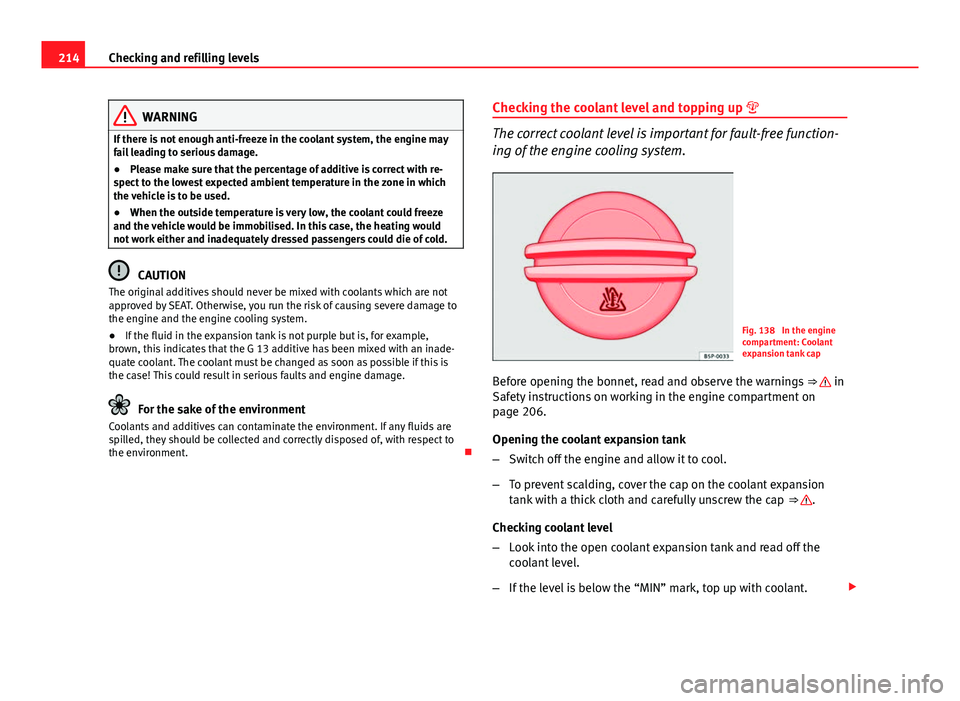
Fig. 138 In the engine
compartment: Coolant
expansion tank cap
Before opening the bonnet, read and observe the warnings ⇒
in
Safety instructions on working in the engine compartment on
page 206.
Opening the coolant expansion tank
– Switch off the engine and allow it to cool.
– To prevent scalding, cover the cap on the coolant expansion
tank with a thick cloth and carefully unscrew the cap ⇒
.
Checking coolant level
– Look into the open coolant expansion tank and read off the
coolant level.
– If the level is below the “MIN” mark, top up with coolant.
Page 288 of 294
Environmental tipAvoiding pollution . . . . . . . . . . . . . . . . . . . 201
ESC . . . . . . . . . . . . . . . . . . . . . . . . . . . . . . . 72, 176 see also Electronic Stability Control . . . . . 148
Exhaust gas purification system . . . . . . . . . . . 180
Exterior mirrors . . . . . . . . . . . . . . . . . . . . . . . . . 190
External aerial . . . . . . . . . . . . . . . . . . . . . . . . . . 197
F
Fabric trim cleaning . . . . . . . . . . . . . . . . . . . . . 194
Fastening rings . . . . . . . . . . . . . . . . . . . . . . . . . . 17
Fire extinguisher . . . . . . . . . . . . . . . . . . . . . . . . 132
First-aid kit . . . . . . . . . . . . . . . . . . . . . . . . . . . . 132
Floor mats . . . . . . . . . . . . . . . . . . . . . . . . . . . . . . 16
Fog lights . . . . . . . . . . . . . . . . . . . . . . . . . . . . . 101
Fog lights bulb . . . . . . . . . . . . . . . . . . . . . . . . . 248
Fog lights with cornering function . . . . . . . . . 105
Footwell lights . . . . . . . . . . . . . . . . . . . . . . . . . 110
Front airbags . . . . . . . . . . . . . . . . . . . . . . . . . . . 34 Description . . . . . . . . . . . . . . . . . . . . . . . . . . 34
Operation . . . . . . . . . . . . . . . . . . . . . . . . . . . 35
Safety notes . . . . . . . . . . . . . . . . . . . . . . . . . 37
Front ashtray . . . . . . . . . . . . . . . . . . . . . . . . . . . 128
Front drink holder . . . . . . . . . . . . . . . . . . . . . . . 127
Front interior light . . . . . . . . . . . . . . . . . . . . . . 109
Front parking aid . . . . . . . . . . . . . . . . . . . . . . . . . . . . . . . . 169
Front passenger airbag deactivation . . . . . . . . 41
Front reading light . . . . . . . . . . . . . . . . . . . . . . 109 Front seat adjustment
Lumbar support . . . . . . . . . . . . . . . . . . . . . 120
Fuel Diesel . . . . . . . . . . . . . . . . . . . . . . . . . . . . . 205
Petrol . . . . . . . . . . . . . . . . . . . . . . . . . . . . . . 205
Fuel consumption . . . . . . . . . . . . . . . . . . . 182, 264
Fuel level Indicator . . . . . . . . . . . . . . . . . . . . . . . . . . . . 59
Fuel reserve . . . . . . . . . . . . . . . . . . . . . . . . . . . . 74
Fuel tank see Fuel reserve . . . . . . . . . . . . . . . . . . . . . . 74
Fuel Tank Opening the fuel tank flap . . . . . . . . . . . . . 200
Fuel: save . . . . . . . . . . . . . . . . . . . . . . . . . . . . . 182
Fuses . . . . . . . . . . . . . . . . . . . . . . . . . . . . . . . . . 237 Fuse box . . . . . . . . . . . . . . . . . . . . . . . . . . . 238
Identifying blown fuses . . . . . . . . . . . . . . . 239
Identifying by colours . . . . . . . . . . . . . . . . 238
Preparation before replacing . . . . . . . . . . . 239
Replacement . . . . . . . . . . . . . . . . . . . . . . . . 239
G
Gear-change indicator . . . . . . . . . . . . . . . . . . . 163
Gear shift pattern . . . . . . . . . . . . . . . . . . . . . . . 156
General overview of the engine compartment 267
Glove compartment . . . . . . . . . . . . . . . . . . . . . 125
Glove compartment light . . . . . . . . . . . . . . . . . 110
Glow plug system . . . . . . . . . . . . . . . . . . . . . . . 151 control lamp . . . . . . . . . . . . . . . . . . . . . . . . . 70 H
Handbrake . . . . . . . . . . . . . . . . . . . . . . . . . . . . 164 Warning lamp . . . . . . . . . . . . . . . . . . . . . . . 165
Hazard warning lights . . . . . . . . . . . . . . . . . . . 106
HBA . . . . . . . . . . . . . . . . . . . . . . . . . . . . . . . . . . 174
Headlight flashers . . . . . . . . . . . . . . . . . . . . . . 108
Headlight range control . . . . . . . . . . . . . . . . . . 103
Headlights Driving abroad . . . . . . . . . . . . . . . . . . . . . . 184
Fog lights . . . . . . . . . . . . . . . . . . . . . . . . . . 101
Headlight washer . . . . . . . . . . . . . . . . . . . . 113
Head restraints Adjusting . . . . . . . . . . . . . . . . . . . . . . 118, 119
Adjustment of the head restraint angle . . 119
Removing . . . . . . . . . . . . . . . . . . . . . . . . . . 119
Heated exterior mirrors . . . . . . . . . . . . . . . . . . 115
Heated front seats . . . . . . . . . . . . . . . . . . . . . . 121
Heated rear window Heating element wires . . . . . . . . . . . . . . . . 191
Heating . . . . . . . . . . . . . . . . . . . . . . . . . . . . . . . 137
Heating system . . . . . . . . . . . . . . . . . . . . . . . . . 138
High pressure cleaners . . . . . . . . . . . . . . . . . . 189
Hill driving assistant . . . . . . . . . . . . . . . . . . . . 166
Horn . . . . . . . . . . . . . . . . . . . . . . . . . . . . . . . . . . 55
How to jump start description . . . . . . . . . . . . . 257
Hydraulic Brake Assist Automatic hazard warning lights activa-tion . . . . . . . . . . . . . . . . . . . . . . . . . . . . . . 174
286 Index
Page 289 of 294
I
Identification plate . . . . . . . . . . . . . . . . . . . . . . 263
Ignition key . . . . . . . . . . . . . . . . . . . . . . . . . . . . 148
Ignition lock . . . . . . . . . . . . . . . . . . . . . . . . . . . 148
Information in the multifunction display Memory displays . . . . . . . . . . . . . . . . . . . . . 61
Instrument and switch lighting . . . . . . . . . . . . 103
Instrument lighting . . . . . . . . . . . . . . . . . . . . . . 55
Instrument panel Service interval display . . . . . . . . . . . . . . . . 63
Instruments . . . . . . . . . . . . . . . . . . . . . . . . . . . . 57
Interior rear vision mirror . . . . . . . . . . . . . . . . . 114
Interval wipe, windscreen . . . . . . . . . . . . . . . . 111
ISOFIX system . . . . . . . . . . . . . . . . . . . . . . . . . . . 49
J Jump-starting . . . . . . . . . . . . . . . . . . . . . . . . . . 256
Jump leads . . . . . . . . . . . . . . . . . . . . . . . . . . . . 256
K
Keys . . . . . . . . . . . . . . . . . . . . . . . . . . . . . . . . . . . 87
L
Leather cleaning . . . . . . . . . . . . . . . . . . . . . . . . 194
Leaving Home function . . . . . . . . . . . . . . . . . . 105
Lights . . . . . . . . . . . . . . . . . . . . . . . . . . . . . . . . 101 Load compartment in the luggage compart-
ment
see Loading the luggage compartment . . . 16
Loading the luggage compartment . . . . . . . . . . 16
Locks . . . . . . . . . . . . . . . . . . . . . . . . . . . . . . . . . 191
LPG . . . . . . . . . . . . . . . . . . . . . . . . . . 58, 152, 202
LPG system Driving . . . . . . . . . . . . . . . . . . . . . . . . . . . . . 152
Filler neck adapter . . . . . . . . . . . . . . . . . . . 203
Level indicator . . . . . . . . . . . . . . . . . . . . . . . 58
Refuelling . . . . . . . . . . . . . . . . . . . . . . . . . . 202
Luggage compartment . . . . . . . . . . . . . . . . . . . 132 Fastening rings . . . . . . . . . . . . . . . . . . . . . . 133
Loading . . . . . . . . . . . . . . . . . . . . . . . . . . . . 132
Luggage net . . . . . . . . . . . . . . . . . . . . . . . . 134
see also Loading the luggage compartment . .16
Luggage compartment light . . . . . . . . . . 110, 256
M
Main beam . . . . . . . . . . . . . . . . . . . . . . . . 101, 108
Main beam headlights control lamp . . . . . . . . . . . . . . . . . . . . . . . . . 75
Maintenance Airbags . . . . . . . . . . . . . . . . . . . . . . . . . . . . . 32
Maintenance and cleaning . . . . . . . . . . . . . . . 187
Manual gearbox . . . . . . . . . . . . . . . . . . . . . . . . 156
Manual heating . . . . . . . . . . . . . . . . . . . . . . . . 138 controls . . . . . . . . . . . . . . . . . . . . . . . . . . . . 137 Manual heating system
Defrosting the windscreen . . . . . . . . . . . . . 138
Demisting the windscreen and side win-dows . . . . . . . . . . . . . . . . . . . . . . . . . . . . . 138
MFI . . . . . . . . . . . . . . . . . . . . . . . . . . . . . . . . . . . . 61
Mirrors Exterior mirrors . . . . . . . . . . . . . . . . . . . . . . 115
Interior rear vision mirror . . . . . . . . . . . . . . 114
vanity mirror . . . . . . . . . . . . . . . . . . . . . . . . 110
Mobile phone . . . . . . . . . . . . . . . . . . . . . . . . . . 197
Multifunction display . . . . . . . . . . . . . . . . . . . . . 61
N
Number of seats . . . . . . . . . . . . . . . . . . . . . . . . . 19
O
Observations . . . . . . . . . . . . . . . . . . . . . . . . . . 184
Octane number . . . . . . . . . . . . . . . . . . . . . . . . . 205
Odometer . . . . . . . . . . . . . . . . . . . . . . . . . . . . . . 63
Oil change . . . . . . . . . . . . . . . . . . . . . . . . . . . . . 212
Oil properties . . . . . . . . . . . . . . . . . . . . . . . . . . 210
One-touch opening and closing Electric windows . . . . . . . . . . . . . . . . . . . . . . 97
Opening and locking . . . . . . . . . . . . . . . . . . . . . 93
Operation when a fault occurs panoramic/tilting sunroof . . . . . . . . . . . . . 100
Outside temperature display . . . . . . . . . . . . . . . 60
Outside temperature indicator . . . . . . . . . . . . . 62
287
Index
Page 291 of 294
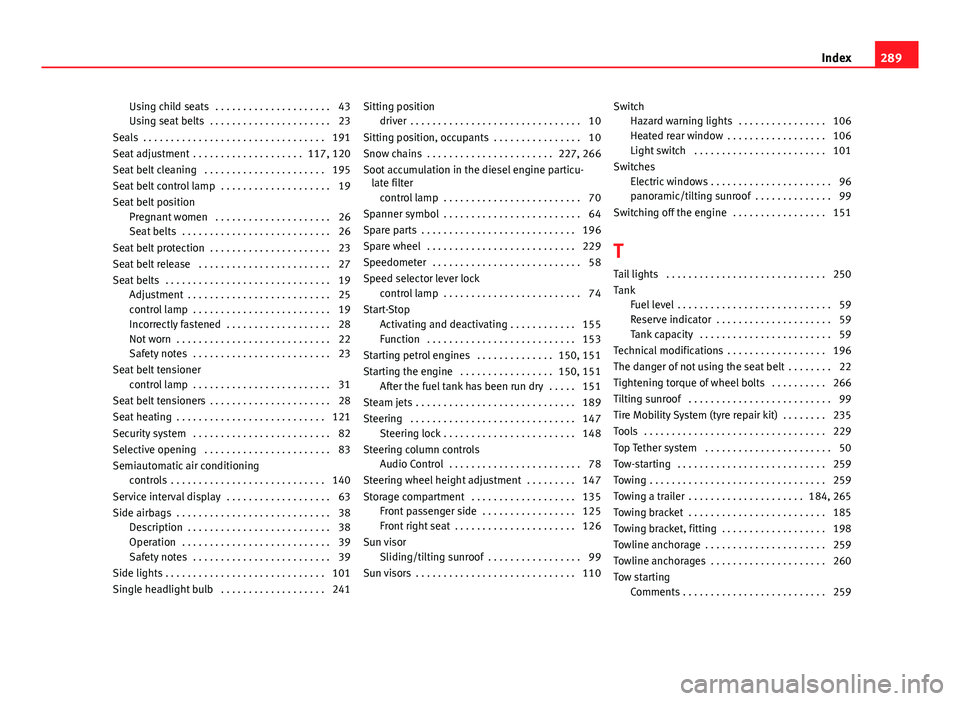
Using child seats . . . . . . . . . . . . . . . . . . . . . 43
Using seat belts . . . . . . . . . . . . . . . . . . . . . . 23
Seals . . . . . . . . . . . . . . . . . . . . . . . . . . . . . . . . . 191
Seat adjustment . . . . . . . . . . . . . . . . . . . . 117, 120
Seat belt cleaning . . . . . . . . . . . . . . . . . . . . . . 195
Seat belt control lamp . . . . . . . . . . . . . . . . . . . . 19
Seat belt position Pregnant women . . . . . . . . . . . . . . . . . . . . . 26
Seat belts . . . . . . . . . . . . . . . . . . . . . . . . . . . 26
Seat belt protection . . . . . . . . . . . . . . . . . . . . . . 23
Seat belt release . . . . . . . . . . . . . . . . . . . . . . . . 27
Seat belts . . . . . . . . . . . . . . . . . . . . . . . . . . . . . . 19 Adjustment . . . . . . . . . . . . . . . . . . . . . . . . . . 25
control lamp . . . . . . . . . . . . . . . . . . . . . . . . . 19
Incorrectly fastened . . . . . . . . . . . . . . . . . . . 28
Not worn . . . . . . . . . . . . . . . . . . . . . . . . . . . . 22
Safety notes . . . . . . . . . . . . . . . . . . . . . . . . . 23
Seat belt tensioner control lamp . . . . . . . . . . . . . . . . . . . . . . . . . 31
Seat belt tensioners . . . . . . . . . . . . . . . . . . . . . . 28
Seat heating . . . . . . . . . . . . . . . . . . . . . . . . . . . 121
Security system . . . . . . . . . . . . . . . . . . . . . . . . . 82
Selective opening . . . . . . . . . . . . . . . . . . . . . . . 83
Semiautomatic air conditioning controls . . . . . . . . . . . . . . . . . . . . . . . . . . . . 140
Service interval display . . . . . . . . . . . . . . . . . . . 63
Side airbags . . . . . . . . . . . . . . . . . . . . . . . . . . . . 38 Description . . . . . . . . . . . . . . . . . . . . . . . . . . 38
Operation . . . . . . . . . . . . . . . . . . . . . . . . . . . 39
Safety notes . . . . . . . . . . . . . . . . . . . . . . . . . 39
Side lights . . . . . . . . . . . . . . . . . . . . . . . . . . . . . 101
Single headlight bulb . . . . . . . . . . . . . . . . . . . 241 Sitting position
driver . . . . . . . . . . . . . . . . . . . . . . . . . . . . . . . 10
Sitting position, occupants . . . . . . . . . . . . . . . . 10
Snow chains . . . . . . . . . . . . . . . . . . . . . . . 227, 266
Soot accumulation in the diesel engine particu- late filter
control lamp . . . . . . . . . . . . . . . . . . . . . . . . . 70
Spanner symbol . . . . . . . . . . . . . . . . . . . . . . . . . 64
Spare parts . . . . . . . . . . . . . . . . . . . . . . . . . . . . 196
Spare wheel . . . . . . . . . . . . . . . . . . . . . . . . . . . 229
Speedometer . . . . . . . . . . . . . . . . . . . . . . . . . . . 58
Speed selector lever lock control lamp . . . . . . . . . . . . . . . . . . . . . . . . . 74
Start-Stop Activating and deactivating . . . . . . . . . . . . 155
Function . . . . . . . . . . . . . . . . . . . . . . . . . . . 153
Starting petrol engines . . . . . . . . . . . . . . 150, 151
Starting the engine . . . . . . . . . . . . . . . . . 150, 151 After the fuel tank has been run dry . . . . . 151
Steam jets . . . . . . . . . . . . . . . . . . . . . . . . . . . . . 189
Steering . . . . . . . . . . . . . . . . . . . . . . . . . . . . . . 147 Steering lock . . . . . . . . . . . . . . . . . . . . . . . . 148
Steering column controls Audio Control . . . . . . . . . . . . . . . . . . . . . . . . 78
Steering wheel height adjustment . . . . . . . . . 147
Storage compartment . . . . . . . . . . . . . . . . . . . 135 Front passenger side . . . . . . . . . . . . . . . . . 125
Front right seat . . . . . . . . . . . . . . . . . . . . . . 126
Sun visor Sliding/tilting sunroof . . . . . . . . . . . . . . . . . 99
Sun visors . . . . . . . . . . . . . . . . . . . . . . . . . . . . . 110 Switch
Hazard warning lights . . . . . . . . . . . . . . . . 106
Heated rear window . . . . . . . . . . . . . . . . . . 106
Light switch . . . . . . . . . . . . . . . . . . . . . . . . 101
Switches Electric windows . . . . . . . . . . . . . . . . . . . . . . 96
panoramic/tilting sunroof . . . . . . . . . . . . . . 99
Switching off the engine . . . . . . . . . . . . . . . . . 151
T Tail lights . . . . . . . . . . . . . . . . . . . . . . . . . . . . . 250
Tank Fuel level . . . . . . . . . . . . . . . . . . . . . . . . . . . . 59
Reserve indicator . . . . . . . . . . . . . . . . . . . . . 59
Tank capacity . . . . . . . . . . . . . . . . . . . . . . . . 59
Technical modifications . . . . . . . . . . . . . . . . . . 196
The danger of not using the seat belt . . . . . . . . 22
Tightening torque of wheel bolts . . . . . . . . . . 266
Tilting sunroof . . . . . . . . . . . . . . . . . . . . . . . . . . 99
Tire Mobility System (tyre repair kit) . . . . . . . . 235
Tools . . . . . . . . . . . . . . . . . . . . . . . . . . . . . . . . . 229
Top Tether system . . . . . . . . . . . . . . . . . . . . . . . 50
Tow-starting . . . . . . . . . . . . . . . . . . . . . . . . . . . 259
Towing . . . . . . . . . . . . . . . . . . . . . . . . . . . . . . . . 259
Towing a trailer . . . . . . . . . . . . . . . . . . . . . 184, 265
Towing bracket . . . . . . . . . . . . . . . . . . . . . . . . . 185
Towing bracket, fitting . . . . . . . . . . . . . . . . . . . 198
Towline anchorage . . . . . . . . . . . . . . . . . . . . . . 259
Towline anchorages . . . . . . . . . . . . . . . . . . . . . 260
Tow starting Comments . . . . . . . . . . . . . . . . . . . . . . . . . . 259
289
Index
Page 292 of 294
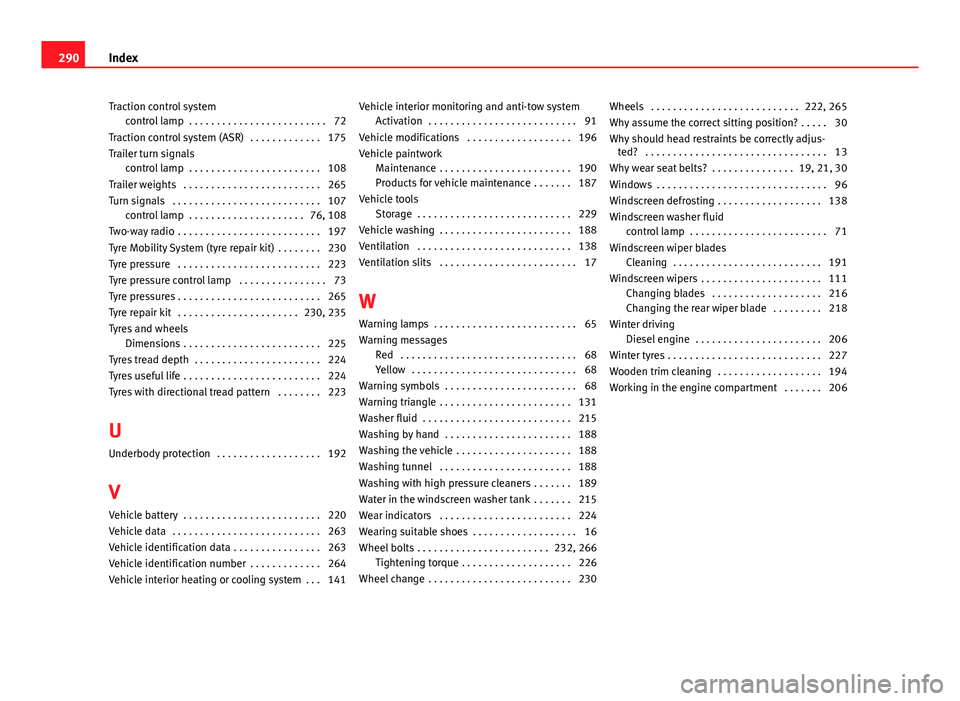
Traction control systemcontrol lamp . . . . . . . . . . . . . . . . . . . . . . . . . 72
Traction control system (ASR) . . . . . . . . . . . . . 175
Trailer turn signals control lamp . . . . . . . . . . . . . . . . . . . . . . . . 108
Trailer weights . . . . . . . . . . . . . . . . . . . . . . . . . 265
Turn signals . . . . . . . . . . . . . . . . . . . . . . . . . . . 107 control lamp . . . . . . . . . . . . . . . . . . . . . 76, 108
Two-way radio . . . . . . . . . . . . . . . . . . . . . . . . . . 197
Tyre Mobility System (tyre repair kit) . . . . . . . . 230
Tyre pressure . . . . . . . . . . . . . . . . . . . . . . . . . . 223
Tyre pressure control lamp . . . . . . . . . . . . . . . . 73
Tyre pressures . . . . . . . . . . . . . . . . . . . . . . . . . . 265
Tyre repair kit . . . . . . . . . . . . . . . . . . . . . . 230, 235
Tyres and wheels Dimensions . . . . . . . . . . . . . . . . . . . . . . . . . 225
Tyres tread depth . . . . . . . . . . . . . . . . . . . . . . . 224
Tyres useful life . . . . . . . . . . . . . . . . . . . . . . . . . 224
Tyres with directional tread pattern . . . . . . . . 223
U Underbody protection . . . . . . . . . . . . . . . . . . . 192
V Vehicle battery . . . . . . . . . . . . . . . . . . . . . . . . . 220
Vehicle data . . . . . . . . . . . . . . . . . . . . . . . . . . . 263
Vehicle identification data . . . . . . . . . . . . . . . . 263
Vehicle identification number . . . . . . . . . . . . . 264
Vehicle interior heating or cooling system . . . 141 Vehicle interior monitoring and anti-tow system
Activation . . . . . . . . . . . . . . . . . . . . . . . . . . . 91
Vehicle modifications . . . . . . . . . . . . . . . . . . . 196
Vehicle paintwork Maintenance . . . . . . . . . . . . . . . . . . . . . . . . 190
Products for vehicle maintenance . . . . . . . 187
Vehicle tools Storage . . . . . . . . . . . . . . . . . . . . . . . . . . . . 229
Vehicle washing . . . . . . . . . . . . . . . . . . . . . . . . 188
Ventilation . . . . . . . . . . . . . . . . . . . . . . . . . . . . 138
Ventilation slits . . . . . . . . . . . . . . . . . . . . . . . . . 17
W Warning lamps . . . . . . . . . . . . . . . . . . . . . . . . . . 65
Warning messages Red . . . . . . . . . . . . . . . . . . . . . . . . . . . . . . . . 68
Yellow . . . . . . . . . . . . . . . . . . . . . . . . . . . . . . 68
Warning symbols . . . . . . . . . . . . . . . . . . . . . . . . 68
Warning triangle . . . . . . . . . . . . . . . . . . . . . . . . 131
Washer fluid . . . . . . . . . . . . . . . . . . . . . . . . . . . 215
Washing by hand . . . . . . . . . . . . . . . . . . . . . . . 188
Washing the vehicle . . . . . . . . . . . . . . . . . . . . . 188
Washing tunnel . . . . . . . . . . . . . . . . . . . . . . . . 188
Washing with high pressure cleaners . . . . . . . 189
Water in the windscreen washer tank . . . . . . . 215
Wear indicators . . . . . . . . . . . . . . . . . . . . . . . . 224
Wearing suitable shoes . . . . . . . . . . . . . . . . . . . 16
Wheel bolts . . . . . . . . . . . . . . . . . . . . . . . . 232, 266 Tightening torque . . . . . . . . . . . . . . . . . . . . 226
Wheel change . . . . . . . . . . . . . . . . . . . . . . . . . . 230 Wheels . . . . . . . . . . . . . . . . . . . . . . . . . . . 222, 265
Why assume the correct sitting position? . . . . . 30
Why should head restraints be correctly adjus-
ted? . . . . . . . . . . . . . . . . . . . . . . . . . . . . . . . . . 13
Why wear seat belts? . . . . . . . . . . . . . . . 19, 21, 30
Windows . . . . . . . . . . . . . . . . . . . . . . . . . . . . . . . 96
Windscreen defrosting . . . . . . . . . . . . . . . . . . . 138
Windscreen washer fluid control lamp . . . . . . . . . . . . . . . . . . . . . . . . . 71
Windscreen wiper blades Cleaning . . . . . . . . . . . . . . . . . . . . . . . . . . . 191
Windscreen wipers . . . . . . . . . . . . . . . . . . . . . . 111 Changing blades . . . . . . . . . . . . . . . . . . . . 216
Changing the rear wiper blade . . . . . . . . . 218
Winter driving Diesel engine . . . . . . . . . . . . . . . . . . . . . . . 206
Winter tyres . . . . . . . . . . . . . . . . . . . . . . . . . . . . 227
Wooden trim cleaning . . . . . . . . . . . . . . . . . . . 194
Working in the engine compartment . . . . . . . 206
290 Index