lock Seat Ibiza SC 2014 User Guide
[x] Cancel search | Manufacturer: SEAT, Model Year: 2014, Model line: Ibiza SC, Model: Seat Ibiza SC 2014Pages: 240, PDF Size: 4.89 MB
Page 30 of 240
The essentials
Emergency towing of the
vehicle Towing Fig. 44
Fig. 45
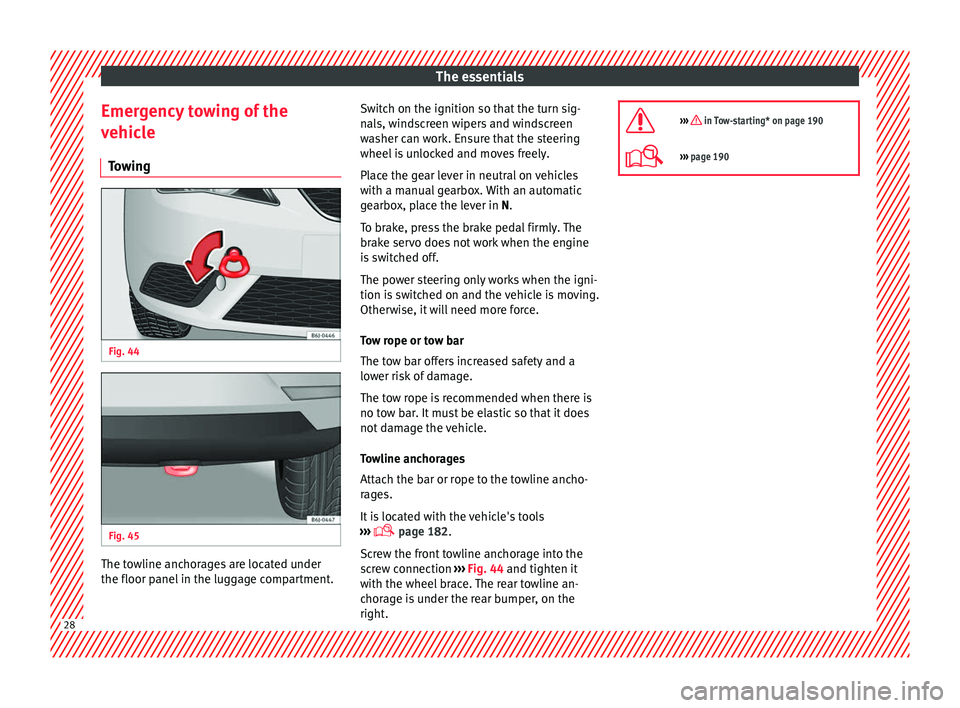
The towline anchorages are located under
the floor panel in the luggage compartment. Switch on the ignition so that the turn sig-
nals, windscreen wipers and windscreen
washer can work. Ensure that the steering
wheel is unlocked and moves freely.
Place the gear lever in neutral on vehicles
with a manual gearbox. With an automatic
gearbox, place the lever in N.
To brake, press the brake pedal firmly. The
brake servo does not work when the engine
is switched off.
The power steering only works when the igni-
tion is switched on and the vehicle is moving.
Otherwise, it will need more force.
Tow rope or tow bar
The tow bar offers increased safety and a
lower risk of damage.
The tow rope is recommended when there is
no tow bar. It must be elastic so that it does
not damage the vehicle.
Towline anchorages
Attach the bar or rope to the towline ancho-
rages.
It is located with the vehicle's tools
››› page 182
.
Sc r
ew the front towline anchorage into the
screw connection ››› Fig. 44 and tighten it
with the wheel
brace. The rear towline an-
chorage is under the rear bumper, on the
right.
››› in Tow-starting* on page 190
›››
page 190 28
Page 33 of 240
Safe driving
the chest and the centre of the steering
wheel
››› Fig. 46. If distance is less than 25
c m, the airb
ag system may not protect you
properly.
● If your physical constitution prevents you
from maintaining the minimum distance of 25
cm, contact a specialised workshop. The
workshop will help you decide if special spe-
cific modifications are necessary.
● When driving, always hold the steering
wheel with both hands on the outside of the
ring at the 9 o'clock and 3 o'clock positions.
This reduces the risk of injury when the driver
airbag is triggered.
● Never hold the steering wheel at the 12
o'clock position, or in any other manner (e.g.
in the centre of the steering wheel). In such
cases, if the airbag is triggered, you may sus-
tain injuries to the arms, hands and head.
● To reduce the risk of injury to the driver
during sudden braking manoeuvres or an ac-
cident, never drive with the backrest tilted far
back! The airbag system and seat belts can
only provide optimal protection when the
backrest is in an upright position and the
driver is wearing his or her seat belt correct-
ly.
● Adjust the head restraint properly to ach-
ieve optimal protection. Adjusting the steering wheel position
Read the additional information carefully
››› page 13
The height and reach of the steering wheel
can be freely adjusted to suit the driver.
– Adjust the driver seat to the correct posi-
tion. WARNING
● Incorrect use of the steering column adjust-
ment function and an incorrect seating posi-
tion can result in serious injury.
● To avoid accidents, the steering column
should be adjusted only when the vehicle is
stationary.
● Adjust the driver seat or steering wheel so
that there is a distance of at least 25 cm be-
tween the steering wheel and your chest
››› Fig. 46. If you fail to observe the minimum
di s
tance, the airbag will not protect you. Risk
of fatal injury.
● If your physical constitution does not allow
you to maintain the minimum distance of
25 cm, contact a Technical Service. The Tech-
nical Service will help you to decide if certain
specific modifications are necessary.
● If you adjust the steering wheel so that it
points towards your face, the driver airbag
will not protect you properly in the event of
an accident. Make sure that the steering
wheel points towards your chest. ●
When driving, always hold the steering
wheel with both hands on the outside of the
ring at the 9 o'clock and 3 o'clock positions.
Never hold the steering wheel at the 12
o'clock position, or in any other manner (e.g.
in the centre of the steering wheel, or on the
inside of the rim). In such cases, if the airbag
is triggered, you may sustain injuries to your
arms, hands and head. Correct sitting position for front
passenger
For your own safety and to reduce the risk of
injury in the event of an accident, we recom-
mend the following adjustments for the front
passenger:
– Move the front passenger seat back as far
as possible ››› .
– Move the seat backrest to an upright posi-
tion so that your back rests completely
against it.
– Adjust the head restraint so that its upper
edge is at the same level as the top of your
head, or as close as possible to the same
level as the top of your head ››› page 32.
– Always keep both feet in the footwell in
front of the front passenger seat.
– Fasten your seat belt securely ››› page 34.
»
31
Technical specifications
Advice
Operation
Safety
The essentials
Page 38 of 240
Safety
Safety instructions on using seat
belts –
Always wear the seat belt as described in
this section.
– Ensure that the seat belts can be fastened
at all times and are not damaged. WARNING
● If seat belts are worn incorrectly or not at
all, the risk of severe injuries increases. The
optimal protection from seat belts can be
achieved only if you use them properly.
● Fasten your seat belt before every trip -
even when driving in town. Other vehicle oc-
cupants must also wear the seat belts at all
times, otherwise they run the risk of being in-
jured.
● The seat belt cannot offer its full protection
if the seat belt is not positioned correctly.
● Never allow two passengers (even children)
to share the same seat belt.
● Always keep both feet in the footwell in
front of your seat as long as the vehicle is in
motion.
● Never unbuckle a seat belt while the vehi-
cle is in motion. Risk of fatal injury.
● The seat belt must never be twisted while it
is being worn.
● The seat belt should never lie on hard or
fragile objects (such as glasses or pens, etc.)
because this can cause injuries. ●
Do not allow the seat belt to be damaged or
jammed, or to rub on any sharp edges.
● Never wear the seat belt under the arm or
in any other incorrect position.
● Loose, bulky clothing (such as an overcoat
over a jacket) impairs the proper fit and func-
tion of the seat belts, reducing their capacity
to protect.
● The slot in the seat belt buckle must not be
blocked with paper or other objects, as this
can prevent the latch plate from engaging se-
curely.
● Never use seat belt clips, fastening rings or
similar items to alter the position of the belt
webbing.
● Frayed or torn seat belts or damage to the
connections, belt retractors or parts of the
buckle could cause severe injuries in the
event of an accident. Therefore, you must
check the condition of all seat belts at regular
intervals.
● Seat belts which have been worn in an acci-
dent and stretched must be replaced by a
specialised workshop. Renewal may be nec-
essary even if there is no apparent damage.
The belt anchorage should also be checked.
● Do not attempt to repair a damaged seat
belt yourself. The seat belts must not be re-
moved or modified in any way.
● The belts must be kept clean, otherwise the
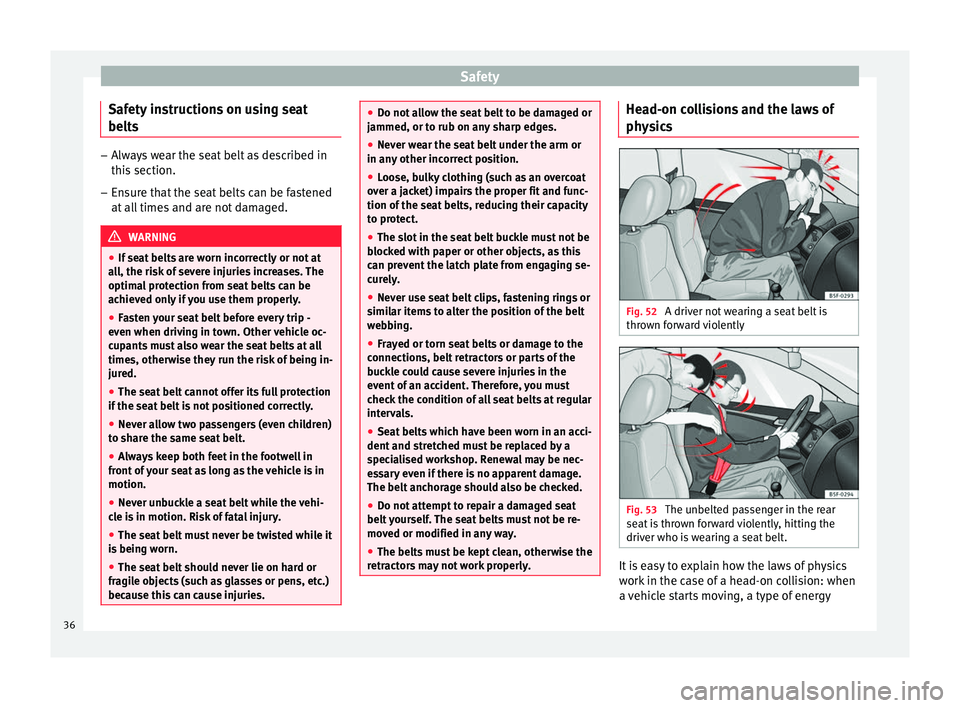
retractors may not work properly. Head-on collisions and the laws of
physics
Fig. 52
A driver not wearing a seat belt is
thrown forward violently Fig. 53
The unbelted passenger in the rear
seat is thrown forward violently, hitting the
driver who is wearing a seat belt. It is easy to explain how the laws of physics
work in the case of a head-on collision: when
a vehicle starts moving, a type of energy
36
Page 40 of 240
Safety
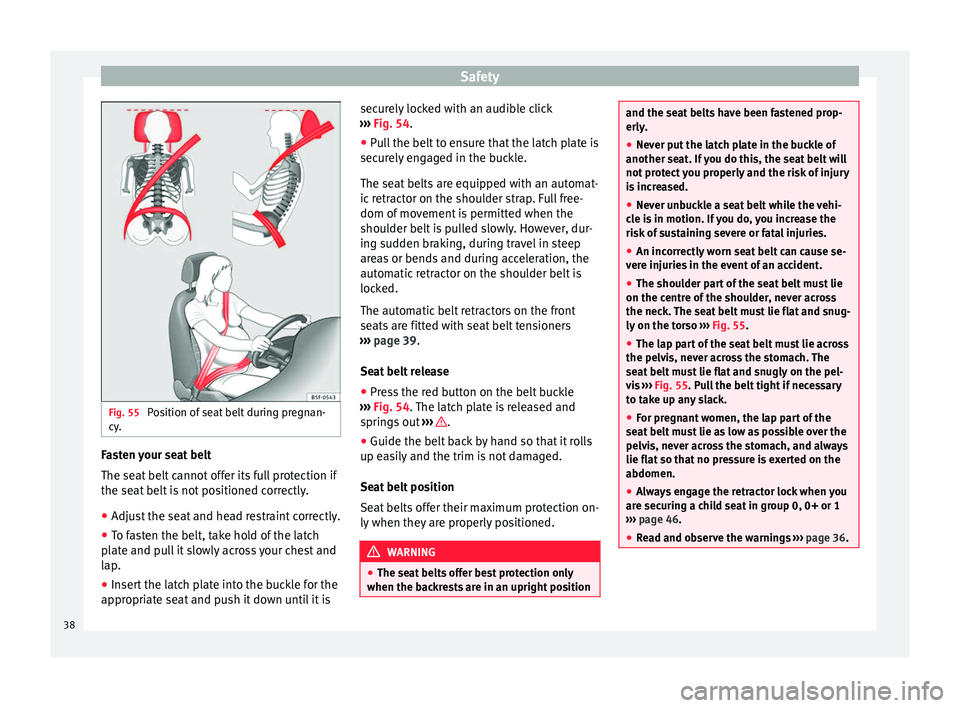
Fig. 55
Position of seat belt during pregnan-
cy. Fasten your seat belt
The seat belt cannot offer its full protection if
the seat belt is not positioned correctly.
● Adjust the seat and head restraint correctly.
● To fasten the belt, take hold of the latch
plate and pull it slowly across your chest and
lap.
● Insert the latch plate into the buckle for the
appropriate seat and push it down until it is securely locked with an audible click
››› Fig. 54 .
● Pu
ll the belt to ensure that the latch plate is
securely engaged in the buckle.
The seat belts are equipped with an automat-
ic retractor on the shoulder strap. Full free-
dom of movement is permitted when the
shoulder belt is pulled slowly. However, dur-
ing sudden braking, during travel in steep
areas or bends and during acceleration, the
automatic retractor on the shoulder belt is
locked.
The automatic belt retractors on the front
seats are fitted with seat belt tensioners
››› page 39.
Seat
belt release
● Press the red button on the belt buckle
››› Fig. 54. The latch plate is released and
sprin
gs out ››› .
● Guide the belt back by hand so that it rolls
up easily and the trim is not damaged.
Seat belt position
Seat belts offer their maximum protection on-
ly when they are properly positioned. WARNING
● The seat belts offer best protection only
when the backrests are in an upright position and the seat belts have been fastened prop-
erly.
●
Never put the latch plate in the buckle of
another seat. If you do this, the seat belt will
not protect you properly and the risk of injury
is increased.
● Never unbuckle a seat belt while the vehi-
cle is in motion. If you do, you increase the
risk of sustaining severe or fatal injuries.
● An incorrectly worn seat belt can cause se-
vere injuries in the event of an accident.
● The shoulder part of the seat belt must lie
on the centre of the shoulder, never across
the neck. The seat belt must lie flat and snug-
ly on the torso ››› Fig. 55.
● The l ap p
art of the seat belt must lie across
the pelvis, never across the stomach. The
seat belt must lie flat and snugly on the pel-
vis ››› Fig. 55. Pull the belt tight if necessary
to t
ake up any slack.
● For pregnant women, the lap part of the
seat belt must lie as low as possible over the
pelvis, never across the stomach, and always
lie flat so that no pressure is exerted on the
abdomen.
● Always engage the retractor lock when you
are securing a child seat in group 0, 0+ or 1
››› page 46.
● Re
ad and observe the warnings ››› page 36.38
Page 43 of 240
Airbag system
The airbag system operation is monitored
electronically. The airbag control lamp will il-
luminate for a few seconds every time the ig-
nition is switched on (self-diagnosis).
There is a fault in the system if the control
lamp
:
● doe
s not light up when the ignition is
switched on ››› page 42
,
● turns off after 4 seconds after the ignition
is switched on
● turns off and then lights up again after the
ignition is switched on
● illuminates or flashes while the vehicle is
moving.
The airbag system is not triggered if:
● the ignition is switched off
● there is a minor frontal collision
● there is a minor side collision
● there is a rear-end collision
● the vehicle turns over. WARNING
● The seat belts and airbags can only provide
maximum protection if the occupants are
seated correctly ››› page 30, Proper sitting
position for occupants.
● If a fault has occurred in the airbag system,
have the system checked immediately by a
specialised workshop. Otherwise, during a frontal collision the system might not trigger
correctly or may fail to trigger at all.
Airbag activation
The airbags deploy extremely rapidly, within
thousandths of a second, to provide addi-
tional protection in the event of an accident.
A fine dust may develop when the airbag de-
ploys. This is normal and it is not an indica-
tion of fire in the vehicle.
The airbag system is only ready to function
when the ignition is on.
In special accidents instances, several air-
bags may activate at the same time.
In the event of minor head-on and side colli-
sions, rear-end collisions, overturning or roll-
over of the vehicle, airbags
do not activate.
Activation factors
The conditions that lead to the airbag system
activating in each situation cannot be gener-
alised. Some factors play an important role,
such as the properties of the object the vehi-
cle hits (hard/soft), angle of impact, vehicle
speed, etc.
Deceleration trajectory is key for airbag acti-
vation. The control unit analyses the collision trajec-
tory and activates the respective restraint
system.
If the deceleration rate is below the prede-
fined reference value in the control unit the
airbags will not be triggered, even though
the accident may cause extensive damage to
the car.
The following airbags are triggered in
serious head-on collisions
● Driver airbag.
● Front passenger front airbag
The following airbags are triggered in
serious side-on collisions
● Front side airbag on the side of the acci-
dent.
● Rear side airbag on the side of the acci-
dent.
● Curtain (head) airbag on the side of the ac-
cident.
In an accident with airbag activation:
● the interior lights switch on (if the interior
light switch is in the courtesy light position);
● the hazard warning lights switch on;
● all doors are unlocked;
● the fuel supply to the engine is cut.
41
Technical specifications
Advice
Operation
Safety
The essentials
Page 49 of 240
Transporting children safety
Follow the manufacturer's instructions and
observe any statutory requirements when in-
stalling and using child seats. Always read
and note ››› page 47 .
W e r
ecommend you always carry the manu-
facturer's Child Seat Instruction Manual to-
gether with the on-board documentation.
Important information on the front
passenger airbag Fig. 63
Passenger's side sun visor: airbag
sticker. Fig. 64
On the rear frame of the passenger
side door: airbag sticker. A sticker with important information about
the passenger airbag is located on the pas-
senger's sun visor and/or on the passenger
side door frame. Read and always observe
the safety information included in the follow-
ing chapters:
● Safety distance with respect to the passen-
ger airbag ››› page 40 .
● Ob
jects between the passenger and the
passenger side airbag ››› in Front airbags
on page 43 .
The p a
ssenger side front airbag, when ena-
bled, is a serious risk for a child that is facing
backward since the airbag can strike the seat
with such force that it can cause serious or
fatal injuries. Children up to 12 years old
should always travel on the rear seat.
Therefore we strongly recommend you to
transport children on the rear seats. This is the safest location in the vehicle. Alternative-
ly, the front passenger airbag can be disa-
bled with a key-operated switch
››› page 45.
When transporting children, use a child seat
appropriate to the age and size of each child. WARNING
● If a child seat is secured to the front pas-
senger seat, the risk to the child of sustain-
ing critical or fatal injuries in the event of an
accident increases.
● An inflating front passenger airbag can
strike the rear-facing child seat and project it
with great force against the door, the roof or
the backrest.
● Never install a child seat facing backwards
on the front passenger seat unless the front
passenger front airbag has been disabled.
Risk of potentially fatal injuries to the child!
However, if it is necessary, in exceptional ca-
ses, to transport a child in the front passen-
ger seat, the front passenger front airbag
must always be disabled ››› page 45, Front
passenger airbag deactivation*. If the front
passenger seat has a height adjustment op-
tion, move it to the highest position.
● For those vehicles that do not include a key
lock switch to deactivate the airbag, the vehi-
cle must be taken to a technical service.
● All vehicle occupants, especially children,
must assume the proper sitting position and
be properly belted in while travelling. » 47
Technical specifications
Advice
Operation
Safety
The essentials
Page 50 of 240
Safety
●
Never hold children or babies on your lap,
this can result in potentially fatal injuries to
the child!
● Never allow a child to be transported in a
vehicle without being properly secured, or to
stand up or kneel on a seat while travelling.
In an accident, the child could be flung
through the vehicle, causing possibly fatal in-
juries to themselves and to the other vehicle
occupants.
● If children assume an improper sitting posi-
tion when the vehicle is moving, they expose
themselves to greater risk of injury in the
event of a sudden braking manoeuvre or in an
accident. This is particularly important if the
child is travelling on the front passenger seat
and the airbag system is triggered in an acci-
dent; as this could cause serious injury or
even death.
● A suitable child seat can protect your child!
● Never leave a child alone in the child seat
or inside the vehicle because depending on
the season, very high temperatures may be
reached inside a parked vehicle, which could
be fatal.
● Children who are less than 1.5 metres tall
must not wear a normal seat belt without a
child seat, as this could cause injuries to the
abdominal and neck areas during a sudden
braking manoeuvre or in an accident.
● Do not allow the seat belt to become twis-
ted and the seat belt should be properly in
place ››› page 34. ●
Only one child may occupy a child seat
››› page 48, Child seats.
● When a c hi
ld seat is mounted in the rear
seats, the door child-proof lock should be ac-
tivated ››› page 82. Child seats
Categorisation of child seats into
groups Only use child seats that are officially ap-
proved and suitable for the child.
Child seats are subject to the regulation ECE-
R 44. ECE-R stands for: Economic Commis-
sion for Europe Regulation.
The child seats are grouped into 5 catego-
ries:
Group 0 : Up to 10 kg (up to around 9
months)
Gr oup 0+
: Up to 13 kg (up to around 18
months)
Group 1
: from 9 to 18 kg (up to approx. 4
years old)
Group 2
: from 15 to 25 kg (up to approx. 7
years old) Group 3: From 22 to 36 kg (over around 7
years old)
Child seats that have been tested and ap-
proved under the ECE R44 standard bear the
test mark on the seat (the letter E in a circle
with the test number below it).
Follow the manufacturer's instructions and
observe any statutory requirements when in-
stalling and using child seats.
We recommend you to always include the
manufacturer's Child Seat Instruction Manual
together with the on-board documentation.
SEAT recommends you use child seats from
the Original Accessories Catalogue . The
se
child seats have been designed and tested
for use in SEAT vehicles. You can find the
right child seat for your model and age group
at SEAT dealers. WARNING
Read and always observe information and
warnings concerning the use of child seats
››› page 47.48
Page 54 of 240
Safety
Top Tether retainer straps* Fig. 67
Position of the Top Tether rings on the
back of the rear seat. Child seats with the Top Tether system come
with a strap for securing the seat to the vehi-
cle anchor point, located at the back of the
rear seat backrest and provide greater re-
straint.
The objective of this strap is to reduce the
forward movement of the child seat in a
crash, to reduce the risk of injuries to the
head from hitting the inside of the vehicle.
Using the Top Tether in rear-facing mounted
seats
Currently, there are very few rear-facing child
safety seats that have Top Tether. Please
carefully read and follow the seat manufac-
turer instructions to learn the proper way to
install the Top Tether strap. WARNING
An undue installation of the safety seat will
increase the risk of injury in the event of a
crash.
● Never tie the retainer strap to a hook in the
luggage compartment.
● Never secure or tie luggage or other items
to the lower anchorages (ISOFIX) or the upper
ones (Top Tether). Fitting the Top Tether* child restraint
to the anchoring point
Fig. 68
Retainer strap: correct adjustment
and fitting. Securing the Top Tether child restraint to the
anchor point situated on the rear of the
backrest
– Pull out the fastening belt of the child re-
straint seat according to the manufacturer's
instructions. –
Guide the Top Tether fastening belt under
the rear seat head restraint ››› Fig. 68 (lift
the he a
d restraint where necessary).
– Slide the belt so that the Top Tether belt of
the child restraint seat is correctly secured
to the anchor on the back of the rear seat.
– Firmly tighten the Top Tether belt following
the child restraint seat manufacturer's in-
structions.
Releasing the retaining strap
– Release the retainer strap in line with the
instructions given by the manufacturer.
– Push the lock and release it from the an-
choring support. WARNING
An undue installation of the safety seat will
increase the risk of injury in the event of a
crash.
● Never tie the retainer strap to a hook in the
luggage compartment.
● Never secure or tie luggage or other items
to the lower anchorages (ISOFIX) or the upper
ones (Top Tether). 52
Page 57 of 240
Dash panel
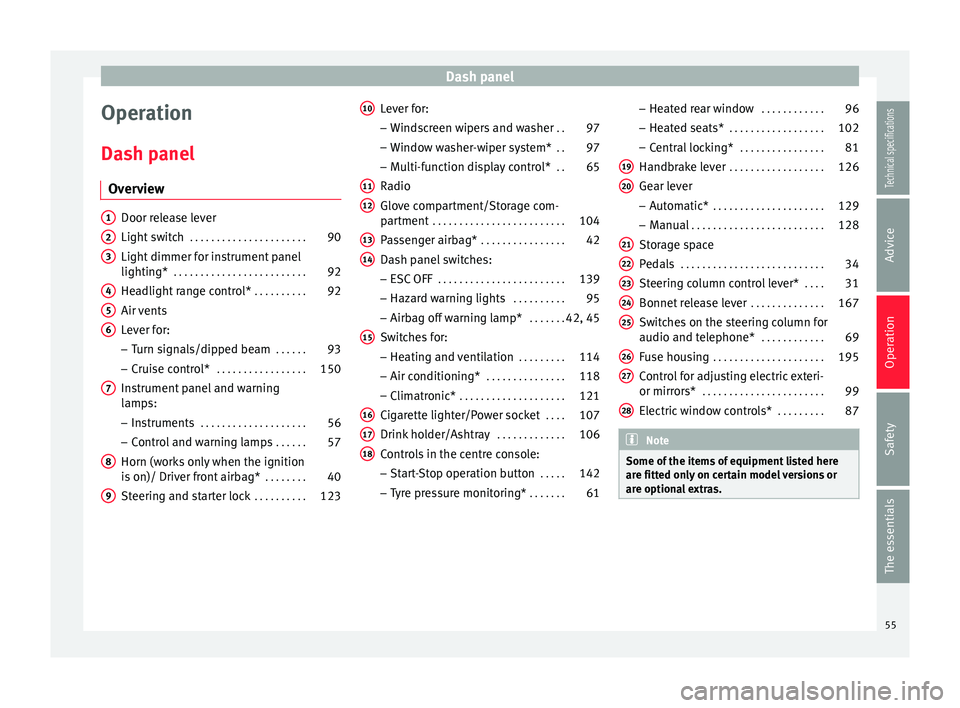
Operation
Dash panel Overview Door release lever
Light switch
. . . . . . . . . . . . . . . . . . . . . . 90
Light dimmer for instrument panel
lighting* . . . . . . . . . . . . . . . . . . . . . . . . . 92
Headlight range control* . . . . . . . . . .92
Air vents
Lever for: – Turn signals/dipped beam . . . . . .93
– Cruise control* . . . . . . . . . . . . . . . . . 150
Instrument panel and warning
lamps: – Instruments . . . . . . . . . . . . . . . . . . . . 56
– Control and warning lamps . . . . . .57
Horn (works only when the ignition
is on)/ Driver front airbag* . . . . . . . .40
Steering and starter lock . . . . . . . . . .123
1 2
3
4
5
6
7
8
9 Lever for:
– Windscreen wipers and washer . .97
– Window washer-wiper system* . .97
– Multi-function display control* . .65
Radio
Glove compartment/Storage com-
partment . . . . . . . . . . . . . . . . . . . . . . . . . 104
Passenger airbag* . . . . . . . . . . . . . . . . 42
Dash panel switches: – ESC OFF . . . . . . . . . . . . . . . . . . . . . . . . 139
– Hazard warning lights . . . . . . . . . .95
– Airbag off warning lamp* . . . . . . .42, 45
Switches for: – Heating and ventilation . . . . . . . . .114
– Air conditioning* . . . . . . . . . . . . . . . 118
– Climatronic* . . . . . . . . . . . . . . . . . . . . 121
Cigarette lighter/Power socket . . . .107
Drink holder/Ashtray . . . . . . . . . . . . .106
Controls in the centre console:
– Start-Stop operation button . . . . .142
– Tyre pressure monitoring* . . . . . . .61
10 11
12
13
14
15
16
17
18 –
Heated rear window . . . . . . . . . . . .96
– Heated seats* . . . . . . . . . . . . . . . . . . 102
– Central locking* . . . . . . . . . . . . . . . . 81
Handbrake lever . . . . . . . . . . . . . . . . . . 126
Gear lever – Automatic* . . . . . . . . . . . . . . . . . . . . . 129
– Manual . . . . . . . . . . . . . . . . . . . . . . . . . 128
Storage space
Pedals . . . . . . . . . . . . . . . . . . . . . . . . . . . 34
Steering column control lever* . . . .31
Bonnet release lever . . . . . . . . . . . . . .167
Switches on the steering column for
audio and telephone* . . . . . . . . . . . .69
Fuse housing . . . . . . . . . . . . . . . . . . . . . 195
Control for adjusting electric exteri-
or mirrors* . . . . . . . . . . . . . . . . . . . . . . . 99
Electric window controls* . . . . . . . . .87 Note
Some of the items of equipment listed here
are fitted only on certain model versions or
are optional extras. 19
20
21
22
23
24
25
26
27
28
55Technical specifications
Advice
Operation
Safety
The essentials
Page 60 of 240
Operation
Priority 2 warning messages will not be
shown until all Priority 1 warning messages
have been dealt with!
Examples of priority 2 warning reports
(yellow):*
● Fuel warning light with the information text
PLEASE REFUEL .
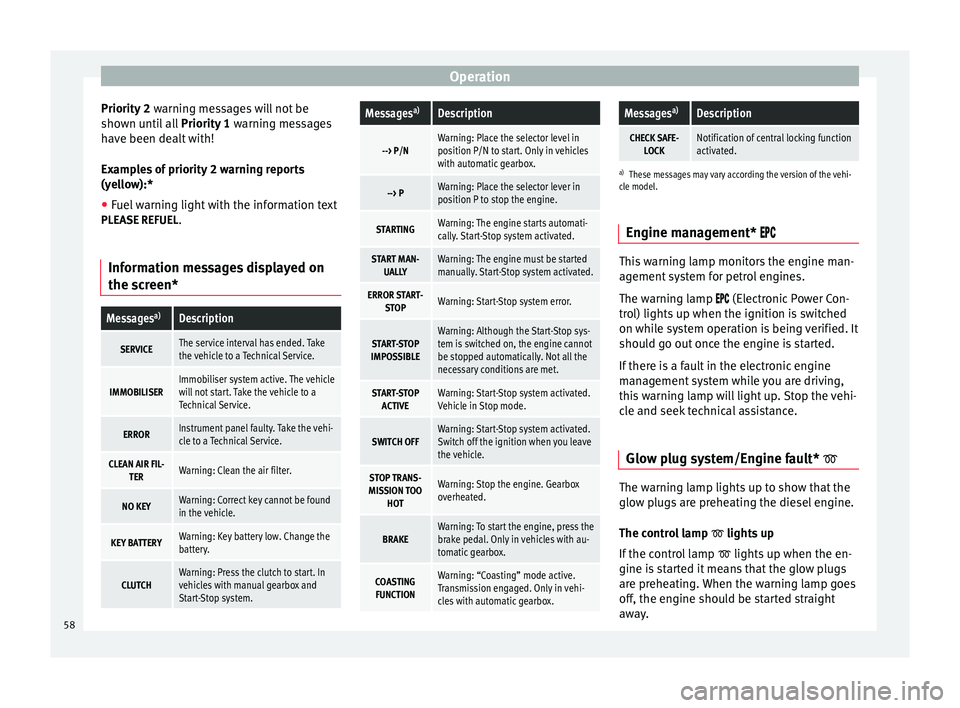
Information messages displayed on
the screen*Messages a)Description
SERVICEThe service interval has ended. Take
the vehicle to a Technical Service.
IMMOBILISERImmobiliser system active. The vehicle
will not start. Take the vehicle to a
Technical Service.
ERRORInstrument panel faulty. Take the vehi-
cle to a Technical Service.
CLEAN AIR FIL-
TERWarning: Clean the air filter.
NO KEYWarning: Correct key cannot be found
in the vehicle.
KEY BATTERYWarning: Key battery low. Change the
battery.
CLUTCHWarning: Press the clutch to start. In
vehicles with manual gearbox and
Start-Stop system.
Messages a)Description
--> P/NWarning: Place the selector level in
position P/N to start. Only in vehicles
with automatic gearbox.
--> PWarning: Place the selector lever in
position P to stop the engine.
STARTINGWarning: The engine starts automati-
cally. Start-Stop system activated.
START MAN-
UALLYWarning: The engine must be started
manually. Start-Stop system activated.
ERROR START- STOPWarning: Start-Stop system error.
START-STOP
IMPOSSIBLEWarning: Although the Start-Stop sys-
tem is switched on, the engine cannot
be stopped automatically. Not all the
necessary conditions are met.
START-STOP ACTIVEWarning: Start-Stop system activated.
Vehicle in Stop mode.
SWITCH OFFWarning: Start-Stop system activated.
Switch off the ignition when you leave
the vehicle.
STOP TRANS-
MISSION TOO HOTWarning: Stop the engine. Gearbox
overheated.
BRAKEWarning: To start the engine, press the
brake pedal. Only in vehicles with au-
tomatic gearbox.
COASTINGFUNCTIONWarning: “Coasting” mode active.
Transmission engaged. Only in vehi-
cles with automatic gearbox.
Messages a)Description
CHECK SAFE-
LOCKNotification of central locking function
activated.
a)These messages may vary according the version of the vehi-
cle model.
Engine management* This warning lamp monitors the engine man-
agement system for petrol engines.
The warning lamp (Electronic Power Con-
trol) lights up when the ignition is switched
on while system operation is being verified. It
should go out once the engine is started.
If there is a fault in the electronic engine
management system while you are driving,
this warning lamp will light up. Stop the vehi-
cle and seek technical assistance.
Glow plug system/Engine fault* The warning lamp lights up to show that the
glow plugs are preheating the diesel engine.
The control lamp
lights up
If the control lamp lights up when the en-
gine is started it means that the glow plugs
are preheating. When the warning lamp goes
off, the engine should be started straight
away.
58