technical data Seat Ibiza ST 2009 Owner's manual
[x] Cancel search | Manufacturer: SEAT, Model Year: 2009, Model line: Ibiza ST, Model: Seat Ibiza ST 2009Pages: 250, PDF Size: 6.4 MB
Page 222 of 250
If and when221
Safety First
Operating instructions
Practical tips
Technical Data
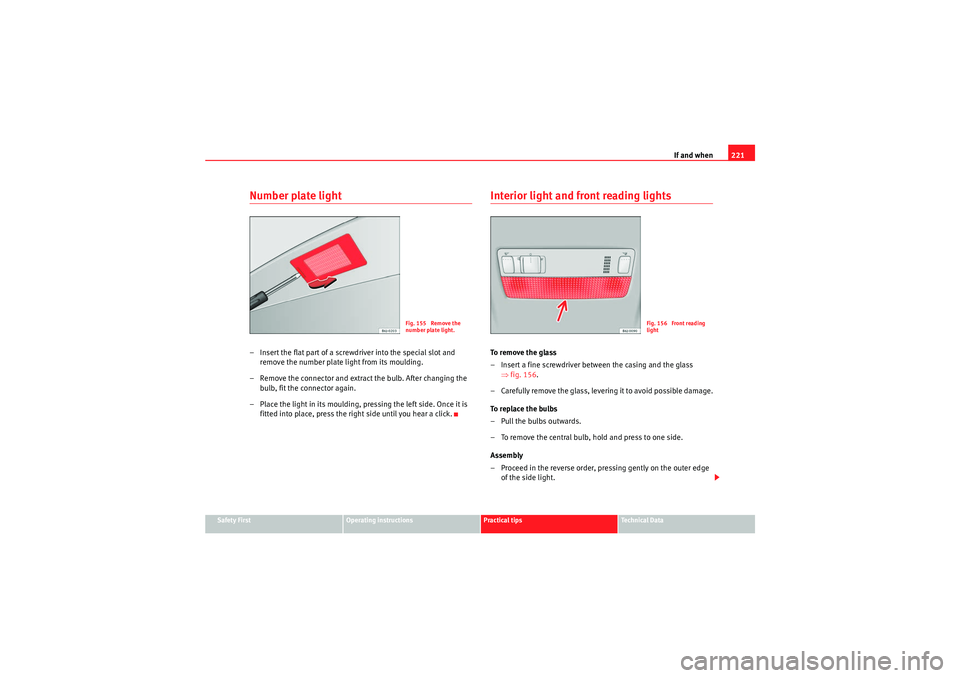
Number plate light– Insert the flat part of a screwdriver into the special slot and
remove the number plate light from its moulding.
– Remove the connector and extract the bulb. After changing the bulb, fit the connector again.
– Place the light in its moulding, pr essing the left side. Once it is
fitted into place, press the right side until you hear a click.
Interior light and front reading lightsTo r e m o v e t h e g l a s s
– Insert a fine screwdriver between the casing and the glass ⇒fig. 156 .
– Carefully remove the glass, levering it to avoid possible damage.
To replace the bulbs
– Pull the bulbs outwards.
– To remove the central bulb, hold and press to one side.
Assembly
– Proceed in the reverse order, pressing gently on the outer edge of the side light.
Fig. 155 Remove the
number plate light.
Fig. 156 Front reading
light
Ibiza ST_EN.book Seite 221 Dienstag, 12. Januar 2010 4:03 16
Page 224 of 250
If and when223
Safety First
Operating instructions
Practical tips
Technical Data
Jump leads
Jump leads must comply with the standard
DIN 72553 (see manufacturer's
documentation). The wire cross section must be at least 25 mm
2 for petrol
engines and at least 35 mm
2 for diesel engines.
Note
•The vehicles must not touch each other, otherwise electricity could flow as
soon as the positive terminals are connected.•The discharged battery must be properly connected to the vehicle elec-
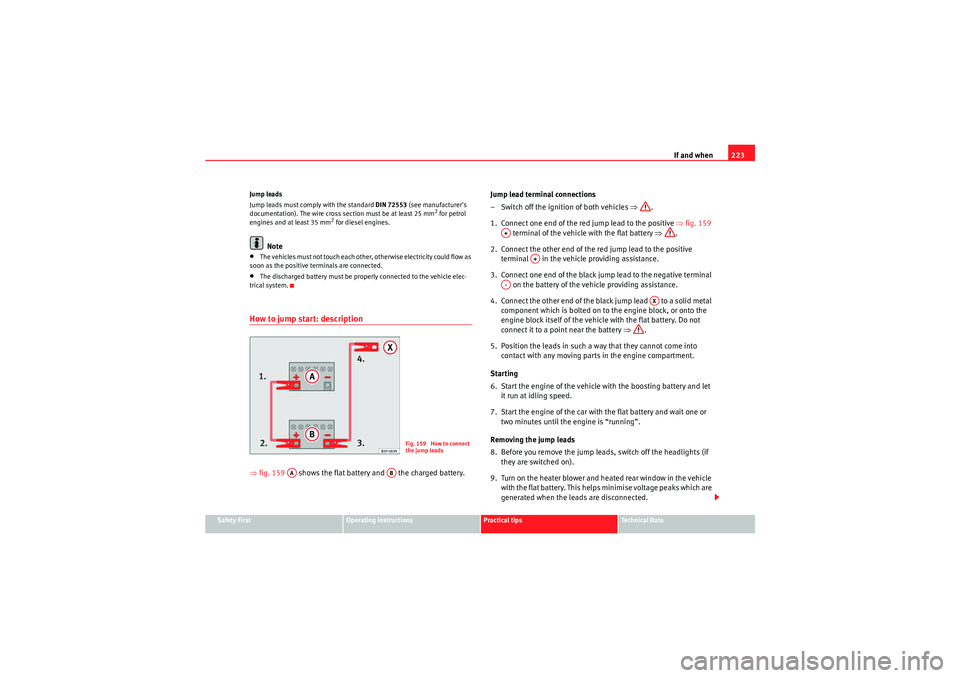
trical system.How to jump start: description⇒ fig. 159 shows the flat battery and the charged battery. Jump lead terminal connections
– Switch off the ignition of both vehicles
⇒.
1. Connect one end of the red jump lead to the positive ⇒fig. 159
terminal of the vehicle with the flat battery ⇒.
2. Connect the other end of the red jump lead to the positive terminal in the vehicle providing assistance.
3. Connect one end of the black jump lead to the negative terminal on the battery of the vehicle providing assistance.
4. Connect the other end of the black jump lead to a solid metal component which is bolted on to the engine block, or onto the
engine block itself of the vehicle with the flat battery. Do not
connect it to a point near the battery ⇒.
5. Position the leads in such a way that they cannot come into contact with any moving parts in the engine compartment.
Starting
6. Start the engine of the vehicle with the boosting battery and let it run at idling speed.
7. Start the engine of the car with the flat battery and wait one or two minutes until the engine is “running”.
Removing the jump leads
8. Before you remove the jump leads, switch off the headlights (if they are switched on).
9. Turn on the heater blower and heated rear window in the vehicle with the flat battery. This helps minimise voltage peaks which are
generated when the leads are disconnected.
Fig. 159 How to connect
the jump leads
AA
AB
A+
A+
A-
AX
Ibiza ST_EN.book Seite 223 Dienstag, 12. Januar 2010 4:03 16
Page 226 of 250
If and when225
Safety First
Operating instructions
Practical tips
Technical Data
Towing and tow-startingTo w - s t a r t i n g *
The use of jump leads is pr eferable to tow-starting.We recommend that you do not tow-start your vehicle. Jump-starting
is preferable ⇒page 222.
However, if your vehicle has to be tow-started:
– Engage the 2
nd or the 3
rd gear.
– Keep the clutch pressed down.
– Switch the ignition on.
– Once both vehicles are moving, release the clutch.
– As soon as the engine starts, press the clutch and move the gear lever into neutral. This helps to prevent driving into the towing
vehicle.
WARNING
The risk of accidents is high when tow-starting. The vehicle being towed
can easily collide with the towing vehicle.
Caution
When tow-starting, fuel could enter the catalytic converter and damage it.
CommentsPlease observe the following po ints if you use a tow-rope:
Notes for the driver of the towing vehicle
– Drive slowly at first until the tow-rope is taut. Then accelerate gradually.
– Begin and change gears cautiously. If you are driving an auto- matic vehicle, accelerate gently.
– Remember that the brake servo and power steering are not working in the vehicle you are towing. Brake earlier than you
would normally, but with a more gentle pressure on the brake.
Notes for the driver of the towed vehicle
– Ensure that the tow-rope remains taut at all times when towing.Tow-rope or tow-bar
It is easier and safer to tow a vehicle with a tow-bar. You should only use a
tow-rope if you do not have a tow-bar.
A tow-rope should be slightly elastic to reduce the loading on both vehicles.
It is advisable to use a tow-rope made of synthetic fibre or similarly elastic
material.
Attach the tow-rope or the tow-bar only to the towing eyes provided or a
towing bracket.
Driving style
Towing requires some experience, especially when using a tow-rope. Both
drivers should be familiar with the technique required for towing. Inexperi-
enced drivers should not attempt to tow-start or tow away another vehicle.
Ibiza ST_EN.book Seite 225 Dienstag, 12. Januar 2010 4:03 16
Page 228 of 250
If and when227
Safety First
Operating instructions
Practical tips
Technical Data
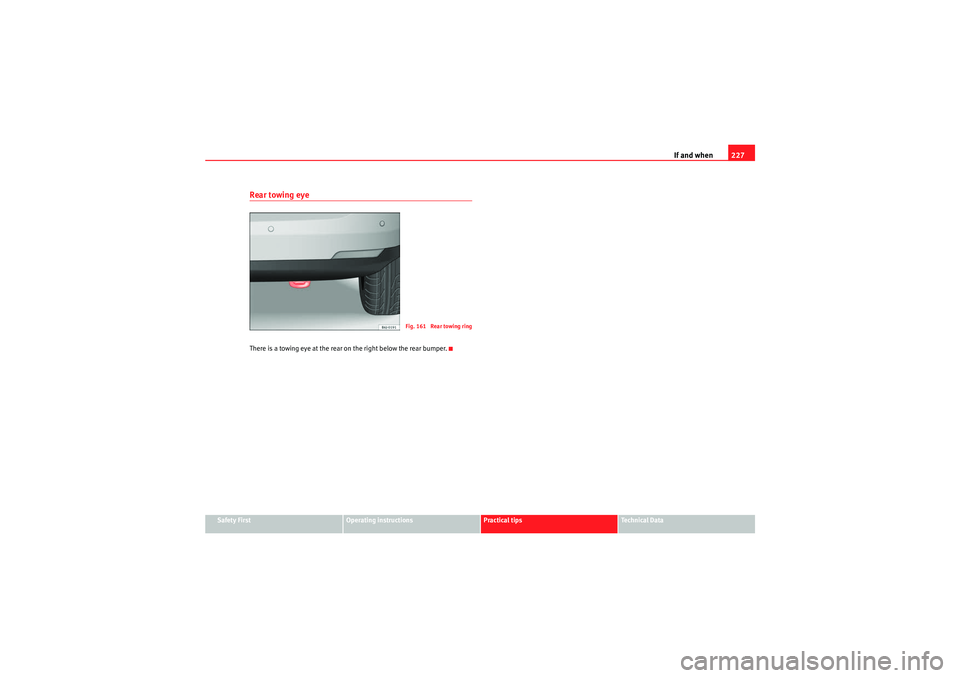
Rear towing eyeThere is a towing eye at the rear on the right below the rear bumper.
Fig. 161 Rear towing ring
Ibiza ST_EN.book Seite 227 Dienstag, 12. Januar 2010 4:03 16
Page 230 of 250
General notes on the technical data229
Safety First
Operating instructions
Practical tips
Technical Data
Te ch n i c a l D a t aGeneral notes on the technical dataOutstanding informationImportant considerations
All data in the official vehicle documents take precedence
over this data.All data provided in this manual are valid for the standard model in Spain. The
vehicle data card included in the Maintenance Programme or the vehicle
registration documents shows which engine is installed in your vehicle.
The figures may be different depending on if additional equipment is fitted,
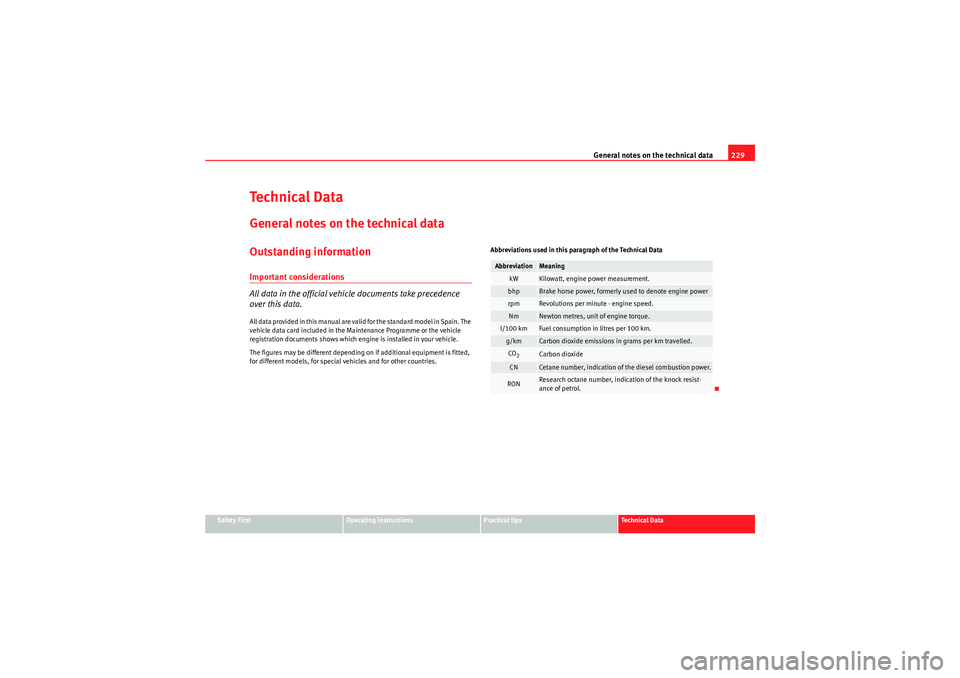
for different models, for special vehicles and for other countries. Abbreviations used in this paragraph of the Technical Data
Abbreviation
Meaning
kW
Kilowatt, engine power measurement.
bhp
Brake horse power, formerly used to denote engine power
rpm
Revolutions per minute - engine speed.
Nm
Newton metres, unit of engine torque.
l/100 km
Fuel consumption in litres per 100 km.
g/km
Carbon dioxide emissions in grams per km travelled.
CO2
Carbon dioxide
CN
Cetane number, indication of the diesel combustion power.
RON
Research octane number, indication of the knock resist-
ance of petrol.
Ibiza ST_EN.book Seite 229 Dienstag, 12. Januar 2010 4:03 16
Page 231 of 250
General notes on the technical data
230Vehicle identification data
The most important data are given on the type plate and the
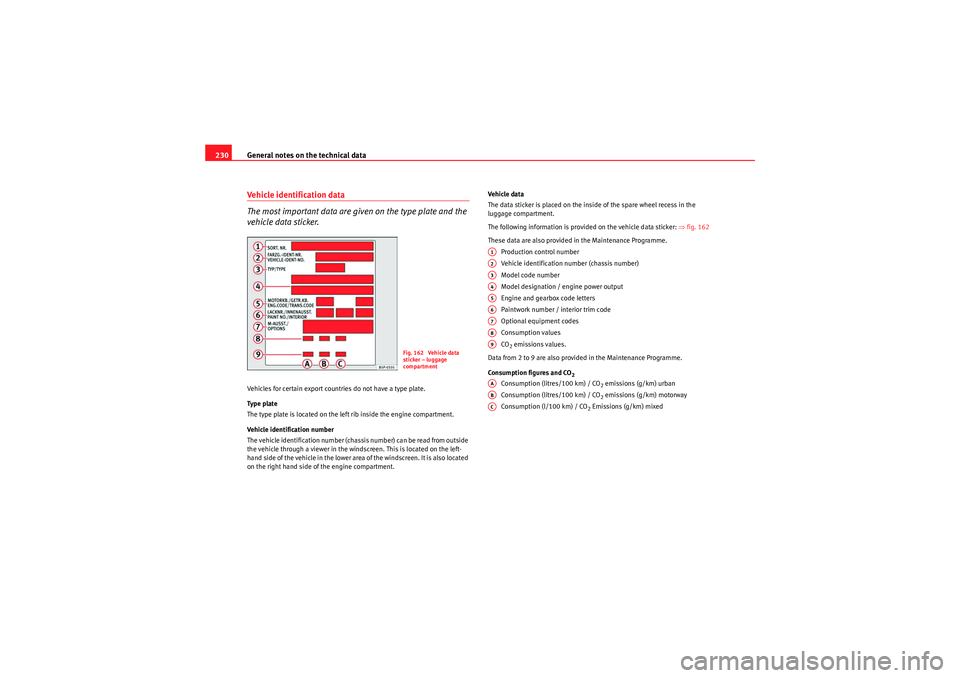
vehicle data sticker.Vehicles for certain export countries do not have a type plate.
Type plate
The type plate is located on the left rib inside the engine compartment.
Vehicle identification number
The vehicle identification number (chassis number) can be read from outside
the vehicle through a viewer in the windscreen. This is located on the left-
hand side of the vehicle in the lower area of the windscreen. It is also located
on the right hand side of the engine compartment. Vehicle data
The data sticker is placed on the inside of the spare wheel recess in the
luggage compartment.
The following information is provided on the vehicle data sticker:
⇒fig. 162
These data are also provided in the Maintenance Programme. Production control number
Vehicle identification number (chassis number)
Model code number
Model designation / engine power output
Engine and gearbox code letters
Paintwork number / interior trim code
Optional equipment codes
Consumption values
CO
2 emissions values.
Data from 2 to 9 are also provided in the Maintenance Programme.
Consumption figures and CO
2
Consumption (litres/100 km) / CO
2 emissions (g/km) urban
Consumption (litres/100 km) / CO2 emissions (g/km) motorway
Consumption (l/100 km) / CO
2 Emissions (g/km) mixed
Fig. 162 Vehicle data
sticker – luggage
compartment
A1A2A3A4A5A6A7A8A9AAABAC
Ibiza ST_EN.book Seite 230 Dienstag, 12. Januar 2010 4:03 16
Page 232 of 250
General notes on the technical data231
Safety First
Operating instructions
Practical tips
Technical Data
Data on fuel consumptionFuel consumption
The consumption and emission details shown on the vehicle
data sticker differ from one vehicle to another.The fuel consumption and CO
2 emissions of the vehicle can be found on the
vehicle data sticker.
The fuel consumption and emissions figures given are based on the vehicle
weight category, which is determined according to the engine/gearbox
combination and the equipment fitted.
The consumption and emission figures are calculated in accordance with the
EC test requirements 1999/100/EC. These test requirements specify a real-
istic test method based on normal everyday driving.
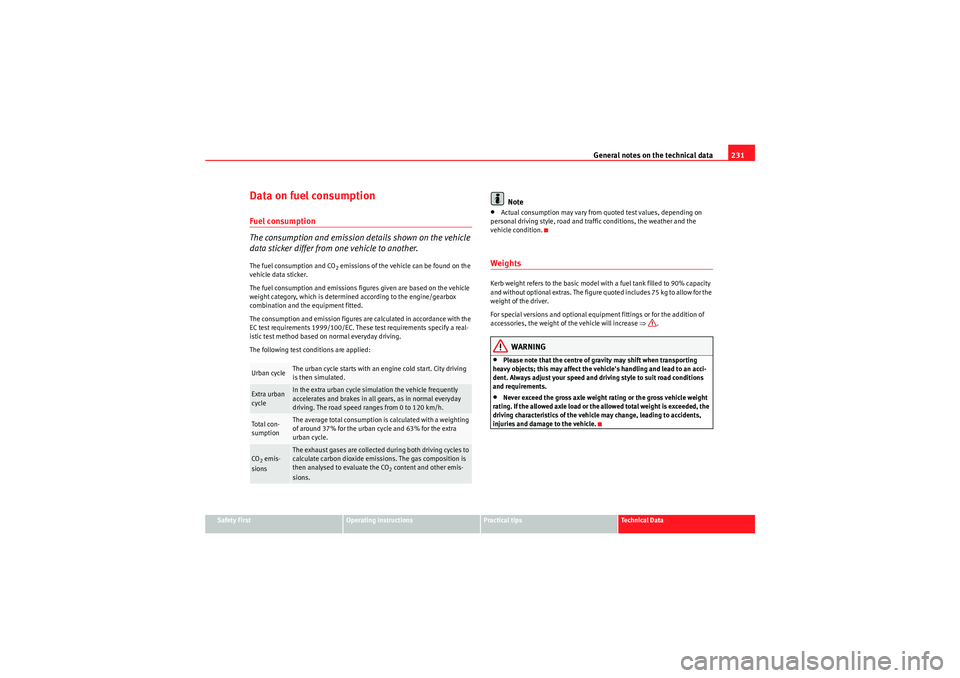
The following test conditions are applied:
Note
•Actual consumption may vary from quoted test values, depending on
personal driving style, road and traffic conditions, the weather and the
vehicle condition.WeightsKerb weight refers to the basic model with a fuel tank filled to 90% capacity
and without optional extras. The figure quoted includes 75 kg to allow for the
weight of the driver.
For special versions and optional equipment fittings or for the addition of
accessories, the weight of the vehicle will increase ⇒.
WARNING
•Please note that the centre of gravity may shift when transporting
heavy objects; this may affect the vehicle's handling and lead to an acci-
dent. Always adjust your speed and driving style to suit road conditions
and requirements.•Never exceed the gross axle weight rating or the gross vehicle weight
rating. If the allowed axle load or the allowed total weight is exceeded, the
driving characteristics of the vehicle may change, leading to accidents,
injuries and damage to the vehicle.
Urban cycle
The urban cycle starts with an engine cold start. City driving
is then simulated.
Extra urban
cycle
In the extra urban cycle simulation the vehicle frequently
accelerates and brakes in all gears, as in normal everyday
driving. The road speed ranges from 0 to 120 km/h.
To ta l co n-
sumption
The average total consumption is calculated with a weighting
of around 37% for the urban cycle and 63% for the extra
urban cycle.
CO2 emis-
sions
The exhaust gases are collected during both driving cycles to
calculate carbon dioxide emissions. The gas composition is
then analysed to evaluate the CO
2 content and other emis-
sions.
Ibiza ST_EN.book Seite 231 Dienstag, 12. Januar 2010 4:03 16
Page 233 of 250
General notes on the technical data
232Towing a trailerTrailer weightsTrailer weight
The trailer weights and drawbar loads approved are selected in intensive
trials according to precisely defined criteria. The approved trailer weights are
valid for vehicles in the EU for maximum speeds of 80 km/h (in certain
circumstances up to 100 km/h). The figures may be different in other coun-
tries. All data in the official vehicle documents take precedence over these
data ⇒ .
Drawbar load
The maximum permitted weight exerted by the trailer drawbar on the ball joint
of the towing bracket must not exceed 75 kg.
In the interest of road safety, we recommend that you always tow
approaching the maximum drawbar load. The response of the trailer on the
road will be poor if the drawbar load is too small.
If the maximum permissible drawbar load cannot be met (e.g. with small,
empty and light-weight single axle trailers o r ta n d e m a x l e t r a i l e r s wi t h a n a x le
base of less than 1 metre), at least 4% of the actual trailer weight is a legal
stipulation for a drawbar load.
WARNING
•For safet y reas ons , d o not excee d the 8 0 k m/h limit . Th is is als o valid in
countries where higher speeds are permitted.•Never exceed the maximum trailer weights or the drawbar load. If the
permissible axle load or the permissible total weight is exceeded, the
driving characteristics of the vehicle may change, leading to accidents,
injuries and damage to the vehicle.
WheelsTyre pressure, snow chains, wheel boltsTyre pressures
The sticker with the tyre pressure values can be found on the inside of the
tank flap. The tyre pressure values given there are for cold tyres. The slightly
raised pressures of warm tyres must not be reduced. ⇒
Snow chains
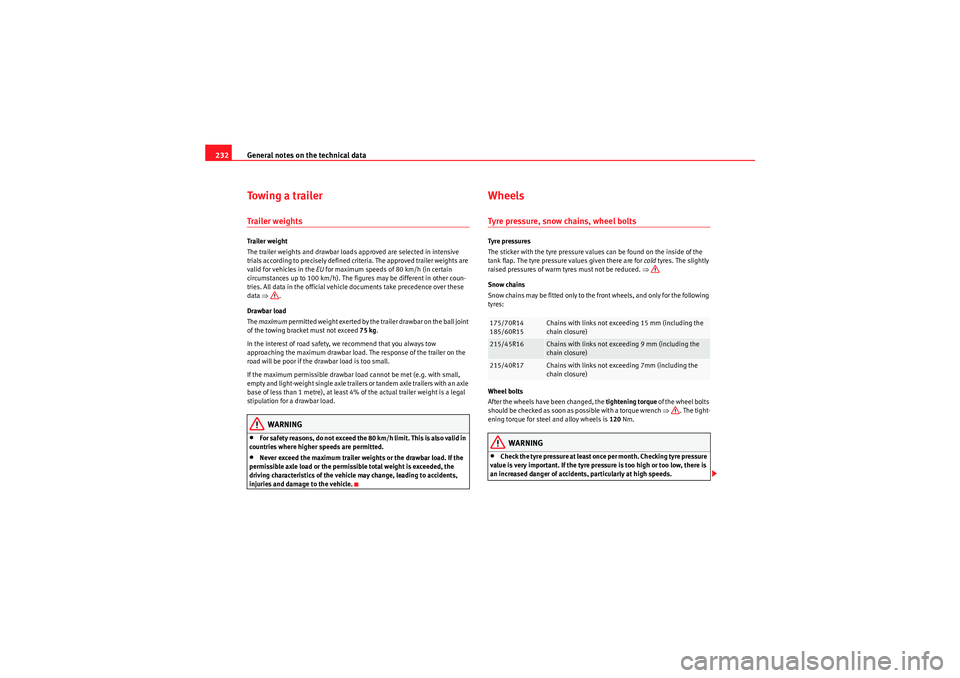
Snow chains may be fitted only to the front wheels, and only for the following
tyres:
Wheel bolts
After the wheels have been changed, the tightening torque of the wheel bolts
s ho uld b e che cke d as s o on as p ossible wit h a to rqu e w re nch ⇒ . The tight-
ening torque for steel and alloy wheels is 120 Nm.
WARNING
•Check the tyre pressure at least once per month. Checking tyre pressure
value is very important. If the tyre pressure is too high or too low, there is
an increased danger of accidents, particularly at high speeds.175/70R14
185/60R15
Chains with links not exceeding 15 mm (including the
chain closure)
215/45R16
Chains with links not exceeding 9 mm (including the
chain closure)
215/40R17
Chains with links not exceeding 7mm (including the
chain closure)
Ibiza ST_EN.book Seite 232 Dienstag, 12. Januar 2010 4:03 16
Page 234 of 250
General notes on the technical data233
Safety First
Operating instructions
Practical tips
Technical Data
•If the torque of the wheel bolts is too low, they could loosen while the
vehicle is in motion. Risk of accident! If the tightening torque is too high,
the wheel bolts and threads can be damaged.Note
We recommend that you ask your Authorised Service Centre for information
about appropriate wheel, tyre and snow chain size.
WARNING (continued)
Ibiza ST_EN.book Seite 233 Dienstag, 12. Januar 2010 4:03 16
Page 235 of 250
Technical Data
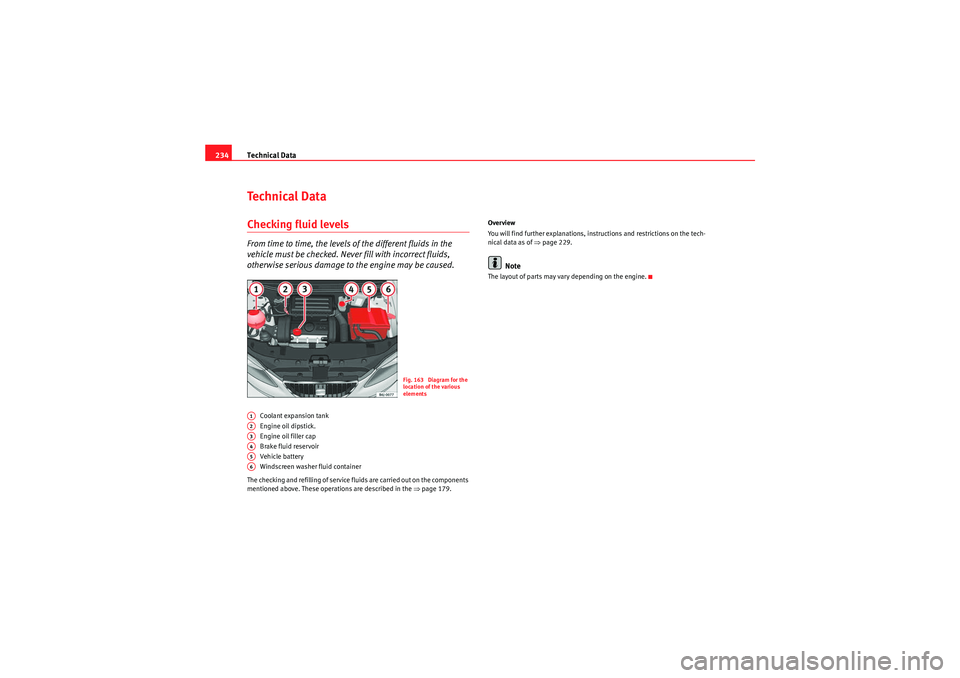
234Technical DataChecking fluid levelsFrom time to time, the levels of the different fluids in the
vehicle must be checked. Never fill with incorrect fluids,
otherwise serious damage to the engine may be caused.
Coolant expansion tank
Engine oil dipstick.
Engine oil filler cap
Brake fluid reservoir
Vehicle battery
Windscreen washer fluid container
The checking and refilling of service fluids are carried out on the components
mentioned above. These operations are described in the ⇒page 179. Overview
You will find further explanations, instructions and restrictions on the tech-
nical data as of
⇒page 229.
Note
The layout of parts may vary depending on the engine.
Fig. 163 Diagram for the
location of the various
elements
A1A2A3A4A5A6
Ibiza ST_EN.book Seite 234 Dienstag, 12. Januar 2010 4:03 16