display Seat Ibiza ST 2009 User Guide
[x] Cancel search | Manufacturer: SEAT, Model Year: 2009, Model line: Ibiza ST, Model: Seat Ibiza ST 2009Pages: 250, PDF Size: 6.4 MB
Page 66 of 250
Cockpit65
Safety First
Operating instructions
Practical tips
Technical Data
The instrument panel displays the following message
6):
SAFE . The vehicle
cannot be started in this case
The engine can, however, be started if the appropriate coded SEAT genuine
key is used.
Note
The vehicle cannot operate properly if you do not have a genuine SEAT key.6)Depending on the version of the model.
Ibiza ST_EN.book Seite 65 Dienstag, 12. Januar 2010 4:03 16
Page 127 of 250
Air conditioning
126•If the function is not deactivated by pressing the button, this will deacti-
vate after approx. 20 min.Economic use of the air conditioningWhen the air conditioning is switched on, the compressor consumes engine
power and has influence on fuel consumption. Consider the following points
in order to have the system operating in the minimum possible time.•If the vehicle interior has overheated due to an excessive solar radiation,
it is best to open the windows or doors to allow the hot air to escape.•While in motion, the air conditioning should not be switched on if the
windows or the sunroof are open.*
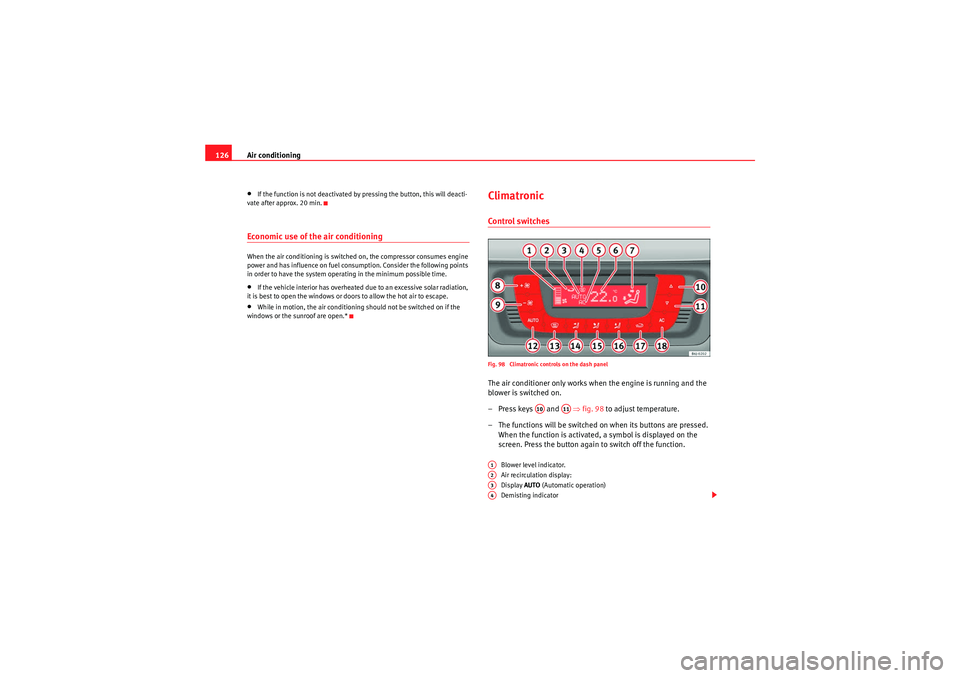
ClimatronicControl switchesFig. 98 Climatronic controls on the dash panelThe air conditioner only works when the engine is running and the
blower is switched on.
–Press keys and ⇒ fig. 98 to adjust temperature.
– The functions will be switched on when its buttons are pressed. When the function is activated, a symbol is displayed on the
screen. Press the button again to switch off the function.
Blower level indicator.
Air recirculation display:
Display AUTO (Automatic operation)
Demisting indicator
A10
A11
A1A2A3A4
Ibiza ST_EN.book Seite 126 Dienstag, 12. Januar 2010 4:03 16
Page 128 of 250
Air conditioning127
Safety First
Operating instructions
Practical tips
Technical Data
AC indicator (Cooling connected)
Interior temperature indicator selected
Air flow direction indicator
Fan speed increase
Fan speed decrease
Interior temperature increase
Interior temperature decrease
Button – Automatic adjustment of temperature, ventilation and air
distribution control
Button – Windscreen demisting function. The air drawn in is directed
at the windscreen. The air recirculation mode will be switched off as soon
as the demisting function is switched on. At temperatures over 3°C, the
cooling system is switched on automatically in order to dry the air.
Button – Air distribution to head area
Button – Air distribution to the upper body.
Button – Air distribution to footwell
– Manual air recirculation
button – To switch on the air conditioning.
WARNING
For your safety, the windows should never be fogged up or covered with
snow or ice. This is essential to ensure good visibility. Please familiarise
yourself with the correct operation of the heating and ventilation system,
including the demist/defrost functions for the windows.
Note
Please consider the general notes.
Automatic mode
In automatic mode air temperature, air flow and distribution
are automatically regulated so that a specified temperature is
attained as quickly as possible, and then maintained.Switching on automatic mode
– Press the button . The indication ⇒page 126, fig. 98
is visible.
–Press keys and ⇒page 126, fig. 98 to adjust the desired
temperature inside the vehicle. We recommend you adjust the
temperature to 22°C (72°F).A comfortable interior climate is quickly reached when a temperature of 22°C
(72°F) is set in automatic mode. Therefore, we recommend you not to change
this adjustment, except as necessary to suit individual preferences or partic-
ular circumstances. The inside temperature can be set between +18°C (64°F)
and +29°C (86°F). If a lower or higher temperature is selected, LO or HI are
respectively displayed on the screen. These are approximate temperatures
which may slightly vary depending on the outside conditions.
Climatronic maintains a constant temperature. To do it, it automatically regu-
lates the supplied air temperature, the blower speed and the air distribution.
The system also considers the sunlight radiation, so there is no need for
manual readjustment. Therefore, automatic mode almost always provides
the best comfort for the vehicle occupants throughout the year.
Automatic mode is switched off whenever an adjustment is made using the
buttons for the air distribution, blower or . The temperature continues to
self-regulate.
A5A6A7A8A9A10A11A12
AUTO
A13
A14
A15
A16
A17
A18
AC
AUTO
A7
A10
A11
AC
Ibiza ST_EN.book Seite 127 Dienstag, 12. Januar 2010 4:03 16
Page 129 of 250
Air conditioning
128Manual mode
In manual mode the air temperature, flow, and the desired air
distribution can be adjusted.Switching on manual mode
– Press one of the buttons ⇒ page 126, fig. 98 to or press
t he blo wer co n t rol a nd do wn . The in dicator is switche d o f f .Te m p e r a t u r e
The inside temperature can be set between +18°C (64°F) and +29°C (86°F).
These are approximate temperatures which may slightly vary depending on
the outside conditions.
If a temperature below 18°C (64°C), is selected, the display switches to LO In
this setting the system runs at maximum cooling output and the temperature
is not regulated.
If a temperature above 29°C (86°F) is selected, the display switches to HI In
this setting the system runs at maximum heating output and the temperature
is not controlled.
Blower
The blower can be adjusted with buttons and ⇒page 126, fig. 98 . If
the blower is off (level is not shown on the screen) and button is kept
pressed down, the Climatronic switches off. Then OFF is displayed on the
screen.
Air distribution
The air distribution is adjusted using the buttons , and . It is also
possible to open and close some of the air outlets separately. Switching the air conditioning system on and off
Pressing the button the air cooling system can be switched off in order to
save fuel. The temperature continues to self-regulate. The set temperature
can then only be reached if it is higher than the outside temperature.
Air recirculation mode
Air recirculation mode prevents fumes or unpleasant smells
from coming from the outside.– Press the button to switch air recirculation mode on or off.
This is ON if the symbol
⇒ page 126, fig. 98 is displayed on
the screen.
Air recirculation mode prevents strong odours in the ambient air from
entering the vehicle interior, for example when passing through a tunnel or in
a traffic jam.
When the outside temperature is low, air recirculation mode improves
heating performance by heating air from the interior instead of cold air from
the outside.
When the outside temperature is high, air recirculation mode improves
cooling performance by cooling air from the interior instead of warm air from
outside.
For safety reasons, the air recirculation should not be switched on when the
air distribution control is set to the windscreen setting
.
A14
A16
A8
A9
A3
A8
A9
A1
A9
AC
Ibiza ST_EN.book Seite 128 Dienstag, 12. Januar 2010 4:03 16
Page 130 of 250
Air conditioning129
Safety First
Operating instructions
Practical tips
Technical Data
WARNING
In air recirculation mode, no cold air from the outside enters the vehicle
interior. If the air conditioner is switched off, the windows can quickly mist
over. Therefore, never leave the air recirculation mode switched on for a
long time (risk of accident).
Note
When engaging reverse gear, the air recirculation is connected automatically
to prevent the entrance of exhaust fumes in the vehicle on travelling back-
wards. In this case the symbol for air recirculation is not displayed.General notesPollution filter
The pollution filter (a combined particulate filter and active carbon filter)
serves as a barrier against impurities in the outside air, including dust and
pollen.
For the air conditioner to work with maximum efficiency, the pollution filter
must be replaced at the specified intervals in the Maintenance Programme.
If the filter loses efficiency prematurely due to use in areas reaching very high
pollution levels, the pollen filter must be changed more frequently than
stated in the Service Schedule.
Caution
•If you suspect that the air conditioner is damaged, switch it off with button
to prevent further damage and have it checked by a qualified workshop.
•Repairs to the air conditioner require specialist knowledge and special
tools. Therefore, we recommend you to take the vehicle to a qualified work-
shop.Note
•If the humidity and temperature outside the vehicle are high, condensa-
tion can drip off the evaporator in the cooling system and so forming a puddle
underneath the vehicle. This is completely normal and there is no need to
suspect a leak.•Keep the air intake slots in front of the windscreen free of snow, ice and
leaves to ensure heating and cooling are not impaired, and to prevent the
windows from misting over.•The air from the vents flows through th e vehicle interior and is extracted
by slots designed for this purpose. Therefore, do not cover these slots with
items of clothing or other objects.•The air conditioner operates most effectively with the windows and the
sliding/tilting roof* closed. However, if the vehicle has been overheated by
sun, the air inside can be cooled faster by opening the windows for a short
time.•Do not smoke while air recirculation mode is on, as smoke drawn into the
air conditioning system leaves a residue on the evaporator, producing a
permanent unpleasant odour.•At low outside temperatures the compressor switches off automatically.
The button cannot be switched on either.•It is advisable to connect the air conditioning at least once a month, to
lubricate the system gaskets and prevent leaks. If a decrease in the cooling
capacity is detected, an Authorised Service Centre should be consulted to
check the system.•To ensure correct operation, the grilles on both sides of the screen must
not be obstructed•When the engine is under extreme strain, switch off the compressor for a
moment.
AC
AUTO
Ibiza ST_EN.book Seite 129 Dienstag, 12. Januar 2010 4:03 16
Page 138 of 250
Driving137
Safety First
Operating instructions
Practical tips
Technical Data
If you select the sport programme,
S, you will drive in a sporty mode, i.e. a
programme in which shifts into high gears are postponed in order to use the
full power of the engine.
Selector lever lock functions
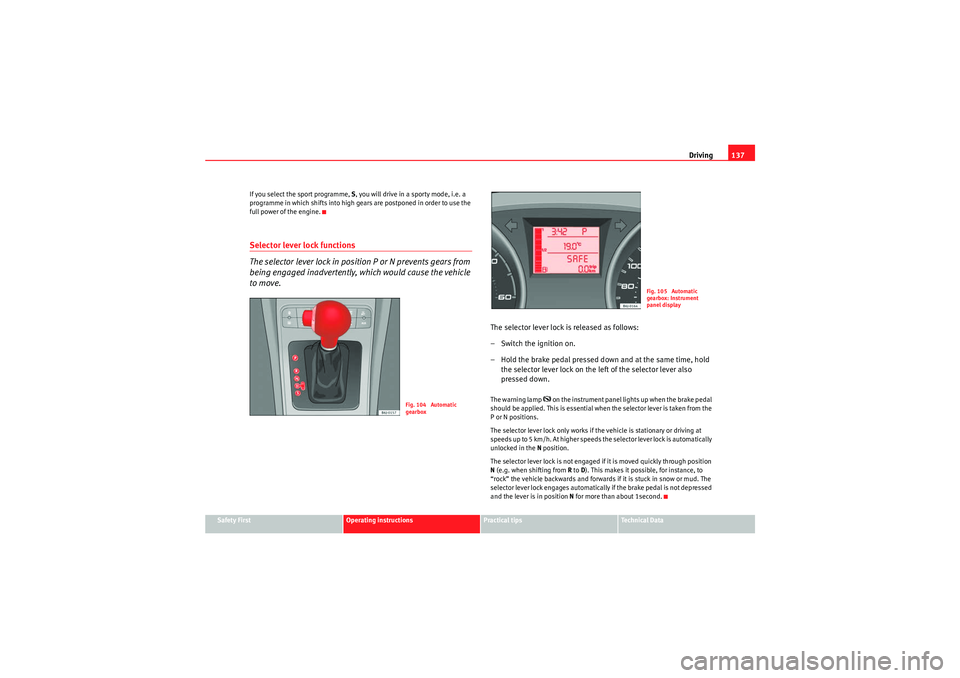
The selector lever lock in positi on P or N prevents gears from
being engaged inadvertently, which would cause the vehicle
to move.
The selector lever lock is released as follows:
– Switch the ignition on.
– Hold the brake pedal pressed down and at the same time, hold
the selector lever lock on the left of the selector lever also
pressed down.The warning lamp
on t he inst ru m e nt pa ne l lig hts up whe n t he bra ke p e dal
should be applied. This is essential when the selector lever is taken from the
P or N positions.
The selector lever lock only works if the vehicle is stationary or driving at
s p e e d s u p t o 5 k m / h . A t h i g h e r s p e e d s t h e s e le c to r le v e r l o ck is a u t o m a t i ca ll y
unlocked in the N position.
The selector lever lock is not engaged if it is moved quickly through position
N (e.g. when shifting from R to D). This makes it possible, for instance, to
“rock” the vehicle backwards and forwards if it is stuck in snow or mud. The
selector lever lock engages automatically if the brake pedal is not depressed
and the lever is in position N for more than about 1second.
Fig. 104 Automatic
gearbox
Fig. 105 Automatic
gearbox: Instrument
panel display
Ibiza ST_EN.book Seite 137 Dienstag, 12. Januar 2010 4:03 16
Page 142 of 250
Driving141
Safety First
Operating instructions
Practical tips
Technical Data
Changing gears in the normal or sport programme using the steering wheel
paddle levers
If the paddle levers ⇒
page 140, fig. 108 are used in the normal or sport
programme, the system switches temporarily to “Tiptronic” mode. To exit
“Tiptronic” mode again, press the right paddle lever towards the steering
wheel for approximately one second. You will also leave “Tiptronic” mode if
the paddle levers are not moved for a certain time.
Note
•The gear paddle levers on the steering wheel can be operated with the
gear lever in any position and with the vehicle in motion.Selector lever positions
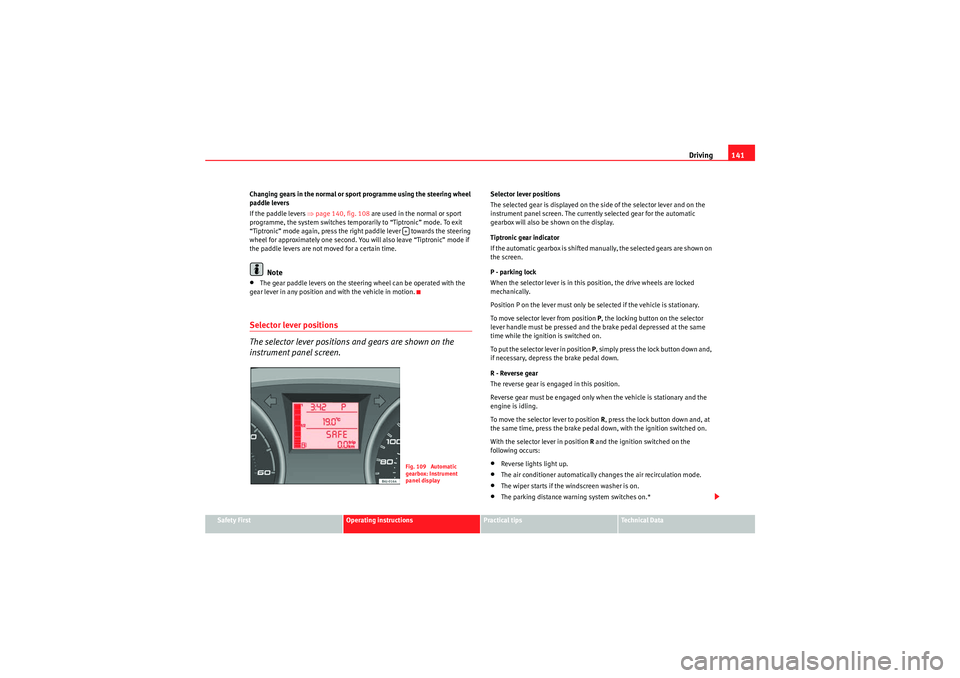
The selector lever positions and gears are shown on the
instrument panel screen.
Selector lever positions
The selected gear is displayed on the side of the selector lever and on the
instrument panel screen. The currently selected gear for the automatic
gearbox will also be shown on the display.
Tiptronic gear indicator
If the automatic gearbox is shifted manually, the selected gears are shown on
the screen.
P - parking lock
When the selector lever is in this position, the drive wheels are locked
mechanically.
Position P on the lever must only be selected if the vehicle is stationary.
To move selector lever from position P, the locking button on the selector
lever handle must be pressed and the brake pedal depressed at the same
time while the ignition is switched on.
To put the selector lever in position P, simply press the lock button down and,
if necessary, depress the brake pedal down.
R - Reverse gear
The reverse gear is engaged in this position.
Reverse gear must be engaged only when the vehicle is stationary and the
engine is idling.
To move the selector lever to position R, press the lock button down and, at
the same time, press the brake pedal down, with the ignition switched on.
With the selector lever in position R and the ignition switched on the
following occurs:•Reverse lights light up.•The air conditioner automatically changes the air recirculation mode.•The wiper starts if the windscreen washer is on.•The parking distance warning system switches on.*
+Fig. 109 Automatic
gearbox: Instrument
panel display
Ibiza ST_EN.book Seite 141 Dienstag, 12. Januar 2010 4:03 16
Page 143 of 250
Driving
142N - Neutral (idling)
If this position is selected, the gearbox is in neutral. Power is not transmitted
to the wheels and the engine does not have a braking function.
Never use the N position to drive down a hill. The engine does not function as
a brake and the brakes are subjected to excessive stain.
You could damage the automatic gearbox if you drive down hills with the gear
lever in position N and the engine switched off.
D - Drive (forwards)
In this position the gearbox automatically changes to a lower or higher gear,
according to the engine's requirements, the driving style and speed. The
braking effect of the engine when driving downhill is very limited when the
selector is in this position. The instrument panel displays the selected gear
as well as the selector lever in position D.
If position N has been selected and you wish to select D, you must press the
foot brake if the vehicle is stationary, or travelling at under 5 km/h.
S - Standard driving position (Sport programme)
When the selector lever is in position S, it will automatically change up into a
higher gear later, and change down into a low gear, if compared with position
D . This way, it is possible to take full advantage of the engine reserve power,
depending on the engine demand, driving style and speed. The braking
effect of the engine when driving downhill is very limited. On the instrument
panel display the selected gear is shown as well as the selector lever to posi-
tion S.
To se lec t gea r range S, press the lock button on the selector lever.
WARNING
If the vehicle moves with no control, an accident and serious injury may
occur.
•As a driver, you should never leave your vehicle if the engine is running
and a gear is engaged. If you have to leave your vehicle while the engine is
running, you must always apply the handbrake and engage parking lock P.•If the engine is running and if D or R are engaged, you will need to hold
the the vehicle stopped by depressing footbrake down. The car would creep
forward as the power transmission is not fully interrupted even when the
engine is idling.•Never accelerate when changing gear or you may cause an accident.•Never move the selector lever to “R” or “P” when driving. Risk of acci-
dent.•Before driving down a very steep slope, reduce your speed and shift to
position 1st.•Always hold the vehicle on the foot brake if you stop uphills. Otherwise,
the vehicle could roll back.•Never allow the brake to rub and do not use the brake pedal too often
or for long periods. Constant braking will cause the brakes to overheat and
will considerably reduce the brake effect. This increases the braking
distance and could cause the brake system to fail.WARNING
Never switch the engine off until the vehicle is stationary. You could lose
control of your vehicle. This could cause an accident and serious injury.•The airbags and belt tensioners do not work when the ignition is
switched off.•The brake servo does not work when the engine is not running. You
need more force to stop the vehicle.•Power assisted steering does not work when the engine is not running.
That is why it is much more difficult to turn the steering wheel.WARNING (continued)
Ibiza ST_EN.book Seite 142 Dienstag, 12. Januar 2010 4:03 16
Page 183 of 250
Checking and refilling levels
182•Wait until no more steam, smoke or coolant is emitted from the bonnet,
then carefully open the bonnet.•When working in the engine compartment, always observe the safety
warnings ⇒page 179.
Closing the bonnet– Slightly raise the bonnet
– Release the bonnet stay and replace it in its support.
– At a height of about 30 cm let it fall so it is locked.If the b onn et d o es n ot clos e , do not p ress d ownwa rds . Op e n it o nce m or e an d
let it fall as before.
WARNING
If the bonnet is not closed properly, it could open while you are driving and
completely obscure your view of the road. Risk of accident.•After closing the bonnet, always check that it is properly secured. The
bonnet must be flush with the surrounding body panels.•If you notice that the bonnet latch is not secured when the vehicle is
moving, stop the vehicle immediately and close the bonnet properly. Risk
of accident.
Engine oilEngine oil specifications
The engine oil used must conf orm with exact specifications.Specifications
The engine comes with a special, high quality, multi grade oil that can be
used in all seasons of the year except for those regions affected by extreme
cold.
As the use of good quality oil is necessary for the correct operation and long
service life of the engine, when it becomes necessary to replenish or change
the oil, always use an oil that complies to the VW standards.
If it is not possible to find oil conforming to the VW standards then oil
conforming to the ACEA or API standards with an appropriate viscosity at
atmospheric temperature should be used instead. The use of this type of oil
may have some repercussions on the performance of the engine for example,
long starting time, increased consumption and a higher emission level.
If a top up is required then different oils may be mixed as long as they all
conform to the VW standards.
The specifications (VW standards) set out in the following page should
appear on the container of the service oil; the container will display together
the different standards for petrol and diesel engines, the oil can be used for
both types of engines.
WARNING (continued)
Ibiza ST_EN.book Seite 182 Dienstag, 12. Januar 2010 4:03 16
Page 192 of 250
Checking and refilling levels191
Safety First
Operating instructions
Practical tips
Technical Data
Brake fluidChecking the brake fluid level
The brake fluid is checked at the intervals given in the service
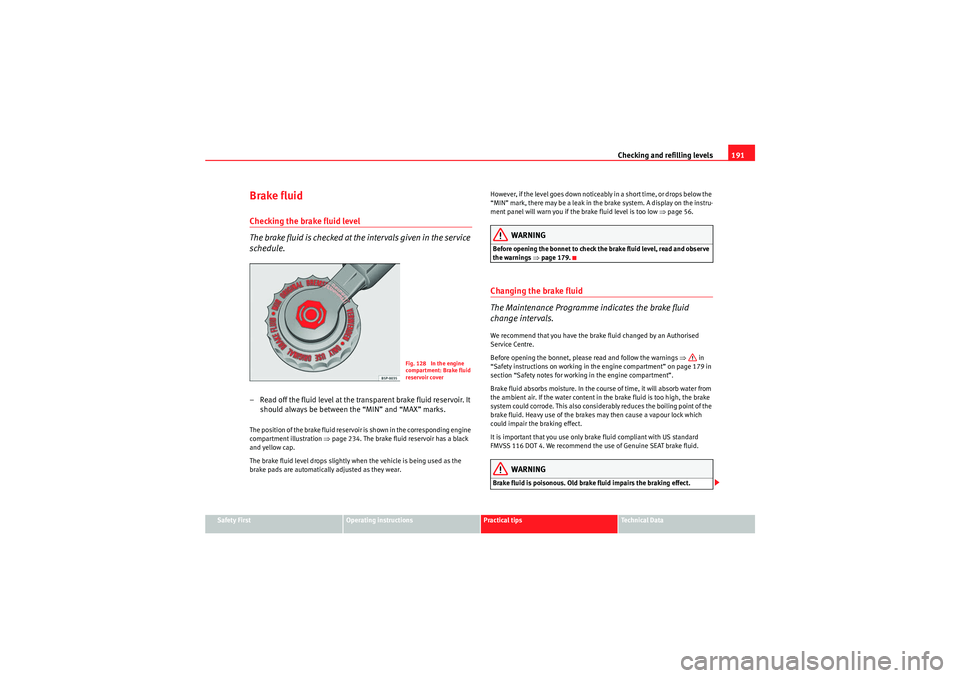
schedule.– Read off the fluid level at the transparent brake fluid reservoir. It
should always be between the “MIN” and “MAX” marks.The position of the brake fluid reservoir is shown in the corresponding engine
compartment illustration ⇒page 234. The brake fluid reservoir has a black
and yellow cap.
The brake fluid level drops slightly when the vehicle is being used as the
brake pads are automatically adjusted as they wear. However, if the level goes down noticeably in a short time, or drops below the
“MIN” mark, there may be a leak in the brake system. A display on the instru-
ment panel will warn you if the brake fluid level is too low
⇒page 56.
WARNING
Before opening the bonnet to check the brake fluid level, read and observe
the warnings ⇒page 179.Changing the brake fluid
The Maintenance Programme indicates the brake fluid
change intervals.We recommend that you have the brake fluid changed by an Authorised
Service Centre.
Before opening the bonnet, please read and follow the warnings ⇒ in
“Safety instructions on working in the engine compartment” on page 179 in
section “Safety notes for working in the engine compartment”.
Brake fluid absorbs moisture. In the course of time, it will absorb water from
the ambient air. If the water content in the brake fluid is too high, the brake
system could corrode. This also considerably reduces the boiling point of the
brake fluid. Heavy use of the brakes may then cause a vapour lock which
could impair the braking effect.
It is important that you use only brake fluid compliant with US standard
FMVSS 116 DOT 4. We recommend the use of Genuine SEAT brake fluid.
WARNING
Brake fluid is poisonous. Old brake fluid impairs the braking effect.
Fig. 128 In the engine
compartment: Brake fluid
reservoir cover
Ibiza ST_EN.book Seite 191 Dienstag, 12. Januar 2010 4:03 16