heating Seat Ibiza ST 2010 Owner's Guide
[x] Cancel search | Manufacturer: SEAT, Model Year: 2010, Model line: Ibiza ST, Model: Seat Ibiza ST 2010Pages: 264, PDF Size: 7.11 MB
Page 164 of 264
Intelligent technology
162Electronic Stability Programme (ESP)*
ESP reduces the danger of skidding by braking the wheels individually.
The system uses the steering wheel angle and road speed to calculate the
changes of direction desired by the driver, and constantly compares them
with the actual behaviour of the vehicle. If the desired course is not being
maintained (for instance, if the vehicle is starting to skid), then the ESP
compensates automatically by braking the appropriate wheel.
The forces acting on the braked wheel bring the vehicle back to a stable
condition. If the vehicle tends to oversteer, the system will act on the front
wheel on the outside of the turn.
WARNING
•It must be remembered that ESP cannot defy the laws of physics. This
should be kept in mind, particularly on slippery and wet roads and when
towing a trailer.•Always adapt your driving style to suit the condition of the roads and
the traffic situation. Do not let the extra safety afforded by ESP tempt you
into taking any risks when driving, as this can cause accidents.Caution
•In order to ensure that ESP functions correctly, all four wheels must be
fitted with the same tyres. Any differences in the rolling radius of the tyres can
cause the system to reduce engine power when this is not desired.•Modifications to the vehicle (e.g. to the engine, the brake system, running
gear or any components affecting the wheels and tyres) could affect the effi-
ciency of the ABS, EDL, ESP and TCS.
Anti-lock brake system (ABS)The anti-lock brake system prevents the wheels locking during braking
⇒ page 160.Electronic differential lock (EDL)*
The electronic differential lock helps prevent the loss of trac-
tion caused if one of the driven wheels starts spinning.EDL helps the vehicle to start moving, accelerate and climb a gradient in slip-
pery conditions where this may otherwise be difficult or even impossible.
The system will control the revolutions of the drive wheels using the ABS
sensors (in case of an EDL fault the warning lamp for ABS lights up)
⇒ page 63.
At speeds of up to approximately 80 km/h, it is able to balance out differ-
ences in the speed of the driven wheels of approximately 100 rpm caused by
a slippery road surface on one side of the vehicle. It does this by braking the
wheel which has lost traction and distributing more driving force to the other
driven wheel via the differential.
To prevent the disc brake of the braking wheel from overheating, the EDL cuts
out automatically if subjected to excessive loads. The vehicle will continue to
function normally without EDL. For this reason, the driver is not informed that
the EDL has been switched off.
The EDL will switch on again automatically when the brake has cooled down.
WARNING
•When accelerating on a slippery surface, for example on ice and snow,
press the accelerator carefully. Despite EDL, the driven wheels may start to
spin. This could impair the vehicle’s stability.
IbizaST_EN.book Seite 162 Dienstag, 14. September 2010 1:31 13
Page 167 of 264

Driving and the environment165
Safety First
Operating Instructions
Practical Tips
Technical Specifications
If you drive with
wet brakes, for example, after crossing areas of water, in
heavy rainfall or even after washing the vehicle, the effect of the brakes is
lessened as the brake discs are wet or even frozen (in winter). In this case the
brakes should be dried by pressing the brake pedal several times.
WARNING
Longer braking distances and faults in the brake system increase the risk
of accidents.•New brake pads must be run in and do not have the correct friction
during the first 200 km. However, the reduced braking capacity may be
compensated by pressing on the brake pedal a little harder. This also
applies when the brake pads have to be changed further on.•If brakes are wet or frozen, or if you are driving on roads which have
been salted, braking power may be lower than normal.•On steep slopes, if brakes are excessively used, they will overheat.
Before driving down a long steep slope, it is advisable to reduce speed and
change down into a lower gear or range (depending on the type of trans-
mission). This makes use of engine braking and relieves the brakes.•Never let the brakes “drag” by applying light pressure. Continuous
braking will cause the brakes to overheat and the braking distance will
increase. Apply and then release the brakes alternately.•Never let the vehicle run with the engine switched off. The braking
distance is increased considerably when the brake servo is not active.•If the brake fluid loses its viscosity and is subjected to heavy use,
vapour bubbles can form in the brake system. This reduces the efficiency of
the brakes.•Non-standard or damaged front spoilers could restrict the airflow to the
brakes and cause them to overheat. Before purchasing accessories please
observe the relevant instructions ⇒page 181, “Technical modifications”.•If a brake circuit fails, the braking distance will be increased consider-
ably. Contact a specialised workshop immediately and avoid unnecessary
journeys.
Exhaust gas purification systemCatalytic converter*To maintain the useful life of the catalytic converter
– Use only unleaded petrol with petrol engines, as lead damages the catalytic converter.
– Do not let the fuel get too low in the tank.
– For engine oil changes, do not replenish with too much engine oil ⇒page 193, “Topping up engine oil E”.
– Never tow the vehicle to start it, use jump leads if necessary ⇒page 231.If you notice misfiring, uneven running or loss of power when the vehicle is
moving, reduce speed immediately and have the vehicle inspected at the
nearest specialised workshop. In general, the exhaust gas warning lamp will
light up when any of the described symptoms occur ⇒page 58. If this
happens, unburnt fuel can enter the exhaust system and escape into the envi-
ronment. The catalytic converter can also be damaged by overheating.
WARNING
The catalytic converter reaches very high temperatures! There is a risk of
fire.•Never park where the catalytic converter could come into contact with
dry grass or flammable materials under the vehicle.•Do not apply additional underseal or anti-corrosion coatings to the
exhaust pipes, catalytic converter or the heat shields on the exhaust
system. These materials could catch fire when the vehicle is being driven.
IbizaST_EN.book Seite 165 Dienstag, 14. September 2010 1:31 13
Page 168 of 264

Driving and the environment
166
CautionNever run the fuel tank completely dry because the irregularity of the fuel
supply may cause ignition problems. This allows unburnt fuel to enter the
exhaust system, which could cause overheating and damage the catalytic
converter.
For the sake of the environment
Even when the emission control system is working perfectly, there may be a
smell of sulphur from the exhaust gas under some conditions. This depends
on the sulphur content of the fuel used. Quite often the problem can be
solved by changing to another brand of fuel.Diesel engine particulate filter*
The diesel engine particulate filter eliminates soot produced
by burning diesel.
Your vehicle is fitted with a DPF (Diesel particulate filter) if the vehicle data
sticker (back cover of the “Maintenance Programme”) lists the PR code 7GG
or 7MG ⇒fig. 121 .
The diesel engine particulate filter eliminates most of the soot from the
exhaust gas system. Under normal driving conditions, the filter cleans itself.
If the driving conditions do not allow the filter to clean itself (for example,
multiple short trips) the filter will be obstructed by dust and pollen and the
indicator
for the diesel engine particulate filter indicator will light up. This
does not represent a fault, it is a warning that indicates that the filter has not
been able to regenerate automatically and that you must carry out a cleaning
cycle, as indicated in ⇒page 62.
WARNING
•The diesel engine particulate filter may reach extremely high tempera-
tures; the vehicle should be parked so that the exhaust pipe does not come
into contact with flammable materials underneath the vehicle. Otherwise
there is a risk of fire.Caution
•Your vehicle is not designed to use biodiesel fuel. Never, under any
circumstances refuel with biodiesel. The use of biodiesel fuel could damage
the engine and the fuel system. The addition of biodiesel to diesel by the
diesel producer in accordance with standard EN 590 is authorised and will
not cause damage to the engine or the fuel system.•Using diesel fuel with a high sulphur content may significantly reduce the
working life of the diesel particulate filter. Your Authorised Service Centre will
be able to tell you which countries have diesel with a high sulphur content.
Fig. 121 Vehicle data
sticker on back cover of
the Maintenance
Programme
IbizaST_EN.book Seite 166 Dienstag, 14. September 2010 1:31 13
Page 170 of 264
Driving and the environment
168Do not use winter tyres all year round as they increase fuel consumption by
up to 10%.
Avoid unnecessary weight
Every kilo of extra weight will put up the fuel consumption, so it is worth
checking the luggage compartment occasionally to make sure that no unnec-
essary loads are being transported.
A roof rack is often left in place for the sake of convenience, even when it is
no longer needed. At a speed of 100-120 km/h your vehicle will use about
12% more fuel as a result of the extra wind resistance caused by the roof rack
even when it is not in use.
Save electricity
The engine activates the alternator, which produces electricity. With the need
for electricity, fuel consumption is also increased. Because of this, always
turn off electrical components when you do not need them. Examples of
components that use a lot of electricity are: the fan at high speeds, the rear
window heating or the seat heaters*.
Note
•If you vehicle has Start-Stop, it is not recommended to disconnect this
function.•It is recommended to close the windows when driving at more than 60
km/h•Do not drive with your foot resting on the clutch pedal, as the pressure can
make the plate spin, more fuel will be used and it can burn the clutch plate
lining, causing a serious fault.•Do not hold the vehicle on a hill with the clutch, use the foot brake or hand
brake, using the latter to start. The fuel consumption will be lower and you will
prevent the clutch plate from being damaged.•On descents, use the engine brake, changing to the gear that is more suit-
able for the slope. The fuel consumption will be lower and the brakes will not
suffer.
Environmental friendlinessEnvironmental protection is a top priority in the design, choice of materials
and production of your new Seat.
Design measures for economical recycling•Joints and connections designed for easy dismantling•Modular construction to facilitate dismantling•Increased use of single-grade materials•Plastic parts and elastomers are rated in accordance with ISO 1043, ISO
11469 and ISO 1629
Choice of materials•Nearly all materials used can be recycled•Similar types of plastics grouped together for easy recycling•Recycled materials used in manufacture•Reduction of volatile compounds in plastics•CFC-free refrigerant in air conditioner
Compliance with prohibited materials regulation : cadmium, lead, mercury,
chrome VI.
Manufacturing methods•Use of recycled material for manufacturing plastic parts•Solvent-free cavity sealing•Solvent-free wax for protecting the vehicles in transit•Solvent-free adhesives•No CFCs used in production•Surplus materials used extensively for energy conversion and building
materials•Overall water consumption reduced•Heat recovery systems
IbizaST_EN.book Seite 168 Dienstag, 14. September 2010 1:31 13
Page 173 of 264
Driving and the environment171
Safety First
Operating Instructions
Practical Tips
Technical Specifications
Always brake in due course. If the trailer has an
overrun brake, apply the
brakes gently at first and then, firmly. This will prevent the jerking that can be
caused by the trailer wheels locking. Select a low gear in due course before
going down a steep downhill. This enables you to use the engine braking to
slow down the vehicle.
Reheating
At very high temperatures and during prolonged slopes, driving in a low gear
and high engine speed, always monitor the coolant temperature gauge
⇒ page 49.
Electronic Stability Programme*
The ESP* system helps to stabilise the trailer in case of skidding or rocking.
IbizaST_EN.book Seite 171 Dienstag, 14. September 2010 1:31 13
Page 178 of 264

Vehicle maintenance and cleaning
176If possible, use a de-icing spray to remove ice. If you use an ice scraper, push
it in one direction only without swinging it.
Use window cleaner or a silicone remover to clean rubber, oil, grease and sili-
cone deposits off.
Wax deposits can be removed with a special cleaner available in your Author-
ised Service Centre. Wax deposits on the windscreen could cause the wiper
blades to judder. Adding a window clea ner that dissolves wax to the wind-
screen washer fluid prevents wiper blades from juddering, but wax deposits
are not removed.
Caution
•Never use warm or hot water to remove snow and ice from windows and
mirrors. This could cause the glass to crack!•The heating element for the rear window is located on the inner side of the
window. To prevent damage, do not put stickers on the heating elements
inside the window.Cleaning windscreen wiper bladesClean wiper blades improve visibility.
1. Use a soft cloth to remove dust and dirt from the windscreen wiper blades.
2. Use window cleaner to clean the windscreen wiper blades. Use a sponge or a cloth to remove stubborn dirt.
Rubber seals maintenance
If rubber seals are well looked after, they will not freeze so
quickly.1. Use a soft cloth to remove dust and dirt from the rubber seals.
2. Apply a specialist care product to the rubber seals.The rubber strips on the doors, windows, bonnet and tailgate will remain
pliable and last longer if they are treated with a suitable care product (for
example silicone spray).
Caring for rubber seals will also prevent premature ageing and leaks. The
doors will be easier to open. If rubber seals are well looked after, they will not
freeze so quickly in winter.Door lock cylinders
The door lock cylinders can freeze up in winter.To de-ice the lock cylinders you should only use spray with lubricating and
anti-corrosive properties.Cleaning chrome parts1. Clean chrome parts with a damp cloth.
2. Polish chrome parts with a soft, dry cloth.
IbizaST_EN.book Seite 176 Dienstag, 14. September 2010 1:31 13
Page 221 of 264
If and when219
Safety First
Operating Instructions
Practical Tips
Technical Specifications
The individual electrical circuits are protected by fuses. The fuses are located
behind a cover at the left-hand end of the dash panel. When the steering
wheel is on the right, the fuses are on the right-hand side of the dash panel,
behind a cover.
The electric windows are protected by
circuit breakers. These reset automat-
ically after a few seconds when the overload (caused for example by frozen
windows) has been corrected.
Fuses colour code
WARNING
Never “repair” damaged fuses and never replace them with fuses with a
higher rating. Failure to comply could result in fire. This could also cause
damage to other parts of the electrical system.
Note
•If a newly replaced fuse blows again after a short time, the electrical
system must be checked by a specialised workshop as soon as possible.•If you replace a fuse with higher-rating fuse, you could cause damage to
another location in the electrical system.
•Always keep some spare fuses in the vehicle. These are available from
SEAT dealers.Fuses on left side of dash panelFuses
Colour
Amps
Beige
5
Brown
7.5
Red
10
Blue
15
Ye l l o w
20
Natural (white)
25
Green
30
Number
Consumer
Amps
1
Power steering/Engine operation
7.5
2
Diagnostics/Heater/Autoclimate/Cli-
matronic/Electric anti-dazzle mirror/Naviga-
tor/Air conditioning pressure switch/ Climate
fan/ Kisi/ AFS Control unit/Coming home
relay/Soundaktor
10
3
Petrol engine control unit/Flow meter/Diesel
engine control unit/Relay coils/Engine opera-
tion/Bi-turbo fuel control unit
5
4
ABS/ESP switch (turning sensor)/Light lever
10
5
Reverse light/Heating nozzles
10
6
Instrument panel
5
7
Rear fog light
7.5
8
Va can t
9
Headlight lever
10
10
Headlight lever/Clutch (Petrol)/Brakes (all)
5
11
Airbag control unit
5
12
Automatic gearbox/ Headlight lever
10
13
Exterior mirror control
5
IbizaST_EN.book Seite 219 Dienstag, 14. September 2010 1:31 13
Page 222 of 264
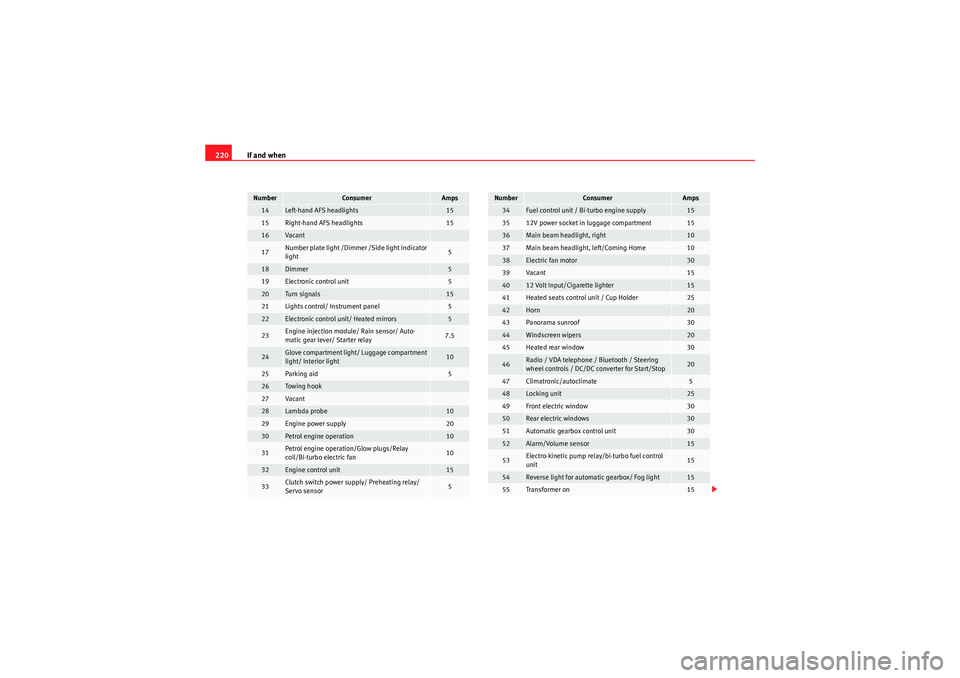
If and when
220
14
Left-hand AFS headlights
15
15
Right-hand AFS headlights
15
16
Vaca n t
17
Number plate light /Dimmer /Side light indicator
light
5
18
Dimmer
5
19
Electronic control unit
5
20
Turn signals
15
21
Lights control/ Instrument panel
5
22
Electronic control unit/ Heated mirrors
5
23
Engine injection module/ Rain sensor/ Auto-
matic gear lever/ Starter relay
7.5
24
Glove compartment light/ Luggage compartment
light/ Interior light
10
25
Parking aid
5
26
Towing hook
27
Vaca n t
28
Lambda probe
10
29
Engine power supply
20
30
Petrol engine operation
10
31
Petrol engine operation/Glow plugs/Relay
coil/Bi-turbo electric fan
10
32
Engine control unit
15
33
Clutch switch power supply/ Preheating relay/
Servo sensor
5
Number
Consumer
Amps
34
Fuel control unit / Bi-turbo engine supply
15
35
12V power socket in luggage compartment
15
36
Main beam headlight, right
10
37
Main beam headlight, left/Coming Home
10
38
Electric fan motor
30
39
Vaca n t
15
40
12 Volt Input/Cigarette lighter
15
41
Heated seats control unit / Cup Holder
25
42
Horn
20
43
Panorama sunroof
30
44
Windscreen wipers
20
45
Heated rear window
30
46
Radio / VDA telephone / Bluetooth / Steering
wheel controls / DC/DC converter for Start/Stop
20
47
Climatronic/autoclimate
5
48
Locking unit
25
49
Front electric window
30
50
Rear electric windows
30
51
Automatic gearbox control unit
30
52
Alarm/Volume sensor
15
53
Electro-kinetic pump relay/bi-turbo fuel control
unit
15
54
Reverse light for automatic gearbox/ Fog light
15
55
Transformer on
15
Number
Consumer
Amps
IbizaST_EN.book Seite 220 Dienstag, 14. September 2010 1:31 13
Page 223 of 264
If and when221
Safety First
Operating Instructions
Practical Tips
Technical Specifications
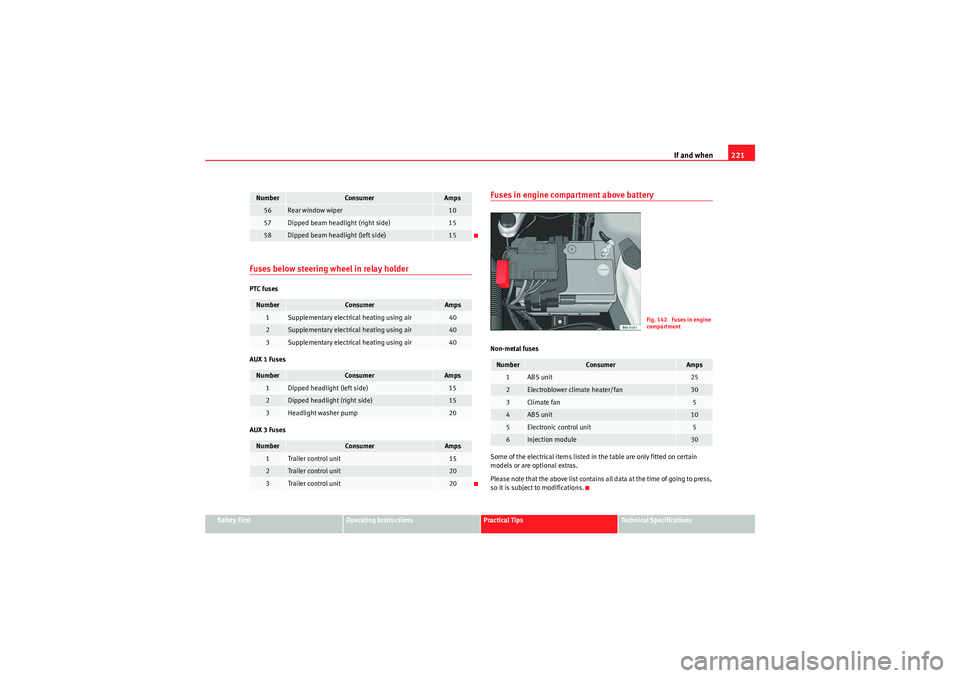
Fuses below steering wheel in relay holderPTC fuses
AUX 1 Fuses
AUX 3 Fuses
Fuses in engine compartment above batteryNon-metal fuses
Some of the electrical items listed in the table are only fitted on certain
models or are optional extras.
Please note that the above list contains all data at the time of going to press,
so it is subject to modifications.
56
Rear window wiper
10
57
Dipped beam headlight (right side)
15
58
Dipped beam headlight (left side)
15
Number
Consumer
Amps
1
Supplementary electrical heating using air
40
2
Supplementary electrical heating using air
40
3
Supplementary electrical heating using air
40
Number
Consumer
Amps
1
Dipped headlight (left side)
15
2
Dipped headlight (right side)
15
3
Headlight washer pump
20
Number
Consumer
Amps
1
Trailer control unit
15
2
Trailer control unit
20
3
Trailer control unit
20
Number
Consumer
Amps
Number
Consumer
Amps
1
ABS unit
25
2
Electroblower climate heater/fan
30
3
Climate fan
5
4
ABS unit
10
5
Electronic control unit
5
6
Injection module
30
Fig. 142 Fuses in engine
compartment
IbizaST_EN.book Seite 221 Dienstag, 14. September 2010 1:31 13
Page 258 of 264

Index
256Floor mats . . . . . . . . . . . . . . . . . . . . . . . . . . . . . . 14
Fog lights . . . . . . . . . . . . . . . . . . . . . . . . . . . . . . . 91
Fog lights with cornering function . . . . . . . . . . . 94
Front airbags . . . . . . . . . . . . . . . . . . . . . . . . . . . . 30
Description . . . . . . . . . . . . . . . . . . . . . . . . . . 30
Operation . . . . . . . . . . . . . . . . . . . . . . . . . . . . 31
Safety notes . . . . . . . . . . . . . . . . . . . . . . . . . . 32
Front drink holder . . . . . . . . . . . . . . . . . . . . . . . 115
Front interior light . . . . . . . . . . . . . . . . . . . . . . . . 98
Front passenger airbag deactivation . . . . . . . . . 37
Front reading light . . . . . . . . . . . . . . . . . . . . . . . . 99
Front seat adjustment Lumbar support . . . . . . . . . . . . . . . . . . . . . . 109
Fuel Diesel . . . . . . . . . . . . . . . . . . . . . . . . . . . . . . 187
Petrol . . . . . . . . . . . . . . . . . . . . . . . . . . . . . . 186
Fuel level Indicator . . . . . . . . . . . . . . . . . . . . . . . . . . . . . 52
Fuel reserve Warning lamp . . . . . . . . . . . . . . . . . . . . . . . . 66
Fuel Tank Opening the fuel tank flap . . . . . . . . . . . . . 185
Fuel tank See Fuel reserve . . . . . . . . . . . . . . . . . . . . . . 66
Fuel: save . . . . . . . . . . . . . . . . . . . . . . . . . . . . . . 167
Fuses . . . . . . . . . . . . . . . . . . . . . . . . . . . . . . . . . 218GG 12 . . . . . . . . . . . . . . . . . . . . . . . . . . . . . . . . . . 195
Gear shift pattern . . . . . . . . . . . . . . . . . . . . . . . 142 General overview of the engine compartment 241
Glove compartment . . . . . . . . . . . . . . . . . . . . . . 112
Glow plug system . . . . . . . . . . . . . . . . . . . . . . . 139
Warning lamp . . . . . . . . . . . . . . . . . . . . . . . . 62
GRA . . . . . . . . . . . . . . . . . . . . . . . . . . . . . . . . . . . 154
HHandbrake . . . . . . . . . . . . . . . . . . . . . . . . . . . . . 150 Warning lamp . . . . . . . . . . . . . . . . . . . . 65, 151
Hazard warning lights . . . . . . . . . . . . . . . . . . . . . 96
HBA . . . . . . . . . . . . . . . . . . . . . . . . . . . . . . . . . . 159
Head restraints Adjusting . . . . . . . . . . . . . . . . . . . . . . . 107, 108
Adjustment of the head restraint angle . . . 108
Removing . . . . . . . . . . . . . . . . . . . . . . . . . . . 108
Headlight flashers . . . . . . . . . . . . . . . . . . . . . . . . 97
Headlight range control . . . . . . . . . . . . . . . . . . . 93
Headlights Driving abroad . . . . . . . . . . . . . . . . . . . . . . . 169
Fog lights . . . . . . . . . . . . . . . . . . . . . . . . . . . . 91
Headlight washer . . . . . . . . . . . . . . . . . . . . 103
Heated exterior mirrors* . . . . . . . . . . . . . . . . . . 104
Heated front seats . . . . . . . . . . . . . . . . . . . . . . . 110
Heated rear window Heating element wires . . . . . . . . . . . . . . . . 176
Heating . . . . . . . . . . . . . . . . . . . . . . . . . . . . . . . 125
Heating system . . . . . . . . . . . . . . . . . . . . . . . . . 126
High pressure cleaners . . . . . . . . . . . . . . . . . . . 174
Hill-start assist . . . . . . . . . . . . . . . . . . . . . . . . . 152
Horn . . . . . . . . . . . . . . . . . . . . . . . . . . . . . . . . . . . 49 How to jump start description . . . . . . . . . . . . . 232
Hydraulic Brake Assist
Automatic hazard warning lights activation . . .159
IIdentification number . . . . . . . . . . . . . . . . . . . . 238
Identification plate . . . . . . . . . . . . . . . . . . . . . . 238
Ignition key . . . . . . . . . . . . . . . . . . . . . . . . . . . . 136
Ignition lock . . . . . . . . . . . . . . . . . . . . . . . . . . . . 136
Information in the multifunction display
Memory displays . . . . . . . . . . . . . . . . . . . . . . 54
Instrument and switch lighting . . . . . . . . . . . . . 93
Instrument lighting . . . . . . . . . . . . . . . . . . . . . . . 49
Instrument panel Service interval display . . . . . . . . . . . . . . . . 56
Instruments . . . . . . . . . . . . . . . . . . . . . . . . . . . . . 51
Interior mirror . . . . . . . . . . . . . . . . . . . . . . . . . . 103
Interior monitoring and anti-towing alarm* Activation . . . . . . . . . . . . . . . . . . . . . . . . . . . . 83
ISOFIX system . . . . . . . . . . . . . . . . . . . . . . . . . . . 44JJump leads . . . . . . . . . . . . . . . . . . . . . . . . . . . . . 231
Jump-starting . . . . . . . . . . . . . . . . . . . . . . . . . . . 231KKeys . . . . . . . . . . . . . . . . . . . . . . . . . . . . . . . . . . . 79
IbizaST_EN.book Seite 256 Dienstag, 14. September 2010 1:31 13