service Seat Ibiza ST 2012 Workshop Manual
[x] Cancel search | Manufacturer: SEAT, Model Year: 2012, Model line: Ibiza ST, Model: Seat Ibiza ST 2012Pages: 282, PDF Size: 3.77 MB
Page 221 of 282
219
Checking and refilling levels
WARNING
There is a serious danger of accidents if a tyre bursts during driving!
● The tyres must be replaced at the latest when the tread wear indica-
tors are worn ⇒ page 218. Failure to do so could result in an accident.
Worn tyres do not grip well at high speeds on wet roads. There is also a
greater risk of aquaplaning.
● At continuously high speeds, a tyre with insufficient pressure flexes
more. This causes it to overheat. This can cause tread separation and tyre
blow-out. Risk of accident. Always observe the recommended tyre pres-
sures.
● If tyres show excessive wear, you should have the running gear
checked by a Technical Service.
● Keep chemicals such as oil, fuel and brake fluid away from tyres.
● Damaged wheels and tyres must be replaced immediately!
For the sake of the environment
Under-inflated tyres will increase fuel consumption.
New tyres and wheels
New tyres and wheels have to be run in.
The tyres and wheel rims are an essential part of the vehicle's design. The
tyres and rims approved by SEAT are specially matched to the characteris-
tics of the vehicle and make a major contribution to good road holding and
safe handling ⇒
.
Tyres should be replaced at least in pairs and not individually (i.e. both front
tyres or both rear tyres together). A knowledge of tyre designations makes it
easier to choose the correct tyres. Radial tyres have the tyre designations
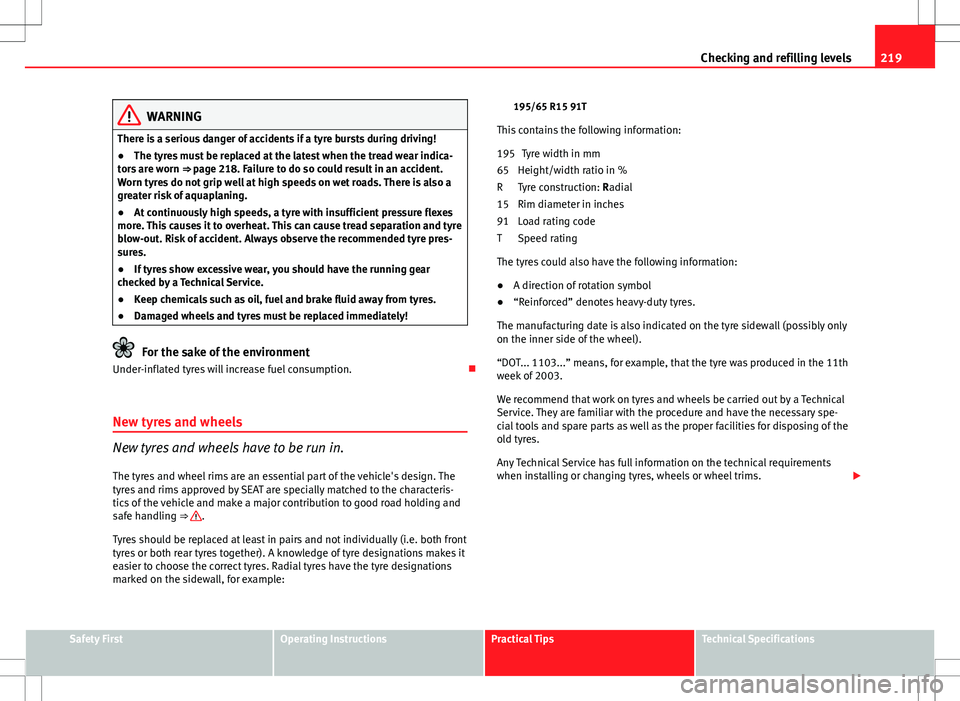
marked on the sidewall, for example: 195/65 R15 91T
This contains the following information: Tyre width in mm
Height/width ratio in %
Tyre construction: Radial
Rim diameter in inches
Load rating code
Speed rating
The tyres could also have the following information:
● A direction of rotation symbol
● “Reinforced” denotes heavy-duty tyres.
The manufacturing date is also indicated on the tyre sidewall (possibly only
on the inner side of the wheel).
“DOT... 1103...” means, for example, that the tyre was produced in the 11th
week of 2003.
We recommend that work on tyres and wheels be carried out by a Technical
Service. They are familiar with the procedure and have the necessary spe-
cial tools and spare parts as well as the proper facilities for disposing of the
old tyres.
Any Technical Service has full information on the technical requirements
when installing or changing tyres, wheels or wheel trims.
195
65
R
15
91
T
Safety FirstOperating InstructionsPractical TipsTechnical Specifications
Page 223 of 282
221
Checking and refilling levels
Winter tyres
Winter tyres will improve the vehicles handling on snow and
ice.
In winter conditions winter tyres will considerably improve the vehicle's han-
dling. The design of summer tyres (width, rubber compound, tread pattern)
gives less grip on ice and snow.
Winter tyres must be inflated to a pressure 0.2 bar higher than the pres-
sures specified for summer tyres (see sticker on fuel tank flap).
Winter tyres must be fitted on all four wheels.
Information on permitted winter tyre sizes can be found in the vehicle's reg-
istration documentation. Use only radial winter tyres. All tyre sizes listed in
the vehicle documentation also apply to winter tyres.
Winter tyres lose their effectiveness when the tread is worn down to a depth
of 4 mm.
The speed rating code ⇒ page 219, New tyres and wheels determines the
following speed limits for winter tyres: ⇒
Qmax. 160 km/h (100 mph)Smax. 180 km/h (110 mph)Tmax. 190 km/h (120 mph)Hmax. 210 km/h (130 mph)
In some countries, vehicles which can exceed the speed rating of the fitted
tyre must have an appropriate sticker in the driver's field of view. These
stickers are available from your Technical Service. The legal requirements of
each country must be followed.
Do not have winter tyres fitted for unnecessarily long periods. Vehicles with
summer tyres handle better when the roads are free of snow and ice. If you have a flat tyre, please refer to the notes on the spare wheel
⇒ page 219, New tyres and wheels.
WARNING
The maximum speed for the winter tyres must not be exceeded. Other-
wise, this could lead to tyre damage and risk of accident.
For the sake of the environment
Fit your summer tyres again as soon as possible. They are quieter, do not
wear so quickly and reduce fuel consumption.
Snow chains
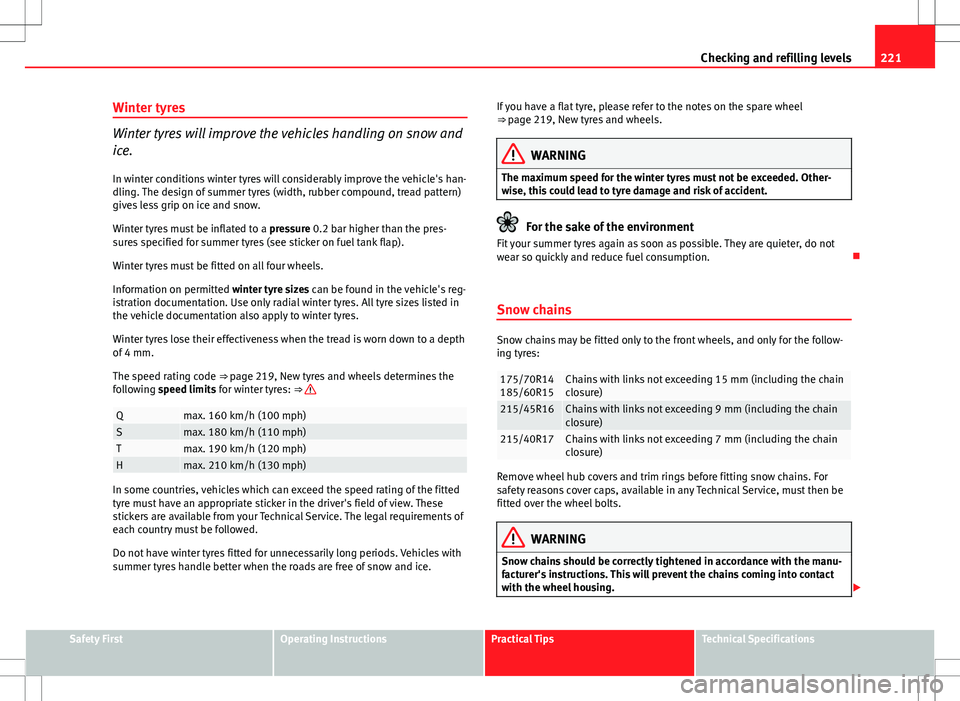
Snow chains may be fitted only to the front wheels, and only for the follow-
ing tyres:
175/70R14
185/60R15Chains with links not exceeding 15 mm (including the chain
closure)
215/45R16Chains with links not exceeding 9 mm (including the chain
closure)
215/40R17Chains with links not exceeding 7 mm (including the chain
closure)
Remove wheel hub covers and trim rings before fitting snow chains. For
safety reasons cover caps, available in any Technical Service, must then be
fitted over the wheel bolts.
WARNING
Snow chains should be correctly tightened in accordance with the manu-
facturer's instructions. This will prevent the chains coming into contact
with the wheel housing.
Safety FirstOperating InstructionsPractical TipsTechnical Specifications
Page 230 of 282
228If and when
WARNING
● Take all precautions so that the base of the jack does not slip. Failure
to do so could result in an accident.
● The vehicle can be damaged if the jack is not applied at the correct
jacking points. There is also a risk of injury since the jack can slip off
suddenly if it is not properly engaged.
Removing and fitting the wheel
For removal and fitting the wheel, the following tasks must
be completed.
After loosening the wheel bolts and raising the vehicle with the
jack, change the wheel as described below:
Removing a wheel
– Unscrew the wheel bolts using the box spanner and place them
on a clean surface.
Fitting a wheel
– Screw on the wheel bolts and tighten slightly with the box
spanner.
The wheel bolts should be clean and easily screwed. Before fitting the spare
wheel, inspect the wheel condition and hub mounting surfaces. These sur-
faces must be clean before fitting the wheel.
If tyres with a specific direction of rotation are fitted, note the direction of
rotation. Anti-theft wheel bolts*
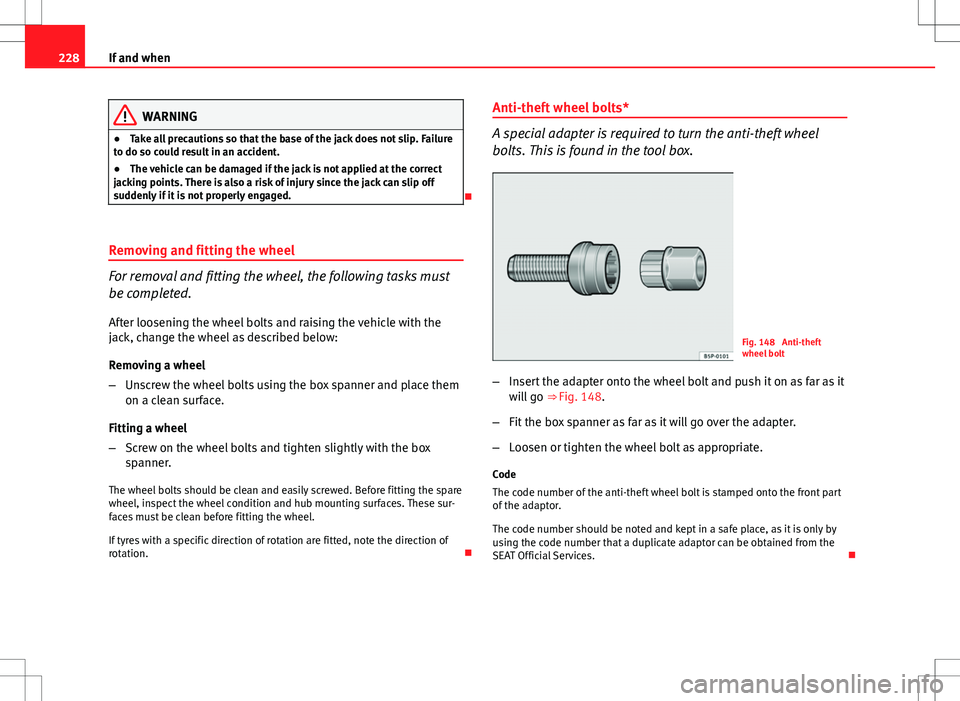
A special adapter is required to turn the anti-theft wheel
bolts. This is found in the tool box.
Fig. 148 Anti-theft
wheel bolt
– Insert the adapter onto the wheel bolt and push it on as far as it
will go ⇒ Fig. 148.
– Fit the box spanner as far as it will go over the adapter.
– Loosen or tighten the wheel bolt as appropriate.
Code
The code number of the anti-theft wheel bolt is stamped onto the front part
of the adaptor.
The code number should be noted and kept in a safe place, as it is only by
using the code number that a duplicate adaptor can be obtained from the
SEAT Official Services.
Page 231 of 282
229
If and when
Tyres with directional tread pattern
Tyres with directional tread pattern must be fitted so that
they rotate in the correct direction. A directional tread pattern can be identified by arrows on the sidewall that
point in the direction of rotation. Always note the direction of rotation indi-
cated when fitting the wheel. This is important so that these tyres can give
maximum grip and avoid excessive noise, tread wear and aquaplaning.
If, in an emergency, you have to fit the spare wheel so it rotates in the wrong
direction, you must drive extremely carefully. The tyre will not give optimum
performance. This is particularly important when driving on wet roads.
To benefit from the advantages of tyres with this type of tread pattern, the
defective tyre should be replaced as soon as possible so that all tyres again
rotate in the correct direction.
Tyre repair kit (Tyre-Mobility-System)*
General information and safety notes
Your vehicle is equipped with a tyre repair kit: the Tyre Mobility System.
In the event of a tyre puncture, a sealing product and an air compressor are
located in the luggage compartment under the floor panel.
The Tyre Mobility System will reliably seal punctures caused by the penetra-
tion of a foreign body of up to about 4 mm in diameter.
It is not necessary to remove the foreign body from the tyre.
Instructions for the sealing product are located on the sealing product con-
tainer. It also contains the instructions for using the compressor.
WARNING
● Do not attempt to repair a puncture with the sealing product if the
tyre has been damaged by driving the vehicle after the tyre has lost its
air.
● Always observe warnings and follow safety instructions concerning
compressor and sealing compound carefully.
● Do not drive faster than 80 km/h (50 mph), avoid heavy acceleration,
hard braking and fast cornering.
● Tyres which have been repaired with sealing compound are only suit-
able for temporary use over a short period. Therefore, please drive care-
fully to the next available specialised workshop.
For the sake of the environment
If you have to dispose of a sealant can, go to a specialised waste service or
to a SEAT Technical Service, where the product can be recycled in an appro-
priate waste container.
Note
● If sealing product should leak out, leave it to dry. This way you can pull it
off like a piece of foil.
● Observe the expiry date stated on the sealing compound can. Have the
sealing compound exchanged by a specialised workshop.
● Seek professional assistance if the repair of a tyre puncture is not possi-
ble with the sealing product.
Safety FirstOperating InstructionsPractical TipsTechnical Specifications
Page 233 of 282
231
If and when
Fuses
Changing a fuse
Blown fuses must be replaced
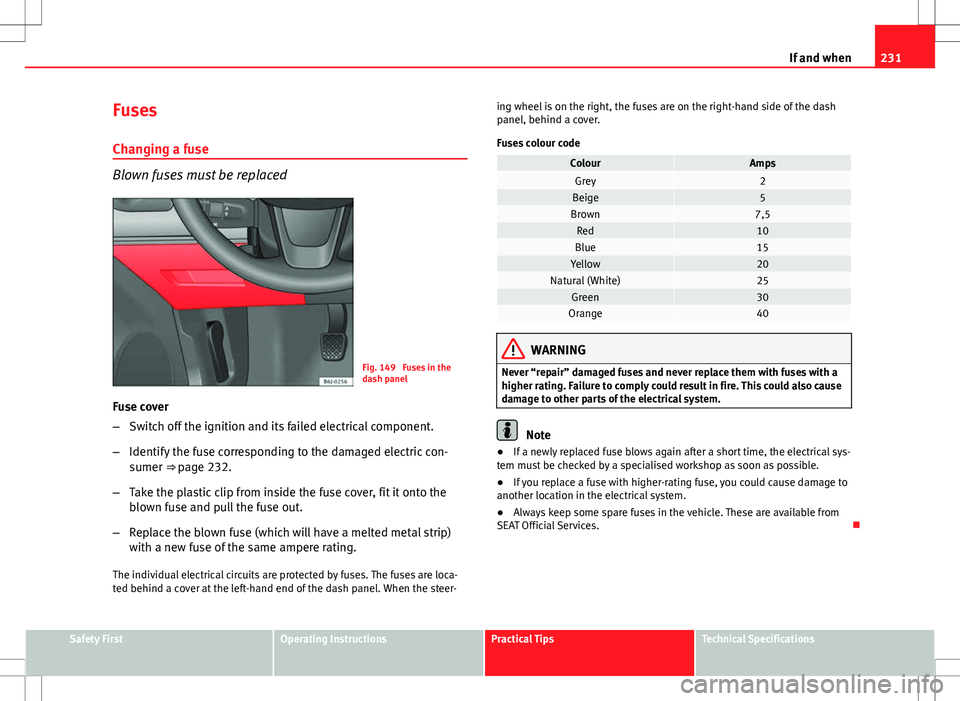
Fig. 149 Fuses in the
dash panel
Fuse cover
– Switch off the ignition and its failed electrical component.
– Identify the fuse corresponding to the damaged electric con-
sumer ⇒ page 232.
– Take the plastic clip from inside the fuse cover, fit it onto the
blown fuse and pull the fuse out.
– Replace the blown fuse (which will have a melted metal strip)
with a new fuse of the same ampere rating.
The individual electrical circuits are protected by fuses. The fuses are loca-
ted behind a cover at the left-hand end of the dash panel. When the steer- ing wheel is on the right, the fuses are on the right-hand side of the dash
panel, behind a cover.
Fuses colour code
ColourAmpsGrey2Beige5Brown7,5Red10Blue15Yellow20Natural (White)25Green30Orange40
WARNING
Never “repair” damaged fuses and never replace them with fuses with a
higher rating. Failure to comply could result in fire. This could also cause
damage to other parts of the electrical system.
Note
● If a newly replaced fuse blows again after a short time, the electrical sys-
tem must be checked by a specialised workshop as soon as possible.
● If you replace a fuse with higher-rating fuse, you could cause damage to
another location in the electrical system.
● Always keep some spare fuses in the vehicle. These are available from
SEAT Official Services.
Safety FirstOperating InstructionsPractical TipsTechnical Specifications
Page 237 of 282
235
If and when
Xenon 1)
//adaptive headlights*
- D1S2)
- LED 3)
- LED3)
- PY 21W
Fog light - H11
WARNING
● Take particular care when working on components in the engine com-
partment if the engine is warm. Risk of burns.
● Bulbs are highly sensitive to pressure. The glass can break when you
touch the bulb, causing injury.
● The high voltage element of gas discharge bulbs* (xenon light) must
be handled correctly. Otherwise, there is a risk of death.
● When changing bulbs, please take care not to injure yourself on sharp
parts in the headlight housing.
CAUTION
● Remove the ignition key before working on the electric system. Other-
wise, a short circuit could occur.
● Switch off the lights or parking lights before you change a bulb.
Dipped and full beam
Side
DRL (day light)
Turn signals
Fog light/cornering
For the sake of the environment
Please ask your specialist retailer how to dispose of used bulbs in the prop-
er manner.
Note
● Depending on weather conditions (cold or wet), the front lights, the fog
lights, the tail lights and the turn signals may be temporarily misted. This
has no influence on the useful life of the lighting system. By switching on
the lights, the area through which the beam of light is projected will quickly
be demisted. However, the edges may continue to be misted.
● Please check at regular intervals that all lighting (especially the exterior
lighting) on your vehicle is functioning properly. This is not only in the inter-
est of your own safety, but also that of all other road users.
● Before changing a bulb, make sure you have the correct new bulb.
● Do not touch the glass part of the bulb with your bare hands, use a cloth
or paper towel instead. Otherwise, the fingerprints left on the glass will va-
porise as a result of the heat generated by the bulb, they will be deposited
on the reflector and will impair its surface.
1)
With this type of headlight, the user can replace the turn signal bulb. Replacement of the
dipped/main beam bulb must be done by a Technical Service, given that complex elements
must be removed from the vehicle and the automatic control system that incorporates it
must be reset.
2) The Xenon bulbs discharge 2.5 times the light flux and have an average lifespan of 5 times
more than that of halogen bulbs, this means that, except due to unusual circumstances,
there is no need to change the bulbs for the whole life of the vehicle.
3) In the event that there is a fault in the LEDs, the complete headlight must be replaced.
Safety FirstOperating InstructionsPractical TipsTechnical Specifications
Page 250 of 282
248If and when
–First fit the glass with the fastening tabs over the frame of the
switch. Next press the front part until the two long tabs click on
the support.
Additional brake lights*
Given the difficulty involved in the replacement of this light it should be
done by the Technical Service.
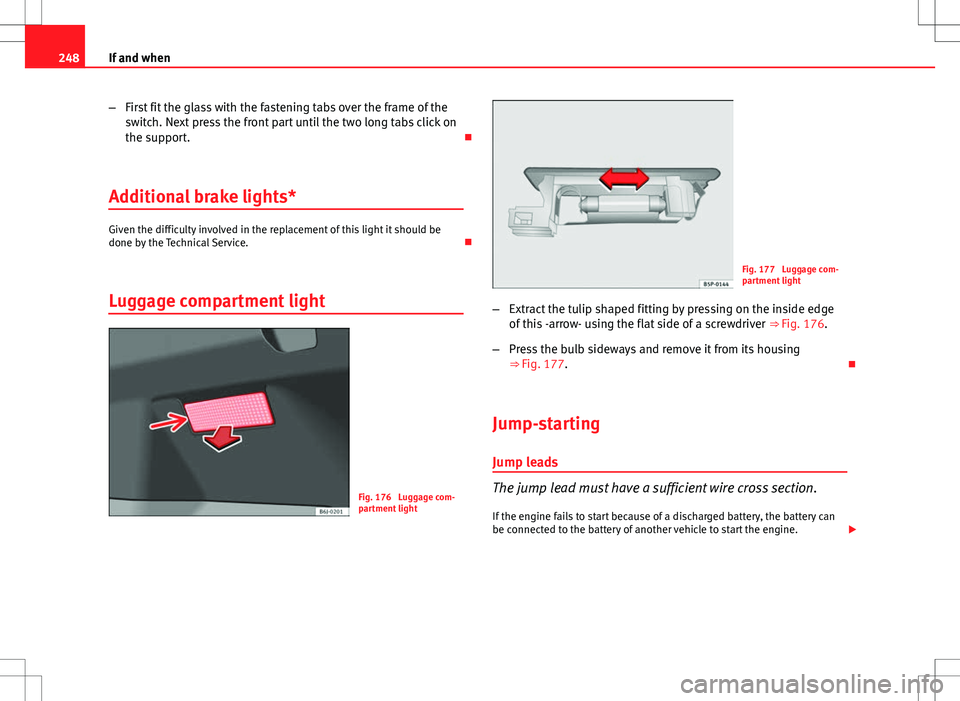
Luggage compartment light
Fig. 176 Luggage com-
partment light
Fig. 177 Luggage com-
partment light
– Extract the tulip shaped fitting by pressing on the inside edge
of this -arrow- using the flat side of a screwdriver ⇒ Fig. 176.
– Press the bulb sideways and remove it from its housing
⇒ Fig. 177.
Jump-starting
Jump leads
The jump lead must have a sufficient wire cross section. If the engine fails to start because of a discharged battery, the battery can
be connected to the battery of another vehicle to start the engine.
Page 260 of 282
258Description of specifications
Drawbar loads
The maximum permitted drawbar load on the ball joint of the towing bracket
must not exceed 75 kg.
In the interest of road safety, we recommend that you always tow approach-
ing the maximum drawbar load. The response of the trailer on the road will
be poor if the drawbar load is too small.
If the maximum permissible drawbar load cannot be met (e.g. with small,
empty and light-weight single axle trailers or tandem axle trailers with a
wheelbase of less than 1 metre), a minimum of 4% of the actual trailer
weight is legally required for the drawbar load.
WARNING
● For safety reasons, do not exceed the 80 km/h (50 mph) limit. This is
also valid in countries where higher speeds are permitted.
● Never exceed the maximum trailer weights or the drawbar load. If the
permissible axle load or the permissible total weight is exceeded, the
driving characteristics of the vehicle may change, leading to accidents,
injuries and damage to the vehicle.
Wheels
Tyre pressure, snow chains, wheel bolts
Tyre pressures
The sticker with the tyre pressure values can be found on the inside of the
fuel tank flap. The tyre pressure values given there are for cold tyres. The
slightly raised pressures of warm tyres must not be reduced. ⇒
Snow chains
Snow chains may be fitted only to the front wheels, and only for the follow-
ing tyres:
175/70R14
185/60R15Chains with links not exceeding 15 mm (including the chain
closure)
215/45R16Chains with links not exceeding 9 mm (including the chain
closure)
215/40R17Chains with links not exceeding 7 mm (including the chain
closure)
Wheel bolts
After the wheels have been changed, the tightening torque of the wheel
bolts should be checked as soon as possible with a torque wrench ⇒
.
The tightening torque for steel and alloy wheels is 120 Nm.
WARNING
● Check the tyre pressure at least once per month. Checking the tyre
pressure is very important. If the tyre pressure is too high or too low,
there is an increased danger of accidents, particularly at high speeds.
● If the tightening torque of the wheel bolts is too low, they could loos-
en while the vehicle is in motion. Risk of accident! If the tightening tor-
que is too high, the wheel bolts and threads can be damaged.
Note
We recommend that you ask your Technical Service for information about
appropriate wheel, tyre and snow chain size.
Page 261 of 282
259
Technical specifications
Technical specifications
Checking fluid levels
From time to time, the levels of the different fluids in the ve-
hicle must be checked. Never fill with incorrect fluids, other-
wise serious damage to the engine may be caused.
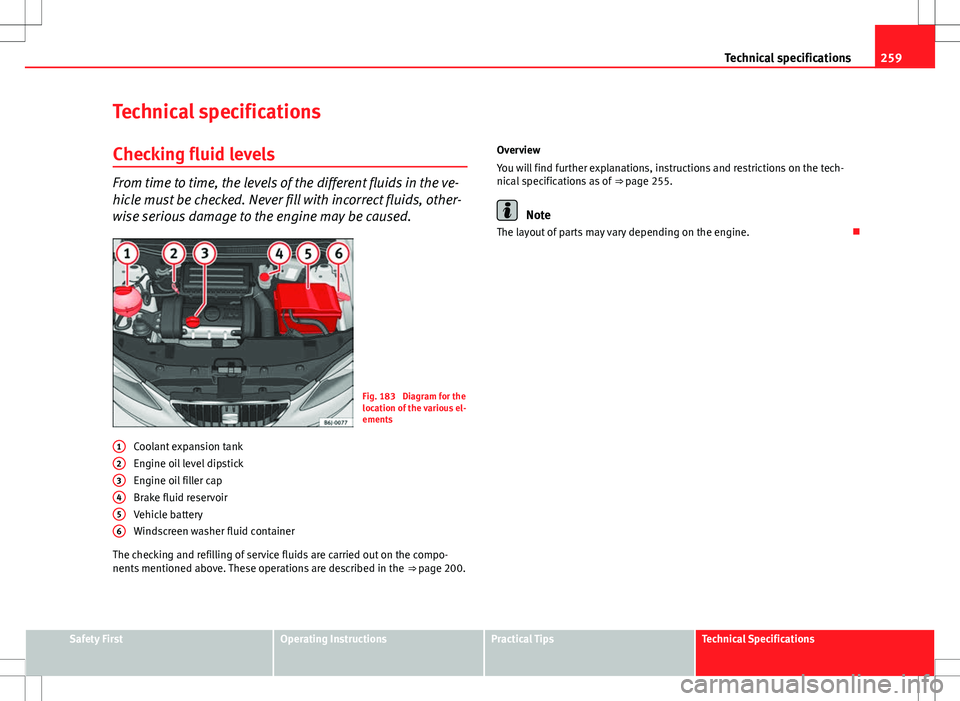
Fig. 183 Diagram for the
location of the various el-
ements
Coolant expansion tank
Engine oil level dipstick
Engine oil filler cap
Brake fluid reservoir
Vehicle battery
Windscreen washer fluid container
The checking and refilling of service fluids are carried out on the compo-
nents mentioned above. These operations are described in the ⇒ page 200.
1
23456
Overview
You will find further explanations, instructions and restrictions on the tech-
nical specifications as of
⇒ page 255.
Note
The layout of parts may vary depending on the engine.
Safety FirstOperating InstructionsPractical TipsTechnical Specifications
Page 277 of 282
Instrument and switch lighting . . . . . . . . . . . . 102
Instrument lighting . . . . . . . . . . . . . . . . . . . . . . 55
Instrument panelService interval display . . . . . . . . . . . . . . . . 63
Instruments . . . . . . . . . . . . . . . . . . . . . . . . . . . . 57
Interior rear vision mirror . . . . . . . . . . . . . . . . . 112
Interval wipe, windscreen . . . . . . . . . . . . . . . . 109
ISOFIX system . . . . . . . . . . . . . . . . . . . . . . . . . . . 49
J
Jump-starting . . . . . . . . . . . . . . . . . . . . . . . . . . 248
Jump leads . . . . . . . . . . . . . . . . . . . . . . . . . . . . 248
K
Keys . . . . . . . . . . . . . . . . . . . . . . . . . . . . . . . . . . . 87
L Leather cleaning . . . . . . . . . . . . . . . . . . . . . . . . 188
Leaving Home function . . . . . . . . . . . . . . . . . . 104
Lights . . . . . . . . . . . . . . . . . . . . . . . . . . . . . . . . 100
Load compartment in the luggage compart- ment
see Loading the luggage compartment . . . 16
Loading the luggage compartment . . . . . . . . . . 16
Locks . . . . . . . . . . . . . . . . . . . . . . . . . . . . . . . . . 185
LPG . . . . . . . . . . . . . . . . . . . . . . . . . . 58, 149, 196
LPG system Driving . . . . . . . . . . . . . . . . . . . . . . . . . . . . . 149
Filler neck adapter . . . . . . . . . . . . . . . . . . . 197 Level indicator . . . . . . . . . . . . . . . . . . . . . . . 58
Refuelling . . . . . . . . . . . . . . . . . . . . . . . . . . 196
Luggage compartment . . . . . . . . . . . . . . . . . . . 129 Fastening rings . . . . . . . . . . . . . . . . . . . . . . 130
Loading . . . . . . . . . . . . . . . . . . . . . . . . . . . . 129
Luggage net . . . . . . . . . . . . . . . . . . . . . . . . 130
see also Loading the luggage compartment . .16
Luggage compartment light* . . . . . . . . . . . . . 108
M
Main beam . . . . . . . . . . . . . . . . . . . . . . . . 100, 106
Main beam headlights control lamp . . . . . . . . . . . . . . . . . . . . . . . . . 75
Maintenance Airbags . . . . . . . . . . . . . . . . . . . . . . . . . . . . . 32
Maintenance and cleaning . . . . . . . . . . . . . . . 181
Manual gearbox . . . . . . . . . . . . . . . . . . . . . . . . 153
Manual heating . . . . . . . . . . . . . . . . . . . . . . . . 135 controls . . . . . . . . . . . . . . . . . . . . . . . . . . . . 134
Manual heating system Defrosting the windscreen . . . . . . . . . . . . . 135
Demisting the windscreen and side win-dows . . . . . . . . . . . . . . . . . . . . . . . . . . . . . 135
MFI . . . . . . . . . . . . . . . . . . . . . . . . . . . . . . . . . . . . 61
Mirrors Exterior mirrors . . . . . . . . . . . . . . . . . . . . . . 113
Interior rear vision mirror . . . . . . . . . . . . . . 112
vanity mirror . . . . . . . . . . . . . . . . . . . . . . . . 109
Mobile phone . . . . . . . . . . . . . . . . . . . . . . . . . . 191
Multifunction display . . . . . . . . . . . . . . . . . . . . . 61 N
Navigator bracket . . . . . . . . . . . . . . . . . . . . . . . 123
Number of seats . . . . . . . . . . . . . . . . . . . . . . . . . 19
O Observations . . . . . . . . . . . . . . . . . . . . . . . . . . 178
Octane number . . . . . . . . . . . . . . . . . . . . . . . . . 199
Odometer . . . . . . . . . . . . . . . . . . . . . . . . . . . . . . 63
Oil . . . . . . . . . . . . . . . . . . . . . . . . . . . . . . . . . . . 203
Oil change . . . . . . . . . . . . . . . . . . . . . . . . . . . . . 206
Oil properties . . . . . . . . . . . . . . . . . . . . . . . . . . 204
One-touch opening and closing Electric windows . . . . . . . . . . . . . . . . . . . . . . 96
Opening and locking . . . . . . . . . . . . . . . . . . . . . 93
Operation when a fault occurs panoramic/tilting sunroof . . . . . . . . . . . . . . 99
Outside temperature indicator . . . . . . . . . . 60, 62
Overview Control lamps . . . . . . . . . . . . . . . . . . . . . 65, 67
Dash panel . . . . . . . . . . . . . . . . . . . . . . . . . . 55
Instruments . . . . . . . . . . . . . . . . . . . . . . . . . 57
Warning lamps . . . . . . . . . . . . . . . . . . . . 65, 67
P Paintwork Polishing . . . . . . . . . . . . . . . . . . . . . . . . . . . 184
Panoramic sunroof . . . . . . . . . . . . . . . . . . . . . . . 98
Parking . . . . . . . . . . . . . . . . . . . . . . . . . . . . . . . 162
Parking lights . . . . . . . . . . . . . . . . . . . . . . . . . . 106
275
Index