Oil Seat Ibiza ST 2014 User Guide
[x] Cancel search | Manufacturer: SEAT, Model Year: 2014, Model line: Ibiza ST, Model: Seat Ibiza ST 2014Pages: 240, PDF Size: 4.89 MB
Page 136 of 240
Operation
WARNING
You could lose control of the vehicle if you ac-
celerate on slippery road surfaces. Risk of se-
rious injury.
● Be particularly careful when using the kick-
down features on slippery road surfaces. With
a fast acceleration, the vehicle could lose
traction and skid.
● You should use the kick-down feature only
when traffic and weather conditions allow it
to be used safely. Gear-change indicator
3 Valid for vehicles: with a manual gearbox
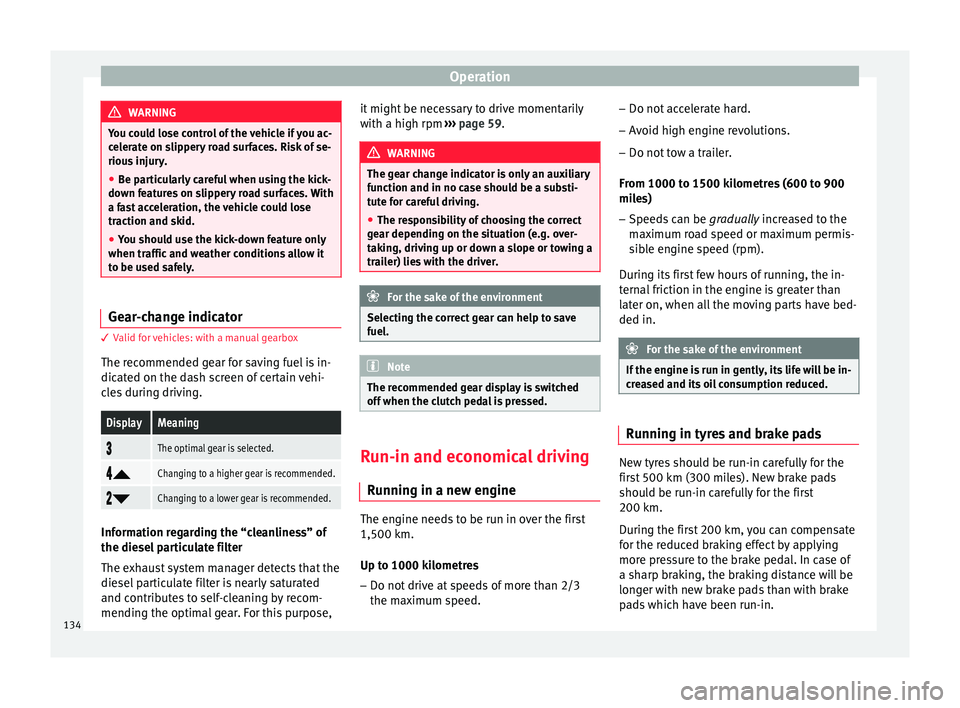
The recommended gear for saving fuel is in-
dicated on the dash screen of certain vehi-
cles during driving.DisplayMeaning
The optimal gear is selected.
Changing to a higher gear is recommended.
Changing to a lower gear is recommended.
Information regarding the “cleanliness” of
the diesel particulate filter
The exhaust system manager detects that the
diesel particulate filter is nearly saturated
and contributes to self-cleaning by recom-
mending the optimal gear. For this purpose, it might be necessary to drive momentarily
with a high rpm
››› page 59. WARNING
The gear change indicator is only an auxiliary
function and in no case should be a substi-
tute for careful driving.
● The responsibility of choosing the correct
gear depending on the situation (e.g. over-
taking, driving up or down a slope or towing a
trailer) lies with the driver. For the sake of the environment
Selecting the correct gear can help to save
fuel. Note
The recommended gear display is switched
off when the clutch pedal is pressed. Run-in and economical driving
Running in a new engine The engine needs to be run in over the first
1,500 km.
Up to 1000 kilometres
– Do not drive at speeds of more than 2/3
the maximum speed. –
Do not accelerate hard.
– Avoid high engine revolutions.
– Do not tow a trailer.
From 1000 to 1500 kilometres (600 to 900
miles) – Speeds can be gradually increased to the
m ax
imum road speed or maximum permis-
sible engine speed (rpm).
During its first few hours of running, the in-
ternal friction in the engine is greater than
later on, when all the moving parts have bed-
ded in. For the sake of the environment
If the engine is run in gently, its life will be in-
creased and its oil consumption reduced. Running in tyres and brake pads
New tyres should be run-in carefully for the
first 500 km (300 miles). New brake pads
should be run-in carefully for the first
200 km.
During the first 200 km, you can compensate
for the reduced braking effect by applying
more pressure to the brake pedal. In case of
a sharp braking, the braking distance will be
longer with new brake pads than with brake
pads which have been run-in.
134
Page 137 of 240
Driving
WARNING
● At first, new tyres do not give maximum
grip, and require running-in. This may cause
an accident. Drive particularly carefully in the
first 500 km.
● New brake pads must be “run in” and do
not have the correct friction properties during
the first 200 km. However, the reduced brak-
ing capacity may be compensated by press-
ing on the brake pedal a little harder. Environmental friendliness
Environmental protection is a top priority in
the design, choice of materials and manufac-
ture of your new SEAT.
Constructive measures to encourage
recycling
● Joints and connections designed for easy
dismantling
● Modular construction to facilitate disman-
tling
● Increased use of single-grade materials.
● Plastic parts and elastomers are marked in
accordance with ISO 1043, ISO 11469 and
ISO 1629.
Choice of materials
● Use of recycled materials. ●
Use of compatible plastics in the same part
if its components are not easily separated.
● Use of recycled materials and/or materials
originating from renewable sources.
● Reduction of volatile components, includ-
ing odour, in plastic materials.
● Use of CFC-free coolants.
Ban on heavy metals, with the exceptions
dictated by law (Annex II of ELV Directive
2000/53/EC): cadmium, lead, mercury, hexa-
v al
ent chromium.
Manufacturing methods
● Reduction of the quantity of thinner in the
protective wax for cavities.
● Use of plastic film as protection during ve-
hicle transport.
● Use of solvent-free adhesives.
● Use of CFC-free coolants in cooling sys-
tems.
● Recycling and energy recovery from resi-
dues (RDF).
● Improvement in the quality of waste water.
● Use of systems for the recovery of residual
heat (thermal recovery, enthalpy wheels,
etc.).
● The use of water-soluble paints. Catalytic converter To maintain the useful life of the catalytic
converter
– Use only unleaded petrol with petrol en-
gines, as lead damages the catalytic con-
verter.
– Do not let the fuel get too low in the tank.
– For engine oil changes, do not replenish
with too much engine oil ››› page 170, Top-
ping up engine oil .
– Nev er t
ow the vehicle to start it, use jump
leads if necessary ›››
page 188.
If you notice misfiring, uneven running or
loss of power when the vehicle is moving, re-
duce speed immediately and have the vehi-
cle inspected at the nearest specialised
workshop. In general, the exhaust warning
lamp will light up when any of the described
symptoms occur ›››
page 57. If this happens,
unburnt fuel can enter the exhaust system
and escape into the environment. The cata-
lytic converter can also be damaged by over-
heating. WARNING
The catalytic converter reaches very high
temperatures! Risk of fire!
● Never park where the catalytic converter
could come into contact with dry grass or
flammable materials under the vehicle. » 135
Technical specifications
Advice
Operation
Safety
The essentials
Page 159 of 240
Care and maintenance
Products for vehicle maintenance
Car-care products are available in your Tech-
nical Services. Keep the product instructions
until you have used them up. WARNING
● Car-care products can be toxic. Because of
this, they must always be kept closed in their
original container. Keep them out of the reach
of children. Failure to comply could result in
poisoning.
● Always read and observe the instructions
and warnings on the package before using
car-care products. Improper use could cause
health problems or damage the vehicle. The
use of certain products may produce noxious
vapours; they should be used in well ventila-
ted areas.
● Never use fuel, turpentine, engine oil, nail
varnish remover or other volatile fluids.
These are toxic and highly flammable. Risk of
fire and explosion.
● Before washing your vehicle, or carrying
out any maintenance, switch the engine off,
apply the handbrake firmly and remove the
key from the ignition. CAUTION
Never attempt to remove dirt, mud or dust if
the surface of the vehicle is dry. Never use a
dry cloth or sponge for cleaning purposes.
This could damage the paintwork or the win-
dows of your vehicle. Soak dirt, mud or dust
with plenty of water. For the sake of the environment
● When purchasing products for your vehicle
maintenance, select the ones which are not
harmful to the environment.
● The waste from car-care products should
not be disposed of with ordinary household
waste. Observe the disposal information on
the package. Care of the vehicle exterior
Automatic car washing tunnel The vehicle paintwork is so durable that the
vehicle can normally be washed without
problems in an automatic car wash tunnel.
However, the paintwork wear depends to a
large extent on the kind of the car wash tun-
nel, the brushes used, its water filtering and
the type of cleaning and preservative prod-
ucts.
Before going through a car wash, be sure to
take the usual precautions such as closing
the windows and sunroof. There is nothing to
note apart from that.
If the vehicle has special accessories such as
spoilers or a roof rack or two-way radio aerial,
etc., it is advisable to consult the car wash
tunnel operator first.After washing, the brakes could take some
time to respond as the brake discs and pads
could be wet, or even frozen in winter. “Dry”
the brakes by braking several times. WARNING
Water, ice and salt on the brake system can
reduce braking effectiveness. Risk of acci-
dent. CAUTION
Before putting the vehicle through the car
wash, do not tighten the aerial if it is folded
because it can be damaged. Washing by hand
Vehicle washing
– First soften the dirt and rinse it off with wa-
ter.
– Clean your vehicle from top to bottom with
a soft sponge, a glove or a brush. Use very
light pressure.
– Rinse the sponge or glove often with clean
water.
– Special car shampoo should only be used
for very stubborn dirt.
– Leave the wheels, sill panels etc. until last,
using a different sponge or glove.
»
157Technical specifications
Advice
Operation
Safety
The essentials
Page 160 of 240
Advice
– Rinse the vehicle thoroughly with water.
– Dry the vehicle surface gently with a cha-
mois leather.
– In cold temperature
, dry the rubber seals
and their s
urfaces to prevent them from
freezing. Apply silicone spray to the rubber
seals.
After washing the vehicle – After washing, avoid sudden and sharp
braking. “Dry” the brakes by braking sever-
al times. WARNING
● Wash your vehicle with the ignition switch-
ed off.
● Protect your hands and arms from cuts on
sharp metal edges when cleaning the under-
body, the inside of the wheel housings etc.
Risk of injury.
● Water, ice and salt on the brake system can
reduce braking effectiveness. Risk of acci-
dent. CAUTION
● Never remove dirt, mud or dust if the vehi-
cle surface is dry. Never use a dry cloth or
sponge for cleaning purposes. This could
scratch the paintwork or glass on your vehi-
cle. ●
Washing the vehicle in low temperatures:
when washing the vehicle with a hose, do not
direct water into the lock cylinders or the
gaps around the doors, rear lid, or sunroof.
Risk of freezing. For the sake of the environment
To protect the environment, the vehicle
should be washed only in specially provided
wash bays, to prevent toxic, oil-laden waste
water from entering the sewer system. In
some places, washing vehicles outside wash
bays is prohibited. Note
Do not wash the vehicle in direct sunlight. Washing the vehicle with a high
pressure cleaner
Be particularly careful when using a high
pressure cleaner!
– Always observe the instructions for the
high-pressure cleaner, particularly those
concerning the pressure and the spraying
di s
tance.
– Increase the spraying distance for soft ma-
terials and painted bumpers. –
Do not use a high pressure cleaner to re-
move ice or snow from windows
››› page 159.
– Never u
se concentrated jet nozzles (“rotat-
ing jets”) ››› .
– After washing, avoid sudden and sharp
braking. “Dry” the brakes by braking sever-
al times ››› page 126 . WARNING
● Never wash tyres with a concentrated jet
(“rotating nozzle”). Even at large spraying
distances and short cleaning times, damage
can occur to the tyres. This may cause an ac-
cident.
● Water, ice and salt on the brake system can
reduce braking effectiveness. Risk of acci-
dent. CAUTION
● Do not use water hotter than +60 °C
(+140 °F). This could damage the vehicle.
● To avoid damage to the vehicle, keep a suf-
ficient distance from sensitive materials such
as flexible hoses, plastic, soundproofing ma-
terial, etc. This also applies to bumpers pain-
ted in the colour of the bodywork. The closer
the nozzle is to the surface, the greater the
wear on the material. 158
Page 161 of 240
Care and maintenance
Vehicle paint maintenance Regular waxing protects the paintwork.
You need to apply wax to your vehicle if water
does not form small drops and run off the
paintwork when it is
clean.
Good quality har
d wax products are available
at your Technical Service.
Regular wax applications help to protect the
paintwork from environmental contaminants
››› page 156. It is also effective in protecting
again
st minor scratches.
Even if a wax solution is used regularly in the
vehicle washing tunnel, it is advisable to pro-
tect the paint with a hard wax coating at least
twice a year.
Polishing the paintwork Polishing is only necessary if the paint has
lost its shine, and the gloss cannot be
brought back by applying wax. Polishing
products can be purchased in your Technical
Service.
The vehicle must be waxed after polishing if
the polish used does not contain wax com-
pounds to seal the paint
›››
page 159, Vehicle
paint maintenance . CAUTION
To prevent damage to the paintwork:
● Do not use polishes and hard wax on pain-
ted parts with a matt finish or on plastic
parts.
● Do not polish your vehicle in a sandy or
dusty environment. Caring for plastic parts
If normal washing fails to clean plastic parts,
clean them with approved solvent-free plas-
tic cleaning and care products.
CAUTION
● The use of liquid air freshener directly over
the air vents of the vehicle may damage plas-
tic parts if the liquid is accidentally spilled.
● Cleaning products which contain solvents
will damage the material. Cleaning windows and exterior
mirrors
Cleaning windows
– Moisten the windows with commercially
available, alcohol based glass cleaner.
– Dry the windows with a clean chamois
leather or a lint-free cloth. Removing snow
– Use a small brush to remove snow from the
windows and mirrors.
Removing ice – Use a de-icer spray.
Use a clean cloth or chamois leather to dry
the windows. The chamois leathers used on
painted surfaces are not suitable to clean
windows because they are soiled with wax
deposits which could smear the windows.
If possible, use a de-icing spray to remove
ice. If you use an ice scraper, push it in one
direction only without swinging it.
Use window cleaner or a silicone remover to
clean rubber, oil, grease and silicone depos-
its off.
Wax deposits can only be removed with a
special cleaner available at your Technical
Service. Wax deposits on the windscreen
could cause the wiper blades to judder. Add-
ing a window cleaner that dissolves wax to
the windscreen washer fluid prevents wiper
blades from juddering, but wax deposits are
not removed. CAUTION
● Never use warm or hot water to remove
snow and ice from windows and mirrors. This
could cause the glass to crack! » 159
Technical specifications
Advice
Operation
Safety
The essentials
Page 163 of 240
Care and maintenance
Alloy wheels require regular attention to pre-
serve their appearance. If road salt and brake
dust are not often removed, the aluminium
finish will be impaired.
Always use an acid-free detergent for alloy
wheel rims.
Car polish or other abrasive agents should
not be used for maintaining the rims. If the
protective coating is damaged, e.g. by flying
stones, the damaged area should be re-
paired immediately. WARNING
Observe the safety warnings ››› in Steel
wheel rims on page 160. Underbody protection
The vehicle underbody is coated to protect it
from chemical and mechanical damage.
The protective coating can be damaged when
driving. We recommend that you check the
protective coating under the body and on the
running gear, and retouch it if necessary, be-
fore and after the winter season.
We recommend that you go to your Technical
Service to carry out repair work and addition-
al anti-corrosion work. WARNING
Do not apply underseal or anti-corrosion
coatings to the exhaust pipes, catalytic con-
verter or the heat shields on the exhaust sys-
tem. The heat of the exhaust system or the
engine could cause them to ignite. Risk of
fire. Cleaning the engine compartment
Take special care when cleaning the engine
compartment.
Anti-corrosion treatment
The engine compartment and the surface of
the power unit are given anti-corrosion treat-
ment at the factory.
Good corrosion protection is particularly im-
portant in winter when the vehicle is fre-
quently driven on salted roads. To prevent
the salt corroding the vehicle, the entire en-
gine compartment should be thoroughly
cleaned before and after winter.
Technical Services
have the proper products
for cleaning and preservation as well as the
necessary workshop equipment. For this rea-
son, we recommend having this work per-
formed by them.
The anti-corrosion protection is usually re-
moved if the engine compartment is cleaned
with grease removing solutions, or if you have the engine cleaned. On commissioning
this work, ensure that all surfaces, seams,
joints and components in the engine com-
partment are given anti-corrosion treatment.
WARNING
● When working in the engine compartment,
always observe the safety warnings
››› page 166.
● Bef
ore opening the bonnet, switch the en-
gine off, apply the handbrake firmly and al-
ways remove the key from the ignition.
● Allow the engine to cool before you clean
the engine compartment.
● Do not clean, for example, the vehicle un-
derbody, wheel arches or wheel trims without
protecting your hands and arms. You may cut
yourself on sharp-edged metal parts. Failure
to comply could result in injury.
● Moisture, ice and salt on the brake system
may affect braking effectiveness. Risk of acci-
dent. Directly after washing, avoid sudden
and sharp braking.
● Never touch the radiator fan. It is tempera-
ture-controlled and could start automatically,
even when the key is removed from the igni-
tion! For the sake of the environment
Fuel, grease and oil deposits can be removed
when the engine is washed. The polluted wa-
ter must be cleaned in an oil separator. For
this reason, engine washing should be » 161
Technical specifications
Advice
Operation
Safety
The essentials
Page 167 of 240
Checking and refilling levels
For the sake of the environment
Just one full tank of leaded fuel would seri-
ously impair the efficiency of the catalytic
converter. Petrol additives
The quality of the fuel influences the behav-
iour, power and service life of the engine.
This is why the petrol you use should carry
suitable additives already included by the
petrol industry, free of metals. These addi-
tives will help to prevent corrosion, keep the
fuel system clean and prevent deposits from
building up in the engine.
If good-quality petrol with metal-free addi-
tives is not available or engine problems
arise, the necessary additives must be added
when refuelling.
Not all petrol additives have been shown to
be effective. The use of unsuitable petrol ad-
ditives may cause significant damage to the
engine and the catalytic converter. Metal ad-
ditives should never be used. Metal additives
may also be contained in petrol additives for
improving anti-detonation ratings or octane
ratings.
SEAT recommends “genuine Volkswagen
Group fuel additives for petrol engines”.
These additives can be bought at SEAT deal- ers, where information on how to use them
can also be obtained. CAUTION
Do not refuel if the filler indicates that the
fuel contains metal. LRP (lead replacement
petrol) fuels contain high concentrations of
metal additives. Using them may damage the
engine! Diesel
Diesel* Diesel fuel
must conform to DIN EN 590 (EN =
“European Standard”). It must have a cetane
number (CN) of at least 51. The cetane num-
ber indicates the ignition quality of the diesel
fuel.
Notes on refuelling ›››
page 163.
Biodiesel* CAUTION
● Your vehicle is not designed to use biodie-
sel fuel. Never, under any circumstances re-
fuel with biodiesel. The use of biodiesel fuel
could damage the engine and the fuel sys-
tem. The addition of biodiesel to diesel fuel
by the diesel manufacturer in accordance with standard EN 590 or DIN 51628 is author-
ised and will not cause damage to the engine
or the fuel system.
● The diesel engine has been designed to be
used exclusively with diesel fuel conforming
to standard EN 590. Never refuel or use pet-
rol, kerosene, fuel oil or any other type of
fuel. If you accidentally fill up the vehicle with the wrong type of fuel, do not start the
engine. Seek assistance from specialised per-
sonnel. The composition of these fuels may
severely damage the fuel system and the en-
gine. Winter operation
Winter-grade diesel
When using “summer-grade diesel fuel”, dif-
ficulties may be experienced at temperatures
below 0 °C (+32 °F) because the fuel thickens
due to wax separation. For this reason, “win-
ter-grade diesel fuel” is available in some
countries during the cold months. It can be
used at temperatures as low as -22 °C (-8 ºF).
In countries with different climatic conditions
the diesel fuel generally sold has different
temperature characteristics. Check with the
Technical Services or filling stations in the
country concerned regarding the type of die-
sel fuels available.
»
165Technical specifications
Advice
Operation
Safety
The essentials
Page 168 of 240
Advice
Filter pre-heater
Your vehicle is fitted with a fuel filter glow
plug system, making it well equipped for op-
eration in winter. This ensures that the fuel
system remains operational to approx. -24 °C
(-11 ºF), provided you use winter-grade die-
sel which is safe to -15 °C (+5 °F).
However, if the fuel has waxed to such an ex-
tent that the engine will not start at tempera-
tures of under -24 °C (-11 °F), simply place
the vehicle in a warm place for a while. CAUTION
Do not mix fuel additives, the so-called “thin-
ners”, or similar additives with diesel fuel. Working in the engine
compartment
Safety instructions on working in the
engine compartment Before starting any work on the engine or in
the engine compartment:
1. Switch off the engine and remove the key
from the ignition.
2. Apply the handbrake.
3. Move the gear lever to neutral or the selec- tor lever to position P. 4. Wait for the engine to cool down.
5. Keep children away from the vehicle.
6. Raise the bonnet
››› page 167.
You should not do any work in the engine
compartment unless you know exactly how to
carry out the jobs and have the correct tools!
Have the work carried out by a specialised
workshop if you are uncertain.
All service fluids and consumables, e.g. cool-
ant, engine oil, spark plugs and batteries,
are under constant development. SEAT pro-
vides a constant flow of information to Tech-
nical Services concerning modifications. For
this reason, we recommend you have service
fluids and consumables replaced by a Techni-
cal Service. Please observe the relevant in-
structions ››› page 155 . The engine compart-
ment of
the vehicle is a hazardous area ››› .
WARNING
All work on the engine or in the engine com-
partment, e.g. checking and refilling fluids,
involves the danger of injury and burns, acci-
dents and even fire.
● Never open the bonnet if you see steam,
smoke or coolant escaping from the engine
compartment. Otherwise, there is a risk of
sustaining burns. Wait until no more steam or
coolant is emitted, then allow the engine to
cool before carefully opening the bonnet. ●
Switch off the engine and remove the key
from the ignition.
● Apply the handbrake and move the gear
lever to neutral or selector lever to position P.
● Keep children away from the vehicle.
● Never touch hot engine parts. There is a
risk of burns.
● Never spill liquids on a hot engine or on a
hot exhaust gas system. This is a fire hazard.
● Avoid causing short-circuits in the electri-
cal system, particularly at the points where
the jump leads are attached ››› page 188. The
battery could explode.
● Never touch the radiator fan. It is tempera-
ture controlled and could start automatically,
even when the engine has been switched off
and the key removed from the ignition!
● Never cover the engine with additional in-
sulating materials such as a blanket. Risk of
fire!
● Do not unscrew the cap on the coolant ex-
pansion tank when the engine is hot. If the
coolant is hot, the cooling system will be
pressurised!
● Protect face, hands and arms by covering
the cap with a large, thick cloth to protect
against escaping coolant and steam.
● Always make sure you have not left any ob-
jects, such as cleaning cloths or tools, in the
engine compartment.
● If you have to work underneath the vehicle,
you must use suitable stands additionally to 166
Page 169 of 240
Checking and refilling levels
support the vehicle, there is a risk of acci-
dent!. A hydraulic jack is insufficient for se-
curing the vehicle and there is a risk of injury.
●
If any work has to be performed when the
engine is started or with the engine running,
there is an additional, potentially fatal, safety
risk from the rotating parts, such as the drive
belts, alternator, radiator fan, etc., and from
the high-voltage ignition system. You should
also observe the following:
– Never touch the electrical wiring of the
ignition system.
– Ensure that jewellery, loose clothing and
long hair do not get trapped in rotating
engine parts. Danger of death. Before
starting any work remove jewellery, tie
back and cover hair, and wear tight-fit-
ting clothes.
– Never accelerate with a gear engaged
without taking the necessary precau-
tions. The vehicle could move, even if the
handbrake is applied. Danger of death.
● If work has to be carried out on the fuel
system or on electrical components, you
must observe the following safety notes in
addition to the above warnings:
– Always disconnect the battery from the
on-board network. The vehicle must be
unlocked when this is done, otherwise
the alarm will be triggered.
– Do not smoke.
– Never work near naked flames.
– Always have a fire extinguisher on hand. CAUTION
When topping up service fluids, make sure
not to mistake them. Using the wrong fluids
could cause serious malfunctions and engine
damage! For the sake of the environment
Service fluids leaks are harmful to the envi-
ronment. For this reason you should make
regular checks on the ground underneath
your vehicle. If you find spots of oil or other
fluids, have your vehicle inspected in a speci-
alised workshop. Opening the bonnet
Read the additional information carefully
››› page 10
The bonnet is released from inside the vehi-
cle.
Before opening the bonnet ensure that the
windscreen wipers are in rest position. WARNING
Hot coolant can scald!
● Never open the bonnet if you see steam,
smoke or coolant escaping from the engine
compartment. ●
Wait until no more steam, smoke or coolant
is emitted from the bonnet, then carefully
open the bonnet.
● When working in the engine compartment,
always observe the safety warnings
››› page 166. Closing the bonnet
–
Slightly lift the bonnet.
– Release the bonnet stay and replace it in its
support.
– At a height of approximately 30 cm let it fall
so it locks.
If the bonnet does not close, do not press
downwards. Open it again and let it fall as
mentioned above. WARNING
If the bonnet is not closed properly, it could
open while you are driving and completely
obscure your view of the road. Risk of acci-
dent.
● After closing the bonnet, always check that
it is properly secured. The bonnet must be
flush with the surrounding body panels.
● If you notice that the bonnet latch is not se-
cured when the vehicle is moving, stop the
vehicle immediately and close the bonnet
properly. Risk of accident. 167Technical specifications
Advice
Operation
Safety
The essentials
Page 170 of 240
Advice
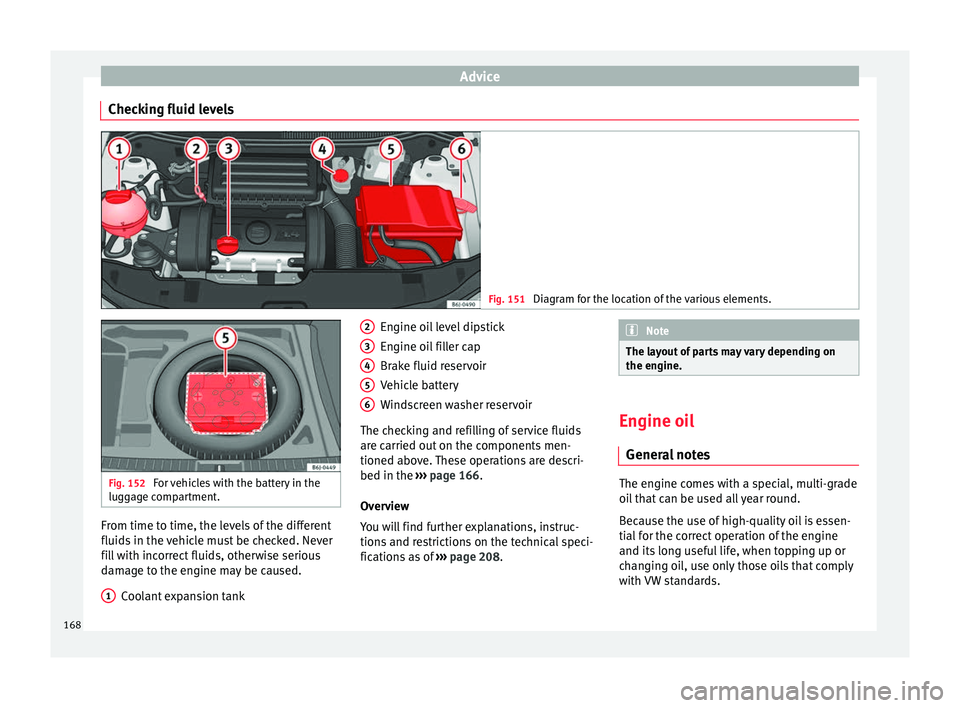
Checking fluid levels Fig. 151
Diagram for the location of the various elements. Fig. 152
For vehicles with the battery in the
luggage compartment. From time to time, the levels of the different
fluids in the vehicle must be checked. Never
fill with incorrect fluids, otherwise serious
damage to the engine may be caused.
Coolant expansion tank
1 Engine oil level dipstick
Engine oil filler cap
Brake fluid reservoir
Vehicle battery
Windscreen washer reservoir
The checking and refilling of service fluids
are carried out on the components men-
tioned above. These operations are descri-
bed in the ››› page 166 .
Ov er
view
You will find further explanations, instruc-
tions and restrictions on the technical speci-
fications as of ››› page 208
.
2 3
4
5
6 Note
The layout of parts may vary depending on
the engine. Engine oil
General notes The engine comes with a special, multi-grade
oil that can be used all year round.
Because the use of high-quality oil is essen-
tial for the correct operation of the engine
and its long useful life, when topping up or
changing oil, use only those oils that comply
with VW standards.
168