light Seat Ibiza ST 2016 Owner's manual
[x] Cancel search | Manufacturer: SEAT, Model Year: 2016, Model line: Ibiza ST, Model: Seat Ibiza ST 2016Pages: 252, PDF Size: 5.56 MB
Page 215 of 252
Wheels
Wheels
Wheel s
and ty r
es
General notes Avoiding damage
– If you have to drive over a kerb or similar
obs t
acle, drive very slowly and at a right
angle.
– Keep grease, oil and fuel off the tyres.
– Inspect the tyres regularly for damage
(cuts, cr ac
ks or blisters, etc.). Remove any
foreign objects embedded in the treads.
Storing tyres
– When you remove the tyres, mark them in
order to maint
ain the same direction of ro-
tation when they are installed again.
– When removed, the wheels and/or tyres
should be st
ored in a cool, dry and prefera-
bly dark location.
– Store tyres in a vertical position, if they are
not fitted on wheel rims.
New ty
res
New tyres must be run in ›››
page 167.
The tread depth of new tyres may vary, ac-
cording to the type and make of tyre and the
tread pattern. Concealed damage
Damage to ty
res and rims is often not readily
visible. If you notice unusual vibrations or the
vehicle pulling to one side, this may indicate
that one of the tyres is damaged. They
should be checked immediately by a Techni-
cal Service.
Tyres with directional tread pattern
An arrow on the tyre sidewall indicates the di-
rection of rotation on tyres with directional
tread. Always observe the direction of rota-
tion indicated when fitting the wheel. This
guarantees optimum grip and helps to avoid
aquaplaning, excessive noise and wear. WARNING
● New tyre s
do not have maximum grip dur-
ing the first 500 km. Drive particularly care-
fully to avoid possible accidents.
● Never drive with damaged tyres. This may
cause an acc
ident.
● If you notice unusual vibrations or if the ve-
hicle pu
lls to one side when driving, stop the
vehicle immediately and check the tyres for
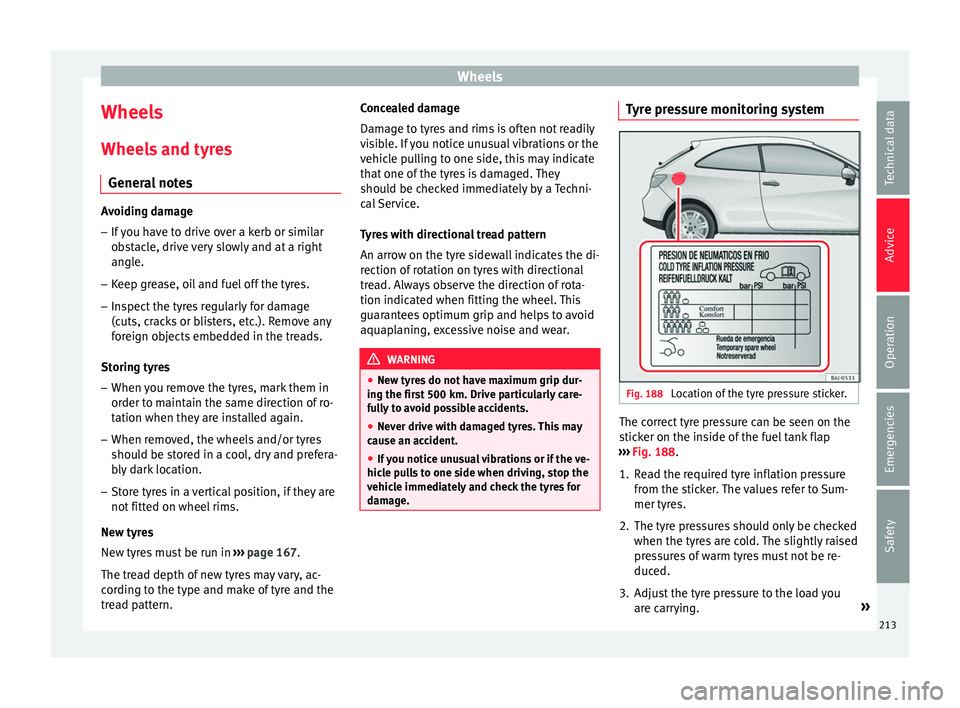
damage. Tyre pressure monitoring system
Fig. 188
Location of the tyre pressure sticker. The correct tyre pressure can be seen on the
s
tic
ker on the in
side of the fuel tank flap
››› Fig. 188.
1. Read the required tyre inflation pressure from the stick
er. The values refer to Sum-
mer tyres.
2. The tyre pressures should only be checked when the tyres
are cold. The slightly raised
pressures of warm tyres must not be re-
duced.
3. Adjust the tyre pressure to the load you are carry
ing. »
213
Technical data
Advice
Operation
Emergencies
Safety
Page 216 of 252
Advice
Tyre pressure
The c orr
ect ty
re pressure is especially impor-
tant at high speeds. The pressure should
therefore be checked at least once a month
and before starting a journey.
Depending on the vehicle, tyre pressure can
be adjusted to medium load to improve driv-
ing comfort (“comfort” tyre pressure). When
driving with comfort tyre pressure fuel con-
sumption may increase slightly. WARNING
A tyre can easily burst if the pressure is too
low, c au
sing an accident!
● At continuously high speeds, a tyre with in-
sufficient pr
essure flexes more. In this way it
becomes too hot, and this can cause tread
separation and tyre blow-out. Always observe
the recommended tyre pressures.
● If the tyre pressure is too low or too high,
the tyres
will wear prematurely and the vehi-
cle will not handle well. Risk of accident! For the sake of the environment
Under-inflated tyres will increase fuel con-
sumption. Tyre useful life
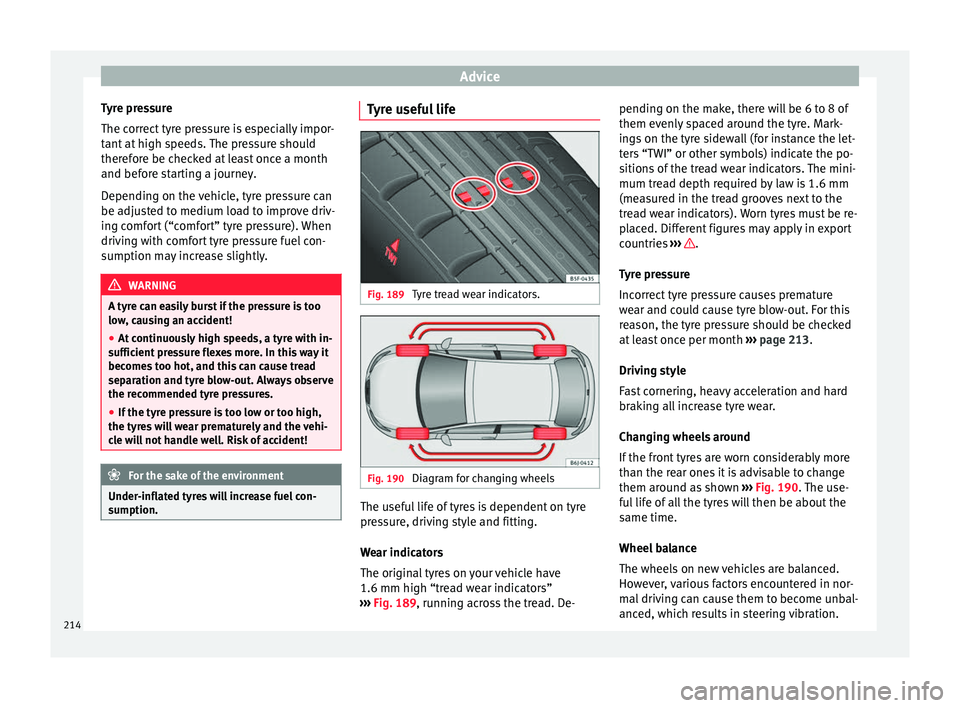
Fig. 189
Tyre tread wear indicators. Fig. 190
Diagram for changing wheels The useful life of tyres is dependent on tyre
pr
e
ss
ure, driving style and fitting.
Wear indicators
The original tyres on your vehicle have
1.6 mm high “tread wear indicators”
››› Fig. 189, running across the tread. De- pending on the make, there will be 6 to 8 of
them evenly s
paced around the tyre. Mark-
ings on the tyre sidewall (for instance the let-
ters “TWI” or other symbols) indicate the po-
sitions of the tread wear indicators. The mini-
mum tread depth required by law is 1.6 mm
(measured in the tread grooves next to the
tread wear indicators). Worn tyres must be re-
placed. Different figures may apply in export
countries ››› .
T y
re pr
essure
Incorrect tyre pressure causes premature
wear and could cause tyre blow-out. For this
reason, the tyre pressure should be checked
at least once per month ››› page 213.
Driving style
Fast cornering, heavy acceleration and hard
braking all increase tyre wear.
Changing wheels around
If the front tyres are worn considerably more
than the rear ones it is advisable to change
them around as shown ››› Fig. 190. The use-
ful life of all the tyres will then be about the
same time.
Wheel balance
The wheels on new vehicles are balanced.
However, various factors encountered in nor-
mal driving can cause them to become unbal-
anced, which results in steering vibration.
214
Page 218 of 252
Advice
●
Never use o l
d tyres or those with an un-
known “history of use”.
● If wheel trims are retrofitted, you must en-
sure that
the flow of air to the brakes is not
restricted. This could cause the brake system
to overheat.
● All four wheels must be fitted with radial
tyres
of the same type, size (rolling circumfer-
ence) and the same tread pattern. For the sake of the environment
Old tyres must be disposed of according to
the l aws
in the country concerned. Note
● A SEA T
Service Centre should be consulted
to find out whether wheels or tyres of differ-
ent sizes to those originally fitted by SEAT
can be fitted, and to find out about the com-
binations allowed between the front axle
(axle 1) and the rear axle (axle 2).
● For technical reasons, it is not generally
possib
le to use the wheels from other vehi-
cles. This can also apply to wheels of the
same model. The use of wheels or tyres
which have not been approved by SEAT for
use with your model may invalidate the vehi-
cle's type approval for use on public roads.
● If the spare tyre is not the same as the
tyres
that are mounted on the vehicle (e.g.
winter tyres) you should only use the spare
tyre for a short period of time and drive with extra care. Refit the normal road wheel as
soon as po
s
sible. Wheel bolts
The design of wheel bolts is matched to the
rims. If differ
ent
wheel rims are fitted, the
correct wheel bolts with the right length and
correctly shaped bolt heads must be used.
This ensures that wheels are fitted securely
and that the brake system functions correctly.
In certain circumstances, you should not use
wheel bolts from a different vehicle, even if it
is the same model ››› page 190. WARNING
If the wheel bolts are not tightened correctly,
the wheel cou l
d become loose while driving.
Risk of accident.
● The wheel bolts must be clean and turn
easi
ly. Never apply grease or oil to them.
● Use only wheel bolts which belong to the
wheel.
● If the pre
scribed torque of the wheel bolts
is too lo
w, they could loosen whilst the vehi-
cle is in motion. Risk of accident! If the tight-
ening torque is too high, the wheel bolts and
threads can be damaged. CAUTION
The prescribed tightening torque for wheel
bolts f
or steel and alloy wheels is 120 Nm. Tyre pressure
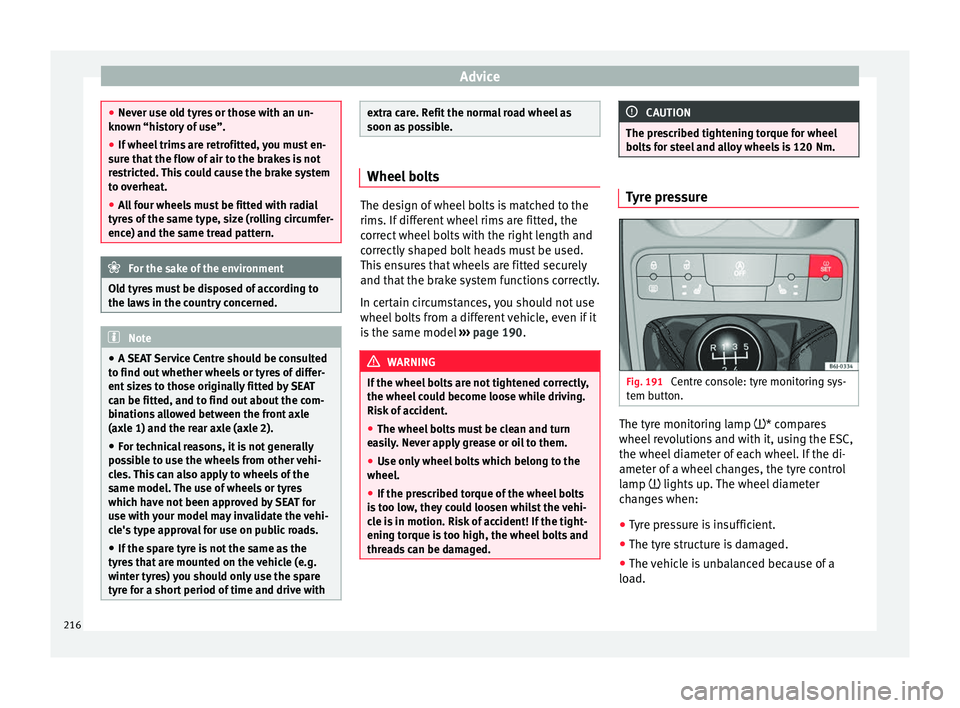
Fig. 191
Centre console: tyre monitoring sys-
t em b
utton. The tyre monitoring lamp * c
omp
are
s
wheel revolutions and with it, using the ESC,
the wheel diameter of each wheel. If the di-
ameter of a wheel changes, the tyre control
lamp lights up. The wheel diameter
changes when:
● Tyre pressure is insufficient.
● The tyre structure is damaged.
● The vehicle is unbalanced because of a
load.
216
Page 219 of 252
Wheels
● The wheel s
of one ax
le are under more
pressure (for example, driving with a trailer or
on steep slopes).
● The vehicle is fitted with snow chains.
● The temporary spare wheel is fitted.
● The wheel on one axle is changed.
Tyre pr
essure adjustment
On adjusting tyre pressure or changing one
or more wheels, the ››› Fig. 191 button must
be kept pressed down, with the ignition on,
until an acoustic signal is heard.
Store the new tyre pressure in the Easy Con-
nect system with the button and the func-
tion b utt
on Set
up
› ›
›
p
age 24.
If
the wheels are under excessive load (for ex-
ample, driving with a trailer or heavy load),
the tyre pressure must be increased to the
recommended value for a full load (see the
sticker on the inside of the fuel flap). If the
tyre monitor system button is pressed down,
the new tyre pressures are confirmed.
The tyre pressure control lamp lights up
If the tyre pressure of a wheel is much lower
than the value set by the driver, then the tyre
pressure control lamp ››› will light up.
WARNING
● When the tyre pr e
ssure control lamp lights
up, reduce speed immediately and avoid any sudden turning or braking manoeuvre. Stop
when poss
ib
le, and check the tyre pressure
and status.
● The driver is responsible for maintaining
correct ty
re pressures. For this reason, tyre
pressure must be regularly checked.
● Under certain circumstances (e.g. when
driving in a spor
ty manner, in winter condi-
tions or on a dirt track) the tyre control lamp
may light up belatedly or may function incor-
rectly. Note
If the battery is disconnected, the yellow
warning l amp
lights up after turning the
ignition on. This should turn off after a brief
journey. Winter service
W int
er ty r
es In winter conditions winter tyres will consid-
er
ab
ly impr
ove the vehicle's handling. The
design of summer tyres (width, rubber com-
pound, tread pattern) gives less grip on ice
and snow.
Winter tyres must be inflated to a pressure of
0.2 bar (2.9 psi/20 kPa) higher than the pres-
sures specified for summer tyres (see sticker
on fuel tank flap). Winter tyres must be fitted on all four wheels.
Information on permitted
winter tyre sizes
can be found in the vehicle's registration
documentation. Use only radial winter tyres.
All tyre sizes listed in the vehicle documenta-
tion also apply to winter tyres.
Winter tyres lose their effectiveness when the
tread is worn down to a depth of 4 mm.
The speed rating code ››› page 215, New
tyres and wheels determines the following
speed limits for winter tyres: ››› max. 160 km/h (99 mph)
m
ax. 180 km/h (112 mph)
m ax. 190 km/h (118 mph)
m ax. 210 km/h (130 mph)
In some c
ountries, vehicles which can exceed
the speed rating of the fitted tyre must have
an appropriate sticker in the driver's field of
view. These stickers are available from your
technical service. The legal requirements of
each country must be followed.
Do not have winter tyres fitted for unnecessa-
rily long periods. Vehicles with summer tyres
handle better when the roads are free of
snow and ice.
If you have a flat tyre, please refer to the
notes on the spare wheel ››› page 215, New
tyres and wheels . »
Q
S
T
H
217
Technical data
Advice
Operation
Emergencies
Safety
Page 223 of 252
Technical specifications
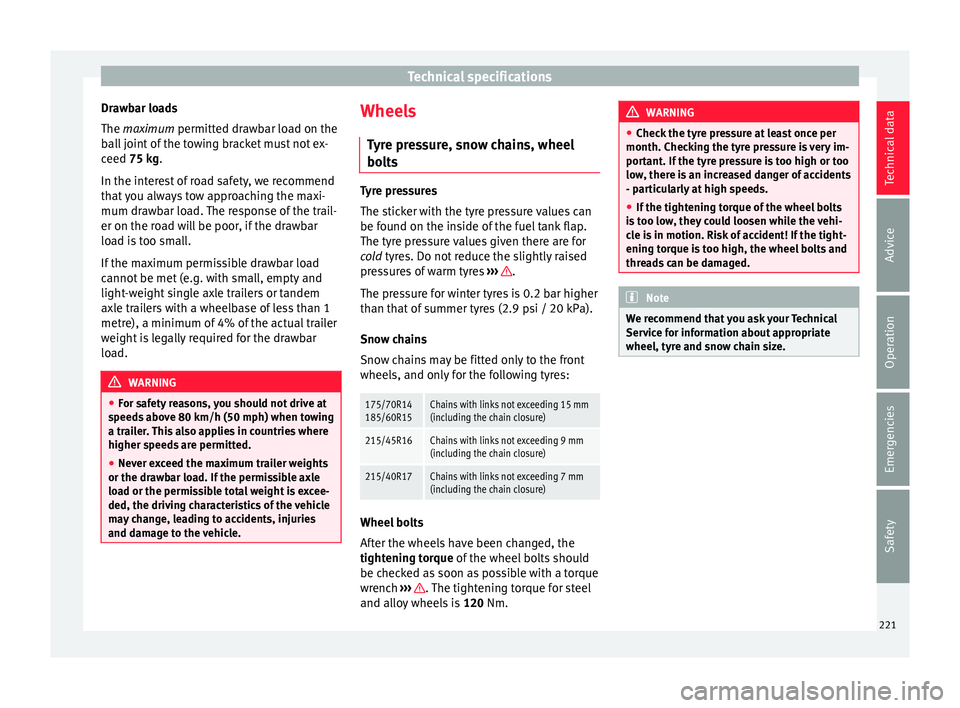
Drawbar loads
The maximum permitt ed dr
awb
ar load on the
ball joint of the towing bracket must not ex-
ceed 75 kg.
In the interest of road safety, we recommend
that you always tow approaching the maxi-
mum drawbar load. The response of the trail-
er on the road will be poor, if the drawbar
load is too small.
If the maximum permissible drawbar load
cannot be met (e.g. with small, empty and
light-weight single axle trailers or tandem
axle trailers with a wheelbase of less than 1
metre), a minimum of 4% of the actual trailer
weight is legally required for the drawbar
load. WARNING
● For saf ety
reasons, you should not drive at
speeds above 80 km/h (50 mph) when towing
a trailer. This also applies in countries where
higher speeds are permitted.
● Never exceed the maximum trailer weights
or the drawbar lo
ad. If the permissible axle
load or the permissible total weight is excee-
ded, the driving characteristics of the vehicle
may change, leading to accidents, injuries
and damage to the vehicle. Wheels
Ty
re pr
essure, snow chains, wheel
bolts Tyre pressures
The stick
er w
ith the tyre pressure values can
be found on the inside of the fuel tank flap.
The tyre pressure values given there are for
cold tyres. Do not reduce the slightly raised
pressures of warm tyres ››› .
The pres s
ure for winter tyres is 0.2 bar higher
than that of summer tyres (2.9 psi / 20 kPa).
Snow chains
Snow chains may be fitted only to the front
wheels, and only for the following tyres:
175/70R14
185/60R15Chains with links not exceeding 15 mm
(including the chain closure)
215/45R16Chains with links not exceeding 9 mm
(including the chain closure)
215/40R17Chains with links not exceeding 7 mm
(including the chain closure) Wheel bolts
Af
t
er the wheel s
have been changed, the
tightening torque of the wheel bolts should
be checked as soon as possible with a torque
wrench ››› . The tightening torque for steel
and al lo
y wheel
s is 120 Nm. WARNING
● Check the ty r
e pressure at least once per
month. Checking the tyre pressure is very im-
portant. If the tyre pressure is too high or too
low, there is an increased danger of accidents
- particularly at high speeds.
● If the tightening torque of the wheel bolts
is too lo
w, they could loosen while the vehi-
cle is in motion. Risk of accident! If the tight-
ening torque is too high, the wheel bolts and
threads can be damaged. Note
We recommend that you ask your Technical
Servic e f
or information about appropriate
wheel, tyre and snow chain size. 221
Technical data
Advice
Operation
Emergencies
Safety
Page 224 of 252
Technical data
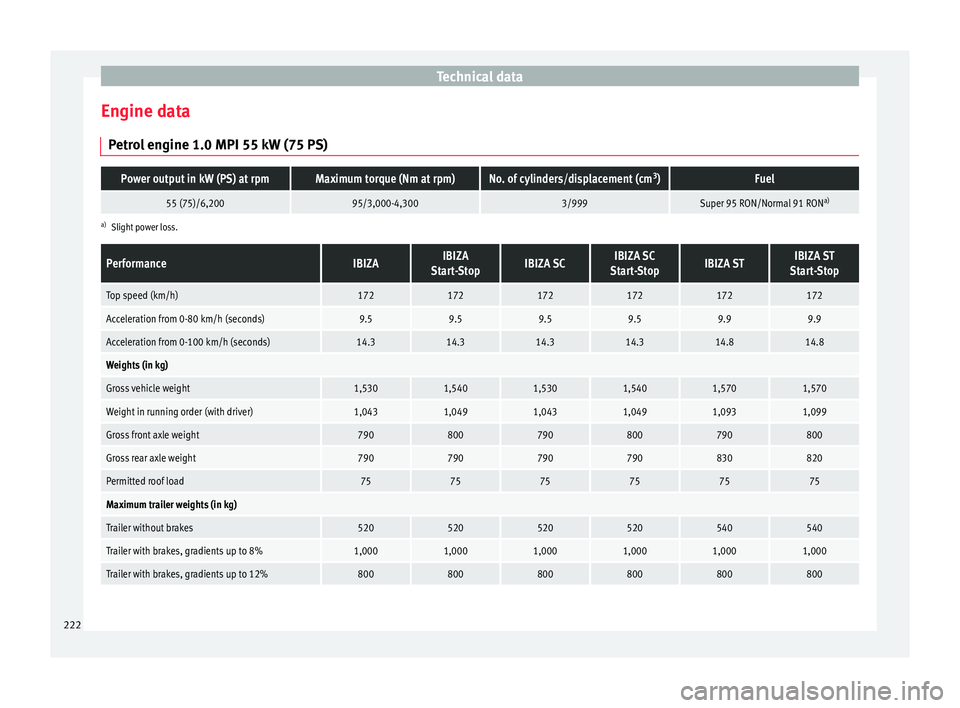
Engine data P etr
ol
engine 1.0 MPI 55 kW (75 PS)
Power output in kW (PS) at rpmMaximum torque (Nm at rpm)No. of cylinders/displacement (cm 3
)Fuel
55 (75)/6,20095/3,000-4,3003/999Super 95 RON/Normal 91 RON a)
a)
Slight power loss.
PerformanceIBIZAIBIZA
Start-StopIBIZA SCIBIZA SC
Start-StopIBIZA STIBIZA ST
Start-Stop
Top speed (km/h)172172172172172172
Acceleration from 0-80 km/h (seconds)9.59.59.59.59.99.9
Acceleration from 0-100 km/h (seconds)14.314.314.314.314.814.8
Weights (in kg)
Gross vehicle weight1,5301,5401,5301,5401,5701,570
Weight in running order (with driver)1,0431,0491,0431,0491,0931,099
Gross front axle weight790800790800790800
Gross rear axle weight790790790790830820
Permitted roof load757575757575
Maximum trailer weights (in kg)
Trailer without brakes520520520520540540
Trailer with brakes, gradients up to 8%1,0001,0001,0001,0001,0001,000
Trailer with brakes, gradients up to 12%800800800800800800 222
Page 225 of 252
Technical specifications
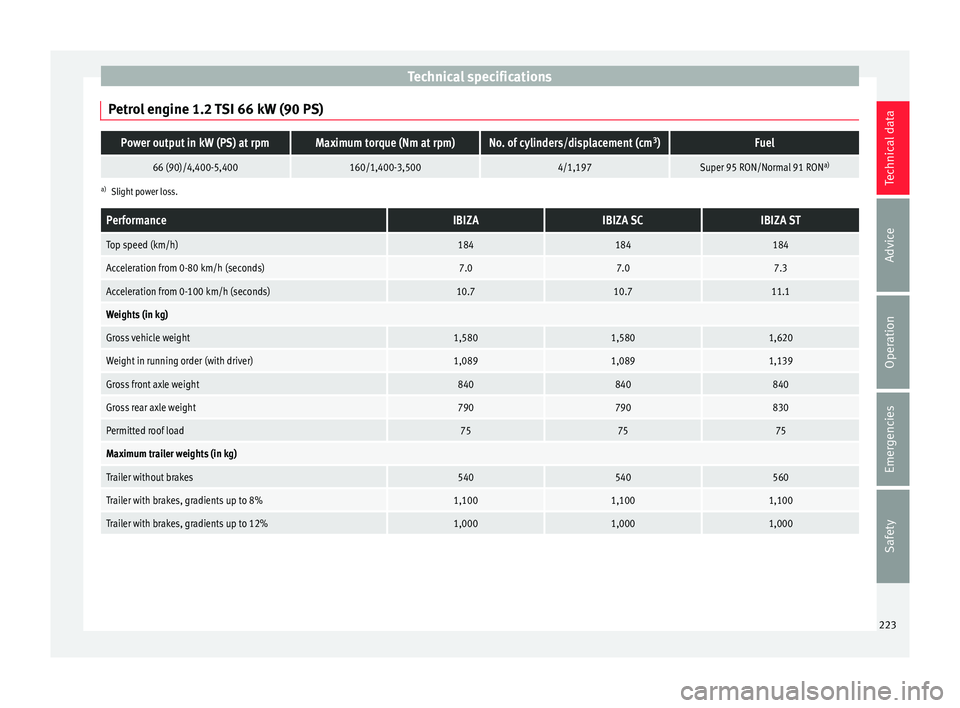
Petrol engine 1.2 TSI 66 kW (90 PS)Power output in kW (PS) at rpmMaximum torque (Nm at rpm)No. of cylinders/displacement (cm 3
)Fuel
66 (90)/4,400-5,400160/1,400-3,5004/1,197Super 95 RON/Normal 91 RON a)
a)
Slight power loss.
PerformanceIBIZAIBIZA SCIBIZA ST
Top speed (km/h)184184184
Acceleration from 0-80 km/h (seconds)7.07.07.3
Acceleration from 0-100 km/h (seconds)10.710.711.1
Weights (in kg)
Gross vehicle weight1,5801,5801,620
Weight in running order (with driver)1,0891,0891,139
Gross front axle weight840840840
Gross rear axle weight790790830
Permitted roof load757575
Maximum trailer weights (in kg)
Trailer without brakes540540560
Trailer with brakes, gradients up to 8%1,1001,1001,100
Trailer with brakes, gradients up to 12%1,0001,0001,000 223
Technical data
Advice
Operation
Emergencies
Safety
Page 226 of 252
Technical data
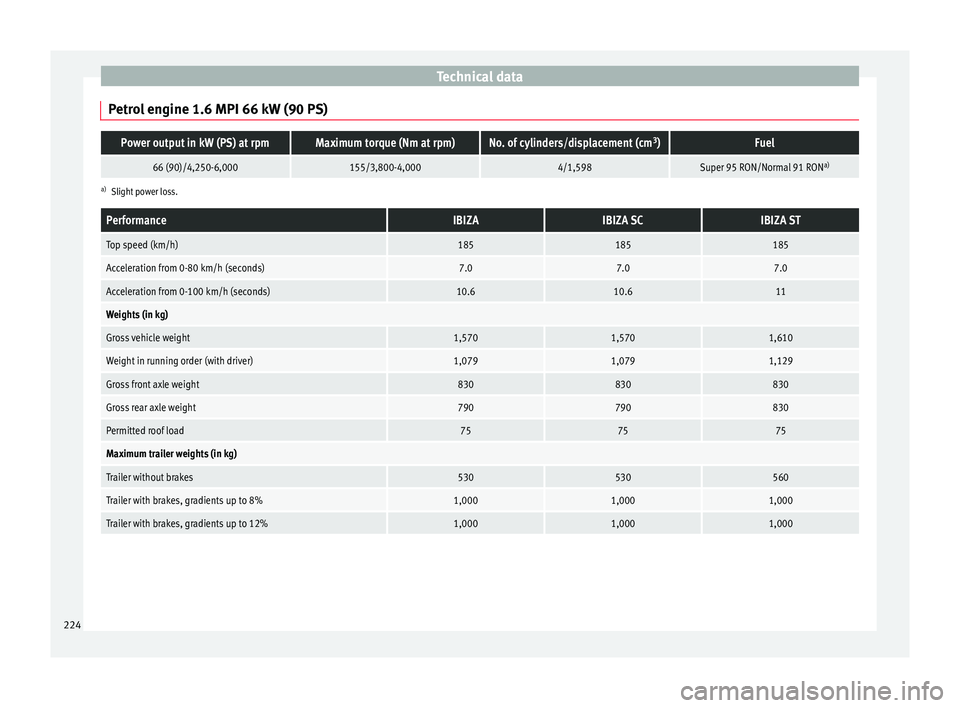
Petrol engine 1.6 MPI 66 kW (90 PS)Power output in kW (PS) at rpmMaximum torque (Nm at rpm)No. of cylinders/displacement (cm 3
)Fuel
66 (90)/4,250-6,000155/3,800-4,0004/1,598Super 95 RON/Normal 91 RON a)
a)
Slight power loss.
PerformanceIBIZAIBIZA SCIBIZA ST
Top speed (km/h)185185185
Acceleration from 0-80 km/h (seconds)7.07.07.0
Acceleration from 0-100 km/h (seconds)10.610.611
Weights (in kg)
Gross vehicle weight1,5701,5701,610
Weight in running order (with driver)1,0791,0791,129
Gross front axle weight830830830
Gross rear axle weight790790830
Permitted roof load757575
Maximum trailer weights (in kg)
Trailer without brakes530530560
Trailer with brakes, gradients up to 8%1,0001,0001,000
Trailer with brakes, gradients up to 12%1,0001,0001,000 224
Page 227 of 252
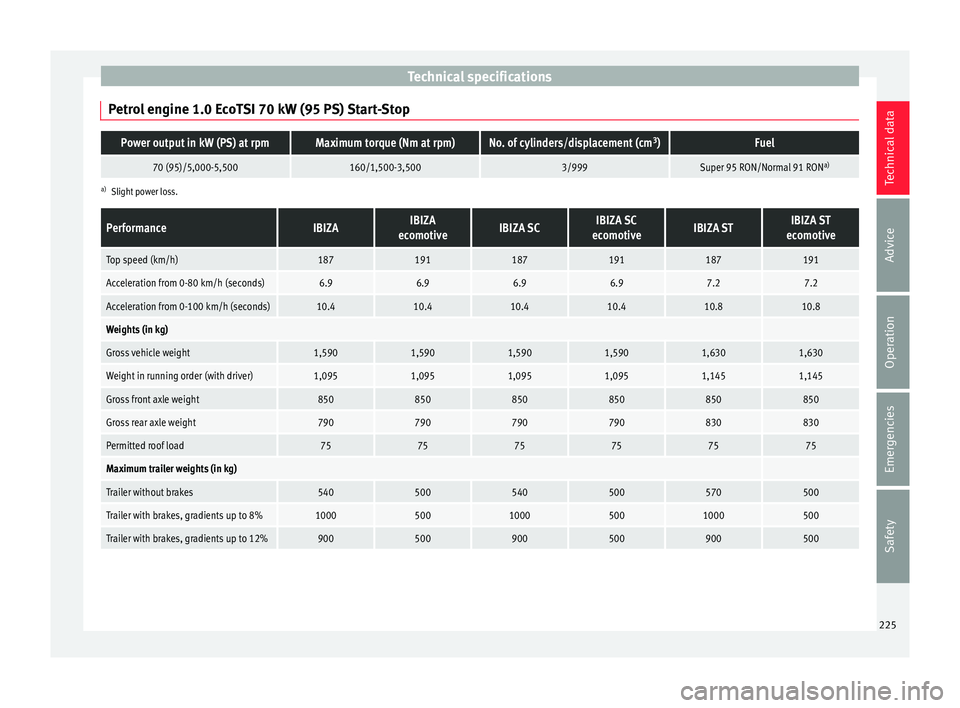
Technical specifications
Petrol engine 1.0 EcoTSI 70 kW (95 PS) Start-StopPower output in kW (PS) at rpmMaximum torque (Nm at rpm)No. of cylinders/displacement (cm 3
)Fuel
70 (95)/5,000-5,500160/1,500-3,5003/999Super 95 RON/Normal 91 RON a)
a)
Slight power loss.
PerformanceIBIZAIBIZA
ecomotiveIBIZA SCIBIZA SC
ecomotiveIBIZA STIBIZA ST
ecomotive
Top speed (km/h)187191187191187191
Acceleration from 0-80 km/h (seconds)6.96.96.96.97.27.2
Acceleration from 0-100 km/h (seconds)10.410.410.410.410.810.8
Weights (in kg)
Gross vehicle weight1,5901,5901,5901,5901,6301,630
Weight in running order (with driver)1,0951,0951,0951,0951,1451,145
Gross front axle weight850850850850850850
Gross rear axle weight790790790790830830
Permitted roof load757575757575
Maximum trailer weights (in kg)
Trailer without brakes540500540500570500
Trailer with brakes, gradients up to 8%100050010005001000500
Trailer with brakes, gradients up to 12%900500900500900500 225
Technical data
Advice
Operation
Emergencies
Safety
Page 228 of 252
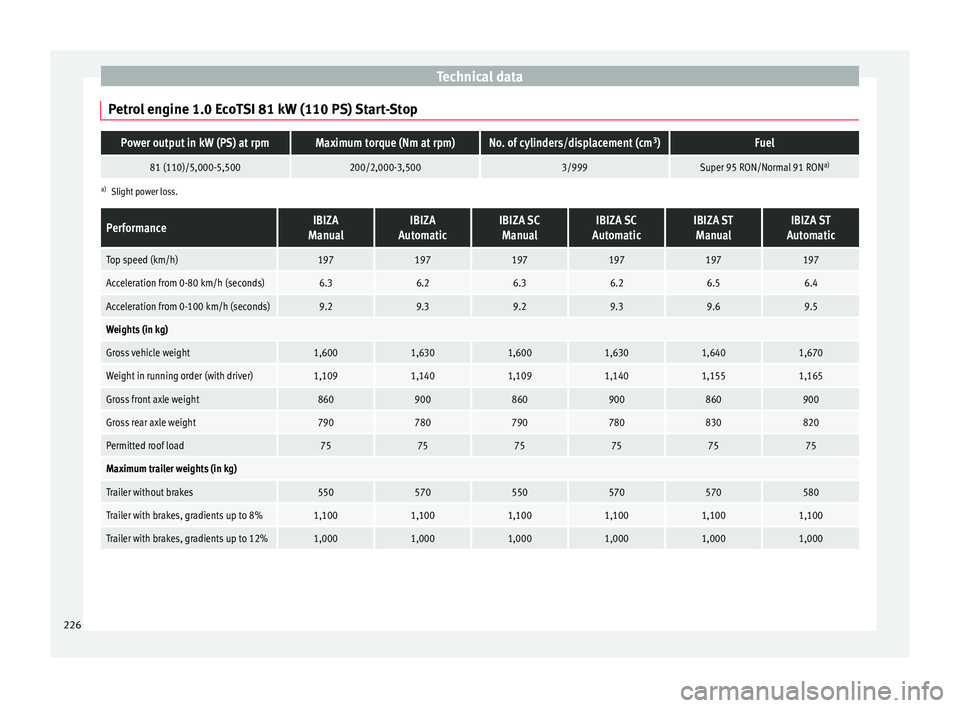
Technical data
Petrol engine 1.0 EcoTSI 81 kW (110 PS) Start-StopPower output in kW (PS) at rpmMaximum torque (Nm at rpm)No. of cylinders/displacement (cm 3
)Fuel
81 (110)/5,000-5,500200/2,000-3,5003/999Super 95 RON/Normal 91 RON a)
a)
Slight power loss.
PerformanceIBIZA
ManualIBIZA
AutomaticIBIZA SC ManualIBIZA SC
AutomaticIBIZA ST ManualIBIZA ST
Automatic
Top speed (km/h)197197197197197197
Acceleration from 0-80 km/h (seconds)6.36.26.36.26.56.4
Acceleration from 0-100 km/h (seconds)9.29.39.29.39.69.5
Weights (in kg)
Gross vehicle weight1,6001,6301,6001,6301,6401,670
Weight in running order (with driver)1,1091,1401,1091,1401,1551,165
Gross front axle weight860900860900860900
Gross rear axle weight790780790780830820
Permitted roof load757575757575
Maximum trailer weights (in kg)
Trailer without brakes550570550570570580
Trailer with brakes, gradients up to 8%1,1001,1001,1001,1001,1001,100
Trailer with brakes, gradients up to 12%1,0001,0001,0001,0001,0001,000 226