light Seat Ibiza ST 2016 Owner's manual
[x] Cancel search | Manufacturer: SEAT, Model Year: 2016, Model line: Ibiza ST, Model: Seat Ibiza ST 2016Pages: 252, PDF Size: 5.56 MB
Page 194 of 252
Advice
Products for vehicle maintenance
C ar
-car
e products are available in your Tech-
nical Services. Keep the product instructions
until you have used them up. WARNING
● Car-c ar
e products can be toxic. Because of
this, they must always be kept closed in their
original container. Keep them out of the reach
of children. Failure to comply could result in
poisoning.
● Always read and observe the instructions
and warnings
on the package before using
car-care products. Improper use could cause
health problems or damage the vehicle. The
use of certain products may produce noxious
vapours; they should be used in well ventila-
ted areas.
● Never use fuel, turpentine, engine oil, nail
varnish remo
ver or other volatile fluids.
These are toxic and highly flammable. Risk of
fire and explosion.
● Before washing your vehicle, or carrying
out any m
aintenance, switch the engine off,
apply the handbrake firmly and remove the
key from the ignition. CAUTION
Never attempt to remove dirt, mud or dust if
the surf ac
e of the vehicle is dry. Never use a
dry cloth or sponge for cleaning purposes.
This could damage the paintwork or the win-
dows of your vehicle. Soak dirt, mud or dust
with plenty of water. For the sake of the environment
● When purc h
asing car care products, try to
select ones that are not harmful to the envi-
ronment.
● The waste from car-care products should
not be dispo
sed of with ordinary household
waste. Observe the disposal information on
the package. Care of the vehicle exterior
Automatic c
ar wash tunnel The vehicle paintwork is so durable that the
v
ehic
le c
an normally be washed without
problems in an automatic car wash tunnel.
However, the paintwork wear depends to a
large extent on the kind of the car wash tun-
nel, the brushes used, its water filtering and
the type of cleaning and preservative prod-
ucts.
Before going through a car wash, be sure to
take the usual precautions such as closing
the windows and sunroof. There is nothing to
note apart from that.
If the vehicle has special accessories such as
spoilers or a roof rack or two-way radio aerial,
etc., it is advisable to consult the car wash
tunnel operator first. After washing, the brakes
could take some
time to respond as the brake discs and pads
could be wet, or even frozen in winter. “Dry”
the brakes by braking several times. WARNING
Water, ice and salt on the brake system can
reduce br ak
ing effectiveness. Risk of acci-
dent. CAUTION
Before putting the vehicle through the car
wash, do not tight
en the aerial if it is folded
because it can be damaged. Hand-washing
Vehicle washing
– First soften the dirt and rinse it off with wa-
ter
.
– Cl
ean your vehicle from top to bottom with
a soft spon
ge, a glove or a brush. Use very
light pressure.
– Rinse the sponge or glove often with clean
water.
– S
pecial car shampoo should only be used
for ver
y stubborn dirt.
– Leave the wheels, sill panels etc. until last,
using a diff
erent sponge or glove.
192
Page 195 of 252
Care and maintenance
– Rin se the
vehic
le thoroughly with water.
– Dry the vehicle surface gently with a cha-
mois le
ather.
– In cold temperature, dry the rubber seals
and their surf
aces to prevent them from
freezing. Apply silicone spray to the rubber
seals.
After washing the vehicle – After washing, avoid sudden and sharp
braking. “Dr
y” the brakes by braking sever-
al times. WARNING
● Wash y
our vehicle with the ignition switch-
ed off.
● Protect your hands and arms from cuts on
sharp metal
edges when cleaning the under-
body, the inside of the wheel housings etc.
Risk of injury.
● Water, ice and salt on the brake system can
reduce brak
ing effectiveness. Risk of acci-
dent. CAUTION
● Never remo v
e dirt, mud or dust if the vehi-
cle surface is dry. Never use a dry cloth or
sponge for cleaning purposes. This could
scratch the paintwork or glass on your vehi-
cle. ●
Washin g the
vehicle in low temperatures:
when washing the vehicle with a hose, do not
direct water into the lock cylinders or the
gaps around the doors, rear lid, or sunroof.
Risk of freezing. For the sake of the environment
To protect the environment, the vehicle
shou ld be w a
shed only in specially provided
wash bays, to prevent toxic, oil-laden waste
water from entering the sewer system. In
some places, washing vehicles outside wash
bays is prohibited. Note
Do not wash the vehicle in direct sunlight. Washing the vehicle with a high pres-
s
ur
e c l
eaner Be particularly careful when using a high
pr
e
ss
ure cleaner!
– Always observe the instructions for the
high-press
ure cleaner, particularly those
concerning the pressure and the spraying
distance.
– Increase the spraying distance for soft ma-
terials
and painted bumpers. –
Do not use a high pre
ssure cleaner to re-
move ice or snow from windows
››› page 194.
– Never use concentrated jet nozzles (“rotat-
ing jets”) ››
› .
– After washing, avoid sudden and sharp
br ak
ing. “Dr
y” the brakes by braking sever-
al times ››› page 152. WARNING
● Never wa sh ty
res with a concentrated jet
(“rotating nozzle”). Even at large spraying
distances and short cleaning times, damage
can occur to the tyres. This may cause an ac-
cident.
● Water, ice and salt on the brake system can
reduce brak
ing effectiveness. Risk of acci-
dent. CAUTION
● Do not use w at
er hotter than +60 °C
(+140 °F). This could damage the vehicle.
● To avoid damage to the vehicle, keep a suf-
ficient dis
tance from sensitive materials such
as flexible hoses, plastic, soundproofing ma-
terial, etc. This also applies to bumpers pain-
ted in the colour of the bodywork. The closer
the nozzle is to the surface, the greater the
wear on the material. 193
Technical data
Advice
Operation
Emergencies
Safety
Page 200 of 252
Advice
– Do not l
et the w
ater soak through the leath-
er or soak into the seams.
– Then wipe off with a soft, dry cloth.
Leather maint
enance
– The leather should be treated twice a year
with a speci
al leather-care product, availa-
ble at Technical Services.
– Apply these products very sparingly.
– Then wipe off with a soft cloth.
SEAT does
everything possible to preserve
the genuine qualities of this natural product.
Due to the natural properties of the specially
selected hides employed, the finished leath-
er has a certain sensitivity to grease and dirt,
etc. so a degree of care is required in every-
day use and when looking after the leather.
Dust and grit in the pores and seams can
scratch and damage the surface. If the vehi-
cle is under solar radiation for long periods,
the leather should be protected to prevent it
from fading. However, slight colour variations
in high-quality natural leather are normal. CAUTION
● Do not use so lv
ents, wax polish, shoe
cream, spot removers or similar products on
leather.
● To avoid damage, stubborn stains should
be removed b
y a specialised workshop. Seat belt cleaning
A dirty belt may not work properly. Check all
seat belts
r
egularly and keep them clean.
Seat belts cleaning
– Pull the dirty seat belt right out and unroll
it.
– Cle
an dirty seat belts with a gentle soap
so
lution.
– Allow it to dry.
– Do not roll the seat belt up until it is dry.
If lar g
e stains form on the belts, the automat-
ic belt retractor will not work correctly. WARNING
● Do not use c hemic
al cleaning agents on the
seat belts, as this can impair the strength of
the webbing. Ensure that seat belts do not
come into contact with corrosive fluids.
● Check the condition of the seat belts at reg-
ular inter
vals. If you notice that the belt web-
bing, fittings, retractor mechanism or buckle
of any of the belts is damaged, the belt must
be replaced by a specialised workshop.
● Do not attempt to repair a damaged seat
belt your
self. The seat belts must not be re-
moved or modified in any way. CAUTION
After cleaning, allow seat belts to dry com-
plet ely
before rolling them up. Otherwise, the
belt retractors could become damaged. 198
Page 202 of 252
Advice
Fuel Ty
pe s
of petrol The correct grade of petrol is listed inside the
fuel t
ank
flap.
The vehicle is equipped with a catalytic con-
verter and must only be run on unleaded pet-
rol. The petrol must comply with European
Standard EN 228 or German standard DIN
51626-1 and must be unleaded. You can re-
fuel with a maximum ethanol proportion of
10 % (E10). The types of petrol are differenti-
ated by their octane rating (RON).
The following titles appear on the corre-
sponding adhesive on the fuel tank flap:
Super unleaded 95 octane or normal 91 oc-
tane unleaded petrol
We recommend you use super 95 octane pet-
rol. If this is not available: normal 91 octane
petrol, with a slight decrease in power.
Super unleaded petrol with a minimum of 95
octanes
You should use super petrol with a minimum
of 95 octanes.
If super is not available, in an emergency you
may refuel with normal 91 octane petrol. In
this case only use moderate engine speeds
and a light throttle. Refuel with super as soon
as possible. Super unleaded 98 octane or super 95 oc-
tane un
l
eaded petrol
We recommend you use super plus 98 octane
petrol. If this is not available: super 95 oc-
tane petrol, with a slight decrease in power.
If super is not available, in an emergency you
may refuel with normal 91 octane petrol. In
this case only use moderate engine speeds
and a light throttle. Refuel with super as soon
as possible.
Petrol additives
The quality of the fuel influences the behav-
iour, power and service life of the engine.
This is why the petrol you use should carry
suitable additives already included by the
petrol industry, free of metals. These addi-
tives will help to prevent corrosion, keep the
fuel system clean and prevent deposits from
building up in the engine.
If good-quality petrol with metal-free addi-
tives is not available or engine problems
arise, the necessary additives must be added
when refuelling ››› .
Not al
l petr
ol additives have been shown to
be effective. The use of unsuitable petrol ad-
ditives may cause significant damage to the
engine and the catalytic converter. Metal ad-
ditives should never be used. Metal additives
may also be contained in petrol additives for
improving anti-detonation ratings or octane
ratings ››› .SEAT recommends “genuine Volkswagen
Gr
oup F
uel Ad
ditives for petrol engines”.
These additives can be bought at SEAT deal-
ers, where information on how to use them
can also be obtained. CAUTION
● Do not ref uel
if the filler indicates that the
fuel contains metal. LRP ( lead replacement
petrol) fuels contain high concentrations of
metal additives. Using them may damage the
engine!
● Never refuel with fuels containing a large
proportion of eth
anol (for example, E50, E85).
This could damage the fuel system.
● Just filling one full tank of leaded fuel or
fuel cont
aining other metal additives would
seriously impair the efficiency of the catalytic
converter.
● Only use fuel additives that have been ap-
proved b
y SEAT. Octane boosting or anti-
knock additives may contain metal additives
that could seriously damage the engine or
the catalytic converter. These additives must
not be used.
● High engine speed and full throttle can
damage the en
gine when using petrol with an
octane rating lower than the correct grade for
the engine. 200
Page 205 of 252
Checking and refilling levels
●
Only open and c lo
se the bonnet when there
is nobody within its range. CAUTION
When topping up service fluids, make sure
not to mi s
take them. Using the wrong fluids
could cause serious malfunctions and engine
damage! For the sake of the environment
Service fluids leaks are harmful to the envi-
ronment. F or thi
s reason you should make
regular checks on the ground underneath
your vehicle. If you find spots of oil or other
fluids, have your vehicle inspected in a speci-
alised workshop. Opening the bonnet
Read the additional information carefully
› ›
›
p
age 10
The bonnet is released from inside the vehi-
cle.
Before opening the bonnet ensure that the
windscreen wipers are in rest position. WARNING
Hot coolant can scald! ●
Never open the bonnet if
you see steam,
smoke or coolant escaping from the engine
compartment.
● Wait until no more steam, smoke or coolant
is emitted fr
om the bonnet, then carefully
open the bonnet.
● When working in the engine compartment,
alway
s observe the safety warnings
››› page 201. Closing the bonnet
–
Slightly lift the bonnet.
– Release the bonnet stay and replace it in its
sup
por t
.
– At a height of approximately 30 cm let it fall
so it locks.
If
the bonnet does not close, do not press
downwards. Open it again and let it fall as
mentioned above. WARNING
If the bonnet is not closed properly, it could
open while y
ou are driving and completely
obscure your view of the road. Risk of acci-
dent.
● After closing the bonnet, always check that
it is pr
operly secured. The bonnet must be
flush with the surrounding body panels. ●
If y ou notic
e that the bonnet latch is not se-
cured when the vehicle is moving, stop the
vehicle immediately and close the bonnet
properly. Risk of accident. 203
Technical data
Advice
Operation
Emergencies
Safety
Page 209 of 252
Checking and refilling levels
WARNING
Oil is highly inflammable! Ensure that no oil
comes int
o contact with hot engine compo-
nents when topping up. CAUTION
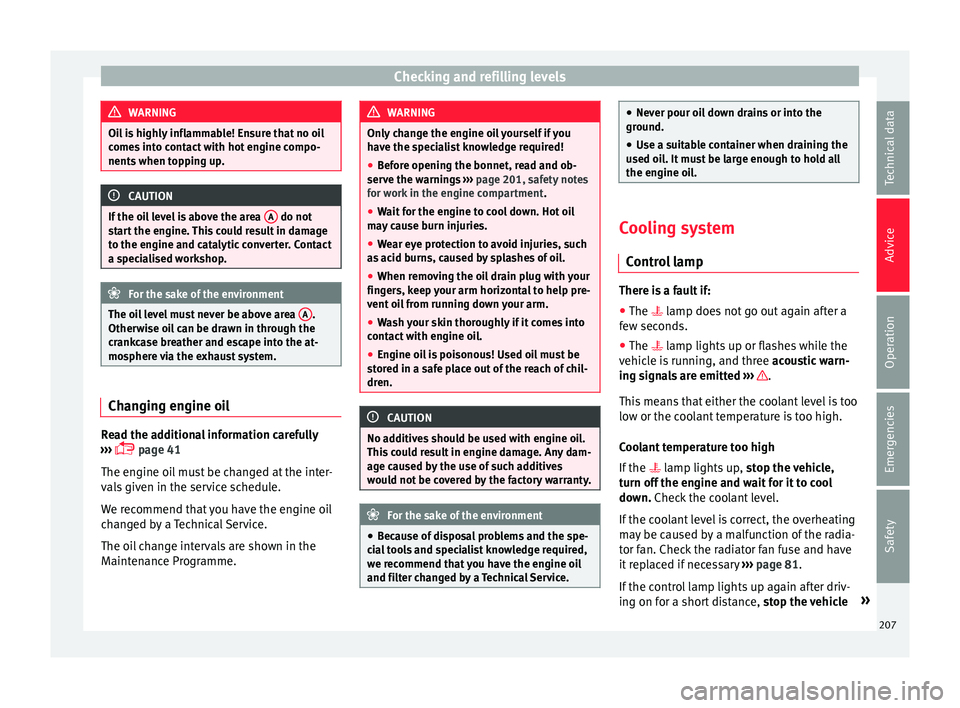
If the oil level is above the area A do not
star t
the engine. This could result in damage
to the engine and catalytic converter. Contact
a specialised workshop. For the sake of the environment
The oil level must never be above area A .
Otherwi se oi
l can be drawn in through the
crankcase breather and escape into the at-
mosphere via the exhaust system. Changing engine oil
Read the additional information carefully
› ›
›
p
age 41
The engine oil must be changed at the inter-
vals given in the service schedule.
We recommend that you have the engine oil
changed by a Technical Service.
The oil change intervals are shown in the
Maintenance Programme. WARNING
Only change the engine oil yourself if you
have the s pec
ialist knowledge required!
● Before opening the bonnet, read and ob-
serve the warnin
gs ››› page 201, safety notes
for work in the engine compartment .
● Wait for the engine to cool down. Hot oil
may c
ause burn injuries.
● Wear eye protection to avoid injuries, such
as acid b
urns, caused by splashes of oil.
● When removing the oil drain plug with your
fingers, k
eep your arm horizontal to help pre-
vent oil from running down your arm.
● Wash your skin thoroughly if it comes into
contact w
ith engine oil.
● Engine oil is poisonous! Used oil must be
stored in a s
afe place out of the reach of chil-
dren. CAUTION
No additives should be used with engine oil.
This c ou
ld result in engine damage. Any dam-
age caused by the use of such additives
would not be covered by the factory warranty. For the sake of the environment
● Becau se of
disposal problems and the spe-
cial tools and specialist knowledge required,
we recommend that you have the engine oil
and filter changed by a Technical Service. ●
Never pour oil do
wn drains or into the
ground.
● Use a suitable container when draining the
used oil. It
must be large enough to hold all
the engine oil. Cooling system
Contro l
lamp There is a fault if:
● The l amp does not go out again after a
f ew sec ond
s.
● The lamp lights up or flashes while the
vehicl
e is running, and three acoustic warn-
ing signals are emitted ››› .
Thi s
me an
s that either the coolant level is too
low or the coolant temperature is too high.
Coolant temperature too high
If the lamp lights up, stop the vehicle,
turn off the engine and wait for it to cool
down. Check the coolant level.
If the coolant level is correct, the overheating
may be caused by a malfunction of the radia-
tor fan. Check the radiator fan fuse and have
it replaced if necessary ››› page 81.
If the control lamp lights up again after driv-
ing on for a short distance, stop the vehicle»
207
Technical data
Advice
Operation
Emergencies
Safety
Page 210 of 252
Advice
and switch the engine off. C ont
act a
Techni-
cal Service or a specialised workshop.
Coolant level too low
If the lamp lights up, stop the vehicle,
turn off the engine and wait for it to cool
down. First check the coolant level. If the lev-
el of the coolant is below the “MIN” mark,
top up with coolant liquid ››› .
WARNING
● If y our
vehicle is immobilised for technical
reasons, move it to a safe distance from traf-
fic. Turn the engine off, turn the hazard lights
on and place the warning triangle.
● Never open the bonnet if you can see or
hear ste
am or coolant escaping from the en-
gine compartment. Risk of scalding. Wait un-
til you can no longer see or hear escaping
steam or coolant.
● The engine compartment is a dangerous
area. Bef
ore carrying out any work in the en-
gine compartment, switch off the engine and
allow it to cool down. Always note the corre-
sponding warnings ››› page 201. Topping up coolant
Read the additional information carefully
› ›
›
p
age 42
Top up coolant when the level is below the
MIN (minimum) mark. Checking coolant level
– Park the vehicle in a horizontal position.
– Switch the ignition off.
– Read off the coolant level on coolant ex-
pansion t
ank. When the engine is cold, the
coolant level should be between the marks.
When the engine is hot, it may be slightly
above the upper mark.
Topping up coolant – Wait for the engine to cool down.
– Cover the coolant expansion tank cap with
a cloth and caref
ully unscrew it to the left
››› .
– Top up the coolant only if there is still cool-
ant in the e
xpan
sion tank, otherwise you
could damage the engine. If there is no
coolant in the expansion tank, do not con-
tinue driving. You should obtain professio- nal assistance ››› .
– If there is still some coolant in the expan-
sion t
ank, t op up t
o the upper mark.
– Top up with coolant until the level becomes
stabl
e.
– Screw the cap back on correctly.
Any los
s of coolant fluid normally indicates a
leak in the cooling system. Take the vehicle
straight to a specialised workshop to have
the cooling system examined. If there are no leaks in the engine cooling system, a loss of
coolant
can only occur if the coolant boils
and is forced out of the system as a result of
overheating. WARNING
● The coolin g sy
stem is under pressure. Do
not unscrew the cap on the coolant expan-
sion tank when the engine is hot: risk of
burns!
● The antifreeze and coolant fluid can be a
health haz
ard. Therefore, the antifreeze
should be stored in the original container in a
safe place out of reach of children. Failure to
comply could result in poisoning.
● If working inside the engine compartment,
remember that, even when the ignition i
s
switched off, the radiator fan may start up au-
tomatically, and therefore there is a risk of in-
jury. WARNING
If there is not enough anti-freeze in the cool-
ant sys t
em, the engine may fail leading to se-
rious damage.
● Please make sure that the percentage of
additive i
s correct with respect to the lowest
expected ambient temperature in the zone in
which the vehicle is to be used.
● When the outside temperature is very low,
the coolant
could freeze and the vehicle
would be immobilised. In this case, the heat-
ing would not work either and inadequately
dressed passengers could die of cold. 208
Page 211 of 252
Checking and refilling levels
CAUTION
Do not top up the expansion tank with cool-
ant fluid if it i
s empty! Air could enter the
cooling system. In this case, stop driving.
Seek specialist assistance. Otherwise, there
is a risk of engine damage. CAUTION
The original additives should never be mixed
with coo l
ants which are not approved by
SEAT. Otherwise, you run the risk of causing
severe damage to the engine and the engine
cooling system.
● If the fluid in the expansion tank is not pur-
ple but
is, for example, brown, this indicates
that the G13 additive has been mixed with an
inadequate coolant. The coolant must be
changed as soon as possible if this is the
case! This could result in serious faults and
engine damage. For the sake of the environment
Coolants and additives can contaminate the
envir onment
. If any fluids are spilled, they
should be collected and correctly disposed
of, with respect to the environment. Brake fluid
Chec k
in g the br
ake fluid level Read the additional information carefully
›››
p
age 43
The position of the brake fluid reservoir is
shown in the corresponding engine compart-
ment illustration ››› page 204. The brake fluid
reservoir has a black and yellow cap.
The brake fluid level drops slightly when the
vehicle is being used as the brake pads are
automatically adjusted as they wear.
However, if the level goes down noticeably in
a short time, or drops below the “MIN” mark,
there may be a leak in the brake system. A
display on the instrument panel will warn you
if the brake fluid level is too low ›››
page 100. WARNING
Before opening the bonnet to check the brake
fluid level, r e
ad and observe the warnings
››› page 201. Changing the brake fluid
The Maintenance Programme indicates brake
fluid c
h
an g
e intervals.
We recommend that you have the brake fluid
changed by a Technical Service. Before opening the bonnet, please read and
follo
w the warnings ››› in safety notes for
w ork
in the en gine c
ompartment on
page 201 in section “Safety notes for work-
ing in the engine compartment”.
In the course of time, brake fluid becomes
hygroscopic and absorbs water from the am-
bient air. If the water content in the brake flu-
id is too high, the brake system could cor-
rode. This also considerably reduces the boil-
ing point of the brake fluid. Heavy use of the
brakes may then cause a vapour lock which
could impair the braking effect.
Be sure to always use the correct brake fluid.
Only use brake fluid that expressly meets the
VW 501 14 standard.
You can buy VW 501 14 standard brake fluid
in a SEAT dealership or a SEAT Official Serv-
ice. If none is available, use only high-quality
brake fluid that meets DIN ISO 4925 CLASS 4
standards, or USA Standards FMVSS 116 DOT
4.
Using any other kind of brake fluid or one
that is not of a high quality may affect opera-
tion of the brake system and reduce its effec-
tiveness. Never use a brake fluid if the con-
tainer does not state that it complies with VW
501 14, DIN ISO 4925 CLASS 4 standards, or
USA standards FMVSS 116 DOT 4. »
209
Technical data
Advice
Operation
Emergencies
Safety
Page 212 of 252
Advice
WARNING
Brake fluid is poisonous. Old brake fluid im-
pairs the br
aking effect.
● Before opening the bonnet to check the
brake fluid lev
el, read and observe the warn-
ings ››› page 201.
● Brake fluid should be stored in the closed
original c
ontainer in a safe place out of reach
of children. There is a toxic risk.
● Perform the brake fluid change according to
the Maintenanc
e Programme. Heavy use of
the brakes may cause a vapour lock if the
brake fluid is left in the brake system for too
long. This would seriously affect the effec-
tiveness of the brakes and the safety of the
vehicle. This may cause an accident. CAUTION
Brake fluid damages the vehicle paintwork.
Wipe off an y
brake fluid from the paintwork
immediately. For the sake of the environment
The brake pads and brake fluid must be col-
lected and di s
posed of according the applica-
ble regulations. The SEAT Technical Service
network has the necessary equipment and
qualified personnel for collecting and dispos-
ing of this waste material. Windscreen washer reservoir
Top
pin g up the w
indscreen washer
reservoir water Read the additional information carefully
›››
p
age 43
The windscreen washer and the headlight
washers are supplied with fluid from the
windscreen washer fluid container in the en-
gine compartment. The container holds ap-
prox. 3 litres; in vehicles with headlight
washers* it holds approx. 4.5 litres.
The tank is in the engine compartment.
Plain water is not enough to clean the wind-
screen and headlights. We recommend that
you always add a product to the windscreen
washer fluid. Approved windscreen cleaning
products exist on the market with high deter-
gent and anti-freeze properties, these may be
added all-year-round. Please follow the dilu-
tion instructions on the packaging. WARNING
Any work carried out in the engine compart-
ment or on the engine mu s
t be carried out
cautiously.
● When working in the engine compartment,
alway
s observe the safety warnings
››› page 201. CAUTION
● Never put r
adiator anti-freeze or other addi-
tives into the windscreen washer fluid.
● Always use approved windscreen cleansing
products di
luted as per instructions. If you
use other washer fluids or soap solutions,
the tiny holes in the fan-shaped nozzles
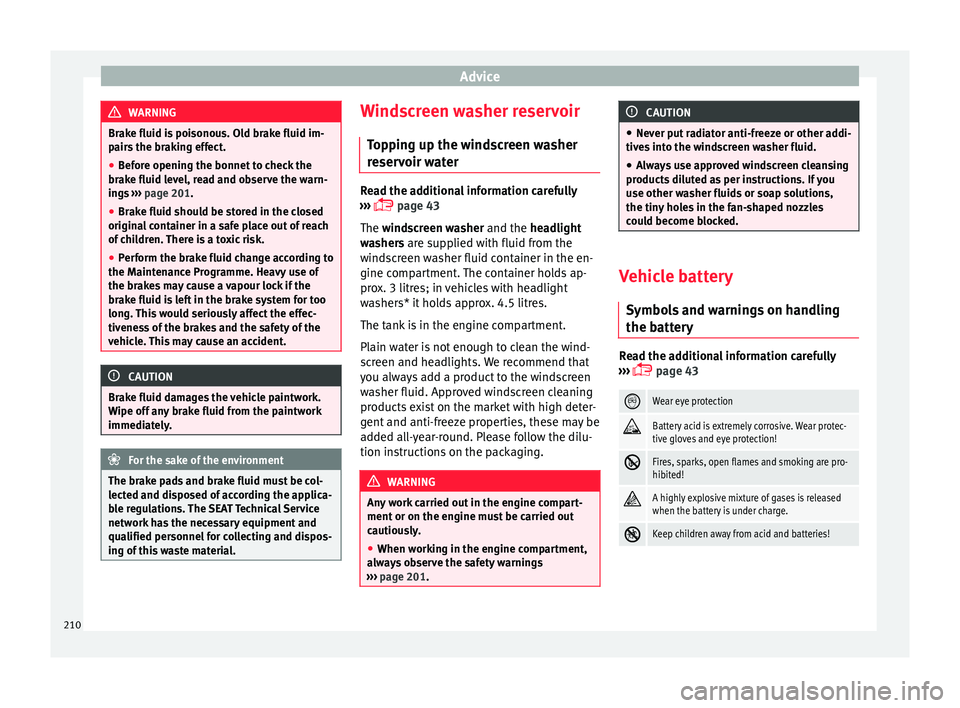
could become blocked. Vehicle battery
Symbol s
and warnings on handling
the battery Read the additional information carefully
› ›
›
p
age 43
Wear eye protection
Battery acid is extremely corrosive. Wear protec-
tive gloves and eye protection!
Fires, sparks, open flames and smoking are pro-
hibited!
A highly explosive mixture of gases is released
when the battery is under charge.
Keep children away from acid and batteries!
210
Page 213 of 252
Checking and refilling levels
WARNING
Always be aware of the danger of injury and
chemica l
burns as well as the risk of accident
or fire when working on the battery and the
electrical system:
● Wear eye protection. Protect your eyes,
skin and clothing fr
om acid and particles con-
taining lead.
● Battery acid is extremely corrosive. Wear
protective glo
ves and eye protection. Do not
tilt the batteries. This could spill acid through
the vents.
● Rinse battery acid from eyes immediately
for severa
l minutes with clear water. Then
seek medical care immediately. Neutralise
any acid splashes on the skin or clothing
with a soapy solution, and rinse off with plen-
ty of water. If acid is swallowed by mistake,
consult a doctor immediately.
● Fires, sparks, open flames and smoking are
prohibited.
When handling cables and electri-
cal equipment, avoid causing sparks and
electrostatic charge. Never short the battery
terminals. High-energy sparks can cause in-
jury.
● A highly explosive mixture of gases is re-
leased when the b
attery is under charge. The
batteries should be charged in a well-ventila-
ted room only.
● Keep children away from acid and batteries.
● Before working on the electrical system,
you must
switch off the engine, the ignition
and all electrical devices. The negative cable on the battery must be disconnected. When a
light bu
l
b is changed, you need only switch
off the light.
● Deactivate the anti-theft alarm by unlock-
ing the vehic
le before you disconnect the bat-
tery! The alarm will otherwise be triggered.
● When disconnecting the battery from the
vehicle on-bo
ard network, disconnect first
the negative cable and then the positive ca-
ble.
● Switch off all electrical devices before re-
connecting the batt
ery. Reconnect first the
positive cable and then the negative cable.
Never reverse the polarity of the connections.
This could cause an electrical fire.
● Never charge a frozen battery, or one which
has th
awed. This could result in explosions
and chemical burns. Always replace a battery
which has frozen. A flat battery can also
freeze at temperatures close to 0 °C (+32 °F).
● Ensure that the vent hose is always connec-
ted to the batt
ery.
● Never use a defective battery. This could
cause an exp
losion. Replace a damaged bat-
tery immediately.
● For vehicles with the battery in the luggage
compartment: Chec
k that the battery gas
ventilation hose is securely attached. CAUTION
● Never dis c
onnect the battery if the ignition
is switched on or if the engine is running. This could damage the electrical system or
electronic
c
omponents.
● Do not expose the battery to direct sunlight
over a long period of
time, as the intense ul-
traviolet radiation can damage the battery
housing.
● If the vehicle is left standing in cold condi-
tions for a lon
g period, protect the battery
from “freezing”. If it freezes it will be dam-
aged. Warning lamp
It lights up
Alternator fault.
The control lamp
lights up when the igni-
tion i s sw
itched on. It should go out when the
engine has started running.
If the control lamp lights up while driving,
the alternator is no longer charging the bat-
tery. You should immediately drive to the
nearest specialised workshop.
You should avoid using electrical equipment
that is not absolutely necessary because this
will drain the battery.
211
Technical data
Advice
Operation
Emergencies
Safety