warning light Seat Ibiza ST 2016 User Guide
[x] Cancel search | Manufacturer: SEAT, Model Year: 2016, Model line: Ibiza ST, Model: Seat Ibiza ST 2016Pages: 252, PDF Size: 5.56 MB
Page 58 of 252
Safety
Safety
Saf e driv
ing
Saf
ety first! This chapter contains important information,
tips, sug
g
estions and warnings that you
should read and consider for both your own
safety and for your passengers' safety. WARNING
● This m anua
l contains important informa-
tion about the operation of the vehicle, both
for the driver and the passengers. The other
sections of the on-board documentation also
contain further information that you should
be aware of for your own safety and for the
safety of your passengers.
● Ensure that the on-board documentation is
kept in the v
ehicle at all times. This is espe-
cially important when lending or selling the
vehicle to another person. Advice about driving
B ef or
e settin
g offFor your own safety and the safety of your
p
a
ssen
gers, always note the following points
before every trip: –
Make sur
e that the vehicle's lights and turn
signals are working properly.
– Check tyre pressure.
– Ensure that all windows provide a clear and
good view of
the surroundings.
– Ensure that all luggage is correctly secured
››› p
age 135.
– Make sure that no objects can interfere
with the pedals.
– Adju
st front seat, head restraint and mir-
rors pr
operly according to your size.
– Ensure that the passenger in the central
rear seat
always has the head restraint in
the correct position for use.
– Instruct passengers to adjust the head re-
straints ac
cording to their height.
– Protect children with appropriate child
seats and properly
applied seat belts
››› page 72.
– Assume the correct sitting position. Instruct
your pas
sengers also to assume a proper
sitting position. ››› page 57.
– Fasten your seat belt securely. Instruct your
passen
gers also to fasten their seat belts
properly. ››› page 61. What affects driving safety? As a driver, you are responsible for yourself
and your p
a
ssengers. When your concentra-
tion or driving safety is affected by any cir-
cumstance, you endanger yourself as well as
others on the road ››› , for this reason:
– Always pay attention to traffic and do not
get di s
tracted by passengers or telephone
calls.
– Never drive when your driving ability is im-
paired (e.g. b
y medication, alcohol, drugs).
– Observe traffic laws and speed limits.
– Always reduce your speed as appropriate
for ro a
d, traffic and weather conditions.
– When travelling long distances, take
breaks
regularly - at least every two hours.
– If possible, avoid driving when you are tired
or stres
sed. WARNING
When driving safety is impaired during a trip,
the risk of injur
y and accidents increases. Safety equipment
Never put your safety or the safety of your
p
a
ssen
gers in danger. In the event of an acci-
dent, the safety equipment may reduce the
56
Page 59 of 252
Safe driving
risk of injury. The following list includes most
of the s
afety
equipment in your SEAT:
● Three-point seat belts
● Belt tension limiter for the front and rear
side seats
● Belt
tensioners for the front seats
● Front airbags
● Side airbags in the front seat backrests,
with ches
t and head protection
● “ISOFIX” anchor points for “ISOFIX” rear
child se
at system
● Height-adjustable front head restraints
● Rear-centre head restraints with in-use po-
sition and non-use pos
ition
● Adjustable steering column
The safety equipment
mentioned above
works together to provide you and your pas-
sengers with the best possible protection in
the event of an accident. However, these
safety systems can only be effective if you
and your passengers are sitting in a correct
position and use this equipment properly.
Safety is everyone's business! Correct position for passengers
Correct s
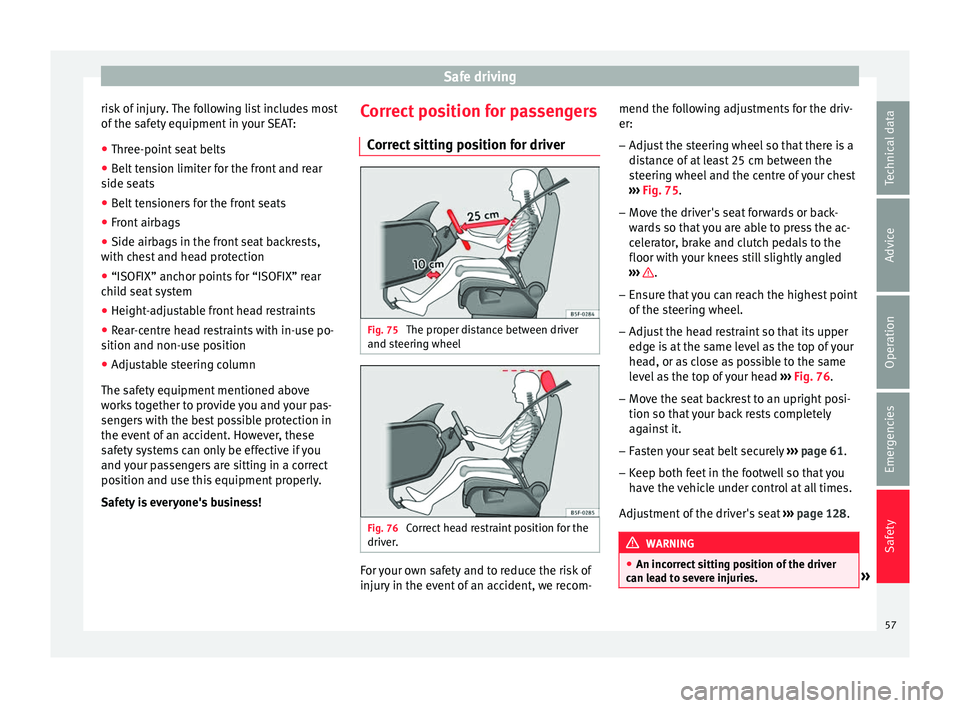
itting position for driver Fig. 75
The proper distance between driver
and s t
eerin g wheel Fig. 76
Correct head restraint position for the
driv er
. For your own safety and to reduce the risk of
injur
y
in the ev ent
of an accident, we recom- mend the following adjustments for the driv-
er:
– Adjust the steering wheel so that there is a
distanc
e of at least 25 cm between the
steering wheel and the centre of your chest
››› Fig. 75.
– Move the driver's seat forwards or back-
wards
so that you are able to press the ac-
celerator, brake and clutch pedals to the
floor with your knees still slightly angled
››› .
– Ensure that you can reach the highest point
of the s
teerin
g wheel.
– Adjust the head restraint so that its upper
edge is at
the same level as the top of your
head, or as close as possible to the same
level as the top of your head ››› Fig. 76.
– Move the seat backrest to an upright posi-
tion so that y
our back rests completely
against it.
– Fasten your seat belt securely ››› p
age 61.
– Keep both feet in the footwell so that you
have the v
ehicle under control at all times.
Adjustment of the driver's seat ››› page 128. WARNING
● An incorrect s
itting position of the driver
can lead to severe injuries. » 57
Technical data
Advice
Operation
Emergencies
Safety
Page 64 of 252
Safety
Seat belt lamp* Fig. 79
Warning lamp on the instrument pan-
el . The control lamp illuminates to remind the
driv
er t
o fa
sten his seat belt.
Before starting the vehicle: – Fasten your seat belt securely.
– Instruct your passengers to fasten their
seat belts pr
operly before driving off.
– Protect children by using a child seat ac-
cording t
o the child's height and weight.
When the ignition is switched on, the control
lamp in the instrument panel lights up* if
the driver or passenger* have not fastened
their seat belts.
An audible warning signal will sound for a
few seconds if the seat belts are not fastened
as the vehicle drives off and reaches a speed
of more than approximately 25 km/h (15 mph) or if the seat belts are unfastened
while the v
ehicle is in motion. The warning
lamp will also flash .
The lamp goes out when the driver and
passenger seat belts are fastened with the ig-
nition switched on.
The protective function of seat belts Fig. 80
Drivers with properly worn seat belts
w i
ll
not be thrown forward in the event of sud-
den braking Properly worn seat belts hold the occupants
in the pr
oper po
sition.
These also help pre-
vent uncontrolled movements that may result
in serious injury and reduce the risk of being
thrown out of the vehicle.
Vehicle occupants wearing their seat belts
correctly benefit greatly from the ability of the
belts to absorb kinetic energy. In addition,
the front part of your vehicle and other pas- sive safety features (such as the airbag sys-
tem) are des
igned to absorb the kinetic ener-
gy released in a collision. Taken together, all
these features reduce the releasing kinetic
energy and consequently, the risk of injury.
This is why it is so important to fasten seat
belts before every trip, even when "just driv-
ing around the corner".
Ensure that your passengers wear their seat
belts as well. Accident statistics have shown
that wearing seat belts is an effective means
of substantially reducing the risk of injury
and improving the chances of survival when
involved in a serious accident. Furthermore,
properly worn seat belts improve the protec-
tion provided by airbags in the event of an
accident. For this reason, wearing a seat belt
is required by law in most countries.
Although your vehicle is equipped with air-
bags, the seat belts must be fastened and
worn. The front airbags, for example, are only
triggered in some cases of head-on collision.
The front airbags will not be triggered during
minor frontal or side collisions, rear-end colli-
sions, rollovers or accidents in which the air-
bag trigger threshold value in the control unit
is not exceeded.
Therefore, you should always wear your seat
belt and ensure that all vehicle occupants
have fastened their seat belts properly before
you drive off!
62
Page 69 of 252
Airbag system
airbag. In this case, the inflating airbag may
inflict c
ritic al
or fatal injuries on the occu-
pant. This also applies to children.
Always maintain the greatest possible dis-
tance between yourself and the front airbag.
This way, the front airbags can completely
deploy when triggered, providing their maxi-
mum protection.
The most important factors that will trigger
an airbag are: the type of accident, the angle
of collision and the speed of the vehicle.
Whether or not the airbags are triggered de-
pends primarily on the vehicle deceleration
rate resulting from the collision and detected
by the control unit. If the vehicle deceleration
occurring during the collision and measured
by the control unit remains below the speci-
fied reference values, the front, side and/or
curtain airbags will not be triggered. Take in-
to account that the visible damage in a vehi-
cle involved in an accident, no matter how
serious, is not a determining factor for the
airbags to have been triggered. WARNING
● Wearin g the se
at belt incorrectly or assum-
ing an incorrect sitting position can lead to
critical or fatal injuries.
● All vehicle occupants, including children,
who are not properly
belted can sustain criti-
cal or fatal injuries if the airbag is triggered.
Children up to 12 years old should always travel on the rear seat. Never transport chil-
dren in the v
ehic
le if they are not restrained
or the restraint system is not appropriate for
their age, size or weight.
● If you are not wearing a seat belt, or if you
lean for
ward or to the side while travelling or
assume an incorrect sitting position, there is
a substantially increased risk of injury. This
increased risk of injury will be further in-
creased if you are struck by an inflating air-
bag.
● To reduce the risk of injury from an inflating
airbag, alwa
ys wear the seat belt properly.
● Always adjust the front seats properly. Description of airbag system
The airbag system mainly comprises (as per
v
ehic
le equipment):
● an el
ectronic control and monitoring sys-
tem (contro
l unit)
● frontal airbags for driver and passenger,
● side airbags,
● curtain airbags,
● a control lamp on the dash panel
›
›› page 68.
● key-operated switch for front passenger air-
bag,
● a contro
l lamp for disabling/enabling the
front pa
ssenger airbag. The airbag system operation is monitored
electronical
ly. The airbag control lamp will il-
luminate for a few seconds every time the ig-
nition is switched on (self-diagnosis).
There is a fault in the system if the control
lamp :
● does not light up when the ignition is
switched on ›
›› page 68,
● turns off after 4 seconds after the ignition
is swit
ched on
● turns off and then lights up again after the
ignition is swit
ched on
● illuminates or flashes while the vehicle is
moving.
The airb
ag system is not triggered if:
● the ignition is switched off
● there is a minor frontal collision
● there is a minor side collision
● there is a rear-end collision
● the vehicle turns over. WARNING
● The seat belt s
and airbags can only provide
maximum protection if the occupants are
seated correctly ››› page 57, Correct position
for passengers.
● If a fault has occurred in the airbag system,
have the sys
tem checked immediately by a
specialised workshop. Otherwise, during a » 67
Technical data
Advice
Operation
Emergencies
Safety
Page 70 of 252
Safety
frontal collision the system might not trigger
correctly
or m
ay fail to trigger at all.Airbag activation
The airbags deploy extremely rapidly, within
thousandths
of
a second, to provide addi-
tional protection in the event of an accident.
A fine dust may develop when the airbag de-
ploys. This is normal and it is not an indica-
tion of fire in the vehicle.
The airbag system is only ready to function
when the ignition is on.
In special accidents instances, several air-
bags may activate at the same time.
In the event of minor head-on and side colli-
sions, rear-end collisions, overturning or roll-
over of the vehicle, airbags do not activate.
Activation factors
The conditions that lead to the airbag system
activating in each situation cannot be gener-
alised. Some factors play an important role,
such as the properties of the object the vehi-
cle hits (hard/soft), angle of impact, vehicle
speed, etc.
Deceleration trajectory is key for airbag acti-
vation. The control unit analyses the collision trajec-
tory
and activ
ates the respective restraint
system.
If the deceleration rate is below the prede-
fined reference value in the control unit the
airbags will not be triggered, even though
the accident may cause extensive damage to
the car.
The following airbags are triggered in seri-
ous head-on collisions
● Driver airbag.
● Front passenger front airbag
The follo
wing airbags are triggered in seri-
ous side-on collisions
● Front side airbag on the side of the acci-
dent.
● Rear s
ide airbag on the side of the acci-
dent.
● Curt
ain (head) airbag on the side of the ac-
cident.
In an acc
ident with airbag activation:
● the interior lights switch on (if the interior
light switc
h is in the courtesy light position);
● the hazard warning lights switch on;
● all doors are unlocked;
● the fuel supply to the engine is cut. Airbag control lamp and seat belt ten-
sioner The control lamp monitors all airbags and
seat belt
t
ensioners in the vehicle, including
control units and wiring connections.
Monitoring of airbag and belt tensioner sys-
tem
Both the airbag and belt tensioner systems
operation is constantly monitored electroni-
cally. The control lamp will light up for a
few seconds every time the ignition is switch-
ed on (self-diagnosis).
The system must be checked when the con-
trol lamp :
● does not light up when the ignition is
switc hed on,
● t
urns off after 4 seconds after the ignition
is swit
ched on
● turns off and then lights up again after the
ignition is swit
ched on
● illuminates or flashes while the vehicle is
moving.
In the ev
ent of a malfunction, the warning
lamp remains on continuously. Have the air-
bag system inspected immediately by a spe-
cialised workshop.
68
Page 71 of 252
Airbag system
If any of the airbags are disabled by a Techni-
c al
Ser
vice, the warning lamp flashes for sev-
eral more seconds after verification and will
turn off if there is no fault. WARNING
● If there i s
a malfunction, the airbag and
belt tensioner system cannot properly per-
form its protective function.
● If a malfunction occurs, have the system
checked immedi
ately by a specialised work-
shop. Otherwise, in the event of an accident,
the airbag system and belt tensioners may
not be triggered, or may not be triggered cor-
rectly. Airbag safety instructions
Fr ont
airb ag
sRead the additional information carefully
› ›
›
p
age 14. WARNING
● The seat belt s
and airbags can only provide
maximum protection if the occupants are
seated correctly ››› page 57, Correct position
for passengers.
● The deployment space between the front
passen
gers and the airbags must not in any
case be occupied by other passenger, pets
and objects. ●
The airbags pr
ovide protection for just one
accident; replace them once they have de-
ployed.
● It is also important not to attach any ob-
jects s
uch as cup holders or telephone
mountings to the surfaces covering the air-
bag units.
● Do not attempt to modify components of
the airbag syst
em in any way. Side airbags*
Read the additional information carefully
› ›
›
p
age 15. WARNING
● If y ou do not
wear a seat belt, if you lean
forward, or are not seated correctly while the
vehicle is in motion, you are at a greater risk
of injury if the side airbag system is triggered
in an accident.
● In order for the side airbags to provide their
maximum prot
ection, the prescribed sitting
position must always be maintained with
seat belts fastened while travelling.
● Occupants of the outer seats must never
carry an
y objects or pets in the deployment
space between them and the airbags, or al-
low children or other passengers to travel in
this position. It is also important not to at-
tach any accessories (such as cup holders) to the doors. This would impair the protection
offered b
y
the side airbags.
● The built-in coat hooks should be used only
for lightweight c
lothing. Do not leave any
heavy or sharp-edged objects in the pockets.
● Great forces, such as hard blows or kicks,
must not
be exerted upon the backrest bol-
ster because the system may be damaged. In
this case, the side airbags would not be trig-
gered.
● Under no circumstances should protective
cover
s be fitted over seats with side airbags
unless the covers have been approved for use
in your vehicle. Because the airbag deploys
from the side of the backrest, the use of con-
ventional seat covers would obstruct the side
airbag, seriously reducing the airbag's effec-
tiveness.
● Any damage to the original seat upholstery
or around the seams
of the side airbag units
must be repaired immediately by a special-
ised workshop.
● The airbags provide protection for just one
accident; rep
lace them once they have de-
ployed.
● Any work on the side airbag system or re-
moval
and installation of the airbag compo-
nents for other repairs (such as removal of
the front seat) should only be performed by a
specialised workshop. Otherwise, faults may
occur during the airbag system operation.
● Do not attempt to modify components of
the airbag syst
em in any way. » 69
Technical data
Advice
Operation
Emergencies
Safety
Page 72 of 252
Safety
●
The side and hea d airb
ags are managed
through sensors located in the interior of the
front doors. To ensure the correct operation of
the side and curtain (head) airbags neither
the doors nor the door panels should be
modified in any way (e.g. fitting loudspeak-
ers). If the front door is damaged, the airbag
system may not work correctly. All work car-
ried out on the front door must be done in a
specialised workshop.
● In a side-on collision the side airbags will
not work if
the sensors do not correctly meas-
ure the pressure increase on the interior of
the doors, due to air escaping through the
areas with holes or openings in the door pan-
el.
● Never drive if the interior door panels have
been removed or if
the panels have not been
correctly fitted.
● Never drive the vehicle if the loudspeakers
in the door panels h
ave been removed, un-
less the holes left by the loudspeakers have
been closed properly.
● Always check that the openings are closed
or cover
ed if additional loudspeakers or other
equipment are fitted inside the door panels.
● Any work carried out to the doors should be
made in an authorised s
pecialised workshop.Curtain airbags*
Read the additional information carefully
› ›
›
p
age 16. WARNING
The airbag is deployed at high speed in frac-
tions of a sec
ond.
● Do not obstruct the head-protection airbag
deployment ar
eas.
● Never secure objects over the curtain air-
bag cov
er or in its deployment area.
● Occupants of the front seats and rear side
seats mu
st never carry any other people, ani-
mals or objects in the deployment space be-
tween them and the airbags. Make sure that
all the vehicle occupants, including children,
observe this.
● The clothes hangers are intended only for
light articl
es of clothing. Do not leave any
heavy or sharp-edged objects in the pockets.
● Do not mount accessories on the doors.
● Use only sun blinds which have been ex-
press
ly approved for use in your vehicle.
● Do not turn the sun blinds towards the win-
dows if
there are objects, e.g. pens or garage
remote controls, secured to them. Deactivating airbags
D e
activ ation of
front passenger front
airbag* Fig. 85
In the glove compartment: Switch for
activ atin
g and de activ
ating the front passen-
ger airbag Fig. 86
Centre side of dash panel: control
l amp f
or deactiv
ated front passenger airbag
in centre console 70
Page 73 of 252
Airbag system
Read the additional information carefully
› ›
›
p
age 15
If you fit a rear-facing child seat to the front
passenger seat, the front passenger front air-
bag must be de-activated.
When the front passenger airbag is deactiva-
ted, this means that only the front passenger
front airbag is deactivated. All the other air-
bags in the vehicle remain activated.
Activating the front passenger front airbag
– Switch the ignition off.
– Open the glove compartment on the front
passen
ger side.
– Insert the key into the slot of the switch for
deactivating the fr
ont passenger airbag
››› Fig. 85. About 3/4 of the key should en-
ter, as far as it will go.
– Then turn the key gently to the position.
Do not f
orce it if you feel resistance, and
make sure you have inserted the key fully.
– When the ignition is switched on, check
whether the control
lamp
on the dash panel does ››› Fig. 86 not
light up ››› .
WARNING
● It is the driv
er's responsibility to ensure
that the key-operated switch is set to the cor-
rect position. ●
You shoul d de
activate the front passenger
front airbag only if you have to use a rear-fac-
ing child seat in exceptional cases
››› page 72, Transporting children safely.
● Never install a child seat facing backwards
on the front pa
ssenger seat unless the front
passenger front airbag has been disabled.
Otherwise, there is a risk of death.
● As soon as the child seat is no longer nee-
ded on the front pa
ssenger seat, enable the
front passenger front airbag again.
● Only deactivate the front passenger front
airbag when the ignition is off
, otherwise a
fault may occur in the airbag system, which
could cause the airbag to not deploy properly
or not deploy at all in case of an accident.
● Never leave the key in the airbag disabling
switch a
s it could get damaged or enable or
disable the airbag during driving.
● When the passenger airbag is deactivated,
if the contro
l lamp is not
continuously lit up when the front passenger
airbag is disabled, there may be a fault in the
airbag system:
–Have the airbag system inspected imme-
diately by a specialised workshop.
– Do not use a child seat on the front pas-
senger seat! The front passenger front
airbag could be triggered in the event of
an accident, even if there is a fault in the
system and, as a result, a child could sus-
tain serious or fatal injuries.
– It is unpredictable whether the front pas-
senger airbag will deploy in the event of an accident. Warn all your passengers of
this.
71
Technical data
Advice
Operation
Emergencies
Safety
Page 77 of 252
Self-help
Emergencies
Self -help
Emer gency
equipment
Emergency warning triangle* Fig. 87
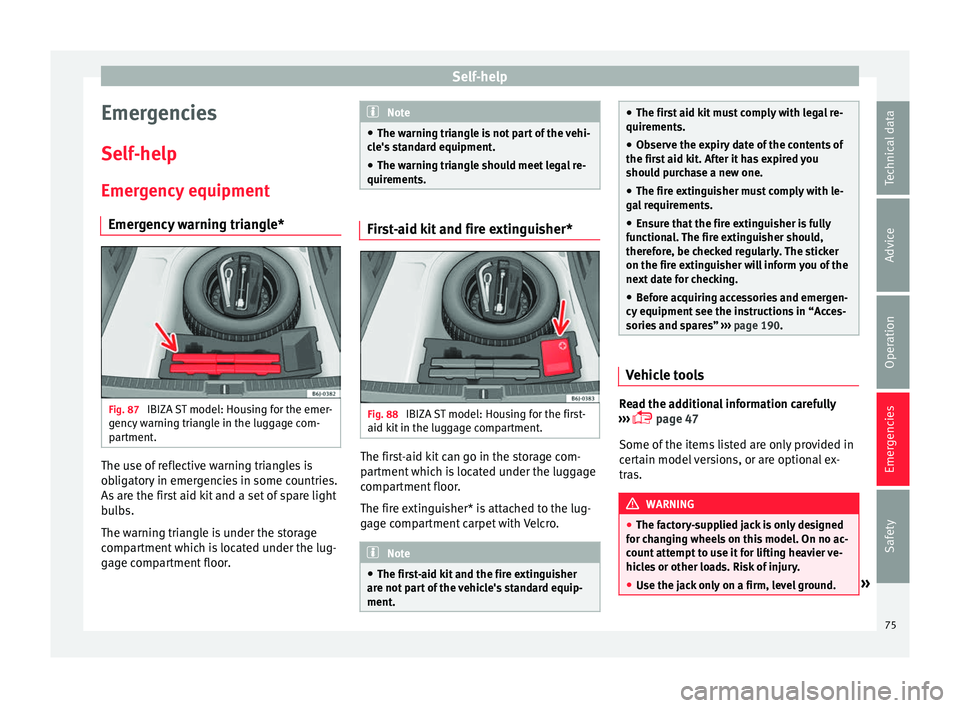
IBIZA ST model: Housing for the emer-
g ency
warnin
g triangle in the luggage com-
partment. The use of reflective warning triangles is
o
b
lig at
ory in emergencies in some countries.
As are the first aid kit and a set of spare light
bulbs.
The warning triangle is under the storage
compartment which is located under the lug-
gage compartment floor. Note
● The warning tri an
gle is not part of the vehi-
cle's standard equipment.
● The warning triangle should meet legal re-
quirements. First-aid kit and fire extinguisher*
Fig. 88
IBIZA ST model: Housing for the first-
aid k it
in the lug g
age compartment. The first-aid kit can go in the storage com-
p
ar
tment whic
h is located under the luggage
compartment floor.
The fire extinguisher* is attached to the lug-
gage compartment carpet with Velcro. Note
● The first -
aid kit and the fire extinguisher
are not part of the vehicle's standard equip-
ment. ●
The first aid k
it must comply with legal re-
quirements.
● Observe the expiry date of the contents of
the first aid k
it. After it has expired you
should purchase a new one.
● The fire extinguisher must comply with le-
gal r
equirements.
● Ensure that the fire extinguisher is fully
functiona
l. The fire extinguisher should,
therefore, be checked regularly. The sticker
on the fire extinguisher will inform you of the
next date for checking.
● Before acquiring accessories and emergen-
cy equipment see the ins
tructions in “Acces-
sories and spares” ››› page 190. Vehicle tools
Read the additional information carefully
› ›
›
p
age 47
Some of the items listed are only provided in
certain model versions, or are optional ex-
tras. WARNING
● The factor y
-supplied jack is only designed
for changing wheels on this model. On no ac-
count attempt to use it for lifting heavier ve-
hicles or other loads. Risk of injury.
● Use the jack only on a firm, level ground. » 75
Technical data
Advice
Operation
Emergencies
Safety
Page 79 of 252
Self-help
After inserting the sealant residue in the tyre,
y ou mu
st
again check the tyre pressure about
10 minutes after starting the engine.
You should only use the tyre mobility set if
the vehicle is parked in a safe place, you are
familiar with the procedure and you have the
necessary tyre mobility set! Otherwise, you
should seek professional assistance.
Do not use the tyre sealant in the following
cases:
● If the wheel rim has been damaged.
● In outside temperatures below -20 °C
(-4 °F).
● In the event of cuts or perforations in the
tyre gre
ater than 4 mm.
● If you have been driving with very low pres-
sure or a comp
letely flat tyre.
● If the sealant bottle has passed its use by
date. WARNING
Using the tyre mobility system can be dan-
gerou s, e
specially when filling the tyre at the
roadside. Please observe the following rules
to minimise the risk of injury:
● Stop the vehicle safely as soon as possible.
Park it at
a safe distance from surrounding
traffic to fill the tyre.
● Ensure the ground on which you park is flat
and solid. ●
All p
assengers and particularly children
must keep a safe distance from the work area.
● Turn on the hazard warning lights to warn
other road u
sers.
● Use the tyre mobility system only if you are
familiar w
ith the necessary procedures. Oth-
erwise, you should seek professional assis-
tance.
● The tyre mobility set is intended for tempo-
rary emer
gency use only until you can reach
the nearest specialised workshop.
● Replace the repaired tyre with the tyre mo-
bility set
as soon as possible.
● The sealant is a health hazard and must be
cleaned immedi
ately if it comes into contact
with the skin.
● Always keep the tyre mobility set out of the
reach of
small children.
● Never use a jack, even if it has been ap-
proved f
or your vehicle.
● Always stop the engine, apply the hand-
brake lev
er firmly and engage gear if using a
manual gearbox, in order to reduce the risk of
vehicle involuntary movement. WARNING
A tyre filled with sealant does not have the
same perf orm
ance properties as a conven-
tional tyre.
● Never drive faster than 80 km/h (50 mph).
● Avoid heavy acceleration, hard braking and
fast
cornering. ●
Drive for on ly
10 minutes at a maximum
speed of 80 km/h (50 mph) and then check
the tyre. For the sake of the environment
Dispose of used or expired sealant observing
an y le
gal requirements. Note
● A new bottle of se a
lant can be purchased at
SEAT dealerships.
● Take into account the separate instruction
manual of
the tyre mobility set* manufactur-
er. Contents of the tyre mobility system*
Fig. 89
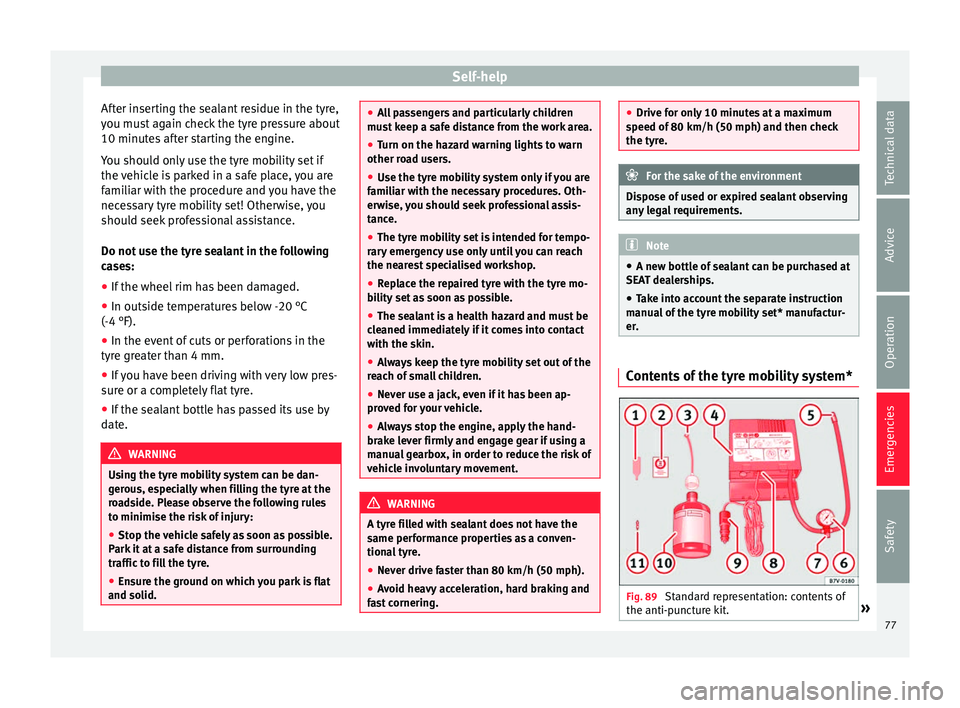
Standard representation: contents of
the anti-p u
nct ur
e kit. » 77
Technical data
Advice
Operation
Emergencies
Safety