wheel Seat Ibiza ST 2016 User Guide
[x] Cancel search | Manufacturer: SEAT, Model Year: 2016, Model line: Ibiza ST, Model: Seat Ibiza ST 2016Pages: 252, PDF Size: 5.56 MB
Page 33 of 252
The essentials
● Pr e
ss
the button on the windscreen
w iper l
ever or the b
utton on the multifunc-
tion s t
eerin g wheel
to store the current speed
and activate the warning.
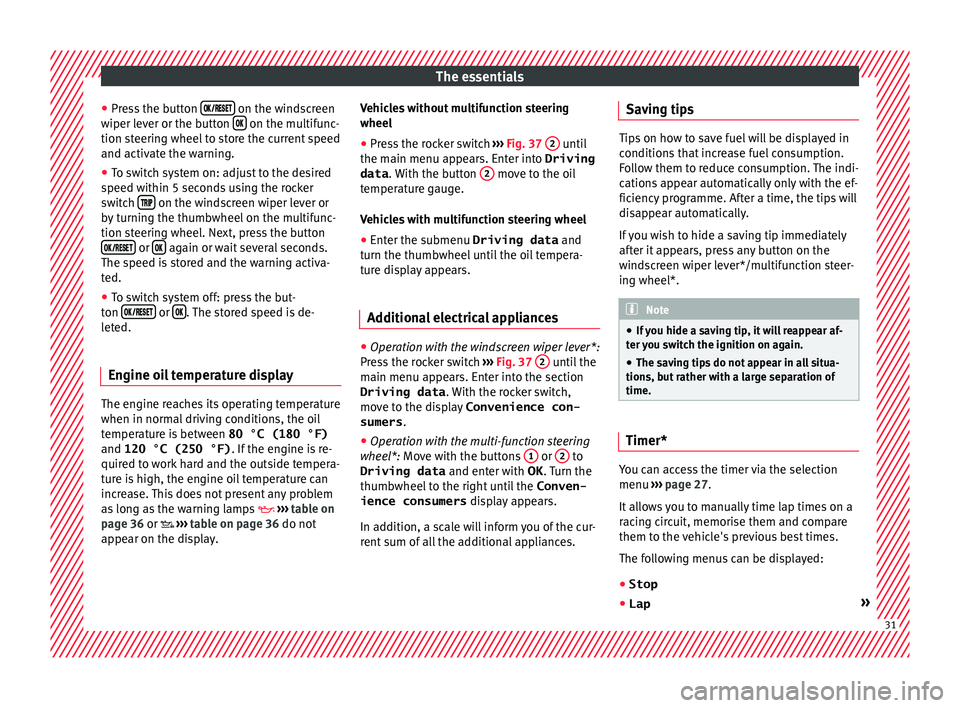
● To switch system on: adjust to the desired
speed within 5 second
s using the rocker
switch on the windscreen wiper lever or
b y
t urnin
g the thumbwheel on the multifunc-
tion steering wheel. Next, press the button or
again or wait several seconds.
The s peed i
s s
tored and the warning activa-
ted.
● To switch system off: press the but-
ton or
. The stored speed is de-
l et
ed.
En gine oi
l temperature display The engine reaches its operating temperature
when in norm
al
driv in
g conditions, the oil
temperature is between 80 °C (180 °F)
and 120 °C (250 °F) . If the engine is re-
quired to work hard and the outside tempera-
ture is high, the engine oil temperature can
increase. This does not present any problem
as long as the warning lamps ›››
table on
page 36 or ›››
table on page 36 do not
appear on the display. Vehicles without multifunction steering
wheel
●
Press the rocker switch ››› Fig. 37
2 until
the m ain menu ap
pear
s. Enter into Driving
data . With the button 2 move to the oil
t emper
atur
e gauge.
Vehicles with multifunction steering wheel
● Enter the submenu Driving data and
turn the thumbwheel u
ntil the oil tempera-
ture display appears.
Additional electrical appliances ●
Operation with the windscreen wiper lever*:
Pr e
ss
the rocker switch ››› Fig. 37 2 until the
m ain menu ap
pear
s. Enter into the section
Driving data . With the rocker switch,
move to the display Convenience con-
sumers .
● Operation with the multi-function steering
wheel*: Mo
ve with the buttons 1 or
2 to
Driving data and enter w
ith OK
.
Turn the
thumbwheel to the right until the Conven-
ience consumers display appears.
In addition, a scale will inform you of the cur-
rent sum of all the additional appliances. Saving tips Tips on how to save fuel will be displayed in
conditions
th
at increase fuel consumption.
Follow them to reduce consumption. The indi-
cations appear automatically only with the ef-
ficiency programme. After a time, the tips will
disappear automatically.
If you wish to hide a saving tip immediately
after it appears, press any button on the
windscreen wiper lever*/multifunction steer-
ing wheel*. Note
● If y ou hide a s
aving tip, it will reappear af-
ter you switch the ignition on again.
● The saving tips do not appear in all situa-
tions, but r
ather with a large separation of
time. Timer*
You can access the timer via the selection
menu
››
›
p
age 27.
It allows you to manually time lap times on a
racing circuit, memorise them and compare
them to the vehicle's previous best times.
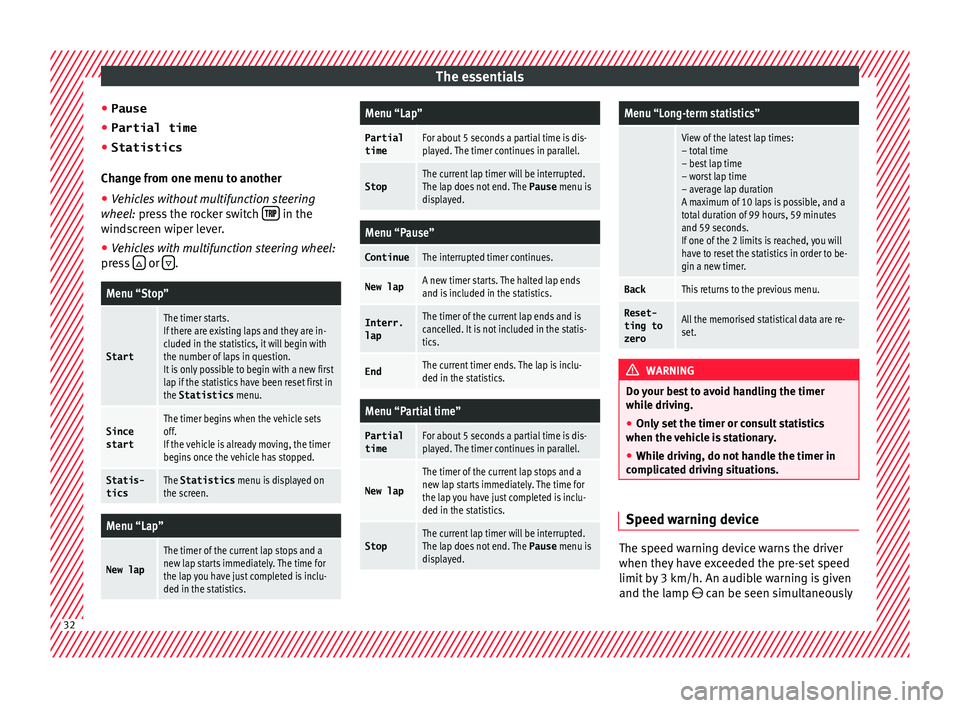
The following menus can be displayed:
● Stop
● Lap » 31
Page 34 of 252
The essentials
● Pause
● Partial time
● Statistics
Ch an
ge fr
om one menu to another
● Vehicles without multifunction steering
wheel: pr
ess the rocker switch in the
w ind
sc
reen wiper lever.
● Vehicles with multifunction steering wheel:
press
or
.
Menu “Stop”
Start
The timer starts.
If there are existing laps and they are in-
cluded in the statistics, it will begin with
the number of laps in question.
It is only possible to begin with a new first
lap if the statistics have been reset first in
the Statistics
menu.
Since
startThe timer begins when the vehicle sets
off.
If the vehicle is already moving, the timer
begins once the vehicle has stopped.
Statis-
ticsThe Statistics menu is displayed on
the screen.
Menu “Lap”
New lap
The timer of the current lap stops and a
new lap starts immediately. The time for
the lap you have just completed is inclu-
ded in the statistics.
Menu “Lap”
Partial
timeFor about 5 seconds a partial time is dis-
played. The timer continues in parallel.
StopThe current lap timer will be interrupted.
The lap does not end. The Pause menu is
displayed.
Menu “Pause”
ContinueThe interrupted timer continues.
New lapA new timer starts. The halted lap ends
and is included in the statistics.
Interr. lapThe timer of the current lap ends and is
cancelled. It is not included in the statis-
tics.
EndThe current timer ends. The lap is inclu-
ded in the statistics.
Menu “Partial time”
Partial
timeFor about 5 seconds a partial time is dis-
played. The timer continues in parallel.
New lap
The timer of the current lap stops and a
new lap starts immediately. The time for
the lap you have just completed is inclu-
ded in the statistics.
StopThe current lap timer will be interrupted.
The lap does not end. The Pause menu is
displayed.
Menu “Long-term statistics”
View of the latest lap times:
– total time
– best lap time
– worst lap time
– average lap duration
A maximum of 10 laps is possible, and a
total duration of 99 hours, 59 minutes
and 59 seconds.
If one of the 2 limits is reached, you will
have to reset the statistics in order to be-
gin a new timer.
BackThis returns to the previous menu.
Reset-
ting to
zeroAll the memorised statistical data are re-
set. WARNING
Do your best to avoid handling the timer
while driv in
g.
● Only set the timer or consult statistics
when the vehicl
e is stationary.
● While driving, do not handle the timer in
complicat
ed driving situations. Speed warning device
The speed warning device warns the driver
when they
h
av e e
xceeded the pre-set speed
limit by 3 km/h. An audible warning is given
and the lamp can be seen simultaneously 32
Page 36 of 252
The essentials
Reading a service notification
W ith the ignition sw
itc
hed on, the engine off
and the vehicle at a standstill, the current
service notification can be read:
Press and hold the button 4 for more than 5
sec ond
s t
o consult the service message.
When the service date has passed , a minus
sign is displayed in front of the number of kil-
ometres or days.
Vehicles with text messages : the following
message is displayed: Service --- km
(miles) or --- days ago .
The time can also be set via the key and
Set up function button in the Easy Connect
sy s
tem
›
›› page 101.
Resetting service interval display
If the service was not carried out by a SEAT
dealership, the display can be reset as fol-
lows: ● Switch off the ignition, press and hold but-
ton ›››
Fig. 121
4 .
● Switch ignition back on.
● Release THE 4
› ›
›
Fig. 121
b
utton and
press it again for the next 20 seconds. Note
● The servic e me
ssage disappears after a few
seconds, when the engine is started or when OK/RESET
is pressed on the windscreen wiper
lever , or OK on the multifunction steering
wheel.
● In v ehic
les with the LongLife system in
which the batter
y has been disconnected for
a long period of time, it is not possible to cal-
culate the date of the next service. Therefore
the service interval display may not be cor-
rect. In this case, bear in mind the maximum
service intervals permitted in the ››› Book-
let Maintenance Programme. Cruise control
Oper atin
g the c rui
se control system
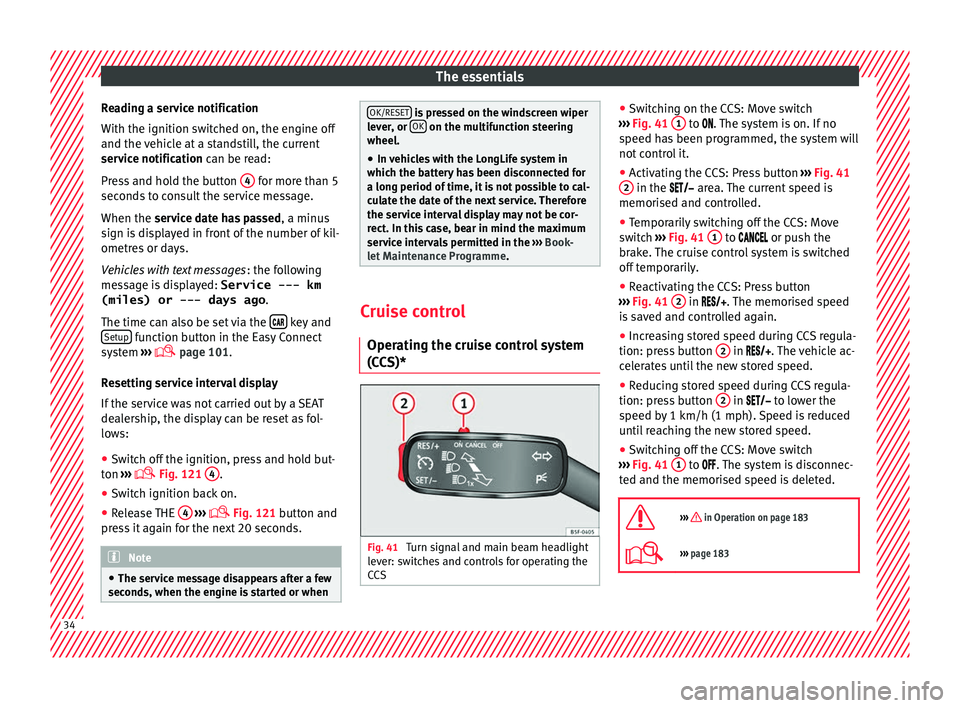
(CCS)* Fig. 41
Turn signal and main beam headlight
l ev
er: sw it
ches and controls for operating the
CCS ●
Sw it
chin
g on the CCS: Move switch
››› Fig. 41 1 to .
The system is on. If no
s peed h a
s been programmed, the system will
not control it.
● Activating the CCS: Press button ››› Fig. 41
2 in the ar
e
a. The c
urrent speed is
memorised and controlled.
● Temporarily switching off the CCS: Move
switch ›
›› Fig. 41 1 to
or push the
br ak e.
The cruise control system is switched
off temporarily.
● Reactivating the CCS: Press button
››› Fig. 41
2 in
. The memorised speed
i s
saved and controlled again.
● Increasing stored speed during CCS regula-
tion: press
button 2 in
. The vehicle ac-
c el
erates until the new stored speed.
● Reducing stored speed during CCS regula-
tion: press
button 2 in t
o lower the
s peed b y
1 km/h (1 mph). Speed is reduced
until reaching the new stored speed.
● Switching off the CCS: Move switch
››› Fig. 41
1 to .
The system is disconnec-
t ed and the memori sed s
peed is deleted.
››› in Operation on page 183
››› page 183 34
Page 47 of 252
The essentials
Identifying a blown fuse
A f u
se i s
blown if its metal strip is ruptured
››› Fig. 59.
● Point a lamp at the fuse to see if it has
blown.
To r
eplace a fuse
● Remove the fuse.
● Replace the blown fuse by one with an
identical
amperage rating (same colour and
markings) and identical size.
● Replace the cover again or close the fuse
box lid.
Bu
lbs
Bulb
s (12 V)
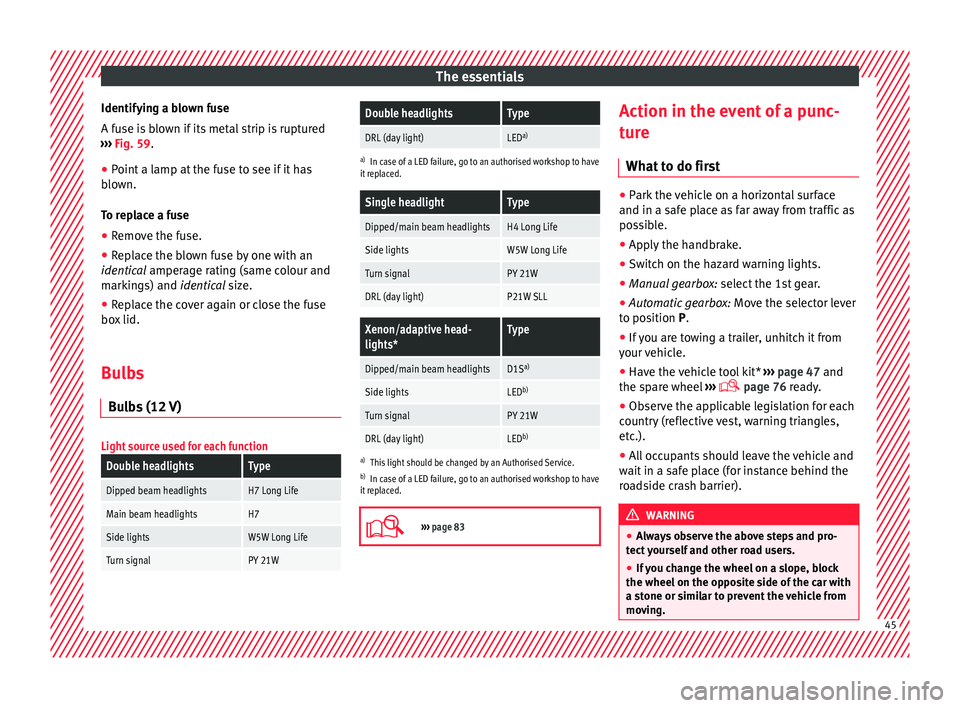
Light source used for each function
Double headlightsType
Dipped beam headlightsH7 Long Life
Main beam headlightsH7
Side lightsW5W Long Life
Turn signalPY 21W
Double headlightsType
DRL (day light)LEDa)
a)
In case of a LED failure, go to an authorised workshop to have
it replaced.
Single headlightType
Dipped/main beam headlightsH4 Long Life
Side lightsW5W Long Life
Turn signalPY 21W
DRL (day light)P21W SLL
Xenon/adaptive head-
lights*Type
Dipped/main beam headlightsD1S a)
Side lightsLEDb)
Turn signalPY 21W
DRL (day light)LEDb)
a)
This light should be changed by an Authorised Service.
b) In case of a LED failure, go to an authorised workshop to have
it replaced.
››› page 83 Action in the event of a punc-
t
ur
e
Wh at
to do first ●
Park the vehicle on a horizontal surface
and in a safe p l
ace as far away from traffic as
possible.
● Apply the handbrake.
● Switch on the hazard warning lights.
● Manual gearbox: select the 1st
gear.
● Automatic gearbox: Move the select
or lever
to position P.
● If you are towing a trailer, unhitch it from
your vehic
le.
● Have the vehicle tool kit* ›››
p
age 47 and
the spare wheel ›››
page 76 ready.
● Observe the applicable legislation for each
country
(reflective vest, warning triangles,
etc.).
● All occupants should leave the vehicle and
wait in a saf
e place (for instance behind the
roadside crash barrier). WARNING
● Alwa y
s observe the above steps and pro-
tect yourself and other road users.
● If you change the wheel on a slope, block
the wheel on the oppos
ite side of the car with
a stone or similar to prevent the vehicle from
moving. 45
Page 49 of 252
The essentials
Changing a wheel V ehic
le t
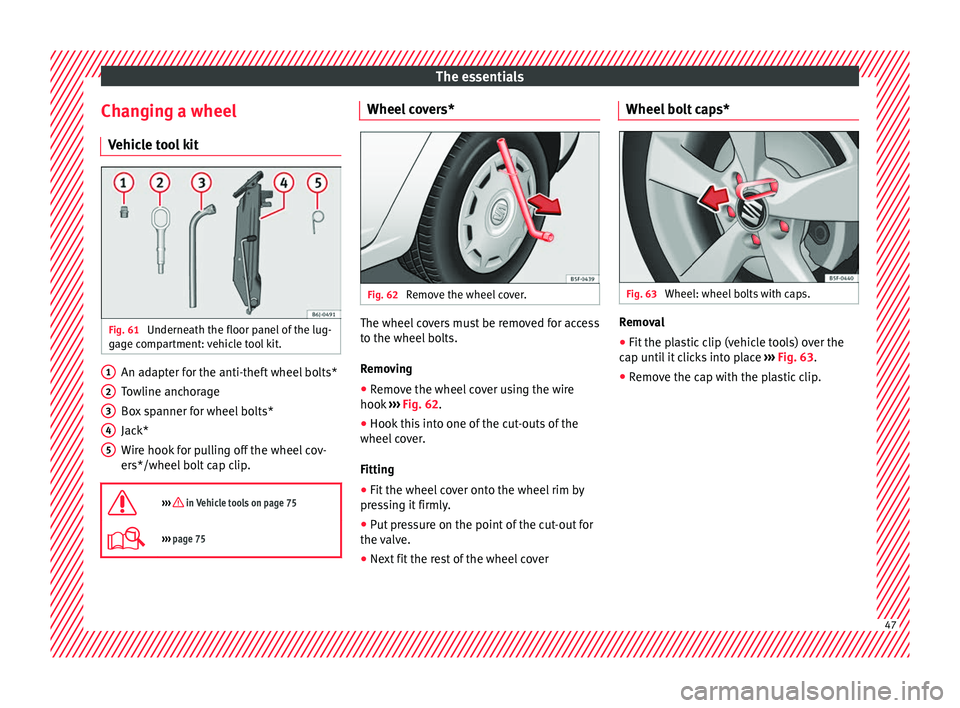
ool kitFig. 61
Underneath the floor panel of the lug-
g ag
e c omp
artment: vehicle tool kit. An adapter for the anti-theft wheel bolts*
T
o
wline anc hor
age
Box spanner for wheel bolts*
Jack*
Wire hook for pulling off the wheel cov-
ers*/wheel bolt cap clip.
››› in Vehicle tools on page 75
››› page 75 1
2
3
4
5 Wheel covers*
Fig. 62
Remove the wheel cover. The wheel covers must be removed for access
t
o the wheel
bolts.
R
emoving
● Remove the wheel cover using the wire
hook ›››
Fig. 62.
● Hook this into one of the cut-outs of the
wheel cov
er.
Fitting
● Fit the wheel cover onto the wheel rim by
press
ing it firmly.
● Put pressure on the point of the cut-out for
the valve.
● Ne
xt fit the rest of the wheel cover Wheel bolt caps*
Fig. 63
Wheel: wheel bolts with caps. Removal
● Fit the plastic clip (vehicle tools) over the
c ap u
ntil
it clicks into place ››› Fig. 63.
● Remove the cap with the plastic clip. 47
Page 50 of 252
The essentials
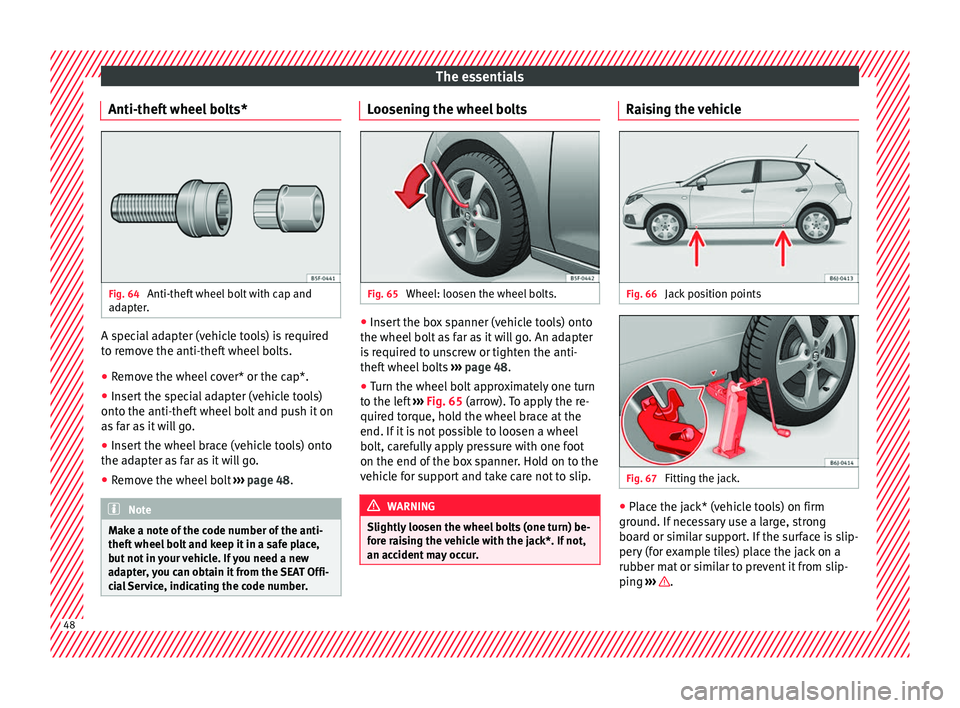
Anti-theft wheel bolts* Fig. 64
Anti-theft wheel bolt with cap and
a d
apt er
. A special adapter (vehicle tools) is required
t
o r
emo v
e the anti-theft wheel bolts.
● Remove the wheel cover* or the cap*.
● Insert the special adapter (vehicle tools)
onto the anti-theft wheel
bolt and push it on
as far as it will go.
● Insert the wheel brace (vehicle tools) onto
the adapter a
s far as it will go.
● Remove the wheel bolt ››› p
age 48. Note
Make a note of the code number of the anti-
theft wheel bo
lt and keep it in a safe place,
but not in your vehicle. If you need a new
adapter, you can obtain it from the SEAT Offi-
cial Service, indicating the code number. Loosening the wheel bolts
Fig. 65
Wheel: loosen the wheel bolts. ●
Insert the box spanner (vehicle tools) onto
the wheel bo
lt a
s far as it will go. An adapter
is required to unscrew or tighten the anti-
theft wheel bolts ››› page 48.
● Turn the wheel bolt approximately one turn
to the left ›
›› Fig. 65 (arrow). To apply the re-
quired torque, hold the wheel brace at the
end. If it is not possible to loosen a wheel
bolt, carefully apply pressure with one foot
on the end of the box spanner. Hold on to the
vehicle for support and take care not to slip. WARNING
Slightly loosen the wheel bolts (one turn) be-
fore r ai
sing the vehicle with the jack*. If not,
an accident may occur. Raising the vehicle
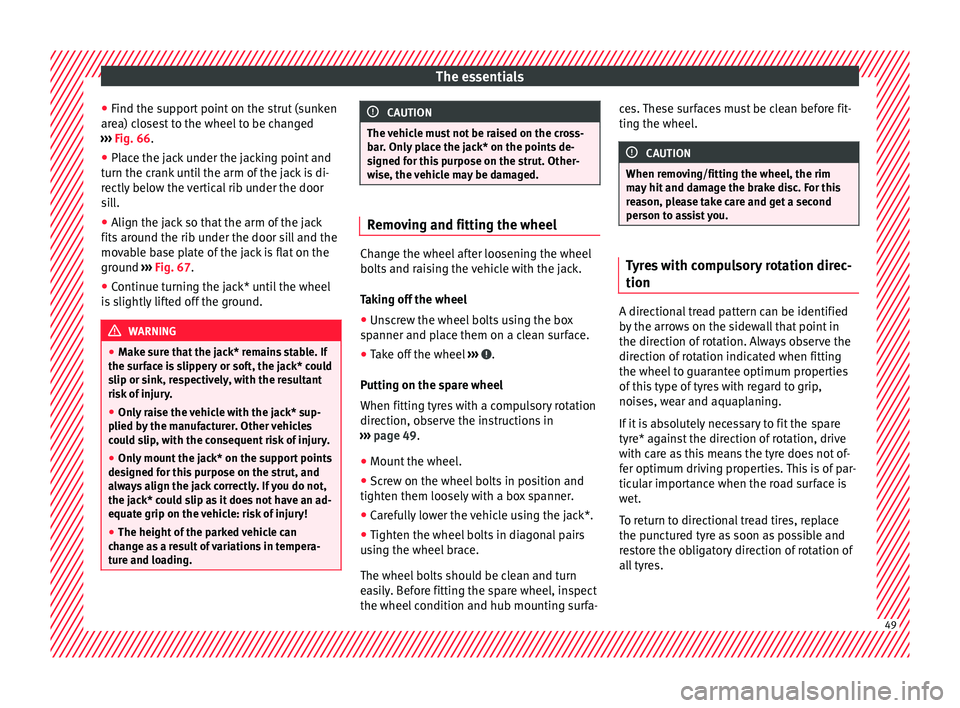
Fig. 66
Jack position points Fig. 67
Fitting the jack. ●
Place the jack* (vehicle tools) on firm
gr ou
nd. If nec
essary use a large, strong
board or similar support. If the surface is slip-
pery (for example tiles) place the jack on a
rubber mat or similar to prevent it from slip-
ping ››› .
48
Page 51 of 252
The essentials
● Find the s up
por t
point on the strut (sunken
area) closest to the wheel to be changed
››› Fig. 66.
● Place the jack under the jacking point and
turn the crank
until the arm of the jack is di-
rectly below the vertical rib under the door
sill.
● Align the jack so that the arm of the jack
fits around the rib u
nder the door sill and the
movable base plate of the jack is flat on the
ground ››› Fig. 67.
● Continue turning the jack* until the wheel
is slightly
lifted off the ground. WARNING
● Make s ur
e that the jack* remains stable. If
the surface is slippery or soft, the jack* could
slip or sink, respectively, with the resultant
risk of injury.
● Only raise the vehicle with the jack* sup-
plied by the m
anufacturer. Other vehicles
could slip, with the consequent risk of injury.
● Only mount the jack* on the support points
designed for thi
s purpose on the strut, and
always align the jack correctly. If you do not,
the jack* could slip as it does not have an ad-
equate grip on the vehicle: risk of injury!
● The height of the parked vehicle can
chang
e as a result of variations in tempera-
ture and loading. CAUTION
The vehicle must not be raised on the cross-
bar. On ly
place the jack* on the points de-
signed for this purpose on the strut. Other-
wise, the vehicle may be damaged. Removing and fitting the wheel
Change the wheel after loosening the wheel
bolts and r
ai
sing the vehicle with the jack.
Taking off the wheel
● Unscrew the wheel bolts using the box
spanner and p l
ace them on a clean surface.
● Take off the wheel ››› .
P uttin
g on the s p
are wheel
When fitting tyres with a compulsory rotation
direction, observe the instructions in
››› page 49.
● Mount the wheel.
● Screw on the wheel bolts in position and
tighten them loosely w
ith a box spanner.
● Carefully lower the vehicle using the jack*.
● Tighten the wheel bolts in diagonal pairs
using the wheel
brace.
The wheel bolts should be clean and turn
easily. Before fitting the spare wheel, inspect
the wheel condition and hub mounting surfa- ces. These surfaces must be clean before fit-
ting the wheel. CAUTION
When removing/fitting the wheel, the rim
may hit
and damage the brake disc. For this
reason, please take care and get a second
person to assist you. Tyres with compulsory rotation direc-
tion
A directional tread pattern can be identified
b
y
the arr o
ws on the sidewall that point in
the direction of rotation. Always observe the
direction of rotation indicated when fitting
the wheel to guarantee optimum properties
of this type of tyres with regard to grip,
noises, wear and aquaplaning.
If it is absolutely necessary to fit the spare
tyre* against the direction of rotation, drive
with care as this means the tyre does not of-
fer optimum driving properties. This is of par-
ticular importance when the road surface is
wet.
To return to directional tread tires, replace
the punctured tyre as soon as possible and
restore the obligatory direction of rotation of
all tyres. 49
Page 52 of 252
The essentials
Subsequent work ●
Alloy wheels: replac e the wheel bolt caps.
● Plate wheels: replac
e the wheel hubcap.
● Return all tools to their proper storing loca-
tion.
● If the replaced wheel does not fit in the
spare wheel
housing, store it safely in the
luggage compartment ›››
page 135.
● Check the tyre pressure of the newly moun-
ted tyre a
s soon as possible.
● In vehicles fitted with a tyre pressure indi-
cator , a
djust the pressure and store it in
memory ›››
page 216.
● Have the tightening torque of the wheel
bolts chec
ked as soon as possible with a tor-
que wrench (it should be 120 Nm). Mean-
while, drive carefully.
● Have the flat tyre replaced as quickly as
possib
le.
Snow chains Use Snow chains should only be used on the
fr
on
t wheel
s.
● Check that they are correctly seated after
driving for a f
ew yards; correct the position if necessary, in accordance with the manufac-
turer's fittin
g instructions.
● Keep your speed below 50 km/h (30 mph).
● If there is a danger of being trapped de-
spite hav
ing mounted the chains, it is best to
disable the driving wheels (ASR) in the ESC
››› page 155.
Snow chains will improve braking ability as
well as traction in winter conditions.
For technical reasons snow chains may only
be used with the following wheel rim/tyre
combination.
175/70R14
185/60R15Chains with links not exceeding 15 mm
(including the chain closure)
215/45R16Chains with links not exceeding 9 mm
(including the chain closure)
215/40R17Chains with links not exceeding 7 mm
(including the chain closure) Remove wheel covers and any integral trim
rin
g bef
ore fittin
g snow chains.
Remove the chains when roads are free of
snow. Driving characteristics worsen, and the
wheels become damaged quickly and may
even be rendered unusable. WARNING
Snow chains should be correctly tightened in
accor d
ance with the manufacturer's instruc- tions. This will prevent the chains coming in-
to cont
act
with the wheel housing.50
Page 53 of 252
The essentials
Emergency towing of the vehi-
c l
e
T o
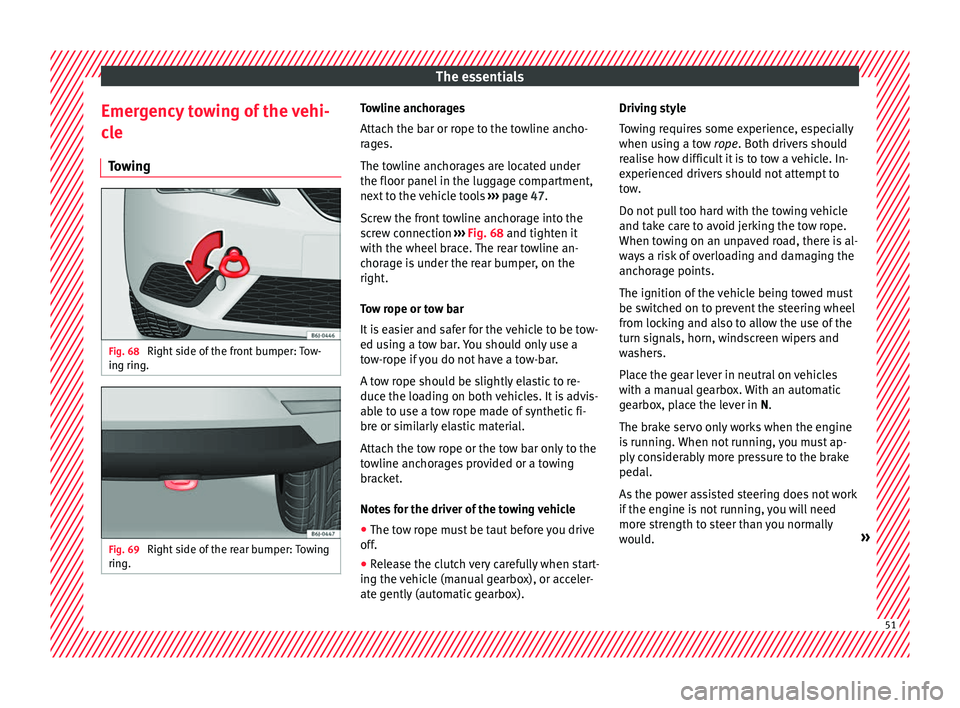
wing Fig. 68
Right side of the front bumper: Tow-
in g rin
g. Fig. 69
Right side of the rear bumper: Towing
rin g. Towline anchorages
Att
ac
h the b ar or r
ope to the towline ancho-
rages.
The towline anchorages are located under
the floor panel in the luggage compartment,
next to the vehicle tools ››› page 47.
Screw the front towline anchorage into the
screw connection ››› Fig. 68 and tighten it
with the wheel brace. The rear towline an-
chorage is under the rear bumper, on the
right.
Tow rope or tow bar
It is easier and safer for the vehicle to be tow-
ed using a tow bar. You should only use a
tow-rope if you do not have a tow-bar.
A tow rope should be slightly elastic to re-
duce the loading on both vehicles. It is advis-
able to use a tow rope made of synthetic fi-
bre or similarly elastic material.
Attach the tow rope or the tow bar only to the
towline anchorages provided or a towing
bracket.
Notes for the driver of the towing vehicle
● The tow rope must be taut before you drive
off.
● Rele
ase the clutch very carefully when start-
ing the vehic
le (manual gearbox), or acceler-
ate gently (automatic gearbox). Driving style
Towin
g requires some experience, especially
when using a tow rope. Both drivers should
realise how difficult it is to tow a vehicle. In-
experienced drivers should not attempt to
tow.
Do not pull too hard with the towing vehicle
and take care to avoid jerking the tow rope.
When towing on an unpaved road, there is al-
ways a risk of overloading and damaging the
anchorage points.
The ignition of the vehicle being towed must
be switched on to prevent the steering wheel
from locking and also to allow the use of the
turn signals, horn, windscreen wipers and
washers.
Place the gear lever in neutral on vehicles
with a manual gearbox. With an automatic
gearbox, place the lever in N.
The brake servo only works when the engine
is running. When not running, you must ap-
ply considerably more pressure to the brake
pedal.
As the power assisted steering does not work
if the engine is not running, you will need
more strength to steer than you normally
would. » 51
Page 54 of 252
The essentials
››› in Notes on page 79
››› page 79 Tow-starting
If the engine will not start, first try starting it
usin
g the b
attery of another vehicle
››› page 52. You should only attempt to tow-
start a vehicle if charging the battery does
not work. This is done by leveraging wheel
movement.
When tow-starting a vehicle with a petrol en-
gine, do not tow it more than a short dis-
tance, otherwise unburned fuel can enter the
catalytic converter.
However, if your vehicle has to be tow-star-
ted:
● Engage 2 nd
or 3 rd
ge ar
.
● Keep the clutch pressed down.
● Switch the ignition on.
● Once both vehicles are moving, release the
clutch.
● As
soon as the engine starts, press the
clutch and mo
ve the gear lever into neutral.
This helps to prevent driving into the towing
vehicle.
››› in Notes on page 79
›››
page 79 How to jump start
Jump l e
a d
s The jump lead must have a sufficient wire
cro
s
s section.
If the engine fails to start because of a dis-
charged battery, the battery can be connec-
ted to the battery of another vehicle to start
the engine.
Jump leads
Jump leads must comply with standard DIN
72553 (see cable manufacturer's instruc-
tions). The wire cross section must be at least
25 mm 2
for petrol engines and at least
35 mm 2
for diesel engines. Note
● The vehic l
es must not touch each other,
otherwise electricity could flow as soon as
the positive terminals are connected.
● The discharged battery must be properly
connected to the on-bo
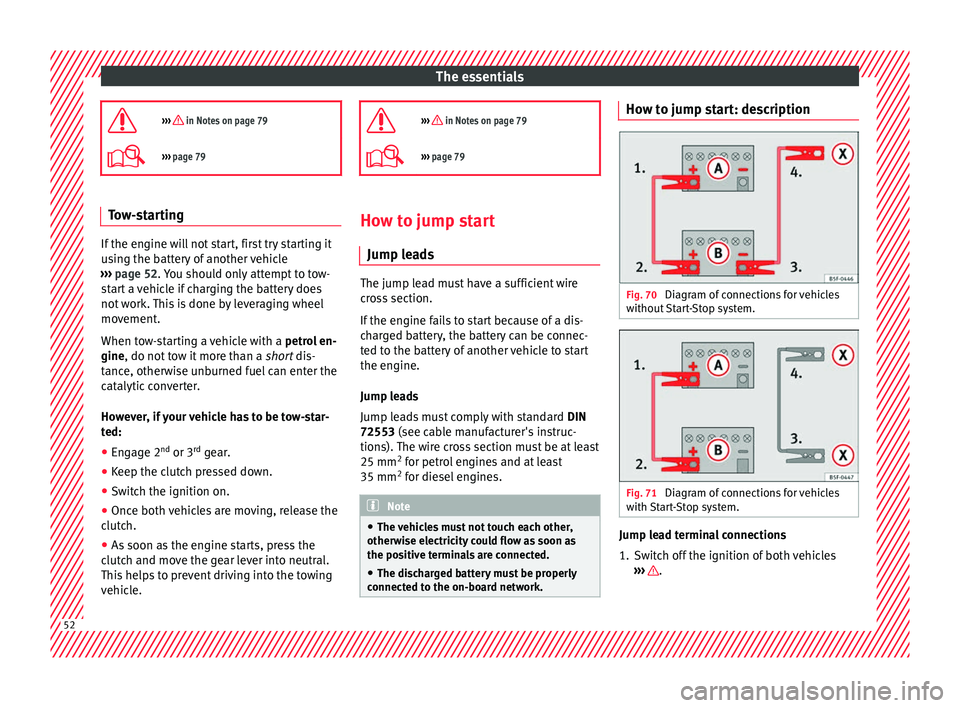
ard network. How to jump start: description
Fig. 70
Diagram of connections for vehicles
w ithout
St
art-Stop system. Fig. 71
Diagram of connections for vehicles
w ith
Star
t-Stop system. Jump lead terminal connections
1. Switch off the ignition of both vehicles
››
› .
52