heating Seat Ibiza ST 2016 Owner's Guide
[x] Cancel search | Manufacturer: SEAT, Model Year: 2016, Model line: Ibiza ST, Model: Seat Ibiza ST 2016Pages: 252, PDF Size: 5.56 MB
Page 153 of 252
Driving
Note
A perfect operation of the vehicle is ensured
if genuine S
EAT keys are used.Starting petrol engines
The engine can only be started using a genu-
ine SEA
T k
ey with its correct code.
– Move the gearbox lever to the neutral posi-
tion and depress
the clutch pedal thor-
oughly and hold it in this position for the
starter to turn the engine on.
– Turn the ignition key to the starting posi-
tion ›››
p
age 150.
– Let go of the ignition key as soon as the en-
gine starts; the s
tarter motor must not run
on with the engine.
After starting a very hot engine, you may
need to slightly press down the accelerator.
When starting a cold engine, it may be a little
noisy for the first few seconds until oil pres-
sure has built up in the hydraulic valve com-
pensators. This is quite normal, and no cause
for concern.
If the engine does not start immediately,
switch the starter off after 10 seconds and try
again after half a minute. If the engine still
does not start, the fuel pump fuse should be
checked ›››
page 81, Fuses. WARNING
● Never st ar
t or run the engine in unventila-
ted or closed rooms. The exhaust gases con-
tain carbon monoxide, an odourless and col-
ourless poisonous gas. Risk of fatal acci-
dents. Carbon monoxide can cause loss of
consciousness and result in death.
● Never leave the vehicle unattended if the
engine is ru
nning.
● Never use “cold start sprays”, they could
explode or cau
se the engine to run at high
revs. Risk of injury. CAUTION
● When the engine is c
old, you should avoid
high engine speeds, driving at full throttle
and over-loading the engine. Risk of engine
damage.
● The vehicle should not be pushed or towed
more than 50 metre
s to start the engine. Un-
burnt fuel could enter the catalytic converter
and damage it.
● Before attempting to push-start or tow a ve-
hicle in order t
o start it, you should first try to
start it using the battery of another vehicle.
Please observe and follow the notes on the
››› page 52, How to jump start. For the sake of the environment
Do not warm-up the engine by running the
engine with the v
ehicle stationary. Start off
immediately, driving gently. This helps the engine reach operating temperature faster
and reduce
s
emissions. Starting diesel engines
The engine can only be started using a genu-
ine SEA
T k
ey with its correct code.
– Move the gearbox lever to the neutral posi-
tion and depress
the clutch pedal thor-
oughly and hold it in this position for the
starter to turn the engine on.
– Turn the ignition key to position ››› Fig. 168
2 . The warning lamp
wi
ll
light for en-
gine pre-heating.
– When the lamp turns off, turn the ignition
key to po
sition 3 to start the engine. Do
not pr
es
s the accelerator.
– Release the ignition key as soon as the en-
gine starts.
The starter motor should not
turn at the same time.
When starting a cold engine, it may be a little
noisy for the first few seconds until oil pres-
sure has built up in the hydraulic valve com-
pensators. This is quite normal, and no cause
for concern.
If there are problems starting the engine, see
the ›››
page 52. »
151
Technical data
Advice
Operation
Emergencies
Safety
Page 160 of 252
Operation
At speeds of up to approximately 80 km/h
(50 mph), it i
s ab
le to balance out differences
in the speed of the driven wheels of approxi-
mately 100 rpm/min caused by a partially
slippery road surface. It does this by braking
the wheel which has lost traction and distrib-
uting more driving force to the other driven
wheel via the differential.
To prevent the disc brake of the braking
wheel from overheating, the EDL cuts out au-
tomatically if subjected to excessive loads.
The vehicle will continue to function normally
without EDL. For this reason, the driver is not
informed that the EDL has been switched off.
The EDL will switch on again automatically
when the brake has cooled down.
Control lamp
A malfunction in the EDL is indicated by the
ABS control lamp ››› page 158. Take the
vehicle to a specialised workshop as soon as
possible. WARNING
● When accel er
ating on a slippery surface,
for example on ice and snow, press the accel-
erator carefully. Despite EDL, the driven
wheels may start to spin. This could impair
the vehicle's stability.
● Always adapt your driving style to suit road
conditions and the tr
affic situation. Do not let
the extra safety afforded by EDL tempt you in- to taking any risks when driving, this can
cause ac
c
idents. CAUTION
Modifications to the vehicle (e.g. to the en-
gine, the br ake sys
tem, running gear or any
components affecting the wheels and tyres)
could affect the efficiency of the EDL
››› page 190. Hydraulic Brake Assist (HBA)*
The function (Hydraulic Brake Assist HBA) is
on
ly
inc luded in
vehicles with ESC.
In an emergency, most drivers brake in time,
but not with maximum force. This results in
unnecessarily long braking distances.
This is when the brake assist system comes
into action. When pressing the brake pedal
rapidly, the assistant interprets it as an emer-
gency. It very quickly builds up the full brake
pressure so that the ABS can be activated
more quickly and efficiently, thus reducing
braking distance.
Do not reduce the pressure on the brake ped-
al, since the brake assist system switches off
automatically as soon as you release the
brake. Automatic hazard warning lights activation
The brake lights fl
ash automatically to indi-
cate that the vehicle is braking suddenly or in
an emergency situation. If the emergency
braking continues until the vehicle comes to
a standstill, the hazard warning lights will
then come on and the brake lights will re-
main on permanently from that moment. The
warning lights will automatically switch off
when the vehicle begins to move again or
when the "warning" light button is pressed. WARNING
● The risk of ac
cident is higher if you drive
too fast, if you do not keep your distance from
the vehicle in front, and when the road sur-
face is slippery or wet. The increased acci-
dent risk cannot be reduced by the brake as-
sist system.
● The brake assist system cannot defy the
laws
of physics. Slippery and wet roads are
dangerous even with the brake assist system!
Therefore, it is essential that you adjust your
speed to suit the road and traffic conditions.
Do not let the extra safety features tempt you
into taking any risks when driving. Anti-lock brake system (ABS)
The anti-lock brake (ABS) system prevents
the wheel
s
fr om loc
king during braking and
is an important part of the vehicle's active
safety system.
158
Page 172 of 252
Operation
Catalytic converter To maintain the useful life of the catalytic
conv
er
ter
– Use only unleaded petrol with petrol en-
gines, as l
ead damages the catalytic con-
verter.
– Do not let the fuel get too low in the tank.
– For engine oil changes, do not replenish
with too much en
gine oil ››› page 206, Top-
ping up engine oil.
– Never tow the vehicle to start it, use jump
lea d
s if necessary ›››
page 52.
If you notice misfiring, uneven running or
loss of power when the vehicle is moving, re-
duce speed immediately and have the vehi-
cle inspected at the nearest specialised
workshop. In general, the exhaust warning
lamp will light up when any of the described
symptoms occur ›››
page 100. If this hap-
pens, unburnt fuel can enter the exhaust sys-
tem and escape into the environment. The
catalytic converter can also be damaged by
overheating. CAUTION
Never run the fuel tank completely dry be-
cause the irr e
gularity of the fuel supply may
cause ignition problems. This allows unburnt
fuel to enter the exhaust system, which could
cause overheating and damage the catalytic
converter. For the sake of the environment
Even when the emission control system is
workin g per
fectly, there may be a smell of
sulphur from the exhaust gas under some
conditions. This depends on the sulphur con-
tent of the fuel used. Quite often the problem
can be solved by changing to another brand
of fuel. Diesel engine particulate filter*
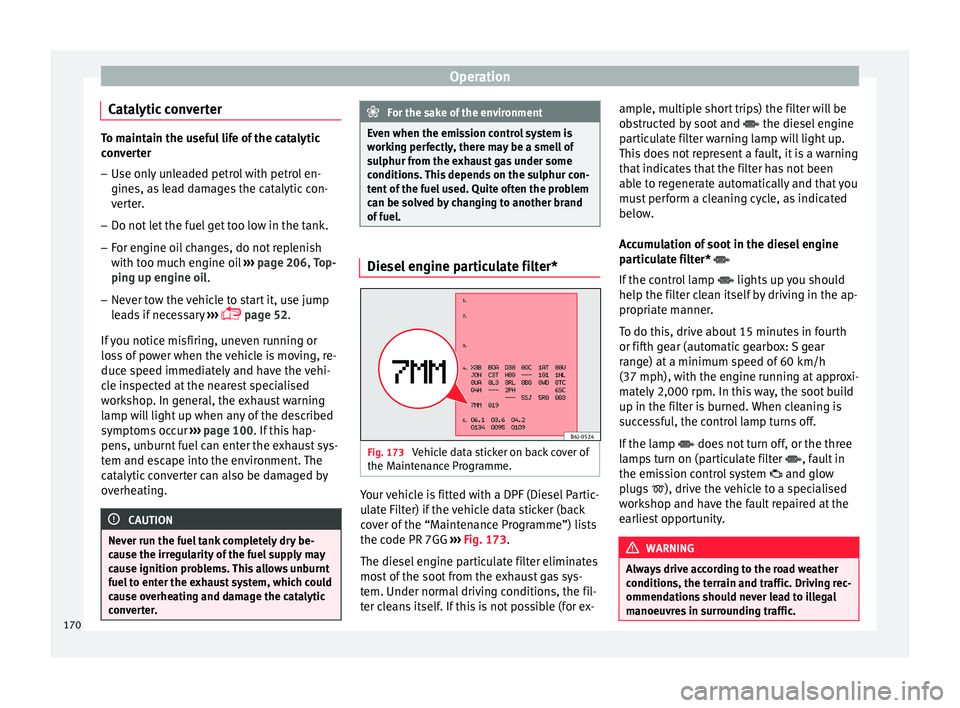
Fig. 173
Vehicle data sticker on back cover of
the M aint
enanc
e Programme. Your vehicle is fitted with a DPF (Diesel Partic-
u
l
at e Fi
lter) if the vehicle data sticker (back
cover of the “Maintenance Programme”) lists
the code PR 7GG ››› Fig. 173.
The diesel engine particulate filter eliminates
most of the soot from the exhaust gas sys-
tem. Under normal driving conditions, the fil-
ter cleans itself. If this is not possible (for ex- ample, multiple short trips) the filter will be
obstruct
ed by soot and the diesel engine
particulate filter warning lamp will light up.
This does not represent a fault, it is a warning
that indicates that the filter has not been
able to regenerate automatically and that you
must perform a cleaning cycle, as indicated
below.
Accumulation of soot in the diesel engine
particulate filter*
If the control lamp lights up you should
help the filter clean itself by driving in the ap-
propriate manner.
To do this, drive about 15 minutes in fourth
or fifth gear (automatic gearbox: S gear
range) at a minimum speed of 60 km/h
(37 mph), with the engine running at approxi-
mately 2,000 rpm. In this way, the soot build
up in the filter is burned. When cleaning is
successful, the control lamp turns off.
If the lamp does not turn off, or the three
lamps turn on (particulate filter , fault in
the emission control system and glow
plugs ), drive the vehicle to a specialised
workshop and have the fault repaired at the
earliest opportunity. WARNING
Always drive according to the road weather
conditions, the t err
ain and traffic. Driving rec-
ommendations should never lead to illegal
manoeuvres in surrounding traffic. 170
Page 173 of 252
Driving
CAUTION
● Your v ehic
le is not designed to use biodie-
sel fuel. Never, under any circumstances re-
fuel with biodiesel. The use of biodiesel fuel
could damage the engine and the fuel sys-
tem. The addition of biodiesel to diesel by
the diesel producer in accordance with stand-
ard EN 590 is authorised and will not cause
damage to the engine or the fuel system.
● Using diesel fuel with a high sulphur con-
tent ma
y significantly reduce the useful life of
the diesel particulate filter. Your Technical
Service will be able to tell you which coun-
tries have diesel with a high sulphur content. Engine management*
This warning lamp monitors the engine man-
ag
ement
sys
tem for petrol engines.
The warning lamp (Electronic Power Con-
trol) lights up when the ignition is switched
on while system operation is being verified. It
should go out once the engine is started.
If there is a fault in the electronic engine
management system while you are driving,
this warning lamp will light up. Take the vehi-
cle to a specialised workshop as soon as
possible and have the engine checked. Emission control system* Control lamp
flashes:
When ther
e is misfiring that can damage the
catalytic converter. Reduce speed and drive
carefully to the nearest specialised workshop
to have the engine checked.
The control lamp lights up:
If a fault has developed during driving which
has reduced the quality of the exhaust gas
(e.g. lambda probe fault). Reduce speed and
drive carefully to the nearest specialised
workshop to have the engine checked.
Engine pre-heating/fault system* The warning lamp lights up to show that the
glo
w p
lugs
are preheating the diesel engine.
The control lamp lights up
If the control lamp lights up when the en-
gine is started it means that the glow plugs
are preheating. The engine can be started
straight away when the lamp switches off.
Control lamp flashes
If a fault develops in the engine management
system while you are driving, the glow plug
system lamp will flash . Take the vehicle to
a specialised workshop as soon as possible
and have the engine checked. Driving tips
Driving abro
ad To drive abroad, the following must be taken
into con
s
ideration:
● For vehicles fitted with a catalytic converter
ensure th
at unleaded petrol is available for
the journey. See the chapter “Refuelling”. Au-
tomobile organisations will have information
about service station networks selling unlea-
ded fuel.
● In some countries, it is possible that your
car model i s
not sold, and therefore some
spare parts are not available or the technical
services may only be able to carry out limited
repairs.
SEAT importers and distributors will gladly
provide information about the technical prep-
aration that your vehicle requires and also
about necessary maintenance and repair
possibilities.
Adhesive strips for headlights
In countries where vehicles drive on the other
side of the road to your home country, the
asymmetric dipped beam may dazzle drivers
of oncoming vehicles. »
171
Technical data
Advice
Operation
Emergencies
Safety
Page 189 of 252
Towing bracket device and trailer
Tyre pressure
Set ty
re pr
essure to the maximum permissi-
ble pressure shown on the sticker on the in-
side of the fuel tank flap. Set the tyre pres-
sure of the trailer tyres in accordance with the
trailer manufacturer's recommendations.
Exterior mirrors
Check whether you can see enough of the
road behind the trailer with the standard rear
vision mirrors. If this is not the case, you
should have additional exterior mirrors fitted.
Both exterior mirrors should be mounted on
hinged extension brackets. Adjust the mirrors
to give sufficient vision to the rear. WARNING
Never transport people in a trailer. This could
res u
lt in fatal accidents. Note
● Tow in
g a trailer places additional demands
on the vehicle. We recommend additional
services between the normal inspection inter-
vals if the vehicle is used frequently for tow-
ing a trailer.
● Find out whether special regulations apply
to tow
ing a trailer in your country. Ball coupling of towing bracket*
The ball coupling is provided with instruc-
tions on fittin
g and r
emoving the ball cou-
pling of the towing bracket. WARNING
The towing bracket ball coupling must be
stor ed sec
urely in the luggage compartment
to prevent them being flung through the vehi-
cle and causing injury. Note
● By l a
w, the ball coupling must be removed
if a trailer is not being towed if it obscures
the number plate. Driving tips
Driving with a trailer always requires extra
c
ar
e.
W eight
distribution
The weight distribution of a loaded trailer
with an unladen vehicle is very unfavourable.
However, if this cannot be avoided, drive ex-
tra slowly to allow for the unbalanced weight
distribution. Speed
The stabi
lity of the vehicle and trailer is re-
duced with increasing speed. For this reason,
it is advisable not to drive at the maximum
permissible speed in an unfavourable road,
weather or wind conditions. This applies es-
pecially when driving downhill.
You should always reduce speed immediately
if the trailer shows the slightest sign of snak-
ing. Never try to stop the “snaking” by in-
creasing speed.
Always brake in due course. If the trailer has
an overrun brake, apply the brakes gently at
first and then, firmly. This will prevent the
jerking that can be caused by locking of trail-
er wheels. Select a low gear in due course
before going down a steep downhill. This en-
ables you to use the engine braking to slow
down the vehicle.
Reheating
At very high temperatures and during pro-
longed slopes, driving with a low gear and
high engine speed; always monitor whether
the excessive coolant temperature gauge is
activated ››› page 207.
187
Technical data
Advice
Operation
Emergencies
Safety
Page 197 of 252
Care and maintenance
painted surfaces are not suitable to clean
w indo
ws
because they are soiled with wax
deposits which could smear the windows.
If possible, use a de-icing spray to remove
ice. If you use an ice scraper, push it in one
direction only without swinging it.
Use window cleaner or a silicone remover to
clean rubber, oil, grease and silicone depos-
its off.
Wax deposits can only be removed with a
special cleaner available at your Technical
Service. Wax deposits on the windscreen
could cause the wiper blades to judder. Add-
ing a window cleaner that dissolves wax to
the windscreen washer fluid prevents wiper
blades from juddering, but wax deposits are
not removed. CAUTION
● Never use w arm or hot
water to remove
snow and ice from windows and mirrors. This
could cause the glass to crack!
● The heating element for the rear window is
located on the inner side of
the window. To
prevent damage, do not put stickers over the
heating elements on the inside of the win-
dow. Cleaning windscreen wiper blades
Clean wiper blades improve visibility. 1. Use a soft cloth to remove dust and dirt
from the w
inds
creen wiper blades.
2. Use window cleaner to clean the wind- screen w
iper blades. Use a sponge or a
cloth to remove stubborn dirt.
Care of rubber seals If rubber seals are well looked after, they will
not freez
e so quic
kly.
1. Use a soft cloth to remove dust and dirt from the rubber seal s.
2.
Apply a specialist care product to the rub-
ber seals.
The rubber strip
s on the doors, windows, etc.
will remain pliable and last longer if they are
treated with a suitable rubber care product
from time to time (for example silicone
spray).
Caring for rubber seals will also prevent pre-
mature ageing and leaks. The doors will be
easier to open. If rubber seals are well looked
after, they will not freeze so quickly in winter.
Door lock cylinder The door lock cylinders can freeze up in win-
t
er
. T
o de-ic
e the lock cylinders you should only
use spra
y with lubricating and anti-corrosive
properties.
Cleaning chrome parts 1. Clean chrome parts with a damp cloth.
2. Polish chrome parts with a soft, dry cloth.
If this
doe
s not provide satisfying results, use
a specialist chrome cleaning product.
Chrome cleaning products will remove stains
from the surface. CAUTION
To prevent scratching chrome surfaces:
● Never use an abrasive cleaning product on
chrome.
● Do not c
lean or polish chrome parts in a
sandy or dus
ty environment. Steel wheel rims
–
Clean steel wheel rims regularly using a
sep ar
at e s
ponge.
Use an industrial cleaner to remove brake
dust. Any damage to the paint on steel wheel
rims should be repaired before starting to
rust. »
195
Technical data
Advice
Operation
Emergencies
Safety
Page 209 of 252
Checking and refilling levels
WARNING
Oil is highly inflammable! Ensure that no oil
comes int
o contact with hot engine compo-
nents when topping up. CAUTION
If the oil level is above the area A do not
star t
the engine. This could result in damage
to the engine and catalytic converter. Contact
a specialised workshop. For the sake of the environment
The oil level must never be above area A .
Otherwi se oi
l can be drawn in through the
crankcase breather and escape into the at-
mosphere via the exhaust system. Changing engine oil
Read the additional information carefully
› ›
›
p
age 41
The engine oil must be changed at the inter-
vals given in the service schedule.
We recommend that you have the engine oil
changed by a Technical Service.
The oil change intervals are shown in the
Maintenance Programme. WARNING
Only change the engine oil yourself if you
have the s pec
ialist knowledge required!
● Before opening the bonnet, read and ob-
serve the warnin
gs ››› page 201, safety notes
for work in the engine compartment .
● Wait for the engine to cool down. Hot oil
may c
ause burn injuries.
● Wear eye protection to avoid injuries, such
as acid b
urns, caused by splashes of oil.
● When removing the oil drain plug with your
fingers, k
eep your arm horizontal to help pre-
vent oil from running down your arm.
● Wash your skin thoroughly if it comes into
contact w
ith engine oil.
● Engine oil is poisonous! Used oil must be
stored in a s
afe place out of the reach of chil-
dren. CAUTION
No additives should be used with engine oil.
This c ou
ld result in engine damage. Any dam-
age caused by the use of such additives
would not be covered by the factory warranty. For the sake of the environment
● Becau se of
disposal problems and the spe-
cial tools and specialist knowledge required,
we recommend that you have the engine oil
and filter changed by a Technical Service. ●
Never pour oil do
wn drains or into the
ground.
● Use a suitable container when draining the
used oil. It
must be large enough to hold all
the engine oil. Cooling system
Contro l
lamp There is a fault if:
● The l amp does not go out again after a
f ew sec ond
s.
● The lamp lights up or flashes while the
vehicl
e is running, and three acoustic warn-
ing signals are emitted ››› .
Thi s
me an
s that either the coolant level is too
low or the coolant temperature is too high.
Coolant temperature too high
If the lamp lights up, stop the vehicle,
turn off the engine and wait for it to cool
down. Check the coolant level.
If the coolant level is correct, the overheating
may be caused by a malfunction of the radia-
tor fan. Check the radiator fan fuse and have
it replaced if necessary ››› page 81.
If the control lamp lights up again after driv-
ing on for a short distance, stop the vehicle»
207
Technical data
Advice
Operation
Emergencies
Safety
Page 210 of 252
Advice
and switch the engine off. C ont
act a
Techni-
cal Service or a specialised workshop.
Coolant level too low
If the lamp lights up, stop the vehicle,
turn off the engine and wait for it to cool
down. First check the coolant level. If the lev-
el of the coolant is below the “MIN” mark,
top up with coolant liquid ››› .
WARNING
● If y our
vehicle is immobilised for technical
reasons, move it to a safe distance from traf-
fic. Turn the engine off, turn the hazard lights
on and place the warning triangle.
● Never open the bonnet if you can see or
hear ste
am or coolant escaping from the en-
gine compartment. Risk of scalding. Wait un-
til you can no longer see or hear escaping
steam or coolant.
● The engine compartment is a dangerous
area. Bef
ore carrying out any work in the en-
gine compartment, switch off the engine and
allow it to cool down. Always note the corre-
sponding warnings ››› page 201. Topping up coolant
Read the additional information carefully
› ›
›
p
age 42
Top up coolant when the level is below the
MIN (minimum) mark. Checking coolant level
– Park the vehicle in a horizontal position.
– Switch the ignition off.
– Read off the coolant level on coolant ex-
pansion t
ank. When the engine is cold, the
coolant level should be between the marks.
When the engine is hot, it may be slightly
above the upper mark.
Topping up coolant – Wait for the engine to cool down.
– Cover the coolant expansion tank cap with
a cloth and caref
ully unscrew it to the left
››› .
– Top up the coolant only if there is still cool-
ant in the e
xpan
sion tank, otherwise you
could damage the engine. If there is no
coolant in the expansion tank, do not con-
tinue driving. You should obtain professio- nal assistance ››› .
– If there is still some coolant in the expan-
sion t
ank, t op up t
o the upper mark.
– Top up with coolant until the level becomes
stabl
e.
– Screw the cap back on correctly.
Any los
s of coolant fluid normally indicates a
leak in the cooling system. Take the vehicle
straight to a specialised workshop to have
the cooling system examined. If there are no leaks in the engine cooling system, a loss of
coolant
can only occur if the coolant boils
and is forced out of the system as a result of
overheating. WARNING
● The coolin g sy
stem is under pressure. Do
not unscrew the cap on the coolant expan-
sion tank when the engine is hot: risk of
burns!
● The antifreeze and coolant fluid can be a
health haz
ard. Therefore, the antifreeze
should be stored in the original container in a
safe place out of reach of children. Failure to
comply could result in poisoning.
● If working inside the engine compartment,
remember that, even when the ignition i
s
switched off, the radiator fan may start up au-
tomatically, and therefore there is a risk of in-
jury. WARNING
If there is not enough anti-freeze in the cool-
ant sys t
em, the engine may fail leading to se-
rious damage.
● Please make sure that the percentage of
additive i
s correct with respect to the lowest
expected ambient temperature in the zone in
which the vehicle is to be used.
● When the outside temperature is very low,
the coolant
could freeze and the vehicle
would be immobilised. In this case, the heat-
ing would not work either and inadequately
dressed passengers could die of cold. 208
Page 237 of 252
Index
Index
A
ABS . . . . . . . . . . . . . . . . . . . . . . . . . . . . . . . . . . . .
158
c ontr o
l lamp . . . . . . . . . . . . . . . . . . . . . . . . . . . 159
Accessories . . . . . . . . . . . . . . . . . . . . . . . . . . . . . . 190
Additional electrical appliances (efficiency pro- gramme) . . . . . . . . . . . . . . . . . . . . . . . . . . . . . . . 31
Adjusting front head restraints . . . . . . . . . . . . . . . . . 60, 129
lights . . . . . . . . . . . . . . . . . . . . . . . . . . . . . . . . . 122
rear head restraints . . . . . . . . . . . . . . . . . . . . . . 60
Adjusting the front seats Adjusting the lumbar support . . . . . . . . . . . . . 128
Adjusting the head restraints front head restraints . . . . . . . . . . . . . . . . . . . . . 129
rear head restraints . . . . . . . . . . . . . . . . . . . . . . 60
Adjusting the seat . . . . . . . . . . . . . . . . . . . . . . . . 128
Adjustment CAR menu . . . . . . . . . . . . . . . . . . . . . . . . . . . . . 101
seats . . . . . . . . . . . . . . . . . . . . . . . . . . . . . . . . . . 57
AFS headlight bulbs . . . . . . . . . . . . . . . . . . . . . . . . 87
Airbag covers . . . . . . . . . . . . . . . . . . . . . . . . . . . . . 14
Airbags . . . . . . . . . . . . . . . . . . . . . . . . . . . . . . . . . . 66 description . . . . . . . . . . . . . . . . . . . . . . . . . . . . . 67
Airbag system . . . . . . . . . . . . . . . . . . . . . . . . . . 14, 66 activation . . . . . . . . . . . . . . . . . . . . . . . . . . . . . . 68
control lamp . . . . . . . . . . . . . . . . . . . . . . . . . . . . 68
deactivation of front airbag . . . . . . . . . . . . . . . . 70
description . . . . . . . . . . . . . . . . . . . . . . . . . . . . . 67
front airbags . . . . . . . . . . . . . . . . . . . . . . . . . 14, 69
functioning . . . . . . . . . . . . . . . . . . . . . . . . . . . . . 68
head-protection airbags . . . . . . . . . . . . . . . . . . 16
side airbags . . . . . . . . . . . . . . . . . . . . . . . . . . . . 15 Air conditioning . . . . . . . . . . . . . . . . . . . . . . 39, 144
Climatronic . . . . . . . . . . . . . . . . . . . . . . . . . . . . 146
controls . . . . . . . . . . . . . . . . . . . . . . . . . . . . . . . 144
General notes . . . . . . . . . . . . . . . . . . . . . . . . . . 140
manual air conditioning . . . . . . . . . . . . . . . . . . . 40
Air outlets . . . . . . . . . . . . . . . . . . . . . . . . . . . . . . . 141
Air recirculation air conditioning . . . . . . . . . . . . . . . . . . . . . . . . 145
heating and fresh air . . . . . . . . . . . . . . . . . . . . 142
Alarm system . . . . . . . . . . . . . . . . . . . . . . . . . . . . 113 Switching off . . . . . . . . . . . . . . . . . . . . . . . . . . . 114
Alloy wheel rims . . . . . . . . . . . . . . . . . . . . . . . . . . 196
Alternator warning lamp . . . . . . . . . . . . . . . . . . . . . . . . . . 211
Ambient lighting . . . . . . . . . . . . . . . . . . . . . . . . . 123
Anti-freeze . . . . . . . . . . . . . . . . . . . . . . . . . . . . . . . 42
Anti-lock brake system . . . . . . . . . . . . 155, 157, 158 control lamp . . . . . . . . . . . . . . . . . . . . . . . . . . . 159
Anti-puncture . . . . . . . . . . . . . . . . . . . . . . . . . . 46, 76
Anti-puncture kit . . . . . . . . . . . . . . . . . . . . 46, 76, 77 Check after 10 minutes . . . . . . . . . . . . . . . . . . . 78
Anti-puncture set . . . . . . . . . . . . . . . . . . . . . . . . . . 76
Anti-theft alarm . . . . . . . . . . . . . . . . . . . . . . . . . . 113
Anti-theft alarm system . . . . . . . . . . . . . . . . . . . . 113 Switching off . . . . . . . . . . . . . . . . . . . . . . . . . . . 114
Aquaplaning . . . . . . . . . . . . . . . . . . . . . . . . . . . . . 215
Aspects to note before setting off . . . . . . . . . . . . . 56
ASR . . . . . . . . . . . . . . . . . . . . . . . . . . . . . . . . . . . . 156 control lamp . . . . . . . . . . . . . . . . . . . . . . . . . . . 156
Assistance systems parking aid . . . . . . . . . . . . . . . . . . . . . . . . . . . . 175
Parking aid . . . . . . . . . . . . . . . . . . . . . . . . . . . . 176
Assistance Systems fatigue detection . . . . . . . . . . . . . . . . . . . . . . . 174
Assisted starting . . . . . . . . . . . . . . . . . . . . . . . . . . 52 Audible warning signal
seat belt not fastened . . . . . . . . . . . . . . . . . . . . 62
warning and control lamps . . . . . . . . . . . . . . . 100
Automatic car wash tunnel . . . . . . . . . . . . . . . . . 192
Automatic gearbox . . . . . . . . . . . . . . . . . . . . . . . . 161 driving programmes . . . . . . . . . . . . . . . . . . . . . 161
Driving tips . . . . . . . . . . . . . . . . . . . . . . . . . . . . 165
kick-down device . . . . . . . . . . . . . . . . . . . . . . . 166
manual release of selector lever . . . . . . . . . . . . 38
selecting gears with Tiptronic . . . . . . . . . . . . . 164
selector lever lock . . . . . . . . . . . . . . . . . . . . . . . 163
selector lever positions . . . . . . . . . . . . . . . . . . 162
tiptronic . . . . . . . . . . . . . . . . . . . . . . . . . . . . . . . 161
Automatic lighting . . . . . . . . . . . . . . . . . . . . . . . . 119
AUX-IN . . . . . . . . . . . . . . . . . . . . . . . . . . . . . . . . . . 107
B Back seat folding down and raising the back seat back- rest . . . . . . . . . . . . . . . . . . . . . . . . . . . . . . . . . 130
Ball coupling . . . . . . . . . . . . . . . . . . . . . . . . . . . . . 187
Battery . . . . . . . . . . . . . . . . . . . . . . . . . . . . . . . . . . 112
Before setting off . . . . . . . . . . . . . . . . . . . . . . . . . . 56
Belt pretensioners . . . . . . . . . . . . . . . . . . . . . . . . . 65
Biodiesel . . . . . . . . . . . . . . . . . . . . . . . . . . . . . . . . 201
Bonnet . . . . . . . . . . . . . . . . . . . . . . . . . 10, 201, 204 closing . . . . . . . . . . . . . . . . . . . . . . . . . . . . . . . . 203
opening . . . . . . . . . . . . . . . . . . . . . . . . . . . . . . . 203
Boot hatch . . . . . . . . . . . . . . . . . . . . . . . . . . . . . . 115
Boot lid . . . . . . . . . . . . . . . . . . . . . . . . . . . . . . . . . 115
Brake assist . . . . . . . . . . . . . . . . . . . . . . . . . . . . . 155
Brake fluid . . . . . . . . . . . . . . . . . . . . . . . . . . 43, 209 Changing . . . . . . . . . . . . . . . . . . . . . . . . . . . . . . 209
Brake pads . . . . . . . . . . . . . . . . . . . . . . . . . 152, 167
Brakes brake fluid . . . . . . . . . . . . . . . . . . . . . . . . . . . . . 209
new Brake pads . . . . . . . . . . . . . . . . . . . . . . . . 152
235
Page 241 of 252
Index
Exhaust gas purification system cat
alytic c
onverter . . . . . . . . . . . . . . . . . . . . . . 169
diesel particulate filter . . . . . . . . . . . . . . . . . . . 169
Extending the luggage compartment . . . . . . . . . . . . . . . . 130
exterior lighting changing the bulbs . . . . . . . . . . . . . . . . . . . . . . 83
Exterior mirrors . . . . . . . . . . . . . . . . . . . . . . . . . . . 127 adjusting . . . . . . . . . . . . . . . . . . . . . . . . . . . . . . . 13
control . . . . . . . . . . . . . . . . . . . . . . . . . . . . . . . . 127
folding in electrically . . . . . . . . . . . . . . . . . . . . 127
folding in manually . . . . . . . . . . . . . . . . . . . . . 127
heated . . . . . . . . . . . . . . . . . . . . . . . . . . . . . . . . 127
Exterior view . . . . . . . . . . . . . . . . . . . . . . . . . . . . . 5, 6
F Fabric: cleaning . . . . . . . . . . . . . . . . . . . . . . . . . . 197
Fastening rings . . . . . . . . . . . . . . . . . . . . . . . . . . . 136
Fatigue detection . . . . . . . . . . . . . . . . . . . . . . . . . 174
Fault in electronic differential lock (EDL) control lamp . . . . . . . . . . . . . . . . . . . . . . . . . . . 158
Faulty bulbs changing the bulbs . . . . . . . . . . . . . . . . . . . . . . 83
Filling the fuel tank . . . . . . . . . . . . . . . . . . . . . . . 199
Filling the tank . . . . . . . . . . . . . . . . . . . . . . . . . . . 199 fuel gauge . . . . . . . . . . . . . . . . . . . . . . . . . . . . . 100
Fire extinguisher . . . . . . . . . . . . . . . . . . . . . . . . . . . 75
First-aid kit . . . . . . . . . . . . . . . . . . . . . . . . . . . . . . . 75
Floor mats . . . . . . . . . . . . . . . . . . . . . . . . . . . . . . . . 61
Fluid Level control . . . . . . . . . . . . . . . . . . . . . . . . . 40
Fog-light bulb FR version . . . . . . . . . . . . . . . . . . . . . . . . . . . . . . 88
Fog light bulb . . . . . . . . . . . . . . . . . . . . . . . . . . . . . 88
Front airbags . . . . . . . . . . . . . . . . . . . . . . . . . . 14, 69 safety instructions . . . . . . . . . . . . . . . . . . . . . . . 69
Front ashtray . . . . . . . . . . . . . . . . . . . . . . . . . . . . . 133
Front drink holder . . . . . . . . . . . . . . . . . . . . . . . . . 133 Front passenger front airbag
control lamp . . . . . . . . . . . . . . . . . . . . . . . . . . . . 68
deactivation . . . . . . . . . . . . . . . . . . . . . . . . . . . . 15
Front seat manual adjustment . . . . . . . . . . . . . . . . . . . . . . 12
Front seat backrest folding . . . . . . . . . . . . . . . . . . . . . . . . . . . . . . . . 128
lifting . . . . . . . . . . . . . . . . . . . . . . . . . . . . . . . . . 128
Fuel . . . . . . . . . . . . . . . . . . . . . . . . . . . . . . . . 41, 200 consumption . . . . . . . . . . . . . . . . . . . . . . . . . . . 220
diesel . . . . . . . . . . . . . . . . . . . . . . . . . . . . . . . . . 201
ethanol . . . . . . . . . . . . . . . . . . . . . . . . . . . . . . . 200
fuel gauge . . . . . . . . . . . . . . . . . . . . . . . . . . . . . 100
refuelling . . . . . . . . . . . . . . . . . . . . . . . . . . . . . . 200
saving . . . . . . . . . . . . . . . . . . . . . . . . . . . . . . . . 168
Fuel consumption . . . . . . . . . . . . . . . . . . . . . . . . . 168 why does fuel consumption increase? . . . . . . 169
Fuel tank cap opening and closing . . . . . . . . . . . . . . . . . . . . . 41
Fuel tank flap opening and closing . . . . . . . . . . . . . . . . . . . . . 41
Fuses . . . . . . . . . . . . . . . . . . . . . . . . . . . . . . . . . 44, 81 fuse box . . . . . . . . . . . . . . . . . . . . . . . . . . . . . . . . 81
identifying blown fuses . . . . . . . . . . . . . . . . . . . 45
Identifying by colours . . . . . . . . . . . . . . . . . . . . . 44
Preparation before replacing . . . . . . . . . . . . . . . 44
replacing . . . . . . . . . . . . . . . . . . . . . . . . . . . . . . . 44
G
Gear-change indicator . . . . . . . . . . . . . . . . . 28, 161
Gearbox lever . . . . . . . . . . . . . . . . . . . . . . . . . . . . . 37
Gear change . . . . . . . . . . . . . . . . . . . . . . . . . . . . . . 37 automatic . . . . . . . . . . . . . . . . . . . . . . . . . . . . . . 38
changing gears (manual gearbox) . . . . . . . . . 161
manual . . . . . . . . . . . . . . . . . . . . . . . . . . . . . . . . 37
manual gear change . . . . . . . . . . . . . . . . . . . . . 161
Gear engaged . . . . . . . . . . . . . . . . . . . . . . . . . . . . . 37 Gear recommendation . . . . . . . . . . . . . . . . . . . . . . 28
General ins
trument panel
Controls and displays . . . . . . . . . . . . . . . . . . . . . 95
Turn signal and main beam lever . . . . . . . . . . 120
warning and indication lamps . . . . . . . . . . . . . . 35
General overview of the engine compartment . . 204
Glove compartment . . . . . . . . . . . . . . . . . . . . . . . 131
Glow plug system . . . . . . . . . . . . . . . . . . . . . . . . . 152
H
Handbrake . . . . . . . . . . . . . . . . . . . . . . . . . 152, 153 warning lamp . . . . . . . . . . . . . . . . . . . . . . . . . . 154
Hazard warning lights . . . . . . . . . . . . . . . . . 22, 123
HBA . . . . . . . . . . . . . . . . . . . . . . . . . . . . . . . . . . . . 158
Head-on collisions and the laws of physics . . . . . 63
Head-protection airbags description . . . . . . . . . . . . . . . . . . . . . . . . . . . . . 16
safety instructions . . . . . . . . . . . . . . . . . . . . . . . 16
Headlight range control . . . . . . . . . . . . . . . . . . . . 122
Headlights Driving abroad . . . . . . . . . . . . . . . . . . . . . . . . . 171
fog lights . . . . . . . . . . . . . . . . . . . . . . . . . . . . . . 120
Headlight washer . . . . . . . . . . . . . . . . . . . . . . . 126
Head restraints . . . . . . . . . . . . . . . . . . . . . . . . . . . . 12 adjustment . . . . . . . . . . . . . . . . . . . . . . . . . . . . 129
front head restraints . . . . . . . . . . . . . . . . . . . . . . 60
Rear head restraints . . . . . . . . . . . . . . . . . . . . . . 60
Headrests . . . . . . . . . . . . . . . . . . . . . . . . . . . . . . . . 12 adjustment . . . . . . . . . . . . . . . . . . . . . . . . . . . . 129
front . . . . . . . . . . . . . . . . . . . . . . . . . . . . . . . . . . . 60
rear . . . . . . . . . . . . . . . . . . . . . . . . . . . . . . . . . . . 60
Heated rear window heating element wires . . . . . . . . . . . . . . . . . . . 195
switch . . . . . . . . . . . . . . . . . . . . . . . . . . . . . . . . 124
Heating . . . . . . . . . . . . . . . . . . . . . . . . . . . . . . . . . 143 Defrosting the windscreen . . . . . . . . . . . . . . . . 143
Demisting the windscreen and side windows 143
239